

|
시장보고서
상품코드
2113766
칩리스 RFID : 시장 점유율 분석, 업계 동향 및 통계, 성장 예측(2026-2031년)Chipless RFID - Market Share Analysis, Industry Trends & Statistics, Growth Forecasts (2026 - 2031) |
||||||
 Mordor Intelligence
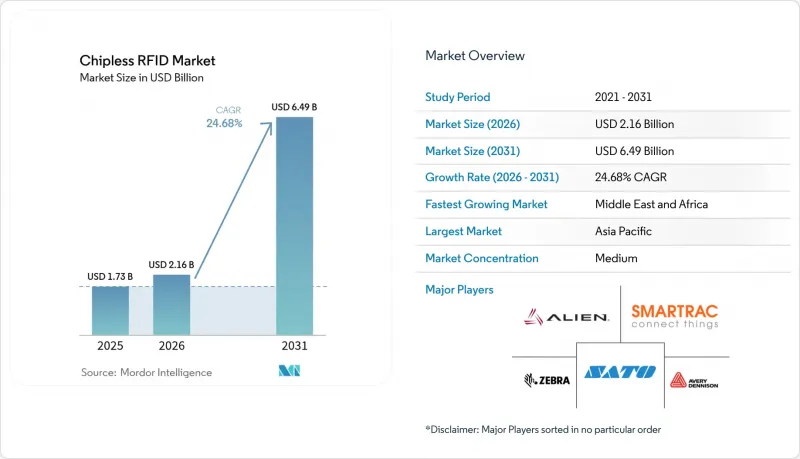
Mordor Intelligence에 의하면, 칩리스 RFID 시장 규모는 2025년에 17억 3,000만 달러로 평가되었습니다. 2026년 21억 6,000만 달러에서 2031년까지 64억 9,000만 달러에 이를 것으로 예상되며, 예측 기간(2026-2031년) CAGR은 24.68%를 나타낼 전망입니다.
본 보고서는 제품 유형(태그, 리더기, 미들웨어), 인쇄 기술(잉크젯, 스크린 인쇄 등), 작동 주파수(LF 125-134 KHz 등), 소재(은 나노 잉크, 구리계 잉크 등), 용도(스마트 카드, 스마트 티켓 등), 최종 사용자 산업(소매 및 전자상거래, 의료 등), 지역별로 분류되어 있습니다. 시장 전망은 금액(달러) 기준으로 제시되어 있습니다.
세계의 칩리스 RFID 시장 동향 및 인사이트
아시아 FMCG 패키지에서 IC리스 태그의 저비용 대량 생산
중국 및 동남아시아의 제조업체들은 플렉서블 기판과 은 나노 페이스트를 결합하여 장당 5센트 미만의 태그를 구현함으로써, 소비재 멀티팩 분야에서 칩리스 RFID 시장의 대량 채택을 촉진하고 있습니다. 수탁 인쇄 업체들은 분당 120미터를 넘는 속도로 멀티 레인 플렉소 인쇄 라인을 가동하고 있어, 공장당 연간 20억 장 이상의 생산이 가능합니다. 설비 개조에 대한 투자 회수 기간이 짧고, 포장 가공 업체와의 지리적 근접성이 도입을 가속화하고 있습니다. 각 공급업체는 브랜드의 지속가능성 목표에 부합하기 위해 재활용 가능한 셀룰로오스 기질의 시범 도입을 추진하고 있습니다. 비용이 낮아짐에 따라 일회용 태그의 용도는 일회용 전자기기 및 단회 투여용 의약품 패키지로 확대되고 있습니다.
정부의 소비세/세금 스탬프 의무화
EU 내 위조품으로 인한 손실액은 160억 유로(173억 달러)로 추산되며, 이에 따라 지침 2024/1640이 제정되었습니다. 이 지침에서는 고유한 RF 시그니처를 갖춘 위변조 방지 식별자의 채택을 권장하고 있습니다. 현재 이탈리아, 스페인, 사우디아라비아 재무부는 주류 및 담배용 스탬프에 대해 칩리스 형식을 지정하고 있으며, 이를 통해 인쇄 업체는 단 한 번의 인쇄 공정으로 보안 기능을 통합할 수 있게 되었습니다. 장기 계약을 통해 엔드투엔드 추적성 플랫폼의 도입이 촉진되고 있으며, 고해상도 리더기의 교체 주기가 연장되고 있습니다. 아세안(ASEAN)에서도 유사한 법규가 검토되고 있어, 2028년까지 두 번째 수요의 물결이 도래할 것으로 예측됩니다.
판독 범위의 한계와 칩 내장형 UHF 시스템과의 비교
칩리스 태그의 판독 거리는 일반적으로 자유 공간에서 최대 3m에 그치지만, 칩이 내장된 UHF 태그의 경우 10m 이상입니다. 따라서 창고에서는 리더기 설치 밀도를 높여야 하므로 인프라 예산이 2배로 늘어날 가능성이 있습니다. 현재 시제품 단계에 있는 다층 메타물질 안테나는 판독 범위를 40% 확대하지만, 금속 랙이나 액체 상태의 내용물로 인해 여전히 신호가 감쇠됩니다. 시스템 통합사업자들은 구역 기반 포털이나 하이브리드 구축을 통해 이에 대응하고 있으며, 칩리스 태그는 패키지 수준의 품목으로만 제한하고, 팔레트에는 계속해서 칩이 내장된 인레이를 채택하고 있습니다.
부문 분석
2025년 매출의 70.42%를 태그 판매가 차지했으며, 이는 칩리스 RFID 시장의 모든 도입 시나리오에서 태그가 필수적임을 여실히 보여줍니다. 아시아의 수탁 인쇄 업체들은 규모의 경제를 활용하여 단가를 낮추고 있는 반면, 유럽의 보안 인쇄 업체들은 고부가가치 인증 솔루션에 주력하고 있습니다. 미들웨어의 수익은 현재로서는 소규모이지만, 기업들이 원시 RF 에코를 실용적인 대시보드로 변환하기 위해 클라우드 커넥터, 데이터 클렌징 및 분석 기능을 필요로 하고 있기 때문에 연평균 성장률(CAGR) 26.05%로 더 빠르게 성장할 것으로 예측됩니다.
미들웨어의 성장 가속화는 협상력을 변화시키고 있으며, 소프트웨어 벤더는 현재 하드웨어 설계 로드맵에 영향을 미치고 오픈 API 채택을 추진하고 있습니다. 그 결과, 태그 제조업체들은 시장 점유율을 지키기 위해 데이터 서비스 팀에 투자하고 있습니다. 이러한 추세에 따라 미들웨어는 예측 유지보수 및 AI 기반 서명 대조와 같은 미래 기능 분야에서 ‘게이트키퍼’로서의 입지를 확립해 가고 있습니다.
스크린 인쇄는 특히 식품 및 음료 포장 분야에서 장기적인 생산성과 성숙한 공급망 덕분에 2025년에 37.35%의 점유율을 차지했습니다. 칩리스 RFID 시장에서는 현재 잉크젯 공정이 연평균 성장률(CAGR) 27.15%로 확대되고 있습니다. 이는 드롭-온-디맨드 방식의 헤드가 고밀도 시그니처 인코딩에 적합한 미세한 안테나를 형성할 수 있기 때문입니다.
잉크젯 기술의 도입은 현장 맞춤형 제작도 지원합니다. 브랜드 소유자는 제품 출시 며칠 전에 한정판 진위 표시를 인쇄할 수 있어, 제품 노후화 위험을 줄일 수 있습니다. 스크린 인쇄 라인은 금형 상각비가 전환 비용을 초과하는 매우 대량으로 생산되는 SKU에서 여전히 우위를 유지하고 있습니다. 그라운드 플레인 인쇄에는 스크린 인쇄를, 마이크로 안테나 인쇄에는 잉크젯 인쇄를 사용하는 하이브리드 라인이 점차 보급되고 있지만, 이는 완전한 대체라기보다는 과도기를 반영한 것입니다.
지역별 분석
2025년, 아시아태평양은 칩리스 RFID 시장을 주도하며 매출의 39.30%를 차지했습니다. 중국의 각 컨버터 기업들은 스크린 인쇄와 플렉소 인쇄를 통합한 생산 라인을 가동하여, 국내 및 수출용 FMCG 브랜드에 서비스를 제공합니다. 한편, 일본의 철도 사업자들은 RFID 지원 운임 징수 시스템을 지방 노선으로 확대되고 있습니다. 호주의 우편 사업자들은 신고 사기를 줄이기 위해 국경을 넘는 소포에 칩리스 태그를 도입하는 시범 사업을 진행하고 있습니다. 지방 자치 단체들은 ‘플라스틱 제로’ 지침에 따라 생분해성 기질 조사에 공동 투자하고 있습니다.
북미는 강력한 지적 재산권 포트폴리오와 의료·항공우주 분야의 초기 도입자층을 바탕으로 이를 뒤따르고 있습니다. 대학들은 스타트업 기업과 협력하여 그래핀 잉크의 상용화를 추진하고 있으며, 연방 정부의 보조금을 통해 생물학적 제제 및 중요 예비 부품의 안전한 공급망이 지원되고 있습니다. 슈퍼마켓 체인들은 신선 식품 폐기물을 줄이고 품목별 데이터를 ESG 보고서에 반영하기 위해 칩리스 태그를 도입하고 있습니다.
유럽은 3위를 기록하고 있지만, 위조 방지 규제를 원동력으로 꾸준한 성장을 보이고 있습니다. 이탈리아와 폴란드의 세금 인장 프로그램에서는 칩리스 RF 보안 계층의 채택이 의무화되어 있습니다. 북유럽의 포장 기업들은 순환 경제 목표를 달성하기 위해 종이 인레이를 통합하고 있으며, 독일의 기계 제조업체는 아시아의 OEM 제조업체를 대상으로 모듈형 잉크젯 헤드를 출하하고 있습니다. 중동 및 아프리카는 현재 규모는 작지만 가장 빠르게 성장하고 있습니다. GCC(걸프협력회의) 중앙은행은 지폐의 RF 인증을 표준화하고 있으며, 남아프리카공화국 세관은 고가 수출품에 칩리스 씰을 도입하고 있습니다.
기타 혜택 :
- 엑셀 형식 시장 예측(ME) 시트
- 3개월간의 애널리스트 지원
자주 묻는 질문
목차
제1장 서론
제2장 조사 방법
제3장 주요 요약
제4장 시장 구도
제5장 시장 규모 및 성장 예측
제6장 경쟁 구도
제7장 시장 기회 및 향후 전망
KTH 26.08.26According to Mordor Intelligence, the chipless RFID market size was valued at USD 1.73 billion in 2025 and estimated to grow from USD 2.16 billion in 2026 to reach USD 6.49 billion by 2031, at a CAGR of 24.68% during the forecast period (2026-2031).
This report is Segmented by Product Type (Tag, Reader, Middleware), Printing Technology (Ink-Jet, Screen, and More), Operating Frequency (LF 125-134 KHz, and More), Material (Silver-Nano Ink, Copper-Based Ink, and More), Application (Smart Cards, Smart Tickets, and More), End-User Industry (Retail and E-Commerce, Healthcare and More), and by Geography. The Market Forecasts are Provided in Terms of Value (USD).
Global Chipless RFID Market Trends and Insights
Lower-cost Mass Production of IC-less Tags in Asian FMCG Packaging
Manufacturers in China and Southeast Asia have combined flexible substrates with silver-nano paste to reach sub-5-cent tags, positioning the chipless RFID market for high-volume adoption in consumer-goods multipacks. Contract printers are running multi-lane flexographic lines at speeds above 120 m/min, allowing over 2 billion units per plant annually. Fast payback on retrofits and geographic proximity to packaging converters accelerate uptake. Suppliers are piloting recyclable cellulose substrates to align with brand sustainability targets. As costs fall, single-use tags are extending into disposable electronics and unit-dose pharmaceutical packs.
Government Excise / Tax-stamp Mandates
EU loss estimates of EUR 16 billion (USD 17.3 billion) in counterfeited goods prompted Directive 2024/1640, which endorses tamper-evident identifiers with unique RF signatures. Ministries of finance in Italy, Spain, and Saudi Arabia now specify chipless formats for alcohol and tobacco stamps so printers can embed security in a single press pass. Long-run contracts incentivise end-to-end traceability platforms and open replacement cycles for high-resolution readers. Similar legislation is under review in ASEAN, suggesting a second wave of demand by 2028.
Limited Read Range versus Chipped UHF Systems
Chipless tags typically peak at 3 m in free air, compared with over 10 m for chipped UHF tags, forcing warehouses to increase reader density, which can double infrastructure budgets. Multi-layer metamaterial antennas now in prototype add 40% range, yet metallic racks and liquid contents still attenuate signals. Integrators respond with zone-based portals and hybrid deployments, reserving chipless tags for package-level items while pallets continue to carry chipped inlays.
Other drivers and restraints analyzed in the detailed report include:
- Printable Conductive-Ink Advances in North American Label Converting
- Passive Sensor Adoption for Cold-chain Healthcare Logistics
- Absence of Harmonised ISO / IEC Encoding Standards
For complete list of drivers and restraints, kindly check the Table Of Contents.
Segment Analysis
Tag sales generated 70.42% of 2025 revenue, underscoring their indispensability across every deployment scenario in the chipless RFID market. Asian contract printers leverage scale to drive unit costs down, while European security printers focus on high-value authenticators. Middleware revenues, although smaller today, are set to climb faster at a 26.05% CAGR because enterprises require cloud connectors, data cleansing, and analytics to turn raw RF echoes into actionable dashboards.
Accelerated middleware growth alters bargaining power; software vendors now influence hardware design road maps and push for open APIs. As a result, tag manufacturers invest in data-services teams to defend share. The trend positions middleware as a gatekeeper for future functionality such as predictive maintenance and AI-based signature matching.
Screen printing held a 37.35% share in 2025 thanks to long-run productivity and mature supply chains, especially within food and beverage packaging. The chipless RFID market now sees ink-jet processes expanding at 27.15% CAGR because droplet-on-demand heads create fine-line antennas suitable for high-density signature encoding.
Ink-jet adoption also supports on-site customisation. Brand owners can print limited-edition authenticity marks days before product launch, cutting obsolescence risk. Screen lines keep their advantage in very high-volume SKUs where tooling amortisation offsets changeover costs. Hybrid lines that start with screen for ground planes and finish with ink-jet for micro-antennas are gaining traction, reflecting a transition phase rather than outright displacement.
Complete Report Scope:
- By Product Type
- Tag
- Reader
- Middleware
- By Operating Frequency
- LF (125-134 kHz)
- HF (13.56 MHz)
- UHF (860-960 MHz)
- By Material
- Silver-nano Ink
- Copper-based Ink
- Graphene/Carbon Ink
- By Application
- Smart Cards
- Smart Tickets
- Brand and Document Authentication
- Asset Tracking
- By End-user Industry
- Retail and E-commerce
- Healthcare and Pharmaceuticals
- Logistics and Transportation
- Banking, Financial Services and Insurance (BFSI)
- Government and Public Sector
- By Geography
- North America
- United States
- Canada
- Mexico
- South America
- Brazil
- Argentina
- Rest of South America
- Europe
- United Kingdom
- Germany
- France
- Italy
- Spain
- Russia
- Rest of Europe
- Asia Pacific
- China
- Japan
- South Korea
- India
- Australia
- Rest of Asia Pacific
- Middle East and Africa
- GCC
- South Africa
- Rest of Middle East and Africa
- North America
Geography Analysis
Asia Pacific led the chipless RFID market with 39.30% revenue in 2025. China's converters run integrated screen and flexographic lines, serving domestic and export FMCG brands, while Japanese rail operators extend RFID-enabled fare systems to rural routes. Australia's postal service is trialling chipless tags on cross-border parcels to cut declaration fraud. Regional governments co-fund research into biodegradable substrates, aligning with zero-plastic directives.
North America follows with strong intellectual-property portfolios and an early-adopter customer base in healthcare and aerospace. Universities collaborate with start-ups to commercialise graphene inks, and federal grants support secure supply chains for biologics and critical spare parts. Supermarket chains deploy chipless tags to reduce perishables wastage and tie item-level data into ESG reporting.
Europe ranks third yet posts steady gains driven by anti-counterfeiting mandates. Tax-stamp programs in Italy and Poland stipulate chipless RF security layers. Nordic packaging firms integrate paper inlays to meet circular-economy targets, and German machine builders ship modular ink-jet heads to Asian OEMs. The Middle East & Africa region, while smaller today, is the fastest growing; GCC central banks standardise banknote RF authentication and South African customs rolls out chipless seals on high-value exports.
- Alien Technology
- Avery Dennison
- Zebra Technologies
- SATO Holdings
- Smartrac Technology
- NXP Semiconductors
- Thinfilm Electronics ASA
- PragmatIC Semiconductor
- Impinj Inc.
- Stora Enso
- Spectra Systems Corp.
- Linxens
- TagSense
- Tageos SA
- Variuscard GmbH
- IDTRONIC GmbH
- SML Group
- Toppan Printing Co.
Additional Benefits:
- The market estimate (ME) sheet in Excel format
- 3 months of analyst support
TABLE OF CONTENTS
1 INTRODUCTION
- 1.1 Study Deliverables
- 1.2 Study Assumptions
- 1.3 Scope of the Study
2 RESEARCH METHODOLOGY
3 EXECUTIVE SUMMARY
4 MARKET LANDSCAPE
- 4.1 Market Overview
- 4.2 Market Drivers
- 4.2.1 Lower-cost Mass-production of IC-less Tags in Asian FMCG Packaging
- 4.2.2 Government Excise/Tax-stamp Mandates (EU Counter-feiting)
- 4.2.3 Printable Conductive-Ink Advances in North American Label Converting
- 4.2.4 Passive Sensor Adoption for Cold-chain Healthcare Logistics
- 4.2.5 Banknote and Secure-Document Authentication Demand (Middle East)
- 4.3 Market Restraints
- 4.3.1 Limited Read Range vs. Chipped UHF Systems
- 4.3.2 Absence of Harmonised ISO/IEC Encoding Standards
- 4.3.3 Retrofit Cost of Reader Infrastructure
- 4.3.4 Moisture and Abrasion Vulnerability of Printed Antennas
- 4.4 Value / Supply-Chain Analysis
- 4.5 Technological Outlook
- 4.5.1 Printing Technologies
- 4.5.1.1 Ink-jet
- 4.5.1.2 Screen
- 4.5.1.3 Flexographic
- 4.5.1.4 Gravure
- 4.5.1 Printing Technologies
- 4.6 Regulatory Outlook
- 4.7 Porter's Five Forces
- 4.7.1 Threat of New Entrants
- 4.7.2 Bargaining Power of Buyers
- 4.7.3 Bargaining Power of Suppliers
- 4.7.4 Threat of Substitutes
- 4.7.5 Competitive Rivalry
- 4.8 Investment Analysis
5 MARKET SIZE AND GROWTH FORECASTS (VALUE)
- 5.1 By Product Type
- 5.1.1 Tag
- 5.1.2 Reader
- 5.1.3 Middleware
- 5.2 By Operating Frequency
- 5.2.1 LF (125-134 kHz)
- 5.2.2 HF (13.56 MHz)
- 5.2.3 UHF (860-960 MHz)
- 5.3 By Material
- 5.3.1 Silver-nano Ink
- 5.3.2 Copper-based Ink
- 5.3.3 Graphene/Carbon Ink
- 5.4 By Application
- 5.4.1 Smart Cards
- 5.4.2 Smart Tickets
- 5.4.3 Brand and Document Authentication
- 5.4.4 Asset Tracking
- 5.5 By End-user Industry
- 5.5.1 Retail and E-commerce
- 5.5.2 Healthcare and Pharmaceuticals
- 5.5.3 Logistics and Transportation
- 5.5.4 Banking, Financial Services and Insurance (BFSI)
- 5.5.5 Government and Public Sector
- 5.6 By Geography
- 5.6.1 North America
- 5.6.1.1 United States
- 5.6.1.2 Canada
- 5.6.1.3 Mexico
- 5.6.2 South America
- 5.6.2.1 Brazil
- 5.6.2.2 Argentina
- 5.6.2.3 Rest of South America
- 5.6.3 Europe
- 5.6.3.1 United Kingdom
- 5.6.3.2 Germany
- 5.6.3.3 France
- 5.6.3.4 Italy
- 5.6.3.5 Spain
- 5.6.3.6 Russia
- 5.6.3.7 Rest of Europe
- 5.6.4 Asia Pacific
- 5.6.4.1 China
- 5.6.4.2 Japan
- 5.6.4.3 South Korea
- 5.6.4.4 India
- 5.6.4.5 Australia
- 5.6.4.6 Rest of Asia Pacific
- 5.6.5 Middle East and Africa
- 5.6.5.1 GCC
- 5.6.5.2 South Africa
- 5.6.5.3 Rest of Middle East and Africa
- 5.6.1 North America
6 COMPETITIVE LANDSCAPE
- 6.1 Market Concentration
- 6.2 Strategic Moves
- 6.3 Market Share Analysis
- 6.4 Company Profiles (includes Global level Overview, Market level overview, Core Segments, Financials as available, Strategic Information, Market Rank/Share, Products and Services, Recent Developments)
- 6.4.1 Alien Technology
- 6.4.2 Avery Dennison
- 6.4.3 Zebra Technologies
- 6.4.4 SATO Holdings
- 6.4.5 Smartrac Technology
- 6.4.6 NXP Semiconductors
- 6.4.7 Thinfilm Electronics ASA
- 6.4.8 PragmatIC Semiconductor
- 6.4.9 Impinj Inc.
- 6.4.10 Stora Enso
- 6.4.11 Spectra Systems Corp.
- 6.4.12 Linxens
- 6.4.13 TagSense
- 6.4.14 Tageos SA
- 6.4.15 Variuscard GmbH
- 6.4.16 IDTRONIC GmbH
- 6.4.17 SML Group
- 6.4.18 Toppan Printing Co.
7 MARKET OPPORTUNITIES AND FUTURE OUTLOOK
- 7.1 White-space and Unmet-need Assessment


