

|
시장보고서
상품코드
2113770
베트남의 유기 비료 : 시장 점유율 분석, 업계 동향과 통계, 성장 예측(2026-2031년)Vietnam Organic Fertilizer - Market Share Analysis, Industry Trends & Statistics, Growth Forecasts (2026 - 2031) |
||||||
 Mordor Intelligence
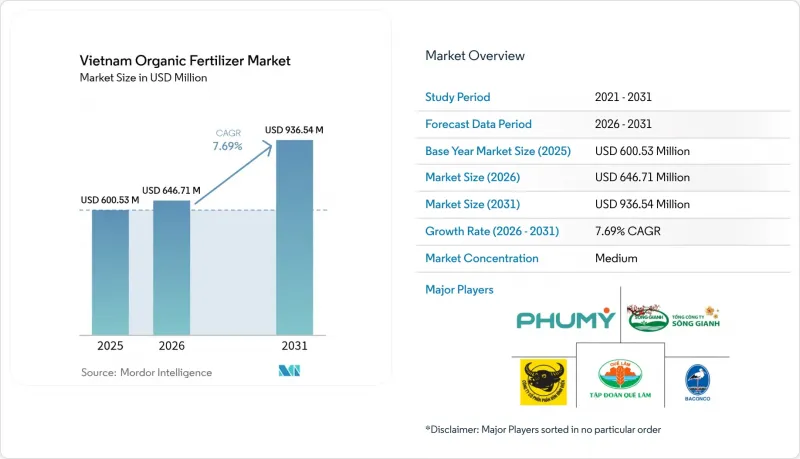
베트남의 유기 비료 시장 규모는 2025년 6억 53만 달러에서 2026년에는 6억 4,671만 달러로 확대하며, 2026-2031년에 CAGR 7.69%로 추이하며, 2031년에는 9억 3,654만 달러에 달할 것으로 예측됩니다.
이 보고서는 제품별(유기 잔여물 및 바이오비료), 형태별(건조 과립 및 액체·현탁 농축액), 용도별(곡물, 지방종자 및 두류, 과일 및 채소, 잔디 및 관상용 식물, 기타 작물)로 분류되어 있습니다. 시장 전망은 금액(달러) 및 메트릭톤으로 제시되어 있습니다.
베트남 유기비료 시장의 동향 및 인사이트
유기비료 이용률 향상을 목표로 하는 정부의 목표
2050년까지 유기비료 사용률을 50%로 끌어올리겠다는 베트남의 목표는 농업 부문 전체의 자재 조달 전략에 큰 영향을 미치고 있습니다. 2025년, 정부 결정 제5190/QD-BNN-BVTV호에서는 생산 능력 요건 및 품질 인증 기준을 포함하여 2030년까지의 유기비료 개발에 관한 구체적인 목표가 제시되어 있습니다. 이동 상황은 성(省)마다 다르지만, 2025년까지 가축 배설물의 80%를 재활용하겠다는 박산성의 목표와 같은 노력은 지방 자치 단체가 국가의 지침을 어떻게 실행하고 있는지를 보여줍니다. 2025년 농업 및 환경 감독 기능의 통합으로 규제 승인 기간이 단축되어, 생산자들은 신제품을 보다 효율적으로 시장에 출시할 수 있게 되었습니다. 이러한 정책 조치는 작물 품종에 관계없이 일관된 수요를 지원하며, 베트남 유기비료 시장에 안정성을 가져다주고 있습니다.
인증된 유기농 농산물의 수출 수요 급증
수출 시장에서 인증된 유기농 농산물의 가격 프리미엄이 베트남 과일·채소 부문의 유기비료 채택을 촉진하고 있습니다. 베트남의 유기농산물 수출 수입은 2025년에 3억 3,500만 달러에 달할 전망이며, 유럽, 북미 및 아시아의 선진 시장에서 공급업체 감사가 증가함에 따라 성장이 지속되고 있습니다. 기존 농산물에 비해 20-30% 높은 가격 프리미엄 덕분에 과일·채소 생산자들은 유기농 자재로 전환하는 추세를 보이고 있습니다. 특히 콜드체인 시설이 잘 갖춰져 있고 항구 접근성이 뛰어난 호치민시 근교에서는 이러한 경향이 두드러집니다. 베트남 남부의 생산자들은 호치민시의 수출 인프라 및 유통 네트워크와 인접해 있다는 이점을 누리고 있습니다. 이러한 가격 프리미엄 덕분에 생산자들은 유기 비료 비용 상승을 상쇄하면서도 국제 시장에서의 경쟁력을 유지할 수 있게 되었습니다.
품질 편차와 가짜 ‘유기농’ 제품이 농가의 신뢰를 훼손하고 있다
품질이 낮으면서도 잘못된 표시가된 유기비료가 널리 유통되고 있는 것은 농가의 신뢰를 훼손하고 시장 성장을 저해하고 있습니다. 특히 효과가 없는 제품을 구매할 위험을 감당할 수 없는 소규모 농가에게 큰 영향을 미치고 있습니다. 베트남에서는 유통되고 있는 1,000여 종의 바이오 제제 중 국가 인증을 받은 것은 불과 50여 종에 불과하며, 이는 심각한 품질관리 문제를 야기하고 위조 제품이 시장에 유입되는 원인이 되고 있습니다. 이러한 품질 편차는 베트남 북부의 소규모 농업 부문에서 특히 심각한 문제로 대두되고 있습니다. 이 지역은 농업 보급 서비스가 제한적이어서 농가가 정품과 위조품을 구별하기 어렵고, 그 결과 유기비료 도입에 소극적인 태도를 보이고 있습니다.
부문 분석
2025년 베트남 유기비료 시장에서 유기 잔여물이 시장 점유율의 63.78%를 차지하고 있습니다. 이는 기존 퇴비화 시스템과 호환되며 비용 대비 효과가 높은 원료로서 가축 분뇨, 벼 껍질, 커피 펄프를 이용할 수 있기 때문입니다. 하위 부문에서는 가축 분뇨가 주류를 이루고 있지만, 빈즈엉 물·환경 주식회사가 운영하는 일일 420메트릭톤의 도시 쓰레기 퇴비화 시설은 도시 근교의 채소 재배 지역에 공급하고 있습니다. 이러한 공급원은 연중 안정적인 가격을 유지하는 확립된 유통 네트워크를 지원하며, 시장에서 유기 잔류물의 지배적인 지위를 공고히 하고 있습니다.
베트남의 토양 조건에 특화된 아조토박터, 리조비움 및 균근균 균주가 국내 연구소에서 개발되고 있는 만큼, 바이오비료 시장은 2031년까지 연평균 성장률(CAGR) 10.05%로 성장할 것으로 예측됩니다. 이러한 제품들은 과수원에서 채택률이 가장 높으며, 농가는 미량영양소의 흡수를 높이고 작물의 수명을 연장하기 위해 고품질 자재에 투자하고 있습니다. 결의안 36-NQ/TW를 통한 생명공학 개발에 대한 지속적인 지원으로 인해 밭 시험이 확대되고 상업적 생산이 가속화될 것으로 예상됩니다. 이에 따라 바이오비료는 베트남 유기 비료 시장에서 중요한 성장 분야로 자리매김할 전망입니다.
기타 혜택:
- 엑셀 형식의 시장 예측(ME) 시트
- 3개월간의 애널리스트 지원
자주 묻는 질문
목차
제1장 서론
제2장 조사 방법
제3장 개요
제4장 시장 구도
제5장 시장 규모와 성장 예측
제6장 경쟁 구도
제7장 시장 기회와 향후 전망
KSA 26.08.25According to Mordor Intelligence, the Vietnam organic fertilizer market size is expected to grow from USD 600.53 million in 2025 to USD 646.71 million in 2026 and is forecast to reach USD 936.54 million by 2031 at 7.69% CAGR over 2026-2031.
This report is Segmented by Product (Organic Residues and Biofertilizers), by Form (Dry Granules and Liquid and Suspension Concentrates), and by Application (Grains and Cereals, Oilseeds and Pulses, Fruits and Vegetables, Turf and Ornamentals, and Other Crops). The Market Forecasts are Provided in Terms of Value (USD) and Volume (Metric Tons).
Vietnam Organic Fertilizer Market Trends and Insights
Government Target to Raise Organic Fertilizer Utilization
Vietnam's target of 50% organic fertilizer usage by 2050 significantly impacts input procurement strategies across the agricultural sector. In 2025, the government's Decision 5190/QD-BNN-BVTV outlines specific targets for organic fertilizer development through 2030, including production capacity requirements and quality certification standards. While implementation varies by province, initiatives such as Bac Giang's target to recycle 80% of livestock waste by 2025 demonstrate how regional authorities implement national directives. The 2025 consolidation of agricultural and environmental oversight reduced regulatory approval times, allowing producers to launch new products more efficiently. These policy measures support consistent demand across crop varieties, providing stability to Vietnam's organic fertilizer market.
Surging Demand for Certified Organic Exports
The price premiums for certified organic produce in export markets drive the adoption of organic fertilizers in Vietnam's fruit and vegetable sectors. Vietnam's organic export revenues reached USD 335 million in 2025, with continued growth driven by increased supplier audits from European, North American, and developed Asian markets. The 20-30% premium over conventional produce encourages fruit and vegetable growers to transition to organic inputs, particularly near Ho Chi Minh City, where cold-chain facilities provide efficient port access. Producers in Southern Vietnam benefit from their proximity to Ho Chi Minh City's export infrastructure and distribution networks. These price premiums enable producers to absorb higher organic fertilizer costs while maintaining competitiveness in international markets.
Quality Variability and Counterfeit "Organic" Products Erode Farmer Trust
The widespread presence of low-quality and incorrectly labeled organic fertilizers reduces farmer trust and limits market growth, especially affecting small-scale farmers who cannot risk purchasing ineffective products. In Vietnam, only about 50 out of 1,000 bio-preparations in circulation have received national certification, creating significant quality control issues that allow counterfeit products to enter the market. This quality inconsistency is particularly problematic in Northern Vietnam's small-scale farming sector, where limited agricultural extension services make it difficult for farmers to identify genuine products from counterfeits, resulting in reluctance to adopt organic fertilizers.
Other drivers and restraints analyzed in the detailed report include:
- High Chemical-Fertilizer Prices Widen the Cost-Competitiveness of Organic Inputs
- Degraded Soils Require Long-Term Organic-Matter Replenishment
- Limited Cold-chain for Organic Produce Tempers Demand Pull
For complete list of drivers and restraints, kindly check the Table Of Contents.
Segment Analysis
Organic residues account for 63.78% of the Vietnam organic fertilizer market share in 2025, driven by the availability of livestock manure, rice husks, and coffee pulp as cost-effective feedstock compatible with existing composting systems. Farmyard manure dominates the sub-segments, while the 420 metric tons per day municipal waste composting facility of Binh Duong Water - Environment Joint Stock Company supplies the peri-urban vegetable farming regions. These sources support an established distribution network that maintains consistent pricing throughout the year, securing the dominant position of residues in the market.
Biofertilizers are projected to grow at a 10.05% CAGR through 2031, as domestic laboratories develop Azotobacter, Rhizobium, and Mycorrhiza strains specific to Vietnam's soil conditions. These products see the highest adoption in fruit orchards, where farmers can invest in premium inputs to enhance micronutrient absorption and product longevity. The ongoing support through Resolution 36-NQ/TW for biotechnology development is anticipated to expand field testing and accelerate commercial production, establishing biofertilizers as a significant growth segment in the Vietnam organic fertilizer market.
Complete Report Scope:
- By Product
- Organic Residues
- Farm Yard Manure
- Crop Residues
- Green Manure
- Other Residues (Poultry Droppings, Fish Waste, Municipal Solid Waste, etc.)
- Biofertilizers
- Azotobacter
- Rhizobium
- Azospirillum
- Blue-Green Algae
- Azolla
- Mycorrhiza
- Other Biofertilizers (Bacillus, Frankia, etc.)
- Organic Residues
- By Form
- Dry Granules
- Liquid and Suspension Concentrates
- By Application
- Grains and Cereals
- Oilseeds and Pulses
- Fruits and Vegetables
- Turf and Ornamentals
- Other Crops (Fodder and Forage Crops, Commercial Crops, etc.)
List of Companies Covered in this Report:
- Binh Dien Fertilizer Joint Stock Company
- Que Lam Group Joint Stock Company
- Song Gianh Joint Stock Corporation
- Baconco Company Limited (PM Thoresen Asia Holdings Public Company Limited)
- Bioway Hitech Joint Stock Company
- Ha Lan Fertilizer Corporation
- Vedan Vietnam Enterprise Corporation Limited
- PetroVietnam Fertilizer and Chemicals Corporation
- Yara International ASA
- Bio Agrosa Fertilizer Co., Ltd
- Vietgro Export Import Company Limited
- Swaroop Agrochemical Industries Private Limited
- Kim Nghia Co. Ltd.
- Agrivari Co., Ltd.
- Thanh Thanh Cong - Bien Hoa Joint Stock Company (TTC AgriS)
Additional Benefits:
- The market estimate (ME) sheet in Excel format
- 3 months of analyst support
TABLE OF CONTENTS
1 Introduction
- 1.1 Study Assumptions and Market Definition
- 1.2 Scope of the Study
2 Research Methodology
3 Executive Summary
4 Market Landscape
- 4.1 Market Overview
- 4.2 Market Drivers
- 4.2.1 Government Target to Raise Organic Fertilizer Utilization
- 4.2.2 Surging Demand for Certified Organic Exports
- 4.2.3 High Chemical-Fertilizer Prices Widen the Cost-Competitiveness of Organic Inputs
- 4.2.4 Degraded Soils Require Long-Term Organic-Matter Replenishment
- 4.2.5 Technological Advancement and Product Innovation
- 4.2.6 Availability of Raw Materials and Waste Streams
- 4.3 Market Restraints
- 4.3.1 Quality Variability and Counterfeit "Organic" Products Erode Farmer Trust
- 4.3.2 Smallholder cash-flow limits hinder upfront switch to premium biofertilizers
- 4.3.3 Limited Cold-chain for Organic Produce Tempers Demand Pull
- 4.3.4 Slow Nutrient Release and Risk Perception
- 4.4 Regulatory Landscape
- 4.5 Technological Outlook
- 4.6 Porter's Five Forces Analysis
- 4.6.1 Threat of New Entrants
- 4.6.2 Bargaining Power of Buyers
- 4.6.3 Bargaining Power of Suppliers
- 4.6.4 Threat of Substitutes
- 4.6.5 Intensity of Competitive Rivalry
5 Market Size and Growth Forecasts (Value and Volume)
- 5.1 By Product
- 5.1.1 Organic Residues
- 5.1.1.1 Farm Yard Manure
- 5.1.1.2 Crop Residues
- 5.1.1.3 Green Manure
- 5.1.1.4 Other Residues (Poultry Droppings, Fish Waste, Municipal Solid Waste, etc.)
- 5.1.2 Biofertilizers
- 5.1.2.1 Azotobacter
- 5.1.2.2 Rhizobium
- 5.1.2.3 Azospirillum
- 5.1.2.4 Blue-Green Algae
- 5.1.2.5 Azolla
- 5.1.2.6 Mycorrhiza
- 5.1.2.7 Other Biofertilizers (Bacillus, Frankia, etc.)
- 5.1.1 Organic Residues
- 5.2 By Form
- 5.2.1 Dry Granules
- 5.2.2 Liquid and Suspension Concentrates
- 5.3 By Application
- 5.3.1 Grains and Cereals
- 5.3.2 Oilseeds and Pulses
- 5.3.3 Fruits and Vegetables
- 5.3.4 Turf and Ornamentals
- 5.3.5 Other Crops (Fodder and Forage Crops, Commercial Crops, etc.)
6 Competitive Landscape
- 6.1 Market Concentration
- 6.2 Strategic Moves
- 6.3 Market Share Analysis
- 6.4 Company Profiles (Includes Global Level Overview, Market Level Overview, Core Segments, Financials as Available, Strategic Information, Market Rank/Share, Products and Services, and Recent Developments)
- 6.4.1 Binh Dien Fertilizer Joint Stock Company
- 6.4.2 Que Lam Group Joint Stock Company
- 6.4.3 Song Gianh Joint Stock Corporation
- 6.4.4 Baconco Company Limited (PM Thoresen Asia Holdings Public Company Limited)
- 6.4.5 Bioway Hitech Joint Stock Company
- 6.4.6 Ha Lan Fertilizer Corporation
- 6.4.7 Vedan Vietnam Enterprise Corporation Limited
- 6.4.8 PetroVietnam Fertilizer and Chemicals Corporation
- 6.4.9 Yara International ASA
- 6.4.10 Bio Agrosa Fertilizer Co., Ltd
- 6.4.11 Vietgro Export Import Company Limited
- 6.4.12 Swaroop Agrochemical Industries Private Limited
- 6.4.13 Kim Nghia Co. Ltd.
- 6.4.14 Agrivari Co., Ltd.
- 6.4.15 Thanh Thanh Cong - Bien Hoa Joint Stock Company (TTC AgriS)


