

|
시장보고서
상품코드
2113848
X선 보안 스캐너 : 시장 점유율 분석, 업계 동향 및 통계, 성장 예측(2026-2031년)X-ray Security Scanner - Market Share Analysis, Industry Trends & Statistics, Growth Forecasts (2026 - 2031) |
||||||
 Mordor Intelligence
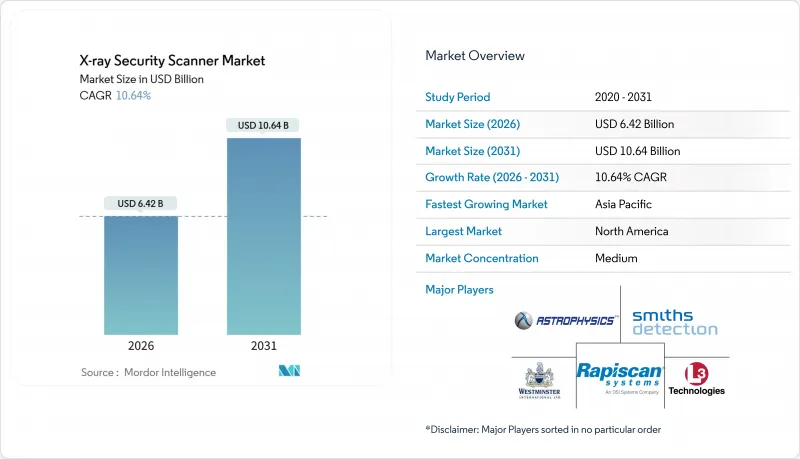
Mordor Intelligence에 의하면, X선 보안 스캐너 시장 규모는 2026년에 64억 2,000만 달러에 이르고, 2031년까지 106억 4,000만 달러로 확대되어 이 기간 CAGR은 10.64%를 나타낼 전망입니다.
본 보고서는 용도별(인물 검사, 제품 검사(우편·소포, 화물·수하물)), 최종 사용자 산업별(항공·운송, 기타),스캐너 구성별(싱글 뷰, 듀얼 뷰, 컴퓨터 단층 촬영(CT)·3D 뷰), 이미지 표시 방식별(2D 이미징, 3D·볼륨 이미징), 지역별로 분류되어 있습니다. 시장 예측은 금액(달러) 기준으로 제시되어 있습니다.
세계의 X선 보안 스캐너 시장 동향 및 인사이트
항공 화물 100% 검사 의무 이행 강화
포워더와 항공사는 과거 ‘알려진 화주’가 보낸 화물에 대해 X선 검사를 면제받던 특례를 상실했습니다. 미국 교통안전청(TSA)은 2024년에 ‘항공 화물 사전 심사(ACAS) 프로그램’을 확대하여, 적재 하루 전까지 전자 매니페스트 제출을 의무화했으며, 또한 위험도가 높은 팔레트에 대해서는 100g 이하의 시트형 폭발물을 감지할 수 있는 CT 또는 듀얼 에너지 장비를 이용한 검사를 실시하도록 했습니다. 2025년에는 유럽연합 항공안전청(EASA)이 150kg을 초과하는 화물에 대해 체적 이미징 요건을 부과하게 되었으며, 이는 와이드바디 항공기 화물칸에 적재되는 화물의 78%를 포괄하게 되었습니다. 기존의 싱글 뷰 방식 X선 터널은 원자 번호별 세분화 기능을 갖추고 있지 않아 이러한 기준을 충족할 수 없습니다. 이에 따라 공항 및 지상 수하물 취급 업체들은 장비 교체 주기를 앞당기고 있습니다. 시스템 통합사업자의 보고에 따르면, 북미의 신규 화물 프로젝트 중 44%가 인라인 CT 개조로 이루어지고 있으며, 조달 기간은 18개월 이하로 단축되었습니다. 연방 정부의 위험 기반 선별 인터페이스와 호환되는 모듈형 제어 소프트웨어를 제공하는 공급업체는 통합 위험을 최소화할 수 있으므로 입찰에서 유리한 입장에 있습니다.
100ml 액체 반입 제한 완화로 인한 EU 공항의 CT 스캐너 도입 촉진
2024년, 유럽연합 집행위원회는 검문소에 C3 인증을 받은 CT가 도입된 경우, 회원국이 기내 반입 액체의 100ml 제한을 철폐하는 것을 허용했습니다. 프랑크푸르트 공항은 2025년 12월까지 42개의 CT 레인 설치를 완료하여, 노트북이나 액체를 기내 수하물에 넣은 채로 검사할 수 있게 됨에 따라 여객 처리 능력을 18% 향상시켰습니다. 샤를 드골 공항은 2027년까지 68개의 레인을 개조하기 위해 1억 2,000만 유로(1억 2,800만 달러)를 배정했습니다. 런던 히스로 공항과 암스테르담 스키폴 공항에서는 2024년 중반 오감지율이 8%를 초과하여 일시적으로 액체 반입 제한을 재도입했으나, 이후 소프트웨어 패치 적용으로 경보 발생률이 4% 이하로 떨어지면서 단계적 재도입의 길이 열렸습니다. 공항 운영사는 현재 CT를 보안 규정 준수는 물론, 항공사가 슬롯 배분 협상 시 활용하는 고객 경험 지표의 관점에서도 필수적인 요소로 인식하고 있습니다.
2급 공항의 CT 및 듀얼 에너지 시스템에 대한 높은 설비 투자액
CT 체크포인트 스캐너의 단가는 250만-320만 달러로, 듀얼 뷰 터널의 약 4배에 달할 전망입니다. 그로 인해 연간 승객 수가 500만 명 이하인 지방 공항에서는 설비 갱신을 위한 자금 조달에 어려움을 겪고 있습니다. 2025년, 미국 교통안전청(TSA)은 469대의 CT 장치에 13억 달러를 배정했으나, 미국의 2등급 공항에는 이에 상응하는 보조금이 없어 프로젝트를 연기할 수밖에 없었습니다. 유럽의 공항 운영자들도 유사한 과제에 직면해 있습니다. 2024년에는 연간 여객 수 300만 명 이하인 공항의 62%가 CT 도입을 연기하고, 소프트웨어 패치를 통해 싱글 뷰형 터널의 수명을 연장하는 방안을 선택했습니다. 리스 프로그램을 통해 결제를 7년에서 10년에 걸쳐 분산할 수는 있지만, 총 소유 비용이 약 30% 증가함에 따라 영업이익률이 압박받고 있습니다. 새로운 자금 조달 수단이 없다면, 많은 중소 공항들은 중기적으로 CT 업그레이드 주기에서 소외된 채 남게 될 것으로 보입니다.
부문별 분석
우편물 및 소포 검사 시장은 2031년까지 연평균 성장률(CAGR) 10.87%로 확대되어, 많은 기존 항공 관련 프로젝트를 능가할 것으로 예측됩니다. 세계우편연합(UPU)의 데이터에 따르면, 국제 소포 취급량은 2027년까지 18억 개에 달할 것으로 예상되며, 우편 사업자들은 벨트 속도 1m/s 이상에서 스캔이 가능한 직교 뷰형 터널을 도입할 수밖에 없는 상황입니다. 미국 우정공사(USPS)의 허브에서는 2024년에 127대의 고속 시스템이 도입되었으며, UPS는 이를 신경망 기반 선별 시스템과 결합함으로써 2차 수작업 재검사를 한 자릿수 수준으로 줄였습니다. 이러한 변화는 현재 항공사가 아닌 소포 사업자가 공급업체에 대해 이미지 분석 로드맵을 주도하고 있음을 여실히 보여줍니다.
화물 및 수하물 검사는 여전히 X선 보안 스캐너 시장의 가장 큰 비중을 차지하고 있으며, 이는 화물의 100% 검사를 의무화하는 규제 당국의 요구에 힘입은 것입니다. 미국 교통안전청(TSA)은 2025년에 검문소용으로 469대의 CT 장비를 구입했으며, 대당 평균 가격은 277만 달러였습니다. 한편, 유럽항공안전청(EASA)의 규정에 따라 150kg을 초과하는 화물에 대해서는 체적 이미징 검사가 의무화되어 있으며, 이로 인해 단일 시점형 터널형 스캐너의 교체가 가속화되고 있습니다. 도시 교통 분야에서는 인체 검색 시스템 도입이 진행되고 있지만, 사생활 침해에 대한 우려로 인해 경기장에서의 백스캐터 방식의 활용이 주춤하고 있어, 운영 사업자들은 mm파 방식으로의 전환을 서두르고 있습니다.
상업시설(소매, 호텔 및 레스토랑, 기업 캠퍼스)에서는 보험사가 주변 경비 실시와 보험료 인하를 연계하고 있기 때문에 2031년까지 연평균 성장률(CAGR) 11.41%를 나타낼 것으로 예측됩니다. 2024년 버지니아주에서 발생한 보안 침해 사건을 계기로, 데이터센터 운영 사업자들은 현재 적재장에 보안 게이트를 설치하고 있으며, 호텔 업계도 자사 시설을 ‘취약한 표적’으로 지정한 미국 국토안보부의 지침을 따르고 있습니다. 일부 소매업체는 RFID 태그와 연동된 출구 레인용 터널 검사 시스템을 도입하고 있으며, 이를 도입한 매장에서는 상품 도난을 12% 줄이는 데 성공했습니다. 이는 보안 스캐너가 위험이 높은 항공 산업에서 일상적인 상업 환경으로 전환되고 있음을 보여주는 증거입니다.
항공 부문은 여전히 주도적인 위치를 차지하고 있으며, 2025년 시장 점유율은 52.8%에 달했습니다. 이는 교통안전청(TSA)의 CT 계약과 440개 공항을 대상으로 한 Leidos와의 26억 달러 규모 서비스 계약에 힘입은 결과입니다. 국경 경비 기관들도 현대화를 추진하고 있습니다. 미국 세관·국경보호청(CBP)은 2024년, 마약 전구물질을 감지하기 위한 듀얼 에너지 식별 기능을 탑재한 차세대 화물 스캐너 도입을 위해 1억 9,800만 달러 규모의 계약을 체결했습니다. 발전소 등 중요 인프라 부문에서는 북미 전력 신뢰성 위원회(NERC)의 물리적 보안 규정을 준수하기 위해 현재 보안 게이트가 설치되어 있습니다.
지역별 분석
아시아태평양은 2031년까지 연평균 성장률(CAGR) 11.26%를 나타낼 것으로 예측되며, 이는 세계에서 가장 빠른 성장 궤도입니다. 중국은 2024년에 1만 287km의 도시 철도를 운행했으며, 인도는 2020년부터 2025년 사이에 614km를 연장했습니다. 두 나라 모두 지하철 개찰구에서 수하물 X선 검사를 의무화하고 있습니다. 델리 메트로의 288개 터널에서는 피크 시간대에 시간당 400개의 가방을 스캔하고 있으며, 싱가포르에서는 AI 분류기를 도입하여 오경보를 34% 줄였습니다. 공항 현대화는 여전히 선택적인 상황이며, 인도의 2급 공항에서는 CT 도입을 위한 연방 정부의 자금 지원을 기다리는 동안 듀얼 뷰 방식으로의 개조가 계속해서 선호되고 있습니다.
2025년 매출 중 북미가 35.1%를 차지했습니다. 미국 교통안전청(TSA)의 CT 스캐너 469대 발주와 Leidos와의 26억 달러 규모 물류 계약은 연방 정부의 안정적인 지출을 뒷받침하고 있습니다. 미국의 국경 현대화도 가속화되고 있습니다. 미국 세관·국경보호청(CBP)은 육로 국경 검문소용 1억 9,800만 달러 상당의 포털 장비를 발주했습니다. 캐나다는 앰배서더 브리지와 피스 아치의 스캐너 교체를 위해 8,900만 캐나다 달러(6,600만 달러)를 배정했으며, 멕시코는 멕시코시티와 칸쿤에서 CT 레인 검사 운영을 진행하고 있습니다.
유럽은 2025년 매출의 약 28%를 차지했습니다. 프랑크푸르트 공항과 파리 공항은 2027년까지 CT를 전면 도입하는 목표를 향해 순조롭게 진행되고 있지만, 히스로 공항과 스키폴 공항의 재설정은 도입 과정에서 발생할 수 있는 위험 요소를 보여주고 있습니다. 중동의 허브 공항들은 걸프 국가들의 인프라 투자와 발맞추고 있습니다. ‘아랍에미리트 비전 2030’에 따른 두바이와 아부다비의 확장 계획에서는 CT 및 듀얼 에너지 기술 도입이 우선순위로 지정되었습니다. 사우디아라비아 공공투자기금(PIF)은 항공 보안 강화를 포함한 전반적인 인프라 구축에 8,000억 달러를 배정했습니다. 남미와 아프리카에서는 아직 도입이 초기 단계에 있지만, 남아프리카공화국 공항공사는 2024년에 14개의 CT 레인을 설치했습니다.
기타 혜택
- 엑셀 형식 시장 예측(ME) 시트
- 3개월간의 애널리스트 지원
자주 묻는 질문
목차
제1장 서론
제2장 조사 방법
제3장 주요 요약
제4장 시장 구도
제5장 시장 규모 및 성장 예측
제6장 경쟁 구도
제7장 시장 기회 및 향후 전망
KTH 26.08.26According to Mordor Intelligence, the x-ray security scanner market size reached USD 6.42 billion in 2026 and is forecast to rise to USD 10.64 billion by 2031, reflecting a 10.64% CAGR across the period.
This report is Segmented by Application (People Screening, Product Screening With Mail and Parcel, and Cargo and Baggage), End-User Industry (Aviation and Transportation, and More), Scanner Configuration (Single-View, Dual-View, and Computed-Tomography/3-D View), Imaging Dimension (2-D Imaging, and 3-D/Volumetric Imaging), and Geography. The Market Forecasts are Provided in Terms of Value (USD).
Global X-ray Security Scanner Market Trends and Insights
Heightened Enforcement of 100% Air-Cargo Screening Mandates
Freight forwarders and airlines have lost exemptions that once allowed known-shipper cargo to bypass X-ray inspection. The Transportation Security Administration enlarged its Air Cargo Advance Screening program in 2024, requiring electronic manifests a full day before loading, then routing higher-risk pallets to CT or dual-energy units capable of detecting sheet explosives under 100 g. In 2025 the European Union Aviation Safety Agency imposed a volumetric-imaging requirement for cargo over 150 kg, covering 78% of wide-body belly freight. Legacy single-view tunnels cannot meet these criteria because they lack atomic-number segmentation, so airports and ground-handling agents are accelerating refresh cycles. Integrators report that inline CT retrofits now represent 44% of new cargo projects in North America, compressing procurement timelines to under 18 months. Vendors that offer modular control software compatible with federal risk-based targeting interfaces are winning bids because they minimize integration risk.
Relaxation of 100 ml Liquid Ban Driving EU Airport CT Scanner Roll-outs
In 2024 the European Commission permitted member states to scrap the 100 ml carry-on liquid limit if checkpoints deploy C3-certified CT. Frankfurt Airport finished 42 CT lanes by December 2025, boosting passenger throughput 18% after laptops and liquids stayed inside bags. Charles de Gaulle Airport allocated EUR 120 million (USD 128 million) to refit 68 lanes by 2027. Although London Heathrow and Amsterdam Schiphol briefly reinstated the liquid rule in mid-2024 because of false-positive rates above 8%, software patches have since cut alarms below 4%, clearing a path to resume phase-in. Airport operators now view CT as essential not only for security compliance but also for customer-experience metrics that airlines use in slot-allocation negotiations.
High CAPEX of CT and Dual-Energy Systems for Tier-2 Airports
CT checkpoint scanners carry unit prices of USD 2.5 million to USD 3.2 million, about four times dual-view tunnels, and regional airports that process under 5 million passengers annually struggle to fund upgrades. In 2025 the Transportation Security Administration allocated USD 1.3 billion for 469 CT units, but U.S. tier-2 airports lacked matching grants and deferred projects. European operators face similar hurdles: 62% of airports below 3 million passengers postponed CT adoption in 2024, opting to extend the life of single-view tunnels through software patches. Leasing programs spread payments over seven to ten years yet add about 30% to total cost of ownership, squeezing operating margins. Without new financing tools, many smaller airports will remain outside the CT upgrade cycle through the medium term.
Other drivers and restraints analyzed in the detailed report include:
- E-commerce Parcel Volumes Forcing High-Throughput Dual-View Systems
- Urban Metro Expansions in Asia Pacific Requiring Compact Drive-Through Scanners
- Public Health and Privacy Pushback on People Scanners at Stadiums
For complete list of drivers and restraints, kindly check the Table Of Contents.
Segment Analysis
Mail and parcel inspection is forecast to advance at a 10.87% CAGR through 2031, overtaking many legacy aviation projects. Universal Postal Union data show that international parcels will reach 1.8 billion by 2027, forcing postal operators to add orthogonal-view tunnels that scan at belt speeds above 1 m/s. United States Postal Service hubs adopted 127 high-speed systems in 2024, and UPS paired them with neural-network triage that cut secondary manual reviews to single-digit levels. These shifts underline how parcel operators, not airlines, are now dictating image-analysis roadmaps to vendors.
Cargo and baggage screening still represents the largest slice of the X-ray security scanner market size, powered by regulators that insist on 100% cargo inspection. The Transportation Security Administration bought 469 CT units for checkpoints in 2025, each averaging USD 2.77 million. Meanwhile, EASA rules require freight above 150 kg to undergo volumetric imaging, accelerating the replacement of single-view tunnels. People-screening deployments continue in urban transit, but privacy objections have slowed backscatter use in stadiums, nudging operators toward millimeter-wave alternatives.
Commercial facilities (retail, hospitality, and corporate campuses) are projected to grow at an 11.41% CAGR through 2031 as insurers link lower premiums to perimeter screening. Data-center operators now place portals at loading docks after a 2024 breach in Virginia, and hotels follow Department of Homeland Security guidance designating them soft targets. Some retailers pilot exit-lane tunnels tied to RFID tags, cutting shrink by 12% in test stores, evidence that security scanners are migrating from high-risk aviation to everyday commercial settings.
Aviation remains dominant, with 52.8% 2025 market share, propelled by Transportation Security Administration CT contracts and Leidos's USD 2.6 billion services deal covering 440 airports. Border agencies are also modernizing: U.S. Customs and Border Protection awarded USD 198 million for next-generation cargo scanners in 2024, embedding dual-energy discrimination to spot narcotics precursors. Critical-infrastructure sectors such as power plants now install portals to comply with North American Electric Reliability Corporation physical-security rules.
Complete Report Scope:
- By Application
- People Screening
- Product Screening
- Mail and Parcel
- Cargo and Baggage
- By End-user Industry
- Aviation and Transportation
- Law Enforcement
- Commercial (Retail, Hospitality, Corporate)
- Government and Border Security
- Critical Infrastructure (Energy, Nuclear, Data Centers)
- By Scanner Configuration
- Single-view
- Dual-view
- Computed-Tomography / 3-D View
- By Imaging Dimension
- 2-D Imaging
- 3-D / Volumetric Imaging
- By Geography
- North America
- United States
- Canada
- Mexico
- Rest of North America
- South America
- Brazil
- Argentina
- Chile
- Rest of South America
- Europe
- United Kingdom
- Germany
- France
- Italy
- Rest of Europe
- Asia Pacific
- China
- India
- Japan
- South Korea
- Rest of Asia Pacific
- Middle East
- Saudi Arabia
- United Arab Emirates
- Qatar
- Rest of Middle East
- Africa
- South Africa
- Nigeria
- Kenya
- Rest of Africa
- North America
Geography Analysis
Asia Pacific is expected to deliver an 11.26% CAGR to 2031, the fastest trajectory worldwide. China operated 10,287 km of urban rail in 2024, while India added 614 km between 2020 and 2025, and both require X-ray bag checks at metro entrances. Delhi Metro's 288 tunnels scan 400 bags per peak-hour cycle, and Singapore reduced false alarms 34% by adding AI classifiers. Airport modernizations remain selective; India's tier-2 airports continue to favour dual-view retrofits while awaiting federal funding for CT.
North America held 35.1% of 2025 revenue. The Transportation Security Administration's 469-unit CT order and Leidos's USD 2.6 billion logistics contract underline steady federal spending. U.S. border modernization also accelerates: Customs and Border Protection ordered USD 198 million in portals for land crossings. Canada allocated CAD 89 million (USD 66 million) to refresh scanners at the Ambassador Bridge and Peace Arch, while Mexico pilots CT lanes in Mexico City and Cancun.
Europe captured roughly 28% of 2025 turnover. Frankfurt and Paris airports are on track for full CT coverage by 2027, yet Heathrow and Schiphol resets show rollout risks. Middle Eastern hubs align with Gulf infrastructure spending: Dubai and Abu Dhabi expansions under UAE Vision 2030 prioritize CT and dual-energy deployments. Saudi Arabia's Public Investment Fund earmarked USD 800 billion for general infrastructure, including aviation security upgrades. South America and Africa remain nascent, though South Africa's Airports Company installed 14 CT lanes in 2024.
- Smiths Detection Group Ltd.
- OSI Systems, Inc.
- Leidos, Inc.
- L3Harris Technologies, Inc.
- Nuctech Company Limited
- Astrophysics Inc.
- Westminster Group Plc
- Adani Systems Inc.
- Autoclear, LLC
- Aventura Technologies, Inc.
- Analogic Corporation
- CEIA S.p.A.
- VOTI Detection Inc.
- VMI Security B.V.
- Gilardoni S.p.A.
- Viken Detection Corporation
- Teledyne Technologies Incorporated
- OR Technology (Oehler Research Technology GmbH)
- ZKTeco Co., Ltd.
- NU Clear Advanced Security Ltd.
Additional Benefits:
- The market estimate (ME) sheet in Excel format
- 3 months of analyst support
TABLE OF CONTENTS
1 INTRODUCTION
- 1.1 Study Assumptions and Market Definition
- 1.2 Scope of the Study
2 RESEARCH METHODOLOGY
3 EXECUTIVE SUMMARY
4 MARKET LANDSCAPE
- 4.1 Market Overview
- 4.2 Market Drivers
- 4.2.1 Heightened Enforcement of 100% Air-Cargo Screening Mandates
- 4.2.2 Relaxation of 100 ml Liquid Ban Driving EU Airport CT Scanner Roll-outs
- 4.2.3 E-commerce Parcel Volumes Forcing High-Throughput Dual-View Systems
- 4.2.4 Urban Metro Expansions in Asia Pacific Requiring Compact Drive-Through Scanners
- 4.2.5 Spectral Imaging Integration Enabling Automated Contraband Classification
- 4.2.6 Subscription-Based "Screening-as-a-Service" Models for Tier-2 Airports
- 4.3 Market Restraints
- 4.3.1 High CAPEX of CT and Dual-Energy Systems for Tier-2 Airports
- 4.3.2 Public Health and Privacy Pushback on People Scanners at Stadiums
- 4.3.3 Export-Control Barriers on Dual-Use Detector Exports
- 4.3.4 Millimeter-Wave Alternatives Reducing X-ray Scanner Adoption in Low-Dose Scenarios
- 4.4 Impact of Macroeconomic Factors on the Market
- 4.5 Industry Value-Chain Analysis
- 4.6 Regulatory Outlook
- 4.7 Technological Outlook
- 4.8 Porter's Five Forces Analysis
- 4.8.1 Bargaining Power of Suppliers
- 4.8.2 Bargaining Power of Buyers
- 4.8.3 Threat of New Entrants
- 4.8.4 Threat of Substitutes
- 4.8.5 Intensity of Competitive Rivalry
5 MARKET SIZE AND GROWTH FORECASTS (VALUE)
- 5.1 By Application
- 5.1.1 People Screening
- 5.1.2 Product Screening
- 5.1.2.1 Mail and Parcel
- 5.1.2.2 Cargo and Baggage
- 5.2 By End-user Industry
- 5.2.1 Aviation and Transportation
- 5.2.2 Law Enforcement
- 5.2.3 Commercial (Retail, Hospitality, Corporate)
- 5.2.4 Government and Border Security
- 5.2.5 Critical Infrastructure (Energy, Nuclear, Data Centers)
- 5.3 By Scanner Configuration
- 5.3.1 Single-view
- 5.3.2 Dual-view
- 5.3.3 Computed-Tomography / 3-D View
- 5.4 By Imaging Dimension
- 5.4.1 2-D Imaging
- 5.4.2 3-D / Volumetric Imaging
- 5.5 By Geography
- 5.5.1 North America
- 5.5.1.1 United States
- 5.5.1.2 Canada
- 5.5.1.3 Mexico
- 5.5.1.4 Rest of North America
- 5.5.2 South America
- 5.5.2.1 Brazil
- 5.5.2.2 Argentina
- 5.5.2.3 Chile
- 5.5.2.4 Rest of South America
- 5.5.3 Europe
- 5.5.3.1 United Kingdom
- 5.5.3.2 Germany
- 5.5.3.3 France
- 5.5.3.4 Italy
- 5.5.3.5 Rest of Europe
- 5.5.4 Asia Pacific
- 5.5.4.1 China
- 5.5.4.2 India
- 5.5.4.3 Japan
- 5.5.4.4 South Korea
- 5.5.4.5 Rest of Asia Pacific
- 5.5.5 Middle East
- 5.5.5.1 Saudi Arabia
- 5.5.5.2 United Arab Emirates
- 5.5.5.3 Qatar
- 5.5.5.4 Rest of Middle East
- 5.5.6 Africa
- 5.5.6.1 South Africa
- 5.5.6.2 Nigeria
- 5.5.6.3 Kenya
- 5.5.6.4 Rest of Africa
- 5.5.1 North America
6 COMPETITIVE LANDSCAPE
- 6.1 Market Concentration
- 6.2 Strategic Moves
- 6.3 Market Share Analysis
- 6.4 Company Profiles (includes Global-level Overview, Market-level Overview, Core Segments, Financials as available, Strategic Information, Market Rank/Share, Products and Services, and Recent Developments)
- 6.4.1 Smiths Detection Group Ltd.
- 6.4.2 OSI Systems, Inc.
- 6.4.3 Leidos, Inc.
- 6.4.4 L3Harris Technologies, Inc.
- 6.4.5 Nuctech Company Limited
- 6.4.6 Astrophysics Inc.
- 6.4.7 Westminster Group Plc
- 6.4.8 Adani Systems Inc.
- 6.4.9 Autoclear, LLC
- 6.4.10 Aventura Technologies, Inc.
- 6.4.11 Analogic Corporation
- 6.4.12 CEIA S.p.A.
- 6.4.13 VOTI Detection Inc.
- 6.4.14 VMI Security B.V.
- 6.4.15 Gilardoni S.p.A.
- 6.4.16 Viken Detection Corporation
- 6.4.17 Teledyne Technologies Incorporated
- 6.4.18 OR Technology (Oehler Research Technology GmbH)
- 6.4.19 ZKTeco Co., Ltd.
- 6.4.20 NU Clear Advanced Security Ltd.
7 MARKET OPPORTUNITIES AND FUTURE OUTLOOK
- 7.1 White-space and Unmet-Need Assessment


