

|
시장보고서
상품코드
2113945
의료용 센서 : 시장 점유율 분석, 업계 동향 및 통계, 성장 예측(2026-2031년)Medical Sensor - Market Share Analysis, Industry Trends & Statistics, Growth Forecasts (2026 - 2031) |
||||||
 Mordor Intelligence
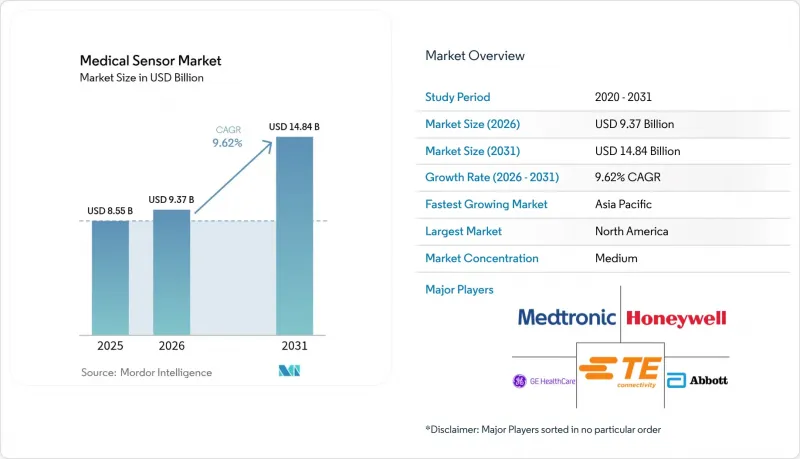
Mordor Intelligence에 의하면, 의료용 센서 시장 규모는 2025년에 85억 5,000만 달러로 평가되었습니다. 2026년 93억 7,000만 달러에서 2031년까지 148억 4,000만 달러에 이를 것으로 예상되며, 예측 기간(2026-2031년) CAGR은 9.62%를 나타낼 전망입니다.
본 보고서는 센서 유형(압력 센서, 온도 센서, 바이오 센서, 혈당 센서 등), 기술(MEMS, 광섬유 등), 도입 형태(웨어러블, 이식형 등), 용도(환자 모니터링, 치료·약물 전달 등), 최종 사용자(병원 및 대규모 의료 시스템 등), 지역별로 분류되어 있습니다. 시장 예측은 금액(달러) 기준으로 제시되어 있습니다.
세계의 의료용 센서 시장 동향 및 인사이트
AI를 활용한 연속 혈당 모니터링의 보급
로슈는 2024년, 저혈당 발작을 몇 시간 전에 예측하는 예측 알고리즘을 통합한 ‘Accu-Chek SmartGuide’ 시스템에 대해 CE 마크를 획득했습니다. 같은 해, FDA는 자동 인슐린 투여의 승인 대상을 2형 당뇨병 환자로 확대하여 폐쇄 루프 요법으로 가는 길을 열었습니다. 덱스콤(Dexcom)이 Oura에 7,500만 달러를 투자한 것은 대사 센싱과 전체적인 웰니스 추적의 융합을 부각시키고 있습니다. 애보트와 메드트로닉의 제휴를 통해 CGM 데이터를 인슐린 펌프의 알고리즘에 거의 실시간으로 연동하는 상호 운용 가능한 플랫폼의 개발이 가속화되고 있습니다. IBM과 로슈는 2025년, 센서 대시보드에 라이프스타일 기반 예측 모델을 추가함으로써 이러한 흐름을 더욱 촉진했습니다.
EU의 MDR(의료기기 규정)에 힘입어 추적 가능성이 보장된 일회용 센서로 전환
의료기기 규정(MDR)의 시행에 따라, 일회용 제품이라 하더라도 내장된 고유한 기기 식별자를 통해 전체 수명 주기에 걸친 추적 가능성이 의무화되었으며, 제조업체들은 유럽의 진료소에 출하되는 일회용 제품에 디지털 추적 기능을 탑재해야 하는 압박을 받고 있습니다. 독일의 한 병원에서는 현재 진료 현장에서 배치 데이터를 기록하는 3D 프린팅 마이크로유체 상처 센서를 시범 도입하고 있으며, 이를 통해 보험 환급과 시판 후 감시를 모두 지원하는 피드백 루프가 형성되고 있습니다. 세계 기업들은 이중 재고를 방지하기 위해 모든 시설에서 MDR 준수 설계를 점점 더 많이 채택하고 있으며, 유럽으로의 주문을 공급하는 아시아태평양의 위탁 생산 라인에서 품질 기준을 높이고 있습니다.
사이버 보안 관련 표시의 차이
FDA의 실시간 위협 평가 프레임워크와 EU의 시판 전 보안 도시에 관한 규정 간의 불일치로 인해 이중 검증 절차가 요구되고 있습니다. 개발 기간은 최대 20%까지 길어지며, 소규모 신생 기업들은 출시를 단일 지역으로 제한하는 경우가 많아, 그 결과 경쟁의 다양성이 제약받고 혁신의 세계적 확산이 지연되고 있습니다.
부문 분석
2025년, 바이오센서는 의료용 센서 시장의 43.35%를 차지했으며, 그 중심에는 강력한 보험 급여 지원을 받고 있는 혈당, 심장, 감염증 검사가 있었습니다. 손가락 채혈을 통한 진단에서 연속 측정으로 전환됨에 따라, 혈당 측정 모듈이 하위 부문의 매출을 주도하고 있습니다. 전기화학 플랫폼에는 비정상적인 측정값을 감지하고 오경보를 줄여주는 AI 필터가 내장되어 있어 임상의의 신뢰를 높이고 있습니다. 압력 센서는 인공호흡기나 혈역학 모니터에서 여전히 필수적인 반면, 온도 센서는 발열 진행 상황을 추적하는 다중 매개변수형 웨어러블 기기에 채택되기 시작했습니다. 유량 센서는 호흡 치료 기기를 지원하며, 팬데믹으로 인한 수요 급증에 힘입어 출하량이 증가했습니다. 테라헤르츠 및 하이퍼스펙트럼 기술을 통해 비침습적인 조직 특성 평가가 가능해짐에 따라, 광학 및 이미지 센서는 연평균 성장률(CAGR) 14.12%로 가장 빠른 성장 궤도를 보이고 있습니다. 가속도 센서는 뇌졸중 환자의 재활 도구를 발전시키고 있으며, 틈새 시장인 그래핀 바이오센서는 서브피코몰 수준의 검출 임계값을 실현하여 향후 상용화가 기대되고 있습니다.
연구 기관들이 호르몬 바이오마커를 표적으로 하는 탄소나노튜브 어레이에 대한 특허를 취득함에 따라, 바이오센서 분야의 경쟁 양상은 확대되고 있으며, 의료용 센서 업계의 파이프라인에 더욱 깊이가 더해지고 있습니다. 시장을 선도하는 기업들은 생체 신호와 예측 대시보드를 통합한 센서·분석 번들을 공동 개발하고 있습니다. 이러한 서비스 계층은 전환 비용을 높이는 동시에 하드웨어 판매를 넘어선 수익원을 확대합니다. 이러한 동향을 고려할 때, 바이오센서는 의료 센서 시장에서 지배적인 역할을 유지하면서도 종양학 및 피부과 분야의 요구를 충족하는 영상 중심의 모달리티에 상대적인 시장 점유율을 양보하게 될 것입니다.
MEMS 플랫폼은 성숙한 제조 생태계와 확립된 신뢰성 지표를 바탕으로 2025년 의료용 센서 시장 규모의 51.90%를 차지했습니다. 이들은 ICU 모니터나 휴대용 펌프에 탑재되는 압력, 가속도, 유량 측정 장치의 기반이 되고 있습니다. CMOS 제조 기술은 고해상도 이미지 센서와 포토다이오드, 증폭기, 무선 인터페이스를 내장한 다기능 시스템 온 칩(SoC) 솔루션을 뒷받침하고 있습니다. 광섬유 센서는 인장 응력을 견디는 유연한 유리 섬유 기술의 발전에 힘입어, 전자기 내성이 필수적인 MRI실이나 화상 치료실에 널리 보급되고 있습니다.
나노 디바이스와 그래핀 디바이스는 출하 대수에서 차지하는 비중이 극히 일부에 불과하지만, 2031년까지 연평균 성장률(CAGR) 14.55%를 기록할 전망입니다. 그래핀 메타표면 바이오센서는 실험실 테스트에서 단일 분자 수준의 바이러스 검출에 성공했습니다. 또한, 대학에서는 화학적 핑거프린팅을 구현하는 음파 그래핀 센서도 개발되어 초고감도화의 가능성이 강조되고 있습니다. 3D 프린팅 유기 전자 분야에서의 병행된 발전으로 인해, 기존의 리소그래피로는 실현할 수 없었던 맞춤형 형상의 설계 자유도가 확대되고 있습니다. 생산 수율이 향상됨에 따라, 의료용 센서 시장 전체에서 틈새 시장이며 높은 감도가 요구되는 이용 사례에서는 나노 스케일의 아키텍처가 MEMS를 대체하는 경향이 더욱 강해질 것입니다.
지역별 분석
북미는 연결형 당뇨병 및 심장 질환 치료 기기의 도입 대수가 많기 때문에 2025년에도 매출 점유율 34.20%를 유지했습니다. ‘CHIPS법’은 반도체 생산 능력 확대에 520억 달러를 배정하고 있으며, 의료 분야에 대한 배분을 우선시함으로써 수입 의존도를 낮추고 있습니다. FDA의 사이버 보안 지침은 ‘보안 설계(Secure by Design)’ 원칙을 추진하고 있으며, 이를 준수하는 공급업체에 선점 우위를 제공합니다. Dexcom과 Oura의 제휴와 같은 전략적 협력은 소비자용 웨어러블 기기와 규제 대상 기기가 점점 더 중첩되는 이 지역의 동향을 여실히 보여주고 있습니다. 캐나다는 단일 지불자 모델을 활용하여 지역 차원의 원격 모니터링을 시범적으로 도입하고 있는 반면, 멕시코는 미국·멕시코·캐나다 자유무역협정(USMCA)의 규정에 따라 근해(nearshore) 방식의 센서 부품 생산을 유치하고 있습니다.
아시아태평양은 2031년까지 연평균 성장률(CAGR) 13.92%를 기록하며 가장 빠른 성장세를 보이고 있습니다. 중국 국가위생건강위원회(NHSA)의 대량 조달을 통해 수백만 대의 SpO2 웨어러블 기기가 1차 의료 현장에 도입되어, 세계 최대 규모의 시계열 혈중 산소 포화도 데이터 세트가 구축되고 있습니다. 일본에서는 고령화 사회와 로봇 수술의 보급이 진행되면서 오토클레이브 대응 센서에 대한 수요가 증가하고 있습니다. 인도에서는 국가 비감염성 질환 대책 프로그램의 일환으로 저비용 혈당 측정기의 보급이 추진되고 있습니다. 한국에서는 파운드리 활용을 통해 설계와 제조를同一?点化할 수 있게 되어, 차세대 압력 센서 및 이미지 센서의 사이클 타임이 단축되고 있습니다. 반도체 웨이퍼 공급 부족은 여전히 역풍으로 작용하고 있지만, 정부의 인센티브에 힘입어 국내 생산 능력 확충이 촉진되면서 의료용 센서 시장 전체의 성장세는 유지되고 있습니다.
유럽에서는 MDR 규제의 조화를 통해 추적성 기준이 강화되면서, 스마트 일회용 센서의 도입이 촉진되고 있습니다. 독일에서는 시판 후 감시를 위한 UDI 코드가 내장된 3D 프린팅 방식의 상처 센서의 시범 도입이 진행되고 있습니다. 영국 국민보건서비스(NHS)에서는 디지털 병동 모델의 일환으로 다중 매개변수 대응 웨어러블 기기의 시범 운영이 진행되고 있으나, 임상의의 업무 부담에 대한 우려로 인해 도입 속도는 완만해지고 있습니다. 프랑스와 이탈리아는 EU의 기한에 앞서 사이버 보안 적합성 평가를 도입하여, 국경을 초월한 의료기기의 상호 운용성을 지원하고 있습니다. 데이터 개인정보 보호 관련 규제로 인해 암호화 및 엣지 처리 혁신이 추진되고 있으며, 안전한 의료용 센서 시장 확대를 위한 세계 설계 템플릿이 형성되고 있습니다.
기타 혜택 :
- 엑셀 형식 시장 예측(ME) 시트
- 3개월간의 애널리스트 지원
자주 묻는 질문
목차
제1장 서론
제2장 조사 방법
제3장 주요 요약
제4장 시장 구도
제5장 시장 규모 및 성장 예측
제6장 경쟁 구도
제7장 시장 기회 및 향후 전망
KTH 26.08.26According to Mordor Intelligence, the medical sensors market size was valued at USD 8.55 billion in 2025 and estimated to grow from USD 9.37 billion in 2026 to reach USD 14.84 billion by 2031, at a CAGR of 9.62% during the forecast period (2026-2031).
This report is Segmented by Sensor Type (Pressure Sensors, Temperature Sensors, Biosensors, Blood-Glucose Sensors, and More), Technology (MEMS, Fiber-Optic, and More), Deployment (Wearable, Implantable, and More), Application (Patient Monitoring, Therapeutic and Drug-Delivery, and More), End-User (Hospitals and Large Health Systems, and More), and Geography. The Market Forecasts are Provided in Terms of Value (USD).
Global Medical Sensor Market Trends and Insights
AI-enabled continuous glucose monitoring adoption
Roche secured CE Mark for its Accu-Chek SmartGuide system in 2024, integrating predictive algorithms that anticipate hypoglycemia events hours in advance. The FDA expanded automated insulin dosing clearance to Type 2 diabetes patients the same year, validating a path for closed-loop therapies. Dexcom's USD 75 million investment in Oura underscores convergence between metabolic sensing and holistic wellness tracking. Collaboration between Abbott and Medtronic is accelerating interoperable platforms that link CGM data to pump algorithms in near real time. IBM and Roche advanced this trajectory in 2025 by adding lifestyle-based predictive models to sensor dashboards.
EU MDR-driven shift to traceable disposable sensors
Medical Device Regulation enforcement obliges full life-cycle traceability through unique device identifiers embedded in even single-use products, pushing manufacturers to integrate digital tracking into disposables shipped to European clinics. German hospitals now pilot 3D-printed microfluidic wound sensors that log batch data at the point of care, creating feedback loops that support both reimbursement and post-market surveillance. Global firms increasingly adopt MDR-compliant design across all facilities to avoid dual inventories, elevating quality baselines in Asia-Pacific contract lines that supply European orders.
Divergent cyber-security labeling
Mismatch between the FDA's real-time threat assessment framework and the EU's pre-market security dossier rulebook requires dual validation pipelines. Development timelines lengthen by up to 20% and smaller entrants frequently limit launches to a single region, constraining competitive diversity and slowing global diffusion of innovations.
Other drivers and restraints analyzed in the detailed report include:
- China NHSA procurement of home-use SpO2 wearables
- Demand for sterilizable sensors in robotic-assisted surgery
- Medical-grade semiconductor wafer shortage
For complete list of drivers and restraints, kindly check the Table Of Contents.
Segment Analysis
Biosensors captured 43.35% of the medical sensors market in 2025, anchored by glucose, cardiac, and infectious disease assays that display strong reimbursement support. Blood-glucose modules dominate subsegment revenues as continuous sensing replaces fingerstick diagnostics. Electrochemical platforms integrate AI filters that flag anomalous readings and reduce false alarms, boosting clinician trust. Pressure sensors remain critical in ventilators and hemodynamic monitors, while temperature elements now feature in multiparameter wearables that track fever progression. Flow sensors support respiratory therapy devices whose volumes rose following pandemic surges. Optical and image sensors hold the fastest growth path with a 14.12% CAGR as terahertz and hyperspectral modalities enable non-invasive tissue characterization. Accelerometers advance rehabilitation tools for stroke survivors, and niche graphene biosensors demonstrate sub-picomolar detection thresholds that anticipate future commercial uptake.
The competitive mix within biosensors is widening as research centers patent carbon nanotube arrays targeting hormonal biomarkers, adding depth to the medical sensors industry pipeline. Market leaders co-develop sensor-analytics bundles that merge raw signals with predictive dashboards. This services layer raises switching costs and broadens profit pools beyond the hardware sale. Given these trends, biosensors will preserve their dominant role while ceding relative percentage share to image-centric modalities that address oncology and dermatology needs within the medical sensors market.
MEMS platforms provided 51.90% of the medical sensors market size in 2025 due to matured fabrication ecosystems and established reliability metrics. They underpin pressure, inertial, and flow devices across ICU monitors and ambulatory pumps. CMOS fabrication supports high-resolution image sensors and multifunctional system-on-chip solutions that house photodiodes, amplifiers, and radio interfaces. Fiber-optic sensors penetrate MRI suites and burn units where electromagnetic immunity is mandatory, supported by advances in flexible glass fibers that survive tensile strain.
Nano and graphene devices, though only a fraction of shipments, will post a 14.55% CAGR through 2031. Graphene metasurface biosensors demonstrated single-molecule viral detection in laboratory trial. Universities also produced sound-wave graphene sensors that achieve chemical fingerprinting, underscoring ultra-high sensitivity possibilities. Parallel progress in 3D-printed organic electronics opens design freedom for custom geometries that conventional lithography cannot deliver. As production yields improve, nano-scale architectures will increasingly displace MEMS in niche, high-sensitivity use cases across the medical sensors market.
Complete Report Scope:
- By Sensor Type
- Pressure Sensors
- Temperature Sensors
- Biosensors
- Blood-Glucose Sensors
- Flow / Airflow Sensors
- Optical / Image Sensors
- Accelerometers and Motion Sensors
- Other Sensor Types
- By Technology
- MEMS
- CMOS
- Fiber-optic
- Nano / Graphene
- 3D-Printed
- Sensor Fusion Modules
- By Mode of Deployment
- Wearable
- Implantable
- Invasive (Catheter-based)
- Non-invasive
- Disposable / Single-use
- By Application
- Patient Monitoring (Vital Signs, RPM)
- Diagnostic Imaging and In-vitro Diagnostics
- Therapeutic and Drug-Delivery
- Surgical and Minimally-Invasive Procedures
- Wellness and Fitness
- By End-user
- Hospitals and Large Health Systems
- Ambulatory Surgical Centers
- Home-care Settings
- Specialty Clinics and Diagnostic Labs
- By Geography
- North America
- United States
- Canada
- Mexico
- Europe
- United Kingdom
- Germany
- France
- Italy
- Rest of Europe
- Asia-Pacific
- China
- Japan
- India
- South Korea
- Rest of Asia-Pacific
- Middle East and Africa
- Middle East
- Saudi Arabia
- United Arab Emirates
- Turkey
- Rest of Middle East
- Africa
- South Africa
- Egypt
- Rest of Africa
- Middle East
- South America
- Brazil
- Argentina
- Rest of South America
- North America
Geography Analysis
North America maintained 34.20% revenue share in 2025 owing to large installed bases of connected diabetes and cardiac devices. The CHIPS Act earmarks USD 52 billion for semiconductor capacity that prioritizes medical allocations, reducing import reliance. FDA cybersecurity guidance promotes secure-by-design principles, granting compliant vendors first-mover position. Strategic alliances, such as the Dexcom-Oura partnership, spotlight a region where consumer wearables and regulated devices increasingly overlap. Canada leverages a single-payer model to pilot community-scale remote monitoring, while Mexico attracts nearshored sensor component production under US-Mexico-Canada free trade provisions.
Asia-Pacific presents the fastest expansion at a 13.92% CAGR through 2031. China's NHSA mass procurement funnels millions of SpO2 wearables into primary care, creating the largest longitudinal oximetry dataset worldwide. Japan's aging society and high adoption of robotic surgery fuel demand for autoclave-resistant sensors. India scales low-cost glucometers under national non-communicable disease programs. South Korea's foundries enable co-location of design and fabrication, shortening cycle times for next-generation pressure and image sensors. Semiconductor wafer shortages remain a headwind, yet government incentives encourage local capacity build-out, maintaining momentum across the medical sensors market.
Europe benefits from harmonized MDR regulations that elevate traceability standards and spur adoption of smart disposable sensors. Germany pilots 3D-printed wound sensors that offer embedded UDI codes for post-market surveillance. The United Kingdom's National Health Service trials multi-parameter wearables under digital ward models, though clinician workload concerns moderate rollout speed. France and Italy adapt cybersecurity conformity assessments ahead of EU deadlines, supporting cross-border device portability. Data privacy mandates drive encryption and edge-processing innovations, shaping global design templates for secure medical sensors market deployments.
- Analog Devices Inc.
- GE Healthcare Technologies Inc.
- Honeywell International Inc.
- TE Connectivity Ltd.
- Medtronic plc
- Abbott Laboratories
- Dexcom Inc.
- Philips Healthcare
- Siemens Healthineers AG
- STMicroelectronics N.V.
- Texas Instruments Inc.
- NXP Semiconductors N.V.
- Sensirion AG
- First Sensor AG
- Masimo Corporation
- Omron Corporation
- Amphenol Advanced Sensors
- Danaher Corporation
- FISO Technologies Inc.
Additional Benefits:
- The market estimate (ME) sheet in Excel format
- 3 months of analyst support
TABLE OF CONTENTS
1 INTRODUCTION
- 1.1 Study Assumptions and Market Definition
- 1.2 Scope of the Study
2 RESEARCH METHODOLOGY
3 EXECUTIVE SUMMARY
4 MARKET LANDSCAPE
- 4.1 Market Overview
- 4.2 Market Drivers
- 4.2.1 AI-enabled Continuous Glucose Monitoring Adoption in North America
- 4.2.2 EU MDR-Driven Shift to Traceable Disposable Sensors
- 4.2.3 China NHSA Procurement of Home-use SpO Wearables
- 4.2.4 Demand for Sterilizable Sensors in Robotic-Assisted Surgery
- 4.2.5 United States CHIPS-Act MEMS Fabs for Medical Sensors
- 4.2.6 3D-Printed Microfluidic Wound Sensors in German Hospitals
- 4.3 Market Restraints
- 4.3.1 Divergent Cyber-Security Labeling
- 4.3.2 Medical-grade Semiconductor Wafer Shortage
- 4.3.3 EU WEEE/RoHS 2024 Cost Impact on Single-use Sensors
- 4.3.4 Clinician Workflow Overload with Multi-param Wearables
- 4.4 Industrial Value Chain Analysis
- 4.5 Regulatory Outlook
- 4.6 Impact of Macroeconomic Factors on the Market
- 4.7 Porter's Five Forces Analysis
- 4.7.1 Bargaining Power of Suppliers
- 4.7.2 Bargaining Power of Buyers
- 4.7.3 Threat of New Entrants
- 4.7.4 Threat of Substitutes
- 4.7.5 Intensity of Competitive Rivalry
5 MARKET SIZE AND GROWTH FORECASTS (VALUE)
- 5.1 By Sensor Type
- 5.1.1 Pressure Sensors
- 5.1.2 Temperature Sensors
- 5.1.3 Biosensors
- 5.1.4 Blood-Glucose Sensors
- 5.1.5 Flow / Airflow Sensors
- 5.1.6 Optical / Image Sensors
- 5.1.7 Accelerometers and Motion Sensors
- 5.1.8 Other Sensor Types
- 5.2 By Technology
- 5.2.1 MEMS
- 5.2.2 CMOS
- 5.2.3 Fiber-optic
- 5.2.4 Nano / Graphene
- 5.2.5 3D-Printed
- 5.2.6 Sensor Fusion Modules
- 5.3 By Mode of Deployment
- 5.3.1 Wearable
- 5.3.2 Implantable
- 5.3.3 Invasive (Catheter-based)
- 5.3.4 Non-invasive
- 5.3.5 Disposable / Single-use
- 5.4 By Application
- 5.4.1 Patient Monitoring (Vital Signs, RPM)
- 5.4.2 Diagnostic Imaging and In-vitro Diagnostics
- 5.4.3 Therapeutic and Drug-Delivery
- 5.4.4 Surgical and Minimally-Invasive Procedures
- 5.4.5 Wellness and Fitness
- 5.5 By End-user
- 5.5.1 Hospitals and Large Health Systems
- 5.5.2 Ambulatory Surgical Centers
- 5.5.3 Home-care Settings
- 5.5.4 Specialty Clinics and Diagnostic Labs
- 5.6 By Geography
- 5.6.1 North America
- 5.6.1.1 United States
- 5.6.1.2 Canada
- 5.6.1.3 Mexico
- 5.6.2 Europe
- 5.6.2.1 United Kingdom
- 5.6.2.2 Germany
- 5.6.2.3 France
- 5.6.2.4 Italy
- 5.6.2.5 Rest of Europe
- 5.6.3 Asia-Pacific
- 5.6.3.1 China
- 5.6.3.2 Japan
- 5.6.3.3 India
- 5.6.3.4 South Korea
- 5.6.3.5 Rest of Asia-Pacific
- 5.6.4 Middle East and Africa
- 5.6.4.1 Middle East
- 5.6.4.1.1 Saudi Arabia
- 5.6.4.1.2 United Arab Emirates
- 5.6.4.1.3 Turkey
- 5.6.4.1.4 Rest of Middle East
- 5.6.4.2 Africa
- 5.6.4.2.1 South Africa
- 5.6.4.2.2 Egypt
- 5.6.4.2.3 Rest of Africa
- 5.6.4.1 Middle East
- 5.6.5 South America
- 5.6.5.1 Brazil
- 5.6.5.2 Argentina
- 5.6.5.3 Rest of South America
- 5.6.1 North America
6 COMPETITIVE LANDSCAPE
- 6.1 Market Concentration
- 6.2 Strategic Moves
- 6.3 Market Share Analysis
- 6.4 Company Profiles (includes Global-level Overview, Market-level Overview, Core Segments, Financials, Strategic Info, Market Rank/Share, Products and Services, Recent Developments)
- 6.4.1 Analog Devices Inc.
- 6.4.2 GE Healthcare Technologies Inc.
- 6.4.3 Honeywell International Inc.
- 6.4.4 TE Connectivity Ltd.
- 6.4.5 Medtronic plc
- 6.4.6 Abbott Laboratories
- 6.4.7 Dexcom Inc.
- 6.4.8 Philips Healthcare
- 6.4.9 Siemens Healthineers AG
- 6.4.10 STMicroelectronics N.V.
- 6.4.11 Texas Instruments Inc.
- 6.4.12 NXP Semiconductors N.V.
- 6.4.13 Sensirion AG
- 6.4.14 First Sensor AG
- 6.4.15 Masimo Corporation
- 6.4.16 Omron Corporation
- 6.4.17 Amphenol Advanced Sensors
- 6.4.18 Danaher Corporation
- 6.4.19 FISO Technologies Inc.
7 MARKET OPPORTUNITIES AND FUTURE OUTLOOK
- 7.1 White-space and Unmet-Need Assessment


