

|
시장보고서
상품코드
2114014
미사일 및 미사일 방어 시스템 : 시장 점유율 분석, 업계 동향과 통계, 성장 예측(2026-2031년)Missiles And Missile Defense Systems - Market Share Analysis, Industry Trends & Statistics, Growth Forecasts (2026 - 2031) |
||||||
 Mordor Intelligence
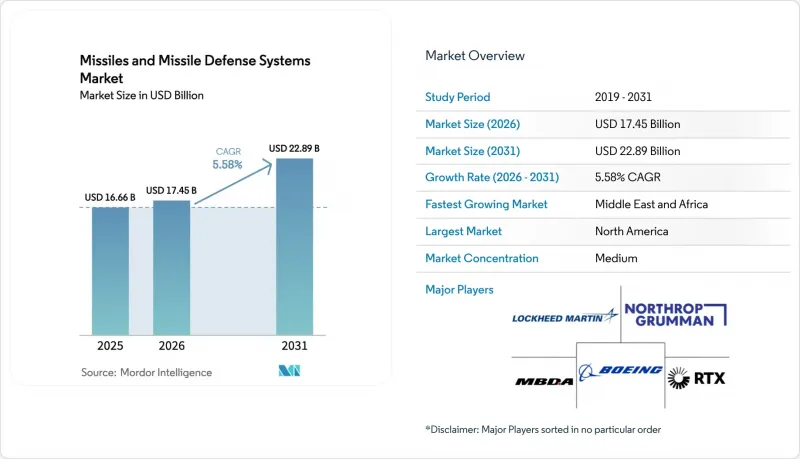
Mordor Intelligence에 따르면 미사일 및 미사일 방어 시스템 시장 규모는 2025년 166억 6,000만 달러에서 2026년에는 174억 5,000만 달러로 확대하며, 2026-2031년에 CAGR 5.58%로 추이하며, 2031년에는 228억 9,000만 달러에 달할 것으로 예측됩니다.
이 보고서는 사거리(단거리, 중거리, 중간거리, 대륙간), 미사일 및 방어 시스템 유형별(미사일 방어 요격 미사일, 대공 미사일 등), 최종사용자(육군, 해군, 공군), 지역(북미 등)별로 세분화되어 있습니다. 시장 예측은 금액(달러) 기준으로 제시됩니다.
전 세계 미사일 및 미사일 방어 시스템 시장의 동향과 인사이트
대국 간의 긴장 고조와 방위 예산의 지속적인 증가
미국이 2025 회계연도에 8,498억 달러의 예산을 요청하고, 그중 337억 달러를 미사일 방어 프로그램에 배정하는 것을 필두로, 국방 예산은 계속 증가하고 있습니다. 중국의 공식 예산 배분은 2025년에 2,360억 달러로 증가했으나, 독립적인 추정에 따르면 실제 지출액은 이를 크게 상회하는 것으로 알려져 있습니다. 중견국들은 이에 대응하여 조달을 가속화하고 있습니다. 그 예로 폴란드의 35억 달러 규모 ‘자벨린’ 발주를 들 수 있으며, 이를 통해 반도체 공급이 확보되고 단가 인하가 실현되었습니다. 현재 조달에서는 다년 계약이 주류를 이루고 있으며, 추진제 및 발사 장치의 생산 라인이 안정적입니다. 이러한 안정적인 자금 조달 주기는 주요 계약업체 및 그 상류 공급업체에 대한 수주량을 보장함으로써 미사일 및 미사일 방어 시스템 시장을 지원하고 있습니다.
세계적인 다층적 통합 방공·미사일 방어 조달로의 전환
각국은 레이더, 위성, 항공기 탑재 센서를 단일 지휘 네트워크로 통합하여, 모든 센서에서 얻은 정보를 바탕으로 모든 요격기를 유도할 수 있도록 하고 있습니다. 나토(NATO)의 2024년 브뤼셀 공동 성명에서는 2028년까지 ‘링크 16’ 및 ‘협동 교전 능력(CEC)’의 도입을 의무화하고 있습니다. 독일의 IRIS-T SLM이나 스페인의 패트리어트 PAC-3 MSE 조달에는 실시간 추적 정보 인계가 가능한 소프트웨어 무전기가 포함되어 있습니다. 이로 인해 발생하는 수요 증가는 미사일에 그치지 않고, 개방형 아키텍처 발사기 및 전투 관리 소프트웨어 공급업체로도 파급되어 미사일 및 미사일 방어 시스템 시장의 수익 기회를 확대하고 있습니다.
매우 높은 연구개발비 및 단일 조달 비용
차세대 요격 미사일의 가격은 많은 구매국들에게 감당하기 어려운 수준입니다. ‘글라이드 단계 인터셉터(Glide Phase Interceptor)’ 프로그램의 총액은 189억 달러에 달하며, 1기당 예상 비용은 4,500만 달러에 가깝습니다. 이는 PAC-3 MSE의 300만 달러라는 가격을 훨씬 웃도는 수준입니다. 유럽의 ‘스카이 쉴드(Sky Shield)’는 IRIS-T의 대량 구매를 통한 할인을 얻기 위해 15개국이 공동 조달을 진행하고 있으나, 공동 조달로 인해 일정이 지연되고 있습니다. 비용 상승에 따라 일부 정부는 발주 수량을 줄이고 있으며, 이로 인해 규모의 경제가 훼손되어 미사일 및 미사일 방어 시스템 시장의 성장이 억제되고 있습니다.
부문 분석
단거리 플랫폼은 2025년 매출의 37.89%를 차지하고 있으며, 저비용 요격 미사일 생산 라인이 계속 가동되고 있는 전술적 시급성을 보여줍니다. 군대가 대형 레이더를 회피하는 드론 및 회전익 무기에 대응함에 따라 단거리 솔루션용 미사일 및 미사일 방어 시스템 시장 규모는 확대되고 있습니다. IRIS-T SLM과 같은 이동식 발사대는 2024년 작전에서 95%의 요격 성공률을 달성하며 구매자의 신뢰를 높이고 있습니다. 대량 수요가 규모의 경제를 지원하고 있으며, 갈륨 질화물 공급 부족에도 불구하고 단가는 안정적입니다. 공급업체들은 모든 사거리에서 표준 발사 캐니스터를 활용하여 물류를 효율화하고 있습니다.
중거리 시스템은 지역적 스탠드오프 무기에 대한 전략적 헤지를 반영하여, 2031년까지 연평균 성장률(CAGR) 6.25%로 확대될 것으로 예측됩니다. 일본의 2025년 토마호크 구매는 민주주의 국가가 핵 조약을 위반하지 않으면서도 영향력을 확대할 수 있음을 보여줍니다. 수량은 적지만, 이 미사일들은 높은 이익률을 창출하여 미사일 및 미사일 방어 시스템 시장 전체를 견인하고 있습니다. 각 제조사는 사거리별로 탐색기 전자 장비와 추진 하위 어셈블리를 공유함으로써 다양한 제품 포트폴리오를 관리하고, 각 주기에 걸친 생산 계획을 원활하게 진행하고 있습니다.
요격 미사일 프로그램은 2025년 매출의 51.45%를 차지하며, 미사일 및 미사일 방어 시스템 시장 점유율의 핵심을 이루고 있습니다. THAAD, 애로우 3, 지상 중거리 방어(GMD)는 고가의 동역학적 파괴체(키네틱 킬 비클)가 필요한 대기권 밖 틈새 시장을 채우고 있습니다. 개방형 아키텍처 발사대는 현재 여러 유형의 요격 미사일 유형을 지원하며, 부대는 특정 시나리오에 맞춰 탑재 구성을 조정하고 플랫폼의 수명을 연장할 수 있게 되었습니다.
저고도 순항 미사일이 기존 레이더 방어 체제에 과제를 안겨주고 있는 만큼, 대공 미사일 시장은 2031년까지 연평균 5.89%의 성장이 예상됩니다. 우크라이나에 대한 NASAMS 판매는 기존 레이더와 네트워크 접속이 가능한 이동식 지휘통제 키트의 가치를 입증했습니다. 공급업체들은 하드웨어 교체가 아닌 소프트웨어 업그레이드를 통해 시커를 개량함으로써 통합 기간을 단축하고 있습니다. 이러한 기동성 덕분에 소규모 군대에서의 도입이 확대되고 있으며, 미사일 및 미사일 방어 시스템 시장의 다양성이 부각되고 있습니다.
지역별 분석
북미는 미국의 다층형 IAMD(통합 항공·미사일 방어) 아키텍처와 캐나다 NORAD(북미항공우주방위사령부)의 현대화에 힘입어 2025년 매출의 35.65%를 차지했습니다. 2025년 미국 미사일방어국(MDA) 예산에서는 차세대 요격 미사일에 135억 달러가 배정되어, 이를 통해 국내 생산 라인이 유지되고 있습니다. 캐나다의 49억 캐나다 달러(51억 6,000만 달러)에 달하는 ‘북부 경보 시스템(NWS)’ 업그레이드 예산은 활공체를 탐지하는 지평선 너머 레이더에 배정되어 있습니다. 이 지역의 우위는 밀집된 계약업체 생태계와 시험장 네트워크에 기인하지만, 향후 연방 의회가 지출 상한선을 설정함에 따라 지출 증가세가 억제될 가능성이 있습니다.
중동 및 아프리카는 연평균 성장률(CAGR) 6.78%로 가장 빠르게 성장하고 있습니다. 사우디아라비아는 150억 달러 규모의 프로그램 하에 THAAD를 배치하여 패트리어트 포대에 대기권 밖 방어 능력을 추가했습니다. 아랍에미리트(UAE)는 드론 공격을 받아 인프라를 보호하기 위해 PAC-3 배치를 확대했습니다. 이스라엘은 ‘아이언 돔’, ‘데이비드 슬링’,‘애로우’와 같은 요격 시스템을 도입해 다층 방어 체제를 유지하고 있으며, 지역내 수출을 지원하는 견고한 국내 공급망을 구축하고 있습니다. 사하라 이남 아프리카의 신흥 구매국들로부터는 현지 조립형 미사일에 대한 새로운 수요가 나타나고 있습니다.
아시아태평양에서는 ITAR(국제무기거래규정)의 제약을 완화하기 위해 국산 개발이 추진되고 있습니다. 일본은 초극초음속 중거리 지대공 미사일(Chu-SAM) 요격 시스템에 51억 달러를 투자하고 있습니다. 한국의 L-SAM은 고도 50km에서 탄도 표적을 요격하며, 2027년 양산화를 향해 나아가고 있습니다. 인도는 ‘아그니 프라임’의 캐니스터 발사를 통한 비행 시험을 실시하여 생존성을 높였습니다. 중국의 DF-17 배치 확대에 따라 주변국들은 센서 네트워크 개발을 가속화하고 있으며, 그 결과 해당 지역의 미사일 및 미사일 방어 시스템 시장이 확대되고 있습니다.
기타 혜택:
- 엑셀 형식의 시장 예측(ME) 시트
- 3개월간의 애널리스트 지원
자주 묻는 질문
목차
제1장 서론
제2장 조사 방법
제3장 개요
제4장 시장 구도
제5장 시장 규모와 성장 예측
제6장 경쟁 구도
제7장 시장 기회와 향후 전망
KSA 26.08.26According to Mordor Intelligence, the missiles and missile defense systems market size is expected to grow from USD 16.66 billion in 2025 to USD 17.45 billion in 2026 and is forecasted to reach USD 22.89 billion by 2031 at a 5.58% CAGR over 2026-2031.
This report is Segmented by Range (Short-Range, Medium-Range, Intermediate-Range, Intercontinental), Missile and Defense System Type (Missile-Defense Interceptors, Anti-Aircraft Missiles, and More), End-User (Army, Navy, and Air Force), and Geography (North America, and More). The Market Forecasts are Provided in Terms of Value (USD).
Global Missiles And Missile Defense Systems Market Trends and Insights
Escalating Great-Power Tensions and Sustained Defense-Budget Growth
Defense budgets continue to rise, led by a US request of USD 849.8 billion for fiscal 2025 that earmarks USD 33.7 billion for missile defense programs. China's official allocation rose to USD 236 billion in 2025, while independent estimates suggest real spending is significantly higher. Middle-power states respond by accelerating purchases, as seen in Poland's USD 3.5 billion Javelin order, which locked in semiconductor supply and reduced unit costs. Multi-year agreements now dominate procurement, smoothing production lines for energetics and launch vehicles. This steady funding cycle supports the missiles and missile defense systems market by guaranteeing volume for prime contractors and their upstream suppliers.
Global Shift Toward Layered Integrated Air and Missile Defense Procurements
Nations are integrating radars, satellites, and airborne sensors into a single command network that cues any interceptor from any sensor. NATO's 2024 Brussels communique mandates the implementation of Link 16 and Cooperative Engagement Capability by 2028. Germany's IRIS-T SLM and Spain's Patriot PAC-3 MSE buys include software radios that enable real-time track handoff. The resulting demand boost extends beyond missiles to open-architecture launchers and battle-management software vendors, broadening revenue opportunities inside the missiles and missile defense systems market.
Extremely High R&D and Unit-Procurement Costs
Next-generation interceptors carry price tags many buyers cannot absorb. The Glide Phase Interceptor program totals USD 18.9 billion, with a projected unit cost of near USD 45 million, which dwarfs the USD 3 million price of the PAC-3 MSE. European Sky Shield pools 15 nations to gain IRIS-T volume discounts, but collective buying slows schedules. As costs rise, some governments trim orders, eroding economies of scale and restraining growth in the missiles and missile defense systems market.
Other drivers and restraints analyzed in the detailed report include:
- Rapid Emergence of Hypersonic Threats Accelerating Interceptor and Sensor Demand
- AI-Enabled Guidance, C2 and Sensor-Fusion Boosting Accuracy and Exportability
- Tightening Export-Control and Compliance Regimes
For complete list of drivers and restraints, kindly check the Table Of Contents.
Segment Analysis
Short-range platforms generated 37.89% of 2025 revenue, illustrating the tactical urgency that keeps production lines active for low-cost interceptors. The missiles and missile defense systems market size for short-range solutions is expanding as armies counter drones and loitering munitions that evade heavy radars. Mobile batteries, such as the IRIS-T SLM, achieved a 95% intercept success rate in 2024 operations, strengthening buyer confidence. Volume demand supports economies of scale that hold unit prices steady despite gallium-nitride shortages. Suppliers leverage standard launch canisters across ranges to streamline logistics.
Intermediate-range systems are forecast to rise at a 6.25% CAGR through 2031, reflecting strategic hedging against regional stand-off weapons. Japan's 2025 Tomahawk purchase demonstrates how democracies can expand their reach without violating nuclear treaties. Although lower in volume, these missiles generate premium margins, thereby lifting the overall market for missiles and missile defense systems. Manufacturers manage the diverse portfolio by sharing seeker electronics and propulsion sub-assemblies between ranges, smoothing production planning across cycles.
Interceptor programs brought 51.45% of 2025 revenue, making them the cornerstone of the missiles and missile defense systems market share. THAAD, Arrow 3, and Ground-based Midcourse Defense fill the exo-atmospheric niche that demands high-priced kinetic kill vehicles. Open-architecture launchers now accept multiple interceptor types, enabling forces to tailor loadouts to specific scenarios and extend platform life.
Anti-aircraft missiles are projected to expand at a rate of 5.89% through 2031, as low-altitude cruise missiles challenge traditional radar defenses. NASAMS sales to Ukraine proved the value of mobile command-and-control kits that network with legacy radars. Suppliers retrofit seekers with software upgrades instead of hardware swaps, cutting integration time. This agility widens adoption across smaller militaries and underscores the diversity within the missiles and missile defense systems market.
Complete Report Scope:
- By Range
- Short-Range (Less than 1 000 km)
- Medium-Range (1 000-3 000 km)
- Intermediate-Range (3 001-5 500 km)
- Intercontinental (More than 5 500 km)
- By Missile and Defense System Type
- Missile-Defense Interceptors
- Anti-Aircraft Missiles
- Anti-Ship Missiles
- Anti-Tank Missiles
- By Platform
- Land
- Naval
- Airborne
- Space
- By End-User
- Army
- Navy
- Air Force
- By Geography
- North America
- United States
- Canada
- Mexico
- Europe
- United Kingdom
- France
- Germany
- Russia
- Rest of Europe
- Asia-Pacific
- China
- India
- Japan
- South Korea
- Rest of Asia-Pacific
- South America
- Brazil
- Rest of South America
- Middle East and Africa
- Middle East
- Saudi Arabia
- United Arab Emirates
- Israel
- Rest of Middle East
- Africa
- South Africa
- Rest of Africa
- Middle East
- North America
Geography Analysis
North America accounted for 35.65% of 2025 revenue, driven by the United States' layered IAMD architecture and Canada's NORAD modernization. The 2025 US Missile Defense Agency budget allocates USD 13.5 billion for next-generation interceptors, thereby preserving domestic production lines. Canada's CAD 4.9 billion (USD 5.16 billion) North Warning System upgrade funds over-the-horizon radars that detect glide vehicles. Regional dominance stems from dense contractor ecosystems and test ranges, though future congressional caps could temper spending growth.
The Middle East and Africa region is the fastest-growing, with a 6.78% CAGR. Saudi Arabia fielded THAAD under a USD 15 billion program, adding exo-atmospheric coverage to Patriot batteries. The United Arab Emirates expanded PAC-3 deployments to protect infrastructure after drone raids. Israel sustains a layered defense by procuring Iron Dome, David's Sling, and Arrow interceptors, creating a robust local supply chain that feeds regional exports. Emerging buyers in Sub-Saharan Africa signal new demand for locally assembled missiles.
Asia-Pacific pursues domestic development to ease ITAR constraints. Japan spends USD 5.1 billion on a hypersonic Chu-SAM interceptor. South Korea's L-SAM intercepted a ballistic target at 50 km altitude and is moving to production in 2027. India flight-tested the Agni-Prime with a canister launch, enhancing its survivability. China's DF-17 expansion prompts neighbors to accelerate the development of sensor networks, thereby enlarging the market for missiles and missile defense systems in the region.
- RTX Corporation
- Lockheed Martin Corporation
- Northrop Grumman Corporation
- The Boeing Company
- MBDA
- Israel Aerospace Industries Ltd.
- Saab AB
- Kongsberg Gruppen ASA
- RAFAEL Advanced Defense Systems Ltd.
- Hanwha Aerospace
- L3Harris Technologies, Inc.
- Diehl Stiftung & Co. KG
- Thales Group
- Bharat Dynamics Limited.
- China Aerospace Science and Technology Corporation
- Roketsan A.S.
Additional Benefits:
- The market estimate (ME) sheet in Excel format
- 3 months of analyst support
TABLE OF CONTENTS
1 INTRODUCTION
- 1.1 Study Assumptions and Market Definition
- 1.2 Scope of the Study
2 RESEARCH METHODOLOGY
3 EXECUTIVE SUMMARY
4 MARKET LANDSCAPE
- 4.1 Market Overview
- 4.2 Market Drivers
- 4.2.1 Escalating great-power tensions and sustained defense-budget growth
- 4.2.2 Global shift toward layered Integrated Air and Missile Defense (IAMD) procurements
- 4.2.3 Rapid emergence of hypersonic threats accelerating interceptor and sensor demand
- 4.2.4 AI-enabled guidance, C2 and sensor-fusion boosting accuracy and exportability
- 4.2.5 National strategic-stockpile programmes securing long-term energetics offtake
- 4.2.6 Proliferated space-based tracking constellations lowering entry barriers
- 4.3 Market Restraints
- 4.3.1 Extremely high R&D and unit-procurement costs
- 4.3.2 Tightening export-control and compliance regimes (ITAR, MTCR, EU dual-use)
- 4.3.3 Heat-resistant material and GaN TR-module supply-chain bottlenecks
- 4.3.4 Rising cyber-security and system-integration risk profile
- 4.4 Value Chain Analysis
- 4.5 Regulatory Landscape
- 4.6 Technological Outlook
- 4.7 Porter's Five Forces Analysis
- 4.7.1 Bargaining Power of Suppliers
- 4.7.2 Bargaining Power of Buyers/Consumers
- 4.7.3 Threat of New Entrants
- 4.7.4 Threat of Substitute Products
- 4.7.5 Intensity of Competitive Rivalry
5 MARKET SIZE AND GROWTH FORECASTS (VALUE)
- 5.1 By Range
- 5.1.1 Short-Range (Less than 1 000 km)
- 5.1.2 Medium-Range (1 000-3 000 km)
- 5.1.3 Intermediate-Range (3 001-5 500 km)
- 5.1.4 Intercontinental (More than 5 500 km)
- 5.2 By Missile and Defense System Type
- 5.2.1 Missile-Defense Interceptors
- 5.2.2 Anti-Aircraft Missiles
- 5.2.3 Anti-Ship Missiles
- 5.2.4 Anti-Tank Missiles
- 5.3 By Platform
- 5.3.1 Land
- 5.3.2 Naval
- 5.3.3 Airborne
- 5.3.4 Space
- 5.4 By End-User
- 5.4.1 Army
- 5.4.2 Navy
- 5.4.3 Air Force
- 5.5 By Geography
- 5.5.1 North America
- 5.5.1.1 United States
- 5.5.1.2 Canada
- 5.5.1.3 Mexico
- 5.5.2 Europe
- 5.5.2.1 United Kingdom
- 5.5.2.2 France
- 5.5.2.3 Germany
- 5.5.2.4 Russia
- 5.5.2.5 Rest of Europe
- 5.5.3 Asia-Pacific
- 5.5.3.1 China
- 5.5.3.2 India
- 5.5.3.3 Japan
- 5.5.3.4 South Korea
- 5.5.3.5 Rest of Asia-Pacific
- 5.5.4 South America
- 5.5.4.1 Brazil
- 5.5.4.2 Rest of South America
- 5.5.5 Middle East and Africa
- 5.5.5.1 Middle East
- 5.5.5.1.1 Saudi Arabia
- 5.5.5.1.2 United Arab Emirates
- 5.5.5.1.3 Israel
- 5.5.5.1.4 Rest of Middle East
- 5.5.5.2 Africa
- 5.5.5.2.1 South Africa
- 5.5.5.2.2 Rest of Africa
- 5.5.5.1 Middle East
- 5.5.1 North America
6 COMPETITIVE LANDSCAPE
- 6.1 Market Concentration
- 6.2 Strategic Moves
- 6.3 Market Share Analysis
- 6.4 Company Profiles (includes Global level Overview, Market level overview, Core Segments, Financials, Strategic Info, Market Rank/Share, Products and Services, Recent Developments)
- 6.4.1 RTX Corporation
- 6.4.2 Lockheed Martin Corporation
- 6.4.3 Northrop Grumman Corporation
- 6.4.4 The Boeing Company
- 6.4.5 MBDA
- 6.4.6 Israel Aerospace Industries Ltd.
- 6.4.7 Saab AB
- 6.4.8 Kongsberg Gruppen ASA
- 6.4.9 RAFAEL Advanced Defense Systems Ltd.
- 6.4.10 Hanwha Aerospace
- 6.4.11 L3Harris Technologies, Inc.
- 6.4.12 Diehl Stiftung & Co. KG
- 6.4.13 Thales Group
- 6.4.14 Bharat Dynamics Limited.
- 6.4.15 China Aerospace Science and Technology Corporation
- 6.4.16 Roketsan A.S.
7 MARKET OPPORTUNITIES AND FUTURE OUTLOOK
- 7.1 White-space and Unmet-Need Assessment


