

|
시장보고서
상품코드
2114027
BaaS(Blockchain as a Service) : 시장 점유율 분석, 업계 동향 및 통계, 성장 예측(2026-2031년)Blockchain-as-a-Service - Market Share Analysis, Industry Trends & Statistics, Growth Forecasts (2026 - 2031) |
||||||
 Mordor Intelligence
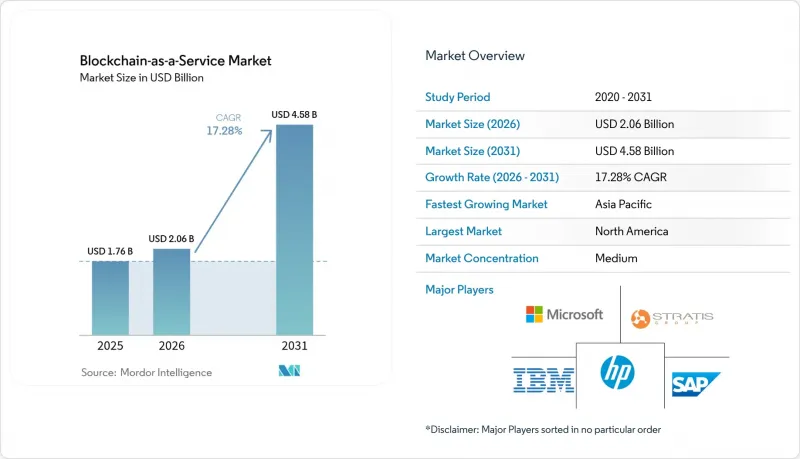
Mordor Intelligence에 의하면, BaaS(Blockchain as a Service) 시장 규모는 2025년 17억 6,000만 달러로 평가되었습니다. 2026년에는 20억 6,000만 달러로 확대되어 2026년부터 2031년에 걸쳐 CAGR 17.28%로 성장을 지속하여, 2031년에는 45억 8,000만 달러에 이를 것으로 예측됩니다.
본 보고서는 구성 요소별(Platform-As-A-Service(PaaS), Infrastructure-As-A-Service(IaaS) 등), 도입 모델별(퍼블릭 클라우드, 프라이빗 클라우드 등), 조직 규모(대기업 및 중소기업),용도(스마트 계약, 결제·정산 등), 최종 사용자 업종(IT 및 통신, 제조업 등), 지역별로 분류되어 있습니다.
세계의 BaaS(Blockchain as a Service) 시장 동향 및 인사이트
규제 대상 산업에서 변조 방지된 데이터 무결성에 대한 수요 증가
의료, 금융, 제약 업계에서는 엄격한 감사 추적 및 출처 추적 요건을 충족하기 위해 블록체인 도입이 점점 더 확대되고 있습니다. Change Healthcare사의 Hyperledger Fabric 도입 사례에서는 변조가 불가능한 로그를 유지하면서 이미 하루 약 5,000만 건의 거래를 처리하고 있습니다. 의약품의 출처를 추적하는 유럽의 규제 역시 이와 같은 도입을 뒷받침하고 있습니다. 금융 기관은 MiCA에 따라 규제 당국이 신뢰할 수 있다고 인정하는 블록체인에 규제 데이터를 기록함으로써 컴플라이언스 업무의 부담을 줄이고 있습니다. 이러한 업계 규제 요건으로 인해, 특히 감사인이 기존 데이터베이스보다 불변의 기록을 선호하는 경향이 강해지면서, BaaS(Blockchain-as-a-Service) 시장은 규정 준수를 실현하는 수단으로서의 입지를 확고히 하고 있습니다. 따라서 선진국에서 새로운 데이터 무결성 정책이 도입될 때마다 수요는 확대되고 있습니다.
각 클라우드 하이퍼스케일러 기업들은 BaaS를 보다 광범위한 ‘X-as-a-Service’ 스택에 통합하고 있습니다.
마이크로소프트는 Azure에서 블록체인, AI, IoT를 통합하여 고객이 익숙한 포털이나 기존 계약을 통해 원장을 활성화할 수 있도록 하고 있습니다. Amazon Web Services와 Google Cloud도 이에 발맞추고 있으며, Kaleido와 Azure의 제휴를 통해 엔터프라이즈 도구에 원활하게 통합할 수 있는 500개 이상의 사전 구축된 API가 제공되고 있습니다. 이러한 번들화를 통해, 특히 고도의 암호화 기술을 보유하지 않은 중견 기업의 경우 조달 주기가 단축되고, 운영 비용을 자본 집약형이 아닌 변동비로 유지할 수 있게 됩니다. 이러한 패키지화 전략을 통해 클라우드 워크로드를 관리하는 모든 고객에게 BaaS(Blockchain as a Service) 시장이 가시화되며, 그 도입은 혁신적인 결정이라기보다는 점진적인 결정으로 인식되게 됩니다.
표준의 파편화와 프로토콜 상호 운용성의 격차
IEEE와 ISO는 계속해서 프레임워크 수립을 추진하고 있지만, 보편적인 플러그 앤 플레이 표준은 존재하지 않아 기업들은 크로스체인 커넥터를 독자적으로 구축할 수밖에 없는 상황입니다(iso.org). Sensors-journal의 조사에 따르면, 이러한 아키텍처는 복잡성을 가중시키고 새로운 공격 표면을 생성하는 것으로 나타났습니다. 그 결과, 다국적 기업들은 국경을 초월한 시범 사업 확대를 주저하고 있으며, 이로 인해 BaaS(Blockchain as a Service) 시장으로의 누적 계약 유입이 둔화되고 있습니다. 주류가 될 상호운용성 프로토콜이 성숙해지기 전까지는 벤더들은 비용을 증가시키고 도입 기간을 장기화시키는 자체 개발 브리지에 로드맵상의 자원을 할당할 수밖에 없습니다.
부문 분석
2025년에는 PaaS(Platform-as-a-Service)가 매출의 37.30%를 차지했습니다. 이는 대기업을 끌어들이는 통합 개발 환경과 설정의 유연성에 힘입은 결과입니다. 한편, 매니지드 서비스는 조직이 직접 노드를 운영하지 않고 턴키 방식의 운영, 보안 패치 적용, 연중무휴 24시간 가동을 요구함에 따라 연평균 성장률(CAGR) 19.25%로 가장 빠르게 성장하고 있습니다. 대규모 다국적 기업의 재무 팀은 구체적인 비용 절감 효과를 제시하고 있습니다. 예를 들어, 지멘스(Siemens)는 국경을 초월한 유동성 관리를 위해 매니지드 레저로 전환한 후, 은행 계좌 수를 절반으로 줄이고 연간 2,000만 달러의 비용 절감을 실현했습니다. 레거시 ERP 시스템과의 연동이나 금융·의료 분야의 업계 고유 규제에 대응하는 데 있어서는 컨설팅 및 도입 작업이 여전히 필수적입니다.
또한, 기업은 합의 형성을 세밀하게 제어해야 하는 한편, 클라우드 과금을 희망하는 경우에도 IaaS(Infrastructure-as-a-Service)를 채택하고 있습니다. 한편, SaaS(Software-as-a-Service) 툴킷은 스마트 계약의 컴파일을 추상화하는 API를 제공하여 소규모 개발자의 진입 장벽을 낮추고 있습니다. 규정 준수 관련 업무 부하 증가로 인해 불변의 감사 추적이 필수 요건이 되었기 때문에 리스크 회피 성향이 강한 이사회조차도 현재는 구독을 승인하고 있습니다. 이러한 지속적인 수요가 그린필드 및 브라운필드 도입 모두에서 BaaS(Blockchain as a Service) 시장의 기반을 뒷받침하고 있습니다.
2025년에는 하이퍼스케일러가 탄력성과 높은 서비스 수준 계약(SLA)을 제공함에 따라 퍼블릭 클라우드가 BaaS(Blockchain-as-a-Service) 시장의 62.20% 점유율을 차지했습니다. 그럼에도 불구하고, 금융 기관과 제약 기업이 MiCA 및 유사한 정책에 기반한 데이터 상주 요건을 충족하기 위해 기밀 데이터를 On-Premise에 보관하고 있기 때문에 하이브리드 클라우드는 연평균 성장률(CAGR) 21.35%로 성장을 지속하고 있습니다. 하이브리드 토폴로지에서는 프로덕션 환경을 방화벽 내부에 유지하면서 개발용 샌드박스에는 퍼블릭 클라우드를 활용함으로써 반복 개발을 가속화합니다.
데이터 주권이나 기밀성이 높은 워크로드의 특성상 외부 인프라 사용이 금지된 상황에서는 프라이빗 클라우드가 계속해서 채택되고 있습니다. 유럽연합(EU)의 새로운 사업 연속성 관련 규정은 비상 대응 계획 수립을 더욱 촉진하고 있어 하이브리드 설계의 매력을 높이고 있습니다. 그 결과, BaaS(Blockchain as a Service) 시장에서는 아키텍처의 다양성이 지속적으로 관찰됩니다. 기업들은 비용 감사 및 새로운 규정 준수 지침에 따라 환경 간에 워크로드를 이전하기 때문에 오케스트레이션 도구에 대한 장기적인 수요가 보장되고 있습니다.
지역별 분석
2025년에도 북미는 BaaS(Blockchain as a Service) 시장 점유율의 40.40%를 차지하며 계속해서 주도적인 위치를 유지했습니다. 이는 골드만삭스와 시타델이 주도한 1억 3,500만 달러 규모의 디지털 자산 자금 조달 라운드 등 대규모 벤처 자금 조달에 힘입은 결과입니다. 미국에 기반을 둔 각 하이퍼스케일러 기업들은 원장 관리 도구를 주류 클라우드 서비스에 통합하여 기존 고객들이 신속하게 도입할 수 있도록 하고 있습니다. 일부 주에서 도입된 규제 샌드박스로 인해 실제 운영 시범 사업이 가속화되고 있지만, 전국적인 정책의 불일치가 여전히 규정 준수 측면에서 불확실성을 야기하여 여러 주에 걸친 확장을 지연시키고 있습니다.
아시아태평양은 2031년까지 연평균 성장률(CAGR)이 18.20%로 가장 급격한 성장을 기록하고 있습니다. 싱가포르와 홍콩에서 정부 주도로 진행되고 있는 CBDC(중앙은행 디지털 통화) 및 토큰화 프로젝트가 구체적인 성공 사례를 만들어내며, 은행과 핀테크 기업들을 상용 플랫폼으로 끌어들이고 있습니다. 일본, 한국, 중국의 각 제조 거점은 아시아 지역 내 무역 회랑을 활용하여 공급망 및 지속가능성 보고서의 활용 사례에 블록체인을 도입하고 있습니다. 대학의 블록체인 연구실을 통해 지역 인재 풀이 확대되어, 다른 지역에서 나타나는 개발자 부족을 보완하는 데 일조하고 있습니다.
유럽에서는 2024년 12월 전면 시행된 MiCA의 통일된 규정이 호재로 작용하고 있습니다. 자동차, 명품, 식품 기업들은 규제 당국과 소비자의 요구를 충족하기 위해 원산지 추적 솔루션을 도입하고 있으며, 르노의 ‘XCEED’ 공급망 시스템이 그 대표적인 예입니다. 유럽중앙은행(ECB)이 추진하는 디지털 자산 시장 통합은 은행들이 분산 원장 인프라를 활용해 백오피스를 현대화하도록 촉진하며, 이는 단기적인 계약 흐름을 유지하는 데 기여할 것입니다. 중동 및 아프리카의 신흥 시장에서는 금융 포용 및 탄소 크레딧 등록 제도를 위한 블록체인의 시범 도입이 진행되고 있으나, 기술적 역량이 제한적이어서 전반적인 보급은 여전히 초기 단계에 머물러 있습니다.
기타 혜택 :
- 엑셀 형식 시장 예측(ME) 시트
- 3개월간의 애널리스트 지원
자주 묻는 질문
목차
제1장 서론
제2장 조사 방법
제3장 주요 요약
제4장 시장 구도
제5장 시장 규모 및 성장 예측
제6장 경쟁 구도
제7장 시장 기회 및 향후 전망
KTH 26.08.26According to Mordor Intelligence, the blockchain-as-a-Service market size is expected to grow from USD 1.76 billion in 2025 to USD 2.06 billion in 2026 and is forecast to reach USD 4.58 billion by 2031 at 17.28% CAGR over 2026-2031.
This report is Segmented by Component (Platform-As-A-Service (PaaS), Infrastructure-As-A-Service (IaaS), and More), Deployment Model (Public Cloud, Private Cloud, and More), Organization Size (Large Enterprises and Small and Medium Enterprises), Application (Smart Contracts, Payments and Settlement, and More), End-User Vertical (IT and Telecom, Manufacturing, and More), and Geography.
Global Blockchain-as-a-Service Market Trends and Insights
Rising demand for tamper-proof data integrity across regulated industries
Health, finance, and pharmaceuticals increasingly adopt blockchain to meet stringent audit-trail and provenance mandates. Change Healthcare's Hyperledger Fabric deployment already processes about 50 million daily transactions while preserving immutable logs. European pharmaceutical rules that track medicine provenance drive similar uptake. Financial institutions cut compliance workloads by recording regulatory data on chains that regulators deem trustworthy under MiCA. These sector mandates position the Blockchain-as-a-Service market as a compliance enabler, particularly as auditors begin to prefer immutable records over traditional databases. Demand, therefore, scales with every new data-integrity policy in advanced economies.
Cloud hyperscalers bundling BaaS into broader X-as-a-Service stacks
Microsoft integrates blockchain, AI, and IoT on Azure, letting clients activate ledgers through familiar portals and existing contracts. Amazon Web Services and Google Cloud follow, while Kaleido's Azure tie-up offers more than 500 pre-built APIs that snap into enterprise tools. Bundling cuts procurement cycles, especially for mid-market firms without deep cryptography skills, and keeps operating costs variable instead of capital-intensive. This packaging strategy keeps the Blockchain-as-a-Service market visible to every customer managing cloud workloads, making adoption an incremental, rather than transformative, decision.
Fragmented standards and protocol interoperability gaps
IEEE and ISO continue to draft frameworks, yet no universal plug-and-play standard exists, forcing enterprises to custom-build cross-chain connectors iso.org. Sensors-journal research shows such architectures add complexity and new attack surfaces. Multinationals therefore hesitate to scale pilots across borders, which slows cumulative contract flow into the Blockchain-as-a-Service market. Until dominant interoperability protocols mature, vendors must allocate road-map resources to proprietary bridges that elevate costs and lengthen implementation timelines.
Other drivers and restraints analyzed in the detailed report include:
- Gradual regulatory clarity on tokenization and stablecoins
- Central-bank sandbox programs sourcing BaaS back-ends
- Talent shortage in distributed-ledger engineering
For complete list of drivers and restraints, kindly check the Table Of Contents.
Segment Analysis
Platform-as-a-Service contributed 37.30% revenue in 2025, underpinned by integrated development environments and configurability that attract large corporations. Managed Services, however, grows fastest at 19.25% CAGR as organizations seek turnkey operations, security patching and 24/7 uptime without running nodes themselves. Large multinational treasury teams cite tangible savings; Siemens cut bank accounts by half and saved USD 20 million each year after migrating to managed ledgers for cross-border liquidity. Consulting and implementation work remains essential to bridge legacy ERP systems and to meet sector-specific regulations in finance and healthcare.
Enterprises also adopt Infrastructure-as-a-Service when they need granular control over consensus settings yet still prefer cloud billing. Meanwhile, software-as-a-service toolkits expose APIs that abstract smart-contract compilation, lowering entry barriers for small developers. Rising compliance workloads make immutable audit trails a default requirement, so even risk-averse boards now approve subscriptions. This persistent demand anchors the Blockchain-as-a-Service market across both greenfield and brownfield deployments.
Public Cloud captured 62.20% of the Blockchain-as-a-Service market share in 2025 because hyperscalers provide elasticity and high service-level agreements. Still, Hybrid Cloud is on track for a 21.35% CAGR as financial institutions and pharmaceutical firms hold sensitive data on-premises to satisfy residency laws under MiCA and similar policies. Hybrid topologies keep production chains behind firewalls while using public cloud for development sandboxes, which speeds iteration.
Private Cloud persists where data sovereignty or classified workloads prohibit any external infrastructure. The European Union's new operational-resilience rules further motivate contingency planning, making hybrid designs attractive. As a result, the Blockchain-as-a-Service market sees consistent architectural diversity: enterprises swap workloads between environments in response to cost audits or new compliance directives, ensuring long-run demand for orchestration tools.
Complete Report Scope:
- By Component
- Platform-as-a-Service (PaaS)
- Infrastructure-as-a-Service (IaaS)
- Software-as-a-Service (SaaS) SDKs and APIs
- Consulting and Implementation Services
- Managed/Operations Services
- By Deployment Model
- Public Cloud
- Private Cloud
- Hybrid Cloud
- By Organization Size
- Large Enterprises
- Small and Medium Enterprises
- By Application
- Smart Contracts
- Supply-Chain Traceability
- Digital Identity and KYC
- Payments and Settlement
- Governance, Risk and Compliance
- Others
- By End-User Vertical
- Banking, Financial Services and Insurance (BFSI)
- Healthcare and Life Sciences
- IT and Telecom
- Retail and E-commerce
- Manufacturing
- Energy and Utilities
- Government and Public Sector
- Others
- By Geography
- North America
- United States
- Canada
- Mexico
- South America
- Brazil
- Argentina
- Chile
- Rest of South America
- Europe
- Germany
- United Kingdom
- France
- Italy
- Spain
- Netherlands
- Russia
- Rest of Europe
- Asia Pacific
- China
- India
- Japan
- South Korea
- ASEAN
- Rest of Asia Pacific
- Middle East and Africa
- Middle East
- GCC (Saudi Arabia, UAE, Qatar, etc.)
- Turkey
- Rest of Middle East
- Africa
- South Africa
- Nigeria
- Kenya
- Rest of Africa
- Middle East
- North America
Geography Analysis
North America continued to dominate in 2025 with a 40.40% Blockchain-as-a-Service market share, buoyed by deep venture funding such as Digital Asset's USD 135 million round led by Goldman Sachs and Citadel. US-based hyperscalers integrate ledger tools into mainstream cloud menus, allowing quick uptakes among existing clients. Regulatory sandboxes in several states accelerate production pilots, though nationwide policy fragmentation still injects compliance uncertainty that slows multi-state rollouts.
Asia Pacific records the steepest growth at an 18.20% CAGR through 2031. Government-backed CBDC and tokenization projects in Singapore and Hong Kong create visible proof points, drawing banks and fintechs onto commercial platforms. Manufacturing hubs across Japan, South Korea and China deploy blockchains for supply-chain and sustainability reporting use cases, leveraging intra-Asia trade corridors. Regional talent pools expand through university blockchain labs, helping offset developer shortages seen elsewhere.
Europe benefits from MiCA's uniform rules that became fully effective in December 2024. Automotive, luxury and food companies implement provenance solutions to satisfy regulators and consumers, exemplified by Renault's XCEED supply-chain systeM. The European Central Bank's advocacy for digital-assets market integration encourages banks to modernize back offices with distributed-ledger infrastructure, sustaining near-term contract flow. Emerging markets in the Middle East and Africa experiment with blockchain for financial inclusion and carbon credit registries, yet overall adoption remains nascent due to limited technical capacity.
- IBM Corporation
- Microsoft Corporation
- Amazon Web Services (AWS)
- Oracle Corporation
- SAP SE
- Hewlett-Packard Enterprise
- Huawei Technologies Co. Ltd.
- Alibaba Cloud
- Tencent Cloud
- R3
- ConsenSys
- Blockstream Inc.
- Stratis Group Ltd.
- PayStand Inc.
- Kaleido
- Guardtime
- Dragonchain Inc.
- Bitfury Group
- LeewayHertz
- Wipro Limited
- Accenture plc
- Infosys Limited
- NTT DATA
- LG CNS
- Tech Mahindra
Additional Benefits:
- The market estimate (ME) sheet in Excel format
- 3 months of analyst support
TABLE OF CONTENTS
1 INTRODUCTION
- 1.1 Study Assumptions and Market Definition
- 1.2 Scope of the Study
2 RESEARCH METHODOLOGY
3 EXECUTIVE SUMMARY
4 MARKET LANDSCAPE
- 4.1 Market Overview
- 4.2 Market Drivers
- 4.2.1 Rising demand for tamper-proof data integrity across regulated industries
- 4.2.2 Cloud hyperscalers bundling BaaS into broader X-as-a-Service stacks
- 4.2.3 Gradual regulatory clarity on tokenization and stablecoins
- 4.2.4 Central-bank sandbox programs sourcing BaaS back-ends
- 4.2.5 Explosion of enterprise-grade blockchain pilots post-COVID-19
- 4.2.6 Scope-3 emissions auditing via blockchain sustainability ledgers (under-radar)
- 4.3 Market Restraints
- 4.3.1 Fragmented standards and protocol interoperability gaps
- 4.3.2 Talent shortage in distributed-ledger engineering
- 4.3.3 Uncertain jurisprudence on smart-contract enforceability
- 4.3.4 Rising cloud spend scrutiny dampening POC budgets (under-radar)
- 4.4 Value Chain Analysis
- 4.5 Regulatory Landscape
- 4.6 Technological Outlook
- 4.7 Porter's Five Forces Analysis
- 4.7.1 Threat of New Entrants
- 4.7.2 Bargaining Power of Buyers
- 4.7.3 Bargaining Power of Suppliers
- 4.7.4 Threat of Substitutes
- 4.7.5 Intensity of Competitive Rivalry
5 MARKET SIZE AND GROWTH FORECASTS (VALUE)
- 5.1 By Component
- 5.1.1 Platform-as-a-Service (PaaS)
- 5.1.2 Infrastructure-as-a-Service (IaaS)
- 5.1.3 Software-as-a-Service (SaaS) SDKs and APIs
- 5.1.4 Consulting and Implementation Services
- 5.1.5 Managed/Operations Services
- 5.2 By Deployment Model
- 5.2.1 Public Cloud
- 5.2.2 Private Cloud
- 5.2.3 Hybrid Cloud
- 5.3 By Organization Size
- 5.3.1 Large Enterprises
- 5.3.2 Small and Medium Enterprises
- 5.4 By Application
- 5.4.1 Smart Contracts
- 5.4.2 Supply-Chain Traceability
- 5.4.3 Digital Identity and KYC
- 5.4.4 Payments and Settlement
- 5.4.5 Governance, Risk and Compliance
- 5.4.6 Others
- 5.5 By End-User Vertical
- 5.5.1 Banking, Financial Services and Insurance (BFSI)
- 5.5.2 Healthcare and Life Sciences
- 5.5.3 IT and Telecom
- 5.5.4 Retail and E-commerce
- 5.5.5 Manufacturing
- 5.5.6 Energy and Utilities
- 5.5.7 Government and Public Sector
- 5.5.8 Others
- 5.6 By Geography
- 5.6.1 North America
- 5.6.1.1 United States
- 5.6.1.2 Canada
- 5.6.1.3 Mexico
- 5.6.2 South America
- 5.6.2.1 Brazil
- 5.6.2.2 Argentina
- 5.6.2.3 Chile
- 5.6.2.4 Rest of South America
- 5.6.3 Europe
- 5.6.3.1 Germany
- 5.6.3.2 United Kingdom
- 5.6.3.3 France
- 5.6.3.4 Italy
- 5.6.3.5 Spain
- 5.6.3.6 Netherlands
- 5.6.3.7 Russia
- 5.6.3.8 Rest of Europe
- 5.6.4 Asia Pacific
- 5.6.4.1 China
- 5.6.4.2 India
- 5.6.4.3 Japan
- 5.6.4.4 South Korea
- 5.6.4.5 ASEAN
- 5.6.4.6 Rest of Asia Pacific
- 5.6.5 Middle East and Africa
- 5.6.5.1 Middle East
- 5.6.5.1.1 GCC (Saudi Arabia, UAE, Qatar, etc.)
- 5.6.5.1.2 Turkey
- 5.6.5.1.3 Rest of Middle East
- 5.6.5.2 Africa
- 5.6.5.2.1 South Africa
- 5.6.5.2.2 Nigeria
- 5.6.5.2.3 Kenya
- 5.6.5.2.4 Rest of Africa
- 5.6.5.1 Middle East
- 5.6.1 North America
6 COMPETITIVE LANDSCAPE
- 6.1 Market Concentration
- 6.2 Strategic Moves
- 6.3 Market Share Analysis
- 6.4 Company Profiles (includes Global level Overview, Market level overview, Core Segments, Financials as available, Strategic Information, Market Rank/Share for key companies, Products and Services, and Recent Developments)
- 6.4.1 IBM Corporation
- 6.4.2 Microsoft Corporation
- 6.4.3 Amazon Web Services (AWS)
- 6.4.4 Oracle Corporation
- 6.4.5 SAP SE
- 6.4.6 Hewlett-Packard Enterprise
- 6.4.7 Huawei Technologies Co. Ltd.
- 6.4.8 Alibaba Cloud
- 6.4.9 Tencent Cloud
- 6.4.10 R3
- 6.4.11 ConsenSys
- 6.4.12 Blockstream Inc.
- 6.4.13 Stratis Group Ltd.
- 6.4.14 PayStand Inc.
- 6.4.15 Kaleido
- 6.4.16 Guardtime
- 6.4.17 Dragonchain Inc.
- 6.4.18 Bitfury Group
- 6.4.19 LeewayHertz
- 6.4.20 Wipro Limited
- 6.4.21 Accenture plc
- 6.4.22 Infosys Limited
- 6.4.23 NTT DATA
- 6.4.24 LG CNS
- 6.4.25 Tech Mahindra
7 MARKET OPPORTUNITIES AND FUTURE OUTLOOK
- 7.1 White-space and Unmet-need Assessment


