

|
시장보고서
상품코드
2114082
컴팩트 카메라 모듈 : 시장 점유율 분석, 업계 동향 및 통계, 성장 예측(2026-2031년)Compact Camera Module - Market Share Analysis, Industry Trends & Statistics, Growth Forecasts (2026 - 2031) |
||||||
 Mordor Intelligence
Mordor Intelligence에 의하면, 컴팩트 카메라 모듈 시장 규모는 2025년 357억 달러에서 2026년에는 379억 1,000만 달러에 이르고, 2026-2031년 CAGR 6.20%로 성장을 지속하여 2031년에는 512억 2,000만 달러에 달할 것으로 예측됩니다.
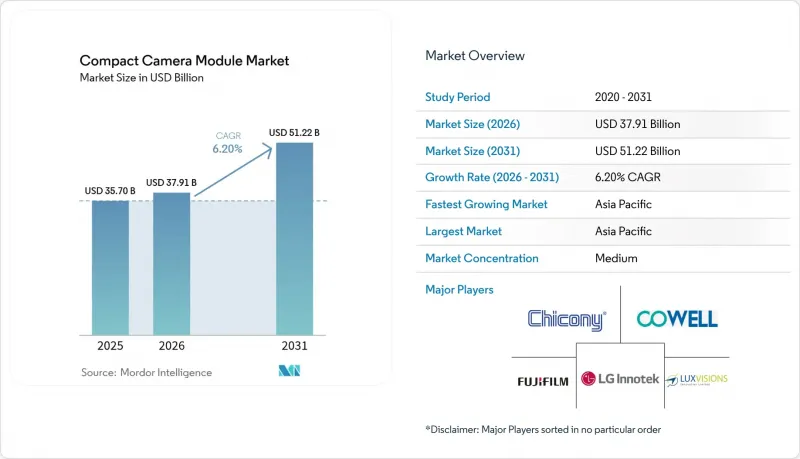
본 보고서는 구성 요소(이미지 센서, 렌즈, 카메라 모듈 어셈블리, VCM(AF 및 OIS)), 초점 방식(자동 초점, 고정 초점),픽셀 해상도(8MP 이하, 9-20MP, 21-48MP, 48MP 이상), 최종 용도(모바일, 가전제품, 자동차, 헬스케어, 보안·감시, 산업용), 지역별로 분류되어 있습니다. 시장 전망은 금액(달러)으로 제시되어 있습니다.
세계 컴팩트 카메라 모듈 시장 동향 및 인사이트
중국과 인도에서 멀티 카메라 탑재 스마트폰(50MP 초과 CIS)이 수요를 가속화하고 있습니다.
스마트폰 제조업체들은 트리플 카메라 및 쿼드 카메라 구성을 표준화하고 있으며, 각 단말기에 하나의 어셈블리가 아닌 3-4개의 컴팩트 카메라 모듈이 탑재됨에 따라 단위 수요가 두 배로 증가하고 있습니다. 소니의 50MP LYT-818 센서와 삼성의 적층형 CIS 로드맵은 경쟁을 심화시키고 비용 곡선을 낮추고 있으며, 이로 인해 중급 기기에서도 고해상도 이미징을 채택할 수 있게 되었습니다. 중국 브랜드들은 카메라 사양을 주요 차별화 요인으로 삼고 있으며, SmartSens 등의 파운드리 기업들은 2억 2,500만 달러 규모의 시리즈 D 자금 조달을 통해 생산 능력 확대를 추진하고 있습니다.
ADAS 의무화에 따라 EU 및 미국 차량에 서라운드 뷰 카메라 탑재가 확대되고 있습니다.
2024년 7월에 시행될 EU의 GSR2 규제에 더해, 향후 도입될 미국의 FMVSS 127 기준에서는 자동 긴급 제동 및 보행자 감지 시스템이 의무화되어 있어 멀티 카메라형 ADAS 스위트에 대한 수요가 증가하고 있습니다. 삼성일렉트로메카닉스는 가혹한 환경에서도 신뢰성을 확보하는 발수 및 가열 기능이 탑재된 인클로저를 개발하여 이에 대응하고 있습니다. 자동차 분야의 매출액은 2030년까지 연평균 성장률(CAGR) 13.8%로 성장하여, 컴팩트 카메라 모듈 시장 전체의 성장률을 상회할 것으로 예측됩니다.
일본·중국·CIS의 수출 규제 강화가 2차 공급망에 영향
도쿄가 갱신한 중요 자재 목록에 따라 중국 공장으로의 첨단 CMOS 부품 출하가 복잡해지고 있으며, 토판 등의 기업은 특정 생산 라인을 이전할 수밖에 없는 상황에 처해 있습니다. 한편, 베트남에서는 우대 조치가 새로운 프로젝트를 유치하고 있습니다. 이러한 전환 기간으로 인해 컴팩트 카메라 모듈 시장의 전체 공급망에 걸쳐 비용 변동과 계획의 불확실성이 발생하고 있습니다.
부문 분석
이미지 센서는 2025년 매출의 40.92%를 차지하며, 콤팩트 카메라 모듈 시장 가치의 핵심으로서의 역할을 부각시키고 있습니다. 소니의 3D 적층 구조는 시스템의 소형화와 고가화를 가능하게 하는 반면, 애플의 멀티 벤더 전략으로 인해 오랫동안 소니가 지배해 온 분야에 삼성이 진입하고 있습니다. 렌즈 제조업체들은 자동차의 가혹한 온도 환경을 견딜 수 있는 유리와 플라스틱의 하이브리드 소재 개발을 추진하고 있으며, 조립 제조업체들은 통합의 복잡화에 따라 이익률 압박에 직면하고 있습니다.
자동 초점 및 광학식 손떨림 보정용 보이스 코일 모터(VCM)는 차량의 진동 요구 사항과 멀티 카메라 탑재 스마트폰 수요에 힘입어 7.05%라는 가장 높은 연평균 성장률(CAGR)을 기록하고 있습니다. 이 부문의 성장세는 하류 시장의 요구 사항이 부품 시장에 파급되어 컴팩트 카메라 모듈 시장의 투자 우선순위를 재편하고 있음을 보여줍니다. 또한, 공급 구조의 변화는 단일 공급업체 리스크를 완화하고, 휴대전화 및 자동차 OEM 제조업체에 대한 안정적인 공급을 가능하게 하고 있습니다.
오토포커스 모듈은 2025년에 78.35%의 점유율을 차지할 것으로 예상되며, 신속하고 정밀한 초점 조정이 필요한 프리미엄 촬영 기능과 밀접하게 연관되어 연평균 성장률(CAGR) 6.18%로 점유율을 지속적으로 확대되고 있습니다. LG 이노텍이 아이폰 16 프로를 위해 개발한 테트라 프리즘 렌즈는 플래그십 모델에 대한 요구가 초점 체인 전체로 파급되는 양상을 여실히 보여주고 있습니다. 그러나 페리스코프 줌 액추에이터를 둘러싼 분쟁은 지적 재산권 침해에 대한 취약성을 드러내고 있습니다.
고정 초점 모듈은 광학적 유연성보다 간결성과 신뢰성이 중시되는 저가형 휴대전화, 웨어러블 센서 및 특정 산업용 기기에 여전히 채택되고 있습니다. 하지만 이러한 분야에서도 AI 기반 노이즈 제거 등의 알고리즘 개선을 통해 기본 성능이 향상되고 있어, 간접적으로 컴팩트 카메라 모듈 시장의 성장세를 유지하고 있습니다.
지역별 분석
아시아태평양은 웨이퍼 제조에서 최종 조립에 이르는 통합된 공급망을 바탕으로 2025년에도 66.35%의 점유율을 유지했습니다. 중국은 첨단 센서에 대한 투자를 주도하고, 한국은 AI에 최적화된 생산에서 혁신을 추진하며, 베트남은 중국 연안 지역에 집중된 허브에서 발생하는 위험을 분산시키는 우대 조치가 포함된 시설을 통해 규모를 확대되고 있습니다.
북미와 유럽은 프리미엄 용도의 중심지를 형성하고 있습니다. EU의 GSR2 규제는 자동차용 카메라 어레이에 대한 장기적인 수요를 확보하고 있는 반면, 미국 기업들은 특허를 적극 활용한 연구 개발을 통해 XR 카메라 기술의 선구자가 되고 있습니다.
중동 및 아프리카는 시작점은 작지만, 스마트폰 보급률과 자동차 안전 규제의 강화에 따라 7.12%라는 가장 높은 연평균 성장률(CAGR)을 보이고 있습니다. 5G 네트워크 및 조립 클러스터에 대한 투자가 생태계의 성숙도를 꾸준히 높이고 있어, 예측 기간 동안 컴팩트 카메라 모듈 시장에 대한 기여도가 점진적으로 확대될 것으로 전망됩니다.
기타 혜택:
- 엑셀 형식 시장 예측(ME) 시트
- 3개월간의 애널리스트 지원
자주 묻는 질문
목차
제1장 서론
제2장 조사 방법
제3장 주요 요약
제4장 시장 구도
제5장 시장 규모와 성장 예측
제6장 경쟁 구도
제7장 시장 기회와 향후 전망
LSH 26.08.25According to Mordor Intelligence, the compact camera module market size is expected to grow from USD 35.7 billion in 2025 to USD 37.91 billion in 2026 and is forecast to reach USD 51.22 billion by 2031 at 6.20% CAGR over 2026-2031.
This report is Segmented by Component (Image Sensor, Lens, Camera Module Assembly, and VCM (AF and OIS)), Focus Type (Auto-Focus, and Fixed-Focus), Pixel Resolution (Upto 8 MP, 9-20 MP, 21-48 MP, and Above 48 MP), End-Use Application (Mobile, Consumer Electronics, Automotive, Healthcare, Security and Surveillance, and Industrial), and Geography. The Market Forecasts are Provided in Terms of Value (USD).
Global Compact Camera Module Market Trends and Insights
Multi-camera smartphones (>50 MP CIS) accelerating demand in China and India
Smartphone makers are standardizing triple and quad-camera setups, multiplying unit demand as each handset now carries three to four compact camera modules instead of a single assembly. Sony's 50 MP LYT-818 sensor and Samsung's stacked CIS roadmap intensify competition and compress cost curves, enabling mid-tier devices to adopt high-resolution imaging. Chinese brands use camera specs as primary differentiation, pushing foundries such as SmartSens to scale capacity after USD 225 million Series D funding.
ADAS mandates driving surround-view camera installations in EU and United States vehicles
The EU's GSR2 rules, effective July 2024, plus forthcoming US FMVSS 127 standards mandate automatic emergency braking and pedestrian detection systems, igniting demand for multi-camera ADAS suites. Samsung Electro-Mechanics has responded with water-repellent, heated enclosures that secure reliability under harsh conditions. Automotive revenue is projected to outpace the overall compact camera module market at a 13.8% CAGR through 2030.
Japan-China CIS export controls tightening tier-2 supply
Tokyo's updated critical materials list complicates shipments of advanced CMOS components to Chinese plants, forcing companies such as Toppan to relocate certain lines while Vietnamese incentives lure new projects. The transition period creates cost swings and planning uncertainty throughout the compact camera module market supply chain.
Other drivers and restraints analyzed in the detailed report include:
- Industrial and healthcare retrofits with SWIR-enabled CCMs
- XR/AR headsets requiring 6-DOF inside-out tracking cameras
- Low yield in wafer-level optics for 8K video modules
For complete list of drivers and restraints, kindly check the Table Of Contents.
Segment Analysis
Image sensors delivered 40.92% of 2025 revenue, underscoring their role as the value core of the compact camera module market. Sony's 3D-stacked architecture enables system miniaturization and premium pricing, while Apple's multivendor strategy injects Samsung into a domain long dominated by Sony. Lens makers pursue hybrid glass-plastic blends to withstand extreme automotive temperatures, and assembly houses confront margin pressure as integration complexity rises.
Voice coil motors (VCMs) for autofocus and optical image stabilization register the quickest 7.05% CAGR, driven by vehicle vibration demands and multi-camera smartphones. The segment's momentum shows how downstream requirements ripple back to components, reshaping the compact camera module market investment priorities. The supply shift also mitigates single-supplier risk, smoothing delivery to handset and vehicle OEMs.
Auto-focus modules captured 78.35% in 2025 and continue to gain at 6.18% CAGR, intertwined with premium photography features that require rapid, precise focal adjustment. LG Innotek's tetraprism lens for iPhone 16 Pro exemplifies how flagship requirements cascade through the focus chain. Periscope-zoom actuator disputes, however, expose vulnerability to intellectual-property breakdowns.
Fixed-focus modules still ship into budget handsets, wearable sensors, and certain industrial devices where simplicity and reliability trump optical flexibility. Yet even in these arenas, algorithmic enhancements such as AI-based denoising elevate baseline performance, indirectly sustaining the compact camera module market momentum.
Complete Report Scope:
- By Component
- Image Sensor
- Lens
- Camera Module Assembly
- VCM (AF and OIS)
- By Focus Type
- Auto-Focus
- Fixed-Focus
- By Pixel Resolution
- Upto 8 MP
- 9-20 MP
- 21-48 MP
- Above 48 MP
- By End-use Application
- Mobile
- Consumer Electronics (Ex-Mobile)
- Automotive
- Healthcare
- Security and Surveillance
- Industrial
- Geography
- North America
- United States
- Canada
- Mexico
- Europe
- Germany
- United Kingdom
- France
- Italy
- Spain
- Rest of Europe
- Asia-Pacific
- China
- Japan
- South Korea
- India
- Southeast Asia
- Rest of Asia-Pacific-Pacific
- South America
- Brazil
- Argentina
- Rest of South America
- Middle East
- GCC
- Turkey
- Rest of Middle East
- Africa
- South Africa
- Rest of Africa
- North America
Geography Analysis
Asia-Pacific maintained 66.35% share in 2025 due to integrated supply chains spanning wafer fabrication to final assembly. China spearheads investment in advanced sensors, South Korea innovates in AI-optimized production, and Vietnam scales with incentive-laden facilities that diversify risk away from concentrated coastal Chinese hubs.
North America and Europe form premium application centers. The EU's GSR2 regulation secures long-term demand for automotive camera arrays, while US firms pioneer XR camera technologies through patent-heavy R&D.
The Middle East and Africa, though starting from a smaller base, exhibit the fastest 7.12% CAGR as smartphone penetration and vehicle safety rules rise. Investment in 5G networks and assembly clusters supports steadily improving ecosystem maturity, signaling incremental contribution to the compact camera module market over the forecast horizon.
- LG Innotek Co., Ltd
- Samsung Electro-Mechanics Co., Ltd
- Sunny Optical Technology (Group) Co., Ltd
- OFilm Group Co., Ltd
- Sharp Corp.
- Chicony Electronics Co., Ltd
- Cowell E Holdings Inc.
- Primax Electronics Ltd
- Sony Corp.
- STMicroelectronics N.V.
- ams OSRAM AG
- OmniVision Technologies Inc.
- Fujifilm Corp.
- Largan Precision Co., Ltd
- Hon Hai Precision (Foxconn)
- LuxVisions Innovation Limited (Lite-On Technology Corporation)
- Leica Camera AG (Leica Microsystems Imaging Solutions)
- Teledyne Lumenera
- Leopard Imaging Inc.
- CM Technology Co., Ltd
- Fujikura Ltd
- Canon Inc.
Additional Benefits:
- The market estimate (ME) sheet in Excel format
- 3 months of analyst support
TABLE OF CONTENTS
1 INTRODUCTION
- 1.1 Study Assumptions and Market Definition
- 1.2 Scope of the Study
2 RESEARCH METHODOLOGY
3 EXECUTIVE SUMMARY
4 MARKET LANDSCAPE
- 4.1 Market Overview
- 4.2 Market Drivers
- 4.2.1 Multi-Camera Smartphones (Above 50 MP CIS) Accelerating Demand in China and India
- 4.2.2 ADAS Mandates Driving Surround-View Camera Installations in EU and United States Vehicles
- 4.2.3 Industrial and Healthcare Retrofits with SWIR-Enabled CCMs
- 4.2.4 XR/AR Headsets Requiring 6-DOF Inside-Out Tracking Cameras
- 4.2.5 Adoption of Optical Under-Display Selfie Modules by Korean OEMs
- 4.2.6 Vietnam Government Incentives for Export-Oriented CCM Assembly
- 4.3 Market Restraints
- 4.3.1 Japan-China CIS Export Controls Tightening Tier-2 Supply
- 4.3.2 Low Yield in Wafer-Level Optics for 8 K Video Modules
- 4.3.3 Patent Wars over Periscope-Zoom Actuators
- 4.3.4 Copper-Driven Shortfall in Automotive-Grade VCSEL Coils
- 4.4 Industry Ecosystem Analysis
- 4.5 Technological Outlook
- 4.5.1 Component-wise Technological Advancements
- 4.5.2 Average Cameras per Device - Smartphones vs. Light Vehicles
- 4.6 Porter's Five Forces Analysis
- 4.6.1 Bargaining Power of Suppliers
- 4.6.2 Bargaining Power of Buyers
- 4.6.3 Threat of New Entrants
- 4.6.4 Threat of Substitutes
- 4.6.5 Intensity of Competitive Rivalry
5 MARKET SIZE AND GROWTH FORECASTS (VALUE)
- 5.1 By Component
- 5.1.1 Image Sensor
- 5.1.2 Lens
- 5.1.3 Camera Module Assembly
- 5.1.4 VCM (AF and OIS)
- 5.2 By Focus Type
- 5.2.1 Auto-Focus
- 5.2.2 Fixed-Focus
- 5.3 By Pixel Resolution
- 5.3.1 Upto 8 MP
- 5.3.2 9-20 MP
- 5.3.3 21-48 MP
- 5.3.4 Above 48 MP
- 5.4 By End-use Application
- 5.4.1 Mobile
- 5.4.2 Consumer Electronics (Ex-Mobile)
- 5.4.3 Automotive
- 5.4.4 Healthcare
- 5.4.5 Security and Surveillance
- 5.4.6 Industrial
- 5.5 Geography
- 5.5.1 North America
- 5.5.1.1 United States
- 5.5.1.2 Canada
- 5.5.1.3 Mexico
- 5.5.2 Europe
- 5.5.2.1 Germany
- 5.5.2.2 United Kingdom
- 5.5.2.3 France
- 5.5.2.4 Italy
- 5.5.2.5 Spain
- 5.5.2.6 Rest of Europe
- 5.5.3 Asia-Pacific
- 5.5.3.1 China
- 5.5.3.2 Japan
- 5.5.3.3 South Korea
- 5.5.3.4 India
- 5.5.3.5 Southeast Asia
- 5.5.3.6 Rest of Asia-Pacific-Pacific
- 5.5.4 South America
- 5.5.4.1 Brazil
- 5.5.4.2 Argentina
- 5.5.4.3 Rest of South America
- 5.5.5 Middle East
- 5.5.5.1 GCC
- 5.5.5.2 Turkey
- 5.5.5.3 Rest of Middle East
- 5.5.6 Africa
- 5.5.6.1 South Africa
- 5.5.6.2 Rest of Africa
- 5.5.1 North America
6 COMPETITIVE LANDSCAPE
- 6.1 Market Concentration
- 6.2 Strategic Moves
- 6.3 Market Share Analysis
- 6.4 Company Profiles (includes Global level Overview, Market level overview, Core Segments, Financials as available, Strategic Information, Market Rank/Share for key companies, Products and Services, and Recent Developments)
- 6.4.1 LG Innotek Co., Ltd
- 6.4.2 Samsung Electro-Mechanics Co., Ltd
- 6.4.3 Sunny Optical Technology (Group) Co., Ltd
- 6.4.4 OFilm Group Co., Ltd
- 6.4.5 Sharp Corp.
- 6.4.6 Chicony Electronics Co., Ltd
- 6.4.7 Cowell E Holdings Inc.
- 6.4.8 Primax Electronics Ltd
- 6.4.9 Sony Corp.
- 6.4.10 STMicroelectronics N.V.
- 6.4.11 ams OSRAM AG
- 6.4.12 OmniVision Technologies Inc.
- 6.4.13 Fujifilm Corp.
- 6.4.14 Largan Precision Co., Ltd
- 6.4.15 Hon Hai Precision (Foxconn)
- 6.4.16 LuxVisions Innovation Limited (Lite-On Technology Corporation)
- 6.4.17 Leica Camera AG (Leica Microsystems Imaging Solutions)
- 6.4.18 Teledyne Lumenera
- 6.4.19 Leopard Imaging Inc.
- 6.4.20 CM Technology Co., Ltd
- 6.4.21 Fujikura Ltd
- 6.4.22 Canon Inc.
7 MARKET OPPORTUNITIES AND FUTURE OUTLOOK
- 7.1 White-space and Unmet-Need Assessment


