

|
시장보고서
상품코드
2114089
BaaS(Biometrics as a Service) 시장 : 시장 점유율 분석, 업계 동향 및 통계, 성장 예측(2026-2031년)Biometrics-as-a-Service - Market Share Analysis, Industry Trends & Statistics, Growth Forecasts (2026 - 2031) |
||||||
 Mordor Intelligence
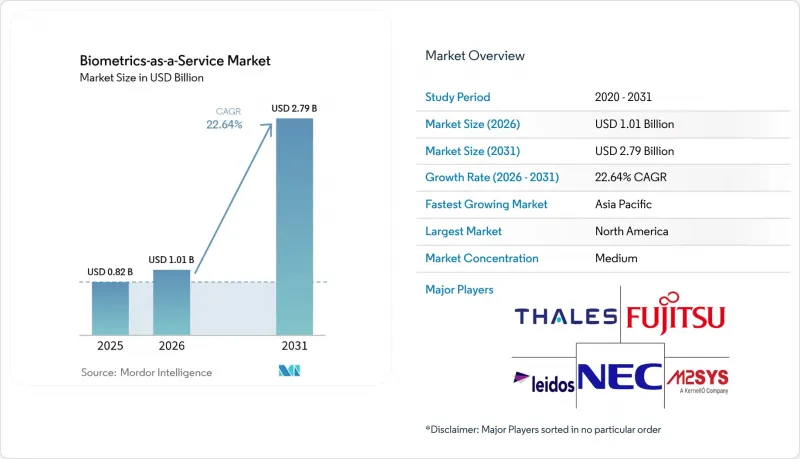
Mordor Intelligence에 의하면, BaaS(Biometrics as a Service) 시장 규모는 2025년에 8억 2,000만 달러로 평가되었고, 2026년 10억 1,000만 달러로 추정되고, 2031년까지 27억 9,000만 달러에 이를 것으로 예측되며, 예측 기간(2026-2031년) CAGR은 22.64%를 나타낼 전망입니다.
본 보고서는 용도별(시설 출입 통제, 근태 관리 등), 생체 인증 방식별(지문 인증, 다중 지문 융합 등), 배포 모델별(퍼블릭 클라우드 등), 최종 사용자 산업별(정부·공공 부문, BFSI 등), 지역별로 분류되어 있습니다. 시장 전망은 입수 가능한 데이터를 바탕으로 금액(달러) 단위로 제시되어 있습니다.
세계의 BaaS(Biometrics as a Service) 시장 동향 및 인사이트
온라인 거래 건수 및 거래액 증가
2024년에는 디지털 결제 거래 건수가 1조 8,600억 건에 달했으며, 비밀번호 인증 시스템으로는 감당할 수 없는 상황이 되어 클라우드 규모의 생체 인증에 대한 수요가 높아지고 있습니다. 온프레미스 생체 인증 시스템에서 SaaS 모델로 전환한 은행에서는 인증 지연 시간이 67% 단축되어 실시간 부정 분석이 가능해졌습니다. BaaS(Biometrics as a Service) 시장은 거래가 급증할 때 컴퓨팅 리소스를 자동으로 프로비저닝함으로써 이러한 확장성 요구에 부응하고 있습니다. 또한, 지연 시간 감소는 사용자 경험을 향상시켜 빈번한 모바일 결제에서 전환율 향상으로 이어집니다. 국경을 초월한 전자상거래가 확대되는 가운데, 가맹점들은 관할 구역을 넘나드는 KYC(신원 확인)를 효율화하는 통합 API를 선호하여 도입하고 있으며, 이것이 시장의 확산을 뒷받침하고 있습니다.
딥페이크 대책 의무의 급증
EU의 AI법은 금융 기관에 2025년 12월까지 합성 미디어에 대한 기술적 방어 조치를 도입할 것을 의무화했습니다. 딥페이크 도구는 단일 이미지에서 설득력 있는 얼굴 동영상을 생성할 수 있어, 단일 요소 인증에 어려움을 초래하고 있습니다. 현재 BaaS(Biometrics as a Service) 시장의 제공업체들은 위장이 어려운 미세한 표정, 동공 반응, 목소리의 배음을 추적하는 생체 감지 기능을 패키지로 제공합니다. 화상 통화나 원격 온보딩 중의 지속적인 인증은 합성 ID 사기를 미연에 방지합니다. 규정 준수 기한으로 인해 조달 주기가 가속화되는 한편, 보험사들은 사이버 위험 보험 계약에 딥페이크 대책을 포함할 것을 점점 더 요구하고 있으며, 이는 도입을 더욱 촉진하고 있습니다.
타사 클라우드에서의 데이터 주권에 대한 우려
유럽 데이터 보호 위원회는 기밀성이 높은 생체 인증 데이터를 승인된 관할 구역 내에 보관할 것을 의무화하고 있어, 이로 인해 다중 리전 SaaS 배포가 복잡해지고 있습니다. 조직은 종종 지역 제한 클라우드나 엣지 어플라이언스에 의존할 수밖에 없어 도입의 복잡성이 증가하고 있습니다. 일부 정부는 템플릿의 역외 전송을 완전히 금지하고 있어, 연합 ID(Federated ID) 프로젝트를 제한하고 있습니다. 벤더들은 이에 대응하여 국가별 샤드(shard)나 고객 관리형 암호화 키를 제공하고 있지만, 이러한 관리 조치는 비용을 증가시키며, 주권 규제가 엄격한 지역에서는 BaaS(Biometrics as a Service) 시장의 성장을 억제하고 있습니다.
부문 분석
2025년에는 스마트폰 센서와 WebAuthn을 통해 기기가 보안 토큰으로 기능하게 되면서, 모바일 인증이 BaaS(Biometrics as a Service) 시장의 28.21%를 차지했습니다. 기업들은 MDM 워크플로우에 기기 고유의 생체 인증 기능을 통합한 결과, 로그인 시간이 단축되고 비밀번호 재설정이 73% 감소했다고 밝혔습니다. 마찬가지로 소비자들도 핀테크 및 전자상거래에서 지문이나 얼굴 인식을 통한 잠금 해제를 수용하고 있으며, 이는 일일 거래량 증가로 이어지고 있습니다. 서비스 제공업체가 단일 클라우드 엔드포인트를 통해 다양한 센서, 펌웨어 업데이트, 생체 감지(라이브니스 체크)를 관리할 수 있게 됨에 따라 BaaS(Biometrics as a Service) 시장은 혜택을 보고 있습니다.
국경 및 입국 관리는 가장 빠르게 성장하는 하위 부문으로, 각국 정부가 입국 및 출국 시스템 자동화를 추진함에 따라 2031년까지 연평균 성장률(CAGR) 22.96%를 나타낼 것으로 예측됩니다. 클라우드 오케스트레이션을 통해 계절적 여객 피크에 대응하는 공항의 확장성이 간소화되며, 엣지 캐싱을 통해 처리가 주권 영역 내에서 이루어집니다. 각 벤더사는 현재 멀티모달을 지원하는 캡처 키오스크와 SaaS 백엔드를 번들로 제공하고 있으며, 이를 통해 조달 주기가 단축되고 있습니다. 보안 요구 사항과 여행자 경험 향상이라는 목표의 상호 작용으로 인해 지출은 지속적으로 증가할 것으로 예상되며, 특히 아시아태평양의 스마트 공항 프로젝트에서 성장이 두드러집니다.
지문 인증 기술은 센서의 성숙도, ISO 템플릿 표준, 그리고 사용자에게 정착된 익숙함 덕분에 2025년에는 BaaS(Biometrics as a Service) 시장에서 31.12%의 점유율을 차지했습니다. 모바일 단말기나 ATM에서의 대규모 도입 실적으로 인해 도입 비용은 낮게 유지되고 있으며, 지속적인 이용량이 확보되고 있습니다. 그러나 합성 지문이나 실리콘 몰드를 이용한 사칭 위험이 높아지고 있습니다. 이에 따라 제공업체들은 지문 인증에 수동적인 얼굴 인증이나 음성 인증을 결합함으로써, 눈에 띄는 편의성 저하를 초래하지 않으면서 신뢰성을 높이고 있습니다.
기업들이 딥페이크에 대한 다층 방어를 요구하는 가운데, 멀티모달 시스템 시장은 연평균 성장률(CAGR) 22.97%로 성장할 전망입니다. SaaS 플랫폼은 얼굴, 음성, 행동 등 각 신호에 걸친 위험 점수 산정을 통합하여 적응형 다중 요소 인증(MFA)을 실현합니다. 머신러닝 앙상블은 컨텍스트에 따라 각 모달리티의 가중치를 부여하여, 저위험 이벤트에서는 처리 속도를 향상시키고, 이상이 감지된 경우에는 심사를 강화합니다. 이러한 보안과 사용자 경험(UX)의 균형 덕분에 BFSI(은행 및 금융 및 보험), 의료, 원격 근무와 같은 이용 사례에서 멀티모달 기술의 도입이 촉진되며, BaaS(Biometrics as a Service) 시장은 더욱 확대되고 있습니다.
지역별 분석
북미는 클라우드의 성숙도, 벤처 자금, 명확한 생체 인증 개인정보 보호 법규에 힘입어 2025년에는 38.29%의 점유율로 BaaS(Biometrics as a Service) 시장을 주도했습니다. 미국의 생체 인증 입국·출국 시스템 등 연방 프로그램은 연간 4억 건 이상의 인증 처리를 수행하고 있으며, 이는 SaaS의 확장성에 대한 스트레스 테스트가 되고 있습니다. 캐나다에서는 상호 운용성 시범 사업을 통해 각 주의 서비스가 전국 공통 디지털 지갑과 연동되고 있는 반면, 멕시코에서는 금융 포용성 추진에 따라 그동안 은행 계좌가 없었던 사람들을 대상으로 생체 인증을 통한 계좌 개설이 진행되고 있습니다. 이러한 동향들이 맞물려 견조한 계약 갱신과 업셀링이 확보되고 있습니다.
아시아태평양은 가장 빠르게 발전하고 있는 지역으로, 2031년까지의 연평균 성장률(CAGR)은 23.06%로 예측됩니다. 인도의 ‘Aadhaar’ 확대부터 싱가포르의 ‘Singpass’에 이르기까지, 각국의 디지털 ID 제도를 통해 생체 인증 로그인이 보편화되며, 업종을 초월한 도입이 촉진되고 있습니다. 일본에서는 마이넘버 카드의 의료·사회보장 분야로의 확대에 따라 일일 본인 확인 건수가 증가하고 있는 반면, 중국에서는 모바일 결제 생태계가 행동 생체 인식의 혁신을 뒷받침하고 있습니다. 아세안(ASEAN)의 신뢰 프레임워크 조화를 위한 노력은 국경을 초월한 본인 확인을 가능하게 하여, BaaS(Biometrics as a Service)의 잠재적 시장을 확대할 가능성이 있습니다.
유럽에서는 꾸준하지만 규제가 엄격한 성장이 관찰되고 있습니다. GDPR(EU 개인정보보호규정) 및 향후 시행될 AI법에 따라 알고리즘의 투명성이 의무화됨에 따라, 편향 완화 실적을 보유한 제공업체가 유리한 입장에 있습니다. 자동차 제조업체들은 개인화를 위해 차량 내 얼굴 인식 및 홍채 인식을 도입하고 있습니다. 산업계 기업들은 위생적 측면과 장갑 착용 시의 편의성을 이유로 현장 출입 관리에 손바닥 정맥 인증 단말기를 도입하고 있습니다. 한편, 중동 및 아프리카에서는 디지털 뱅킹과 국경 관리 분야에서 초기 단계의 시범 사업이 진행되고 있습니다. 데이터 거주지 조항으로 인해 현지 호스팅 파트너가 필요한 경우가 많아, 이것이 시장 진출 전략을 형성하고 있습니다.
기타 혜택 :
- 엑셀 형식 시장 전망(ME) 시트
- 3개월간 애널리스트 지원
자주 묻는 질문
목차
제1장 서론
제2장 조사 방법
제3장 주요 요약
제4장 시장 구도
제5장 시장 규모 및 성장 예측
제6장 경쟁 구도
제7장 시장 기회 및 향후 전망
AJY 26.08.26According to Mordor Intelligence, the biometrics-as-a-Service market size was valued at USD 0.82 billion in 2025 and estimated to grow from USD 1.01 billion in 2026 to reach USD 2.79 billion by 2031, at a CAGR of 22.64% during the forecast period (2026-2031).
This report is Segmented by Application (Site Access Control, Time and Attendance Recording, and More), Biometric Modality (Fingerprint Recognition, Multi-Fingerprint Fusion, and More), Deployment Model (Public Cloud, and More), End-User Industry (Government and Public Sector, BFSI, and More), and Geography. The Market Forecasts are Provided in Terms of Value (USD), Based On Availability.
Global Biometrics-as-a-Service Market Trends and Insights
Rising Volume and Value of Online Transactions
Digital payment volumes hit 1.86 trillion transactions in 2024, overwhelming password systems and elevating demand for cloud-scale biometric verification. Banks moving from on-premises biometrics to SaaS models report 67% lower authentication latency, enabling real-time fraud analytics. The Biometrics-as-a-Service market answers these scalability needs by auto-provisioning compute during transaction spikes. Lower latency also improves user experience, which lifts conversion rates for high-frequency mobile payments. As cross-border e-commerce expands, merchants prefer unified APIs that streamline KYC across jurisdictions, reinforcing market uptake.
Explosion of Deep-fake Mitigation Mandates
The EU AI Act compels financial institutions to deploy technical defenses against synthetic media by December 2025. Deepfake tools can create convincing facial videos from single images, challenging single-factor checks. Biometrics-as-a-Service market providers now bundle liveness detection that tracks micro-expressions, pupillary response, and voice harmonics harder to spoof. Continuous authentication during video calls or remote onboarding deters synthetic identity fraud. Compliance deadlines accelerate procurement cycles, while insurers increasingly require deepfake safeguards in cyber-risk policies, further stimulating adoption.
Third-party Cloud Data-sovereignty Concerns
The European Data Protection Board requires sensitive biometrics to stay within approved jurisdictions, complicating multi-region SaaS rollouts. Organizations often resort to regional clouds or edge appliances, inflating deployment complexity. Some governments ban outbound template transfers entirely, restricting federated identity projects. Vendors respond by offering country-specific shards and customer-managed encryption keys, but such controls raise cost, trimming Biometrics-as-a-Service market growth where sovereignty rules are strict.
Other drivers and restraints analyzed in the detailed report include:
- Cloud-native IAM Suites Embedding Biometrics
- Post-quantum Cryptography Complementarity
- Bias and Demographic Performance Gaps
For complete list of drivers and restraints, kindly check the Table Of Contents.
Segment Analysis
Mobile authentication accounted for 28.21% of the Biometrics-as-a-Service market in 2025 as smartphone sensors and WebAuthn turn devices into security tokens. Enterprises cite shorter login times and 73% fewer password resets after embedding device-native biometrics in MDM workflows. Consumers likewise accept fingerprint or facial unlock for fintech and e-commerce, translating into high daily transaction volumes. The Biometrics-as-a-Service market benefits because service providers manage sensor heterogeneity, firmware updates, and liveness checks through a single cloud endpoint.
Border and immigration control is the fastest-rising subsegment, set for a 22.96% CAGR through 2031 as governments automate entry/exit systems. Cloud orchestration simplifies scalability for airports handling seasonal passenger peaks, while edge caching keeps processing within sovereign zones. Vendors now bundle multimodal capture kiosks with SaaS back-ends, reducing procurement cycles. The interplay of security mandates and traveler experience goals ensures sustained spending, with growth particularly strong in Asia-Pacific smart-airport projects.
Fingerprint technology held a 31.12% Biometrics-as-a-Service market share in 2025 thanks to mature sensors, ISO template standards, and entrenched user familiarity. Large installed bases in mobile devices and ATMs keep capture costs low, ensuring ongoing volume. Yet synthetic fingerprints and silicone molds raise spoofing risk. Providers therefore pair fingerprints with passive facial or voice checks, increasing assurance without noticeable friction.
Multimodal systems will expand at a 22.97% CAGR as enterprises seek defense-in-depth against deepfakes. SaaS platforms unify risk scoring across face, voice, and behavioral signals, enabling adaptive MFA. Machine-learning ensembles weigh modalities based on context, improving throughput for low-risk events and stepping up scrutiny where anomalies surface. This balance of security and UX is propelling multimodal adoption across BFSI, healthcare, and remote-work use cases, further enlarging the Biometrics-as-a-Service market.
Complete Report Scope:
- By Application
- Site Access Control
- Time and Attendance Recording
- Mobile Authentication
- Web and Workplace Login
- e-Payments and Transaction Authentication
- Border and Immigration Control
- Law-Enforcement and Surveillance
- Other Applications
- By Biometric Modality
- Fingerprint Recognition
- Multi-fingerprint Fusion
- Facial Recognition
- Iris Recognition
- Palm and Vein Recognition
- Voice Recognition
- Behavioural Biometrics
- Multimodal Biometrics
- Other Modalities
- By Deployment Model
- Public Cloud
- Private Cloud
- Hybrid Cloud
- By End-user Industry
- Government and Public Sector
- BFSI
- Healthcare
- Retail and E-commerce
- IT and Telecom
- Travel and Hospitality
- Education
- Other End-user Industries
- By Geography
- North America
- United States
- Canada
- Mexico
- South America
- Brazil
- Argentina
- Rest of South America
- Europe
- United Kingdom
- Germany
- France
- Italy
- Spain
- Netherlands
- Rest of Europe
- Asia-Pacific
- China
- Japan
- South Korea
- India
- ASEAN
- Rest of Asia-Pacific
- Middle East and Africa
- Middle East
- Saudi Arabia
- United Arab Emirates
- Turkey
- Rest of Middle East
- Africa
- South Africa
- Nigeria
- Kenya
- Rest of Africa
- Middle East
- North America
Geography Analysis
North America dominated the Biometrics-as-a-Service market with a 38.29% share in 2025, underpinned by cloud maturity, venture funding, and clear biometric privacy statutes. Federal programs such as the U.S. biometric entry-exit system handle over 400 million annual verifications, stress-testing SaaS scalability. Canadian interoperability pilots link provincial services to a national wallet, while Mexican financial inclusion drives biometric onboarding of the previously unbanked. Together these dynamics ensure robust contract renewals and upsells.
Asia-Pacific is the fastest-advancing region, forecast at a 23.06% CAGR to 2031. National digital-ID schemes from India's Aadhaar extensions to Singapore's Singpass normalize biometric logins, stimulating cross-sector adoption. Japan's My Number card expansion into healthcare and social security increases daily verification volume, while China's mobile-payment ecosystem fuels behavioral biometrics innovation. ASEAN's effort to harmonize trust-frameworks could unlock cross-border verification, enlarging the addressable Biometrics-as-a-Service market.
Europe shows steady but regulation-heavy growth. GDPR and the forthcoming AI Act impose algorithmic transparency, favoring providers with bias-mitigation credentials. Automotive OEMs employ in-cabin facial and iris recognition for personalization. Industrial firms deploy palm-vein stations for shop-floor access, citing hygiene and gloves compatibility. Meanwhile, the Middle East and Africa see early-stage pilots in digital banking and border management. Data-residency clauses often necessitate local hosting partners, shaping go-to-market strategies.
- Thales Group
- IDEMIA France SAS
- NEC Corporation
- Fujitsu Limited
- Leidos Holdings Inc.
- Aware Inc.
- ImageWare Systems Inc.
- BIO-key International Inc.
- M2SYS Technology (Kernel LLC)
- Mobbeel Solutions S.L.L.
- BioEnable Technologies Pvt Ltd.
- Clearview AI Inc.
- HID Global Corporation
- Suprema Inc.
- Veridium IP Ltd.
- Cognitec Systems GmbH
- Precise Biometrics AB
- Daon Inc.
- Microsoft Corporation
- Amazon Web Services Inc.
- Google LLC (Google Cloud)
- Ping Identity Holding Corp.
- LexisNexis Risk Solutions Inc.
Additional Benefits:
- The market estimate (ME) sheet in Excel format
- 3 months of analyst support
TABLE OF CONTENTS
1 INTRODUCTION
- 1.1 Study Assumptions and Market Definition
- 1.2 Scope of the Study
2 RESEARCH METHODOLOGY
3 EXECUTIVE SUMMARY
4 MARKET LANDSCAPE
- 4.1 Market Overview
- 4.2 Market Drivers
- 4.2.1 Rising volume and value of on-line transactions
- 4.2.2 Explosion of deep-fake mitigation mandates
- 4.2.3 Cloud-native IAM suites embedding biometrics
- 4.2.4 Post-quantum cryptography complementarity
- 4.2.5 National digital-ID roll-outs (G2P and G2C)
- 4.2.6 WebAuthn-based password-less workspaces
- 4.3 Market Restraints
- 4.3.1 Third-party cloud data-sovereignty concerns
- 4.3.2 Bias and demographic performance gaps
- 4.3.3 Fragmented certification and liability regimes
- 4.3.4 Synthetic identity fraud arms-race
- 4.4 Industry Value Chain Analysis
- 4.5 Regulatory Landscape
- 4.6 Technological Outlook
- 4.6.1 Voice and speech AI breakthroughs
- 4.6.2 Ubiquitous mobile biometrics and facial Liveness
- 4.6.3 Continuous and behavioural authentication
- 4.6.4 Vital-signal biometrics via wearables
- 4.7 Porter's Five Forces Analysis
- 4.7.1 Bargaining Power of Suppliers
- 4.7.2 Bargaining Power of Buyers
- 4.7.3 Threat of New Entrants
- 4.7.4 Threat of Substitutes
- 4.7.5 Competitive Rivalry
- 4.8 Impact of Macroeconomic Factors
- 4.9 Investment and Funding Analysis
5 MARKET SIZE AND GROWTH FORECASTS (VALUE)
- 5.1 By Application
- 5.1.1 Site Access Control
- 5.1.2 Time and Attendance Recording
- 5.1.3 Mobile Authentication
- 5.1.4 Web and Workplace Login
- 5.1.5 e-Payments and Transaction Authentication
- 5.1.6 Border and Immigration Control
- 5.1.7 Law-Enforcement and Surveillance
- 5.1.8 Other Applications
- 5.2 By Biometric Modality
- 5.2.1 Fingerprint Recognition
- 5.2.2 Multi-fingerprint Fusion
- 5.2.3 Facial Recognition
- 5.2.4 Iris Recognition
- 5.2.5 Palm and Vein Recognition
- 5.2.6 Voice Recognition
- 5.2.7 Behavioural Biometrics
- 5.2.8 Multimodal Biometrics
- 5.2.9 Other Modalities
- 5.3 By Deployment Model
- 5.3.1 Public Cloud
- 5.3.2 Private Cloud
- 5.3.3 Hybrid Cloud
- 5.4 By End-user Industry
- 5.4.1 Government and Public Sector
- 5.4.2 BFSI
- 5.4.3 Healthcare
- 5.4.4 Retail and E-commerce
- 5.4.5 IT and Telecom
- 5.4.6 Travel and Hospitality
- 5.4.7 Education
- 5.4.8 Other End-user Industries
- 5.5 By Geography
- 5.5.1 North America
- 5.5.1.1 United States
- 5.5.1.2 Canada
- 5.5.1.3 Mexico
- 5.5.2 South America
- 5.5.2.1 Brazil
- 5.5.2.2 Argentina
- 5.5.2.3 Rest of South America
- 5.5.3 Europe
- 5.5.3.1 United Kingdom
- 5.5.3.2 Germany
- 5.5.3.3 France
- 5.5.3.4 Italy
- 5.5.3.5 Spain
- 5.5.3.6 Netherlands
- 5.5.3.7 Rest of Europe
- 5.5.4 Asia-Pacific
- 5.5.4.1 China
- 5.5.4.2 Japan
- 5.5.4.3 South Korea
- 5.5.4.4 India
- 5.5.4.5 ASEAN
- 5.5.4.6 Rest of Asia-Pacific
- 5.5.5 Middle East and Africa
- 5.5.5.1 Middle East
- 5.5.5.1.1 Saudi Arabia
- 5.5.5.1.2 United Arab Emirates
- 5.5.5.1.3 Turkey
- 5.5.5.1.4 Rest of Middle East
- 5.5.5.2 Africa
- 5.5.5.2.1 South Africa
- 5.5.5.2.2 Nigeria
- 5.5.5.2.3 Kenya
- 5.5.5.2.4 Rest of Africa
- 5.5.5.1 Middle East
- 5.5.1 North America
6 COMPETITIVE LANDSCAPE
- 6.1 Market Concentration
- 6.2 Strategic Moves
- 6.3 Market Share Analysis
- 6.4 Company Profiles (includes Global level Overview, Market level overview, Core Segments, Financials as available, Strategic Information, Market Rank/Share, Products and Services, Recent Developments)
- 6.4.1 Thales Group
- 6.4.2 IDEMIA France SAS
- 6.4.3 NEC Corporation
- 6.4.4 Fujitsu Limited
- 6.4.5 Leidos Holdings Inc.
- 6.4.6 Aware Inc.
- 6.4.7 ImageWare Systems Inc.
- 6.4.8 BIO-key International Inc.
- 6.4.9 M2SYS Technology (Kernel LLC)
- 6.4.10 Mobbeel Solutions S.L.L.
- 6.4.11 BioEnable Technologies Pvt Ltd.
- 6.4.12 Clearview AI Inc.
- 6.4.13 HID Global Corporation
- 6.4.14 Suprema Inc.
- 6.4.15 Veridium IP Ltd.
- 6.4.16 Cognitec Systems GmbH
- 6.4.17 Precise Biometrics AB
- 6.4.18 Daon Inc.
- 6.4.19 Microsoft Corporation
- 6.4.20 Amazon Web Services Inc.
- 6.4.21 Google LLC (Google Cloud)
- 6.4.22 Ping Identity Holding Corp.
- 6.4.23 LexisNexis Risk Solutions Inc.
7 MARKET OPPORTUNITIES AND FUTURE OUTLOOK
- 7.1 White-space and Unmet-Need Assessment


