

|
시장보고서
상품코드
2114101
건물 일체형 태양광발전(BIPV) 시장 : 시장 점유율 분석, 업계 동향 및 통계, 성장 예측(2026-2031년)Building Integrated Photovoltaic (BIPV) - Market Share Analysis, Industry Trends & Statistics, Growth Forecasts (2026 - 2031) |
||||||
 Mordor Intelligence
Mordor Intelligence에 의하면, 건물 일체형 태양광발전(BIPV) 시장 규모는 2025년에 134억 5,000만 달러로 평가되었고, 2026년에 166억 6,000만 달러로 추정되고, 2031년까지 470억 2,000만 달러에 이를 것으로 예측되며, 2026-2031년 CAGR 23.06%로 성장할 전망입니다.
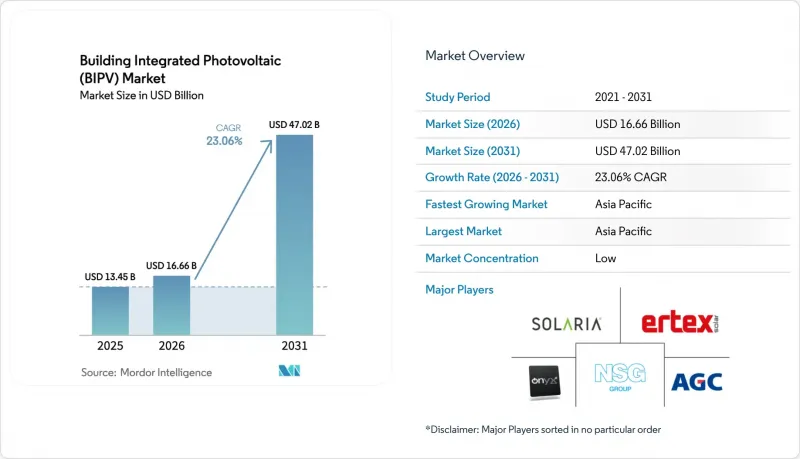
본 보고서는 기술별(결정질 실리콘, 박막, 신기술), 최종 사용자별(주거용, 상업시설, 산업 시설, 공공·기관 시설), 지역별(북미, 유럽, 아시아태평양, 남미, 중동 및 아프리카)로 분류되어 있습니다. 시장 규모 및 전망은 금액(달러)으로 표시되어 있습니다.
세계의 건물 일체형 태양광(BIPV) 시장 동향 및 인사이트
지원적인 정책 인센티브와 탄소 중립 건축 의무화
유럽의 ‘건축물 에너지 성능에 관한 지침(2024/1275)’에서는 2030년까지 모든 신축 건축물에 태양광 발전 설비 설치가 가능한 지붕을 의무화하고 있으며, 250제곱미터를 초과하는 공공 건축물에 대한 단계적 개보수는 2027년부터 시작됩니다. 독일의 KfW 442 프로그램은 2025년에 5억 유로를 편성하여 설치 비용의 10-30%를 보조하는 한편, 프랑스에서는 통합형 파사드에 대해 MaPrimeRenov 보조금을 최대 1만 1,000유로까지 확대했습니다. 중국에서는 2025년 말까지 676개 현을 대상으로 ‘전 현 태양광 발전 의무화’가 시행되며, 신축 산업용 건물의 옥상에는 자가 발전 설비 설치 또는 재생에너지 증서 구매가 의무화되어 있습니다. 이로 인해 건물 일체형 태양광 발전(BIPV) 시장 수요가 사실상 보장되게 됩니다. 이러한 규제로 인해 인허가 절차 기간이 단축되고 전문 시공업체의 육성이 진행되면서, BIPV는 임의적인 개조에서 건축 기준상의 요건으로 전환되고 있습니다. 이와 유사한 지침을 도입하는 관할 구역이 늘어남에 따라, 개발업자들은 승인 절차 후반에 발생할 수 있는 고액의 설계 변경을 피하기 위해 기본 설계 단계에서 태양광 발전 도입 계획을 미리 반영하고 있습니다.
태양광 발전 및 BOS(Balance of System) 비용의 하락
2025년 중반에는 단결정 PERC 모듈 가격이 와트당 0.12달러까지 하락했으며, 인버터 공급업체 간의 경쟁 압력으로 인해 전자 기기 가격은 전년 대비 18% 인하되었습니다. AGC 및 NSG/필킨턴이 출시한 표준화된 커튼월 키트는 정션 박스와 웨더 씰을 공장에서 일체화함으로써 현장 작업 공수를 25% 절감했습니다. 투명 PV 유리는 여전히 Low-E 유리보다 20-40% 비싸지만, 임대료가 높은 부동산을 개발하는 개발업자들은 발전 수익 창출과 옥상 설비의 혼잡 완화를 통해 그 비용 차이를 회수하고 있습니다. 만안 지역에서는 2025년에 BIPV를 통한 전력의 균등화 발전 원가가 소매 전기 요금을 밑돌게 되었으며, 일사량이 2,200 kWh/m²/년을 초과하는 지역에서는 보조금 없이도 도입이 가능해졌습니다. BOS 제조업체의 규모 확대에 따라 건축 일체형 태양광 발전(BIPV) 시장은 가격 탄력성을 누리고 있으며, 그동안 비용 문제로 인해 통합형 태양광 파사드 도입이 어려웠던 중규모 상업 프로젝트에도 문이 열리고 있습니다.
초기 설치 및 설계의 복잡성이 높음
BIPV에는 구조, 전기, 파사드 각 팀 간의 치밀한 협력이 필요하지만, 그러한 통합적인 워크플로우를 제공할 수 있는 종합 건설사는 거의 없습니다. 뉴욕주와 캘리포니아주에서는 구조 하중, 계통 연계, 대피 경로에 대해 개별 승인이 요구되며, 이로 인해 소프트 비용이 옥상 설치형 어레이보다 12-18% 높아지고, 공사 기간도 최대 6개월 연장됩니다. 주문 제작된 커튼월로의 통합은 예산에 평방미터당 550-850유로의 추가 비용을 발생시킬 가능성이 있어, 비용에 민감한 개발자들은 더 저렴한 카포트로 눈을 돌리는 경향이 있습니다. 보험사는 검사관이 UL 1703 및 IEC 61730 준수를 확인할 때까지 보험료를 5-15% 가산하고 있습니다. 이는 침수나 급속 정지 기능의 신뢰성에 대한 경계심을 반영한 것입니다. 인력 부족이 위험을 더욱 악화시키고 있습니다. 북미에서 활동하는 인증 설치 기술자는 2,000명 미만이며, 개발사는 하루 800달러의 비용으로 유럽에서 작업자를 초빙할 수밖에 없어, 현지 교육이 본격화되기 전까지는 프로젝트의 이익률을 압박하게 됩니다.
부문별 분석
2025년 출하량에서 결정질 실리콘이 87.5%를 차지하며 건물 일체형 태양광 발전(BIPV) 시장에서 최대 점유율을 기록했지만, 페로브스카이트-실리콘 탠덤은 2031년까지 연평균 성장률(CAGR) 27.5%로 성장하여 그 격차를 좁혀갈 전망입니다. LONGi사의 ‘Hi-MO 9’는 24.92%의 변환 효율을 달성하여 실리콘의 고출력이라는 강점을 한층 더 강화했습니다. 한편, 퍼스트 솔라사의 ‘시리즈 7’ CdTe는 고온의 창고 환경에서도 출력을 유지했습니다. 그럼에도 불구하고, 29.1%의 변환 효율을 자랑하는 실험실 수준의 탠덤 셀이 유럽 각지에서 시범적인 파사드 설치를 뒷받침하고 있어, 그리드 패리티가 코앞으로 다가왔음을 시사하고 있습니다. Heliatek사의 유기 필름에 대한 초기 현장 데이터는 25년의 내구성을 달성할 수 있음을 시사하며, 플렉서블 모듈이 수명이 짧은 일시적인 제품이라는 인식을 뒤집고 있습니다. 건축 통합형 태양광 발전(BIPV) 시장은 현재 건축가들에게 강성이 높은 고밀도 패널부터 경량 유기 롤에 이르기까지 폭넓은 선택지를 제공하고 있으며, 프로젝트 팀은 프로젝트에 맞추어 기판, 무게, 미관을 선정할 수 있게 되었습니다. 공급망의 미묘한 차이도 중요합니다. 저철분 유리 부족은 결정질 프로젝트를 지연시킬 가능성이 있지만, 폴리머 기판을 사용한 탠덤형 모듈은 이러한 제약을 피할 수 있습니다. 2027년에 페로브스카이트 모듈이 IEC 61215 인증을 획득하면 자금 조달의 장벽이 해소되어, 결정질 제조업체들은 시장 점유율의 급격한 하락에 직면할 가능성이 있습니다.
2세대 박막 태양전지는 그 중간에 위치하고 있습니다. CdTe, CIGS, 비정질 실리콘은 온도 계수가 낮아 사막 기후에서도 발전 효율을 유지할 수 있지만, 에너지 밀도는 여전히 최상위권인 단결정 PERC에 미치지 못하는 상황입니다. 모듈 가격이 하락하는 가운데, 박막 태양전지는 와트 수를 놓고 직접 경쟁하기보다는 틈새 시장 가치, 곡면 스카이라이트, 역사적 건축물의 파사드, 초경량 장력 지붕과 같은 분야로 무게중심을 옮겨가고 있습니다. 각 OEM 업체들은 결정질 웨이퍼에 페로브스카이트 코팅을 라미네이팅하는 하이브리드 생산 라인에 투자하며, 공장의 대대적인 설비 갱신 없이 효율 향상을 추구하고 있습니다. 그 결과에 따라 실리콘이 기존 입지를 지켜낼지, 아니면 건축 통합형 태양광 발전(BIPV) 시장에서 새로운 화학 조성의 소재에 고급 건축 프로젝트를 양보하게 될지가 결정될 것입니다.
지역별 분석
아시아태평양은 2025년에 전 세계 출하량의 40.7%를 차지했으며, 2031년까지 연평균 23.8%의 성장이 예상되어 건축 통합형 태양광 발전(BIPV) 시장에서 주도적인 위치를 유지할 전망입니다. 중국에서는 676개 현에 태양광 발전 도입 의무가 부과되어 지속적인 수요가 보장되고 있습니다. 한편, 일본에서는 고정가격임베디드제도(FIT) 개정에 따라 자가 소비가 장려되어 지붕 설치형 태양광 발전의 수익성이 향상되고 있습니다. 선전시에서는 5,000m²를 초과하는 상업용 건물에 대해 BIPV 패널 설치를 의무화하고 있어, 이에 따라 국내 대형 기업인 LONGi, Trina, Risen에 수주가 집중되고 있습니다. 인도는 2030년까지 300GW의 태양광 발전 목표를 제시하고, 정부 시설용 BIPV 목표도 별도로 설정하고 있지만, 주마다 다른 규제와 파사드 엔지니어 부족이 도입의 걸림돌이 되고 있습니다. 싱가포르 텐가(Tenga) 지구가 주도하는 아세안(ASEAN) 시범 사업에서는 42,000세대의 주택에 태양광 발전이 가능한 지붕 설치를 의무화하고 있으며, 정책만 명확해지면 그 확장성이 입증된 바 있습니다.
유럽은 ‘건축물의 에너지 성능에 관한 지침’에 힘입어 2위를 차지하고 있습니다. 독일, 프랑스, 스페인에서는 프로젝트 비용의 30-50%가 공공 자금으로 충당되는 반면, 스웨덴에서는 1톤당 이산화탄소(tCO2)에 대해 100유로를 초과하는 탄소세가 수명 주기 비용의 관점에서 태양광 발전의 통합을 촉진하고 있습니다. 영국의 ‘퓨처 홈스 스탠다드(Future Homes Standard)’는 2025년 이후 주택 개발업자에게 BIPV 채택을 의무화하고 있지만, 브렉시트 이후의 노동력 부족으로 인해 2024년 이후 설치업자의 임금이 12-15% 상승하고 있습니다. 북유럽 국가에서는 일조 시간의 변동으로 인해 연간 발전량이 불안정해지지만, 계절적인 발전량 감소를 상쇄하는 고효율 탠덤 패널에 대한 관심이 높아지고 있습니다. 전반적으로, 지원적인 인센티브가 예측 가능한 프로젝트 파이프라인을 뒷받침하고 있으며, 다국적 기업들은 이를 활용하여 건물 일체형 태양광 발전(BIPV) 시장에서 국경을 초월한 조달 전략을 시범적으로 전개하고 있습니다.
북미에서의 확장은 캘리포니아주, 뉴욕주 및 캐나다 일부 지역에 집중되어 있으며, 개정된 순계량제(net metering) 제도와 30%의 연방 투자 세액 공제(ITC) 덕분에 투자 회수 기간이 8-10년으로 단축되었습니다. 캘리포니아주의 ‘타이틀 24’는 10,000제곱피트가 넘는 상업용 건물에도 태양광 발전 의무화를 확대하고 있어, 이로 인해 노후 건물의 외관 개보수가 촉진되고 있습니다. 뉴욕주의 ‘기후법’은 지방 자치단체의 부동산 관리자에게 2030년까지 전력의 70%를 재생에너지로 충당할 것을 의무화하고 있으며, 이로 인해 주 정부 계약에서 BIPV 파사드의 도입이 촉진되고 있습니다. 중동 및 아프리카은 아직 발전 단계에 있지만, 미래가 기대되고 있습니다. NEOM과 마스다르 시티에서는 재생에너지를 통한 전력 공급 100%를 목표로 하는 마스터 플랜에 솔라 스킨 도입이 포함되어 있습니다. 연간 2,200 kWh/m²를 초과하는 높은 일사량 덕분에 보조금 없이도 6년 미만의 투자 회수 기간이 가능하며, 이 지역은 건축 일체형 태양광 발전(BIPV) 시장의 차세대 성장 거점으로 자리매김하고 있습니다.
기타 혜택 :
- 엑셀 형식 시장 예측(ME) 시트
- 3개월간의 애널리스트 지원
자주 묻는 질문
목차
제1장 서론
제2장 조사 방법
제3장 주요 요약
제4장 시장 구도
제5장 시장 규모 및 성장 예측
제6장 경쟁 구도
제7장 시장 기회 및 향후 전망
AJY 26.08.26According to Mordor Intelligence, the building integrated photovoltaic market size is projected to be USD 13.45 billion in 2025, USD 16.66 billion in 2026, and reach USD 47.02 billion by 2031, growing at a CAGR of 23.06% from 2026 to 2031.
This report is Segmented by Technology (Crystalline Silicon, Thin-Film, and Emerging), End-User (Residential, Commercial, Industrial, and Institutional and Public Buildings), and Geography (North America, Europe, Asia-Pacific, South America, and Middle East and Africa). The Market Sizes and Forecasts are Provided in Terms of Value (USD).
Global Building Integrated Photovoltaic (BIPV) Market Trends and Insights
Supportive Policy Incentives & Zero-Carbon Building Mandates
Europe's Energy Performance of Buildings Directive 2024/1275 requires solar-ready roofs on all new structures by 2030, and phased retrofits for public buildings above 250 square meters now begin in 2027. Germany's KfW 442 program earmarked EUR 500 million in 2025 to subsidize 10-30% of installed costs, while France extended MaPrimeRenov grants up to EUR 11,000 for integrated facades. China's whole-county solar mandate, covering 676 counties by late 2025, obliges new industrial rooftops to host on-site generation or purchase renewable certificates, effectively guaranteeing a pipeline for the Building Integrated Photovoltaic (BIPV) market. These rules shorten permitting cycles, train specialist installers, and shift BIPV from a discretionary upgrade to a code requirement. As more jurisdictions transpose similar directives, developers front-load solar envelopes into schematic designs to avoid costly redesigns later in the approval process.
Declining PV & Balance-of-System Costs
Monocrystalline PERC modules dropped to USD 0.12 per watt in mid-2025, and competitive pressure among inverter suppliers trimmed electronics pricing by 18% year-on-year. Standardized curtain-wall kits released by AGC and NSG/Pilkington cut on-site labor by 25% by integrating junction boxes and weather seals at the factory. Transparent PV glass still costs 20-40% more than low-E glazing, but high-rent developers recoup premiums by monetizing electricity and reducing mechanical-penthouse congestion. In the Gulf, the levelized cost of BIPV electricity fell below retail tariffs in 2025, enabling subsidy-free adoption where irradiance tops 2,200 kWh/m2/yr. As BOS manufacturers scale, the Building Integrated Photovoltaic (BIPV) market enjoys price elasticity that opens mid-tier commercial projects previously priced out of integrated solar facades.
High Initial Installation & Design Complexity
BIPV requires tight coordination among structural, electrical, and facade teams, yet few general contractors offer that integrated workflow. New York and California demand separate approvals for structural load, interconnection, and fire egress, pushing soft costs 12-18% above rooftop arrays and stretching timelines by up to six months. Custom curtain-wall integration can add EUR 550-850/m2 to budgets, nudging cost-conscious developers toward cheaper carports. Insurers levy 5-15% premiums until inspectors confirm UL 1703 and IEC 61730 compliance, reflecting caution over water ingress and rapid-shutdown reliability. A talent bottleneck compounds risks: fewer than 2,000 certified installers operate in North America, leading developers to import European crews at USD 800/day, which erodes project margins until local training accelerates.
Other drivers and restraints analyzed in the detailed report include:
- Rising Demand for Net-Zero / Smart-City Developments
- Growth of Facade-Integrated Transparent PV Glass
- Structural / Fire-Safety Code Barriers
For complete list of drivers and restraints, kindly check the Table Of Contents.
Segment Analysis
Crystalline silicon commanded 87.5% of 2025 volume, equating to the largest Building Integrated Photovoltaic (BIPV) market share, yet perovskite-silicon tandems are set to erode that lead with a 27.5% CAGR to 2031. LONGi's Hi-MO 9 hit 24.92% efficiency, reinforcing silicon's high-wattage advantage, while First Solar's Series 7 CdTe maintained output in high-temperature warehouses. Still, laboratory tandem cells at 29.1% efficiency have spurred pilot facades across Europe, indicating looming parity. Early field data from Heliatek's organic films suggest 25-year durability is attainable, undermining the perception that flexible modules are short-life novelties. The Building Integrated Photovoltaic (BIPV) market now offers architects a spectrum from rigid, high-density panels to light organic rolls, allowing project teams to match substrate, weight, and aesthetics. Supply-chain nuances matter: low-iron glass shortages can stall crystalline projects, whereas polymer-substrate tandems bypass that constraint. Once IEC 61215 certification reaches perovskite modules in 2027, financing barriers will fall, and crystalline players may confront accelerated share loss.
Second-generation thin films occupy a middle ground. CdTe, CIGS, and amorphous silicon demonstrate lower temperature coefficients, which protects yield in desert climates, yet their energy density still trails top-tier mono-PERC. As module prices slide, thin films pivot to niche value, curved skylights, heritage facades, and ultra-light tensile roofs, rather than head-to-head wattage battles. OEMs are investing in hybrid lines that laminate perovskite coatings onto crystalline wafers, chasing efficiency gains without radical factory retools. The outcome will decide whether silicon defends incumbency or concedes premium architectural projects to newer chemistries within the Building Integrated Photovoltaic (BIPV) market.
Complete Report Scope:
- By Technology
- Crystalline Silicon (Monocrystalline, Polycrystalline)
- Thin-Film (CdTe, CIGS, a-Si)
- Emerging (Perovskite, Organic PV, Tandem)
- By End-User
- Residential
- Commercial
- Industrial
- Institutional and Public Buildings
- By Building Element (Qualitative Analysis)
- Roofs
- Facades/Curtain Walls
- Windows and Transparent Glazing
- Skylights and Atriums
- Shading Devices (Louvers, Balconies)
- By Geography
- North America
- United States
- Canada
- Mexico
- Europe
- Germany
- France
- United Kingdom
- Spain
- Italy
- NORDIC Countries
- Russia
- Rest of Europe
- Asia-Pacific
- China
- Japan
- India
- South Korea
- ASEAN Countries
- Australia and New Zealand
- Rest of Asia-Pacific
- South America
- Brazil
- Argentina
- Colombia
- Rest of South America
- Middle East and Africa
- Saudi Arabia
- United Arab Emirates
- South Africa
- Nigeria
- Egypt
- Rest of Middle East and Africa
- North America
Geography Analysis
Asia-Pacific controlled 40.7% of global volume in 2025 and is forecast to grow 23.8% annually through 2031, protecting its leadership in the Building Integrated Photovoltaic (BIPV) market. China's 676-county solar mandate guarantees continuous demand, while Japan's feed-in tariff revision rewards self-consumption, lifting rooftop economics. Shenzhen obliges commercial buildings above 5,000 m2 to install BIPV skins, funneling orders to domestic giants LONGi, Trina, and Risen. India sets 300 GW solar by 2030 with a carved-out BIPV target for government facilities, but heterogeneous state codes and a shortage of facade engineers slow roll-out. ASEAN pilots, led by Singapore's Tengah district, mandate solar-ready roofs on 42,000 homes, showing scalability once policy clarity arrives.
Europe ranks second, propelled by the Energy Performance of Buildings Directive. Germany, France, and Spain underwrite 30-50% of project costs, while Sweden's carbon tax above EUR 100/tCO2 steers lifecycle economics toward integrated solar. The United Kingdom's Future Homes Standard pushes residential developers to adopt BIPV from 2025, though post-Brexit labor shortages inflated installer wages 12-15% after 2024. Nordic daylight fluctuations complicate annual yield but spur interest in high-efficiency tandem panels that offset seasonal lows. Altogether, supportive incentives anchor a predictable pipeline that multinationals use to trial cross-border procurement strategies within the Building Integrated Photovoltaic (BIPV) market.
North America's expansion clusters in California, New York, and parts of Canada, where updated net-metering and 30% federal ITC compress payback to 8-10 years. California's Title 24 extends solar mandates to commercial buildings over 10,000 ft2, triggering facade retrofits on older stock. New York's Climate Act compels municipal property managers to offset 70% of electricity with renewables by 2030, driving state contracts toward BIPV facades. The Middle East and Africa remain nascent yet promising, with NEOM and Masdar City embedding solar skins in master plans that target 100% renewable supply. High irradiance above 2,200 kWh/m2/yr offers sub-6-year payback even without subsidies, positioning the region as the next growth pole for the Building Integrated Photovoltaic (BIPV) market.
- Onyx Solar Energy SL
- AGC Inc.
- Nippon Sheet Glass (Pilkington)
- Ertex Solartechnik GmbH
- Solaria Corporation
- Sunovation GmbH
- Mitrex Inc.
- Changzhou Almaden Co. Ltd.
- NanoPV Solar Inc.
- Tesla Inc.
- First Solar Inc.
- Sharp Corporation
- Hanwha Q-Cells
- Canadian Solar Inc.
- LONGi Green Energy
- Trina Solar Ltd.
- Risen Energy Co. Ltd.
- Waaree Energies Ltd.
- Heliatek GmbH
- Ascent Solar Technologies
Additional Benefits:
- The market estimate (ME) sheet in Excel format
- 3 months of analyst support
TABLE OF CONTENTS
1 Introduction
- 1.1 Study Assumptions & Market Definition
- 1.2 Scope of the Study
2 Research Methodology
3 Executive Summary
4 Market Landscape
- 4.1 Market Overview
- 4.2 Market Drivers
- 4.2.1 Supportive policy incentives & zero-carbon building mandates
- 4.2.2 Declining PV & balance-of-system costs
- 4.2.3 Rising demand for net-zero/smart-city developments
- 4.2.4 Growth of facade-integrated transparent PV glass
- 4.2.5 Corporate ESG & green-building certification pressures
- 4.2.6 5G-ready rooftop infrastructure synergy
- 4.3 Market Restraints
- 4.3.1 High initial installation & design complexity
- 4.3.2 Structural / fire-safety code barriers
- 4.3.3 Limited skilled installers & facade-engineering know-how
- 4.3.4 Supply-chain constraints for specialty BIPV glass
- 4.4 Supply-Chain Analysis
- 4.5 Regulatory Landscape
- 4.6 Technological Outlook
- 4.7 Porter's Five Forces
- 4.7.1 Bargaining Power of Suppliers
- 4.7.2 Bargaining Power of Buyers
- 4.7.3 Threat of New Entrants
- 4.7.4 Threat of Substitutes
- 4.7.5 Intensity of Competitive Rivalry
- 4.8 Investment & Funding Analysis
5 Market Size & Growth Forecasts
- 5.1 By Technology
- 5.1.1 Crystalline Silicon (Monocrystalline, Polycrystalline)
- 5.1.2 Thin-Film (CdTe, CIGS, a-Si)
- 5.1.3 Emerging (Perovskite, Organic PV, Tandem)
- 5.2 By End-User
- 5.2.1 Residential
- 5.2.2 Commercial
- 5.2.3 Industrial
- 5.2.4 Institutional and Public Buildings
- 5.3 By Building Element (Qualitative Analysis)
- 5.3.1 Roofs
- 5.3.2 Facades/Curtain Walls
- 5.3.3 Windows and Transparent Glazing
- 5.3.4 Skylights and Atriums
- 5.3.5 Shading Devices (Louvers, Balconies)
- 5.4 By Geography
- 5.4.1 North America
- 5.4.1.1 United States
- 5.4.1.2 Canada
- 5.4.1.3 Mexico
- 5.4.2 Europe
- 5.4.2.1 Germany
- 5.4.2.2 France
- 5.4.2.3 United Kingdom
- 5.4.2.4 Spain
- 5.4.2.5 Italy
- 5.4.2.6 NORDIC Countries
- 5.4.2.7 Russia
- 5.4.2.8 Rest of Europe
- 5.4.3 Asia-Pacific
- 5.4.3.1 China
- 5.4.3.2 Japan
- 5.4.3.3 India
- 5.4.3.4 South Korea
- 5.4.3.5 ASEAN Countries
- 5.4.3.6 Australia and New Zealand
- 5.4.3.7 Rest of Asia-Pacific
- 5.4.4 South America
- 5.4.4.1 Brazil
- 5.4.4.2 Argentina
- 5.4.4.3 Colombia
- 5.4.4.4 Rest of South America
- 5.4.5 Middle East and Africa
- 5.4.5.1 Saudi Arabia
- 5.4.5.2 United Arab Emirates
- 5.4.5.3 South Africa
- 5.4.5.4 Nigeria
- 5.4.5.5 Egypt
- 5.4.5.6 Rest of Middle East and Africa
- 5.4.1 North America
6 Competitive Landscape
- 6.1 Market Concentration Analysis
- 6.2 Strategic Moves (M&A, Partnerships, PPAs)
- 6.3 Market Share Analysis (Market Rank/Share for key companies)
- 6.4 Company Profiles (includes Global level Overview, Market level overview, Core Segments, Financials as available, Strategic Information, Products & Services, and Recent Developments)
- 6.4.1 Onyx Solar Energy SL
- 6.4.2 AGC Inc.
- 6.4.3 Nippon Sheet Glass (Pilkington)
- 6.4.4 Ertex Solartechnik GmbH
- 6.4.5 Solaria Corporation
- 6.4.6 Sunovation GmbH
- 6.4.7 Mitrex Inc.
- 6.4.8 Changzhou Almaden Co. Ltd.
- 6.4.9 NanoPV Solar Inc.
- 6.4.10 Tesla Inc.
- 6.4.11 First Solar Inc.
- 6.4.12 Sharp Corporation
- 6.4.13 Hanwha Q-Cells
- 6.4.14 Canadian Solar Inc.
- 6.4.15 LONGi Green Energy
- 6.4.16 Trina Solar Ltd.
- 6.4.17 Risen Energy Co. Ltd.
- 6.4.18 Waaree Energies Ltd.
- 6.4.19 Heliatek GmbH
- 6.4.20 Ascent Solar Technologies
7 Market Opportunities & Future Outlook
- 7.1 White-Space & Unmet-Need Assessment


