

|
시장보고서
상품코드
2114104
디지털 전력 유틸리티 시장 : 시장 점유율 분석, 업계 동향 및 통계, 성장 예측(2026-2031년)Digital Power Utility - Market Share Analysis, Industry Trends & Statistics, Growth Forecasts (2026 - 2031) |
||||||
 Mordor Intelligence
Mordor Intelligence에 의하면, 디지털 전력 유틸리티 시장 규모는 2025년에 1,316억 달러로 평가되었고, 2026년 1,426억 8,000만 달러로 추정되고, 2031년까지 2,138억 8,000만 달러에 이를 것으로 예측되며, 예측 기간(2026-2031년) CAGR은 8.42%를 나타낼 전망입니다.
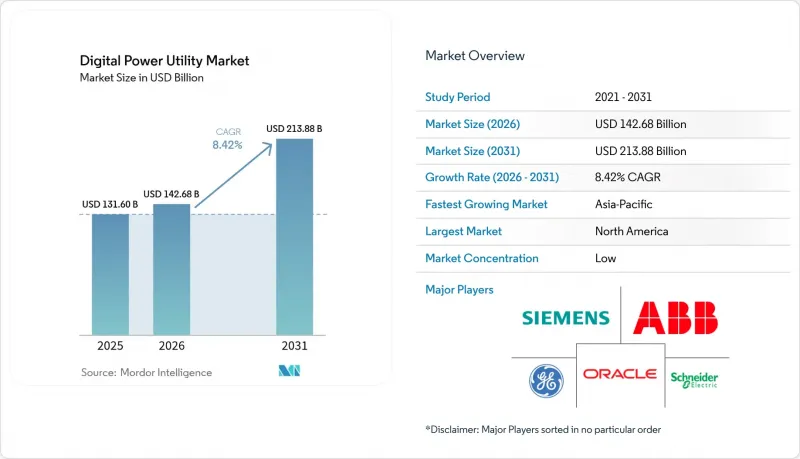
본 보고서는 기술별(통합 솔루션 및 하드웨어), 부문별(발전, 송배전, 에너지 저장, 에너지 거래·소매), 지역별(북미, 유럽, 아시아태평양, 남미, 중동 및 아프리카)로 분류되어 있습니다. 시장 규모 및 전망은 금액(달러)으로 표시되어 있습니다.
세계의 디지털 전력 유틸리티 시장 동향 및 인사이트
스마트 그리드에 대한 투자 가속화
전력 사업자들은 2024년에 스마트 그리드 업그레이드에 400억 달러 이상을 투자하며, 현대화를 자본 계획의 표준적인 관점으로 자리매김했습니다. American Electric Power사의 오하이오주 3억 5,000만 달러 규모 도입 프로젝트와 DTE Energy사의 40억 달러 규모 프로그램은 하드웨어 교체에서 상호 운용성이 높고 데이터가 풍부한 인프라로의 전환을 여실히 보여주고 있습니다. 투자는 정전 감소를 위한 첨단 계량, 배전 자동화, 상황 인식을 융합한 플랫폼을 점점 더 중시하는 추세입니다. 실시간 모니터링을 통해 서비스 중단 시간이 단축되고 현장 유지보수 비용이 절감되므로 투자 수익률은 매력적입니다. 또한, 전력 회사는 부가가치 서비스를 통해 상세한 소비 데이터를 수익화함으로써 새로운 수익 기회도 얻고 있습니다.
재생에너지 및 분산형 에너지 자원(DER)의 통합
FERC 명령 제2222호에 따라 집계된 분산형 자원에 대해 도매 시장이 개방됨에 따라, 레거시 시스템으로는 대응할 수 없는 고도의 조정이 요구되고 있습니다. 현재 수백만 개의 옥상 태양광 발전 설비, 배터리 팩, 전기차 충전기가 전력계통과 상호 연동되어 있으며, 양방향 전력 흐름은 예외가 아닌 당연한 일이 되었습니다. 로컬 처리 기능을 갖춘 엣지 디바이스는 데이터가 제어 센터로 전송되기 전에 마이크로 수준에서 변동을 조정합니다. 이러한 아키텍처를 채택한 전력 회사들은 재생에너지의 출력 변동이 더욱 부드러워지고 출력 억제가 감소했다고 보고하고 있습니다. 이러한 변화는 소비자가 유연한 행동을 취함으로써 금전적 인센티브를 받는 고객 중심의 비즈니스 모델 촉진으로도 이어지고 있습니다.
막대한 초기 설비 투자(CAPEX)가 필요
스마트 그리드의 본격적인 도입에는 고객 1,000명당 200만-500만 달러의 비용이 소요되며, 투자 회수 기간은 일반적인 규제 주기를 초과합니다. 지방채에 의존하는 소규모 협동조합은 자금 조달의 장벽을 넘기 위해 고군분투하고 있으며, 장기적으로는 운영비를 절감할 수 있을 도입이 지연되고 있습니다. 규제상의 지연(신청부터 승인까지 일반적으로 18개월이 소요됨)은 부품 가격이 변동할 때 구매력을 저하시킵니다. 새롭게 등장한 민관 파트너십이 일부 문제를 완화하고 있지만, 그 도입은 여전히 산발적인 수준에 그치고 있습니다.
부문별 분석
2025년 매출액 중 통합 플랫폼이 60.35%를 차지했으며, 이는 데이터 사일로를 해소하고 공급업체 관리를 효율화하는 통합 시스템에 대한 전력 사업자의 선호도를 여실히 보여줍니다. 디지털 트윈은 다양한 부하 및 기후 시나리오 하에서 자산의 거동을 모델링하고 예측 정비를 가능하게 함으로써 예기치 않은 정전을 최대 30%까지 줄여줍니다. 이러한 제품군에 포함된 AI 기반 분석 기능은 부품 고장을 6-12개월 전에 예측하므로, 사업자는 서비스 중단 없이 전력 우회 공급 및 수리 일정을 수립할 시간을 확보할 수 있습니다. 하드웨어 분야의 디지털 전력 유틸리티 시장은 현재로서는 규모가 아직 작지만, 아시아태평양 전체에 걸쳐 수백만 대에 달하는 5G 지원 스마트 계량기, 리클로저, 위상 측정 장치가 도입되고 있어 급속히 확대되고 있습니다. 통신 인프라에 대한 투자는 클라우드 전환과 연동되어 있으며, 실시간 보호 체계에 필수적인 결정론적 지연을 확보하기 위해 광섬유 및 프라이빗 LTE 백본이 구축되고 있습니다. 에지 데이터를 로컬에서 처리하는 미들웨어는 백홀 비용을 절감하는 동시에 고객의 프라이버시를 보호합니다. 이 기능은 데이터 주권에 관한 규제가 강화됨에 따라 주목을 받고 있습니다. 개별 제품도 여전히 중요하지만, 경쟁 우위는 알고리즘 훈련, 기기 펌웨어, 고객 포털을 하나의 통합 솔루션으로 다룰 수 있는 ‘원활한 오케스트레이션’에 있습니다.
하드웨어 구성 요소는 신흥 시장의 계량 시스템 도입 가속화와 스마트 기기의 사후 설치 추세를 반영하여, 2031년까지 연평균 성장률(CAGR) 11.02%를 나타낼 것으로 예측됩니다. 예를 들어, 인도와 동남아시아의 전력 회사는 수익 보호를 계량 데이터의 무결성과 연계하고 있습니다. 또한, 스마트 기기는 선불 결제를 용이하게 하고 미수금 위험을 줄여줍니다. 한편, 성숙 시장에서는 송전망의 안정성을 해치지 않으면서 재생 에너지를 통합하기 위해 릴레이 보호 및 변전소 자동화 시스템의 업데이트가 진행되고 있습니다. 디지털 전력 유틸리티 시장에서는 실리콘 수준에서 사이버 보안 기능을 통합한 벤더가 계속해서 높은 평가를 받고 있으며, 형식 승인을 부여하기 전에 구성 요소 수준의 공격 표면을 평가하도록 한 규제 당국의 요건을 충족하고 있습니다. 플랫폼이 성숙해짐에 따라 개방형 표준 API가 조달 요건의 표준이 되어, 전력 사업자가 단일 벤더의 생태계에 얽매이지 않게 됩니다.
지역별 분석
2025년에는 북미가 시장 매출의 37.45%를 차지하며 1위를 차지했습니다. 내셔널 그리드(National Grid)의 350억 달러 규모의 현대화 프로그램과 퍼스트 에너지(First Energy)의 14억 2,000만 달러 규모의 송전망 강화 이니셔티브 등, 신뢰성 강화 및 재생에너지 통합을 목표로 한 조치에 힘입어 투자가 지속되고 있습니다. ‘인프라 투자 및 고용법’을 통한 연방 정부의 자금 지원은 첨단 도체, 동적 선로 정격 센서, 1초 미만의 보호 체계에 대한 수요를 더욱 부추기고 있습니다. 캐나다의 국경을 넘는 전력 거래 참여 확대는 복잡성을 가중시키고 있으며, 이는 거래 최적화 플랫폼 도입을 촉진하고 있습니다.
아시아태평양은 성장의 원동력이 되고 있으며, 디지털 전력 유틸리티 시장은 2026-2031년 연평균 성장률(CAGR) 12.25%로 확대될 것으로 예측됩니다. 중국은 AI 기반 고장 감지 및 블록체인을 활용한 P2P 결제를 도입한 스마트 그리드 시범 사업에 43억 달러 이상을 투자하고 있습니다. 인도는 전국적인 전력 사업 개혁 프로그램의 일환으로 2억 5,000만 대의 스마트 계량기 도입을 목표로 하고 있습니다. 동남아시아에서는 기존 시장에서 흔히 볼 수 있는 레거시 시스템의 제약을 피하고, 양방향 송전에 대응하는 그린필드 송전망을 구축하고 있습니다. 일본과 한국은 엣지 AI를 활용한 전압 제어 방식의 시범 운영을 지속하고 있으며, 다른 인구 밀집 지역에도 적용 가능한 모델을 제시하고 있습니다.
유럽에서는 ‘유럽 그린딜’의 기후 목표를 바탕으로 꾸준한 추진세가 유지되고 있습니다. 각국은 국경을 초월한 재생에너지 거래를 가능하게 하기 위해 고전압 직류(HVDC) 연계선 및 동적 선로 정격의 도입을 가속화하고 있으며, 한편 지정학적 긴장에 따른 회복탄력성 확보의 필요성으로 인해 상황 인식 분석에 대한 투자가 촉진되고 있습니다. 중동 및 아프리카 시장은 아직 발전 단계에 있지만, 걸프 국가들이 탄화수소 의존에서 벗어나 경제 다각화를 추진하고 있으며, 사하라 이남 경제권이 Off-grid 태양광 발전과 미니그리드를 통합하고 있어 미래성이 기대되고 있습니다. 남미의 상황은 제각각입니다. 브라질에서는 송전 회랑의 확장에 따라 실시간 열 감시가 필요한 반면, 아르헨티나에서는 재생에너지의 급속한 성장으로 인해 분산형 에너지 자원 관리 시스템(DERMS)의 도입이 진행되고 있습니다. 모든 지역에서 데이터 거버넌스에 관한 규제가 아키텍처 선택에 영향을 미치고 있으며, 현지화된 클라우드 존과 엣지 컴퓨팅 노드가 표준 기능으로 자리 잡고 있습니다.
기타 혜택 :
- 엑셀 형식 시장 예측(ME) 시트
- 3개월간의 애널리스트 지원
자주 묻는 질문
목차
제1장 서론
제2장 조사 방법
제3장 주요 요약
제4장 시장 구도
제5장 시장 규모 및 성장 예측
제6장 경쟁 구도
제7장 시장 기회 및 향후 전망
AJY 26.08.26According to Mordor Intelligence, the digital power utility market size was valued at USD 131.60 billion in 2025 and estimated to grow from USD 142.68 billion in 2026 to reach USD 213.88 billion by 2031, at a CAGR of 8.42% during the forecast period (2026-2031).
This report is Segmented by Technology (Integrated Solutions and Hardware), Sector (Power Generation, Transmission and Distribution, Energy Storage, and Energy Trading and Retail), and Geography (North America, Europe, Asia-Pacific, South America, and Middle East and Africa). The Market Sizes and Forecasts are Provided in Terms of Value (USD).
Global Digital Power Utility Market Trends and Insights
Accelerated Smart-Grid Investments
Utilities allocated more than USD 40 billion to smart-grid upgrades during 2024, turning modernisation into the default capital-planning lens. American Electric Power's USD 350 million Ohio deployment and DTE Energy's USD 4 billion programme illustrate the pivot from hardware replacement toward interoperable, data-rich infrastructure. Investments increasingly favour platforms that fuse advanced metering, distribution automation, and situational awareness for outage mitigation. The return profile is attractive because real-time monitoring trims service-interruption minutes and curbs field-maintenance costs. Utilities also gain new revenue opportunities by monetising granular consumption data through value-added services.
Integration of Renewable Energy & DERs
FERC Order 2222 opened wholesale markets to aggregated distributed resources, demanding sophisticated orchestration that legacy systems cannot support. Millions of rooftop solar arrays, battery packs, and EV chargers now interact with the bulk grid, making bidirectional flows normal rather than exceptional. Edge devices with local processing balance micro-level variability before data flows upward to control centres. Utilities adopting these architectures report smoother renewable ramp-rates and lower curtailment. The shift also spurs customer-centric business models in which consumers receive financial incentives for flexible behaviour.
High Upfront CAPEX Requirements
Full-scale smart-grid deployments cost USD 2-5 million per thousand customers, with recovery periods stretching beyond typical regulatory cycles. Smaller cooperatives relying on municipal bonds struggle to clear financing thresholds, delaying roll-outs that could lower operating expenses in the long term. Regulatory lag-often 18 months between filing and approval-erodes purchasing power when component prices fluctuate. Emerging public-private partnerships provide partial relief, yet adoption remains sporadic.
Other drivers and restraints analyzed in the detailed report include:
- Regulatory Push for Decarbonisation & Efficiency
- Edge-AI Deployment for Real-Time Grid Optimisation
- Legacy-System Interoperability Barriers
For complete list of drivers and restraints, kindly check the Table Of Contents.
Segment Analysis
Integrated platforms held 60.35% of 2025 revenue, underscoring utilities' preference for unified systems that collapse data silos and streamline vendor management. Digital twins model asset behaviour under various loading and climate scenarios, enabling predictive maintenance that cuts unplanned outages by up to 30%. AI-driven analytics within these suites forecast component failures six to twelve months in advance, giving operators time to re-route power and schedule repairs without service disruption. The digital power utility market for hardware remains smaller today, yet it is expanding faster because millions of 5G-enabled smart meters, reclosers, and phasor measurement units are entering service across the Asia-Pacific. Communication infrastructure investments synchronize with cloud migration, laying fibre and private-LTE backbones that secure deterministic latency essential for real-time protection schemes. Middleware that processes edge data locally reduces backhaul costs while safeguarding customer privacy, a capability gaining traction as data-sovereignty regulations tighten. Although individual products still matter, the competitive edge lies in seamless orchestration, the ability to treat algorithm training, device firmware, and customer portals as one converged solution.
Hardware components are forecast to record an 11.02% CAGR through 2031, reflecting accelerated metering roll-outs and intelligent device retrofits in emerging markets. For example, utilities in India and Southeast Asia tie revenue protection to meter data integrity; intelligent devices also facilitate prepaid billing, reducing receivables risk. Meanwhile, mature markets update relay protection and substation automation to integrate renewables without compromising grid stability. The digital power utility market continues to reward vendors that embed cybersecurity features at the silicon level, satisfying regulators who now evaluate component-level attack surfaces before granting type approval. As platforms mature, open-standards APIs become default procurement requirements, so utilities are not locked into single-vendor ecosystems.
Complete Report Scope:
- By Technology
- Integrated Solutions
- Digital Twin Platforms
- AI and Analytics Suites
- IoT and Edge-Computing Middleware
- Hardware
- Intelligent Grid Devices (IEDs)
- Advanced Metering Infrastructure
- Communication Infrastructure
- Integrated Solutions
- By Sector
- Power Generation
- Transmission and Distribution
- Energy Storage
- Energy Trading and Retail
- By Geography
- North America
- United States
- Canada
- Mexico
- Europe
- Germany
- United Kingdom
- France
- Italy
- NORDIC Countries
- Russia
- Rest of Europe
- Asia-Pacific
- China
- India
- Japan
- South Korea
- ASEAN Countries
- Rest of Asia-Pacific
- South America
- Brazil
- Argentina
- Rest of South America
- Middle East and Africa
- Saudi Arabia
- United Arab Emirates
- South Africa
- Egypt
- Rest of Middle East and Africa
- North America
Geography Analysis
North America led with 37.45% market revenue in 2025. Investment has been sustained by measures such as National Grid's USD 35 billion modernisation programme and FirstEnergy's USD 1.42 billion grid enhancement initiative, aiming to fortify reliability and integrate renewables. Federal funding via the Infrastructure Investment and Jobs Act further ignites demand for advanced conductors, dynamic line-rating sensors, and sub-second protection schemes. Canada's growing participation in cross-border power trading introduces additional complexity that fuels the adoption of trading-optimization platforms.
Asia-Pacific represents the growth engine, with the digital power utility market expected to expand at a 12.25% CAGR from 2026 to 2031. China has invested over USD 4.3 billion in smart-grid pilots incorporating AI fault-detection and blockchain-enabled peer-to-peer settlement. India is targeting 250 million smart-meter installations under nationwide utility-reform programmes. Southeast Asia builds greenfield grids designed for bidirectional flows, bypassing legacy-system limitations common in older markets. Japan and South Korea continue to pilot edge-AI voltage-control schemes, demonstrating exportable blueprints for other densely populated regions.
Europe maintains steady momentum anchored by the European Green Deal's climate objectives. Nations accelerate HVDC interconnectors and dynamic line-rating deployment to unlock cross-border renewable trade, while resilience imperatives following geopolitical tensions spur investments in situational-awareness analytics. The Middle East and Africa's market remains nascent but shows promise as Gulf states diversify away from hydrocarbons and sub-Saharan economies integrate off-grid solar with mini-grids. South America exhibits mixed dynamics; Brazil's expanding transmission corridors require real-time thermal monitoring, whereas Argentina's renewable boom drives distributed-resource management system (DERMS) procurement. Across all regions, data-governance regulations influence architectural choices, making localised cloud zones and edge compute nodes standard features.
- ABB Ltd
- Accenture PLC
- AutoGrid Systems Inc.
- Capgemini SE
- Cisco Systems Inc.
- General Electric Company
- Hitachi Energy Ltd
- Honeywell International Inc.
- IBM Corporation
- Infosys Limited
- Itron Inc.
- Landis+Gyr Group AG
- Microsoft Corporation
- Oracle Corporation
- OSI (Open Systems International)
- SAP SE
- Schneider Electric SE
- Siemens AG
- Wipro Limited
Additional Benefits:
- The market estimate (ME) sheet in Excel format
- 3 months of analyst support
TABLE OF CONTENTS
1 Introduction
- 1.1 Study Assumptions & Market Definition
- 1.2 Scope of the Study
2 Research Methodology
3 Executive Summary
4 Market Landscape
- 4.1 Market Overview
- 4.2 Market Drivers
- 4.2.1 Accelerated smart-grid investments
- 4.2.2 Integration of renewable energy & DERs
- 4.2.3 Regulatory push for decarbonization & efficiency
- 4.2.4 Edge-AI deployment for real-time grid optimisation
- 4.2.5 Data-centre flexibility procurement surge
- 4.2.6 Cyber-resilience mandates driving digital-twin uptake
- 4.3 Market Restraints
- 4.3.1 High upfront CAPEX requirements
- 4.3.2 Legacy-system interoperability barriers
- 4.3.3 Utility-grade data-scientist scarcity
- 4.3.4 Rising cyber-insurance premiums
- 4.4 Supply-Chain Analysis
- 4.5 Regulatory Landscape
- 4.6 Technological Outlook
- 4.7 Porter's Five Forces
- 4.7.1 Bargaining Power of Suppliers
- 4.7.2 Bargaining Power of Consumers
- 4.7.3 Threat of New Entrants
- 4.7.4 Threat of Substitutes
- 4.7.5 Intensity of Competitive Rivalry
5 Market Size & Growth Forecasts
- 5.1 By Technology
- 5.1.1 Integrated Solutions
- 5.1.1.1 Digital Twin Platforms
- 5.1.1.2 AI and Analytics Suites
- 5.1.1.3 IoT and Edge-Computing Middleware
- 5.1.2 Hardware
- 5.1.2.1 Intelligent Grid Devices (IEDs)
- 5.1.2.2 Advanced Metering Infrastructure
- 5.1.2.3 Communication Infrastructure
- 5.1.1 Integrated Solutions
- 5.2 By Sector
- 5.2.1 Power Generation
- 5.2.2 Transmission and Distribution
- 5.2.3 Energy Storage
- 5.2.4 Energy Trading and Retail
- 5.3 By Geography
- 5.3.1 North America
- 5.3.1.1 United States
- 5.3.1.2 Canada
- 5.3.1.3 Mexico
- 5.3.2 Europe
- 5.3.2.1 Germany
- 5.3.2.2 United Kingdom
- 5.3.2.3 France
- 5.3.2.4 Italy
- 5.3.2.5 NORDIC Countries
- 5.3.2.6 Russia
- 5.3.2.7 Rest of Europe
- 5.3.3 Asia-Pacific
- 5.3.3.1 China
- 5.3.3.2 India
- 5.3.3.3 Japan
- 5.3.3.4 South Korea
- 5.3.3.5 ASEAN Countries
- 5.3.3.6 Rest of Asia-Pacific
- 5.3.4 South America
- 5.3.4.1 Brazil
- 5.3.4.2 Argentina
- 5.3.4.3 Rest of South America
- 5.3.5 Middle East and Africa
- 5.3.5.1 Saudi Arabia
- 5.3.5.2 United Arab Emirates
- 5.3.5.3 South Africa
- 5.3.5.4 Egypt
- 5.3.5.5 Rest of Middle East and Africa
- 5.3.1 North America
6 Competitive Landscape
- 6.1 Market Concentration
- 6.2 Strategic Moves (M&A, Partnerships, PPAs)
- 6.3 Market Share Analysis (Market Rank/Share for key companies)
- 6.4 Company Profiles (includes Global level Overview, Market level overview, Core Segments, Financials as available, Strategic Information, Products & Services, and Recent Developments)
- 6.4.1 ABB Ltd
- 6.4.2 Accenture PLC
- 6.4.3 AutoGrid Systems Inc.
- 6.4.4 Capgemini SE
- 6.4.5 Cisco Systems Inc.
- 6.4.6 General Electric Company
- 6.4.7 Hitachi Energy Ltd
- 6.4.8 Honeywell International Inc.
- 6.4.9 IBM Corporation
- 6.4.10 Infosys Limited
- 6.4.11 Itron Inc.
- 6.4.12 Landis+Gyr Group AG
- 6.4.13 Microsoft Corporation
- 6.4.14 Oracle Corporation
- 6.4.15 OSI (Open Systems International)
- 6.4.16 SAP SE
- 6.4.17 Schneider Electric SE
- 6.4.18 Siemens AG
- 6.4.19 Wipro Limited
7 Market Opportunities & Future Outlook
- 7.1 White-space & Unmet-Need Assessment


