

|
시장보고서
상품코드
2114116
약물유전체학 시장 : 시장 점유율 분석, 업계 동향 및 통계, 성장 예측(2026-2031년)Pharmacogenomics - Market Share Analysis, Industry Trends & Statistics, Growth Forecasts (2026 - 2031) |
||||||
 Mordor Intelligence
Mordor Intelligence에 의하면, 약물유전체학 시장 규모는 2025년 102억 7,000만 달러로 평가되었고, 2026년에는 111억 5,000만 달러로 추정되고, 2026-2031년 CAGR 8.61%로 성장을 지속할 전망이며, 2031년에는 168억 6,000만 달러에 이를 것으로 예측됩니다.
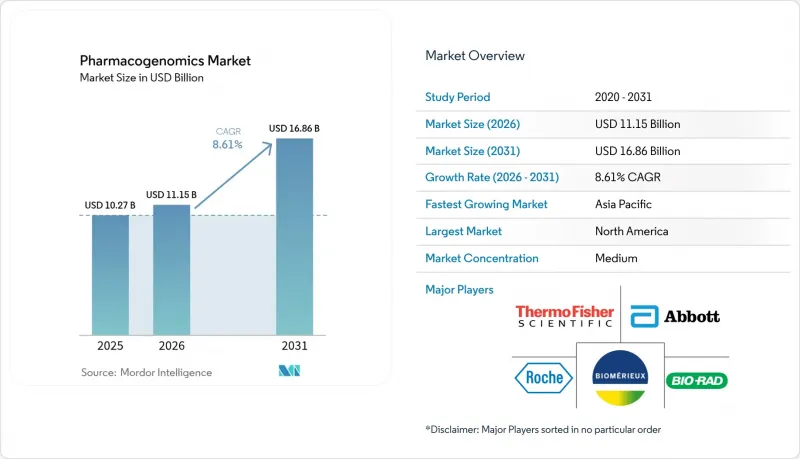
본 보고서는 제품 및 서비스별(장비, 시약 및 키트 등), 기술별(중합효소 연쇄반응, DNA 염기서열 분석 등), 검체 유형별(혈액 등), 용도별(신약·의약품 개발, 종양학, 신경학 등), 지역별(북미, 유럽,아시아태평양, 중동 및 아프리카, 남미)로 분류되어 있습니다. 시장 예측은 금액(달러)으로 제시되어 있습니다.
세계의 약물유전체학 시장 동향 및 인사이트
맞춤형 의료에 대한 수요 증가
현재 의료 시스템에서는 유전자 검사를 핵심 인프라로 간주하고 있습니다. 이는 예방적 유전자 패널 검사를 활용함으로써 처방 조정이 42% 감소하고, 복약 순응도가 향상된다는 결과 데이터가 제시되었기 때문입니다. PREPARE 다기관 공동 연구에서는 파마코유전체학에 기반한 지침 하에서 약물 관련 이상반응이 33% 감소한 것으로 보고되었습니다. 미국 재향군인부는 획일적인 처방에서 벗어나, 약물 선택을 재향군인의 유전자형에 맞추기 위한 전국적인 프로그램을 전개하고 있습니다. 이러한 이점은 예산이 제한된 의료 시스템에서도 약물유전체학 시장의 꾸준한 성장을 뒷받침하고 있습니다. 또한, 풍부한 데이터를 기반으로 한 도입 모델은 보험사가 장기적인 비용 절감 효과를 정량화하는 데 도움이 되며, 보험 적용 확대 제안을 강화하고 있습니다.
유전자 염기서열 분석 기술의 발전
일루미나(Illumina)사의 ‘NovaSeq X’는 시료당 비용을 절감하면서도 처리량을 향상시켜, 지역 병원에서도 종합적인 패널 검사를 이용할 수 있는 가격대를 실현했습니다. 옥스포드 나노포어(Oxford Nanopore)와 팩바이오(PackBio)의 롱 리드 플랫폼은 기존 방법으로는 검출할 수 없었던 CYP2D6의 구조적 변이를 규명할 수 있게 되었습니다. 일리노이 대학교의 나노포어 시스템은 시퀀싱 시간을 2주에서 1시간으로 단축하고 비용을 90% 절감함으로써, 환자 곁에서 검사를 가능하게 하고 있습니다. 3세대 도구는 검사 대상이 제한적이었던 집단에서 복잡한 하플로유형을 포착하여 형평성 격차를 해소하는 동시에, 대상 약물유전체학 시장을 확대되고 있습니다. 또한, 더 빠르고 저렴한 시퀀싱을 통해 정보 분석 및 상담 서비스에 할당할 예산을 확보할 수 있게 됩니다.
약물유전체학 검사에 수반되는 높은 비용
종합적인 검사 패널의 비용은 200-2,000달러 범위이며, 보험에 가입하지 않은 환자나 소규모 진료소에게는 경제적 부담이 되고 있습니다. 또한, 지방의 의료 제공업체는 교육 및 IT 통합 비용도 부담해야 하므로 도입이 지연되고 있습니다. 의사결정 지원 엔진에 대한 초기 투자는 자본 예산을 압박하지만, 모델링에 따르면 부작용 감소로 인해 장기적으로는 비용 절감이 예상됩니다. 일괄 구매 컨소시엄이나 머신러닝을 활용한 분류 도구는 검사 1건당 비용을 절감하는 데 도움이 됩니다. 시약 및 시퀀싱 장비 비용의 하락으로 인해 중기적으로는 이러한 제약이 완화될 전망입니다.
부문 분석
2025년 현재, 시약 및 키트는 약물유전체학 시장 점유율의 43.92%를 차지했으며, 이는 검사 건수의 많음과 소모품의 견인력에 힘입은 것입니다. 그러나 소프트웨어 및 서비스는 연평균 성장률(CAGR) 10.68%로 가장 빠르게 성장하고 있으며, 이는 원시 시퀀싱 데이터보다 실행 가능한 인사이트력으로의 전환을 반영합니다. 병원에서는 전자 차트에 직접 통합될 수 있는 AI 지원형 의사결정 지원 모듈을 선호하고 있으며, 이를 통해 해석에 소요되는 시간을 몇 시간에서 몇 분으로 단축하고 있습니다. PGxAI사의 ‘Deneb’ 모델은 약물유전체학적 판정 결과와 약물 반응 알고리즘을 융합하여 투여량 조정에 활용함으로써 이러한 변화를 상징하고 있습니다. 기기 분야는 각 벤더사가 검체 전처리, 증폭, 분석 기능을 단일 벤치사이드 장치에 통합하여 워크플로우의 복잡성을 줄이고 있기 때문에 계속해서 안정적인 수익원으로 자리 잡고 있습니다.
습식 실험실과 디지털 구성 요소의 융합으로 인해, 약물유전체학 시장의 솔루션 번들 형태가 재정의되고 있습니다. QIAGEN사의 QIAcuity 디지털 PCR 제품군은 2024년에 100종의 어세이를 추가하여 종양학, 순환기학, 통증 관리 패널을 지원하고 있습니다. 서비스 계약에는 현재, 사전 동의에 관한 인증 기준을 충족하기 위해 원격 유전 상담이 포함되어 있습니다. 클라우드 인프라가 성숙해짐에 따라, 구독형 바이오인포매틱스가 영구 라이선스를 대체하며 공급업체와 진료소 양측의 현금 흐름을 원활하게 하고 있습니다. 이러한 동향은 수익을 정기적인 분석 및 지원 서비스로 전환함으로써, 약물유전체학 시장 규모 확대 추세를 뒷받침하고 있습니다.
DNA 시퀀싱은 이미 약물유전체학 시장 점유율의 32.41%를 차지하고 있으며, 시약 비용의 하락과 돌연변이 감지 능력의 향상에 힘입어 연평균 성장률(CAGR) 11.86%를 나타낼 것으로 예측됩니다. 일루미나(Illumina)의 NovaSeq X 플랫폼은 유전체당 비용을 절감하고 대규모 의료 네트워크에서 집단 시퀀싱을 가능하게 했습니다. 팩바이오(PackBio)의 롱 리드 장치는 오피오이드 투여량 결정에 필수적인 복잡한 CYP2D6 재구성을 매핑합니다.
마이크로어레이는 여전히 고처리량 표적 패널에서 유용하며, 특히 190만 개의 PGx 마커를 보유한 ‘인피니움 세계 다이버시티 어레이(Infinium Global Diversity Array)’가 대표적입니다. PCR 분석법은 수술 전후의 항혈소판제 관리 등 신속한 결과 제공이 필수적인 상황에서 우위를 발휘합니다. 질량 분석법 및 전기영동법은 틈새 시장에서 여전히 그 역할을 유지하고 있습니다. 이러한 종합적인 영향으로 인해 멀티오믹스 시퀀싱 허브를 중심으로 한 통합이 진행되며, 약물유전체학 시장이 강화되고 있습니다.
지역별 분석
2025년, 북미는 약물유전체학 시장의 41.35%를 차지했습니다. 이는 성숙한 검사실 인프라, CPIC 도입을 위한 자원, 그리고 FDA의 지원적인 프레임워크에 힘입은 결과입니다. 메이요 클리닉과 콜로라도 대학교는 워크플로우 통합의 모범 사례를 제시하고 있는 반면, 재향군인부(VA) 프로그램은 900만 명의 가입자로 그 범위를 확대되고 있습니다. 그러나 보험사별 대응에는 편차가 나타나고 있으며, 유나이티드 헬스케어(United Healthcare)의 2024년 보험 적용 제한으로 인해 다유전자 패널의 보급이 둔화되고 있습니다(myriad.com).
유럽에서는 꾸준한 진전이 나타나고 있으며, 유럽의약품청(EMA)이 2024년에 AI를 활용한 약물유전체학에 관한 지침을 최종 확정함에 따라, 제약사들은 동반진단 신청을 확대하기 위한 명확한 지침을 얻게 되었습니다. 프랑스, 독일, 북유럽 국가들의 국민건강보험 서비스에서는 장기적인 비용 절감 효과를 측정하기 위해 집단 패널 실증 시험을 실시하고 있으며, 이는 약물유전체학 시장의 추가적인 확산을 촉진하고 있습니다.
아시아태평양은 가장 성장세가 두드러지는 지역으로, 연평균 성장률(CAGR)은 14.18%로 예측됩니다. 중국의 ‘제14차 5개년 계획(의료 분야)’에는 공공 병원에 대한 약물유전체학 스크리닝 도입이 포함되었으며, 국내 시퀀싱 공급망 확보가 진행되고 있습니다. Acrannolife와 같은 인도의 스타트업 기업들은 순환기학 및 정신의학 분야를 위한 현지 가격으로 책정된 PGx 패키지를 제공합니다. 싱가포르의 한 조사에 따르면, 참가자의 46.1%가 치료적 의의를 지닌 CYP2D6 대립 유전자를 보유하고 있는 것으로 밝혀져, 미충족 의료 수요가 크다는 사실이 부각되었습니다(nature.com). 대규모 코호트와 다양한 하플로유형은 전 세계 바이오마커 발견 파이프라인을 강화하고, 약물유전체학 시장 전체의 규모를 확대시키고 있습니다.
기타 혜택 :
- 엑셀 형식 시장 예측(ME) 시트
- 3개월간의 애널리스트 지원
자주 묻는 질문
목차
제1장 서론
제2장 조사 방법
제3장 주요 요약
제4장 시장 구도
제5장 시장 규모 및 성장 예측
제6장 경쟁 구도
제7장 시장 기회 및 향후 전망
AJY 26.08.26According to Mordor Intelligence, the pharmacogenomics market size is expected to grow from USD 10.27 billion in 2025 to USD 11.15 billion in 2026 and is forecast to reach USD 16.86 billion by 2031 at 8.61% CAGR over 2026-2031.
This report is Segmented by Product & Service (Instruments, Reagents & Kits, and More), Technology (Polymerase Chain Reaction, DNA Sequencing, and More), Sample Type (Blood, and More), Application (Drug Discovery & Development, Oncology, Neurology, and More), and Geography (North America, Europe, Asia-Pacific, Middle East and Africa, South America). The Market Forecasts are Provided in Terms of Value (USD).
Global Pharmacogenomics Market Trends and Insights
Rising Demand for Personalized Medicine
Health systems now view genetic testing as core infrastructure because outcome data show 42% fewer prescribing adjustments and higher adherence when pre-emptive panels are used. The PREPARE multisite study reported a 33% drop in drug-related adverse events under pharmacogenomic guidance. Veterans Affairs has rolled out a nationwide program to align drug choice with veterans' genotypes, moving away from one-size-fits-all prescribing. These benefits underpin steady pharmacogenomics market growth even in budget-constrained systems. Data-rich implementation models also help payers quantify long-term savings, strengthening coverage proposals.
Advancements in Genetic Sequencing Technologies
Illumina's NovaSeq X has lowered per-sample costs while boosting throughput, making comprehensive panels affordable for community hospitals. Oxford Nanopore and PacBio long-read platforms now resolve CYP2D6 structural variants missed by earlier methods. A University of Illinois nanopore system compresses sequencing time from 2 weeks to 1 hour, cutting costs by 90% and enabling near-patient testing. Third-generation tools capture complex haplotypes in under-represented populations, closing equity gaps and expanding the addressable pharmacogenomics market. Faster, cheaper sequencing also frees budgets for informatics and counseling services.
High Costs Associated with Pharmacogenomic Testing
Comprehensive panels range from USD 200-2,000, creating affordability gaps for uninsured patients and small clinics. Rural providers also shoulder training and IT integration expenses, delaying roll-outs. Upfront investment in decision-support engines strains capital budgets, although modeling shows long-run savings from fewer adverse reactions. Bulk-purchasing consortia and machine-learning triage tools help curb per-test charges. Cost declines in reagents and sequencing hardware are expected to ease this restraint in the medium term.
Other drivers and restraints analyzed in the detailed report include:
- Growing Prevalence of Chronic and Genetic Diseases
- Increasing Research and Development Investments
- Limited Reimbursement Coverage
For complete list of drivers and restraints, kindly check the Table Of Contents.
Segment Analysis
Reagents and kits represented 43.92% of pharmacogenomics market share in 2025, underpinned by high test volumes and consumable pull-through. Yet software and services are expanding fastest at 10.68% CAGR, reflecting a pivot toward actionable insights over raw sequence data. Hospitals favor AI-assisted decision-support modules that plug directly into electronic health records, reducing interpretation time from hours to minutes. PGxAI's Deneb model exemplifies this shift by blending pharmacogenetic calls with drug-response algorithms to inform dosing adjustments. Instruments remain a steady contributor as vendors integrate sample prep, amplification and analytics into single bencheside units, easing workflow complexity.
The convergence of wet-lab and digital components is redefining solution bundles within the pharmacogenomics market. QIAGEN's QIAcuity digital PCR line added 100 assays in 2024 to support oncology, cardiology and pain panels. Service contracts now include tele-genetic counseling to meet accreditation standards for informed consent. As cloud infrastructure matures, subscription-based bioinformatics is displacing perpetual licenses, smoothing cash flow for both suppliers and clinics. These trends reinforce the pharmacogenomics market size trajectory by shifting revenue toward recurring analytics and support offerings.
DNA sequencing already commands 32.41% of pharmacogenomics market share and is projected to grow at 11.86% CAGR, lifted by falling reagent costs and richer variant detection. Illumina's NovaSeq X platform reduced per-genome costs, unlocking population-scale screening for large health networks. Long-read instruments from PacBio map complex CYP2D6 rearrangements critical for opioid dosing.
Microarrays remain relevant for high-throughput targeted panels, especially the Infinium Global Diversity Array with 1.9 million PGx markers. PCR assays win where rapid turnaround is vital, such as perioperative antiplatelet management. Mass-spectrometry and electrophoresis retain niche roles. The net effect is continued consolidation around multi-omics sequencing hubs, strengthening the pharmacogenomics market.
Complete Report Scope:
- By Product & Service
- Instruments
- Reagents & Kits
- Software & Services
- By Technology
- Polymerase Chain Reaction (PCR)
- DNA Sequencing
- Microarray
- Mass Spectrometry
- Electrophoresis
- Other Technologies
- By Sample Type
- Blood
- Saliva
- Other Biospecimens
- By Application
- Drug Discovery & Development
- Oncology
- Neurology
- Cardiology
- Pain Management
- Other Therapeutic Areas
- By Geography
- North America
- United States
- Canada
- Mexico
- Europe
- Germany
- United Kingdom
- France
- Italy
- Spain
- Rest of Europe
- Asia-Pacific
- China
- Japan
- India
- Australia
- South Korea
- Rest of Asia-Pacific
- Middle East & Africa
- GCC
- South Africa
- Rest of Middle East & Africa
- South America
- Brazil
- Argentina
- Rest of South America
- North America
Geography Analysis
North America accounted for 41.35% of the pharmacogenomics market in 2025, underpinned by mature lab infrastructure, CPIC implementation resources and supportive FDA frameworks. Mayo Clinic and University of Colorado provide blueprints for workflow integration, while the Veterans Affairs program extends reach across 9 million enrollees. Nonetheless, payer variability persists, with UnitedHealthcare's 2024 coverage curbs dampening multigene panel uptake myriad.com.
Europe shows steady advances as the European Medicines Agency finalized AI-driven pharmacogenomic guidance in 2024, giving manufacturers clarity to scale companion-diagnostic submissions. National health services in France, Germany and the Nordics are piloting population panels to measure long-term cost offsets, promoting broader pharmacogenomics market penetration.
Asia-Pacific is the fastest-growing region, forecast at 14.18% CAGR. China's Five-Year Health Plan embeds pharmacogenomic screening into public hospitals and secures domestic sequencing supply chains. Indian start-ups like Acrannolife provide locally priced PGx bundles for cardiology and psychiatry. Singapore research found 46.1% of participants carried actionable CYP2D6 alleles, underscoring unmet need nature.com. Expansive population cohorts and diverse haplotypes augment global biomarker discovery pipelines, amplifying the overall pharmacogenomics market size.
- Abbott Laboratories
- Agilent Technologies
- Beckton Dickinson
- bioMerieux
- Bio-Rad Laboratories
- Eurofins
- Roche
- Illumina
- Merck
- Pacific Biosciences
- PerkinElmer
- QIAGEN
- Thermo Fisher Scientific
- Myriad Genetics
- Genomind
- OneOme
- Admera Health
- Genelex
- Coriell Life Sciences
- Danaher
- Luminex
- Color Health
- Natera
Additional Benefits:
- The market estimate (ME) sheet in Excel format
- 3 months of analyst support
TABLE OF CONTENTS
1 Introduction
- 1.1 Study Assumptions & Market Definition
- 1.2 Scope of the Study
2 Research Methodology
3 Executive Summary
4 Market Landscape
- 4.1 Market Overview
- 4.2 Market Drivers
- 4.2.1 Rising Demand for Personalized Medicine
- 4.2.2 Advancements in Genetic Sequencing Technologies
- 4.2.3 Growing Prevalence of Chronic and Genetic Diseases
- 4.2.4 Increasing Research and Development Investments
- 4.2.5 High Incidence of Adverse Drug Reactions (ADRs)
- 4.2.6 Expanding Pharmaceutical and Biotechnology Industries
- 4.3 Market Restraints
- 4.3.1 High Costs Associated with Pharmacogenomic Testing
- 4.3.2 Limited Reimbursement Coverage
- 4.3.3 Ethical and Privacy Concerns
- 4.3.4 Lack of Clear Regulatory Guidelines
- 4.4 Porter's Five Forces Analysis
- 4.4.1 Threat of New Entrants
- 4.4.2 Bargaining Power of Buyers
- 4.4.3 Bargaining Power of Suppliers
- 4.4.4 Threat of Substitutes
- 4.4.5 Intensity of Competitive Rivalry
5 Market Size & Growth Forecasts (Value in USD)
- 5.1 By Product & Service
- 5.1.1 Instruments
- 5.1.2 Reagents & Kits
- 5.1.3 Software & Services
- 5.2 By Technology
- 5.2.1 Polymerase Chain Reaction (PCR)
- 5.2.2 DNA Sequencing
- 5.2.3 Microarray
- 5.2.4 Mass Spectrometry
- 5.2.5 Electrophoresis
- 5.2.6 Other Technologies
- 5.3 By Sample Type
- 5.3.1 Blood
- 5.3.2 Saliva
- 5.3.3 Other Biospecimens
- 5.4 By Application
- 5.4.1 Drug Discovery & Development
- 5.4.2 Oncology
- 5.4.3 Neurology
- 5.4.4 Cardiology
- 5.4.5 Pain Management
- 5.4.6 Other Therapeutic Areas
- 5.5 By Geography
- 5.5.1 North America
- 5.5.1.1 United States
- 5.5.1.2 Canada
- 5.5.1.3 Mexico
- 5.5.2 Europe
- 5.5.2.1 Germany
- 5.5.2.2 United Kingdom
- 5.5.2.3 France
- 5.5.2.4 Italy
- 5.5.2.5 Spain
- 5.5.2.6 Rest of Europe
- 5.5.3 Asia-Pacific
- 5.5.3.1 China
- 5.5.3.2 Japan
- 5.5.3.3 India
- 5.5.3.4 Australia
- 5.5.3.5 South Korea
- 5.5.3.6 Rest of Asia-Pacific
- 5.5.4 Middle East & Africa
- 5.5.4.1 GCC
- 5.5.4.2 South Africa
- 5.5.4.3 Rest of Middle East & Africa
- 5.5.5 South America
- 5.5.5.1 Brazil
- 5.5.5.2 Argentina
- 5.5.5.3 Rest of South America
- 5.5.1 North America
6 Competitive Landscape
- 6.1 Market Concentration
- 6.2 Market Share Analysis
- 6.3 Company Profiles (includes Global level Overview, Market level overview, Core Segments, Financials as available, Strategic Information, Market Rank/Share for key companies, Products & Services, and Recent Developments)
- 6.3.1 Abbott Laboratories
- 6.3.2 Agilent Technologies
- 6.3.3 Becton, Dickinson & Co.
- 6.3.4 bioMerieux
- 6.3.5 Bio-Rad Laboratories
- 6.3.6 Eurofins Scientific
- 6.3.7 F. Hoffmann-La Roche AG
- 6.3.8 Illumina
- 6.3.9 Merck KGaA
- 6.3.10 Pacific Biosciences
- 6.3.11 PerkinElmer
- 6.3.12 Qiagen
- 6.3.13 Thermo Fisher Scientific Inc.
- 6.3.14 Myriad Genetics
- 6.3.15 Genomind
- 6.3.16 OneOme
- 6.3.17 Admera Health
- 6.3.18 Genelex
- 6.3.19 Coriell Life Sciences
- 6.3.20 Danaher Corporation
- 6.3.21 Luminex Corporation
- 6.3.22 Color Health
- 6.3.23 Natera
7 Market Opportunities & Future Outlook
- 7.1 White-space & Unmet-Need Assessment


