

|
시장보고서
상품코드
2114145
마약 스캐너 시장 : 시장 점유율 분석, 업계 동향 및 통계, 성장 예측(2026-2031년)Narcotics Scanner - Market Share Analysis, Industry Trends & Statistics, Growth Forecasts (2026 - 2031) |
||||||
 Mordor Intelligence
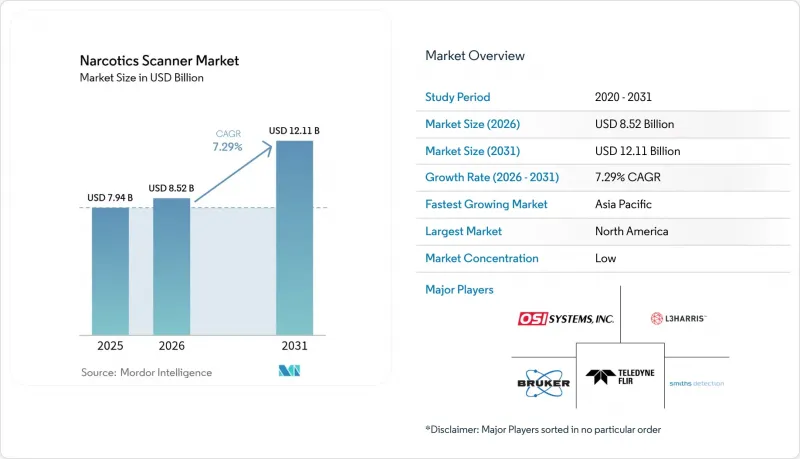
Mordor Intelligence에 의하면, 마약 스캐너 시장 규모는 2025년 79억 4,000만 달러로 평가되었고, 2026년에는 85억 2,000만 달러로 추정되고, 2026-2031년 CAGR 7.29%로 성장을 지속할 전망이며, 2031년에는 121억 1,000만 달러에 이를 것으로 예측됩니다.
본 보고서는 제품 유형별(데스크톱/벤치탑형, 핸드헬드/휴대형, 워크스루형, 차량/컨테이너용 스캐너, 로봇형 및 드론 탑재형), 기술별(이온 이동도 분광법, 라만 분광법 등), 약물 유형별(오피오이드, 코카인 등), 최종 사용자별(공항, 항만 등), 지역별로 분류되어 있습니다. 시장 예측은 금액(달러) 기준으로 제시되어 있습니다.
세계의 마약 스캐너 시장 동향 및 인사이트
우편 및 택배 경로를 통한 합성 오피오이드 밀수가 급증
2024년에는 우편 경로를 통해 사상 최대량의 펜타닐이 운송되었으며, 우편 센터는 신속한 선별을 위해 X선 컴퓨터 단층 촬영과 분광 분석을 결합한 고처리 능력 스캐너의 도입을 불가피하게 되었습니다. ‘STOP법’에 따라 국제 배송업체는 위험 평가 엔진에 반영될 사전 전자 데이터 제공이 의무화되었으며, 이를 통해 세관 당국은 위험 표시가 된 소포를 자동 검사 레인으로 분류할 수 있게 되었습니다. 로렌스 리버모어 연구소는 CT 영상에서 위협을 인식하는 정확도를 향상시키는 ‘물리학 기반 물질 식별 기술’에 대한 특허를 취득했습니다. 이를 통해 검사 주기를 단축하면서 감지 정확도를 높일 수 있게 되었습니다. 압수 사례 분석에 따르면, 밀수업자들은 파라핀 왁스 병이나 허위 표시된 전자 부품을 이용하고 있는 것으로 밝혀졌으며, 이에 따라 화학·생물·폭발물 센서를 단일 사용자 인터페이스(UI) 하에 통합한 다층 스크리닝이 추진되고 있습니다.
공항 내 듀얼 에너지 자동 미량 물질 감지 시스템 도입 확대
미국 교통안전청(TSA)은 형광을 발산하지 않고 포장재를 투과하여 감지하는 1064 nm 라만식 휴대용 장치의 개량을 위해 수년에 걸쳐 보조금을 투입하고 있으며, 이를 통해 2차 검사 대기 줄을 대폭 단축하고 있습니다. 미국 국토안보부의 ‘Screening at Speed’ 프로그램에서는 3초 이내에 금속 및 유기물 위협을 식별하는 밀리파식 휴대용 장치의 시범 운영이 진행되고 있습니다. 일본 세관은 스미스 디텍션(Smiths Detection)사에 차세대 포털형 검사 장비를 발주했으며, 오경보를 억제하기 위해 AI 이미지 분석을 통합한 고해상도 듀얼 에너지 어레이로 전 세계가 전환하는 것을 뒷받침하고 있습니다.
이온 이동도 분광법의 높은 위양성률이 사용자의 신뢰를 떨어뜨리고 있습니다.
검토를 거친 연구에 따르면, 펜타닐에 대해 나노그램 수준의 감도를 보이지만, 동시에 무해한 물질과의 교차 반응도 지적되고 있으며, 이것이 반복적인 경보를 유발하여 운영자의 신뢰를 떨어뜨리고 있습니다. NIST는 오염을 제한하기 위해 석영을 사용한 튜브의 재설계를 제안하고 있으며, 확인을 위해 IMS와 라만 분광법을 결합한 워크플로우 프로토콜을 제안함으로써 조사 지연을 절반으로 줄이고 있습니다. 현재 공항에서는 이온 이동도 시그니처를 적응형 라이브러리와 대조하는 머신러닝 필터를 도입하여, 고가의 하드웨어를 교체하지 않고도 오감지율을 줄이고 있습니다.
부문 분석
2025년에는 순찰 경찰관과 세관 직원이 현장 초기 선별에서 휴대성을 중시한 결과, 핸드헬드형 장치가 마약 스캐너 시장의 45.60%를 차지했습니다. 로봇 및 드론 탑재형 시스템은 시장 규모는 작지만, 위험한 장소나 광대한 구역에서의 원격 검사에 대한 수요를 반영하여 연평균 성장률(CAGR) 8.18%로 성장할 전망입니다. 핸드헬드형 마약 스캐너 시장 규모는 새로운 AI 펌웨어로 인해 감지 시간이 단축되고 임무 생산성이 향상됨에 따라 꾸준히 확대될 것으로 예측됩니다. 한편, 데스크톱형 분석 장치는 증거 관리 요건으로 인해 종합적인 스펙트럼 확인이 요구되는 실험실 워크플로우에서 계속해서 핵심적인 역할을 수행하고 있습니다. 한편, 컨테이너용 갠트리형 장비는 듀얼 에너지 이미징과 중성자 시그니처를 통합하여 해운 노선에서 100% 스캔 의무 준수를 보장합니다. 각 벤더사는 동일한 검출 코어를 사용하여 휴대용에서 로봇 탑재형으로 전환할 수 있는 모듈형 키트를 포지셔닝함으로써, 수명 주기 전반에 걸쳐 고객 유지율을 높이고 있습니다.
운영상의 제약이 제품 전략을 형성하고 있습니다. 워크스루형 포털은 구형 터미널 내 설치에 제한이 있어 신규 도입이 억제되고 있지만, 다중 에너지 센서를 추가하는 개조 공사를 통해 기존 설비의 유용성이 유지되고 있습니다. 드론의 탑재 능력은 현재 소형화된 라만 장치에 대응하고 있어, 승선 전에 선박 갑판을 상공에서 스캔하는 것이 가능해졌습니다. 증거 분석 실험실에서는 탁상형 질량 분석기가 여전히 주류를 이루고 있지만, 현장용 키트를 통해 추정된 데이터를 사법 데이터베이스에 직접 업로드하는 사례가 증가하면서 미처리 사건의 적체를 줄이고 있습니다. 이러한 융합은 통일된 훈련 방침을 뒷받침하고, 당국의 도입 비용을 절감하며, 교체 수요를 촉진함으로써 2030년까지 마약 스캐너 시장을 지탱하고 있습니다.
이온 이동도 분광법(IMS)은 성숙한 공급망과 운영자의 숙련도를 바탕으로 2025년 매출의 37.70%를 차지했습니다. 테라헤르츠 시스템이 연평균 성장률(CAGR) 8.44%를 기록함에 따라, IMS의 마약 스캐너 시장 점유율은 점차 감소할 것으로 예측됩니다. 테라헤르츠 장비는 서브mm급 해상도로 숨겨진 물체를 매핑하여 직접 접촉의 필요성을 없애줍니다. 이는 이온화 방사선 사용을 피할 수 있기 때문에 사생활 보호를 중시하는 시설에 특히 매력적입니다.
라만 분광법은 휴대용 장치의 도입으로 그 성장세가 더욱 확대되고 있습니다. 1064 nm 대역에서의 기술 발전으로 형광이 감소하여 불투명한 플라스틱을 통과하는 스캔 속도가 향상되었습니다. 적외선 분광법 및 FT-IR 분광법은 분자 지문 분석이 요구되는 특수한 틈새 시장에서 입지를 유지하고 있습니다. 단일 하우징 내에 라만 분광법과 IMS를 통합한 하이브리드 구성에서는 위협 프로파일에 따라 스캔 작업을 분할함으로써 오경보를 줄이고 있습니다. X선 회절 시스템은 벌크 분말의 결정 구조에 대한 정보를 제공하지만, 높은 초기 투자 비용이 보급을 저해하고 있습니다. 각 기업은 소프트웨어 정의형 검출 기술에 대한 연구 개발에 주력하고 있으며, 이를 통해 라이브러리를 무선으로 업데이트함으로써 하드웨어를 교체하지 않고도 새로운 향정신성 약물에 대한 대응을 확실하게 하고 있습니다.
지역별 분석
북미는 2025년에 전 세계 매출의 41.95%를 차지했으며, 여전히 핵심 지역으로서의 지위를 유지하고 있습니다. 이는 수입 소포에 대한 전자 데이터 제출을 의무화하는 ‘STOP 법’과 같은 연방 정부의 규제와, 첨단 검사 장비에 대한 보조금을 지원하는 국토안보부(DHS)의 프로그램에 힘입은 결과입니다. 세관·국경보호국(CBP)은 주요 입국 지점에서 현장 실험실 시범 사업을 실시하여, 압수 정보와 조달 간의 피드백 루프를 강화하고 있습니다. 이 지역의 마약 스캐너 시장 규모는 2027년까지 공급업체의 수주 잔고를 확보해 주는 다년간의 예산 배정의 혜택을 받고 있습니다.
아시아태평양은 연평균 성장률(CAGR) 8.29%로 확대될 것으로 예상되며, 이는 전 세계에서 가장 빠른 속도입니다. 각국 정부는 국경 검문소와 항만 시설의 현대화를 위해 새로운 자금을 배정하고 있는 반면, 법 집행 기관은 합성 각성제의 확산을 막기 위해 비접촉식 라만 분광법 휴대용 장비를 도입하고 있습니다. 일본이 우즈베키스탄의 기동팀에 제공한 250만 달러 규모의 지원 패키지는 지역 거래량을 견인하는 국경을 초월한 역량 구축의 좋은 예입니다. 중국의 희토류 분야 지배적 지위는 원자재 조달 리스크를 초래하므로, 구매자들은 비용 변동을 헤지하기 위해 이중 조달을 추구하고 있으며, 이로 인해 지역 공급업체들이 탄력을 받고 있습니다.
유럽에서는 생체 인증 도입을 지연시키는 개인정보 보호 문제가 있음에도 불구하고 안정적인 업데이트 수요가 나타나고 있습니다. 각 기관은 GDPR(EU 개인정보보호규정)(일반 데이터 보호 규정)을 준수하면서 데이터 처리의 한계를 보완하기 위해 테라헤르츠파 및 중성자 기술에 투자하고 있습니다. 남미에서는 북미 경로를 통한 코카인 유입에 대응하기 위해 컨테이너 스캐너 도입을 확대하고 있으며, 기술 이전을 위해 양자 간 원조를 활용하고 있습니다. 중동 및 아프리카에서는 대규모 항만 및 중요 인프라 정비에 투입되는 마약·테러 대책 자금에 발맞추어 수요가 서서히 확대되고 있습니다. 신흥 경제국 전반에서는 재정 주기에 맞추어 확장 가능한 모듈식 솔루션을 우선시하고 있으며, 이로 인해 마약 감지 스캐너 시장에는 장기적인 성장 여지가 확보되어 있습니다.
기타 혜택 :
- 엑셀 형식 시장 예측(ME) 시트
- 3개월간의 애널리스트 지원
자주 묻는 질문
목차
제1장 서론
제2장 조사 방법
제3장 주요 요약
제4장 시장 구도
제5장 시장 규모 및 성장 예측
제6장 경쟁 구도
제7장 시장 기회 및 향후 전망
AJY 26.08.26According to Mordor Intelligence, the narcotics scanner market size is expected to grow from USD 7.94 billion in 2025 to USD 8.52 billion in 2026 and is forecast to reach USD 12.11 billion by 2031 at 7.29% CAGR over 2026-2031.
This report is Segmented by Product Type (Desktop/Benchtop, Handheld/Portable, Walk-Through Portal, Vehicle/Container Scanners, Robotic and Drone-Mounted), Technology (Ion Mobility Spectrometry, Raman Spectroscopy, and More), Drug Type (Opioids, Cocaine, and More), End-User (Airports, Seaports, and More), and Geography. The Market Forecasts are Provided in Terms of Value (USD).
Global Narcotics Scanner Market Trends and Insights
Surge in synthetic opioid trafficking via postal and express freight routes
Postal channels moved record fentanyl volumes in 2024, forcing mail centers to deploy high-throughput scanners that marry X-ray computed tomography with spectroscopy for rapid triage. The STOP Act obliges international shippers to provide advance electronic data that feeds risk-scoring engines, allowing customs teams to route flagged parcels into automated inspection lanes. Lawrence Livermore patented physics-informed material disambiguation that improves threat recognition in CT images, cutting inspection cycle times while raising hit accuracy. Seizure intelligence shows traffickers using paraffin wax jars and mislabeled electronic parts, spurring multi-layer screening that blends chemical, biological, and explosive sensors under a single UI.
Rising airport adoption of dual-energy automated trace detection systems
The Transportation Security Administration funnels multiyear grants to refine 1064 nm Raman handhelds that read through packaging without fluorescence, slashing secondary screening queues. The Department of Homeland Security Screening at Speed program pilots millimeter-wave wands that discern metallic and organic threats in under three seconds. Japanese customs ordered next-generation portals from Smiths Detection, reinforcing a global pivot toward high-resolution dual-energy arrays that integrate AI image-analytics to suppress false alarms.
High False-Positive Rates of Ion Mobility Spectrometry Reducing User Confidence
Peer-reviewed studies show nanogram sensitivity for fentanyl but also highlight cross-reactivity with benign substances, which drives repeat alarms and erodes operator trust. NIST advocates tube redesigns using quartz to limit contamination and proposes workflow protocols that pair IMS with Raman for confirmation, halving investigative delays. Airports now insert machine-learning filters that compare ion mobility signatures against adaptive libraries, trimming error ratios without expensive hardware swaps.
Other drivers and restraints analyzed in the detailed report include:
- Regulatory mandates for 100% container scanning at major seaports
- Increasing use of contactless Raman handhelds by field law enforcement
- Data-privacy constraints limiting biometric-integrated scanner deployment in the EU
For complete list of drivers and restraints, kindly check the Table Of Contents.
Segment Analysis
Handheld units generated 45.60% of the narcotics scanner market in 2025 as patrol officers and customs agents prioritized portability for on-scene triage. Robotic and drone-mounted systems, while accounting for a smaller base, are set to advance at 8.18% CAGR, reflecting demand for remote inspection in hazardous or expansive areas. The narcotics scanner market size for handhelds is projected to widen steadily because new AI firmware pushes down detection time, improving mission productivity. Desktop analyzers continue to anchor laboratory workflows where chain-of-custody requirements demand comprehensive spectral confirmation. Meanwhile, container gantries integrate dual-energy imaging and neutron signatures, ensuring compliance with 100% scanning mandates in shipping lanes. Vendors position modular kits that let agencies migrate from handhelds to robotic mounts using the same detection core, driving lifecycle stickiness.
Operational constraints shape product strategy. Walk-through portals face installation limits inside older terminals, curbing new builds; however, retrofits that add multienergy sensors keep the installed base relevant. Drone payload capacity now supports miniaturized Raman devices, enabling aerial scanning of ship decks before boarding. Benchtop mass-spectrometry remains dominant in evidentiary labs, but field kits increasingly upload presumptive data directly to judicial databases, shortening case backlogs. This convergence supports a unified training doctrine, reducing agency onboarding costs and bolstering replacement demand, sustaining the narcotics scanner market through 2030.
Ion mobility spectrometry delivered 37.70% of 2025 revenue, underpinned by mature supply chains and operator familiarity. The narcotics scanner market share for IMS is forecast to erode gradually as terahertz systems post an 8.44% CAGR. Terahertz units map concealed objects with sub-millimeter resolution, eliminating the need for direct contact, which is particularly appealing to privacy-conscious venues as it avoids the use of ionizing radiation.
Raman spectroscopy builds on momentum from handheld deployments; advancements at 1064 nm reduce fluorescence, speeding up scans through opaque plastics. Infrared and FT-IR spectroscopy maintain specialized niches where molecular fingerprinting is required. Hybrid stacks that merge Raman and IMS inside a single chassis split scan duty by threat profile, mitigating false alarms. X-ray diffraction systems offer crystallographic insights for bulk powders, although high capital costs restrain uptake. Firms channel R&D toward software-defined detection that updates libraries over the air, ensuring responsiveness to novel psychoactive substances without hardware replacement.
Complete Report Scope:
- By Product Type
- Desktop / Benchtop
- Handheld / Portable
- Walk-Through Portal
- Vehicle / Container Scanners
- Robotic and Drone-Mounted Scanners
- By Technology
- Ion Mobility Spectrometry (IMS)
- Raman Spectroscopy
- Infrared (FT-IR and NIR) Spectroscopy
- Mass Spectrometry
- Terahertz Imaging
- X-ray Diffraction (XRD)
- Neutron Activation and Gamma-Ray
- Hybrid and Multi-Modal Systems
- By Drug Type Detected
- Opioids (Heroin, Fentanyl and Analogues)
- Cocaine and Crack
- Methamphetamine and Amphetamines
- Cannabis and THC Concentrates
- Novel Psychoactive Substances
- Others
- By Deployment Site / End-user
- Airports
- Seaports and Container Terminals
- Land Border Crossings
- Law-Enforcement and Police Departments
- Defense and Military Facilities
- Postal and Courier Sorting Centers
- Correctional Facilities and Prisons
- Private Industry and Critical Infrastructure
- By Geography
- North America
- United States
- Canada
- Mexico
- South America
- Brazil
- Argentina
- Colombia
- Rest of South America
- Europe
- Germany
- France
- United Kingdom
- Spain
- Italy
- Rest of Europe
- Asia-Pacific
- China
- India
- Japan
- South Korea
- Southeast Asia
- Australia
- New Zealand
- Rest of Asia-Pacific
- Middle East and Africa
- Middle East
- Saudi Arabia
- United Arab Emirates
- Israel
- Turkey
- Rest of Middle East
- Africa
- South Africa
- Nigeria
- Kenya
- Rest of Africa
- Middle East
- North America
Geography Analysis
North America contributed 41.95% of global revenue in 2025 and remains the anchor region, fueled by federal mandates such as the STOP Act that enforce electronic data submission for inbound parcels and by DHS programs that subsidize advanced screening gear. Customs and Border Protection executes on-site lab pilots at major gateways, tightening the feedback loop between seizure intelligence and procurement. The narcotics scanner market size in the region benefits from multiyear budget allocations that secure vendor order backlogs through 2027.
Asia Pacific is projected to expand at 8.29% CAGR, the fastest worldwide. Governments allocate new funding to modernize border posts and port facilities, while law enforcement units acquire contactless Raman handhelds aimed at synthetic stimulants proliferation. Japan's USD 2.5 million support package for Uzbekistan's mobile teams exemplifies cross-border capacity building that drives regional volume. China's rare-earth dominance poses input risk; hence buyers pursue dual sourcing to hedge cost volatility, giving regional suppliers traction.
Europe shows steady replacement demand despite the privacy hurdles that slow biometric integration. Agencies invest in terahertz and neutron techniques to offset data-processing limits while aligning with the GDPR. South America scales container scanners to combat cocaine flow toward North Atlantic routes, leveraging bilateral aid for knowledge transfer. Middle East and Africa see incremental gains tied to counter-narco-terrorism funds that equip large seaports and critical infrastructure. Collectively, emerging economies prioritize modular solutions that can grow with fiscal cycles, ensuring long runway for the narcotics scanner market.
- OSI Systems Inc. (Rapiscan Systems)
- Smiths Detection Inc.
- FLIR Systems Inc. (Teledyne FLIR)
- Bruker Corporation
- L3Harris Technologies (Security and Detection)
- Nuctech Company Limited
- Viken Detection
- Thermo Fisher Scientific Inc.
- CEIA SpA
- DetectaChem LLC
- Astrophysics Inc.
- Chemring Group PLC
- QinetiQ Group PLC
- Leidos Holdings Inc.
- Teledyne Photon Machines
- Rigaku Corporation
- Safran SA (Morpho Detection legacy)
- Environics Oy
- Westminster Group PLC
- Rapisafe LLC
Additional Benefits:
- The market estimate (ME) sheet in Excel format
- 3 months of analyst support
TABLE OF CONTENTS
1 INTRODUCTION
- 1.1 Study Assumptions and Market Definition
- 1.2 Scope of the Study
2 RESEARCH METHODOLOGY
3 EXECUTIVE SUMMARY
4 MARKET LANDSCAPE
- 4.1 Market Overview
- 4.2 Market Drivers
- 4.2.1 Surge in Synthetic Opioid Trafficking via Postal and Express Freight Routes in North America and Europe
- 4.2.2 Rising Airport Adoption of Dual-Energy Automated Trace Detection Systems
- 4.2.3 Regulatory Mandates for 100 % Container Scanning at Major Seaports (e.g., US SAFE Port Act)
- 4.2.4 Increasing Use of Contactless Raman Handhelds by Field Law Enforcement in Asia
- 4.2.5 Growth of Dark-Web Parcel Deliveries Prompting Mail Center Screening Investments
- 4.2.6 Government Funding for Counter-Narco Terrorism Programs in Middle East and Africa
- 4.3 Market Restraints
- 4.3.1 High False-Positive Rates of Ion Mobility Spectrometry Reducing User Confidence
- 4.3.2 Data-Privacy Constraints Limiting Biometric-Integrated Scanner Deployment in EU
- 4.3.3 Budgetary Austerity in Small Airports and Caribbean Harbors
- 4.3.4 Supply-Chain Dependence on Rare-Earth Components Inflating Scanner Costs
- 4.4 Impact of Macroeconomic Factors on the Market
- 4.5 Regulatory Outlook
- 4.6 Porter's Five Forces Analysis
- 4.6.1 Threat of New Entrants
- 4.6.2 Bargaining Power of Buyers/Consumers
- 4.6.3 Bargaining Power of Suppliers
- 4.6.4 Threat of Substitute Products
- 4.6.5 Intensity of Competitive Rivalry
- 4.7 Industry Value Chain Analysis
- 4.8 Investment Analysis
5 MARKET SIZE AND GROWTH FORECASTS (VALUE)
- 5.1 By Product Type
- 5.1.1 Desktop / Benchtop
- 5.1.2 Handheld / Portable
- 5.1.3 Walk-Through Portal
- 5.1.4 Vehicle / Container Scanners
- 5.1.5 Robotic and Drone-Mounted Scanners
- 5.2 By Technology
- 5.2.1 Ion Mobility Spectrometry (IMS)
- 5.2.2 Raman Spectroscopy
- 5.2.3 Infrared (FT-IR and NIR) Spectroscopy
- 5.2.4 Mass Spectrometry
- 5.2.5 Terahertz Imaging
- 5.2.6 X-ray Diffraction (XRD)
- 5.2.7 Neutron Activation and Gamma-Ray
- 5.2.8 Hybrid and Multi-Modal Systems
- 5.3 By Drug Type Detected
- 5.3.1 Opioids (Heroin, Fentanyl and Analogues)
- 5.3.2 Cocaine and Crack
- 5.3.3 Methamphetamine and Amphetamines
- 5.3.4 Cannabis and THC Concentrates
- 5.3.5 Novel Psychoactive Substances
- 5.3.6 Others
- 5.4 By Deployment Site / End-user
- 5.4.1 Airports
- 5.4.2 Seaports and Container Terminals
- 5.4.3 Land Border Crossings
- 5.4.4 Law-Enforcement and Police Departments
- 5.4.5 Defense and Military Facilities
- 5.4.6 Postal and Courier Sorting Centers
- 5.4.7 Correctional Facilities and Prisons
- 5.4.8 Private Industry and Critical Infrastructure
- 5.5 By Geography
- 5.5.1 North America
- 5.5.1.1 United States
- 5.5.1.2 Canada
- 5.5.1.3 Mexico
- 5.5.2 South America
- 5.5.2.1 Brazil
- 5.5.2.2 Argentina
- 5.5.2.3 Colombia
- 5.5.2.4 Rest of South America
- 5.5.3 Europe
- 5.5.3.1 Germany
- 5.5.3.2 France
- 5.5.3.3 United Kingdom
- 5.5.3.4 Spain
- 5.5.3.5 Italy
- 5.5.3.6 Rest of Europe
- 5.5.4 Asia-Pacific
- 5.5.4.1 China
- 5.5.4.2 India
- 5.5.4.3 Japan
- 5.5.4.4 South Korea
- 5.5.4.5 Southeast Asia
- 5.5.4.6 Australia
- 5.5.4.7 New Zealand
- 5.5.4.8 Rest of Asia-Pacific
- 5.5.5 Middle East and Africa
- 5.5.5.1 Middle East
- 5.5.5.1.1 Saudi Arabia
- 5.5.5.1.2 United Arab Emirates
- 5.5.5.1.3 Israel
- 5.5.5.1.4 Turkey
- 5.5.5.1.5 Rest of Middle East
- 5.5.5.2 Africa
- 5.5.5.2.1 South Africa
- 5.5.5.2.2 Nigeria
- 5.5.5.2.3 Kenya
- 5.5.5.2.4 Rest of Africa
- 5.5.5.1 Middle East
- 5.5.1 North America
6 COMPETITIVE LANDSCAPE
- 6.1 Market Concentration
- 6.2 Strategic Moves
- 6.3 Market Share Analysis
- 6.4 Company Profiles (includes Global-Level Overview, Market-Level Overview, Core Segments, Financials, Strategic Information, Market Rank/Share, Products and Services, and Recent Developments)
- 6.4.1 OSI Systems Inc. (Rapiscan Systems)
- 6.4.2 Smiths Detection Inc.
- 6.4.3 FLIR Systems Inc. (Teledyne FLIR)
- 6.4.4 Bruker Corporation
- 6.4.5 L3Harris Technologies (Security and Detection)
- 6.4.6 Nuctech Company Limited
- 6.4.7 Viken Detection
- 6.4.8 Thermo Fisher Scientific Inc.
- 6.4.9 CEIA SpA
- 6.4.10 DetectaChem LLC
- 6.4.11 Astrophysics Inc.
- 6.4.12 Chemring Group PLC
- 6.4.13 QinetiQ Group PLC
- 6.4.14 Leidos Holdings Inc.
- 6.4.15 Teledyne Photon Machines
- 6.4.16 Rigaku Corporation
- 6.4.17 Safran SA (Morpho Detection legacy)
- 6.4.18 Environics Oy
- 6.4.19 Westminster Group PLC
- 6.4.20 Rapisafe LLC
7 MARKET OPPORTUNITIES AND FUTURE OUTLOOK
- 7.1 White-space and Unmet-Need Assessment


