

|
시장보고서
상품코드
2114151
태양전지판 재활용 : 시장 점유율 분석, 업계 동향과 통계, 성장 예측(2026-2031년)Solar Panel Recycling - Market Share Analysis, Industry Trends & Statistics, Growth Forecasts (2026 - 2031) |
||||||
 Mordor Intelligence
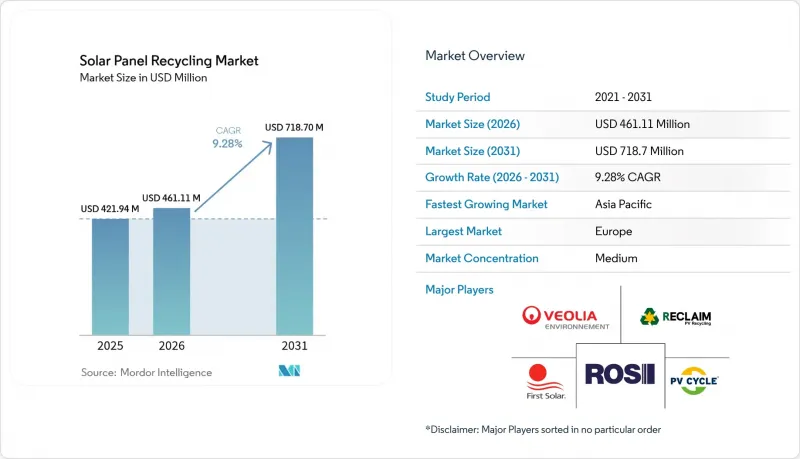
Mordor Intelligence에 따르면 태양전지판 재활용 시장 규모는 2025년 4억 2,194만 달러에서 2026년에는 4억 6,111만 달러로 확대하며, 2026-2031년에 CAGR 9.28%로 추이하며, 2031년까지 7억 1,870만 달러에 달할 것으로 예측됩니다.
이 보고서는 공정(열처리, 기계적 처리, 레이저 처리), 패널 유형(결정질 실리콘, 박막), 수명(일반 열화, 조기 열화),회수 소재(유리, 실리콘 웨이퍼, 은, 알루미늄, 기타 금속) 및 지역(북미, 유럽, 아시아태평양, 남미, 중동 및 아프리카)별로 분류되어 있습니다. 시장 규모 및 전망은 금액(달러) 기준으로 제시되어 있습니다.
전 세계 태양전지판 재활용 시장의 동향 및 인사이트
2025-2030년에 수명이 다한 태양광 모듈의 폐기가 급증할 전망
최초의 고정가격임베디드제도(FIT) 붐이 일어난 지 25년이 지나면서, 구형 태양광발전 어레이의 폐기량이 급증하고 있습니다. 이탈리아에서는 2050년까지 452만 톤의 태양광발전 폐기물이 발생할 것으로 예측되며, 초기 옥상 설치 인센티브가 만료되는 2036년경에 정점을 찍을 전망입니다. 2022년까지 393GW의 설치 용량을 달성한 중국에서는 2030년까지 18GW의 폐기 모듈이 발생할 것으로 예측되며, 이러한 폐기물 흐름에 대응하기 위해 전용 재활용 작업 분과회가 설립되었습니다. 처리량의 집중화를 통해 단위당 물류 비용이 절감되고, 처리 업체는 고정밀 설비의 감가상각이 가능해짐에 따라 태양전지판 재활용 시장은 단순한 폐기물 처리에서 가치 창출로 전환되고 있습니다.
EU식 WEEE(폐전기전자기기) 준수 의무가 전 세계에서 확대
유럽연합(EU)이 제시한 회수율 85%, 재료 회수율 80%라는 목표는 세계 표준 모델이 되었습니다. 워싱턴주의 제조자 회수법은 2025년 7월에 시행되었습니다. 사우스캐롤라이나주는 2024년에 이에 이어 13에이커를 초과하는 태양광발전 설비를 대상으로 한 등록 제도를 도입했습니다. 2025년 중반에 시행될 예정인 미국 연방 정부의 ‘범용 폐기물 규정(Universal Waste Rule)’안은 주를 넘나드는 요건을 통일하는 것입니다. 투자자에게 있으며, 예측 가능한 규정 준수 비용은 재활용 공장의 다년간 걸친 투자 회수를 지원하는 기반이 되며, 태양전지판 재활용 시장에게는 이러한 규제를 통해 지속적인 원료 공급이 확보되는 결과를 가져옵니다.
재활용 비용은 여전히 회수되는 유리 덩어리의 가치를 상회하고 있습니다.
유리는 패널 질량의 3분의 2를 차지하지만, 재판매 가치는 극히 미미합니다. 모듈 1장의 재활용 비용은 15-45달러에 달하는 반면, 매립 처리 비용은 2달러입니다. 그러나 유럽의 시범 프로젝트에서는 태양광발전용 규격을 충족하는 평판유리가 제조되고 있으며, 고품질이면서 저탄소인 유리가 이러한 격차를 해소할 가능성을 시사하고 있습니다. 당분간 태양전지판 재활용 시장의 유리 부문에 있어서는 보조금과 친환경 설계 규제가 여전히 필수적입니다.
부문 분석
2025년 태양전지판 재활용 시장에서 기계식 파쇄는 63.72%의 시장 점유율을 차지하고 있으며, 설비 투자 비용이 낮고 처리 능력이 입증되어 지지를 받고 있습니다. 반면, 레이저를 이용한 박리 기술은 연평균 성장률(CAGR) 14.88%로 성장하고 있으며, 펨토초 펄스를 활용하여 솔더를 녹이지 않고 셀을 박리함으로써 은의 순도를 유지하고 있습니다. NREL(국립재생에너지연구소)의 연구 성과가 시범 단계에서 실용화 단계로 전환됨에 따라 레이저 처리 라인을 통한 태양전지판 재활용 시장 규모는 3배로 증가할 것으로 예상됩니다. 프레임 제거로 시작하여 레이저 또는 열을 이용한 박리로 끝나는 하이브리드 플로우 시트에서는 현재 95%에 육박하는 회수율을 달성하고 있으며, 원자재 수입과의 비용 격차가 줄어들고 있습니다. 2세대 시설에서는 머신 비전 선별기와 로봇 그리퍼를 결합하는 사례가 늘어나고 있으며, 수작업을 절반으로 줄이는 동시에 작업자의 안전성을 높이고 있습니다. 기계식 플랫폼은 특히 대규모 재고의 경우, 유리 및 알루미늄의 분해를 효율적으로 처리하고 있습니다. 대량 처리와 정밀 처리라는 두 가지 흐름이 공존하고 있다는 사실은 태양전지판 재활용 시장이 단일 기술에 기반한 서비스에서 다양한 원료의 혼합에 최적화된 다양한 공정 포트폴리오로 전환되고 있음을 보여줍니다.
2025년 폐기물 유입량 중 결정질 실리콘 모듈이 88.34%를 차지하며, 이 부문에서 태양전지판 재활용 시장의 규모를 주도하고 있습니다. 박막 모듈의 처리량은 여전히 소규모이지만, 특히 유틸리티 분야에서 CIGS 및 CdTe의 도입이 증가함에 따라 연평균 성장률(CAGR) 17.46%로 성장할 것으로 예측됩니다. 퍼스트 솔라(First Solar)의 글로벌 네트워크는 지금까지 약 40만 톤의 CdTe 모듈을 재활용하여 왔으며, 95%라는 높은 재료 회수율을 자랑하며 다른 박막 기업이 따라잡고자 하는 벤치마크가 되고 있습니다.
경제성은 크게 다릅니다. 결정계에서는 은이나 웨이퍼의 회수가 중시되는 반면, 박막계에서는 텔루륨, 카드뮴, 인듐의 회수가 주요 목표가 됩니다. 현재 특수한 침출법이나 전해 정련법을 활용함으로써 48시간 이내에 52% 이상의 인듐을 회수할 수 있게 되었으며, 이를 통해 차세대 헤테로접합 생산 라인의 원자재 공급 위험이 줄어들고 있습니다. 모듈의 다양화가 진행됨에 따라 이에 특화된 시설도 증가하고 있으며, 태양전지판 재활용 시장은 복잡성이 커지는 한편, 수익의 폭도 넓어질 것입니다.
지역별 분석
2025년, 유럽은 태양전지판 재활용 시장의 38.15%를 차지했습니다. 이는 주로 WEEE 지침에 기반한 85% 회수율 및 80% 회수율이라는 의무적 기준이 도입되었기 때문입니다. 독일에서는 2030년까지 40만-100만 톤의 태양광발전 폐기물이 발생할 것으로 예측되고 있으며, 이는 에코디자인 지침의 더욱 엄격한 재활용 가능성 기준에 따른 처리 능력 확대를 촉진하고 있습니다. AGC Glass Europe이 ROSI와 제휴하여 초저탄소 유리를 개발하고 있는 것과 같은 국경을 초월한 협력 관계는 순환형 경제 정책과 산업계의 연계를 보여주는 좋은 사례입니다.
아시아태평양은 연평균 성장률(CAGR) 15.92%가 예상되며, 중국의 393GW에 달하는 설치 용량이 세계 최대 사용 후 태양전지판 폐기물 풀을 형성하고 있습니다. CP가 자금을 지원하는 작업반이 국가 기준 초안을 작성 중이며, 장쑤성과 산시성에 위치한 시범 플랜트에서는 기계·열 하이브리드 방식을 산업 규모로 확대하고 있습니다. 인도의 규정 초안에서는 재활용 사업자에 대한 사업성 격차 자금 지원 및 폐기물 보고 의무화가 제안되어 있으며, 이들이 채택되면 투자가 촉진될 것으로 기대됩니다. 일본의 적립 기금 정책은 재활용과 토지 복원을 위한 자금을 확보하고 있으며, 이 지역에 참고가 될 만한 모델을 제공하고 있습니다.
북미에서는 ‘인플레이션 억제법’에 따른 세액 공제 혜택을 받고 있으며, 재활용 금속이 국내 생산 성분으로 취급되고 있습니다. 워싱턴주의 2025년 회수법과 사우스캐롤라이나주의 2024년 입지 규정은 지방 차원의 확실성을 높이고 있습니다. 2025년에 예정된 연방 정부의 ‘일반 폐기물’ 지정은 주 경계를 넘는 물류를 원활하게 할 것입니다. SOLARCYCLE사가 3억 4,400만 달러를 투자한 시더타운 공장은 민간 부문의 자신감을 상징하며, 연간 1,000만 장의 모듈을 처리하고 5-6GW 분량의 재활용 유리를 공급할 수 있습니다.
기타 혜택:
- 엑셀 형식의 시장 예측(ME) 시트
- 3개월간의 애널리스트 지원
자주 묻는 질문
목차
제1장 서론
제2장 조사 방법
제3장 개요
제4장 시장 구도
제5장 시장 규모와 성장 예측
제6장 경쟁 구도
제7장 시장 기회와 향후 전망
KSA 26.08.26According to Mordor Intelligence, the solar panel recycling market size is expected to grow from USD 421.94 million in 2025 to USD 461.11 million in 2026 and is forecast to reach USD 718.7 million by 2031 at 9.28% CAGR over 2026-2031.
This report is Segmented by Process (Thermal, Mechanical, and Laser), Panel Type (Crystalline Silicon and Thin Film), Shelf Life (Normal Loss and Early Loss), Material Recovered (Glass, Silicon Wafers, Silver, Aluminum, and Other Metals), and Geography (North America, Europe, Asia-Pacific, South America, and Middle East and Africa). The Market Sizes and Forecasts are Provided in Terms of Value (USD).
Global Solar Panel Recycling Market Trends and Insights
Wave of End-of-Life PV Modules Hitting in 2025-2030
A quarter-century after the first feed-in-tariff boom, a surge of legacy arrays is approaching retirement. Italy expects 4.52 million t of PV waste by 2050, peaking near 2036 when early rooftop incentives reach obsolescence. China, with 393 GW installed by 2022, anticipates 18 GW of discarded modules by 2030 and has established dedicated recycling working groups to address this stream. Volume clustering reduces unit logistics costs and enables processors to amortize high-precision equipment, shifting the solar panel recycling market from waste disposal to value extraction.
EU-Style WEEE Compliance Mandates Expanding Worldwide
The European Union's 85% collection and 80% material-recovery targets have become the default global template. Washington State's producer-take-back law took effect in July 2025. South Carolina followed in 2024 with a registration regime for arrays bigger than 13 acres. Proposed U.S. federal universal-waste rules, slated for mid-2025, would harmonize interstate requirements. For investors, predictable compliance costs underpin multiyear recycling-plant paybacks, and for the solar panel recycling market, the mandates lock in recurring feedstock.
Recycling Cost Still Exceeds Value of Recovered Bulk Glass
Glass accounts for two-thirds of a panel's mass, yet it offers minimal resale value. The cost to recycle a module can range from USD 15 to USD 45, compared to USD 2 for landfill dumping. Pilot projects in Europe, however, have produced flat glass that meets PV-grade specifications, hinting that premium, low-carbon glass could close the gap. In the near term, subsidies and ecodesign rules remain essential for the glass fraction of the solar panel recycling market.
Other drivers and restraints analyzed in the detailed report include:
- Rising Commodity Value of Silver, Indium & Other Critical Materials
- Commercial-Scale Mechanical + Thermal Hybrid Processes Slash Recycling Costs
- Patchy Collection Logistics & Reverse-Supply Networks
For complete list of drivers and restraints, kindly check the Table Of Contents.
Segment Analysis
Mechanical shredding held a 63.72% market share in the solar panel recycling market in 2025, favoured for its low capital expenditure and proven throughput. Yet laser-enabled delamination is growing at 14.88% CAGR, leveraging femtosecond pulses to detach cells without melting solder, thereby preserving silver purity. The solar panel recycling market size for laser lines is expected to triple as NREL results move from pilot to commercial adoption. Hybrid flowsheets that begin with frame removal and conclude with laser or thermal delamination now exhibit recovery rates approaching 95%, shrinking the cost gap with raw-material imports.Second-generation facilities increasingly couple machine-vision sorters with robotic grippers, reducing hands-on labor by half and enhancing operator safety. Mechanical platforms continue to handle glass and aluminum disassembly efficiently, particularly for utility-scale inventories. The coexistence of bulk-volume and precision-value streams illustrates the solar panel recycling market's transition from a single-technology service to a diversified process portfolio optimized for a mix of feedstocks.
Crystalline silicon modules accounted for 88.34% of 2025 waste inflows, thereby anchoring the solar panel recycling market size for that category. Thin-film volumes remain modest but are forecast to grow at an 17.46% CAGR as CIGS and CdTe deployments rise, especially in utility segments. First Solar's global network, which has recycled nearly 400,000 tons of CdTe modules, showcases a 95% material recovery rate and sets a benchmark that other thin-film firms aim to match.
The economics diverge sharply: crystalline paths emphasise silver and wafer reclamation, whereas thin-film streams target tellurium, cadmium, and indium. Specialized leaching and electro-winning can now retrieve 52% or more indium within 48 hours, thereby limiting raw-material supply risk for next-generation heterojunction lines. As module diversity grows, so will tailored facilities, adding complexity but also revenue depth to the solar panel recycling market.
Complete Report Scope:
- By Process
- Thermal
- Mechanical
- Laser
- By Panel Type
- Crystalline Silicon
- Thin Film
- By Shelf Life
- Normal Loss (Above 25 yr)
- Early Loss (Below 10 yr)
- By Material Recovered
- Glass
- Silicon Wafers
- Silver
- Aluminium
- Other Metals (Cu, Indium, etc.)
- By Geography
- North America
- United States
- Canada
- Mexico
- Europe
- Germany
- United Kingdom
- France
- Italy
- NORDIC Countries
- Russia
- Rest of Europe
- Asia-Pacific
- China
- India
- Japan
- South Korea
- ASEAN Countries
- Rest of Asia-Pacific
- South America
- Brazil
- Argentina
- Rest of South America
- Middle East and Africa
- Saudi Arabia
- United Arab Emirates
- South Africa
- Turkey
- Rest of Middle East and Africa
- North America
Geography Analysis
Europe controlled 38.15% of the solar panel recycling market in 2025, primarily due to the implementation of mandatory 85% collection and 80% recovery thresholds under the WEEE Directive. Germany forecasts 400,000-1 million t of PV waste by 2030, catalysing capacity expansions aligned with the Ecodesign Directive's stricter recyclability criteria. Cross-border collaborations, such as AGC Glass Europe partnering with ROSI on ultra-low-carbon glass, exemplify industrial alignment with circular-economy policy.
Asia-Pacific is set for a 15.92% CAGR as China's 393 GW installed base translates into the world's largest end-of-life pool. CP-funded working groups are drafting national standards, and pilot plants in Jiangsu and Shanxi are scaling mechanical-thermal hybrids to industrial levels. India's draft rules propose viability-gap funding for recyclers and mandatory waste reporting, measures expected to unlock investment once adopted. Japan's reserve-fund policy secures financing for recycling and land restoration, providing a replicable model for the region.
North America benefits from the Inflation Reduction Act's tax credits, which treat recycled metals as domestic content. Washington State's 2025 take-back law and South Carolina's 2024 siting rules add sub-national certainty. Federal universal-waste designation, anticipated in 2025, would streamline interstate flows. SOLARCYCLE's USD 344 million Cedartown plant is emblematic of private-sector confidence, capable of processing 10 million modules per year and supplying 5-6 GW of recycled glass
- Veolia Environnement SA
- First Solar Inc.
- PV Cycle
- Reclaim PV Recycling Pty Ltd
- ROSI Solar
- Canadian Solar Inc.
- Hanwha Q Cells
- Trina Solar Co. Ltd
- Jinko Solar Holding Co. Ltd
- SunPower Corporation
- Sharp Corporation
- Yingli Energy Co. Ltd
- Reiling Group
- We Recycle Solar Inc.
- Green Clean Solar LLC
- Envaris GmbH
- Cleanlites Recycling Inc.
- TotalEnergies Renewables (Nextcycle JV)
- Soren EP
- Solarcycle Inc.
Additional Benefits:
- The market estimate (ME) sheet in Excel format
- 3 months of analyst support
TABLE OF CONTENTS
1 Introduction
- 1.1 Study Assumptions & Market Definition
- 1.2 Scope of the Study
2 Research Methodology
3 Executive Summary
4 Market Landscape
- 4.1 Market Overview
- 4.2 Market Drivers
- 4.2.1 Wave of end-of-life (EoL) PV modules hitting in 2025-2030
- 4.2.2 EU-style WEEE compliance mandates expanding worldwide
- 4.2.3 Rising commodity value of silver, indium & other critical minerals
- 4.2.4 Commercial?scale mechanical + thermal hybrid processes slash recycling costs
- 4.2.5 Supply-chain reshoring need for secondary critical minerals
- 4.2.6 Insurance-linked decommissioning funds demanding recycling audits
- 4.3 Market Restraints
- 4.3.1 Recycling cost still > value of recovered bulk glass
- 4.3.2 Patchy collection logistics & reverse-supply network
- 4.3.3 Fragmented ownership of rooftop PV assets
- 4.3.4 Trans-boundary haz-mat transport regulations (Pb, Cd)
- 4.4 Supply-Chain Analysis
- 4.5 Regulatory Landscape
- 4.6 Technological Outlook
- 4.7 Porter's Five Forces
- 4.7.1 Threat of New Entrants
- 4.7.2 Bargaining Power of Suppliers
- 4.7.3 Bargaining Power of Buyers
- 4.7.4 Threat of Substitutes
- 4.7.5 Competitive Rivalry
5 Market Size & Growth Forecasts
- 5.1 By Process
- 5.1.1 Thermal
- 5.1.2 Mechanical
- 5.1.3 Laser
- 5.2 By Panel Type
- 5.2.1 Crystalline Silicon
- 5.2.2 Thin Film
- 5.3 By Shelf Life
- 5.3.1 Normal Loss (Above 25 yr)
- 5.3.2 Early Loss (Below 10 yr)
- 5.4 By Material Recovered
- 5.4.1 Glass
- 5.4.2 Silicon Wafers
- 5.4.3 Silver
- 5.4.4 Aluminium
- 5.4.5 Other Metals (Cu, Indium, etc.)
- 5.5 By Geography
- 5.5.1 North America
- 5.5.1.1 United States
- 5.5.1.2 Canada
- 5.5.1.3 Mexico
- 5.5.2 Europe
- 5.5.2.1 Germany
- 5.5.2.2 United Kingdom
- 5.5.2.3 France
- 5.5.2.4 Italy
- 5.5.2.5 NORDIC Countries
- 5.5.2.6 Russia
- 5.5.2.7 Rest of Europe
- 5.5.3 Asia-Pacific
- 5.5.3.1 China
- 5.5.3.2 India
- 5.5.3.3 Japan
- 5.5.3.4 South Korea
- 5.5.3.5 ASEAN Countries
- 5.5.3.6 Rest of Asia-Pacific
- 5.5.4 South America
- 5.5.4.1 Brazil
- 5.5.4.2 Argentina
- 5.5.4.3 Rest of South America
- 5.5.5 Middle East and Africa
- 5.5.5.1 Saudi Arabia
- 5.5.5.2 United Arab Emirates
- 5.5.5.3 South Africa
- 5.5.5.4 Turkey
- 5.5.5.5 Rest of Middle East and Africa
- 5.5.1 North America
6 Competitive Landscape
- 6.1 Market Concentration
- 6.2 Strategic Moves (M&A, Partnerships, PPAs)
- 6.3 Market Share Analysis (Market Rank/Share for key companies)
- 6.4 Company Profiles (includes Global level Overview, Market level overview, Core Segments, Financials as available, Strategic Information, Products & Services, and Recent Developments)
- 6.4.1 Veolia Environnement SA
- 6.4.2 First Solar Inc.
- 6.4.3 PV Cycle
- 6.4.4 Reclaim PV Recycling Pty Ltd
- 6.4.5 ROSI Solar
- 6.4.6 Canadian Solar Inc.
- 6.4.7 Hanwha Q Cells
- 6.4.8 Trina Solar Co. Ltd
- 6.4.9 Jinko Solar Holding Co. Ltd
- 6.4.10 SunPower Corporation
- 6.4.11 Sharp Corporation
- 6.4.12 Yingli Energy Co. Ltd
- 6.4.13 Reiling Group
- 6.4.14 We Recycle Solar Inc.
- 6.4.15 Green Clean Solar LLC
- 6.4.16 Envaris GmbH
- 6.4.17 Cleanlites Recycling Inc.
- 6.4.18 TotalEnergies Renewables (Nextcycle JV)
- 6.4.19 Soren EP
- 6.4.20 Solarcycle Inc.
7 Market Opportunities & Future Outlook
- 7.1 White-space & unmet-need assessment


