

|
시장보고서
상품코드
2114161
의료용 영상 관리 : 시장 점유율 분석, 업계 동향과 통계, 성장 예측(2026-2031년)Medical Imaging Management - Market Share Analysis, Industry Trends & Statistics, Growth Forecasts (2026 - 2031) |
||||||
 Mordor Intelligence
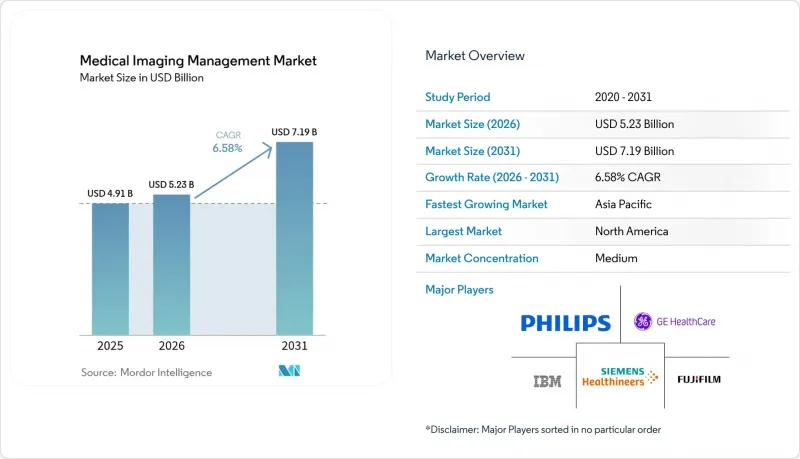
Mordor Intelligence에 따르면 2026년 의료용 영상 관리 시장의 규모는 52억 3,000만 달러로 추정되고 있으며, 2025년 49억 1,000만 달러에서 확대하며, 2031년에는 71억 9,000만 달러에 달할 것으로 예측됩니다.
2026-2031년까지 연평균 성장률(CAGR) 6.58%로 성장할 것으로 전망됩니다.
이 보고서는 시스템별(PACS(의료영상저장전송시스템), 벤더 중립 아카이브(VNA),애플리케이션 독립형 임상 아카이브(AICA) 등), 도입 형태별(온프레미스, 클라우드 기반, 하이브리드), 최종사용자별(병원, 영상 진단센터 등) 및 지역별(북미, 유럽 등)로 분류되어 있습니다. 시장 전망은 금액(달러) 기준으로 제시되어 있습니다.
전 세계 의료 영상 관리 시장의 동향 및 인사이트
진단 영상 및 영상 IT 분야의 기술 혁신
첨단 광자 계수 CT, 전신 MRI 및 AI를 활용한 워크플로우 툴은 의료 영상 관리 시장에서 대규모 영상 세트의 처리 방식을 재정의하고 있습니다. FDA는 MRI 노이즈 감소를 목적으로 하는 ‘Ezra Flash AI’를 승인함으로써, 알고리즘을 통한 후처리가 진단의 정확성을 저해하지 않으면서 처리 능력을 향상시킬 수 있음을 입증했습니다. 노스웨스턴 메디슨(Northwestern Medicine)의 생성형 AI 시범 도입에서는 정확도를 저하시키지 않으면서 평균 보고서 작성 시간을 573초에서 435초로 단축했습니다. 현재 각 벤더사는 AI 도입 프레임워크를 기업 아카이브 내에 직접 통합하고 있으며, 방사선과 전문의가 영상 진단을 수행하는 도중에도 실시간 추론이 가능해졌습니다. 그 결과, 플랫폼은 멀티모달 데이터 스트림을 수집하고, AI 모델을 통합하며, 그 결과를 환자의 경과 기록으로 아카이브에 저장해야 합니다. 이러한 기능들은 탄력적인 컴퓨팅 능력과 신속한 알고리즘 업데이트를 보장하는 클라우드 네이티브 기업의 경쟁 우위를 강화하며, 의료 영상 관리 시장 전체의 성장을 가속화하고 있습니다.
만성질환 유병률의 증가
영상 진단 이용률은 연간 3-4%의 속도로 증가하고 있는 반면, 방사선과 전문의의 공급은 고작 2.5% 증가에 그치고 있으며, 수용 능력 부족이 심각해지고 있습니다. 만성 심혈관 질환, 종양 질환, 신경질환의 경우, 질병의 진행 상황을 추적하기 위해 반복적으로 영상 진단을 실시해야 합니다. 현재 병원에서는 수년에 걸친 영상 이력을 정리하고, 집단 건강 분석과 통합할 수 있는 아카이브를 요구하고 있습니다. 벤더 중립 아카이브(VNA)는 데이터 사일로를 완화하고, 임상의가 조직의 경계를 넘어 협력할 수 있도록 합니다. 이는 책임 의료 모델(Accountable Care Model)에 있으며, 필수적인 요소입니다. 그 결과, 만성질환 관리에 대한 압박으로 인해 의료 영상 관리 시장 전반에 걸쳐 지속적인 도입 추세가 촉진되고 있습니다.
높은 도입 및 통합 비용
기업급 PACS나 VNA 도입은 종종 예산 예상을 초과합니다. 한 증분 비용 분석에 따르면 부서 전체에 걸친 PACS 도입은 검사 건수가 많은 전문 분야에서 비용 절감 효과를 거두는 데 어려움을 겪고 있는 것으로 나타났습니다. 필라델피아 소아 병원은 VNA로 전환한 후 5년 동안 약 300만 달러의 비용 절감을 달성했으나, 소규모 의료 기관은 초기 전환 비용을 감당할 만한 규모가 되지 않습니다. 구독형 클라우드 모델은 설비 투자를 줄여주지만, 데이터 전송료나 장기 보관료와 같은 새로운 비용 항목이 발생합니다. 이러한 비용 압박으로 인해 지방 병원이나 개인 개업의의 도입이 미뤄질 가능성이 있으며, 의료 영상 관리 시장의 단기적인 확장에 제동이 걸릴 우려가 있습니다.
부문 분석
2025년, PACS(의료영상저장전송시스템)은 의료 영상 관리 시장의 51.65%를 차지하며, 기존 방사선과용 워크스테이션이나 DICOM 라우터가 가진 도입 실적의 우위가 입증되었습니다. PACS와 연계된 의료 영상 관리 시장의 규모는 벤더 중립 아카이브(VNA)가 연평균 성장률(CAGR) 7.86%로 확대되는 가운데, 시장 전체에 비해 완만한 성장에 그칠 것으로 예측됩니다. 벤더 중립형 설계에서는 아카이브와 뷰어가 분리되어 있으므로, 조직은 라이선스 비용을 절감하고 코어 스토리지를 변경하지 않고도 AI 알고리즘을 통합할 수 있게 됩니다.
클라우드 우선(Cloud First) 제공업체들은 경쟁 구도를 새롭게 바꾸고 있습니다. 애플리케이션에 구애받지 않는 임상 아카이브는 거버넌스 계층을 추가함으로써 영상 데이터를 순환기학, 병리학, 수술 계획 각 애플리케이션에 균등하게 제공합니다. 의료 시스템이 데이터 주권, AI 통합, 재해 복구의 우선순위를 재검토하는 가운데, 이러한 동향들이 맞물려 의료 영상 관리 시장을 재편하고 있습니다.
지역별 분석
북미는 성숙한 보험 환급 제도, 견고한 광대역 환경, 그리고 적극적인 AI 시범 사업에 힘입어 전 세계 매출의 38.95%를 차지하며 선두를 달리고 있습니다. 8,600만 달러 규모의 LEAP 프로그램과 같은 연방 정부 보조금은 알고리즘 보증 기능을 통합한 상호 운용 가능한 플랫폼에 대한 병원의 투자를 촉진하고 있습니다. 캐나다의 각 주에서는 시설 간 종양학 상담을 가능하게 하는 주 전역의 VNA를 도입하여 의료 영상 관리 시장에서 지역의 리더십을 강화하고 있습니다.
아시아태평양은 2031년까지 연평균 성장률(CAGR) 8.74%를 기록하며 가장 급격한 성장을 보이고 있습니다. 중국 규제 당국은 2020년 9건에 비해 2023년 중반까지 59건의 AI 영상 진단 장비를 승인하여, 클라우드 PACS 및 AI 보고서 기능 애드온의 상용화 길을 열었습니다. 인도의 보험 제도 확대는 영상 라이브러리와 수익 주기 시스템을 통합한 전자 건강 기록의 의무화를 지원하고 있습니다. 태국에서는 지방 진료소와 중앙 방사선과 전문의를 연결하는 원격의료 키오스크가 도입되면서 경량 웹 뷰어에 대한 수요가 증가하고 있습니다. 이러한 정책 전환과 설비 투자가 맞물려 아시아태평양 전체의 의료 영상 관리 시장 성장을 가속화하고 있습니다.
유럽에서는 꾸준한 보급세가 나타나고 있습니다. GDPR에 따라 아카이브내 암호화, 감사 추적, 동의 관리가 추진되는 한편, EU AI법에서는 대부분의 영상 AI 툴이 ‘고위험’으로 분류되어, 공급업체는 2025년 2월까지 규정 준수 대응 모듈을 구축해야 할 의무가 있습니다. 독일, 프랑스,영국에서는 국가 디지털화 예산을 지역 병원을 통합하는 기업 영상 관리 인프라에 투입하고 있습니다. 중동의 GCC 국가들에서는 의료 관광 목표 달성을 위해 진단 체계의 현대화가 진행되고 있으며, 라틴아메리카의 의료 기관에서는 설비 투자의 장벽을 피하기 위해 클라우드형 VNA가 채택되고 있습니다. 이러한 다양한 촉진요인과 제약으로 인해 EMEA 지역 및 북미를 제외한 북미·남미 전역에서 의료 영상 관리 시장은 한 자릿수 중반대의 성장률을 유지하고 있습니다.
기타 혜택:
- 엑셀 형식의 시장 예측(ME) 시트
- 3개월간의 애널리스트 지원
자주 묻는 질문
목차
제1장 서론
제2장 조사 방법
제3장 개요
제4장 시장 구도
제5장 시장 규모와 성장 예측
제6장 경쟁 구도
제7장 시장 기회와 향후 전망
KSA 26.08.26According to Mordor Intelligence, medical imaging management market size in 2026 is estimated at USD 5.23 billion, growing from 2025 value of USD 4.91 billion with 2031 projections showing USD 7.19 billion, growing at 6.58% CAGR over 2026-2031.
This report is Segmented by System (Picture Archiving and Communications System (PACS), Vendor-Neutral Archive (VNA), Application-Independent Clinical Archive (AICA), and More), Deployment Mode (On-Premise, Cloud-Based and Hybrid), End User (Hospitals, Diagnostic Imaging Centers, and More), and Geography (North America, Europe, and More). The Market Forecasts are Provided in Terms of Value (USD).
Global Medical Imaging Management Market Trends and Insights
Technological Innovations in Diagnostic Imaging & Image IT
Advanced photon-counting CT, whole-body MRI and AI-powered workflow tools are redefining how the medical imaging management market handles large image sets. The FDA cleared Ezra Flash AI for MRI noise reduction, proving that algorithmic post-processing can raise throughput without harming diagnostic integrity. Northwestern Medicine's generative AI pilot cut average report time from 573 seconds to 435 seconds with no accuracy loss. Vendors now bundle AI deployment frameworks directly inside enterprise archives, enabling real-time inference while radiologists read studies. As a result, platforms must ingest multi-modal data streams, orchestrate AI models and archive results in longitudinal patient records. These capabilities strengthen the competitive edge of cloud-native firms that promise elastic compute and rapid algorithm updates, accelerating growth across the medical image management market.
Rising Prevalence of Chronic Diseases
Imaging utilization is climbing 3-4% yearly, whereas radiologist supply grows only 2.5%, tightening capacity constraints. Chronic cardiovascular, oncologic and neurologic conditions require repeat imaging to track disease progression. Hospitals now seek archives that collate multi-year image histories and integrate with population-health analytics. Vendor-neutral designs reduce data silos and let clinicians collaborate across organizations, a necessity for accountable-care models. Consequently, chronic-care pressures stimulate sustained adoption momentum across the medical imaging management market.
High Implementation & Integration Costs
Enterprise-grade PACS or VNA rollouts often exceed forecast budgets. One incremental-cost analysis showed that a department-wide PACS deployment struggled to deliver positive savings for high-volume specialties. Children's Hospital of Philadelphia did save nearly USD 3 million over five years after migrating to a VNA, yet smaller providers lack the scale to absorb up-front conversion fees. Subscription cloud models reduce capital expenditure but introduce new line items such as egress charges and long-term archive fees. Cost pressure may postpone procurement among rural hospitals and independent practices, tempering short-run expansion of the medical image management market.
Other drivers and restraints analyzed in the detailed report include:
- Big-Data & AI Integration into Imaging Workflows
- Government Incentives for Healthcare IT Adoption
- Escalating Cyber-Attacks on Imaging Archives
For complete list of drivers and restraints, kindly check the Table Of Contents.
Segment Analysis
Picture Archiving & Communication Systems held 51.65% of the medical image management market share in 2025, confirming the installed base advantage of traditional radiology workstations and DICOM routers. The medical image management market size tied to PACS is forecast to grow more slowly than the overall market as vendor-neutral archives accelerate at an 7.86% CAGR. Vendor-neutral designs decouple the archive from the viewer, letting organizations cut licensing costs and integrate AI algorithms without modifying core storage.
Cloud-first providers are rewriting the competitive script. Application-independent clinical archives add a governance layer that surfaces imaging to cardiology, pathology and surgical planning apps on equal terms. Together these trends reshape the medical image management market as health systems reevaluate data-sovereignty, AI integration and disaster-recovery priorities.
Complete Report Scope:
- By System
- Picture Archiving & Communication System (PACS)
- Vendor-Neutral Archive (VNA)
- Application-Independent Clinical Archive (AICA)
- Other Systems
- By Deployment Mode
- On-premise
- Cloud-based
- Hybrid
- By End User
- Hospitals
- Diagnostic Imaging Centers
- Ambulatory Surgery Centers
- Other End Users
- By Geography
- North America
- United States
- Canada
- Mexico
- Europe
- Germany
- United Kingdom
- France
- Italy
- Spain
- Rest of Europe
- Asia Pacific
- China
- Japan
- India
- Australia
- South Korea
- Rest of Asia Pacific
- Middle East and Africa
- GCC
- South Africa
- Rest of Middle East and Africa
- South America
- Brazil
- Argentina
- Rest of South America
- North America
Geography Analysis
North America leads with 38.95% of global revenue, underpinned by mature reimbursement, robust broadband and aggressive AI pilots. Federal grants such as the USD 86 million LEAP program catalyze hospital spending on interoperable platforms that embed algorithm assurance features. Canadian provinces deploy province-wide VNAs to enable cross-site oncology consults, reinforcing regional leadership in the medical image management market.
Asia Pacific delivers the steepest growth at 8.74% CAGR to 2031. China's regulator approved 59 AI imaging devices by mid-2023 versus nine in 2020, opening commercialization channels for cloud PACS and AI reporting add-ons. India's insurance expansion fuels electronic-record mandates that bundle imaging libraries with revenue-cycle systems. Thailand rolled out telemedicine kiosks linking rural clinics to central radiologists, boosting demand for lightweight web viewers. Collectively, these policy shifts and capacity investments accelerate the medical image management market across APAC.
Europe posts steady uptake. GDPR pushes encryption, audit trails and consent management inside archives, while the EU AI Act labels most imaging-AI tools "high-risk," forcing vendors to build compliance modules by February 2025. Germany, France and the UK channel national-digitization budgets into enterprise imaging backbones that federate regional hospitals. GCC countries in the Middle East modernize diagnostics for medical-tourism goals, and Latin American providers adopt cloud VNAs to sidestep capex barriers. These diverse drivers and constraints sustain mid-single-digit growth for the medical image management market across EMEA and the Americas outside North America.
- Agfa-Gevaert
- BridgeHead Software
- Carestream Health (Onex)
- FUJIFILM
- GE Healthcare
- IBM Watson Health / Merative
- Novarad
- Koninklijke Philips
- Siemens Healthineers
- Lexmark (Claron)
- McKesson Enterprise Imaging
- Dell Technologies (Cloud for Healthcare)
- Sectra
- Change Healthcare
- Hyland Healthcare
- Visage Imaging
- INFINITT Healthcare
- Ram Soft
- Konica Minolta Healthcare
- Merge Healthcare (Merative)
Additional Benefits:
- The market estimate (ME) sheet in Excel format
- 3 months of analyst support
TABLE OF CONTENTS
1 Introduction
- 1.1 Study Assumptions & Market Definition
- 1.2 Scope of the Study
2 Research Methodology
3 Executive Summary
4 Market Landscape
- 4.1 Market Overview
- 4.2 Market Drivers
- 4.2.1 Technological innovations in diagnostic imaging & image IT
- 4.2.2 Rising prevalence of chronic diseases
- 4.2.3 Big-data & AI integration into imaging workflows
- 4.2.4 Government incentives for healthcare IT adoption
- 4.2.5 Rapid shift toward cloud-native enterprise imaging platforms
- 4.2.6 Value-based-care push for longitudinal imaging archives
- 4.3 Market Restraints
- 4.3.1 High implementation & integration costs
- 4.3.2 Shortage of radioisotopes curbing SPECT / PET upgrades
- 4.3.3 Escalating cyber-attacks on imaging archives
- 4.3.4 Proprietary data models causing vendor lock-in
- 4.4 Regulatory Landscape
- 4.5 Technological Outlook
- 4.6 Porter's Five Forces Analysis
- 4.6.1 Threat of New Entrants
- 4.6.2 Bargaining Power of Buyers
- 4.6.3 Bargaining Power of Suppliers
- 4.6.4 Threat of Substitutes
- 4.6.5 Intensity of Competitive Rivalry
5 Market Size & Growth Forecasts (Value)
- 5.1 By System
- 5.1.1 Picture Archiving & Communication System (PACS)
- 5.1.2 Vendor-Neutral Archive (VNA)
- 5.1.3 Application-Independent Clinical Archive (AICA)
- 5.1.4 Other Systems
- 5.2 By Deployment Mode
- 5.2.1 On-premise
- 5.2.2 Cloud-based
- 5.2.3 Hybrid
- 5.3 By End User
- 5.3.1 Hospitals
- 5.3.2 Diagnostic Imaging Centers
- 5.3.3 Ambulatory Surgery Centers
- 5.3.4 Other End Users
- 5.4 By Geography
- 5.4.1 North America
- 5.4.1.1 United States
- 5.4.1.2 Canada
- 5.4.1.3 Mexico
- 5.4.2 Europe
- 5.4.2.1 Germany
- 5.4.2.2 United Kingdom
- 5.4.2.3 France
- 5.4.2.4 Italy
- 5.4.2.5 Spain
- 5.4.2.6 Rest of Europe
- 5.4.3 Asia Pacific
- 5.4.3.1 China
- 5.4.3.2 Japan
- 5.4.3.3 India
- 5.4.3.4 Australia
- 5.4.3.5 South Korea
- 5.4.3.6 Rest of Asia Pacific
- 5.4.4 Middle East and Africa
- 5.4.4.1 GCC
- 5.4.4.2 South Africa
- 5.4.4.3 Rest of Middle East and Africa
- 5.4.5 South America
- 5.4.5.1 Brazil
- 5.4.5.2 Argentina
- 5.4.5.3 Rest of South America
- 5.4.1 North America
6 Competitive Landscape
- 6.1 Market Concentration
- 6.2 Market Share Analysis
- 6.3 Company Profiles (includes Global level Overview, Market level overview, Core Segments, Financials as available, Strategic Information, Market Rank/Share for key companies, Products & Services, and Recent Developments)
- 6.3.1 Agfa-Gevaert Group
- 6.3.2 BridgeHead Software
- 6.3.3 Carestream Health (Onex)
- 6.3.4 Fujifilm Holdings
- 6.3.5 GE Healthcare
- 6.3.6 IBM Watson Health / Merative
- 6.3.7 Novarad Corporation
- 6.3.8 Koninklijke Philips N.V.
- 6.3.9 Siemens Healthineers
- 6.3.10 Lexmark (Claron)
- 6.3.11 McKesson Enterprise Imaging
- 6.3.12 Dell Technologies (Cloud for Healthcare)
- 6.3.13 Sectra AB
- 6.3.14 Change Healthcare
- 6.3.15 Hyland Healthcare
- 6.3.16 Visage Imaging
- 6.3.17 INFINITT Healthcare
- 6.3.18 RamSoft Inc.
- 6.3.19 Konica Minolta Healthcare
- 6.3.20 Merge Healthcare (Merative)
7 Market Opportunities & Future Outlook
- 7.1 White-space & Unmet-need Assessment


