

|
시장보고서
상품코드
2114167
동물 창상관리 : 시장 점유율 분석, 업계 동향과 통계, 성장 예측(2026-2031년)Animal Wound Care - Market Share Analysis, Industry Trends & Statistics, Growth Forecasts (2026 - 2031) |
||||||
 Mordor Intelligence
Mordor Intelligence에 따르면 동물 창상관리 시장 규모는 2025년 14억 4,000만 달러에서 2026년에는 15억 5,000만 달러로 확대하며, 2026-2031년에 CAGR 7.74%로 추이하며, 2031년까지 22억 5,000만 달러에 달할 것으로 예측됩니다.
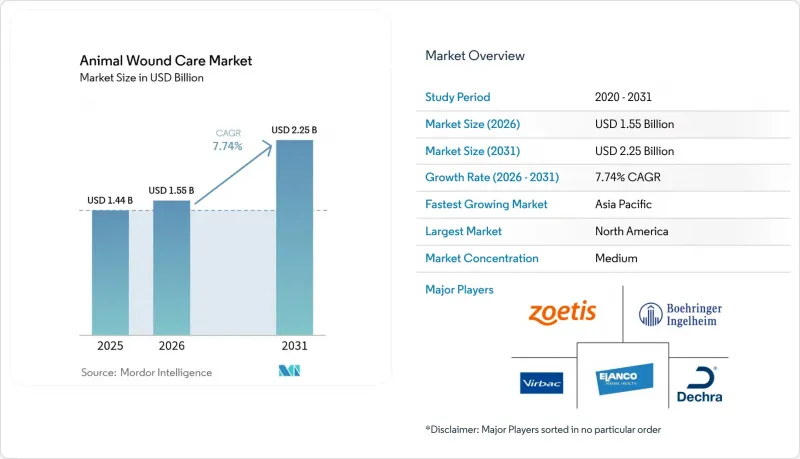
이 보고서는 제품 유형별(외과수술용[드레싱 등], 첨단[폼 드레싱 등], 기존형, 기타 제품]), 동물 유형별(반려동물[개 등], 가축),최종사용자별(동물병원·진료소, 재택 간호 환경 등), 지역별(북미, 유럽, 아시아태평양 등)로 분류되어 있습니다. 이 보고서에서는 상기 각 부문 시장 규모(달러)를 제시하고 있습니다.
전 세계 동물 상처 관리 시장의 동향 및 인사이트
정부 및 복지 관련 정책
각국의 복지 개혁은 근거 기반 드레싱에 대한 수요를 높이는 의무적인 프로토콜로 이어지고 있습니다. 2024년 미국 농무부(USDA) 동물 복지법 개정에 따라 조사 절차 중 진통 효과가 있는 하이드로겔의 사용이 의무화되어 연구 기관들은 재고 갱신을 서두르고 있습니다. 유럽연합(EU)은 현재 식용 동물에 대한 인간용 제품의 오프라벨 사용을 제한하고 있으며, 잔류 기준을 충족하는 수의학 전용 제품의 구매를 유도하고 있습니다. 호주의 2025년 가축 복지 계획은 수출 적격성을 문서화된 상처 치료 기록과 연계하고 있으며, 생산자들이 항균제가 함침된 폼을 채택하도록 장려하고 있습니다. 이러한 조치들은 동물 상처 관리 시장에 규정 준수를 기반으로 한 최소 기준을 확립하는 동시에, 비교 유효성에 관한 자료가 부족한 공급업체들에게는 불이익을 주고 있습니다. 중기적으로는 선진 지역의 규제 집행 강화가 수출 지향적인 신흥 시장으로도 파급되어, 프리미엄 치료법의 대상 사용자층을 확대할 것입니다.
반려동물 사육 및 의료비
팬데믹 기간 중 급증한 반려동물 사육 마릿수는 여전히 높은 수준을 유지하고 있으며, 반려인들은 1회 내원당 상처 관리 비용을 늘리고 있습니다. 미국에서개 1마리당 연간 수의 의료비는 2022년 1,060달러에서 2025년에는 평균 1,201달러로 증가했으며, 수술 후 관리가 주요 지출 항목으로 자리 잡고 있습니다. 일본의 1인 가구에서는 다인 가구의 2배 비율로 고양이를 기르고 있으며, 경미한 열상이라도 콜라겐이나 항균 폼을 선택하고 있습니다. 인도에서는 2025년에 반려동물 보험 보급률이 2배인 1.6%에 달하여, 첨단 치료법에 대한 본인 부담에 대한 거부감이 완화되었습니다. 성숙한 시장에서 판매량의 정체는 재량 지출의 증가로 상쇄되고 있으며, 이는 신흥 도시 지역에서 프리미엄 드레싱의 보급을 지원하고 있습니다.
높은 수의학 치료비
미국에서는 2022-2025년에 진료비가 18% 상승하여, 일반 진료시 1회당 61달러, 응급 상처 세척시 400달러 이상에 달했습니다. 호주에서는 2025년에 반려동물 주인의 34%가 비용 문제를 우려하여 권장되는 상처 관리를 미루고 있으며, 저소득 가정에서는 그 비율이 48%까지 상승했습니다. 예산 부족으로 인해 반려동물 주인들은 항균성이나 보습 기능이 없는 시판용 거즈를 선택하는 경향이 있으며, 이는 프리미엄 제품의 보급을 저해하고 있습니다. 축산 농가는 제한된 이익률과 드레싱 비용을 저울질하여, 규정 준수나 수출 규제가 개입하지 않는 한 최소한의 처치를 선택하는 경우가 많습니다. 반려동물 보험이 아직 보급되지 않은 지역에서는 비용에 대한 민감성으로 인해 임상적 이점이 있음에도 불구하고 콜라겐 드레싱이나 음압 요법 장치의 도입이 저해되고 있습니다.
부문 분석
2025년에는 외과수술용 제품이 매출의 40.1%를 차지했습니다. 이는 전 세계 동물병원에서 시행되는 중성화 수술 및 골절 치료 건수가 많기 때문입니다. 시아노아크릴레이트계 접착제는 기존의 봉합으로는 섬세한 피부가 찢어질 수 있으므로 조류나 이국적인 동물의 사례에서 널리 사용되고 있습니다. 요르겐센 래버러토리즈(Jorgensen Laboratories)는 2025년에 ‘Vetbond’의 매출이 29% 증가했다고 보고했습니다. 첨단 상처 피복재는 치유 기간 단축 및 피복재 교체 횟수 감소라는 임상적 근거에 힘입어, 2031년까지 연평균 성장률(CAGR) 8.32%를 기록하며 동물 상처 관리 시장 전체를 상회하는 성장이 예상됩니다. 항균 폼, 하이드로콜로이드, 은알기네이트 역시 항생제의 적정 사용이라는 목표에 부합하며, 생물막 대책의 첫 번째 선택지로 자리 잡고 있습니다. 기존의 면 거즈는 예산 제약이 있는 현장에서는 여전히 사용되고 있지만, 수의학 교육 과정에서 수분 관리와 감염 대책이 중요시됨에 따라 그 시장 점유율은 점차 감소하고 있습니다.
첨단 드레싱의 기세는 구매 기준이 단가에서 치료 총비용으로 전환되고 있음을 여실히 보여주고 있습니다. 진료소 측에서는 보습성 드레싱을 도입함으로써 내원 횟수가 줄어들고 마취 필요성도 감소했다는 보고가 접수되고 있습니다. 소나 돼지 조직 유래 콜라겐 드레싱은 육아 조직 형성이 느린 말의 사지 상처 치료 분야에서 틈새 시장을 개발해 나가고 있습니다. FDA의 지침안에 따라 항균제의 분류가 엄격해지고, 경쟁 제품군이 좁혀지며, 임상의들의 신뢰가 높아짐에 따라 동물 상처 치료 시장에서 첨단 드레싱 시장 규모는 급속히 확대될 것으로 예상됩니다. 규제 대응 자원이 부족한 소규모 제조업체들은 시장에서 철수할 가능성이 있으며, 그 결과 검증된 제품 포트폴리오를 보유한 글로벌 공급업체로의 판매가 더욱 집중될 것입니다.
지역별 분석
북미는 높은 반려동물 보유율, 충실한 보험 적용 범위, 신속한 규제 승인의 지원을 받아 2025년에도 39.76%의 점유율을 유지했습니다. FDA는 2024-2025년에 14건의 새로운 상처 치료용 의료기기를 승인했으며, 이를 통해 조기 도입을 진행하는 진료소가 약품 리스트을 신속하게 갱신할 수 있게 되었습니다. 캐나다는 미국과의 규제 조화로 혜택을 보고 있지만, 주별 차이로 인해 약간의 단절이 발생하고 있습니다. 멕시코는 성장의 거점으로 부상하고 있으며, 2025년에 설립된 빌백(Vilback)사의 새로운 유통 허브 덕분에 중미 및 미국 남부 전역에서의 접근성이 향상되고 있습니다.
아시아태평양은 가장 빠르게 성장하는 지역으로, 2031년까지 연평균 성장률(CAGR) 7.11%를 기록할 것으로 예측됩니다. 일본의 가구당 수의학 의료비는 2025년에 8만 9,000엔(610달러)에 달하며, 이 중 상처 관리 제품이 전체의 9%를 차지하고 있습니다. 중국의 개와 고양이 사육 마릿수는 2025년에 1억 2,000만 마리를 넘으며, 엘란코(Elanco)의 상하이 교육 센터에서는 임상의들을 대상으로 고급 상처 처치 프로토콜에 대한 교육을 시행하고 있습니다. 인도에서는 반려동물 사육 마릿수가 두 자릿수 성장세를 보이고 있으며, 수의과 대학에서는 최신 상처 관리 모듈 교육이 시작되었습니다. 호주와 뉴질랜드는 성숙한 고소비 시장으로, 보험사가 이미 첨단 치료 비용을 보상하고 있으며, 제품 출시를 위한 유용한 테스트베드가 되고 있습니다.
유럽에서는 규제 체계가 엄격하여 단기적인 성장이 둔화되고 있습니다. 독일, 영국, 프랑스는 여전히 대규모 시장이지만, 유럽의약품청(EMA)의 규제 준수 비용이 신제품 도입을 지연시키고 있습니다. 스페인과 이탈리아는 젊은 층의 반려동물 기르기 비율 상승의 혜택을 보고 있는 반면, 폴란드와 헝가리에서는 제조 분야에 대한 투자가 활발해지고 있습니다. 남미는 브라질이 중심을 이루고 있으며, 이 국가의 축산 농가는 동물 복지를 중시하는 수출 요건을 충족하기 위해 항균 폼을 채택하고 있습니다. 아르헨티나 시장은 통화 안정화로 인해 수입 능력이 향상되면서 2025년에 회복세를 보였습니다. 중동 및 아프리카에서는 여전히 시장 침투율이 낮은 편이며, 유의미한 수요는 걸프협력회의(GCC) 회원국 및 남아프리카공화국에 집중되어 있습니다.
기타 혜택:
- 엑셀 형식의 시장 예측(ME) 시트
- 3개월간의 애널리스트 지원
자주 묻는 질문
목차
제1장 서론
제2장 조사 방법
제3장 개요
제4장 시장 구도
제5장 시장 규모와 성장 예측
제6장 경쟁 구도
제7장 시장 기회와 향후 전망
KSA 26.08.26According to Mordor Intelligence, the animal wound care market size is expected to grow from USD 1.44 billion in 2025 to USD 1.55 billion in 2026 and is forecast to reach USD 2.25 billion by 2031 at 7.74% CAGR over 2026-2031.
This report is Segmented by Products (Surgical [Dressings, and More], Advanced [Foam Dressings, and More], Traditional, and Other Products), Animal Type (Companion [Dogs, and More], and Livestock), End Users (Veterinary Hospitals & Clinics, Home-Care Settings, and More), and Geography (North America, Europe, Asia Pacific, and More). The Market Provides the Value (in USD) for the Above-Mentioned Segments.
Global Animal Wound Care Market Trends and Insights
Government & Welfare Initiatives
National welfare reforms are translating into mandatory protocols that elevate demand for evidence-based dressings. The 2024 USDA Animal Welfare Act amendments require analgesic hydrogel use during research procedures, pushing institutes to upgrade inventory . The European Union now restricts off-label use of human products on food-producing animals, channeling purchases toward veterinary-specific lines that meet residue standards. Australia's 2025 farm-animal welfare plan ties export eligibility to documented wound treatment records, nudging producers toward antimicrobial-impregnated foam. These measures create a compliance-driven floor for the animal wound care market while penalizing suppliers that lack comparative-efficacy dossiers. Over the medium term, enforcement intensity in developed regions will ripple into export-oriented emerging markets, widening the addressable user base for premium therapies.
Pet Adoption & Healthcare Spending
Companion-animal ownership that surged during the pandemic remains elevated, and owners are spending more per visit on wound management. U.S. households averaged USD 1,201 in annual veterinary outlays per dog in 2025, compared with USD 1,060 in 2022, with post-surgical care a key line item . Single-person households in Japan are adopting cats at twice the rate of multi-person homes and choose collagen or antimicrobial foams for even minor lacerations. In India, pet-insurance penetration doubled to 1.6% in 2025, reducing out-of-pocket resistance to advanced therapies. Higher discretionary spending offsets volume saturation in mature markets and fuels the adoption of premium dressings in emerging urban centers.
High Veterinary-Care Costs
Consultation fees climbed 18% between 2022 and 2025 in the United States, reaching USD 61 per routine visit and over USD 400 for emergency debridement . Australia, 34% of pet owners deferred recommended wound care in 2025 because of affordability concerns, with rates rising to 48% in low-income households. Budget pressure steers owners toward over-the-counter gauze that lacks antimicrobial or moisture-retention features, limiting penetration of premium products. Livestock producers weigh dressing costs against slim profit margins, often opting for minimal intervention unless compliance or export mandates intervene. In regions where pet insurance remains scarce, cost sensitivity threatens uptake of collagen dressings and negative-pressure devices despite their clinical advantages.
Other drivers and restraints analyzed in the detailed report include:
- Advanced Wound-Dressing Adoption
- Regenerative Therapies Adoption
- Regulatory Complexity (EU)
For complete list of drivers and restraints, kindly check the Table Of Contents.
Segment Analysis
Surgical items accounted for 40.1% of revenue in 2025, reflecting high volumes of spay-neuter procedures and fracture repairs conducted across clinics worldwide. Cyanoacrylate adhesives are popular for avian and exotic cases because delicate skin tears under traditional sutures; Jorgensen Laboratories recorded a 29% sales uplift for Vetbond in 2025. Advanced dressings are projected to outpace the broader animal wound care market at 8.32% CAGR through 2031, buoyed by clinical evidence of shorter healing times and fewer dressing changes. Antimicrobial foams, hydrocolloids, and silver alginates also align with antibiotic-stewardship goals, positioning them as frontline choices against biofilm. Traditional cotton gauze continues to serve budget-constrained settings but is yielding share as veterinary curricula emphasize moisture management and infection control.
Advanced dressings' momentum underscores a shift in purchasing criteria from unit cost toward total cost of care. Clinics report fewer clinic visits and reduced anesthesia demand when moisture-retentive dressings are employed. Collagen dressings derived from bovine or porcine tissue are finding niches in equine limb wounds where granulation tissue forms slowly. The animal wound care market size for advanced dressings is expected to grow briskly as draft FDA guidance tightens antimicrobial classification, narrowing competitive sets and improving clinician confidence. Smaller manufacturers lacking regulatory resources may exit, further consolidating sales toward global suppliers with validated portfolios.
Complete Report Scope:
- By Product
- Surgical
- Dressings
- Sutures & Staples
- Tissue Adhesives
- Others
- Advanced
- Foam Dressings
- Hydrocolloid Dressings
- Hydrogel Dressings
- Alginate Dressings
- Collagen Dressings
- Antimicrobial Dressings
- Traditional
- Gauze
- Adhesive Bandages
- Cotton Swabs & Wraps
- Other Products
- Cell & Gene Therapies
- Platelet Concentrates
- NPWT Devices
- Surgical
- By Animal Type
- Companion Animals
- Dogs
- Cats
- Other Companion
- Livestock Animals
- Cattle
- Swine
- Poultry
- Sheep & Goats
- Companion Animals
- By End User
- Veterinary Hospitals & Clinics
- Home-care Settings
- Research & Academic Institutes
- Animal Shelters & NGOs
- By Geography
- North America
- United States
- Canada
- Mexico
- Europe
- Germany
- United Kingdom
- France
- Italy
- Spain
- Rest of Europe
- Asia-Pacific
- China
- India
- Japan
- South Korea
- Australia
- Rest of Asia-Pacific
- Middle East and Africa
- GCC
- South Africa
- Rest of Middle East and Africa
- South America
- Brazil
- Argentina
- Rest of South America
- North America
Geography Analysis
North America retained a 39.76% share in 2025, supported by high pet ownership, robust insurance coverage, and rapid regulatory approvals. The FDA cleared 14 new wound-care devices between 2024 and 2025, enabling early adopter clinics to refresh formularies quickly. Canada benefits from regulatory alignment with the United States, although provincial variations introduce minor fragmentation. Mexico is emerging as a growth pole; a new Virbac distribution hub established in 2025 improves access across Central America and the southern United States.
Asia-Pacific is the fastest-growing region and is projected to post a 7.11% CAGR through 2031. Japan's per-household veterinary spend reached JPY 89,000 (USD 610) in 2025, with wound-care products comprising 9% of the total. China's dog and cat population surpassed 120 million in 2025, and Elanco's Shanghai training center is equipping clinicians with advanced dressing protocols. India shows double-digit growth in pet populations, and veterinary colleges have begun teaching modern wound-management modules. Australia and New Zealand feature mature, high-spend markets where insurers already reimburse advanced therapies, making them useful test beds for product launches.
Europe's stricter regulatory framework dampens short-term growth. Germany, the United Kingdom, and France remain sizable markets, but EMA compliance costs delay new product introductions. Spain and Italy are benefiting from rising ownership among younger demographics, while Poland and Hungary attract manufacturing investment. South America is anchored by Brazil, where livestock producers adopt antimicrobial foams to satisfy welfare-driven export requirements; Argentina's market rebounded in 2025 as currency stabilization improved import capacity. The Middle East and Africa remain underpenetrated, with meaningful demand concentrated in Gulf Cooperation Council countries and South Africa.
- Advancis Veterinary Ltd.
- Animalcare Group plc
- B. Braun
- Boehringer Ingelheim AH
- Dechra Pharmaceuticals
- Elanco
- Innovacyn
- Jorgensen Laboratories
- KeriCure
- Medtronic
- Milliken & Company
- MWI Animal Health
- Neogen
- Primavet
- Sentrx Animal Care Inc.
- Solventum
- Vernacare
- Vetoquinol
- Virbac
- Zoetis
Additional Benefits:
- The market estimate (ME) sheet in Excel format
- 3 months of analyst support
TABLE OF CONTENTS
1 Introduction
- 1.1 Study Assumptions & Market Definition
- 1.2 Scope of the Study
2 Research Methodology
3 Executive Summary
4 Market Landscape
- 4.1 Market Overview
- 4.2 Market Drivers
- 4.2.1 Government & Welfare Initiatives
- 4.2.2 Pet Adoption & Healthcare Spending
- 4.2.3 Advanced Wound-Dressing Adoption
- 4.2.4 Intensive Livestock-Farming Injuries
- 4.2.5 Tele-Veterinary Wound Management
- 4.2.6 Regenerative Therapies Adoption
- 4.3 Market Restraints
- 4.3.1 Lack Of Comparative Studies
- 4.3.2 High Veterinary-Care Costs
- 4.3.3 Regulatory Complexity (EMS)
- 4.3.4 Limited Awareness
- 4.4 Supply-Chain Analysis
- 4.5 Regulatory Landscape
- 4.6 Technological Outlook
- 4.7 Porter's Five Forces
- 4.7.1 Threat of New Entrants
- 4.7.2 Bargaining Power of Buyers
- 4.7.3 Bargaining Power of Suppliers
- 4.7.4 Threat of Substitutes
- 4.7.5 Competitive Rivalry
5 Market Size & Growth Forecasts (Value, USD)
- 5.1 By Product
- 5.1.1 Surgical
- 5.1.1.1 Dressings
- 5.1.1.2 Sutures & Staples
- 5.1.1.3 Tissue Adhesives
- 5.1.1.4 Others
- 5.1.2 Advanced
- 5.1.2.1 Foam Dressings
- 5.1.2.2 Hydrocolloid Dressings
- 5.1.2.3 Hydrogel Dressings
- 5.1.2.4 Alginate Dressings
- 5.1.2.5 Collagen Dressings
- 5.1.2.6 Antimicrobial Dressings
- 5.1.3 Traditional
- 5.1.3.1 Gauze
- 5.1.3.2 Adhesive Bandages
- 5.1.3.3 Cotton Swabs & Wraps
- 5.1.4 Other Products
- 5.1.4.1 Cell & Gene Therapies
- 5.1.4.2 Platelet Concentrates
- 5.1.4.3 NPWT Devices
- 5.1.1 Surgical
- 5.2 By Animal Type
- 5.2.1 Companion Animals
- 5.2.1.1 Dogs
- 5.2.1.2 Cats
- 5.2.1.3 Other Companion
- 5.2.2 Livestock Animals
- 5.2.2.1 Cattle
- 5.2.2.2 Swine
- 5.2.2.3 Poultry
- 5.2.2.4 Sheep & Goats
- 5.2.1 Companion Animals
- 5.3 By End User
- 5.3.1 Veterinary Hospitals & Clinics
- 5.3.2 Home-care Settings
- 5.3.3 Research & Academic Institutes
- 5.3.4 Animal Shelters & NGOs
- 5.4 By Geography
- 5.4.1 North America
- 5.4.1.1 United States
- 5.4.1.2 Canada
- 5.4.1.3 Mexico
- 5.4.2 Europe
- 5.4.2.1 Germany
- 5.4.2.2 United Kingdom
- 5.4.2.3 France
- 5.4.2.4 Italy
- 5.4.2.5 Spain
- 5.4.2.6 Rest of Europe
- 5.4.3 Asia-Pacific
- 5.4.3.1 China
- 5.4.3.2 India
- 5.4.3.3 Japan
- 5.4.3.4 South Korea
- 5.4.3.5 Australia
- 5.4.3.6 Rest of Asia-Pacific
- 5.4.4 Middle East and Africa
- 5.4.4.1 GCC
- 5.4.4.2 South Africa
- 5.4.4.3 Rest of Middle East and Africa
- 5.4.5 South America
- 5.4.5.1 Brazil
- 5.4.5.2 Argentina
- 5.4.5.3 Rest of South America
- 5.4.1 North America
6 Competitive Landscape
- 6.1 Market Concentration
- 6.2 Market Share Analysis
- 6.3 Company Profiles (includes Global level Overview, Market level overview, Core Segments, Financials as available, Strategic Information, Market Rank/Share for key companies, Products, and Recent Developments)
- 6.3.1 Advancis Veterinary Ltd.
- 6.3.2 Animalcare Group plc
- 6.3.3 B. Braun Vet Care GmbH
- 6.3.4 Boehringer Ingelheim AH
- 6.3.5 Dechra Pharmaceuticals PLC
- 6.3.6 Elanco Animal Health
- 6.3.7 Innovacyn Inc.
- 6.3.8 Jorgensen Laboratories
- 6.3.9 KeriCure Inc.
- 6.3.10 Medtronic plc
- 6.3.11 Milliken & Company
- 6.3.12 MWI Animal Health
- 6.3.13 Neogen Corporation
- 6.3.14 Primavet Inc.
- 6.3.15 Sentrx Animal Care Inc.
- 6.3.16 Solventum
- 6.3.17 Vernacare
- 6.3.18 Vetoquinol SA
- 6.3.19 Virbac
- 6.3.20 Zoetis Inc.
7 Market Opportunities & Future Outlook
- 7.1 White-space & Unmet-need Assessment


