

|
시장보고서
상품코드
2114273
유럽의 농업용 미생물 : 시장 점유율 분석, 업계 동향 및 통계, 성장 예측(2026-2031년)Europe Agricultural Microbial - Market Share Analysis, Industry Trends & Statistics, Growth Forecasts (2026 - 2031) |
||||||
 Mordor Intelligence
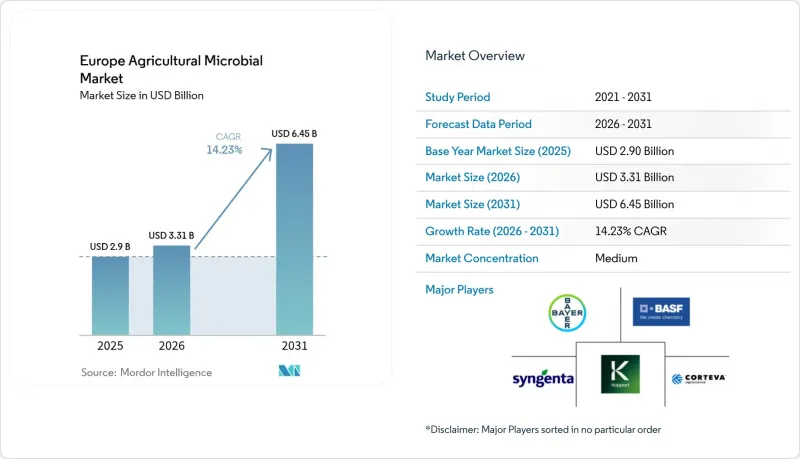
Mordor Intelligence에 의하면, 유럽의 농업용 미생물 시장 규모는 2025년에 29억 달러로 평가되었습니다. 2026년 33억 1,000만 달러에서 2031년까지 64억 5,000만 달러에 이를 것으로 추정되고 예측 기간(2026-2031년) CAGR은 14.23%를 나타낼 전망입니다.
본 보고서는 유형별(세균, 균류 등), 용도별(곡물, 콩류·유지종자, 상업 작물, 과일 및 채소 등), 시용 방법별(토양 처리, 엽면 살포 등), 지역별(독일, 영국, 프랑스,스페인, 이탈리아, 네덜란드, 러시아 등)으로 분류되어 있습니다. 시장 예측은 금액(달러) 기준으로 제시되어 있습니다.
유럽의 농업용 미생물 시장 동향 및 인사이트
유기농업 및 재생농업의 도입 확대
유럽연합(EU) 전체의 유기농 인증 농지는 2024년에 1,590만 헥타르에 달했으며, 이는 농업 이용 총 면적의 10.2%를 차지합니다. 프랑스, 스페인, 이탈리아 3개국에서는 유기농 인증 기준에 따라 총 700만 헥타르 이상이 관리되고 있습니다. 유기 인증 이상의 토양 건강 지표를 중시하는 재생 농업은 탄소 크레딧 제도나 소매업체의 지속가능성 스코어카드에서 피복 작물, 경작 감소, 미생물 제제 사용과 같은 실천이 평가받음에 따라 더욱 빠르게 확대되고 있습니다. 이러한 추세는 독일과 프랑스에서 특히 두드러지며, 이들 국가에서는 대규모 경작 농장이 미생물 제제를 정밀 파종 워크플로우에 통합하기 위한 농업학적 전문 지식과 설비를 갖추고 있습니다. 한편, 스페인과 이탈리아의 지중해 연안에 위치한 소규모 농장들도 협동조합의 보급 서비스를 통해 고부가가치 원예 작물에 맞춘 적용 프로토콜이 보급됨에 따라 빠르게 따라잡고 있습니다.
유럽연합(EU)의 ‘농장에서 식탁까지(Farm-to-Fork)’ 전략에 따른 농약 감축 의무
2020년에 채택되어 2024년 법 개정을 통해 강화된 유럽연합 집행위원회의 ‘팜-투-포크(Farm-to-Fork)’ 전략은 2030년까지 화학 농약 사용량과 위험을 50% 감축할 것을 의무화하고 있으며, 이로 인해 발생한 규제상의 공백을 생물학적 대체 수단이 메워야 합니다. 회원국들은 이 목표를 각국의 행동 계획에 반영하고 있습니다. 예를 들어, 프랑스는 유럽연합 전체의 기한보다 앞서 글리포세이트와 네오니코티노이드계 농약의 단계적 폐지를 약속한 반면, 독일은 수역 주변의 완충지대에 대한 규제를 강화하여 많은 기존 살포 방식을 사실상 금지하고 있습니다. 이러한 규제는 두 가지 측면에서 미생물의 활용을 가속화하고 있습니다. 첫째, 시장에서 화학 농약의 경쟁 제품을 배제함으로써 생산자들이 보트리티스병이나 흰가루병 등의 병해에 대해 박테리아나 균류를 이용한 생물학적 방제를 시도하도록 압박하고 있습니다. 또한, 유럽연합(EU)의 ‘농약의 지속 가능한 사용에 관한 지침’에 따른 규제의 영향도 이러한 전환을 더욱 뒷받침하고 있습니다. 이 지침은 비화학적 방법을 우선시하는 통합 해충 관리(IPM) 계획을 의무화하고 있으며, 미생물 제제를 단순한 선택적 추가 수단으로 취급하는 것이 아니라 규정 준수 체계에 포함시키고 있습니다.
초기 제품 비용과 유통 비용의 높음
미생물 제제는 일반적으로 헥타르당 화학 농약의 동등 제품보다 20-40% 더 비쌉니다. 이 가격 차이는 발효, 냉장 보관, 그리고 짧은 유통 기한과 같은 경제적 요인에 의해 발생하며, 생산 및 유통 비용을 상승시키고 있습니다. 평균 경작 면적이 3-8헥타르이며, 자금 사정상의 제약으로 인해 투입 자재 예산이 제한된 남유럽 및 동유럽의 소규모 농가에게 이 가격 차이는 도입을 시도하는 데 있어 큰 장벽이 되고 있습니다. 이익률이 낮은 농가들은 효과가 입증되고 즉각적인 효과를 보이는 투입 자재를 우선시하지만, 미생물 제제의 경우 높은 비용을 정당화할 수 있는 토양 건강에 대한 누적적 효과를 입증하기 위해서는 여러 시즌에 걸친 관찰이 필요한 경우가 많습니다. 유통 인프라도 문제를 더욱 심각하게 만들고 있습니다. 미생물 제제는 생균 수를 유지하기 위해 냉장 운송과 냉장 보관이 필요하기 때문에 화학 비료 유통업체에는 발생하지 않는 물류비가 추가로 발생하기 때문입니다. 농촌 지역의 콜드체인망이 여전히 미비한 폴란드와 루마니아에서는 판매업자가 이러한 비용을 최종 소비자에게 전가하고 있어 가격 차이를 더욱 확대시키고 있습니다. 일부 제조업체는 대금을 수확량 실적에 연동시키는 성과 보상형 계약을 제공함으로써 대응하고 있지만, 이러한 계약에는 제3자에 의한 검증이 필요하며, 농업학적 자문 서비스를 통해 시험 포장의 모니터링과 결과 기록이 가능한 서유럽 시장 이외의 지역에서는 여전히 드문 사례입니다.
부문별 분석
2025년, 유럽의 농업용 미생물 시장 규모의 64.70%를 세균계 미생물 제품이 차지했습니다. 이는 질소 고정, 인산 용해, 그리고 곰팡이 병원체의 생물학적 방제에서 입증된 효능을 발휘하는 바실러스(Bacillus), 슈도모나스(Pseudomonas), 리조비움(Rhizobium)과 같은 확립된 속이 뒷받침하고 있습니다. 세균 부문의 성숙에 따라 업계 재편이 진행되고 있으며, BASF SE와 Bayer AG는 독자적인 균주와 발효 능력을 확보하기 위해 소규모 접종제 제조업체를 인수하고 있습니다. 곰팡이계 제품은 기존의 수화제와 비교하여 저장 안정성과 밭 살포의 균일성을 향상시키는 액상 제제 분야의 최근 기술 혁신의 혜택을 받고 있습니다. 유럽의 살생물제 규정(Biocidal Products Regulation) 및 식물보호제품 규정(Plant Protection Products Regulation)에 기반한 규제 체계가 승인 일정에 영향을 미치고 있으며, 박테리아 및 균류 균주는 포유류에 대한 독성이 낮고 환경 내 잔류성이 낮은 경우 신속 심사 대상이 되는 경우가 많습니다.
곰팡이계 미생물 제제는 토양 전염성 병해를 억제하면서 토양 구조와 유기물 함량을 개선하는 이중 기능 제품에 대한 생산자 수요에 힘입어 2031년까지 연평균 성장률(CAGR) 15.12%로 확대되고 있습니다. 바이러스계 미생물 제제는 나비목 해충을 표적으로 하는 바쿠로바이러스가 주류를 이루며, 고부가가치 작물에서의 틈새 용도로 활용되고 있습니다. 이러한 작물에서는 매우 특이적인 해충 방제가 가능하기 때문에 높은 가격 책정이 정당화되며, 유익한 곤충에 대한 비표적 영향을 최소화할 수 있습니다. 원생동물계 미생물 제제는 여전히 신흥 분야이며, 주로 제어 환경 농업에서 토양 전염성 선충이나 뿌리 병원균을 억제하기 위해 사용되고 있습니다. 그러나 생산 비용의 감소에 따라, 농장 규모에서의 제제에 관한 조사가 가속화되고 있습니다.
기타 혜택 :
- 엑셀 형식 시장 예측(ME) 시트
- 3개월간의 애널리스트 지원
자주 묻는 질문
목차
제1장 서론
제2장 조사 방법
제3장 주요 요약
제4장 시장 구도
제5장 시장 규모 및 성장 예측
제6장 경쟁 구도
제7장 시장 기회 및 향후 전망
KTH 26.08.28According to Mordor Intelligence, the Europe agricultural microbial market size was valued at USD 2.90 billion in 2025 and estimated to grow from USD 3.31 billion in 2026 to reach USD 6.45 billion by 2031, at a CAGR of 14.23% during the forecast period (2026-2031).
This report is Segmented by Type (Bacteria, Fungi, and More), by Application (Grains and Cereals, Pulses and Oilseeds, Commercial Crops, Fruits and Vegetables, and More), by Mode of Application (Soil Treatment, Foliar Spray, and More), and by Geography (Germany, United Kingdom, France, Spain, Italy, Netherlands, Russia, and More). The Market Forecasts are Provided in Terms of Value (USD).
Europe Agricultural Microbial Market Trends and Insights
Increasing Adoption of Organic and Regenerative Farming
Certified organic farmland across the European Union reached 15.9 million hectares in 2024, representing 10.2% of the total utilized agricultural area. France, Spain, and Italy collectively manage over 7 million hectares under organic protocols. Regenerative agriculture, which emphasizes soil health metrics beyond organic certification, is expanding even faster as carbon credit programs and retailer sustainability scorecards reward practices such as cover cropping, reduced tillage, and microbial inoculant use. The trend is most pronounced in Germany and France, where large-scale arable farms possess the agronomic expertise and equipment to integrate microbials into precision-seeding workflows, yet smaller Mediterranean holdings in Spain and Italy are catching up as cooperative extension services disseminate application protocols tailored to high-value horticultural crops.
European Union Farm-to-Fork Pesticide-Reduction Mandates
The European Commission's Farm-to-Fork strategy, adopted in 2020 and reinforced through 2024 legislative updates, mandates a 50% reduction in chemical pesticide use and risk by 2030, creating a regulatory void that biological alternatives must fill . Member states are translating this target into national action plans. For instance, France has committed to phasing out glyphosate and neonicotinoids ahead of the Europe Union-wide deadline, while Germany has introduced stricter buffer zones around water bodies that effectively ban many conventional sprays. These restrictions are accelerating the adoption of microbes in two ways. First, they remove chemical competitors from the market, forcing growers to trial bacterial and fungal biocontrols for diseases such as botrytis and powdery mildew. The regulatory influence of the European Union's Sustainable Use of Pesticides Directive further reinforces this shift by requiring integrated pest management plans that prioritize non-chemical methods, embedding microbials into the compliance framework rather than treating them as optional add-ons.
High Upfront Product and Distribution Costs
Microbial products typically cost 20 to 40% more per hectare than chemical equivalents, a price gap driven by fermentation, cold-storage, and shorter shelf-life economics that inflate production and distribution expenses. For smallholder farms in Southern and Eastern Europe, where average holdings range from 3 to 8 hectares, and cash-flow constraints limit input budgets, this premium represents a meaningful barrier to trial adoption. Growers operating on thin margins prioritize inputs with proven, immediate returns, whereas microbials often require multi-season observation to demonstrate cumulative soil-health benefits that justify higher costs. Distribution infrastructure compounds the challenge, as microbial products demand refrigerated transport and storage to maintain viable cell counts, adding logistics expenses that chemical distributors avoid. In Poland and Romania, where rural cold-chain networks remain underdeveloped, distributors pass these costs to end users, further widening the price gap. Some manufacturers are responding by offering pay-for-performance contracts that tie payment to yield outcomes, yet these arrangements require third-party verification and remain rare outside Western European markets, where agronomic advisory services can monitor trial plots and document results.
Other drivers and restraints analyzed in the detailed report include:
- Consumer Demand for Residue-Free Produce
- Expansion of European Union Carbon-Credit Schemes Rewarding Bio-Fertilizer Use
- Limited Farmer Awareness and Training Gaps
For complete list of drivers and restraints, kindly check the Table Of Contents.
Segment Analysis
Bacteria-based microbials captured 64.70% of the Europe agricultural microbial market size in 2025, anchored by established genera such as Bacillus, Pseudomonas, and Rhizobium that deliver proven efficacy in nitrogen fixation, phosphate solubilization, and biocontrol of fungal pathogens. The bacterial segment's maturity is attracting consolidation, with BASF SE and Bayer AG acquiring smaller inoculant firms to secure proprietary strains and fermentation capacity. Fungal products are benefiting from recent innovations in liquid formulations, which improve shelf stability and field application uniformity compared to traditional wettable powders. Regulatory frameworks under the Europe Biocidal Products Regulation and Plant Protection Products Regulation influence approval timelines, with bacterial and fungal strains often qualifying for expedited review when they exhibit low mammalian toxicity and environmental persistence.
Fungi microbials are expanding at a 15.12% CAGR through 2031, driven by grower demand for dual-function products that suppress soil-borne diseases while improving soil structure and organic matter content. Viral microbials, dominated by baculoviruses targeting lepidopteran pests, serve niche applications in high-value crops where highly specific pest control justifies premium pricing and minimizes non-target impacts on beneficial insects. Protozoa remain an emerging segment, primarily applied in controlled-environment agriculture to suppress soil-borne nematodes and root pathogens. However, research into field-scale formulations is accelerating as production costs decline.
Complete Report Scope:
- By Type
- Bacteria
- Fungi
- Others
- By Application
- Fruits and Vegetables
- Grains and Cereals
- Pulses and Oilseeds
- Commercial Crops
- Other Crop Types
- By Mode of Application
- Soil Treatment
- Foliar Spray
- Seed Treatment
- By Geography
- Germany
- France
- United Kingdom
- Italy
- Spain
- Turkey
- Russia
- Rest of Europe
List of Companies Covered in this Report:
- BASF SE
- Bayer AG
- Syngenta Group Co. Ltd.
- Corteva Inc.
- Koppert Group B.V.
- Novonesis A/S
- UPL Limited
- Bioceres Crop Solutions Corp.
- Lallemand Inc.
- FMC Corporation
- Mitsui & Co., Ltd.
- Andermatt Group AG
- Biobest Group NV
- Sumitomo Chemical Co., Ltd.
- AEA Investors LP
Additional Benefits:
- The market estimate (ME) sheet in Excel format
- 3 months of analyst support
TABLE OF CONTENTS
1 INTRODUCTION
- 1.1 Study Assumptions and Market Definition
- 1.2 Scope of the Study
2 RESEARCH METHODOLOGY
3 EXECUTIVE SUMMARY
4 MARKET LANDSCAPE
- 4.1 Market Overview
- 4.2 Market Drivers
- 4.2.1 Increasing adoption of organic and regenerative farming
- 4.2.2 European Union Farm-to-Fork pesticide-reduction mandates
- 4.2.3 Consumer demand for residue-free produce
- 4.2.4 Expansion of European Union carbon-credit schemes rewarding bio-fertilizer use
- 4.2.5 AI-guided microbiome formulations boosting field efficacy
- 4.2.6 Post-Brexit United Kingdom fast-track pathway for biological registrations
- 4.3 Market Restraints
- 4.3.1 High upfront product and distribution costs
- 4.3.2 Limited farmer awareness and training gaps
- 4.3.3 Lengthy two-step European Union microbial registration process
- 4.3.4 Cold-chain and logistics gaps in Central and Eastern Europe
- 4.4 Regulatory Landscape
- 4.5 Porter's Five Forces Analysis
- 4.5.1 Bargaining Power of Suppliers
- 4.5.2 Bargaining Power of Buyers
- 4.5.3 Threat of New Entrants
- 4.5.4 Threat of Substitutes
- 4.5.5 Intensity of Competitive Rivalry
5 MARKET SIZE AND GROWTH FORECASTS (VALUE)
- 5.1 By Type
- 5.1.1 Bacteria
- 5.1.2 Fungi
- 5.1.3 Others
- 5.2 By Application
- 5.2.1 Fruits and Vegetables
- 5.2.2 Grains and Cereals
- 5.2.3 Pulses and Oilseeds
- 5.2.4 Commercial Crops
- 5.2.5 Other Crop Types
- 5.3 By Mode of Application
- 5.3.1 Soil Treatment
- 5.3.2 Foliar Spray
- 5.3.3 Seed Treatment
- 5.4 By Geography
- 5.4.1 Germany
- 5.4.2 France
- 5.4.3 United Kingdom
- 5.4.4 Italy
- 5.4.5 Spain
- 5.4.6 Turkey
- 5.4.7 Russia
- 5.4.8 Rest of Europe
6 COMPETITIVE LANDSCAPE
- 6.1 Strategic Moves
- 6.2 Market Share Analysis
- 6.3 Company Profiles (Includes Global Level Overview, Market Level Overview, Core Segments, Financials as Available, Strategic Information, Market Rank/Share, Products and Services, Recent Developments)
- 6.3.1 BASF SE
- 6.3.2 Bayer AG
- 6.3.3 Syngenta Group Co. Ltd.
- 6.3.4 Corteva Inc.
- 6.3.5 Koppert Group B.V.
- 6.3.6 Novonesis A/S
- 6.3.7 UPL Limited
- 6.3.8 Bioceres Crop Solutions Corp.
- 6.3.9 Lallemand Inc.
- 6.3.10 FMC Corporation
- 6.3.11 Mitsui & Co., Ltd.
- 6.3.12 Andermatt Group AG
- 6.3.13 Biobest Group NV
- 6.3.14 Sumitomo Chemical Co., Ltd.
- 6.3.15 AEA Investors LP


