|
시장보고서
상품코드
2114275
플라스티졸 : 시장 점유율 분석, 업계 동향 및 통계, 성장 예측(2026-2031년)Plastisols - Market Share Analysis, Industry Trends & Statistics, Growth Forecasts (2026 - 2031) |
||||||
 Mordor Intelligence
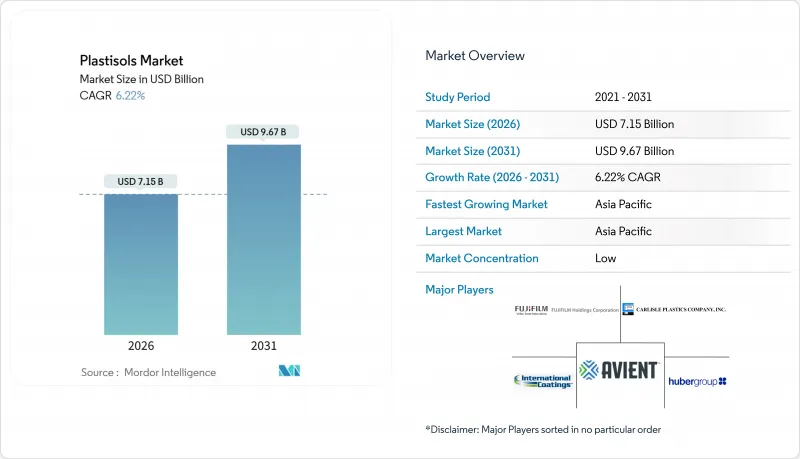
Mordor Intelligence에 의하면, 플라스티졸 시장 규모는 2026년에 71억 5,000만 달러로 추정되고 예측 기간(2026-2031년) CAGR 6.22%로 성장을 지속하여, 2031년까지 96억 7,000만 달러에 이를 전망입니다.
본 보고서는 용도별(접착제·실런트, 페인트 및 코팅, 인쇄 잉크, 성형품, 기타), 최종 사용자 산업별(건축 및 건설, 운송, 섬유, 가전·기계, 기타), 지역별(아시아태평양, 북미, 유럽, 남미, 중동 및 아프리카)로 분류되어 있습니다. 시장 전망은 금액(달러) 기준으로 제시되어 있습니다.
세계의 플라스티졸 시장 동향 및 인사이트
건설 붐이 도료 및 실런트 수요를 견인
사우디아라비아의 ‘비전 2030’에서는 해당 지역의 고온 사막 기후에 가장 적합한 유연성을 지닌 플라스티졸계 실란트의 사용을 중시하고 있습니다. 브라질에서는 인프라 정비 노력에 따라 플라스티졸계 지붕용 필름 재료 및 교량 접합부용 화합물 수요가 증가하고 있습니다. 아세안(ASEAN) 지역의 보호용 코팅에 대한 지출은 엑소노벨(Akzo Nobel)의 간사이 페인트(Kansai Paint) 동남아시아 자산 인수와 요툰(Jotun)의 인도네시아 생산 능력 확장에 힘입어 증가했습니다. 높은 내충격성으로 인해, 폴리에스터 마감보다 가격이 비싸더라도 플라스티졸이 강판 지붕재나 외벽재로 점점 더 선호되고 있습니다. 그러나 아르헨티나의 대규모 프로젝트는 환율 변동과 수입 허가 지연으로 인해 어려움을 겪고 있어, 단기적인 성장 전망을 저해하고 있습니다.
아시아태평양의 섬유용 스크린 인쇄 생산 능력 확대
인도의 ‘생산 연계형 인센티브(PLI)’ 제도를 통해 섬유 제조 부문에 막대한 투자가 이루어졌습니다. 이는 7곳의 PM MITRA 메가파크와 맞물려 국내 스크린 인쇄 생산량 확대를 목표로 하고 있습니다. 중국의 염색·프린팅 부문에서는 단가가 하락했음에도 불구하고 2025년에 수출량이 증가했습니다. 이러한 동향은 생산 능력 유지 전략을 시사하며, 결과적으로 잉크 소비량 증가로 이어지고 있습니다. 화학섬유에 대한 GST(상품 및 서비스세) 인하로 투입 비용이 대폭 절감되었습니다. 이 조치로 인해 저온에서 경화되는 플라스티졸 잉크의 사용이 촉진되어, 1회 인쇄당 에너지 소비량을 절감할 가능성이 있습니다. 베트남과 방글라데시는 2030년까지 섬유 제품 수출을 대폭 확대하는 것을 목표로 하고 있어, 플라스티졸 배합 잉크 수요를 견인할 태세를 갖추고 있습니다. GOTS 및 RoHS 인증을 받은 잉크는 지역 바이어들 사이에서 지지를 넓혀가고 있으며, 배합 제조업체들은 프탈레이트를 포함하지 않는 고품질 화학 조성으로의 전환을 추진하고 있습니다.
엄격한 PVC 및 프탈레이트 규제(REACH, RoHS, CPSIA)
2023년부터 시행되는 ECHA의 장난감 및 육아용품에 대한 DINP, DIDP, DnOP 사용 금지 조치로 인해 이중 재고 관리가 필요해지면서 운전자금 수요가 증가하고 있습니다. 미국에서는 TSCA에 따른 신고 의무가 행정적 부담을 초래하고 있으며, 소규모 컴파운더는 의무화된 제3자 기관에 의한 프탈레이트류 시험 비용을 부담해야 합니다. 중국의 GB 6675는 유럽 규격과 일치하고 있으며, 인도도 IS 9873 규정의 최종 결정을 앞두고 있어 전 세계 규제의 수렴이 두드러지고 있습니다. 규제 준수의 복잡성이 심화되는 가운데, 인수합병(M&A) 활동이 활발해지고 있으며, 그 대표적인 사례로 2024년 Novolex가 Pactiv Evergreen을 인수한 것을 들 수 있습니다. 이는 규제 대응을 위한 지출을 강화하고, 중견 시장에서의 경쟁을 격화시키기 위한 목적입니다.
부문별 분석
인쇄 잉크는 2025년 매출액 기준 플라스티졸 시장 점유율의 33.24%를 차지하며 1위를 기록했으며, 2031년까지 연평균 성장률(CAGR) 7.18%로 성장을 이어가며 선두 자리를 유지할 전망입니다. 인도의 PLI(생산 연계형 인센티브) 제도, 중국의 적극적인 수출 전략, 그리고 아세안(ASEAN) 국가들의 조달처 다각화가 의류 장식 수요의 급증을 뒷받침하고 있습니다. 이러한 수요 증가로 인해, 면 및 폴리에스터 혼방 원단에서 불투명성과 신축성으로 알려진 플라스티졸 배합 잉크에 대한 지속적인 재주문이 발생하고 있습니다. 이러한 배합 잉크는 플래시 경화 속도뿐만 아니라 발색성 면에서도 수성 잉크를 능가합니다. 프리미엄 틈새 시장에서는 프탈레이트를 사용하지 않고 GOTS 인증을 획득한 제품이 명확히 선호되고 있으며, 이를 통해 의류 수출업체들은 유럽의 화학 물질 관리 감사를 원활하게 통과할 수 있게 되었습니다.
스크린 인쇄의 확고한 우위는 원자재에 대한 안정적인 수요를 보장하며, 전 세계 잉크 제조업체들의 생산 능력 확대를 뒷받침하고 있습니다. 업계가 프탈레이트를 사용하지 않고 일부는 바이오 유래 화학 성분으로 전환하고 있음은 분명합니다. 페인트 및 코팅, 접착제·실런트, 성형품은 비교적 작은 역할을 하고 있지만, 이들의 전략적 중요성은 부정할 수 없습니다. 플라스티졸 기반의 자동차 언더바디 코팅은 방음성과 방식성을 제공합니다. 한편, 딥 성형된 공구 손잡이나 전기 커넥터는 두꺼운 필름 특성 개선의 혜택을 받고 있습니다. 일사량이 많은 지역에서는 옥외 간판에 내자외선성 플라스티졸 코팅이 채택되어 수명이 연장되고 있습니다.
지역별 분석
아시아태평양은 2025년에 전 세계 플라스티졸 시장 매출의 51.12%를 차지했으며, 2031년까지 연평균 성장률(CAGR) 6.33%로 성장할 전망입니다. 인도의 PLI(생산 연계형 인센티브) 제도가 새로운 인쇄 라인을 뒷받침하는 한편, 중국은 단가 하락에 직면해 있음에도 수출량을 견조하게 유지하고 있어, 이러한 요인들이 맞물려 잉크 판매 성장을 견인하고 있습니다. 아세안(ASEAN) 국가들의 건설 지출이 실런트 수요의 급증을 견인하고 있으며, 이에 따라 악소노벨(AkzoNobel)과 요툰(Jotun)은 해당 지역의 생산 능력을 확대되고 있습니다. 일본과 한국에서는 자동차 부식 방지 코팅을 강화하여 급증하는 전기차(EV) 차량 대수에 대응하고 있습니다. 합성섬유에 대한 GST(상품 및 서비스세) 인하로 인해 이 지역의 비용 경쟁력은 더욱 공고해지고 있습니다.
북미에서는 경차 생산이 안정적으로 유지되고 있는 데 따른 혜택을 보고 있습니다. 전기차 비중이 증가함에 따라 차량 1대당 언더바디 코팅 면적도 확대되고 있습니다. CPSIA에 따른 프탈레이트류 금지 조치에 대응하여, 장난감 및 육아용품 분야에서 프탈레이트가 포함되지 않은 플라스티졸로의 전환이 두드러지게 나타나고 있으며, 이는 ISO 인증을 취득한 제조업체 시장 점유율을 끌어올리고 있습니다. 멕시코의 조립 업계는 USMCA에 따른 관세 면제 도료를 효과적으로 활용하고 있습니다. 한편, 캐나다의 건설 프로젝트에서는 가혹한 동결·해동 주기를 견딜 수 있는 틈새 시장용 지붕용 도료가 요구되고 있습니다.
유럽에서는 REACH 규제로 인해 성장이 둔화되고 있습니다. 이 규제로 인해 이중 재고 관리가 필요해지면서 규정 준수 비용이 증가하고 있습니다. CO₂ 규제 강화로 인해 자동차 제조업체들은 경량 금속으로의 전환을 강요받고 있으며, 그 결과 접착성이 향상된 플라스티졸에 대한 수요가 증가하고 있습니다. 독일, 프랑스, 영국은 자동차, 건설, 섬유 등 다양한 분야에 걸친 지역적 용도에서 선도적인 역할을 담당하고 있습니다. 러시아는 제재로 인해 공급 제약에 직면한 반면, 북유럽 국가들은 해상 풍력 발전 설비에 플라스티졸을 활용하고 있어 내피로성 코팅의 필요성이 강조되고 있습니다.
기타 혜택 :
- 엑셀 형식 시장 예측(ME) 시트
- 3개월간의 애널리스트 지원
자주 묻는 질문
목차
제1장 서론
제2장 조사 방법
제3장 주요 요약
제4장 시장 구도
제5장 시장 규모 및 성장 예측
제6장 경쟁 구도
제7장 시장 기회 및 향후 전망
KTH 26.08.28According to Mordor Intelligence, the plastisols market size is estimated at USD 7.15 billion in 2026, and is expected to reach USD 9.67 billion by 2031, at a CAGR of 6.22% during the forecast period (2026-2031).
This report is Segmented by Application (Adhesives and Sealants, Paints and Coatings, Printing Inks, Moldings, and Other Applications), End-User Industry (Building and Construction, Transportation, Textiles, Appliances and Machines, and Other End-User Industries), and Geography (Asia-Pacific, North America, Europe, South America, and Middle-East and Africa). Market Forecasts are Provided in Terms of Value (USD).
Global Plastisols Market Trends and Insights
Construction Boom Driving Coatings and Sealants Demand
Saudi Arabia's Vision 2030 emphasizes the use of flexible plastisol sealants, ideal for the region's high-temperature desert climate. In Brazil, an infrastructure initiative is driving up the demand for plastisol roofing membranes and bridge-joint compounds. ASEAN's spending on protective coatings was bolstered by AkzoNobel's takeover of Kansai Paint's assets in Southeast Asia and Jotun's expansion of capacity in Indonesia. Coated-steel roofing and cladding increasingly prefer plastisol, as its impact resistance justifies the premium over polyester finishes. However, macro-projects in Argentina face challenges due to currency fluctuations and delays in import licenses, curbing short-term growth prospects.
Expansion of Textile Screen-Printing Capacity in Asia-Pacific
India's Production Linked Incentive scheme has infused significant investment into the textile manufacturing sector. This, in conjunction with seven PM MITRA mega-parks, aims to boost the domestic screen-printing output. China's printing-and-dyeing sector saw a rise in export volume in 2025, despite a dip in unit prices. This trend hints at capacity defense strategies, which, in turn, amplify ink consumption. A reduction in GST on man-made fiber has slashed input costs. This move promotes the use of plastisol inks, which cure at lower temperatures, potentially cutting per-run energy consumption. Vietnam and Bangladesh are poised to drive up the demand for plastisol formulations as they target substantial textile exports by 2030. Inks certified under GOTS and RoHS are gaining traction among regional buyers, steering formulators towards premium non-phthalate chemistries.
Stringent PVC and Phthalate Regulations (REACH, RoHS, CPSIA)
Effective 2023, ECHA's bans on DINP, DIDP, and DnOP in toys and childcare goods necessitate dual inventories, inflating working-capital needs. In the U.S., TSCA notifications introduce administrative burdens, with small compounders incurring costs for mandated third-party phthalate testing. China's GB 6675 aligns with European standards, and India is on the verge of finalizing its IS 9873 rules, underscoring a global regulatory convergence. The rising complexity of compliance has fueled mergers and acquisitions activity, highlighted by Novolex's acquisition of Pactiv Evergreen in 2024, aiming to bolster regulatory spending and intensify competition in the mid-tier market.
Other drivers and restraints analyzed in the detailed report include:
- Automotive Corrosion-Protection and Lightweighting Needs
- Shift to Phthalate-Free Plastisols for Toys and Childcare Goods
- Volatile PVC Resin and Plasticizer Feedstock Prices
For complete list of drivers and restraints, kindly check the Table Of Contents.
Segment Analysis
Printing Inks led 2025 revenue with 33.24% plastisol market share and will maintain the top position by expanding at a 7.18% CAGR through 2031. India's PLI incentives, China's aggressive export strategies, and ASEAN's sourcing diversification have fueled a surge in garment-decoration demand. This uptick has led to consistent re-orders for plastisol formulations, known for their opacity and elasticity on cotton and polyester blends. These formulations not only outpace water-based inks in flash-curing speed but also in color saturation. In premium niches, there's a clear preference for phthalate-free, GOTS-approved versions, allowing apparel exporters to seamlessly navigate European chemical-management audits.
The unwavering dominance of screen-printing ensures a steady demand for raw materials, bolstering capacity expansions among global ink manufacturers. The industry's shift towards non-phthalate, partially bio-based chemistries is evident. While Paints and Coatings, Adhesives and Sealants, and Moldings play a smaller role, their strategic importance is undeniable. Automotive underbody coatings, based on plastisol, provide sound-damping and corrosion protection. Meanwhile, dip-molded tool handles and electrical connectors benefit from enhanced thick-film qualities. In high-insolation areas, outdoor signage utilizes UV-resistant plastisol coats, extending its service life.
Complete Report Scope:
- By Application
- Adhesives and Sealants
- Paints and Coatings
- Printing Inks
- Moldings
- Other Applications
- By End-user Industry
- Building and Construction
- Transportation
- Textiles
- Appliances and Machines
- Other End-user Industries
- By Geography
- Asia-Pacific
- China
- India
- Japan
- South Korea
- ASEAN Countries
- Rest of Asia-Pacific
- North America
- United States
- Canada
- Mexico
- Europe
- Germany
- United Kingdom
- Italy
- France
- Spain
- Russia
- NORDIC Countries
- Rest of Europe
- South America
- Brazil
- Argentina
- Rest of South America
- Middle-East and Africa
- Saudi Arabia
- South Africa
- Rest of Middle-East and Africa
- Asia-Pacific
Geography Analysis
Asia-Pacific posted 51.12% of the global plastisol market revenue in 2025 and will climb at a 6.33% CAGR through 2031. India's PLI scheme backs new printing lines, while China, despite facing unit-price erosion, staunchly defends its export volume, collectively bolstering ink sales growth. Construction expenditures in ASEAN fuel a surge in sealant demand, prompting AkzoNobel and Jotun to expand their regional capacities. As Japan and South Korea enhance their automotive corrosion-protection layers, they cater to the burgeoning EV fleets. A reduced GST on synthetic yarn solidifies the region's cost leadership.
North America reaps benefits from a consistent light-vehicle output. With an increasing mix of EVs, each vehicle demands a larger underbody coating area. In response to CPSIA phthalate bans, there's a notable shift towards non-phthalate plastisol in toys and childcare products, bolstering the market share of ISO-certified manufacturers. Mexico's assembly sector capitalizes on tariff-free coatings under the USMCA. Meanwhile, Canadian construction projects require niche roofing applications that must withstand challenging freeze-thaw cycles.
Europe grapples with tempered growth due to REACH restrictions, which necessitate maintaining dual inventories and inflate compliance costs. Stricter CO2 regulations push automakers towards lighter metals, consequently boosting the demand for adhesion-enhanced plastisols. Germany, France, and the UK lead the charge in regional applications spanning automotive, construction, and textile sectors. While Russia faces supply constraints due to sanctions, the Nordics leverage plastisol for offshore wind installations, emphasizing the need for fatigue-resistant coatings.
- Avient Corporation
- Campbell Plastics
- Carlisle Plastics Company
- Chemionics Corporation
- Fujifilm Holdings Corporation
- Huber Group
- International Coatings
- Lancer Group International
- MONARCH COLOR CORPORATION
- PATCHAM
- Polyblend
- PolySol LLC
- Sinclair & Rush, Inc.
- Sushee Coatings
- Uniway Asia Limited
- VITA LIQUID POLYMERS
Additional Benefits:
- The market estimate (ME) sheet in Excel format
- 3 months of analyst support
TABLE OF CONTENTS
1 Introduction
- 1.1 Study Assumptions and Market Definition
- 1.2 Scope of the Study
2 Research Methodology
3 Executive Summary
4 Market Landscape
- 4.1 Market Overview
- 4.2 Market Drivers
- 4.2.1 Construction boom driving coatings and sealants demand
- 4.2.2 Expansion of textile screen-printing capacity in Asia-Pacific
- 4.2.3 Automotive corrosion-protection and lightweighting needs
- 4.2.4 Shift to phthalate-free plastisols for toys and childcare goods
- 4.2.5 Emergence of 3-D-printable and smart-functional plastisols
- 4.3 Market Restraints
- 4.3.1 Stringent PVC and phthalate regulations (REACH, RoHS, CPSIA)
- 4.3.2 Volatile PVC resin and plasticizer feedstock prices
- 4.3.3 Competition from powder and water-borne coatings
- 4.4 Value Chain Analysis
- 4.5 Porter's Five Forces
- 4.5.1 Bargaining Power of Suppliers
- 4.5.2 Bargaining Power of Buyers
- 4.5.3 Threat of New Entrants
- 4.5.4 Threat of Substitutes
- 4.5.5 Degree of Competition
5 Market Size and Growth Forecasts (Value)
- 5.1 By Application
- 5.1.1 Adhesives and Sealants
- 5.1.2 Paints and Coatings
- 5.1.3 Printing Inks
- 5.1.4 Moldings
- 5.1.5 Other Applications
- 5.2 By End-user Industry
- 5.2.1 Building and Construction
- 5.2.2 Transportation
- 5.2.3 Textiles
- 5.2.4 Appliances and Machines
- 5.2.5 Other End-user Industries
- 5.3 By Geography
- 5.3.1 Asia-Pacific
- 5.3.1.1 China
- 5.3.1.2 India
- 5.3.1.3 Japan
- 5.3.1.4 South Korea
- 5.3.1.5 ASEAN Countries
- 5.3.1.6 Rest of Asia-Pacific
- 5.3.2 North America
- 5.3.2.1 United States
- 5.3.2.2 Canada
- 5.3.2.3 Mexico
- 5.3.3 Europe
- 5.3.3.1 Germany
- 5.3.3.2 United Kingdom
- 5.3.3.3 Italy
- 5.3.3.4 France
- 5.3.3.5 Spain
- 5.3.3.6 Russia
- 5.3.3.7 NORDIC Countries
- 5.3.3.8 Rest of Europe
- 5.3.4 South America
- 5.3.4.1 Brazil
- 5.3.4.2 Argentina
- 5.3.4.3 Rest of South America
- 5.3.5 Middle-East and Africa
- 5.3.5.1 Saudi Arabia
- 5.3.5.2 South Africa
- 5.3.5.3 Rest of Middle-East and Africa
- 5.3.1 Asia-Pacific
6 Competitive Landscape
- 6.1 Market Concentration
- 6.2 Strategic Moves
- 6.3 Market Share(%)/Ranking Analysis
- 6.4 Company Profiles (includes Global level Overview, Market level overview, Core Segments, Financials as available, Strategic Information, Products and Services, Recent Developments)
- 6.4.1 Avient Corporation
- 6.4.2 Campbell Plastics
- 6.4.3 Carlisle Plastics Company
- 6.4.4 Chemionics Corporation
- 6.4.5 Fujifilm Holdings Corporation
- 6.4.6 Huber Group
- 6.4.7 International Coatings
- 6.4.8 Lancer Group International
- 6.4.9 MONARCH COLOR CORPORATION
- 6.4.10 PATCHAM
- 6.4.11 Polyblend
- 6.4.12 PolySol LLC
- 6.4.13 Sinclair & Rush, Inc.
- 6.4.14 Sushee Coatings
- 6.4.15 Uniway Asia Limited
- 6.4.16 VITA LIQUID POLYMERS
7 Market Opportunities and Future Outlook
- 7.1 White-space and Unmet-need Assessment