

|
시장보고서
상품코드
2114278
볼 밸브 시장 : 시장 점유율 분석, 업계 동향 및 통계, 성장 예측(2026-2031년)Ball Valve - Market Share Analysis, Industry Trends & Statistics, Growth Forecasts (2026 - 2031) |
||||||
 Mordor Intelligence
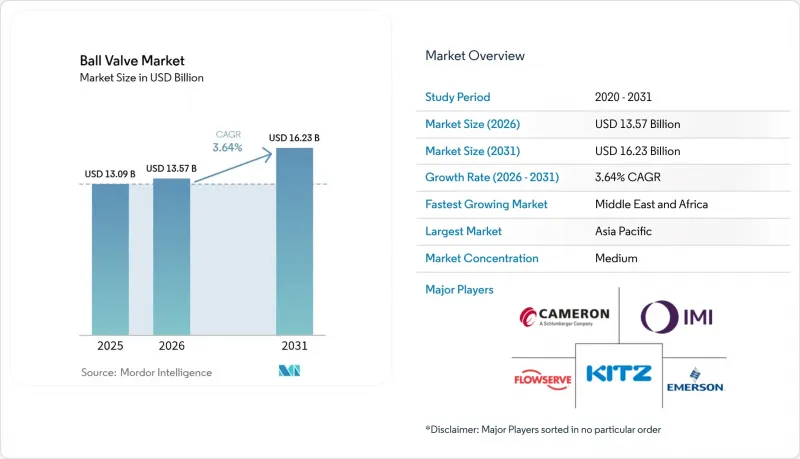
Mordor Intelligence에 의하면, 볼 밸브 시장 규모는 2025년에 130억 9,000만 달러로 평가되었고, 2026년 135억 7,000만 달러에서 2031년까지 162억 3,000만 달러에 이를 것으로 예측되며, 예측 기간(2026-2031년) CAGR은 3.64%를 나타낼 전망입니다.
본 보고서는 밸브 유형별(플로팅식, 트러니언 마운트식, 라이징 스템식, 탑 엔트리식, 풀 용접식, 극저온용), 재질별(탄소강, 스테인리스 스틸, 주철 등), 밸브 크기별(1인치 이하, 1-6인치, 6-25인치 등), 작동 방식별(수동, 전동, 공압, 기타), 최종 사용자별(석유 및 가스, 화학, 수자원, 기타) 및 지역별로 분류되어 있습니다. 시장 전망은 금액(달러) 기준으로 제시되어 있습니다.
세계 볼 밸브 시장 동향 및 인사이트
아시아태평양 신흥국의 LNG 인프라 급속한 확대
아시아 각국 정부는 LNG를 에너지 안보를 강화하고 석탄 의존도를 낮추기 위한 즉각적인 수단으로 보고 있습니다. 2025년에는 주로 아시아의 수입 터미널을 대상으로 한 전 세계 LNG 수출 능력이 18% 증가할 전망이며, 이에 따라 -162°C까지의 내한성을 갖춘 극저온용 볼 밸브에 대한 수요가 증가하고 있습니다. 이러한 밸브는 액화, 수송, 재기화 전 공정에서 메탄 누출이 없는 밀폐성을 보장해야 합니다. 따라서 고도의 금속 공학 전문 지식과 검증된 저온 시험 실적을 보유한 공급업체가 유리합니다. 파이프라인망이 잘 정비되지 않은 베트남이나 필리핀과 같은 수입 의존형 시장에서는 고품질의 트러니언 장착형 극저온 밸브를 사양으로 하는 부유식 저장·재기화 설비(FSRU)가 도입되고 있습니다. 이러한 요건으로 인해 평균 판매 가격이 상승하고, 주요 공급업체는 대체 위험으로부터 보호받게 되어 볼 밸브 시장의 수익성 높은 성장이 더욱 강화될 것입니다.
유럽 전역의 수소 및 CCS 프로젝트에서 가혹한 환경용 볼 밸브 채택 확대
2030년까지 1,000만 톤의 재생 가능 수소를 생산하겠다는 EU의 계획에 따라, 700바를 초과하는 압력을 견디면서 수소 유발 균열을 방지할 수 있는 파이프라인 및 저장 네트워크가 필요합니다. 이러한 기계적 요구 사항과 이산화탄소 포집 및 저장(CCS) 라인에서 초임계 CO2로 인한 부식 문제에 대응하기 위해 듀플렉스 및 슈퍼 듀플렉스 합금이 주류 생산 소재로 자리 잡고 있습니다. 끊임없이 진화하는 수소 규격에 따라 자재 인증을 획득한 제조업체는 플랜트 소유자가 계약을 체결하기 전에 검증된 안전 문서를 요구하기 때문에 선구자로서의 우위를 누리고 있습니다. 이러한 추세는 유럽이 기술 실증의 장으로서의 역할을 공고히 하고, 볼 밸브 시장의 프리미엄 계층을 확대시키고 있습니다.
전 세계 단조 생산 능력의 제약으로 인한 리드타임 장기화
지난 10년에 걸친 공급업체 통합으로 인해, 대구경 니켈 합금 블랭크를 생산할 수 있는 오픈 다이 단조 공장은 불과 몇 곳만 남아 있습니다. 항공우주 산업과 에너지 산업 수요가 동시에 증가함에 따라 생산 능력에 대한 부담이 커지고 있으며, 납기 기간은 기존 12-16주에서 24-32주로 늘어났습니다. 현재 프로젝트 소유주는 일정상의 리스크가 기술적 이점을 상회하는 경우, 완충 재고를 확보하거나 대체 밸브 유형을 수용하는 추세입니다. 일부 OEM은 수직 통합을 추진하고 있지만, 필요한 자본과 인증 획득까지 소요되는 기간으로 인해 상황 개선은 금세기 후반까지 미뤄질 전망입니다.
부문 분석
플로팅 설계 볼 밸브 시장 규모는 정유시설, 상수도, 범용 분야에서의 높은 적응성에 힘입어 2025년에는 매출의 26.60%를 차지했습니다. 극저온용 볼 밸브는 틈새 시장이지만, LNG 터미널이나 수소 수출 허브에서 -162°C까지 확실한 밀봉이 요구됨에 따라 연평균 성장률(CAGR) 6.12%로 확대되고 있습니다. 최종 사용자는 헬륨 질량 분석기를 통한 시험으로 검증된 ‘제로 리크’ 시트 및 ‘블로우아웃 방지’ 스템을 중시하고 있으며, 이러한 기준이 진입 장벽을 높여 고가 대를 유지하는 결과로 이어지고 있습니다.
현재 해저 파일럿 프로젝트를 통해 검증된 적층 가공 방식의 유로는 완전 용접 본체의 경량화와 압력 손실 감소를 실현하고 있습니다. 한편, 오빗형 및 라이징 스템형 변형 제품은 스로틀 운전으로 인해 기존 플로팅 밸브가 손상될 수 있는 상황에서도 시트의 수명을 유지합니다. 이러한 발전들이 맞물려 제품 포트폴리오의 다양화와 기능 범위의 확대로 이어졌으며, 버터플라이 밸브나 플러그 밸브와 같은 대체품이 검토되고 있는 시장에서도 볼 밸브의 중요성을 유지하고 있습니다.
탄소강은 파이프라인 및 산업용 유틸리티 전반에서 뛰어난 강도 대 비용 비율을 자랑하기 때문에 2025년 볼 밸브 시장 규모의 31.50%를 차지했습니다. 수소 프로젝트에서는 현재 취화에 강한 슈퍼 듀플렉스 및 오스테나이트계 합금 본체가 선호되고 있으며, 합금 수요는 연평균 성장률(CAGR) 5.07%로 증가하고 있습니다. 또한, 듀플렉스 계열 등급은 허용 압력 등급을 높일 수 있어, 파이프라인 엔지니어가 파이프 두께를 얇게 하여 설비 투자를 절감할 수 있게 해줍니다.
스테인리스 스틸 가격 변동에 따라 각 OEM 업체들은 304L과 316L의 요구 사항을 모두 충족하는 이중 인증 등급의 채택을 추진하고 있으며, 이를 통해 조달의 유연성이 향상되고 있습니다. 또한 적층 가공 기술의 도입으로, 고니켈 매트릭스가 시트 영역을 보강하고 외피에는 주로 탄소강이 사용되는 기능성 경사 재료가 도입되어 총비용 최적화가 이루어지고 있습니다.
지역별 분석
2025년, 아시아는 볼 밸브 시장 매출의 30.60%를 차지했습니다. 이는 중국의 산업 성장과 동남아시아의 LNG 수입 터미널이 주도한 결과입니다. 보다 깨끗한 에너지 믹스를 의무화하는 정부 정책이 밸브의 지속적인 조달을 뒷받침하고 있습니다. 인도의 ‘메이크 인 인디아(Make in India)’ 계획은 국내 밸브 생산을 촉진하고 있지만, 수소 시범 프로젝트를 위한 가혹한 사용 조건에 대응하는 트림에 대해서는 여전히 수입에 의존하고 있습니다. 일본과 한국은 틈새 화학 공정을 위한 고성능 합금을 우선시하며, 지역 무역에서 기술적 우위를 유지하고 있습니다.
중동은 가장 빠르게 성장하는 지역으로, 사업자들이 기존 유전에서 저배출 밸브 개조를 추진하고 새로운 LNG 메가 트레인을 건설하고 있어 2031년까지 연평균 성장률(CAGR)이 4.94%를 나타낼 것으로 예측됩니다. 카타르의 노스필드 확장 프로젝트만 해도 수천 대의 극저온 유닛이 필요한 반면, 사우디 아람코는 메탄 배출 강도 목표를 달성하기 위해 가스 집약 네트워크 전체에 스마트 액추에이터를 도입하고 있습니다. 튀르키예의 수송망 확충 계획 또한 대구경 파이프라인용 밸브 수주 증가로 이어지고 있습니다.
북미는 미드스트림 분야의 교체 의무로 인해 여전히 큰 시장 점유율을 유지하고 있습니다. 셰일가스 집가스 시스템에는 산성 가스에 내성이 있는 고압 볼 밸브가 필요합니다. 캐나다의 오일샌드 파이프라인에서는 비투멘의 마모를 해결하기 위해 하드페이스 가공된 시트가 요구되고 있습니다. 에너지 시장을 개방하고 있는 멕시코는 수출용 파이프라인을 위해 API 6D 인증을 획득한 밸브를 수입하고 있습니다. 기후 변화 규제는 ISO 15848-1 인증 제품의 채택을 촉진하고 있으며, 이는 확고한 입지를 가진 브랜드에 유리한 추가 요건을 가져오고 있습니다.
기타 혜택 :
- 엑셀 형식 시장 예측(ME) 시트
- 3개월간의 애널리스트 지원
자주 묻는 질문
목차
제1장 서론
제2장 조사 방법
제3장 주요 요약
제4장 시장 구도
제5장 시장 규모 및 성장 예측
제6장 경쟁 구도
제7장 시장 기회 및 향후 전망
AJY 26.08.26According to Mordor Intelligence, the ball valve market size was valued at USD 13.09 billion in 2025 and estimated to grow from USD 13.57 billion in 2026 to reach USD 16.23 billion by 2031, at a CAGR of 3.64% during the forecast period (2026-2031).
This report is Segmented by Valve Type (Floating, Trunnion-Mounted, Rising-Stem, Top-Entry, Fully-Welded, Cryogenic), Material (Carbon Steel, Stainless Steel, Cast Iron, and More), Valve Size (Up To 1", 1"-6", 6"-25", and More), Actuation (Manual, Electric, Pneumatic, and More), End-User (Oil & Gas, Chemicals, Water, and More), and Geography. The Market Forecasts are Provided in Terms of Value (USD).
Global Ball Valve Market Trends and Insights
Accelerated LNG Infrastructure Expansion in Emerging Asia Pacific
Asian governments view LNG as an immediate route to strengthen energy security and cut coal reliance. An 18% rise in global LNG export capacity in 2025, mainly aimed at Asian import terminals, magnifies demand for cryogenic ball valves rated to -162 °C. These units must guarantee methane-tight sealing throughout liquefaction, transport, and regasification duty, which favors vendors with deep metallurgical expertise and validated low-temperature testing records. Import-dependent markets such as Vietnam and the Philippines, lacking pipeline grids, are rolling out floating storage and regasification units that specify premium trunnion-mounted cryogenic valves. This requirement lifts average selling prices and insulates leading suppliers from substitution risk, reinforcing profitable growth for the Ball valve market.
Rising Adoption of Severe-Service Ball Valves in Hydrogen & CCS Projects across Europe
The EU's plan to generate 10 million t of renewable hydrogen by 2030 requires pipelines and storage networks that can withstand pressures above 700 bar while avoiding hydrogen-induced cracking. Duplex and super-duplex alloys are moving into mainstream production to meet these mechanical demands and the corrosion challenges of supercritical CO2 in carbon capture and storage (CCS) lines. Manufacturers that certify materials under evolving hydrogen standards enjoy a first-mover advantage, because plant owners seek proven safety documentation before awarding contracts. This trend cements Europe's role as a technology test bed and enlarges the premium tier of the Ball valve market.
Prolonged Lead-Times due to Global Forging Capacity Constraints
A decade of supplier consolidation has left only a handful of open-die forges capable of producing large-diameter, nickel-alloy blanks. Simultaneous demand from aerospace and energy increases capacity strain, with delivery cycles stretching to 24-32 weeks versus the historical 12-16 week window. Project owners now embed buffer inventories or accept alternate valve styles if schedule risk outweighs technical benefit. Some OEMs pursue vertical integration, but capital needs and qualification timelines delay relief until late decade.
Other drivers and restraints analyzed in the detailed report include:
- North American Mid-stream Asset Modernization Mandates Driving Replacement Demand
- Rapid Digitalization of Water Utilities Spurs Smart Ball Valve Retrofit in Nordics
- High Capital Outlay for Metal-Seated Valves in Abrasive Mining Applications
For complete list of drivers and restraints, kindly check the Table Of Contents.
Segment Analysis
The Ball valve market size for floating designs logged 26.60% revenue in 2025, driven by their adaptability across refinery, water, and general-purpose services. Cryogenic ball valves, though niche, are rising at a 6.12% CAGR as LNG terminals and hydrogen export hubs demand guaranteed sealing down to -162 °C. End users emphasize zero-leakage seats and blow-out-proof stems validated by helium mass-spectrometer testing, a standard that raises entry barriers and sustains premium price realization.
Additive-manufactured flow paths, now field-proven in subsea pilots, reduce weight and pressure drop in fully welded bodies. Meanwhile, orbit and rising-stem variants preserve seat life where throttling duty would damage conventional floating valves. Together, these developments diversify product portfolios and extend the functional scope, preserving relevance of ball valves even in markets exploring butterfly or plug alternatives.
Carbon steel held 31.50% share of the Ball valve market size in 2025 thanks to its favorable strength-to-cost ratio across pipelines and industrial utilities. Hydrogen projects now favor alloy-based bodies with super-duplex or austenitic grades to resist embrittlement, raising alloy demand at a 5.07% CAGR. Duplex grades also unlock higher allowable pressure ratings, enabling pipeline engineers to downsize schedules and shave capex.
Stainless-steel price volatility pushes OEMs to qualify dual-certified grades that meet both 304L and 316L requirements, streamlining procurement flexibility. Additive manufacturing introduces functionally graded materials where high-nickel matrices reinforce seat zones, while carbon-steel dominates outer shells, optimizing total cost.
Complete Report Scope:
- By Valve Type
- Floating Ball Valves
- Trunnion-Mounted Ball Valves
- Rising-Stem / Orbit Ball Valves
- Top-Entry Ball Valves
- Fully-Welded Ball Valves
- Cryogenic Ball Valves
- By Material
- Carbon Steel
- Stainless Steel
- Cast Iron / Ductile Iron
- Alloy-Based (Duplex, Inconel, Hastelloy)
- Bronze and Brass
- Other Materials
- By Valve Size
- Up to 1" (DN 25)
- 1" - 6"
- 6 " - 25"
- 25" - 50"
- Above 50"
- By Actuation
- Manual
- Electric
- Pneumatic
- Hydraulic
- Electro-Hydraulic
- By End-User Industry
- Oil and Gas
- Chemicals and Petrochemicals
- Water and Wastewater
- Power Generation
- Mining and Metals
- Food and Beverage
- Pharmaceuticals and Biotechnology
- HVAC and Refrigeration
- Pulp and Paper
- Other Industries
- By Geography
- North America
- United States
- Canada
- Mexico
- Europe
- United Kingdom
- Germany
- France
- Italy
- Rest of Europe
- Asia-Pacific
- China
- Japan
- India
- South Korea
- Rest of Asia-Pacific
- Middle East
- Israel
- Saudi Arabia
- United Arab Emirates
- Turkey
- Rest of Middle East
- Africa
- South Africa
- Egypt
- Rest of Africa
- South America
- Brazil
- Argentina
- Rest of South America
- North America
Geography Analysis
Asia accounted for 30.60% of Ball valve market revenue in 2025, propelled by Chinese industrial growth and Southeast Asian LNG import terminals. Government policies that mandate cleaner energy mix underpin sustained valve procurement. India's "Make in India" scheme fosters domestic valve production yet still relies on imported severe-service trims for hydrogen pilots. Japan and South Korea prioritize high-performance alloys for niche chemical processes, maintaining a technology premium in regional trade.
The Middle East is the fastest-growing cluster, projecting 4.94% CAGR to 2031 as operators retrofit low-emission valves in legacy fields and build green-field LNG mega-trains. Qatar's North Field expansion alone calls for thousands of cryogenic units, while Saudi Aramco deploys smart actuators across gas gathering networks to satisfy methane-intensity goals. Turkey's transit ambitions also translate into large-bore pipeline valve orders.
North America retains sizable share owing to mid-stream replacement mandates. Shale-gas gathering systems need high-pressure ball valves resistant to acid gases. Canadian oil sands lines demand hard-faced seats to manage bitumen abrasion. Mexico, opening its energy market, imports API 6D-certified valves for export-class pipelines. Climate regulation stimulates adoption of ISO-15848-1 certified products, adding incremental requirements that favor established brands.
- Emerson Electric Co.
- Flowserve Corporation
- Schlumberger (Cameron)
- IMI plc
- Kitz Corporation
- Crane Co.
- Baker Hughes (Valves and Process Solutions)
- Honeywell International Inc.
- Alfa Laval AB
- Curtiss-Wright Corporation
- SAMSON AG
- Velan Inc.
- CIRCOR International Inc.
- AVK Holding
- Mueller Water Products Inc.
- Neway Valve Co., Ltd.
- Bonney Forge Corp.
- Metso Corporation (Valmet)
- Hitachi Ltd.
- Valvitalia S.p.A.
- Georg Fischer Ltd.
- Danfoss A/S
- Castel SRL
- Sanhua Holding Group
Additional Benefits:
- The market estimate (ME) sheet in Excel format
- 3 months of analyst support
TABLE OF CONTENTS
1 INTRODUCTION
- 1.1 Study Assumptions and Market Definition
- 1.2 Scope of the Study
2 RESEARCH METHODOLOGY
3 EXECUTIVE SUMMARY
4 MARKET LANDSCAPE
- 4.1 Market Overview
- 4.2 Market Drivers
- 4.2.1 Accelerated LNG Infrastructure Expansion in Emerging Asia Pacific
- 4.2.2 Rising Adoption of Severe-Service Ball Valves in Hydrogen and CCS Projects across Europe
- 4.2.3 North American Mid-stream Asset Modernization Mandates Driving Replacement Demand
- 4.2.4 Rapid Digitalization of Water Utilities Spurs Smart Ball Valve Retrofit in Nordics
- 4.2.5 Surge in FPSO Deployments Boosting Cryogenic Ball Valve Uptake in Brazil and West Africa
- 4.2.6 Regulatory Push for Low-Emission ("Fugitive-Methane-Free") Valves in the Middle East
- 4.3 Market Restraints
- 4.3.1 Prolonged Lead-Times due to Global Forging Capacity Constraints
- 4.3.2 High Capital Outlay for Metal-Seated Valves in Abrasive Mining Applications
- 4.3.3 Increasing Preference for Plug and Butterfly Valves in Compact HVAC Systems
- 4.3.4 Volatile Stainless-Steel Prices Eroding Margins for Tier-2 Asian Manufacturers
- 4.4 Value / Supply-Chain Analysis
- 4.5 Regulatory Outlook
- 4.6 Technological Outlook
- 4.7 Porter's Five Forces Analysis
- 4.7.1 Bargaining Power of Suppliers
- 4.7.2 Bargaining Power of Buyers
- 4.7.3 Threat of New Entrants
- 4.7.4 Threat of Substitutes
- 4.7.5 Intensity of Competitive Rivalry
- 4.8 Investment and Funding Analysis
5 MARKET SIZE AND GROWTH FORECASTS (VALUE)
- 5.1 By Valve Type
- 5.1.1 Floating Ball Valves
- 5.1.2 Trunnion-Mounted Ball Valves
- 5.1.3 Rising-Stem / Orbit Ball Valves
- 5.1.4 Top-Entry Ball Valves
- 5.1.5 Fully-Welded Ball Valves
- 5.1.6 Cryogenic Ball Valves
- 5.2 By Material
- 5.2.1 Carbon Steel
- 5.2.2 Stainless Steel
- 5.2.3 Cast Iron / Ductile Iron
- 5.2.4 Alloy-Based (Duplex, Inconel, Hastelloy)
- 5.2.5 Bronze and Brass
- 5.2.6 Other Materials
- 5.3 By Valve Size
- 5.3.1 Up to 1" (DN 25)
- 5.3.2 1" - 6"
- 5.3.3 6 " - 25"
- 5.3.4 25" - 50"
- 5.3.5 Above 50"
- 5.4 By Actuation
- 5.4.1 Manual
- 5.4.2 Electric
- 5.4.3 Pneumatic
- 5.4.4 Hydraulic
- 5.4.5 Electro-Hydraulic
- 5.5 By End-User Industry
- 5.5.1 Oil and Gas
- 5.5.2 Chemicals and Petrochemicals
- 5.5.3 Water and Wastewater
- 5.5.4 Power Generation
- 5.5.5 Mining and Metals
- 5.5.6 Food and Beverage
- 5.5.7 Pharmaceuticals and Biotechnology
- 5.5.8 HVAC and Refrigeration
- 5.5.9 Pulp and Paper
- 5.5.10 Other Industries
- 5.6 By Geography
- 5.6.1 North America
- 5.6.1.1 United States
- 5.6.1.2 Canada
- 5.6.1.3 Mexico
- 5.6.2 Europe
- 5.6.2.1 United Kingdom
- 5.6.2.2 Germany
- 5.6.2.3 France
- 5.6.2.4 Italy
- 5.6.2.5 Rest of Europe
- 5.6.3 Asia-Pacific
- 5.6.3.1 China
- 5.6.3.2 Japan
- 5.6.3.3 India
- 5.6.3.4 South Korea
- 5.6.3.5 Rest of Asia-Pacific
- 5.6.4 Middle East
- 5.6.4.1 Israel
- 5.6.4.2 Saudi Arabia
- 5.6.4.3 United Arab Emirates
- 5.6.4.4 Turkey
- 5.6.4.5 Rest of Middle East
- 5.6.5 Africa
- 5.6.5.1 South Africa
- 5.6.5.2 Egypt
- 5.6.5.3 Rest of Africa
- 5.6.6 South America
- 5.6.6.1 Brazil
- 5.6.6.2 Argentina
- 5.6.6.3 Rest of South America
- 5.6.1 North America
6 COMPETITIVE LANDSCAPE
- 6.1 Market Concentration
- 6.2 Strategic Moves
- 6.3 Market Share Analysis
- 6.4 Company Profiles (includes Global level Overview, Market level overview, Core Segments, Financials as available, Strategic Information, Market Rank/Share for key companies, Products and Services, and Recent Developments)
- 6.4.1 Emerson Electric Co.
- 6.4.2 Flowserve Corporation
- 6.4.3 Schlumberger (Cameron)
- 6.4.4 IMI plc
- 6.4.5 Kitz Corporation
- 6.4.6 Crane Co.
- 6.4.7 Baker Hughes (Valves and Process Solutions)
- 6.4.8 Honeywell International Inc.
- 6.4.9 Alfa Laval AB
- 6.4.10 Curtiss-Wright Corporation
- 6.4.11 SAMSON AG
- 6.4.12 Velan Inc.
- 6.4.13 CIRCOR International Inc.
- 6.4.14 AVK Holding
- 6.4.15 Mueller Water Products Inc.
- 6.4.16 Neway Valve Co., Ltd.
- 6.4.17 Bonney Forge Corp.
- 6.4.18 Metso Corporation (Valmet)
- 6.4.19 Hitachi Ltd.
- 6.4.20 Valvitalia S.p.A.
- 6.4.21 Georg Fischer Ltd.
- 6.4.22 Danfoss A/S
- 6.4.23 Castel SRL
- 6.4.24 Sanhua Holding Group
7 MARKET OPPORTUNITIES AND FUTURE OUTLOOK
- 7.1 White-Space and Unmet-Need Assessment


