

|
시장보고서
상품코드
2114297
자동차 엔진 캡슐화 : 시장 점유율 분석, 업계 동향 및 통계, 성장 예측(2026-2031년)Automotive Engine Encapsulation - Market Share Analysis, Industry Trends & Statistics, Growth Forecasts (2026 - 2031) |
||||||
 Mordor Intelligence
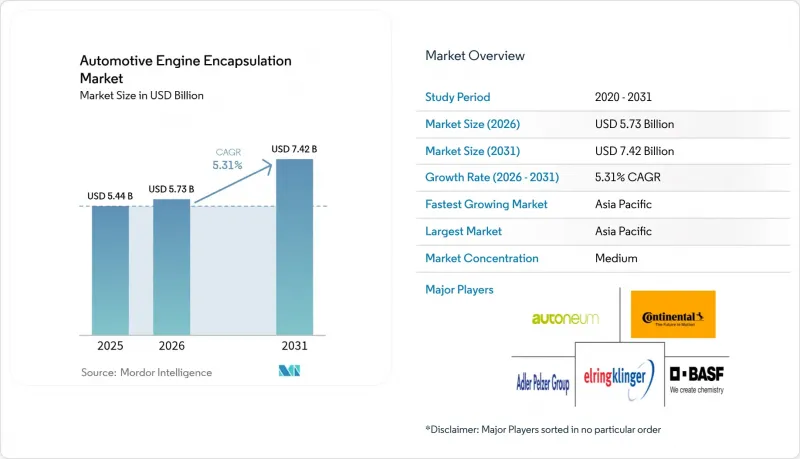
Mordor Intelligence에 의하면, 자동차 엔진 캡슐화 시장 규모는 2025년 54억 4,000만 달러로 평가되었습니다. 2026년에는 57억 3,000만 달러로 확대되어 2026년부터 2031년에 걸쳐 CAGR 5.31%로 성장을 지속하여, 2031년에는 74억 2,000만 달러에 이를 것으로 예측됩니다.
본 보고서는 제품 유형(엔진 탑재형 및 차체 탑재형), 연료 유형(가솔린, 디젤 등), 소재 유형(탄소섬유, 폴리우레탄 등), 차량 유형(승용차, 소형 상용차 등), 판매 채널(OEM 장착 및 애프터마켓),지역(북미, 남미 등)별로 세분화되어 있습니다. 시장 예측은 금액(달러) 기준으로 제시되어 있습니다.
세계의 자동차 엔진 캡슐화 시장 동향 및 인사이트
유로 7 도입 이후 더욱 엄격해진 콜드 스타트 CO₂ 배출 목표
유로 7은 2026년 11월부터 신차에 대해 시행되며, 적합 기준이 20만km로 연장됨에 따라 콜드 스타트 시의 배기가스가 그 어느 때보다 엄격하게 감시될 것입니다. 자동차 제조업체들은 현재 -7°C에서 35°C에 이르는 광범위한 주변 온도 범위에서 예열 시간을 단축하고 엔진 소음을 저감하는 캡슐화 기술을 필요로 하고 있습니다. 이러한 요구 사항에 따라 탄소섬유 구조와 상변화 층을 결합한 하이브리드 소재 스택이 주목받고 있으며, 음향 성능을 희생하지 않으면서도 배기가스 규제를 준수할 수 있게 해줍니다.
프리미엄 브랜드의 ‘도서관처럼 조용한’ 내연기관 차량으로의 전환
고급 자동차 브랜드는 정숙성이 뛰어난 전기차(EV)의 경험을 반영하여, 공회전 시 차량 내 소음을 40 dB 미만으로 억제하는 것을 목표로 하고 있습니다. 에어로겔 배리어를 이용한 다층 캡슐화를 통해 단열성을 유지하면서 소음 저감 계수 0.9 이상을 실현하고 있습니다. 현재 개발 프로그램은 엔진에 그치지 않고 변속기 터널까지 확대되어, 파워트레인 전체를 단일 음원으로 간주하여 통합적인 솔루션을 구축하고 있습니다.
BEV 파워트레인의 급속한 보급으로 인해 내연기관(ICE)의 점유율이 하락
유럽의 신차 등록 대수에서 BEV가 차지하는 비율은 2024년에 15.40%에 달했고, 2030년까지 50%를 넘어설 것으로 예측되어, 내연기관(ICE) 전용 캡슐화에 대한 수요는 줄어들고 있습니다. 부품 공급업체들은 축소되는 ICE 프로그램에서 발생한 이익을 EV용 단열 제품에 재투자하지 않으면 이익률 하락에 직면하게 될 것입니다.
부문별 분석
2025년에는 엔진 탑재형 캡슐화가 자동차 엔진 캡슐화 시장을 주도하며 51.12%의 점유율을 차지했습니다. 이러한 모듈은 파워트레인에 직접 장착되므로 진동 격리 성능이 뛰어나며, 신속한 예열과 라인사이드 장착을 가능하게 합니다. 차체 장착형 설계는 연평균 성장률(CAGR) 7.26%로 확대되고 있으며, 플랫폼 통합을 지원하고 조립 시간을 단축하기 위해 대형 언더바디 부위에 주조되는 사례가 늘고 있습니다.
차체 장착형 캡슐화는 방음재를 구조 부재와 일체화하여 엔진룸을 밀폐하는 동시에 강성을 향상시킵니다. 이 방식은 여러 개의 브래킷이나 패스너가 필요 없는 기가캐스트(GigaCast) 방식의 차체 하부 구조와 잘 어울립니다. 공급업체는 다이캐스팅의 열 사이클을 견디고 층간 박리를 일으키지 않는 소재를 개발해야 합니다. 그 결과, 차체 장착형 솔루션을 적용한 자동차 엔진 캡슐화 시장 규모는 2031년까지 꾸준히 확대될 것으로 예측됩니다.
2025년, 가솔린 엔진은 전 세계 승용차 시장에서의 높은 보급률을 배경으로 자동차 엔진 캡슐화 시장 규모의 65.20%를 차지했습니다. 가솔린 엔진용 캡슐화에서는 신속한 예열과 공회전 시 소음 저감이 중시되고 있습니다.
하이브리드 차량 및 레인지 익스텐더 모델의 경우, 배터리 냉각과 연소열 차단이 결합되어 있어 전동 파워트레인은 7.61%라는 가장 높은 연평균 성장률(CAGR)을 보이고 있습니다. 각 공급업체들은 엔진의 급격한 온도 상승으로부터 셀을 보호하는 동시에 인버터의 이상 소음을 줄이는 두 가지 목적을 겸비한 배리어를 설계하고 있습니다. 디젤 엔진은 토크가 필요한 이용 사례에서 여전히 활용되고 있지만, 후처리 과정의 복잡성으로 인해 비용 측면에서 과제에 직면해 있습니다.
지역별 분석
아시아태평양은 2025년에 48.10%의 점유율로 자동차 엔진 캡슐화 시장을 주도했으며, 연평균 성장률(CAGR) 8.18%로 확대되고 있습니다. 중국의 우위는 막대한 자동차 생산 대수와 정책 주도의 하이브리드차 성장에 기인하며, 전기차(EV) 중심의 로드맵 하에서도 내연기관(ICE)용 캡슐화에 대한 수요를 지속시키고 있습니다. 인도에서는 생산 실적에 연동된 인센티브를 통해 공급업체들이 캡슐화의 현지 생산에 참여하고 있으며, 비용 경쟁력과 관세상의 우대 조치를 동시에 확보하고 있습니다.
유럽에서는 유로 7 규제를 활용하여 콜드 스타트 시 배기가스 대책을 위한 첨단 솔루션을 추진하고 있습니다. 이에 더해 하이브리드 차량의 보급이 내연기관(ICE)의 지속적인 중요성을 부각시키고 있습니다. 탄소섬유와 디지털 트윈 기술은 우선 이 지역에서 성숙한 후 전 세계로 확산되면서, 해당 지역의 사상적 리더십을 강화하고 있습니다. 북미에서는 더 대형의 파워트레인을 채택하고 견고한 열·음향 차단 장치가 필요한 SUV 및 픽업 트럭의 판매를 배경으로 꾸준한 성장을 이루고 있습니다.
중동 및 아프리카 및 남미는 여전히 신흥 시장으로서의 위치를 유지하고 있습니다. 이 지역들은 수입된 NVH 키트나 CKD(완전 조립 키트)에 의존하고 있지만, 현지 생산이 증가함에 따라 그린필드 공장을 건설하는 공급업체가 늘고 있습니다. 전반적으로 자동차 엔진 캡슐화 시장은 아시아태평양의 생산 능력을 중심으로 지역적 통합이 진행되는 한편, 유럽이 전 세계적으로 수용되는 추세를 주도하고 있습니다.
기타 혜택 :
- 엑셀 형식 시장 예측(ME) 시트
- 3개월간의 애널리스트 지원
자주 묻는 질문
목차
제1장 서론
제2장 조사 방법
제3장 주요 요약
제4장 시장 구도
제5장 시장 규모 및 성장 예측
제6장 경쟁 구도
제7장 시장 기회 및 향후 전망
KTH 26.08.28According to Mordor Intelligence, the automotive engine encapsulation market size is expected to grow from USD 5.44 billion in 2025 to USD 5.73 billion in 2026 and is forecast to reach USD 7.42 billion by 2031 at 5.31% CAGR over 2026-2031.
This report is Segmented by Product Type (Engine-Mounted and Body-Mounted), Fuel Type (Gasoline, Diesel, and More), Material Type (Carbon Fiber, Polyurethane, and More), Vehicle Type (Passenger Cars, Light Commercial Vehicles, and More), Sales Channel (OEM-Fitted and Aftermarket), and Geography (North America, South America, and More). The Market Forecasts are Provided in Terms of Value (USD).
Global Automotive Engine Encapsulation Market Trends and Insights
Stricter Post-Euro 7 Cold-Start CO2 Targets
Euro 7 takes effect for new vehicle types in November 2026 and extends compliance to 200,000 km, putting cold-start emissions under unprecedented scrutiny. Automakers now need encapsulation that accelerates warm-up times and dampens engine noise across ambient ranges from -7°C to 35°C. The requirement pushes hybrid material stacks that blend carbon-fiber structures with phase-change layers, securing emission compliance without sacrificing acoustics.
Premium-Brand Shift to Library-Quiet ICE Cabins
Luxury marques target idle cabin noise below 40 dB, mirroring silent EV experiences. Multi-layer encapsulation with aerogel barriers achieves noise reduction coefficients above 0.9 while sustaining thermal insulation. Programs now extend beyond engines to transmission tunnels, treating the full powertrain as one acoustic source for a unified solution.
Rapid BEV Power-Train Mix Diluting ICE Volume
BEV penetration in new car registration across Europe hit 15.40% in 2024 and is forecast to be above 50% by 2030, shrinking demand for ICE-specific encapsulation. Suppliers must reinvest profits from declining ICE programs into EV-thermal products or face margin erosion.
Other drivers and restraints analyzed in the detailed report include:
- Battery Pre-Conditioning Needs in PHEVs
- Lightweight Carbon-Fiber Cost Curve Inflection
- Petro-Chemical Price Volatility for Polymer Foams
For complete list of drivers and restraints, kindly check the Table Of Contents.
Segment Analysis
Engine-mounted encapsulations led the automotive engine encapsulation market with a 51.12% share in 2025. These modules excel at vibration isolation because they sit directly on the power unit, enabling rapid warm-up and line-side installation. Body-mounted designs are accelerating at 7.26% CAGR and increasingly cast into large underbody sections, supporting platform consolidation and lowering assembly time.
Body-mounted encapsulation integrates acoustic barriers with structural members, improving stiffness while sealing the engine bay. This format dovetails with gigacast underbodies that eliminate multiple brackets and fasteners. Suppliers must formulate materials that tolerate die-casting thermal cycles without delamination. Consequently, the automotive engine encapsulation market size for body-mounted solutions is projected to expand steadily through 2031.
Gasoline engines accounted for 65.20% automotive engine encapsulation market size in 2025, supported by their prevalence in global passenger fleets. Encapsulation for gasoline units emphasizes rapid warm-up and idle noise suppression.
Electric powertrains exhibit the briskest 7.61% CAGR because hybrids and range-extended models blend battery cooling with combustion insulation. Suppliers engineer dual-purpose barriers that protect cells from engine heat spikes while muting inverter whine. Diesel remains for torque-intensive use cases but faces cost headwinds due to after-treatment complexity.
Complete Report Scope:
- By Product Type
- Engine-Mounted
- Body-Mounted
- By Fuel Type
- Gasoline
- Diesel
- Electric
- By Material Type
- Carbon Fiber
- Polyurethane
- Polypropylene
- Polyamide
- Glasswool
- By Vehicle Type
- Passenger Cars
- Light Commercial Vehicles
- Medium and Heavy Commercial Vehicles
- By Sales Channel
- OEM-Fitted
- Aftermarket
- Geography
- North America
- United States
- Canada
- Rest of North America
- South America
- Brazil
- Argentina
- Rest of South America
- Europe
- Germany
- United Kingdom
- France
- Italy
- Spain
- Rest of Europe
- Asia-Pacific
- China
- Japan
- India
- South Korea
- Australia
- New Zealand
- Rest of Asia-Pacific
- Middle East and Africa
- Saudi Arabia
- United Arab Emirates
- Egypt
- Turkey
- South Africa
- Rest of Middle East and Africa
- North America
Geography Analysis
Asia-Pacific led the automotive engine encapsulation market with 48.10% share in 2025 and is advancing at 8.18% CAGR. China's dominance derives from vast vehicle output and policy-driven hybrid growth that prolongs ICE encapsulation demand even in an EV-centric roadmap. India's production-linked incentives lure suppliers to localize encapsulation, combining cost competitiveness with duty advantages.
Europe is leveraging Euro 7 regulations to drive advanced solutions for cold-start emissions. This, coupled with the widespread adoption of hybrids, underscores the continued relevance of internal combustion engines (ICE). Carbon-fiber and digital-twin tools mature here first, then migrate globally, reinforcing the region's thought leadership. North America grows steadily on the back of SUV and pickup sales that use larger powertrains, which need robust thermal-acoustic barriers.
The Middle East and Africa, and South America, remain emerging pockets. They rely on imported NVH kits or CKD assembly, yet rising local output attracts suppliers establishing greenfield plants. Altogether, the automotive engine encapsulation market continues regional consolidation around APAC capacity while Europe drives specification trends embraced worldwide.
- Autoneum Holding AG
- Continental AG
- ElringKlinger AG
- BASF SE
- 3M Company
- Rochling Group
- Adler Pelzer Group
- Trocellen Automotive
- Woco Group
- SA Automotive
- Charlotte Baur Formschaumtechnik GmbH
- Sumitomo Riko Co. Ltd
- Sika Automotive
- Pritex Ltd
- UGN Inc.
- Langfang Sound (China)
Additional Benefits:
- The market estimate (ME) sheet in Excel format
- 3 months of analyst support
TABLE OF CONTENTS
1 Introduction
- 1.1 Study Assumptions & Market Definition
- 1.2 Scope of the Study
2 Research Methodology
3 Executive Summary
4 Market Landscape
- 4.1 Market Overview
- 4.2 Market Drivers
- 4.2.1 Stricter post-Euro 7 cold-start CO2 targets
- 4.2.2 Premium-brand shift to "library-quiet" ICE cabins
- 4.2.3 Battery pre-conditioning needs in PHEVs
- 4.2.4 Lightweight carbon-fiber cost curve inflection
- 4.2.5 Gigacasting enabling larger body-mounted encapsulations
- 4.2.6 OEM digital twins optimising under-hood thermal maps
- 4.3 Market Restraints
- 4.3.1 Rapid BEV power-train mix diluting ICE volumes
- 4.3.2 Petro-chemical price volatility for polymer foams
- 4.3.3 Limited recyclability of multi-layer NVH composites
- 4.3.4 Engine-bay packaging conflicts in downsized ICEs
- 4.4 Value / Supply-Chain Analysis
- 4.5 Regulatory Landscape
- 4.6 Technological Outlook
- 4.7 Porter's Five Forces
- 4.7.1 Threat of New Entrants
- 4.7.2 Bargaining Power of Buyers / Consumers
- 4.7.3 Bargaining Power of Suppliers
- 4.7.4 Threat of Substitute Products
- 4.7.5 Intensity of Competitive Rivalry
5 Market Size & Growth Forecasts (Value in USD)
- 5.1 By Product Type
- 5.1.1 Engine-Mounted
- 5.1.2 Body-Mounted
- 5.2 By Fuel Type
- 5.2.1 Gasoline
- 5.2.2 Diesel
- 5.2.3 Electric
- 5.3 By Material Type
- 5.3.1 Carbon Fiber
- 5.3.2 Polyurethane
- 5.3.3 Polypropylene
- 5.3.4 Polyamide
- 5.3.5 Glasswool
- 5.4 By Vehicle Type
- 5.4.1 Passenger Cars
- 5.4.2 Light Commercial Vehicles
- 5.4.3 Medium and Heavy Commercial Vehicles
- 5.5 By Sales Channel
- 5.5.1 OEM-Fitted
- 5.5.2 Aftermarket
- 5.6 Geography
- 5.6.1 North America
- 5.6.1.1 United States
- 5.6.1.2 Canada
- 5.6.1.3 Rest of North America
- 5.6.2 South America
- 5.6.2.1 Brazil
- 5.6.2.2 Argentina
- 5.6.2.3 Rest of South America
- 5.6.3 Europe
- 5.6.3.1 Germany
- 5.6.3.2 United Kingdom
- 5.6.3.3 France
- 5.6.3.4 Italy
- 5.6.3.5 Spain
- 5.6.3.6 Rest of Europe
- 5.6.4 Asia-Pacific
- 5.6.4.1 China
- 5.6.4.2 Japan
- 5.6.4.3 India
- 5.6.4.4 South Korea
- 5.6.4.5 Australia
- 5.6.4.6 New Zealand
- 5.6.4.7 Rest of Asia-Pacific
- 5.6.5 Middle East and Africa
- 5.6.5.1 Saudi Arabia
- 5.6.5.2 United Arab Emirates
- 5.6.5.3 Egypt
- 5.6.5.4 Turkey
- 5.6.5.5 South Africa
- 5.6.5.6 Rest of Middle East and Africa
- 5.6.1 North America
6 Competitive Landscape
- 6.1 Market Concentration
- 6.2 Strategic Moves
- 6.3 Market Share Analysis
- 6.4 Company Profiles (Includes Global Level Overview, Market Level Overview, Core Segments, Financials as Available, Strategic Information, Market Rank/Share for Key Companies, Products and Services, SWOT Analysis, and Recent Developments)
- 6.4.1 Autoneum Holding AG
- 6.4.2 Continental AG
- 6.4.3 ElringKlinger AG
- 6.4.4 BASF SE
- 6.4.5 3M Company
- 6.4.6 Rochling Group
- 6.4.7 Adler Pelzer Group
- 6.4.8 Trocellen Automotive
- 6.4.9 Woco Group
- 6.4.10 SA Automotive
- 6.4.11 Charlotte Baur Formschaumtechnik GmbH
- 6.4.12 Sumitomo Riko Co. Ltd
- 6.4.13 Sika Automotive
- 6.4.14 Pritex Ltd
- 6.4.15 UGN Inc.
- 6.4.16 Langfang Sound (China)
7 Market Opportunities & Future Outlook
- 7.1 White-space & Unmet-Need Assessment


