
|
시장보고서
상품코드
2114335
통신 분야 블록체인 : 시장 점유율 분석, 업계 동향 및 통계, 성장 예측(2026-2031년)Blockchain In Telecom - Market Share Analysis, Industry Trends & Statistics, Growth Forecasts (2026 - 2031) |
||||||
 Mordor Intelligence
Mordor Intelligence에 의하면, 통신 분야 블록체인 시장 규모는 2026년에 26억 7,000만 달러에 이르고, 2031년까지 77억 4,000만 달러로 확대되며 예측 기간 동안 CAGR 23.72%로 성장할 전망입니다.
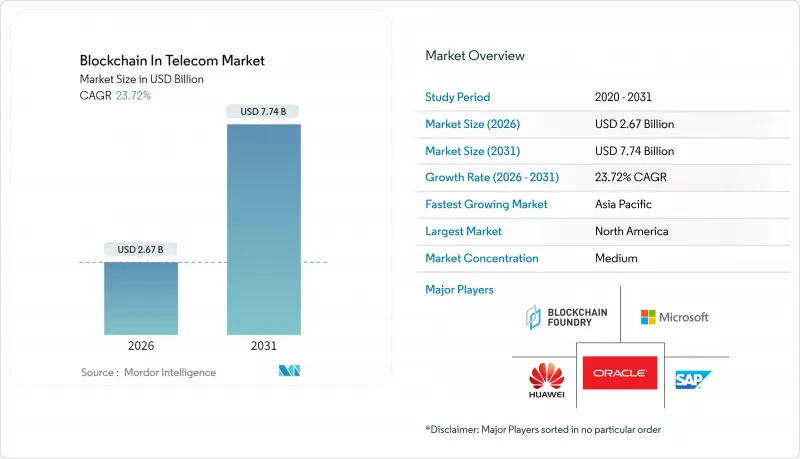
본 보고서는 용도별(ID 관리, 결제·청구, 스마트 계약 등), 구성 요소별(플랫폼, 서비스 등), 블록체인 유형별(퍼블릭, 프라이빗, 컨소시엄, 하이브리드), 배포 유형별(On-Premise, 클라우드 기반),조직 규모별(중소기업, 대기업), 지역별로 분류되어 있습니다. 시장 예측은 금액(달러) 기준으로 제시되어 있습니다.
세계의 통신 분야 블록체인 시장 동향 및 인사이트
통신 분야의 부정 방지 노력
2024년 전 세계 부정행위로 인한 손실액은 398억 9,000만 미달러에 달했으며, 통신 사업자들은 통화 상세 데이터를 발생원에서 기록하고, SIM 박스를 통한 우회를 실시간으로 차단하는 불변 원장의 도입을 서둘러야 하는 상황에 처해 있습니다. 미국의 STIR/SHAKEN 규정에서는 암호화된 발신자 ID 서명이 의무화되어 있으며, 중앙 집중형 데이터베이스는 크레덴셜 스터핑 공격의 표적이 되기 쉬우므로 현재 여러 Tier 1 통신사가 블록체인 레지스트리의 시범 운영을 진행하고 있습니다. 에릭슨이 바텔코(Batelco)와 함께 실시한 파일럿 프로젝트에서는 6개월 이내에 로밍 사기를 34% 감소시켰으며, 원장 기반의 공유 인텔리전스가 측정 가능한 성과를 가져온다는 것을 입증했습니다. 사기 방지 요구를 충족하기 위해서는 경쟁사가 자체 가입자 기록을 공개하지 않고도 위험 데이터를 공유할 수 있는 컨소시엄형 설계가 적합합니다.
보안성이 강화된 5G 네트워크 슬라이싱에 대한 수요 증가
네트워크 슬라이싱 계약은 자율주행차나 원격 수술에서 지연 시간과 대역폭을 보장합니다. ITU-T 표준 Y.3087은 슬라이스의 라이프사이클 로그를 위한 분산 원장의 연동 지점을 규정하고 있으며, 블록체인을 여러 통신 사업자 간의 SLA에서 신뢰 계층으로 확립하고 있습니다. 한국의 2025년 규정에서는 공공 부문 슬라이스에 대한 원장 기록이 의무화되어 있으며, SK텔레콤과 KT코퍼레이션에 의한 도입이 가속화되고 있습니다. 또한, 스마트 계약은 성능이 기준에서 벗어날 경우의 위약금 지급을 자동화하여, 통신 사업자의 이익률을 잠식하던 수 주간에 걸친 정산 주기를 제거합니다.
업계 전반의 상호운용성 표준 부재
TM Forum의 58개 오픈 API 중 블록체인을 지원하는 것은 불과 3개에 불과하여, 통신 사업자들은 Hyperledger Fabric과 Ethereum 사이드체인 간의 트랜잭션을 변환하는 맞춤형 미들웨어에 자금을 투자할 수밖에 없습니다. MEF의 오케스트레이션 사양에서는 원장 바인딩이 적어도 2027년까지 연기되어 있어, 조기 도입 사업자들은 자산 매몰을 우려하고 있습니다. IEEE의 상호운용성 프로젝트는 여전히 초안 단계에 머물러 있어, 통신 사업자들은 여러 통합을 병행함으로써 위험을 분산시키고 있지만, 그 결과 운영 비용이 증가하고 ROI 향상이 저해되고 있습니다.
부문별 분석
2025년에는 ‘결제 및 청구’ 부문이 36.63%의 점유율로 수익을 주도했으나, 통신 시장에서 사업자들이 SLA 로직을 블록체인상의 Solidity 코드에 직접 통합함에 따라 스마트 계약 워크플로는 연평균 성장률(CAGR) 25.81%로 성장할 전망입니다. 이러한 변화는 블록체인의 장점이 기존의 결제 경로를 모방하는 것이 아니라, 로밍 및 주파수 대역 공유에 대한 합의를 자동화하는 데 있다는 인식을 반영합니다. ID 관리 프로젝트는 ETSI의 eSIM 규정을 준수하며, 블록체인을 기반으로 하는 발신자 ID 레지스트리는 STIR/SHAKEN 준수를 실현하여 중앙 집중식 허니팟을 사용하지 않고도 부정 사용을 줄이고 있습니다.
한국에서는 새로운 연결 프로비저닝 원장을 통해 번호 이전이 10분 이내에 완료될 수 있게 되었습니다. 이는 기존 HLR 시스템에서 48시간이 소요되었던 것과는 대조적입니다. 네트워크 슬라이싱 오케스트레이션은 ITU-T Y.3087 지침을 준수하며, 법적 정당성을 확보하기 위해 모든 매개변수 변경 사항이 기록됩니다. Oracle의 기성 템플릿을 통해 통합 기간이 9개월에서 6주로 단축되어, OSS 팀이 충분히 갖춰지지 않은 중견 통신사의 도입이 가속화되고 있습니다.
통신 업계가 블록체인을 활용한 통신 시장 내 아키텍처 통제를 추구하는 가운데, 2025년 매출의 57.33%를 원장 플랫폼이 차지했습니다. 그러나 전 세계적으로 통신 분야 전문 지식과 블록체인 기술을 모두 갖춘 엔지니어가 2,000명 미만에 불과하기 때문에 서비스 부문은 연평균 성장률(CAGR) 24.55%를 나타낼 것으로 예측됩니다. Guardtime사의 감사 의뢰가 340% 급증하고 있으며, 이는 계약 보안 검증이 필수적이어지고 있음을 보여줍니다. 하드웨어 노드는 여전히 시장 점유율이 가장 낮지만, 20밀리초 미만의 검증 지연 시간을 필요로 하는 5G 엣지 시나리오에는 필수적입니다.
컨설팅 기업과 하이퍼스케일러가 이러한 인력 부족을 메우고 있습니다. IBM과 액센츄어는 2025년에 인증 프로그램을 시작할 예정이며, 한편 AWS, Azure, Google Cloud는 통신 사업자가 GDPR(EU 개인정보보호규정), 중국의 데이터 보안법 및 기타 규제 요건을 도입 직후부터 준수할 수 있도록 통신 거버넌스 팩을 통합하고 있습니다. 이러한 기능 세트 덕분에 클라우드 플랫폼의 성장률은 On-Premise 구축보다 1.5퍼센트 포인트 더 높습니다.
지역별 분석
2025년에는 FCC(연방통신위원회)의 발신자 인증 규정에 따라 미국 통신 사업자들이 원장 기반 등록 시스템을 도입해야 했으며, 그 결과 1년 이내에 자동 음성 통화(로보콜)가 28% 감소함에 따라 북미가 매출의 37.12%를 차지하며 1위를 차지했습니다. 캐나다는 2025년에 유사한 지침을 제정했으며, 멕시코는 2024년에 블록체인을 활용한 번호 이동성을 의무화하여 번호 이전 소요 시간을 48시간에서 6시간으로 단축했습니다.
아시아태평양은 2031년까지 연평균 성장률(CAGR) 28.17%로 가장 높은 성장률을 기록할 전망입니다. 릴라이언스 지오(Reliance Geo)는 블록체인을 전국 규모의 5G 슬라이스에 통합했으며, 한국에서는 공공 프로젝트에 대한 원장 기록 의무화가 도입을 가속화하고 있습니다. 중국은 2025년 말까지 통신 사업자에게 1,847건의 블록체인 서비스 라이선스를 발급하며, 분산 원장을 필수 인프라로 자리매김하고 있습니다. 일본의 라쿠텐 모바일은 블록체인을 활용해 기존 사업자와의 주파수 공유 타임스탬프를 기록함으로써, 분쟁 해결까지 걸리는 기간을 6주에서 3일로 단축했습니다.
유럽은 2025년에 28.5%의 점유율을 차지했으며, 이는 ETSI가 제정하고 보다폰, 오렌지, 도이치 텔레콤이 채택한 GDPR(EU 개인정보보호규정) 준수 eSIM 원장 규격에 힘입은 결과입니다. 중동 및 아프리카는 연평균 성장률(CAGR) 25.3%를 기록했으며, 남아프리카공화국에서 블록체인을 활용한 SIM 등록 의무화로 인해 9개월 동안 부정 활성화가 41% 감소했습니다. 남미 성장의 중심은 브라질이며, 아나텔(Anatel)의 번호 이동성 개혁으로 인해 번호 이전 소요 시간이 4시간으로 단축되었습니다.
기타 혜택 :
- 엑셀 형식 시장 예측(ME) 시트
- 3개월간의 애널리스트 지원
자주 묻는 질문
목차
제1장 서론
제2장 조사 방법
제3장 주요 요약
제4장 시장 구도
제5장 시장 규모 및 성장 예측
제6장 경쟁 구도
제7장 시장 기회 및 향후 전망
KTH 26.08.28According to Mordor Intelligence, the blockchain in telecom market size reached USD 2.67 billion in 2026 and is projected to climb to USD 7.74 billion by 2031, advancing at a 23.72% CAGR during the forecast period.
This report is Segmented by Application (Identity Management, Payment and Billing, Smart Contract, and More), Component (Platform, Services, and More), Blockchain Type (Public, Private, Consortium, and Hybrid), Deployment Type (On-Premises, and Cloud-Based), Organization Size (Small and Medium Enterprises, and Large Enterprises), and Geography. The Market Forecasts are Provided in Terms of Value (USD).
Global Blockchain In Telecom Market Trends and Insights
Focus on Telecom Fraud Mitigation
Global fraud losses touched USD 39.89 billion in 2024, pushing operators to adopt immutable ledgers that record call-detail data at source and block SIM-box bypass in real time. The United States STIR/SHAKEN rules require cryptographic caller-ID signatures, and several Tier-1 carriers now trial blockchain registries because centralized databases invite credential-stuffing attacks. Ericsson's pilot with Batelco cut roaming fraud 34% within six months, proving ledger-based shared intelligence delivers measurable gains. Fraud-mitigation needs favor consortium designs that let rivals share risk data without exposing proprietary subscriber records.
Rising Demand for Secure 5G Network Slicing
Network-slice contracts guarantee latency and bandwidth for autonomous vehicles or remote surgery. ITU-T standard Y.3087 sets distributed-ledger hooks for slice life-cycle logs, cementing blockchain as the trust layer for multi-operator SLAs. South Korea's 2025 rule makes ledger logging compulsory in public-sector slices, accelerating adoption by SK Telecom and KT Corporation. Smart contracts also automate penalty payments once performance drifts, eliminating multi-week reconciliation cycles that eroded operator margins.
Lack of Industry-wide Interoperability Standards
Only three of TM Forum's 58 Open APIs cover blockchain, forcing carriers to bankroll bespoke middleware that translates transactions between Hyperledger Fabric and Ethereum sidechains. MEF's orchestration spec defers ledger bindings until at least 2027, making early adopters fear stranded assets. IEEE's interoperability project is still a draft, so operators hedge bets with parallel integrations that inflate operating costs and curb ROI.
Other drivers and restraints analyzed in the detailed report include:
- Increasing Roaming-settlement Efficiency Initiatives
- Regulatory Push for SIM and Device-identity Protection
- Scalability and Energy-efficiency Concerns
For complete list of drivers and restraints, kindly check the Table Of Contents.
Segment Analysis
Payment and Billing led revenue with a 36.63% share in 2025, but Smart Contract workflows are on track for a 25.81% CAGR as operators embed SLA logic directly into Solidity code in the blockchain in telecom market. The shift reflects recognition that blockchain's advantage lies in automating roaming and spectrum-sharing agreements rather than mirroring legacy payment rails. Identity-management projects align with ETSI's eSIM rules, and caller-ID registries anchored in blockchain deliver STIR/SHAKEN compliance, trimming fraud without central honeypots.
Emerging Connectivity Provisioning ledgers now port numbers in under 10 minutes in South Korea, versus 48 hours under legacy HLR systems. Network-slicing orchestration follows ITU-T Y.3087 guidance, logging every parameter change for legal defensibility. Oracle's pre-built templates slash integration from nine months to six weeks, accelerating uptake among mid-tier carriers that lack deep OSS teams.
Ledger platforms dominated 57.33% of 2025 revenue as operators sought architectural control in the blockchain in telecom market. However, Services are projected to post a 24.55% CAGR because fewer than 2,000 engineers combine telecom domain mastery and blockchain skills worldwide. Guardtime recorded a 340% jump in audit mandates, signaling that contract-security validation is becoming non-negotiable. Hardware nodes remain the smallest slice yet are indispensable for 5G edge scenarios needing sub-20-millisecond validation latency.
Consultancies and hyperscalers are filling the talent void. IBM and Accenture launched certification tracks in 2025, while AWS, Azure, and Google Cloud embed telecom governance packs that let carriers comply with GDPR, China's Data Security Law, and other mandates straight out of the box. This feature set propels cloud platforms to grow 1.5 percentage points faster than on-premises builds.
Complete Report Scope:
- By Application
- Identity Management
- Payment and Billing
- Smart Contract
- Connectivity Provisioning
- Fraud Management and Authentication
- Network Management and Slicing Orchestration
- By Component
- Platform
- Services
- Hardware Nodes and Gateways
- By Blockchain Type
- Public Blockchain
- Private Blockchain
- Consortium Blockchain
- Hybrid Blockchain
- By Deployment Type
- On-premises
- Cloud-based
- By Organization Size
- Small and Medium Enterprises (SMEs)
- Large Enterprises
- By Geography
- North America
- United States
- Canada
- Mexico
- South America
- Brazil
- Argentina
- Rest of South America
- Europe
- Germany
- United Kingdom
- France
- Italy
- Spain
- Rest of Europe
- Asia-Pacific
- China
- Japan
- India
- South Korea
- ASEAN
- Rest of Asia-Pacific
- Middle East
- Saudi Arabia
- United Arab Emirates
- Rest of Middle East
- Africa
- South Africa
- Nigeria
- Rest of Africa
- North America
Geography Analysis
North America led with 37.12% revenue in 2025 after FCC caller-authentication rules compelled U.S. carriers to deploy ledger-based registries that cut robocalls by 28% within a year. Canada drafted parallel guidelines in 2025, and Mexico mandated blockchain number portability in 2024, trimming porting windows from 48 hours to six hours.
Asia-Pacific will record the fastest 28.17% CAGR through 2031. Reliance Jio integrated blockchain into nationwide 5G slices, while South Korea's compulsory ledger logging for public projects accelerates uptake. China issued 1,847 blockchain service licenses to telecom firms by late-2025, equating distributed ledgers with essential infrastructure. Japan's Rakuten Mobile uses blockchain to timestamp spectrum-sharing events with incumbents, shortening dispute cycles from six weeks to three days.
Europe held 28.5% share in 2025, propelled by GDPR-aligned eSIM ledger standards from ETSI that Vodafone, Orange, and Deutsche Telekom embraced. Middle East and Africa posted a 25.3% CAGR, with South Africa's blockchain SIM-registration mandate slashing fraudulent activations 41% in nine months. South America's growth centers on Brazil, where Anatel's portability reforms whittled transfer time to four hours.
- Huawei Technologies Co., Ltd.
- Microsoft Corporation
- Oracle Corporation
- SAP SE
- Blockchain Foundry Inc.
- Ping Identity Holding Corp. (ShoCard)
- Telefonaktiebolaget LM Ericsson
- Nokia Corporation
- International Business Machines Corporation
- Deutsche Telekom AG
- AT&T Inc.
- Verizon Communications Inc.
- Vodafone Group Plc
- Orange S.A.
- Telefonica, S.A.
- T-Mobile US, Inc.
- SoftBank Group Corp.
- Swisscom AG
- Reliance Jio Infocomm Limited
- BT Group plc
- Koninklijke KPN N.V.
- Guardtime OU
- Clear Projects Ltd.
- Syntropy Technologies Ltd.
- America Movil, S.A.B. de C.V. (Claro)
- Rakuten Group, Inc.
Additional Benefits:
- The market estimate (ME) sheet in Excel format
- 3 months of analyst support
TABLE OF CONTENTS
1 INTRODUCTION
- 1.1 Study Assumptions and Market Definition
- 1.2 Scope of the Study
2 RESEARCH METHODOLOGY
3 EXECUTIVE SUMMARY
4 MARKET LANDSCAPE
- 4.1 Market Overview
- 4.2 Market Drivers
- 4.2.1 Focus on Telecom Fraud Mitigation
- 4.2.2 Rising Demand for Secure 5G Network Slicing
- 4.2.3 Increasing Roaming-settlement Efficiency Initiatives
- 4.2.4 Regulatory Push for SIM and Device-identity Protection
- 4.2.5 Emergence of Telco-focused Blockchain-as-a-service (BaaS)
- 4.2.6 Monetization of Carrier, Edge Nodes via Blockchain Marketplaces
- 4.3 Market Restraints
- 4.3.1 Lack of Industry-wide Interoperability Standards
- 4.3.2 Scalability and Energy-efficiency Concerns
- 4.3.3 High Integration Costs with Legacy OSS/BSS
- 4.3.4 Limited Telco-grade Smart-contract Audit Expertise
- 4.4 Industry Value Chain Analysis
- 4.5 Regulatory Landscape
- 4.6 Technological Outlook
- 4.7 Porter's Five Forces Analysis
- 4.7.1 Bargaining Power of Suppliers
- 4.7.2 Bargaining Power of Buyers
- 4.7.3 Threat of New Entrants
- 4.7.4 Threat of Substitutes
- 4.7.5 Intensity of Competitive Rivalry
5 MARKET SIZE AND GROWTH FORECASTS (VALUE)
- 5.1 By Application
- 5.1.1 Identity Management
- 5.1.2 Payment and Billing
- 5.1.3 Smart Contract
- 5.1.4 Connectivity Provisioning
- 5.1.5 Fraud Management and Authentication
- 5.1.6 Network Management and Slicing Orchestration
- 5.2 By Component
- 5.2.1 Platform
- 5.2.2 Services
- 5.2.3 Hardware Nodes and Gateways
- 5.3 By Blockchain Type
- 5.3.1 Public Blockchain
- 5.3.2 Private Blockchain
- 5.3.3 Consortium Blockchain
- 5.3.4 Hybrid Blockchain
- 5.4 By Deployment Type
- 5.4.1 On-premises
- 5.4.2 Cloud-based
- 5.5 By Organization Size
- 5.5.1 Small and Medium Enterprises (SMEs)
- 5.5.2 Large Enterprises
- 5.6 By Geography
- 5.6.1 North America
- 5.6.1.1 United States
- 5.6.1.2 Canada
- 5.6.1.3 Mexico
- 5.6.2 South America
- 5.6.2.1 Brazil
- 5.6.2.2 Argentina
- 5.6.2.3 Rest of South America
- 5.6.3 Europe
- 5.6.3.1 Germany
- 5.6.3.2 United Kingdom
- 5.6.3.3 France
- 5.6.3.4 Italy
- 5.6.3.5 Spain
- 5.6.3.6 Rest of Europe
- 5.6.4 Asia-Pacific
- 5.6.4.1 China
- 5.6.4.2 Japan
- 5.6.4.3 India
- 5.6.4.4 South Korea
- 5.6.4.5 ASEAN
- 5.6.4.6 Rest of Asia-Pacific
- 5.6.5 Middle East
- 5.6.5.1 Saudi Arabia
- 5.6.5.2 United Arab Emirates
- 5.6.5.3 Rest of Middle East
- 5.6.6 Africa
- 5.6.6.1 South Africa
- 5.6.6.2 Nigeria
- 5.6.6.3 Rest of Africa
- 5.6.1 North America
6 COMPETITIVE LANDSCAPE
- 6.1 Market Concentration
- 6.2 Strategic Moves
- 6.3 Market Share Analysis
- 6.4 Company Profiles (includes Global level Overview, Market Level Overview, Core Segments, Financials as Available, Strategic Information, Market Rank/Share for Key Companies, Products and Services, and Recent Developments)
- 6.4.1 Huawei Technologies Co., Ltd.
- 6.4.2 Microsoft Corporation
- 6.4.3 Oracle Corporation
- 6.4.4 SAP SE
- 6.4.5 Blockchain Foundry Inc.
- 6.4.6 Ping Identity Holding Corp. (ShoCard)
- 6.4.7 Telefonaktiebolaget LM Ericsson
- 6.4.8 Nokia Corporation
- 6.4.9 International Business Machines Corporation
- 6.4.10 Deutsche Telekom AG
- 6.4.11 AT&T Inc.
- 6.4.12 Verizon Communications Inc.
- 6.4.13 Vodafone Group Plc
- 6.4.14 Orange S.A.
- 6.4.15 Telefonica, S.A.
- 6.4.16 T-Mobile US, Inc.
- 6.4.17 SoftBank Group Corp.
- 6.4.18 Swisscom AG
- 6.4.19 Reliance Jio Infocomm Limited
- 6.4.20 BT Group plc
- 6.4.21 Koninklijke KPN N.V.
- 6.4.22 Guardtime OU
- 6.4.23 Clear Projects Ltd.
- 6.4.24 Syntropy Technologies Ltd.
- 6.4.25 America Movil, S.A.B. de C.V. (Claro)
- 6.4.26 Rakuten Group, Inc.
7 MARKET OPPORTUNITIES AND FUTURE OUTLOOK
- 7.1 White-space and Unmet-Need Assessment