

|
시장보고서
상품코드
2114337
항공용 커넥터 : 시장 점유율 분석, 업계 동향과 통계, 성장 예측(2026-2031년)Aviation Connectors - Market Share Analysis, Industry Trends & Statistics, Growth Forecasts (2026 - 2031) |
||||||
 Mordor Intelligence
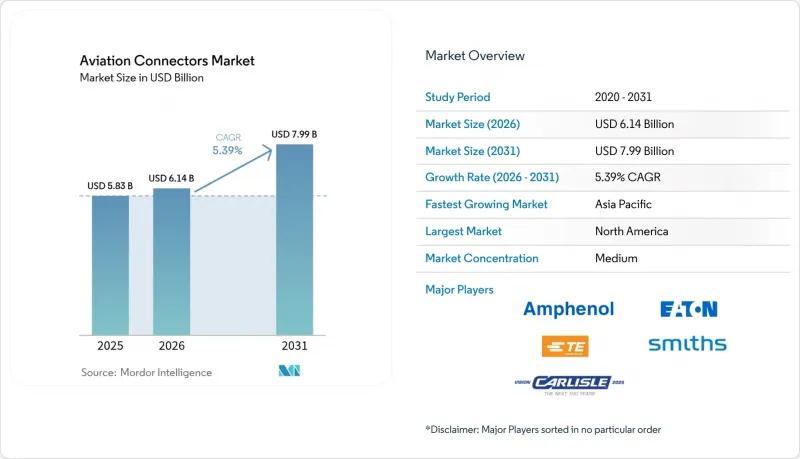
Mordor Intelligence에 따르면 2026년 항공용 커넥터 시장의 규모는 61억 4,000만 달러로 추정되고 있으며, 2025년 58억 3,000만 달러에서 확대하며, 2031년에는 79억 9,000만 달러에 달할 것으로 예측됩니다.
2026-2031년까지 연평균 성장률(CAGR) 5.39%로 성장할 것으로 전망됩니다.
이 보고서는 유형(PCB, RF 커넥터, 기타), 형태(원형, 직사각형),용도(항공전자기기, 배전, 조명 시스템, 객실 관리, 기타), 최종사용자(OEM, 애프터마켓), 플랫폼(상용기, 군용기, 기타), 소재(알루미늄 합금, 스테인리스, 기타), 지역별로 분류되어 있습니다. 시장 전망은 금액(달러) 기준으로 제시되어 있습니다.
세계 항공용 커넥터 시장의 동향 및 인사이트
지속적으로 증가하는 민간 항공기 대수
2024년 11월까지 전 세계 항공기 인도 대수는 1,180대에 달하며, 에어버스와 보잉의 누적 수주 잔고는 현재 1만 2,000대를 넘어섰습니다. 이로 인해 향후 수년간의 생산 전망이 확고해졌으며, 항공용 커넥터 시장에 견고한 성장 기반이 확보되었습니다. 아시아태평양의 항공사들은 여객 수가 2019년 수준을 상회하는 회복세를 보이는 가운데, 신규 수주의 약 40%를 차지하고 있으며, 한편, 단일 통로 항공기 프로그램에서는 월 60대 이상의 지속적인 생산 속도가 목표로 설정되어 있습니다. 각 협동체기(narrow-body)에는 약 1,200개의 커넥터가 탑재되어 있으며, 광폭기(wide-body)의 경우 2,500개를 초과하기도 합니다. 따라서 생산 속도가 조금이라도 상승하면 커넥터 출하량도 그에 비례하여 증가합니다. 리스 회사는 운항 중인 항공기의 절반 이상을 소유하고 있으며, 표준화된 인터페이스를 지정하는 경향이 강해지고 있으며, OEM 각사는 다양한 운항 사업자 간에 유지보수를 효율화하는 모듈식 설계를 채택하는 것을 촉진하고 있습니다. 노후화된 기체에 대한 객실 및 조종실 개조 프로그램으로 인해 정기적인 커넥터 교체가 필요한 도입 기반은 더욱 확대되고 있습니다.
경량 항공기용 전기 시스템에 대한 수요 증가
‘모어 일렉트릭(More Electric)’ 항공기 구성은 연료 소비량을 3-5% 절감하고 시스템 신뢰성을 높일 것이라는 기대감으로 인해 점점 더 널리 보급되고 있습니다. 전동식 환경 제어 팩, 제빙 장치, 비행 제어 액추에이터를 통해 기내 발전량은 기존 기계식 유형의 약 200kVA에서 차세대 설계에서는 1MW 이상으로 증가합니다. 이러한 변화로 인해 항공기 1대당 커넥터 수는 최대 60% 증가하며, 공급업체들은 중량 절감에 도움이 되는 복합재료나 알루미늄·리튬 합금을 사용한 하우징을 제공해야 하는 상황에 직면해 있습니다. 예를 들어 보잉 787에 탑재된 이튼(Eaton)사의 전원 패널에는 270VDC 및 115VAC 정격의 1,500개 이상의 고출력 접점이 통합되어 있으며, 더 높은 전류 밀도를 지원하는 첨단 방열 채널로 지원되고 있습니다. 유럽의 한 연구 컨소시엄은 알루미늄을 탄소섬유 강화 플라스틱으로 대체함으로써 두 자릿수의 경량화를 실현할 수 있음을 입증했으며, 이는 고성능 복합재 하우징의 채택을 촉진하고 있습니다.
항공기 납품 관련 기존 주문 잔고
엔진 공급, 인력, 문서화 문제로 인해 생산이 제약을 받고 있으며, 생산 목표 달성에 차질이 생기고 있습니다. 보잉의 737 MAX 생산 라인은 2024년 대부분 기간 중 월 38대 생산 상한선에 머물러 있으며, 이로 인해 기체 제조 후반 공정과 관련된 커넥터 출하가 연기되고 있습니다. 에어버스(Airbus) 역시 파워플랜트 점검 주기로 인해 최종 조립 속도가 둔화되면서 A320neo 제품군에서 유사한 생산 속도 둔화를 겪었습니다. 이전의 생산 속도 가정을 바탕으로 재고를 축적해 온 공급업체들은 현재 운전 자본이 증가하고 있으며, 마일스톤 연계형 결제가 연기됨에 따라 단기적인 현금 흐름이 경색되고 있습니다. 특히 소규모 Tier 3 기업은 프로그램의 다양성이 부족하고, 단일 통로기 생산 확대가 회복되기를 기다려야 하므로 취약한 입장에 놓여 있습니다.
부문 분석
2025년에는 레이더, 위성통신, 항법 시스템이 최대 40GHz까지 안정적인 성능을 필요로 하므로 RF 인터페이스가 37.82%라는 최대 시장 점유율을 차지할 것입니다. 따라서 항공기 제조사들은 이러한 용도에서 앞으로도 견고한 동축 케이블을 계속 우선시할 것으로 보입니다. 통합 모듈형 항공전자 장비 내에서 AFDX 및 시간 민감형 네트워킹(TSN)을 지원하는 인쇄회로기판용 커넥터는 1Gbps 이상으로 전환되고 있으며, 임피던스 예산이 점점 더 엄격해지고 있으며, 공급업체들은 접점 형태의 개선을 요구받고 있습니다. 스트리밍급 엔터테인먼트, 전자항공가방(EFB), 예측 유지보수 분석이 기체 전체에서 더 높은 대역폭으로 전환됨에 따라 광섬유 커넥터 시장은 연평균 성장률(CAGR) 7.41%로 확대되고 있으며, 이는 항공용 커넥터 시장 전체의 성장률을 상회하는 수치입니다. 유나이티드 항공이 1,000대 이상의 나로우바디 항공기를 대상으로 한 Starlink 도입 계획만으로도 2027년까지 40만개 이상의 신규 광섬유 종단부 수요가 발생할 것으로 전망됩니다.
광섬유에 대한 수요는 분산형 박스에서 중앙 집중형 네트워크 아키텍처로의 전환을 반영하고 있습니다. 콜린스 에어로스페이스의 ‘Pro Line Fusion’은 광 백플레인을 이용하여 처리 클러스터를 연결함으로써, 하네스의 무게를 3분의 1 가까이 줄이면서, 페일세이프 요건을 충족하는 중복 채널을 제공합니다. RF 커넥터는 착륙 장치 베이와 같은 고진동 영역에서 여전히 확고한 입지를 유지하고 있는 반면, 하이브리드형 전원·신호 어셈블리는 신흥 전기식 택싱 시스템에서 점유율을 확대하고 있습니다. 전반적으로 소재 기술의 발전과 설치 작업자에 대한 교육을 통해 광섬유의 청정도 및 굽힘 반경 관리와 같은 초기 과제는 점차 극복되고 있으며, 도입은 앞으로도 증가 추세를 유지할 전망입니다.
원형 인터페이스는 2025년 매출의 56.10%를 차지하고 있으며, 2031년까지 연평균 6.85%의 증가가 예상됩니다. 이 제품들이 갖춘 360도 EMI 차폐, 나사식 결합, IP67 규격의 밀폐성은 유체, 온도 변동, 진동이 집중되는 주날개 뿌리 부분, 엔진 파일론, 휠 웰과 같은 영역에 적합합니다. 직사각형 장치는 기판 간 공간이 제한된 고밀도 항공전자 장비 랙에서 그 진가를 발휘합니다. 그러나 이러한 하우징은 습기 방지를 위해 2차 개스킷에 의존하고 있으며, 점검 주기가 짧아지고, 결과적으로 총 소유 비용이 높아지게 됩니다.
AS85049를 준수하는 복합재 원형 쉘은 알루미늄 제품에 비해 무게를 약 35% 줄이면서도 동일한 패널 절개부에 완벽하게 맞습니다. 이는 하네스 재설계를 피할 수 있으므로 항공기 운항 사업자들로부터 높은 평가를 받고 있는 특징입니다. 한편, 직사각형 유형은 블레이드 접점이 위치당 100A를 초과하는 전류를 흘리는 배전 장치에서 점차 채택이 확대되고 있습니다. 도시 항공 모빌리티(UAM) 실증기에서는 두 형태가 공존하고 있습니다. 원형 케이스는 모터 전류를 전송하고, 슬림한 직사각형 케이스는 좁은 나셀 내부에서 센서 데이터와 배터리 텔레메트리 데이터를 전송합니다. 이러한 혼합 아키텍처로 인해 커넥터의 총 수는 증가하며, 다양한 형태를 단일 모듈로 통합할 수 있는 공급업체의 수익 확대가 예상됩니다.
지역별 분석
북미는 보잉(Boeing)사의 737 MAX 및 787 시리즈, 그리고 록히드 마틴(Lockheed Martin)사의 F-35 최종 조립 사업에 힘입어 2025년 매출의 40.10%를 차지했습니다. 주요 커넥터 기업은 미국 국내에 비해 약 60% 낮은 인건비를 활용하고, USMCA(미국·멕시코·캐나다 협정)에 따른 니어쇼어링의 강점을 살려 멕시코에 생산 거점을 집중하고 있습니다. 또한 이 지역은 차세대 전투기 및 미사일 시스템용 고신뢰성 인터페이스를 지원하는 견고한 국방 지출의 혜택도 누리고 있습니다.
유럽은 탄탄한 항공우주 생태계를 유지하고 있으며, 에어버스는 2024년 11월까지 643대의 제트기를 인도할 예정으로, 다쏘와 레오나르도의 군용기 생산을 보완하고 있습니다. EASA(유럽항공안전청)에 의한 규제 조화로 인해 여러 국가에서의 조달 절차가 간소화되었지만, 브렉시트 이후의 이중 인증으로 인해 영국 시설에서는 리드타임이 더욱 길어지고 있습니다. 유럽의 국적 항공사가 보유한 대규모 와이드바디 기단은 기내 광섬유 업그레이드 개조에 대한 지속적인 수요를 창출하고 있습니다.
아시아태평양은 연평균 성장률(CAGR) 8.52%로 가장 빠르게 성장하는 지역입니다. COMAC의 C919는 2024년에 8대의 인도를 달성했으며, 2028년까지 연간 150대를 목표로 하고 있습니다. 한편, 인도의 새로운 C295 생산 라인은 2024년 9월에 첫 수송기를 출하했습니다. 양국의 국내 공급망 개발 정책에 따라 적극적인 현지 커넥터 인증 프로그램이 추진되고 있지만, 높은 신뢰성 측면에서 여전히 격차가 존재하므로 유럽 및 미국 공급업체에게는 진입 여지가 남아 있습니다. 저비용 항공사(LCC)의 기단 확대와 MRO(정비·수리·오버홀) 역량 강화로 인해 특히 지난 10년 동안 기내 연결성 개선이 확대됨에 따라 애프터마켓의 활발한 성장이 확실시되고 있습니다.
기타 혜택
- 엑셀 형식의 시장 예측(ME) 시트
- 3개월간의 애널리스트 지원
자주 묻는 질문
목차
제1장 서론
제2장 조사 방법
제3장 개요
제4장 시장 구도
제5장 시장 규모와 성장 예측
제6장 경쟁 구도
제7장 시장 기회와 향후 전망
KSA 26.08.26According to Mordor Intelligence, aviation connectors market size in 2026 is estimated at USD 6.14 billion, growing from 2025 value of USD 5.83 billion with 2031 projections showing USD 7.99 billion, growing at 5.39% CAGR over 2026-2031.
This report is Segmented by Type (PCB, RF Connectors, and More), Shape (Circular, Rectangular), Application (Avionics, Power Distribution, Lighting Systems, Cabin Management, and More), End User (OEM, Aftermarket), Platform (Commercial Aircraft, Military Aircraft, and More), Material (Aluminum Alloys, Stainless Steel, and More), and Geography. Market Forecasts are Provided in Terms of Value (USD).
Global Aviation Connectors Market Trends and Insights
Growing Commercial Aircraft Fleet Expansion
Global deliveries reached 1,180 jets through November 2024, and combined Airbus and Boeing backlogs now top 12,000 units, which locks in multi-year production visibility and secures a solid runway for the aviation connectors market. Asia-Pacific airlines absorb roughly 40% of new orders as traffic rebounds beyond 2019 levels, while single-aisle programs target sustained output rates above 60 jets per month. Each narrowbody contains about 1,200 connectors, and widebodies can exceed 2,500, so any production-rate uptick directly multiplies connector shipments. Lessors own more than half of the active fleet and increasingly specify standardized interfaces, encouraging OEMs to embed modular designs that streamline maintenance across varied operators. Cabin and cockpit retrofit programs for aging airframes further widen the installed base that needs periodic connector replacement.
Rising Demand for Lightweight Aircraft Electrical Systems
More Electric Aircraft configurations grow on the promise of 3-5% lower fuel burn and higher system reliability. Electric environmental control packs, ice-protection units, and flight-control actuators increase onboard generation from approximately 200 kVA on legacy types to over 1 MW on next-generation designs. This shift increases connector counts by up to 60% per airframe and prompts suppliers to deliver housings in composite or aluminum-lithium alloys that help keep weight in check. Eaton's power panels on the Boeing 787, for instance, integrate more than 1,500 high-power contacts rated for 270 VDC and 115 VAC, supported by advanced thermal paths that handle greater current density. Research consortia in Europe have validated double-digit weight savings when aluminum is replaced with carbon-fiber-reinforced polymers, helping the case for high-performance composite shells.
Existing Backlog of Aircraft Deliveries
Production targets have slipped as engine supply, labor, and documentation issues restrict output. Boeing's 737 MAX line stayed capped at 38 units per month for most of 2024, which defers connector shipments linked to later fuselage build stages. Airbus faced similar pacing on the A320neo family after powerplant inspection cycles slowed final assembly. Suppliers that built inventory against earlier rate assumptions now carry higher working capital, and their milestone-linked payments shift right, tightening near-term cash flow. Smaller tier-three firms are especially vulnerable because they lack program diversity and must wait for single-aisle ramps to recover.
Other drivers and restraints analyzed in the detailed report include:
- Proliferation of In-Flight Entertainment and Connectivity
- Increasing Adoption of More Electric Aircraft Architecture
- Volatility in Raw Material Prices
For complete list of drivers and restraints, kindly check the Table Of Contents.
Segment Analysis
RF interfaces account for the largest market share of 37.82% in 2025, as radar, satellite communication, and navigation systems require stable performance up to 40 GHz. Therefore, aircraft builders will continue to favor rugged coaxial lines in these applications. Printed circuit board connectors supporting AFDX and Time-Sensitive Networking within integrated modular avionics are migrating toward 1 Gbps and beyond, tightening impedance budgets that prompt suppliers to refine contact geometry. Fiber optic connectors are expanding at a 7.41% CAGR, faster than the aviation connectors market, as streaming-class entertainment, electronic flight bags, and predictive maintenance analytics move to higher bandwidth around the airframe. United's 1,000-plus narrowbody Starlink campaign alone drives a requirement for more than 400,000 new fiber terminations by 2027.
The demand for fiber optics mirrors the shift from federated boxes to centralized network architectures. Collins Aerospace's Pro Line Fusion utilizes optical backplanes to link processing clusters, reducing harness weight by nearly one-third while providing redundant paths that meet fail-safe mandates. RF connectors maintain their foothold in high-vibration areas, such as landing gear bays, whereas hybrid power-and-signal assemblies are gaining ground in emerging electric taxi systems. Overall, material advances and installer training are overcoming early pain points of fiber cleanliness and bend-radius control, so adoption will stay on a rising arc.
Circular interfaces accounted for 56.10% of the 2025 turnover and are predicted to increase by 6.85% annually through 2031. Their inherent 360-degree EMI shielding, threaded coupling, and IP67 sealing are suited for wing root zones, engine pylons, and wheel wells, where fluids, temperature swings, and vibration converge. Rectangular devices thrive in dense avionics racks where board-to-board space runs tight; still, those housings rely on secondary gasketing for moisture protection, so inspection intervals end up shorter, raising the cost of ownership.
Composite circular shells approved to AS85049 cut weight by about 35% compared with aluminum while slotting into identical panel cutouts, an attribute fleet operators prize because it avoids harness redesign. Rectangular styles win incremental use in power distribution units where blade contacts carry over 100 A per position. On Urban Air Mobility demonstrators, both shapes coexist: round cases carry motor current, and slim rectangles ferry sensor data and battery telemetry inside tight nacelles. This blended architecture should increase overall connector counts and expand revenue for suppliers that can integrate varied geometries into a single module.
Complete Report Scope:
- By Type
- PCB (Printed Circuit Board)
- RF Connectors
- Fiber Optic
- Other Types
- By Shape
- Circular
- Rectangular
- By Application
- Avionics
- Power Distribution
- Lighting Systems
- Cabin Management
- Landing Gear
- In-Flight Entertainment and Connectivity
- By End User
- Original Equipment Manufacturer (OEM)
- Aftermarket
- By Platform
- Commercial Aircraft
- Military Aircraft
- Business Jets
- Helicopters
- Unmanned Aerial Vehicles (UAVs)
- By Material
- Aluminum Alloys
- Stainless Steel
- Composite and Polymer
- Other Materials
- By Geography
- North America
- United States
- Canada
- Mexico
- South America
- Brazil
- Argentina
- Rest of South America
- Europe
- Germany
- United Kingdom
- France
- Spain
- Rest of Europe
- Asia-Pacific
- China
- India
- Japan
- South Korea
- ASEAN
- Rest of Asia-Pacific
- Middle East and Africa
- Middle East
- Saudi Arabia
- United Arab Emirates
- Turkey
- Rest of Middle East
- Africa
- South Africa
- Nigeria
- Kenya
- Rest of Africa
- Middle East
- North America
Geography Analysis
North America captured 40.10% of 2025 revenue, powered by Boeing's 737 MAX and 787 lines plus Lockheed Martin's F-35 final assembly operations. Connector majors cluster production in Mexico, taking advantage of labor costs that are approximately 60% lower than those in the domestic U.S. and leveraging near-shoring resilience under the USMCA. The region also benefits from strong defense spending that underwrites high-reliability interfaces for next-generation fighters and missile systems.
Europe maintains a rich aerospace ecosystem, with Airbus delivering 643 jets through November 2024 and complementing military output from Dassault and Leonardo. Regulatory harmonization under EASA simplifies multi-country sourcing, although post-Brexit dual certification adds extra lead time for U.K. facilities. Extensive wide-body fleets at European flag carriers generate recurring demand for retrofitting fiber optic upgrades inside cabins.
Asia-Pacific is the fastest-growing region at an 8.52% CAGR. COMAC's C919 achieved eight deliveries in 2024 and targets 150 annually by 2028, while India's new C295 line shipped its first transport aircraft in September 2024. Domestic supply-chain development policies in both nations drive aggressive local connector qualification programs, though high-reliability gaps still leave room for Western vendors. Fleet expansion across low-cost carriers and MRO capacity additions assure vibrant aftermarket growth, especially as cabin-connectivity retrofits scale throughout the decade.
- Amphenol Corporation
- TE Connectivity Ltd
- Eaton Corporation plc (Souriau-Sunbank)
- Radiall SA
- ITT Inc
- Smiths Group plc (Smiths Interconnect)
- Rosenberger Hochfrequenztechnik GmbH and Co KG
- Carlisle Companies Inc (Carlisle Interconnect Technologies)
- Conesys Inc
- Glenair Inc
- Fischer Connectors SA
- Axon Cable SA
- Harwin plc
- Bel Fuse Inc
- JST Manufacturing Co Ltd
- PEI-Genesis Inc
- Hirose Electric Co Ltd
- Sabritec (Glenair)
- LEMO SA
- Phoenix Contact GmbH and Co KG
Additional Benefits:
- The market estimate (ME) sheet in Excel format
- 3 months of analyst support
TABLE OF CONTENTS
1 INTRODUCTION
- 1.1 Study Assumptions and Market Definition
- 1.2 Scope of the Study
2 RESEARCH METHODOLOGY
3 EXECUTIVE SUMMARY
4 MARKET LANDSCAPE
- 4.1 Market Overview
- 4.2 Market Drivers
- 4.2.1 Growing Commercial Aircraft Fleet Expansion
- 4.2.2 Rising Demand for Lightweight Aircraft Electrical Systems
- 4.2.3 Proliferation of In-Flight Entertainment and Connectivity
- 4.2.4 Increasing Adoption of More Electric Aircraft Architecture
- 4.2.5 Standardization of Modular Connector Interfaces by Aerospace OEMs
- 4.2.6 Emergence of Urban Air Mobility Platforms Requiring High-Density Connectors
- 4.3 Market Restraints
- 4.3.1 Existing Backlog of Aircraft Deliveries
- 4.3.2 Volatility in Raw Material Prices
- 4.3.3 Qualification Delays Due to Rigorous Aviation Certification Cycles
- 4.3.4 Limitations of Legacy Aircraft Wiring Harness Designs in Retrofit Programs
- 4.4 Value Chain Analysis
- 4.5 Impact of Macroeconomic Factors on the Market
- 4.6 Regulatory Landscape
- 4.7 Technological Outlook
- 4.8 Porter's Five Forces Analysis
- 4.8.1 Threat of New Entrants
- 4.8.2 Bargaining Power of Buyers/Consumers
- 4.8.3 Bargaining Power of Suppliers
- 4.8.4 Threat of Substitute Products
- 4.8.5 Intensity of Competitive Rivalry
5 MARKET SIZE AND GROWTH FORECASTS (VALUE)
- 5.1 By Type
- 5.1.1 PCB (Printed Circuit Board)
- 5.1.2 RF Connectors
- 5.1.3 Fiber Optic
- 5.1.4 Other Types
- 5.2 By Shape
- 5.2.1 Circular
- 5.2.2 Rectangular
- 5.3 By Application
- 5.3.1 Avionics
- 5.3.2 Power Distribution
- 5.3.3 Lighting Systems
- 5.3.4 Cabin Management
- 5.3.5 Landing Gear
- 5.3.6 In-Flight Entertainment and Connectivity
- 5.4 By End User
- 5.4.1 Original Equipment Manufacturer (OEM)
- 5.4.2 Aftermarket
- 5.5 By Platform
- 5.5.1 Commercial Aircraft
- 5.5.2 Military Aircraft
- 5.5.3 Business Jets
- 5.5.4 Helicopters
- 5.5.5 Unmanned Aerial Vehicles (UAVs)
- 5.6 By Material
- 5.6.1 Aluminum Alloys
- 5.6.2 Stainless Steel
- 5.6.3 Composite and Polymer
- 5.6.4 Other Materials
- 5.7 By Geography
- 5.7.1 North America
- 5.7.1.1 United States
- 5.7.1.2 Canada
- 5.7.1.3 Mexico
- 5.7.2 South America
- 5.7.2.1 Brazil
- 5.7.2.2 Argentina
- 5.7.2.3 Rest of South America
- 5.7.3 Europe
- 5.7.3.1 Germany
- 5.7.3.2 United Kingdom
- 5.7.3.3 France
- 5.7.3.4 Spain
- 5.7.3.5 Rest of Europe
- 5.7.4 Asia-Pacific
- 5.7.4.1 China
- 5.7.4.2 India
- 5.7.4.3 Japan
- 5.7.4.4 South Korea
- 5.7.4.5 ASEAN
- 5.7.4.6 Rest of Asia-Pacific
- 5.7.5 Middle East and Africa
- 5.7.5.1 Middle East
- 5.7.5.1.1 Saudi Arabia
- 5.7.5.1.2 United Arab Emirates
- 5.7.5.1.3 Turkey
- 5.7.5.1.4 Rest of Middle East
- 5.7.5.2 Africa
- 5.7.5.2.1 South Africa
- 5.7.5.2.2 Nigeria
- 5.7.5.2.3 Kenya
- 5.7.5.2.4 Rest of Africa
- 5.7.5.1 Middle East
- 5.7.1 North America
6 COMPETITIVE LANDSCAPE
- 6.1 Market Concentration
- 6.2 Strategic Moves
- 6.3 Market Share Analysis
- 6.4 Company Profiles (includes Global Level Overview, Market Level Overview, Core Segments, Financials as Available, Strategic Information, Market Rank/Share for Key Companies, Products and Services, and Recent Developments)
- 6.4.1 Amphenol Corporation
- 6.4.2 TE Connectivity Ltd
- 6.4.3 Eaton Corporation plc (Souriau-Sunbank)
- 6.4.4 Radiall SA
- 6.4.5 ITT Inc
- 6.4.6 Smiths Group plc (Smiths Interconnect)
- 6.4.7 Rosenberger Hochfrequenztechnik GmbH and Co KG
- 6.4.8 Carlisle Companies Inc (Carlisle Interconnect Technologies)
- 6.4.9 Conesys Inc
- 6.4.10 Glenair Inc
- 6.4.11 Fischer Connectors SA
- 6.4.12 Axon Cable SA
- 6.4.13 Harwin plc
- 6.4.14 Bel Fuse Inc
- 6.4.15 JST Manufacturing Co Ltd
- 6.4.16 PEI-Genesis Inc
- 6.4.17 Hirose Electric Co Ltd
- 6.4.18 Sabritec (Glenair)
- 6.4.19 LEMO SA
- 6.4.20 Phoenix Contact GmbH and Co KG
7 MARKET OPPORTUNITIES AND FUTURE OUTLOOK
- 7.1 White-Space and Unmet-Need Assessment


