

|
시장보고서
상품코드
2114349
특수 실리카 시장 : 시장 점유율 분석, 업계 동향 및 통계, 성장 예측(2026-2031년)Specialty Silica - Market Share Analysis, Industry Trends & Statistics, Growth Forecasts (2026 - 2031) |
||||||
 Mordor Intelligence
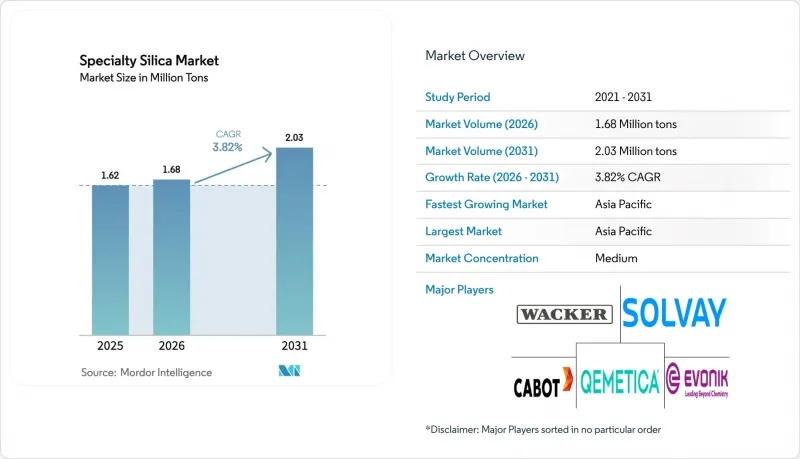
Mordor Intelligence에 의하면, 특수 실리카 시장 규모는 2025년에 162만 톤으로 평가되었고, 2026년에 168만 톤으로 추정되고, 2031년까지 203만 톤에 이를 것으로 예측되며, 2026-2031년 CAGR 3.82%로 성장할 전망입니다.
본 보고서는 유형별(침전 실리카, 실리카겔, 기타), 제조 공정별(습식/침전법, 화염 수분해법, 벼 껍질 재 유래 바이오 실리카), 용도별(고무·타이어, 일렉트로믹스 및 반도체, 기타), 지역별(아시아태평양, 북미, 유럽, 남미, 중동 및 아프리카)로 분류되어 있습니다. 시장 전망은 수량(톤) 기준으로 제시되어 있습니다.
세계의 특수 실리카 시장 동향 및 인사이트
고무 업계 수요 증가
타이어 제조업체들은 현재 차량 1대당 3-5%의 연료 소비량을 절감하는 구름 저항 목표를 달성하기 위해, 고무 100부당 80-100부의 침전 실리카를 배합하고 있습니다. 중국의 각 OEM 업체들은 유로 7 기준을 준수한 ‘중국 7’ 규제를 대비하기 위해 2025년에 에보닉(Evonik)사의 ‘ULTRASIL’ 등급을 채택했습니다. 실리카-실란 커플링 시스템은 젖은 노면 그립력을 향상시키고 발열을 저감하지만, 표면적을 엄격하게 관리해야 하기 때문에 중국의 여러 타이어 공장이 실리카 제조 시설 근처에 위치하게 되었습니다. 인도 및 동남아시아에서는 운전자들이 바이애스 타이어에서 레이디얼 타이어로 전환함에 따라 교체용 타이어 수요가 확대되고 있습니다. 차량 운영 사업자들로부터 트레드 수명이 15-20% 연장되었습니다는 보고가 있으며, 8-10%의 가격 프리미엄이 있음에도 불구하고 실리카를 풍부하게 함유한 타이어는 경제적으로 매력적인 선택지가 되고 있습니다.
퍼스널케어 분야에서 유변학 제 및 무광제로서의 보급 확대
각 화장품 브랜드는 석면 오염 관련 소송과 ‘클린 라벨’에 대한 관심 증가를 배경으로, 활석(탈크)을 콜로이드 및 침전 실리카로 대체하고 있습니다. 실리카는 자체 무게의 최대 2.5배에 달하는 유분을 흡수하여, 피부 감촉을 해치지 않으면서 매트한 마무리를 실현합니다. 로레알과 에스티 로더는 2025년, 프레스티지 부문에서 프리미엄 가격을 책정한 실리카를 풍부하게 배합한 파운데이션을 출시했습니다. 에어로겔 성형체는 서방형 향기 구체를 형성하고 있으며, 그 판매 가격은 1kg당 15-20달러인 반면, 범용 침전 실리카 등급의 가격은 2-3달러입니다. EU 화장품 규정 1223/2009는 순도의 추적성을 의무화하고 있으며, ISO 22716 인증을 취득한 평판이 좋은 실리카 공급업체를 우대하고 있습니다.
높은 생산 비용과 에너지 집약성
화염 가수분해에는 1톤당 8-10 MWh의 전력을 소비하며, 2026년 EU의 전력 가격이 150-200유로/MWh가 됨에 따라, 와커(Wacker)사의 부르크하우젠 공장의 현금 원가는 35-40% 상승할 것입니다. 탄소 국경 조정세로 인해 수입 실리카에는 톤당 80-100유로의 추가 부담이 발생하므로, 2028년까지 배출량을 50% 감축하는 것을 목표로 1억 2,000만 유로를 투자한 현장 재생에너지 도입 프로그램이 추진되고 있습니다. 석탄을 주전원으로 하는 아시아 생산자들은 유럽의 습식 실리카 가격보다 25% 낮은 가격을 책정하고 있으며, 이로 인해 EU 공급업체들은 초고순도라는 틈새 시장으로 전환하고 있습니다. 습식 침전법에서는 1톤당 고작 2-3MWh만 소비하지만, 분무 건조 공정에서는 여전히 천연가스 가격 급등에 직면해 있습니다. 이익률 축소로 인해 유럽 및 미국 기업들은 범용 제품의 대량 생산보다 고부가가치 등급의 제품을 우선시할 수밖에 없게 되었습니다.
부문 분석
2025년에는 침전법 실리카가 수량 기준 42.84%를 차지했으며, 고가의 흄드 등급으로는 달성할 수 없는 비용 대비 성능 비율을 중시하는 타이어 컴파운드 및 코팅 분야에서 확고한 입지를 뒷받침하고 있어, 이를 통해 특수 실리카 시장 규모에서 주도적인 위치를 확립하고 있습니다. 이 부문은 친환경 타이어의 보급이 확대되고, 웨트 마스터배치 가공을 통해 타이어 1개당 충전량이 증가함에 따라 2031년까지 연평균 성장률(CAGR) 4.18%를 나타낼 것으로 예측됩니다. 의약품용 건조제 및 일회용 바이오프로세싱용 크로마토그래피 매체에서의 실리카겔 수요는 꾸준히 증가하고 있는 반면, 콜로이드 등급은 첨단 반도체 분야의 CMP 슬러리 확장에 힘입어 성장하고 있습니다. 휴메드 실리카는 40nm 미만의 입자 분포가 요구되는 실리콘 실란트, 접착제, 저유전율 봉지재 등에서 틈새 시장이긴 하지만 여전히 필수적인 존재로 자리 잡고 있습니다. 퓨즈드 실리카는 열팽창 계수가 거의 0에 가까워 광섬유 프리폼 및 EUV 포토마스크 제조에 필수적이며, 가장 높은 가격대를 차지하고 있습니다.
지역별 분석
아시아태평양은 2025년에 특수 실리카 시장 규모의 45.52%를 차지한 것으로 평가되었으며, 2031년까지 연평균 성장률(CAGR) 4.55%로 확대될 것으로 전망됩니다. 이는 다가오는 ‘중국 7’ 기준을 충족하기 위해 실리카·실란 화합물의 사용이 점점 더 의무화되고 있는 중국 내 6억 5,000만 개의 타이어 생산에 의해 주도되고 있습니다. 인도는 바이오 실리카의 선구자로 부상하고 있으며, 타타 케미칼즈(Tata Chemicals)가 펀자브주에 2만 톤의 생산 능력을 갖춘 공장을 설립했습니다. 이 공장은 벼 껍질 폐기물을 효율적으로 활용하여 국내 타이어 제조업체에 공급하고 있습니다. 일본과 한국은 반도체 등급의 휴메드 실리카 및 퓨즈드 실리카의 세계적 거점으로 자리매김하고 있으며, 엄격한 금속 오염 관리를 통해 3nm 로직 및 EUV 포토마스크 시장에 공급하고 있습니다. 산동 링크 실리카가 건설한 베트남 및 태국 시설은 지역 내 고무 수요에 여전히 접근할 수 있는 저비용 아세안 지역으로 침전법을 통한 생산 능력을 이전했음을 보여줍니다.
북미에서는 전기차(EV) 배터리 분리막 코팅 및 백신용 메조포러스 실리카와 같은 분야에서 점진적인 성장이 관찰됩니다. 이러한 분야에서는 규제에 대한 숙련도와 cGMP 인프라가 프리미엄 가격 책정을 뒷받침하고 있습니다. 캐보트(Cabot)사의 일리노이주 타스코라 공장은 실리콘 고무 및 CMP용 지역 흄드 실리카 수요의 60%를 공급하고 있는 반면, USMCA(미국·멕시코·캐나다 협정) 규정에 따른 멕시코 내 타이어 조립으로 인해 브라질산 침전 실리카 수입이 증가하고 있습니다. 유럽 시장 점유율 확대율은 전력 가격 급등과 탄소세로 인해 상품의 이익률이 압박받고 있어 낮은 수준을 유지하고 있지만, 이 지역은 품질이 비용을 상회하는 의약품 및 배터리용 등급 분야에서 견고한 틈새 시장을 개척하고 있습니다. 솔베이(Solvay)가 2025년에 일반 상품 제품 라인을 올비아(Orbia)에 매각하는 등 생산 능력의 합리화는 이러한 변화를 여실히 보여주고 있습니다.
남미에서는 브라질의 타이어 및 농업 기계 부문이 중심을 이루고 있으며, 이메리스의 상파울루 공장은 미쉐린과 브리지스톤의 각 공장에 제품을 공급하고 있습니다. 중동 및 아프리카는 여전히 수입 의존형이며, 사우디아라비아와 남아프리카공화국에는 고순도 석영 광상이 없기 때문에 도료 및 건설용 충전재용 침전 실리카를 구매하고 있습니다. 지정학적 자원 안보 및 지속가능성 노력으로 인해 아시아태평양의 수량적 우위가 더욱 강화될 가능성이 있지만, 북미 및 유럽은 특수 고순도 제품이나 의약품 분야와 같은 틈새 시장을 통해 가치 측면에서 여전히 불균형적으로 큰 점유율을 차지할 것입니다.
기타 혜택 :
- 엑셀 형식 시장 예측(ME) 시트
- 3개월간의 애널리스트 지원
자주 묻는 질문
목차
제1장 서론
제2장 조사 방법
제3장 주요 요약
제4장 시장 구도
제5장 시장 규모 및 성장 예측
제6장 경쟁 구도
제7장 시장 기회 및 향후 전망
AJY 26.08.26According to Mordor Intelligence, the specialty silica market size is projected to be 1.62 million tons in 2025, 1.68 million tons in 2026, and reach 2.03 million tons by 2031, growing at a CAGR of 3.82% from 2026 to 2031.
This report is Segmented by Type (Precipitated Silica, Silica Gel, and Others), Production Process (Wet/Precipitated, Flame Hydrolysis, and Bio-Silica From Rice-Husk Ash), Application (Rubber and Tires, Electronics and Semiconductors, and Others), and Geography (Asia-Pacific, North America, Europe, South America, and Middle East and Africa). The Market Forecasts are Provided in Terms of Volume (Tons).
Global Specialty Silica Market Trends and Insights
Increasing Demand from Rubber Industry
Tire makers now blend 80-100 parts per hundred rubber of precipitated silica to satisfy rolling-resistance targets that cut fuel consumption by 3-5% per vehicle. Chinese OEMs adopted Evonik's ULTRASIL grades in 2025 to prepare for China 7 rules that mirror Euro 7 thresholds. The silica-silane coupling system improves wet grip and lowers heat buildup, though it requires strict surface-area control, prompting several Chinese tire plants to co-locate near silica facilities. Replacement-tire demand in India and Southeast Asia is amplifying volume as motorists shift from bias-ply to radial designs. Fleet operators report tread-life gains of 15-20%, making silica-rich tires economically attractive despite an 8-10% price premium.
Growing Penetration from Personal-Care Rheology and Matting Agents
Cosmetic brands are replacing talc with colloidal and precipitated silica amid litigation over asbestos contamination and rising clean-label preference. Silica absorbs up to 2.5 times its weight in oil, delivering a matte finish without compromising skin feel. L'Oreal and Estee Lauder launched silica-rich foundations in 2025 that command price premiums in the prestige segment. Aerogel forms support controlled-release fragrance spheres that sell for USD 15-20 per kilogram, versus USD 2-3 for commodity precipitated grades. EU Cosmetics Regulation 1223/2009 mandates purity traceability, favoring established silica suppliers with ISO 22716 certification.
High Production Cost and Energy Intensity
Flame-hydrolysis consumes 8-10 MWh per ton, and EU electricity prices of EUR 150-200/MWh in 2026 lift cash costs by 35-40% at Wacker's Burghausen site. Carbon-border levies add EUR 80-100 per ton to imported silica, prompting a EUR 120 million onsite renewables program to cut emissions by 50% by 2028. Asian producers with coal-based baseload power undercut European fumed-silica prices by 25%, steering EU suppliers toward ultra-high-purity niches. Wet-precipitated routes use only 2-3 MWh per ton yet still face higher natural-gas prices for spray-drying. The narrowing margin forces Western firms to prioritize premium grades over commodity volumes.
Other drivers and restraints analyzed in the detailed report include:
- Shift Toward Low-VOC/High-Performance Industrial Coatings Requiring Specialty Silica
- Increasing Usage in EV Battery Separators and Solid-State Electrolytes
- Availability of Substitutes
For complete list of drivers and restraints, kindly check the Table Of Contents.
Segment Analysis
Precipitated silica accounted for 42.84% volume in 2025, underscoring its entrenched role in tire compounds and coatings that value a cost-to-performance ratio unattainable for higher-priced fumed grades, thereby anchoring specialty silica market size leadership. The segment is projected to post a 4.18% CAGR through 2031 as green-tire penetration deepens and wet-masterbatch processing raises loadings per tire. Silica gel demand grows steadily in pharmaceutical desiccants and chromatography media for single-use bioprocessing, while colloidal grades ride CMP-slurry expansion in advanced semiconductors. Fumed silica stays niche yet indispensable in silicone sealants, adhesives, and low-dielectric encapsulants that require less than 40 nm particle distributions. Fused silica commands the highest prices as it enables optical-fiber preforms and EUV photomasks with near-zero thermal expansion.
Complete Report Scope:
- By Type
- Precipitated Silica
- Silica Gel
- Colloidal Silica
- Fumed Silica
- Fused Silica
- By Production Process
- Wet/Precipitated
- Flame Hydrolysis
- Sol-Gel
- Bio-silica from Rice-Husk Ash
- By Application
- Rubber and Tires
- Personal Care
- Food and Feed Additives
- Chemicals
- Paints, Coatings and Inks
- Plastics
- Electronics and Semiconductors
- Metal and Refractories
- Other Applications (Healthcare and Pharmaceuticals, etc.)
- By Geography
- Asia-Pacific
- China
- India
- Japan
- South Korea
- ASEAN Countries
- Rest of Asia-Pacific
- North America
- United States
- Canada
- Mexico
- Europe
- Germany
- United Kingdom
- France
- Italy
- Rest of Europe
- South America
- Brazil
- Argentina
- Rest of South America
- Middle East and Africa
- Saudi Arabia
- South Africa
- Rest of Middle East and Africa
- Asia-Pacific
Geography Analysis
Asia-Pacific held 45.52% of specialty silica market size in 2025 and is projected to expand at a 4.55% CAGR through 2031, driven by China's production of 650 million tires that increasingly specify silica-silane compounds to meet impending China 7 standards. India emerges as a bio-silica front-runner with Tata Chemicals inaugurating a 20,000-ton Punjab plant that monetizes rice-husk waste and supplies domestic tire makers. Japan and South Korea remain global hubs for semiconductor-grade fumed and fused silica, leveraging stringent metal-contamination controls to serve 3 nm logic and EUV photomask markets. Vietnamese and Thai facilities built by Shandong Link Silica illustrate a migration of precipitated capacity toward lower-cost ASEAN locations that still access regional rubber demand.
North America captures incremental growth from EV battery-separator coatings and vaccine-grade mesoporous silica, segments where regulatory familiarity and cGMP infrastructure underpin premium pricing. Cabot's Tuscola, Illinois plant supplies 60% of regional fumed-silica needs for silicone rubber and CMP, while Mexican tire assemblies under USMCA rules boost precipitated-silica imports from Brazil. Europe's share growth rate is low due to elevated power prices and carbon levies that squeeze commodity margins, yet the region carves defensible niches in pharmaceutical and battery-grade grades where quality trumps cost. Capacity rationalization such as Solvay's 2025 divestment of commodity lines to Orbia underscores this shift.
South America centers on Brazil's tire and agricultural machinery sectors, with Imerys' Sao Paulo plant feeding Michelin and Bridgestone facilities. Middle East and Africa remain import-oriented, purchasing precipitated silica for coatings and construction fillers in Saudi Arabia and South Africa given the absence of high-purity quartz deposits. Geopolitical resource security and sustainability credentials will likely reinforce Asia-Pacific's quantitative lead, yet North America and Europe will continue to command a disproportionate share of value through specialized high-purity and pharmaceutical niches.
- 3M
- Cabot Corporation
- Clariant
- Denka Company Limited
- Elkem ASA
- Evonik Industries AG
- Fuji Silysia Chemical Ltd.
- Fuso Chemical Co., Ltd.
- Imerys
- Nouryon
- Oriental Silicas Corporation
- Oriental Silicas Corporation
- Orisil
- QEMETICA
- Solvay
- Tata Chemicals
- Tokuyama Corporation
- W. R. Grace & Co.
- Wacker Chemie AG
Additional Benefits:
- The market estimate (ME) sheet in Excel format
- 3 months of analyst support
TABLE OF CONTENTS
1 Introduction
- 1.1 Study Assumptions and Market Definition
- 1.2 Scope of the Study
2 Research Methodology
3 Executive Summary
4 Market Landscape
- 4.1 Market Overview
- 4.2 Market Drivers
- 4.2.1 Increasing Demand from Rubber Industry
- 4.2.2 Growing Penetration from Personal-Care Rheology and Matting Agents
- 4.2.3 Shift Toward Low-VOC/High-Performance Industrial Coatings Requiring Specialty Silica
- 4.2.4 Increasing Usage in EV Battery Separators and Solid-State Electrolytes
- 4.2.5 Growing Emphasis on Mesoporous Silica as Next-Gen Vaccine Adjuvant Carrier
- 4.3 Market Restraints
- 4.3.1 High Production Cost and Energy Intensity
- 4.3.2 Availability of Substitutes
- 4.3.3 Limited Supply of High-Purity Quartz Feedstock in Key Regions
- 4.4 Value Chain Analysis
- 4.5 Porter's Five Forces
- 4.5.1 Bargaining Power of Suppliers
- 4.5.2 Bargaining Power of Buyers
- 4.5.3 Threat of New Entrants
- 4.5.4 Threat of Substitutes
- 4.5.5 Degree of Competition
5 Market Size and Growth Forecasts (Volume)
- 5.1 By Type
- 5.1.1 Precipitated Silica
- 5.1.2 Silica Gel
- 5.1.3 Colloidal Silica
- 5.1.4 Fumed Silica
- 5.1.5 Fused Silica
- 5.2 By Production Process
- 5.2.1 Wet/Precipitated
- 5.2.2 Flame Hydrolysis
- 5.2.3 Sol-Gel
- 5.2.4 Bio-silica from Rice-Husk Ash
- 5.3 By Application
- 5.3.1 Rubber and Tires
- 5.3.2 Personal Care
- 5.3.3 Food and Feed Additives
- 5.3.4 Chemicals
- 5.3.5 Paints, Coatings and Inks
- 5.3.6 Plastics
- 5.3.7 Electronics and Semiconductors
- 5.3.8 Metal and Refractories
- 5.3.9 Other Applications (Healthcare and Pharmaceuticals, etc.)
- 5.4 By Geography
- 5.4.1 Asia-Pacific
- 5.4.1.1 China
- 5.4.1.2 India
- 5.4.1.3 Japan
- 5.4.1.4 South Korea
- 5.4.1.5 ASEAN Countries
- 5.4.1.6 Rest of Asia-Pacific
- 5.4.2 North America
- 5.4.2.1 United States
- 5.4.2.2 Canada
- 5.4.2.3 Mexico
- 5.4.3 Europe
- 5.4.3.1 Germany
- 5.4.3.2 United Kingdom
- 5.4.3.3 France
- 5.4.3.4 Italy
- 5.4.3.5 Rest of Europe
- 5.4.4 South America
- 5.4.4.1 Brazil
- 5.4.4.2 Argentina
- 5.4.4.3 Rest of South America
- 5.4.5 Middle East and Africa
- 5.4.5.1 Saudi Arabia
- 5.4.5.2 South Africa
- 5.4.5.3 Rest of Middle East and Africa
- 5.4.1 Asia-Pacific
6 Competitive Landscape
- 6.1 Market Concentration
- 6.2 Strategic Moves
- 6.3 Market Share(%)/Ranking Analysis
- 6.4 Company Profiles (includes Global level Overview, Market level overview, Core Segments, Financials as available, Strategic Information, Market Rank/Share for key companies, Products and Services, and Recent Developments)
- 6.4.1 3M
- 6.4.2 Cabot Corporation
- 6.4.3 Clariant
- 6.4.4 Denka Company Limited
- 6.4.5 Elkem ASA
- 6.4.6 Evonik Industries AG
- 6.4.7 Fuji Silysia Chemical Ltd.
- 6.4.8 Fuso Chemical Co., Ltd.
- 6.4.9 Imerys
- 6.4.10 Nouryon
- 6.4.11 Oriental Silicas Corporation
- 6.4.12 Oriental Silicas Corporation
- 6.4.13 Orisil
- 6.4.14 QEMETICA
- 6.4.15 Solvay
- 6.4.16 Tata Chemicals
- 6.4.17 Tokuyama Corporation
- 6.4.18 W. R. Grace & Co.
- 6.4.19 Wacker Chemie AG
7 Market Opportunities and Future Outlook
- 7.1 White-space and Unmet-Need Assessment
- 7.2 Emerging Use in Solid-state Batteries
- 7.3 Circular-economy Pathways for Bio-silica


