
|
시장보고서
상품코드
2114357
임상 워크플로우 솔루션 시장 : 시장 점유율 분석, 업계 동향 및 통계, 성장 예측(2026-2031년)Clinical Workflow Solutions - Market Share Analysis, Industry Trends & Statistics, Growth Forecasts (2026 - 2031) |
||||||
 Mordor Intelligence
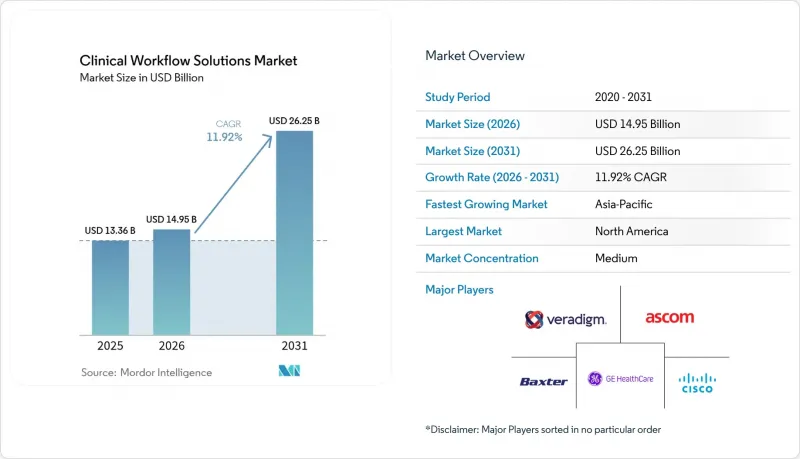
Mordor Intelligence에 의하면, 임상 워크플로우 솔루션 시장 규모는 2025년에 133억 6,000만 달러로 평가되었고, 2026년 149억 5,000만 달러에서 2031년까지 262억 5,000만 달러에 이를 것으로 예측되며, 예측 기간(2026-2031년) CAGR은 11.92%를 나타낼 전망입니다.
본 보고서는 구성 요소별(소프트웨어 및 서비스), 제품 유형별(데이터 통합 솔루션, 실시간 통신 솔루션 등), 제공 형태별(온프레미스, 클라우드 기반, 하이브리드), 조직 규모별(대기업 및 중소기업), 최종 사용자별(병원 등), 지역별(북미, 유럽 등)로 분류되어 있습니다. 시장 예측은 금액(달러) 기준으로 제시되어 있습니다.
세계의 임상 워크플로우 솔루션 시장 동향 및 인사이트
의무화된 세계 상호운용성 표준이 도입을 가속화
Health Level Seven Fast Healthcare Interoperability Resources(HL7 FHIR)는 점점 더 많은 의료 시스템에서 시범 단계에서 실제 운영 단계로 전환되고 있으며, 표준 기반 애플리케이션 프로그래밍 인터페이스(API)의 더 광범위한 수용을 촉진하고 있습니다. 피어 리뷰를 거친 연구에 따르면, 대부분의 디지털 헬스 기업은 전환 기간 동안 비즈니스 연속성을 확보하기 위해 이미 표준 기반 API와 자체 개발 API를 조합하여 활용하고 있습니다. 그 직접적인 결과로, 이전에는 맞춤형 인터페이스용으로 확보되었던 통합 예산이 현재는 새로운 분석 기능으로 재배정되고 있어, 프로젝트 포트폴리오 내에서 암묵적인 비용 이동이 시사되고 있습니다. 또한, 사전 인증된 FHIR 인터페이스를 입증할 수 있는 공급업체는 조달 과정에서 가장 흔한 장벽 중 하나를 해소함으로써 판매 주기를 단축할 수 있을 것으로 보입니다.
전 세계 의료 인력 부족 심화가 자동화를 촉진
2026년까지 수백만 명의 간호사 및 관련 전문 인력이 부족할 것으로 예측됨에 따라, 임상 워크플로우 솔루션 시장에서 자동화는 ‘선택 사항’에서 ‘미션 크리티컬’한 지위로 격상되었습니다. 업계 단체에 따르면, 문서 작성, 인력 배치, 예측 기반 근무표 작성을 목적으로 하는 AI 도구 사용이 급속히 증가하고 있으며, 의료 그룹의 도입률은 전년 대비 2배 이상에 달한다고 합니다. 이러한 급증은 번아웃 지표가 이사회 수준의 핵심 성과 지표(KPI)로 자리 잡음에 따라, 현장 직원이 구매 위원회에 점점 더 큰 영향력을 행사하고 있음을 보여줍니다. 이에 따른 추론으로, 순수한 관리 업무상의 과제가 아닌 인적 요인에 의한 과제를 해결하는 소프트웨어는 인재 유지 목표와 직접적으로 연결되므로 지속적인 수요가 예상됩니다.
높은 통합 비용과 교육 비용
명백한 이점이 있음에도 불구하고, 파편화된 레거시 환경에 새로운 플랫폼을 통합하는 데 드는 비용과 복잡성은 여전히 도입의 주요 장벽으로 남아 있습니다. 교육 예산은 기술 투자에 뒤처지는 경우가 많아, 그 결과 이용 현황에 편차가 발생하고 투자 수익률(ROI)이 낮아지는 경향이 있습니다. 이러한 경향으로 미루어 볼 때, 변경 관리 서비스를 통합한 솔루션을 제공하는 벤더는 고객이 더 신속하게 가치를 실현할 수 있도록 지원할 수 있으므로, 프리미엄 가격을 책정할 수 있을 것으로 보입니다.
부문 분석
2025년에는 소프트웨어 부문이 임상 워크플로우 솔루션 시장 규모의 71.05%를 차지했으며, 병원 전체의 디지털화 이니셔티브를 뒷받침하는 최대 부문이 되었습니다. 4년 연속으로 플랫폼 업그레이드를 우선시하는 자본 예산이 편성된 것은 소프트웨어가 여전히 프로세스 현대화의 관문임을 보여줍니다. 그럼에도 불구하고, 의료 기관들이 도입에 필요한 전문 지식과 지속적인 최적화를 요구함에 따라, 서비스 부문은 2026-2031년 연평균 성장률(CAGR) 14.18%를 기록하며 소프트웨어 부문의 성장률을 상회할 것으로 예측됩니다. 이를 통해 코드 그 자체가 아니라 지식 이전이야말로 현재 지속 가능한 성과 향상을 주도하고 있으며, 공급업체들이 구독 계약에 컨설팅 팀을 포함하도록 유도하고 있음을 추측할 수 있습니다.
서비스의 성장은 IT 자원이 제한적이고, 외부 지도를 통해 가동 개시까지의 기간이 단축되는 중규모 병원에서 특히 두드러집니다. 성과 연계형 보상 제도에 따른 페널티가 확대되는 가운데, 경영진은 규제 미준수 위험을 줄이기 위해 자문 지원에 자금을 지원하는 데 적극적인 태도를 보이고 있습니다. 그 결과, 서비스 전문 기업과 플랫폼 벤더 간의 인수합병 활동이 활발해질 가능성이 높으며, 단일 책임 창구를 원하는 구매자에게는 통합형 솔루션이 매력적인 선택지가 될 것으로 보입니다.
2025년 시점에서 데이터 통합 솔루션은 임상 워크플로우 솔루션 시장의 30.10%를 차지했으며, 이는 서로 다른 전자건강기록(EHR) 모듈을 연결하는 ‘결합 조직’으로서의 역할을 반영하고 있습니다. 한편, 케어 협업 도구는 2031년까지 연평균 성장률(CAGR) 14.75%로 확대될 것으로 예측되며, 이는 팀 중심의 의료 제공 모델로의 전환을 시사합니다. 팬데믹으로 인해 보안 메시징, 작업 목록 공유, 시설 간 커뮤니케이션에 대한 수요가 가속화되었습니다. 이러한 행동 변화는 비상 상황이 완화된 후에도 지속되고 있습니다. 이는 협업 플랫폼이 ‘편의성’의 영역을 넘어 ‘임상적 필요성’으로 전환되었음을 시사합니다.
AI의 발전은 협업 기능을 한층 더 강화하고 있으며, 어떤 전문의에게 언제 상담해야 하는지에 대한 예측적 제안을 제공합니다. 이러한 지능형 기능을 탑재한 벤더들은 계약 갱신율이 높다고 보고하고 있는데, 이는 임상 사용자들이 정적인 메시징 기능보다 상황에 따른 추천 기능을 더 중요하게 여긴다는 것을 보여줍니다. 여기서 도출되는 결론은 차별화의 요인이 인터페이스의 세련됨뿐만 아니라 의사결정 지원의 심도에도 점점 더 중점을 두게 될 것이라는 점입니다.
지역별 분석
북미는 2025년, 성숙한 IT 인프라, 높은 1인당 의료비, 그리고 품질 보고에 기술 활용을 장려하는 규제적 인센티브에 힘입어 전 세계 매출의 43.60%를 차지했습니다. 대규모 의료 시스템은 기술 대기업과 제휴하여 첨단 AI 도구의 실증 실험을 진행했습니다. 예를 들어, 서터 헬스(Sutter Health)가 수년에 걸쳐 진행한 공동 프로젝트는 영상 진단 워크플로우에 AI를 활용한 인사이트력을 접목하는 것을 목표로 하고 있습니다. 여기서 도출되는 한 가지 결론은 조기 도입자 네트워크가 참고 사례로 기능하며, 뒤처질 것을 우려하는 동종 업계 경쟁사들의 도입 결정을 가속화하고 있다는 점입니다.
아시아태평양은 중국, 인도, 인도네시아의 디지털 병원에 대한 공공 자금 투자를 배경으로, 2026-2031년 연평균 성장률(CAGR) 13.12%를 기록하며 가장 빠르게 성장하는 지역이 될 것으로 예측됩니다. AI 진단을 추진하기 위해 시로암 병원과 Philips가 최근 체결한 양해각서는 기존 제약을 극복하는 ‘도약적 솔루션’에 대한 해당 지역 수요를 여실히 보여주고 있습니다. 많은 의료 기관이 여전히 1세대 또는 2세대 전자의무기록(EHR)을 도입하고 있다는 점을 고려할 때, 공급업체는 도입 초기부터 최신 표준을 통합할 수 있어 장기적인 통합 작업의 부담을 줄일 가능성이 있습니다. 이는 서유럽 동종 업계에 비해 암묵적인 비용 측면에서의 우위를 의미합니다.
유럽에서는 견조한 보급률을 유지하고 있으며, 일반 데이터 보호 규정(GDPR(EU 개인정보보호규정))이 ‘프라이버시 바이 디자인’ 아키텍처를 형성하고 있습니다. 각국 시장마다 차이는 있지만, 독일이나 영국의 주요 기관에서는 AI를 활용한 일정 관리 및 환경형 문서화 실험이 진행되고 있습니다. 이를 통해 엄격한 데이터 규제가 벤더로 하여금 동의 관리 모듈을 정교화하도록 촉진하고 있으며, 이러한 기술은 향후 규제가 완화된 시장에서 부가가치로 재활용될 수 있을 것으로 추측됩니다. 중동 및 아프리카, 남미와 같은 신흥 지역은 도입 단계상 아직 초기 단계에 있지만, 원격 의료 및 클라우드 솔루션에 대한 관심이 높아 온프레미스 단계를 완전히 건너뛸 가능성이 시사되고 있습니다.
기타 혜택 :
- 엑셀 형식 시장 예측(ME) 시트
- 3개월간 애널리스트 지원
자주 묻는 질문
목차
제1장 서론
제2장 조사 방법
제3장 주요 요약
제4장 시장 구도
제5장 시장 규모 및 성장 예측
제6장 경쟁 구도
제7장 시장 기회 및 향후 전망
AJY 26.08.26According to Mordor Intelligence, the clinical workflow solutions market size was valued at USD 13.36 billion in 2025 and estimated to grow from USD 14.95 billion in 2026 to reach USD 26.25 billion by 2031, at a CAGR of 11.92% during the forecast period (2026-2031).
This report is Segmented by Component (Software and Services), Product Type (Data-Integration Solutions, Real-Time Communication Solutions, and More), Delivery Mode (On-Premise, Cloud-Based, and Hybrid), Organization Size (Large Enterprises and SMEs), End-User (Hospitals, and More), and Geography (North America, Europe, and More). The Market Forecasts are Provided in Terms of Value (USD).
Global Clinical Workflow Solutions Market Trends and Insights
Mandated Global Interoperability Standards Accelerating Adoption
Health-level Seven Fast Healthcare Interoperability Resources (HL7 FHIR) moved from pilot phase to production reality in a growing share of health systems, catalyzing broader acceptance of standards-based application-programming interfaces (APIs). Peer-reviewed research shows that most digital health firms already rely on a mix of standards-based and proprietary APIs to ensure business continuity during transitions. A direct consequence is that integration budgets, previously set aside for custom interfaces, are now being redirected toward new analytical features, indicating an implicit cost shift within project portfolios. An additional inference is that vendors able to demonstrate pre-certified FHIR interfaces can shorten sales cycles by addressing one of the most common procurement hurdles.
Escalating Worldwide Healthcare Workforce Shortages Prompting Automation
A projected shortfall of millions of nurses and allied professionals by 2026 has elevated automation from optional to mission-critical status in the clinical workflow solutions market. Industry associations note a rapid uptick in AI tools aimed at documentation, staffing, and predictive rostering, with reported adoption in medical groups more than doubling year on year. This surge signals that frontline staff increasingly influence purchasing committees, as burnout metrics become board-level key performance indicators. A corollary inference is that software addressing human-factor pain points, rather than purely administrative ones, will enjoy enduring demand because it aligns directly with workforce-retention goals.
High Integration & Training Costs
Despite evident benefits, the cost and complexity of integrating new platforms into fragmented legacy environments remain leading barriers to adoption. Training budgets often lag behind technology spend, leading to inconsistent utilization and muted return on investment (ROI). The pattern implies that vendors offering embedded change-management services can command a premium because they help customers realize value faster.
Other drivers and restraints analyzed in the detailed report include:
- Shift to Value-Based Care Requiring End-to-End Workflow Visibility
- Proliferation of Connected Medical Devices Generating Real-Time Data Streams
- Fragmented Legacy IT Ecosystems Hindering Seamless Interoperability
For complete list of drivers and restraints, kindly check the Table Of Contents.
Segment Analysis
The software segment accounted for the most significant clinical workflow solutions market size at 71.05% in 2025, underpinning digitization initiatives across hospitals. Four consecutive years of capital budgets favoring platform upgrades indicate that software remains the entry point for modernizing processes. Nonetheless, services are forecast to post a 14.18% CAGR from 2026 to 2031, outpacing software expansion as providers seek implementation expertise and continuous optimization. An inference is that knowledge transfer, not code alone, now drives sustainable performance gains, encouraging vendors to embed consultancy teams into subscription contracts.
The services upswing is particularly visible among mid-sized hospitals, where IT resources are limited and external guidance accelerates go-live timelines. As pay-for-performance penalties grow, leadership is willing to fund advisory support to reduce the risk of regulatory non-compliance. Consequently, merger activity among service specialists and platform vendors is likely to intensify, suggesting that integrated offerings will appeal to buyers seeking a single accountability point.
Data integration solutions held 30.10% of the clinical workflow solutions market in 2025, reflecting their role as the connective tissue for disparate electronic health record (EHR) modules. However, care collaboration tools are projected to expand at a 14.75% CAGR through 2031, pointing to a shift toward team-centric delivery models. The pandemic accelerated demand for secure messaging, shared task lists, and cross-site communication; this behavioral change has persisted even as emergency conditions eased. The observation implies that collaboration platforms have crossed the threshold from convenience to clinical necessity.
Advances in AI are further boosting collaboration utilities, providing predictive suggestions about which specialist to engage and when. Vendors embedding such intelligence report higher renewal rates, indicating that clinical users value context-aware recommendations over static messaging functions. The inference here is that differentiation will increasingly reside in decision-support depth rather than interface polish alone.
Complete Report Scope:
- By Component
- Software
- Services
- By Product Type
- Data-Integration Solutions
- Real-Time Communication Solutions
- Workflow-Automation Solutions
- Care-Collaboration Solutions
- Enterprise Reporting & Analytics Solutions
- By Delivery Mode
- On-Premise
- Cloud-Based
- Hybrid
- By Organization Size
- Large Enterprises
- SMEs
- By End-User
- Hospitals
- Long-Term Care Facilities
- Other End-Users
- By Geography (Value)
- North America
- United States
- Canada
- Mexico
- Europe
- Germany
- United Kingdom
- France
- Italy
- Spain
- Rest of Europe
- Asia-Pacific
- China
- India
- Japan
- Australia
- South Korea
- Rest of Asia-Pacific
- Middle East & Africa
- GCC
- South Africa
- Rest of Middle East & Africa
- South America
- Brazil
- Argentina
- Rest of South America
- North America
Geography Analysis
North America produced 43.60% of global revenue in 2025, buoyed by mature IT infrastructure, substantial per-capita healthcare spending, and regulatory incentives that reward technology use in quality reporting. Large health systems partnered with technology giants to pilot advanced AI tools; for instance, Sutter Health's multi-year collaboration aims to inject AI-driven insights into imaging workflows. One inference is that early adopter networks serve as reference sites, accelerating procurement decisions among peers wary of being left behind.
Asia-Pacific is forecast as the fastest-growing territory with a 13.12% CAGR between 2026 and 2031, underpinned by public funding for digital hospitals in China, India, and Indonesia. A recent memorandum between Siloam Hospitals and Philips to advance AI diagnostics exemplifies regional appetite for leapfrog solutions that circumvent legacy constraints. Given that many facilities are still in the first or second EHR generation, vendors can embed modern standards from inception, potentially reducing long-term integration debt-an implicit cost advantage relative to Western counterparts.
Europe maintains solid penetration, with General Data Protection Regulation (GDPR) shaping privacy-by-design architectures. Although national markets differ, leading institutions in Germany and the United Kingdom experiment with AI-enabled scheduling and ambient documentation. The inference is that stringent data rules push vendors to refine consent management modules, which can later be repurposed as value-adds in less regulated markets. Emerging regions in the Middle East, Africa, and South America are earlier in the adoption curve but exhibit high interest in telehealth and cloud solutions, suggesting they may skip the on-premise phases entirely.
- Alcidion Group
- Ascom
- Baxter
- Cisco Systems
- CliniComp Intl.
- EvidenceCare
- GE HealthCare Technologies Inc.
- GetWellNetwork
- iMDsoft
- Imprivata Inc.
- Infor
- Koninklijke Philips
- Lumeon Ltd.
- Mckesson
- Oracle
- Picis Clinical Solutions
- Sectra
- SONIFI Health
- Stryker
- Veradigm Inc
- Wolters Kluwer
Additional Benefits:
- The market estimate (ME) sheet in Excel format
- 3 months of analyst support
TABLE OF CONTENTS
1 Introduction
- 1.1 Study Assumptions & Market Definition
- 1.2 Scope of the Study
2 Research Methodology
3 Executive Summary
4 Market Landscape
- 4.1 Market Overview
- 4.2 Market Drivers
- 4.2.1 Mandated Global Interoperability Standards (HL7 FHIR, ISO/IEEE) Accelerating Adoption
- 4.2.2 Escalating Worldwide Healthcare Workforce Shortages Prompting Automation
- 4.2.3 Shift to Value-Based Care Requiring End-to-End Workflow Visibility
- 4.2.4 Proliferation of Connected Medical Devices Generating Real-Time Data Streams
- 4.2.5 Rapid Uptake of Cloud-Native Hospital Information Systems Enabling SaaS Deployment
- 4.2.6 Pandemic-Driven Demand for Remote Clinical Collaboration & Command Centers
- 4.3 Market Restraints
- 4.3.1 High Integration & Training Costs
- 4.3.2 Limited Digital Literacy Among Clinical Staff Impeding Transformation
- 4.3.3 Fragmented Legacy IT Ecosystems Hindering Seamless Interoperability
- 4.3.4 Data-Privacy & Cyber-Security Concerns Hampering Cloud Adoption
- 4.4 Regulatory Outlook
- 4.5 Technological Landscape
- 4.6 Porter's Five Forces Analysis
- 4.6.1 Threat of New Entrants
- 4.6.2 Bargaining Power of Buyers
- 4.6.3 Bargaining Power of Suppliers
- 4.6.4 Threat of Substitutes
- 4.6.5 Intensity of Competitive Rivalry
5 Market Size & Growth Forecasts (Value)
- 5.1 By Component
- 5.1.1 Software
- 5.1.2 Services
- 5.2 By Product Type
- 5.2.1 Data-Integration Solutions
- 5.2.2 Real-Time Communication Solutions
- 5.2.3 Workflow-Automation Solutions
- 5.2.4 Care-Collaboration Solutions
- 5.2.5 Enterprise Reporting & Analytics Solutions
- 5.3 By Delivery Mode
- 5.3.1 On-Premise
- 5.3.2 Cloud-Based
- 5.3.3 Hybrid
- 5.4 By Organization Size
- 5.4.1 Large Enterprises
- 5.4.2 SMEs
- 5.5 By End-User
- 5.5.1 Hospitals
- 5.5.2 Long-Term Care Facilities
- 5.5.3 Other End-Users
- 5.6 By Geography (Value)
- 5.6.1 North America
- 5.6.1.1 United States
- 5.6.1.2 Canada
- 5.6.1.3 Mexico
- 5.6.2 Europe
- 5.6.2.1 Germany
- 5.6.2.2 United Kingdom
- 5.6.2.3 France
- 5.6.2.4 Italy
- 5.6.2.5 Spain
- 5.6.2.6 Rest of Europe
- 5.6.3 Asia-Pacific
- 5.6.3.1 China
- 5.6.3.2 India
- 5.6.3.3 Japan
- 5.6.3.4 Australia
- 5.6.3.5 South Korea
- 5.6.3.6 Rest of Asia-Pacific
- 5.6.4 Middle East & Africa
- 5.6.4.1 GCC
- 5.6.4.2 South Africa
- 5.6.4.3 Rest of Middle East & Africa
- 5.6.5 South America
- 5.6.5.1 Brazil
- 5.6.5.2 Argentina
- 5.6.5.3 Rest of South America
- 5.6.1 North America
6 Competitive Landscape
- 6.1 Market Concentration
- 6.2 Portfolio Analysis
- 6.3 Market Share Analysis
- 6.4 Company Profiles (includes Global level Overview, Market level overview, Core Segments, Financials as available, Strategic Information, Market Rank/Share for key companies, Products & Services, and Recent Developments)
- 6.4.1 Alcidion Group
- 6.4.2 Ascom Holding AG
- 6.4.3 Baxter International
- 6.4.4 Cisco Systems Inc.
- 6.4.5 CliniComp Intl.
- 6.4.6 EvidenceCare
- 6.4.7 GE HealthCare Technologies Inc.
- 6.4.8 GetWellNetwork Inc.
- 6.4.9 iMDsoft
- 6.4.10 Imprivata Inc.
- 6.4.11 Infor Inc.
- 6.4.12 Koninklijke Philips N.V.
- 6.4.13 Lumeon Ltd.
- 6.4.14 McKesson Corporation
- 6.4.15 Oracle Corporation
- 6.4.16 Picis Clinical Solutions
- 6.4.17 Sectra AB
- 6.4.18 SONIFI Health
- 6.4.19 Stryker Corporation
- 6.4.20 Veradigm Inc
- 6.4.21 Wolters Kluwer N.V.
7 Market Opportunities & Future Outlook
- 7.1 White-Space & Unmet-Need Assessment