

|
시장보고서
상품코드
2114425
채혈 : 시장 점유율 분석, 업계 동향 및 통계, 성장 예측(2026-2031년)Blood Collection - Market Share Analysis, Industry Trends & Statistics, Growth Forecasts (2026 - 2031) |
||||||
 Mordor Intelligence
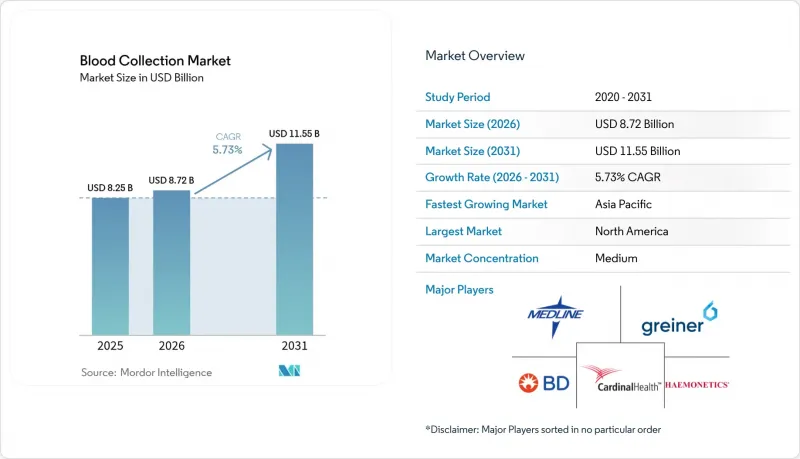
Mordor Intelligence에 의하면, 채혈 시장 규모는 2025년에 82억 5,000만 달러, 2026년 87억 2,000만 달러에서 2031년까지 115억 5,000만 달러에 이를 것으로 예측되며, 예측 기간(2026-2031년) CAGR은 5.73%를 기록할 전망입니다.
본 보고서는 제품별(바늘·주사기, 안전 바늘, 기타), 채취 방법별(수동, 자동), 용도별(진단, 치료·수혈), 최종 사용자별(병원 및 진단센터, 기타), 지역별(북미, 유럽, 아시아태평양, 중동 및 아프리카, 남미)로 분류되어 있습니다. 시장 전망은 입수 가능한 데이터를 바탕으로 금액(달러) 단위로 제시되어 있습니다.
전 세계 채혈 시장 동향 및 인사이트
만성 질환 유병률 증가
현재 미국 성인의 76.4%가 만성 질환을 앓고 있으며, 젊은 층의 발병률도 상승하고 있어 일상적인 정맥혈 및 모세혈관 혈액 검사 수요가 확대되고 있습니다. 의료 서비스 제공업체들은 인력을 비례적으로 늘리지 않고도 증가하는 검체량을 관리하기 위해 자동 분석기 및 분산형 채혈 키트의 도입을 확대되고 있습니다. 가치 기반 의료 계약에서는 적시 모니터링이 보상 지급 조건이 되고 있기 때문에 병원들은 1차 진료 클리닉에 POC(Point-of-Care) 응고 검사 및 HbA1c 검사 패널을 도입하고 있습니다. 이에 대응하여 장비 제조업체들은 장시간 이송 중에도 바이오마커를 보존할 수 있도록 최적화된 항응고제가 미리 주입된 튜브의 소형화를 추진하고 있습니다. 이러한 변화들이 맞물리면서 채혈 시장의 수익 전망은 계속해서 견조한 추세를 보이고 있습니다.
외상·사고 발생률 증가
도시화에 따라 즉각적인 혈액형 판정·스크리닝 및 응고 검사가 필요한 외상 환자의 내원 건수가 증가하고 있습니다. 레벨 I 외상 센터에서는 2mL의 동맥혈을 채취하여 3분 이내에 결과를 산출하는 카트리지식 POC 분석 장치를 응급실에 도입하고 있습니다. 이 전략으로 인해 이송부터 처치 시작까지의 시간이 단축되고 생존율이 향상됨에 따라, 지역 병원들도 이 모델을 도입하고 있습니다. 각 공급업체는 플러시 시각화 기능을 통합한 진공 보조식 윙이 달린 수액 세트를 도입하여, 혼란스러운 상황에서도 첫 천자 시간을 단축하고 재천자를 최소화하고 있습니다. 신흥 시장의 의료시설에서는 기증 기관이 조달 비용을 부담하고 있기 때문에 이러한 안전성이 최적화된 키트로의 전환이 빠르게 진행되고 있습니다.
혈액 매개 감염증 및 오염 위험
2025년, FDA는 B형 간염 선별 검사에 관한 최신 지침을 발표하고 헌혈자 검사 플랫폼의 성능 기준을 강화함에 따라, 채혈 센터의 규정 준수 비용이 증가했습니다. 시설에서는 오염을 줄이기 위해 이중 멸균 장벽이나 조립식 폐쇄 루프 채혈 시스템을 도입하고 있지만, 이러한 안전 대책으로 인해 단위당 비용이 급등하고 있습니다. 인프라가 미비한 지역의 검사실은 이러한 업그레이드에 필요한 자금 조달에 어려움을 겪고 있으며, 구매를 미루는 바람에 단기적인 수요가 둔화되고 있습니다. 신종 병원체에 대한 지속적인 모니터링으로 인해 장비 업그레이드에 대한 압박은 지속되고 있으나, 추가 비용을 보전해 줄 환급 제도가 거의 존재하지 않아 채혈 시장의 확대 속도는 둔화되고 있습니다.
부문 분석
바늘과 주사기는 2025년 매출의 38.12%를 차지하며, 다양한 의료 현장에서 정맥 접근을 위해 광범위하게 사용되고 있음을 보여줍니다. 한편, 튜브는 가장 빠르게 성장하는 틈새 시장으로, 임상의들이 유전자 검사, 단백질체학, 종양학 패널용으로 특화된 첨가제가 포함된 코드화된 바큐테이너를 요구함에 따라 2031년까지 연평균 성장률(CAGR) 7.29%를 기록할 전망입니다. 이러한 추세는 검사 기술의 고도화가 채혈 시장의 소모품 구성을 어떻게 재편하고 있는지를 여실히 보여줍니다.
OSHA(미국 산업안전보건청)의 기준에 따라 안전 바늘에 대한 수요는 꾸준히 증가하고 있지만, 고가인 탓에 이익률이 낮은 외래 검사실에서는 도입 속도가 둔화되고 있습니다. 모세관용 란셋은 대사 질환이나 감염증 선별 검사에 손가락 끝에서 채혈하는 것으로 충분한 소규모 클리닉에서 지지를 얻고 있습니다. BD MiniDraw는 모세혈관 채혈의 혁신을 구현한 제품으로, 정맥 채혈과 동등한 정확도를 단 6방울의 채혈량으로 실현하여 소비자의 접근성을 확대되고 있습니다. 수혈 서비스용 혈액백은 병원에서 수요가 안정적이지만, 합성 대체품과 최적화된 재고 관리 시스템으로 인해 수량 증가세는 억제되고 있습니다. 현재 시장 점유율은 아직 작지만, 새롭게 등장한 로봇식 및 무바늘 제품은 임상적 검증 사례가 축적됨에 따라 2030년 이후에 큰 점유율을 확보할 가능성이 있습니다.
2025년에도 수동 채혈은 55.05%의 점유율을 유지했습니다. 이는 특히 지역 병원이나 이동 채혈소에서 이 기술이 정착되어 있으며, 설비 투자가 최소한으로 끝난다는 점을 반영한 것입니다. 그러나 채혈 기술자 부족(미국에서 연간 1만 9,600명의 인력 부족이 예상)을 배경으로, 자동화 부문은 연평균 성장률(CAGR) 8.43%로 성장할 전망입니다. 의료 기관에서는 Vitestro의 시스템과 같은 자율형 로봇 검사 도입이 진행되고 있으며, 첫 천자 성공률 95%를 달성함과 동시에 검체 품질을 표준화하고 있습니다.
검사 건수가 많은 외래 검사실에서는 처리 능력 향상과 재채혈 비용 절감을 통해 로봇 도입의 타당성이 인정되고 있지만, 크리티컬 액세스 병원에서는 해부학적으로 어려운 사례를 처리하기 위해 여전히 수작업의 범용성에 의존하고 있습니다. AI 유도형 초음파 프로브는 카트에 원활하게 통합되어 평균 채혈 시간을 90초로 단축하고, 환자의 불편함을 최소화하고 있습니다. 설비 투자는 여전히 장벽으로 작용하고 있지만, 리스 모델과 생산성 인센티브를 통해 비용 대비 효과의 격차는 줄어들고 있으며, 채혈 시장의 자동화 전환이 지속되고 있습니다.
지역별 분석
북미는 엄격한 OSHA(미국 산업안전보건청) 규정 준수 및 높은 1인당 검사 이용률에 힘입어 2025년 매출의 42.10%를 차지했습니다. 병원들은 높은 처리 능력과 오류 방지 기능을 갖춘 장비를 권장하는 점점 더 엄격해지는 기증자 선별 지침에 대응하기 위해 로봇 채혈의 시범 도입에 투자하고, 완전 밀폐형 시스템으로의 전환을 추진하고 있습니다. 이 지역의 도입 대수를 고려하면 성장은 여전히 완만하지만, 교체 주기와 기술 혁신이 예측 가능한 지속적인 매출을 뒷받침하고 있습니다.
유럽은 이에 뒤이어, 회원국 간의 안전 기준을 통일하고 혈액 제제의 국경 간 공유를 촉진하는 ‘인체 유래 물질에 관한 2024년 EU 규정’이 성장의 견인차 역할을 하고 있습니다. 각국의 의료 제도는 진공 보조식 안전 튜브 및 바코드를 통한 추적 가능성에 대한 현대화 자금을 배정하고 있으며, 이것이 꾸준한 확장을 뒷받침하고 있습니다. 독일과 네덜란드에서 AI 기반 정맥 감지 장치의 시범 도입은 임상 성능 벤치마크가 조달 결정을 얼마나 촉진하는지를 보여주고 있으며, 이는 서유럽 전역의 매출 증가를 뒷받침하고 있습니다.
아시아태평양은 2031년까지 연평균 성장률(CAGR) 6.19%라는 가장 높은 성장률을 기록할 전망입니다. 이는 의료 인프라 확충과 호주의 ‘플라즈마 패스웨이(Plasma Pathway)’와 같은 정책 이니셔티브에 기인한 것으로, 이를 통해 연간 9만 5,000건의 헌혈이 증가하고 있습니다. 중국의 병원 확장 계획에서는 완전 자동화된 검체 처리 라인이 도입되고 있으며, 이에 대응하는 폐쇄형 시스템용 소모품에 대한 수요가 확대되고 있습니다. 인도의 원격의료 급속한 확대는 농촌 지역에서 모세혈관을 이용한 지질·혈당 검사의 보급을 촉진하고 있으며, 유통 네트워크를 확장하는 동시에 채혈 시장에 새로운 수요원을 창출하고 있습니다. 중동 및 아프리카와 남미는 구매력 면에서 다른 지역에 뒤처져 있지만, 3차 의료 센터 및 외상 치료 시설에 집중된 투자는 특히 WHO의 부상 예방 지침을 충족하는 안전 설계 바늘 분야에서 기회 확대를 시사하고 있습니다.
기타 혜택
- 엑셀 형식 시장 예측(ME) 시트
- 3개월간의 애널리스트 지원
자주 묻는 질문
목차
제1장 서론
제2장 조사 방법
제3장 주요 요약
제4장 시장 구도
제5장 시장 규모와 성장 예측
제6장 경쟁 구도
제7장 시장 기회와 향후 전망
LSH 26.08.26According to Mordor Intelligence, the blood collection market size was valued at USD 8.25 billion in 2025 and estimated to grow from USD 8.72 billion in 2026 to reach USD 11.55 billion by 2031, at a CAGR of 5.73% during the forecast period (2026-2031).
This report is Segmented by Product (Needles & Syringes, Safety Needles, and More), Collection Method (Manual, Automated), Application (Diagnostics and Therapeutics/Transfusion), End User (Hospitals & Diagnostic Centers, and More), and Geography (North America, Europe, Asia-Pacific, Middle East & Africa, South America). The Market Forecasts are Provided in Terms of Value (USD), Based On Availability.
Global Blood Collection Market Trends and Insights
Growing Prevalence of Chronic Diseases
Chronic disorders now affect 76.4% of US adults, and incidence among younger cohorts is climbing, pushing routine venous and capillary testing demand upward. Healthcare providers are scaling automated analyzers and decentralized sampling kits to manage rising specimen volumes without proportionally increasing headcount. Value-based care contracts tie reimbursement to timely monitoring, prompting hospitals to embed point-of-care (POC) coagulation and HbA1c panels inside primary-care clinics. Device makers respond by miniaturizing tubes pre-filled with optimized anticoagulants that preserve biomarkers for extended transport windows. These shifts collectively reinforce sustained revenue visibility for the blood collection market.
Rising Incidence of Trauma and Accidents
Urbanization correlates with higher trauma presentations that require immediate type-and-screen and coagulation work-ups. Level-I trauma centers are outfitting emergency bays with cartridge-based POC analyzers fed by 2 mL arterial draws, delivering results inside 3 minutes. The strategy reduces door-to-intervention time and improves survival metrics, nudging regional hospitals to replicate the model. Suppliers have introduced vacuum-assisted winged infusion sets with integrated flash-visibility to shorten first-stick time and minimize redraws under chaotic conditions. Emerging-market facilities are leapfrogging to these safety-optimized kits as donor agencies underwrite procurement.
Risk of Blood-Borne Infections and Contamination
In 2025 the FDA issued updated hepatitis-B screening guidance that tightens performance criteria for donor testing platforms, raising compliance costs for collection centers. Facilities adopt double-sterility barriers and prefabricated closed-loop collection systems to mitigate contamination, but these safeguards elevate per-unit expense. Laboratories in infrastructure-poor regions struggle to fund such upgrades, deferring purchases and dampening near-term demand. Continuous surveillance for emerging pathogens maintains the pressure to upgrade devices, yet reimbursement schemes seldom offset added overhead, tempering the blood collection market's expansion rate.
Other drivers and restraints analyzed in the detailed report include:
- Increasing Volume of Surgical Procedures
- Expansion of Diagnostic and Point-of-Care Testing Infrastructure
- Needlestick Injuries and Associated Liability Costs
For complete list of drivers and restraints, kindly check the Table Of Contents.
Segment Analysis
Needles and syringes accounted for 38.12% of 2025 revenue, underscoring their widespread use for venous access across various care settings. Tubes, however, constitute the fastest-advancing niche, set to log a 7.29% CAGR through 2031 as clinicians demand additive-coded vacutainers tailored for genetics, proteomics, and oncology panels. This trajectory highlights how assay sophistication reconfigures consumable mix within the blood collection market.
Demand for safety needles rises steadily thanks to OSHA standards, yet premium pricing moderates adoption speed in low-margin outpatient labs. Capillary lancets are gaining favor in retail clinics, where fingertip sampling is sufficient for metabolic and infectious disease screens. BD MiniDraw exemplifies capillary innovation, matching venous-draw accuracy with six-drop volumes, broadening consumer access. Blood bags maintain stable hospital demand for transfusion services, although synthetic substitutes and optimized inventory systems are curbing volume growth. Emerging robotic and needle-free products, currently a small slice, could capture an outsized share post-2030 as clinical validation accumulates.
Manual draws retained a 55.05% share in 2025, reflecting the entrenched nature of these skills and their minimal capital requirements, especially in community hospitals and mobile drives. Yet the automated cohort will expand at an 8.43% CAGR, propelled by phlebotomist shortages projected at 19,600 US openings per year. Institutions trial autonomous robots like Vitestro's system, achieving 95% first-stick success and standardizing specimen quality.
High-volume outpatient labs justify robotics through throughput and reduced redraw costs, whereas critical-access hospitals still rely on manual versatility for challenging anatomies. AI-guided ultrasound probes integrate seamlessly into carts, reducing the average collection time to 90 seconds and minimizing patient discomfort. Capital expenditure remains a barrier; nonetheless, leasing models and productivity incentives are narrowing the affordability gap, sustaining the blood collection market's automation pivot.
Complete Report Scope:
- By Product
- Needles & Syringes
- Safety Needles
- Tubes (Vacutainer, EDTA, Serum, Gel, Etc.)
- Lancets & Capillary Devices
- Blood Bags (Collection & Transfer)
- Other Products
- By Collection Method
- Manual
- Automated
- By Application
- Diagnostics
- Therapeutics / Transfusion
- By End User
- Hospitals & Diagnostic Centers
- Blood Banks
- Point-Of-Care & Home-Care Settings
- Other End Users
- Geography
- North America
- United States
- Canada
- Mexico
- Europe
- Germany
- United Kingdom
- France
- Italy
- Spain
- Rest of Europe
- Asia-Pacific
- China
- Japan
- India
- Australia
- South Korea
- Rest of Asia-Pacific
- Middle East & Africa
- GCC
- South Africa
- Rest of Middle East & Africa
- South America
- Brazil
- Argentina
- Rest of South America
- North America
Geography Analysis
North America preserved 42.10% of 2025 revenue, buoyed by stringent OSHA compliance and high per-capita test utilization. Hospitals invest in robotic phlebotomy pilots and transition to fully closed systems to meet tightening donor-screening guidelines that favor high-throughput, error-proof devices. Growth remains moderate given the region's installed base, yet replacement cycles and tech refreshes underpin predictable recurring sales.
Europe follows closely, guided by the 2024 EU Regulation on substances of human origin, which harmonizes safety standards across member states and encourages cross-border sharing of blood products. National health systems allocate modernization funds to vacuum-assisted safety tubes and barcode traceability, underpinning steady expansion. Pilot deployments of AI-enabled vein-finders in Germany and the Netherlands illustrate how clinical performance benchmarks catalyze procurement decisions, supporting revenue uplift across Western Europe.
Asia-Pacific is set to deliver the fastest 6.19% CAGR to 2031, drawing on healthcare infrastructure upgrades and policy initiatives like Australia's Plasma Pathway that add 95,000 donations annually. China's hospital expansion plans integrate fully automated sample-processing lines, magnifying demand for compatible closed-system consumables. India's telehealth surge spurs rural adoption of capillary-based lipid and glucose testing, stretching distribution networks and providing fresh volume streams for the blood collection market. Though Middle East & Africa and South America trail in spending power, targeted investments in tertiary centers and trauma facilities signal rising opportunities, especially for safety-engineered needles that satisfy WHO injury-prevention guidelines.
- Beckton Dickinson
- Terumo
- Cardinal Health
- Greiner Bio One International
- Fresenius
- Haemonetics
- Mckesson
- Medline Industries
- Nipro
- Sarstedt
- Thermo Fisher Scientific
- Abbott Laboratories
- Danaher
- ICU Medical
- QIAGEN
- Grifols
- Quest Diagnostics
- Velano Vascular
- Greiner Group AG
- Sol-Millennium Medical Group
Additional Benefits:
- The market estimate (ME) sheet in Excel format
- 3 months of analyst support
TABLE OF CONTENTS
1 Introduction
- 1.1 Study Assumptions & Market Definition
- 1.2 Scope Of The Study
2 Research Methodology
3 Executive Summary
4 Market Landscape
- 4.1 Market Overview
- 4.2 Market Drivers
- 4.2.1 Growing Prevalence of Chronic Diseases
- 4.2.2 Rising Incidence of Trauma And Accidents
- 4.2.3 Increasing Volume of Surgical Procedures
- 4.2.4 Expansion of Diagnostic and Point-of-Care Testing Infrastructure
- 4.2.5 Technological Advancements in Blood Collection Devices
- 4.2.6 Government Initiatives Promoting Blood Donation And Safety
- 4.3 Market Restraints
- 4.3.1 Risk of Blood-Borne Infections and Contamination
- 4.3.2 Needlestick Injuries and Associated Liability Costs
- 4.3.3 Emergence of Alternative Non-Invasive Diagnostic Technologies
- 4.3.4 Shortage of Skilled Phlebotomy Professionals
- 4.4 Regulatory Landscape
- 4.5 Porter's Five Forces Analysis
- 4.5.1 Threat Of New Entrants
- 4.5.2 Bargaining Power Of Buyers/Consumers
- 4.5.3 Bargaining Power Of Suppliers
- 4.5.4 Threat Of Substitute Products
- 4.5.5 Intensity Of Competitive Rivalry
5 Market Size & Growth Forecasts (Value, USD)
- 5.1 By Product
- 5.1.1 Needles & Syringes
- 5.1.2 Safety Needles
- 5.1.3 Tubes (Vacutainer, EDTA, Serum, Gel, Etc.)
- 5.1.4 Lancets & Capillary Devices
- 5.1.5 Blood Bags (Collection & Transfer)
- 5.1.6 Other Products
- 5.2 By Collection Method
- 5.2.1 Manual
- 5.2.2 Automated
- 5.3 By Application
- 5.3.1 Diagnostics
- 5.3.2 Therapeutics / Transfusion
- 5.4 By End User
- 5.4.1 Hospitals & Diagnostic Centers
- 5.4.2 Blood Banks
- 5.4.3 Point-Of-Care & Home-Care Settings
- 5.4.4 Other End Users
- 5.5 Geography
- 5.5.1 North America
- 5.5.1.1 United States
- 5.5.1.2 Canada
- 5.5.1.3 Mexico
- 5.5.2 Europe
- 5.5.2.1 Germany
- 5.5.2.2 United Kingdom
- 5.5.2.3 France
- 5.5.2.4 Italy
- 5.5.2.5 Spain
- 5.5.2.6 Rest of Europe
- 5.5.3 Asia-Pacific
- 5.5.3.1 China
- 5.5.3.2 Japan
- 5.5.3.3 India
- 5.5.3.4 Australia
- 5.5.3.5 South Korea
- 5.5.3.6 Rest of Asia-Pacific
- 5.5.4 Middle East & Africa
- 5.5.4.1 GCC
- 5.5.4.2 South Africa
- 5.5.4.3 Rest of Middle East & Africa
- 5.5.5 South America
- 5.5.5.1 Brazil
- 5.5.5.2 Argentina
- 5.5.5.3 Rest of South America
- 5.5.1 North America
6 Competitive Landscape
- 6.1 Market Concentration
- 6.2 Market Share Analysis
- 6.3 Company Profiles (includes Global level Overview, Market level overview, Core Business Segments, Financials, Headcount, Key Information, Market Rank, Market Share, Products and Services, and analysis of Recent Developments)
- 6.3.1 Becton, Dickinson & Company
- 6.3.2 Terumo Corporation
- 6.3.3 Cardinal Health
- 6.3.4 Greiner Bio-One International GmbH
- 6.3.5 Fresenius Kabi AG
- 6.3.6 Haemonetics Corporation
- 6.3.7 McKesson Corporation
- 6.3.8 Medline Industries LP
- 6.3.9 Nipro Corporation
- 6.3.10 Sarstedt AG & Co. KG
- 6.3.11 Thermo Fisher Scientific Inc.
- 6.3.12 Abbott Laboratories
- 6.3.13 Danaher (Beckman Coulter)
- 6.3.14 ICU Medical Inc.
- 6.3.15 Qiagen NV
- 6.3.16 Grifols SA
- 6.3.17 Quest Diagnostics
- 6.3.18 Velano Vascular
- 6.3.19 Greiner Group AG
- 6.3.20 Sol-Millennium Medical Group
7 Market Opportunities & Future Outlook
- 7.1 White-Space & Unmet-Need Assessment


