
|
시장보고서
상품코드
2114426
동맥절개 폐쇄 디바이스 시장 : 시장 점유율 분석, 업계 동향 및 통계, 성장 예측(2026-2031년)Arteriotomy Closure Devices - Market Share Analysis, Industry Trends & Statistics, Growth Forecasts (2026 - 2031) |
||||||
 Mordor Intelligence
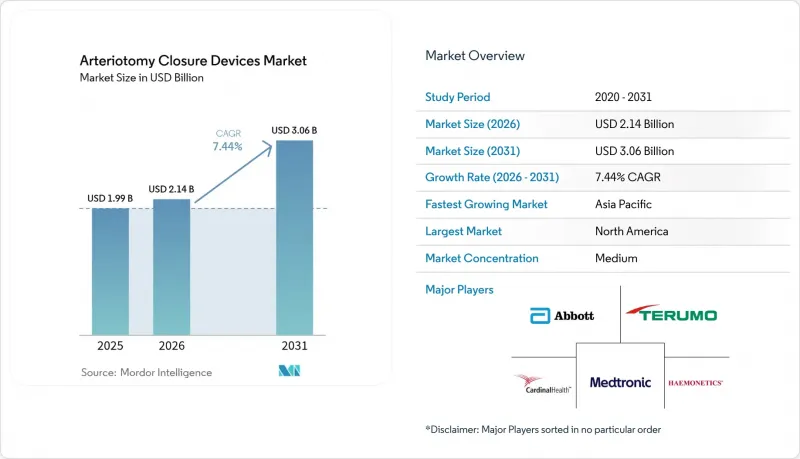
Mordor Intelligence에 의하면, 2026년 동맥절개 폐쇄 디바이스 시장 규모는 21억 4,000만 달러로 추정되고, 2025년 19억 9,000만 달러에서 확대해, 2031년에는 30억 6,000만 달러에 이를 것으로 예측됩니다.
2026-2031년 연평균 성장률(CAGR) 7.44%로 성장할 것으로 전망됩니다.
본 보고서는 제품별(능동형 폐쇄 장치, 수동형 폐쇄 장치), 용도별(대퇴동맥 접근 시술, 요골/상완동맥 접근 시술, 대구경 접근), 최종 사용자별(병원 등), 지역별(북미, 유럽,아시아태평양, 중동 및 아프리카, 남미)로 분류되어 있습니다. 시장 예측은 금액(달러) 기준으로 제시되어 있습니다.
세계의 동맥절개 폐쇄 디바이스 시장 동향 및 인사이트
심혈관 질환 및 말초혈관 질환 유병률 증가
2024년 기준, 전 세계 심혈관 질환 환자 수는 6억 5,500만 명에 달했으며, 말초동맥질환 사례 수는 2010년 이후 23% 증가했습니다. 그 결과, 신뢰할 수 있는 폐쇄 솔루션이 필요한 진단용 혈관조영술, PCI 및 말초 중재술 각 분야에서 지속적인 성장이 나타나고 있습니다. 당뇨병 환자의 시술 복잡성으로 인해 재접속이 필요한 경우가 많으며, 이는 동맥절개 폐쇄 디바이스 시장에서 꾸준하고 지속적인 수요로 이어지고 있습니다. 이러한 장치를 사용하면 수동 압박을 통한 지혈에 소요되는 시간이 10분에서 약 1분으로 단축되므로, 카테터실에서는 하루당 시술 건수를 늘릴 수 있습니다. 특정 동맥 부위를 표적으로 하는 정밀 치료에서도 차별화된 폐쇄 플랫폼이 필요하며, 의료기관이 비축해야 하는 제품 라인업은 확대되고 있습니다. 그 결과, 5F부터 24F까지의 시스 크기를 아우르는 종합적인 제품 포트폴리오를 제공할 수 있는 제조업체는 매출 증대 기회를 포착할 준비가 되어 있습니다.
고령 인구 증가와 PCI 시술 건수 증가
75세 이상 환자는 PCI 시술 환자층 중에서 가장 빠르게 증가하고 있습니다. 석회화나 항응고 요법의 병용으로 인해 출혈 위험이 높아지기 때문에 수동 압박보다 기기를 이용한 폐쇄가 선호되고 있습니다. 임상 데이터에 따르면, 80대 환자에서 폐쇄 시스템을 사용한 경우 기술적 성공률은 94%, 중대한 합병증 발생률은 1% 미만으로 나타났습니다. 특히 2024년 메디케어가 외래 PCI의 보험 적용 범위를 확대함에 따라 당일 퇴원의 확산이 추가적인 호재로 작용하고 있습니다. 의료 기관은 환자의 삶의 질(QOL)도 중시하고 있으며, 조기 보행 시작은 낙상 위험과 병원 내 감염을 줄여줍니다. 이러한 요인들이 복합적으로 작용하여 동맥절개 폐쇄 디바이스 시장에 대한 구조적이고 장기적인 수요 촉진요인을 강화하고 있습니다.
능동 폐쇄 장치의 높은 평균 판매 가격(ASP)
액티브 폐쇄 시스템의 가격은 개당 200-400달러로, 수동 압박 키트의 50-100달러라는 비용을 크게 상회합니다. 대구경 TAVR 사례에서 여러 개의 장치가 필요한 경우, 시술당 비용이 1,000달러를 초과할 수도 있어 가격에 민감한 지역에서는 예산에 부담을 주는 요인이 됩니다. 일괄 구매를 통해 단축된 입원 일수를 상쇄할 수는 있지만, 신흥 시장의 공립 병원에서는 자금 조달의 유연성이 부족한 경우가 많아, Tier 1 의료 센터 이외의 지역에서의 보급이 지연되고 있습니다.
부문 분석
동맥절개 폐쇄 디바이스 시장에서 2025년 매출의 58.62%를 능동형 플랫폼이 차지했습니다. 이는 주로 5F-21F의 시스 크기를 지원하며, 실제 임상 레지스트리에서 97.5%의 기술적 성공률을 달성한 봉합사를 사용하는 시스템 덕분입니다. 이러한 시스템을 통한 즉각적인 지혈은 카테터실의 처리 능력 향상에 기여하며, 광범위한 시술에 대응할 수 있다는 점이 시장 내 주도적 지위를 뒷받침하고 있습니다.
한편, 생체 흡수성 폴리머를 통해 콜라겐 플러그 잔류에 대한 기존의 우려가 해소됨에 따라, 패시브형 솔루션은 2031년까지 연평균 성장률(CAGR) 11.49%를 나타낼 것으로 예측됩니다. 초기 임상 경험에 따르면, 평균 1분 내 지혈과 30일 이내의 신속한 흡수가 확인되었으며, 이에 따라 패시브형 제품은 특히 이물질 회피가 최우선 과제인 젊은 층이나 비만 환자층에서 점유율을 점차 확대해 나갈 것으로 전망됩니다.
지역별 분석
북미는 2025년 동맥절개 폐쇄 디바이스 시장의 전 세계 매출의 42.98%를 차지했습니다. 메디케어와 민간 보험사는 환자에게 추가 비용 부담 없이 폐쇄 기구의 비용을 상환하고 있기 때문에 PCI 및 전기생리학적 시술에서 널리 채택되고 있습니다. 또한, 미국의 의료 종사자들은 출혈 합병증을 최소화하기 위해 기기를 이용한 폐쇄를 권장해야 한다는 의료법적 요구 사항도 제기되고 있습니다. 캐나다의 단일 지불자 모델은 비용 대비 효과 연구에서 입원 일수 단축이 입증된 폐쇄법의 보급을 뒷받침하고 있는 반면, 멕시코에서는 지속적으로 성장하는 민간 병원 부문이 최첨단 폐쇄 기술에 맞추어 카테터실의 기능 강화를 추진하고 있습니다.
유럽은 여전히 성숙하고 규모가 큰 시장으로, 엄격한 근거 요건과 가치 지향적인 조달 체계가 특징입니다. 독일은 이식 건수에서 선두를 달리고 있으며, 영국에서는 비용 대비 효과가 높은 플러그형 기기가 급속히 보급되고 있습니다. 또한 프랑스와 이탈리아에서는 높은 시술 건수와 당일 퇴원에 유리한 진료비 보상 코드 덕분에 꾸준한 성장을 유지하고 있습니다. 브렉시트 이후의 규제 차이로 인해 제품 등록 일정은 복잡해지고 있지만, EU의 MDR 인증은 안전성 증명을 바탕으로 한 기술의 차별화를 지속적으로 촉진하고 있습니다.
아시아태평양은 심장 의료 인프라의 확대와 허혈성 심장 질환 발병률 증가를 배경으로, 2031년까지 8.83%라는 지역별 최고 수준의 연평균 성장률(CAGR)을 달성할 것으로 예측됩니다. 중국에서는 공공 및 민간 카테터실 투자가 수술 건수 증가를 가속화하고 있는 반면, 국내 의료기기 제조업체들은 기술 이전을 위해 세계 리더과의 제휴를 점점 더 확대되고 있습니다. 일본에서는 선진적인 보험 환급 제도와 고도의 시술 기술이 생체 흡수성 폐쇄 플랫폼의 조기 도입을 뒷받침하고 있습니다. 인도 수요 전망은 견조하지만, 가격에 대한 민감도가 매우 높기 때문에 단계적인 제품 라인업과 효율적인 유통 체계가 요구되고 있습니다.
기타 혜택 :
- 엑셀 형식 시장 예측(ME) 시트
- 3개월간의 애널리스트 지원
자주 묻는 질문
목차
제1장 서론
제2장 조사 방법
제3장 주요 요약
제4장 시장 구도
제5장 시장 규모 및 성장 예측
제6장 경쟁 구도
제7장 시장 기회 및 향후 전망
AJY 26.08.26According to Mordor Intelligence, arteriotomy closure devices market size in 2026 is estimated at USD 2.14 billion, growing from 2025 value of USD 1.99 billion with 2031 projections showing USD 3.06 billion, growing at 7.44% CAGR over 2026-2031.
This report is Segmented by Product (Active Closure Devices, Passive Closure Devices), Application (Femoral Arterial Access Procedures, Radial/Brachial Arterial Access Procedures, Large-Bore Access), End User (Hospitals, and More), and Geography (North America, Europe, Asia-Pacific, Middle East & Africa, South America). The Market Forecasts are Provided in Terms of Value (USD).
Global Arteriotomy Closure Devices Market Trends and Insights
Increasing Prevalence of Cardiovascular & Peripheral Vascular Disorders
Global cardiovascular disease affected 655 million individuals in 2024, and peripheral arterial disease cases have risen 23% since 2010, resulting in sustained growth across diagnostic angiography, PCI, and peripheral interventions that all require reliable closure solutions. Procedure complexity in diabetic populations often demands repeat access, translating into steady, recurring demand within the arteriotomy closure devices market. Devices cut hemostasis time to around 1 minute versus 10 minutes for manual compression, allowing cath-labs to increase daily caseloads. Precision therapies targeting specific arterial beds likewise necessitate differentiated closure platforms, broadening the product mix that facilities must stock. Consequently, manufacturers that can offer comprehensive portfolios spanning sheath sizes from 5F to 24F are poised to capture incremental revenue.
Rising Geriatric Population & PCI Volumes
Patients older than 75 are the fastest-growing PCI cohort; comorbid calcification and anticoagulation elevate bleeding risk, making device-based closure preferable to manual compression. Outreach data show technical success rates of 94% and major complication rates below 1% when operators deploy closure systems in octogenarian cases. Same-day discharge adds further momentum, particularly since Medicare broadened outpatient PCI reimbursement in 2024. Health-systems also emphasize patient quality-of-life, and quicker ambulation lessens fall risk and hospital-acquired infections. Together these factors reinforce structural, long-term demand drivers for the arteriotomy closure devices market.
High ASPs of Active Closure Devices
Active closure systems range from USD 200 to 400 each, significantly above the USD 50-100 cost of manual compression kits. When large-bore TAVR cases require multiple devices, per-procedure spend can exceed USD 1,000, straining budgets in price-sensitive regions. Although bundled purchasing can offset inpatient days saved, public hospitals in emerging markets often lack capital flexibility, slowing penetration outside tier-one centers.
Other drivers and restraints analyzed in the detailed report include:
- Rapid Uptake of Transradial & Same-Day Discharge Cath-Lab Programs
- Growth in Large-Bore Interventions (TAVR, EVAR) Requiring Percutaneous Closure
- Device-Related Complications & Steep Learning Curve
For complete list of drivers and restraints, kindly check the Table Of Contents.
Segment Analysis
Active platforms accounted for 58.62% of 2025 revenue within the arteriotomy closure devices market, primarily due to suture-mediated systems that span 5F-21F sheath sizes and achieve a 97.5% technical success rate in real-world registries. Their immediate hemostasis supports cath-lab throughput, and broad procedural coverage underpins their market leadership.
Passive solutions, however, are expected to post an 11.49% CAGR through 2031, as bio-absorbable polymers address previous concerns over retained collagen plugs. Early clinical experience suggests 1-minute average hemostasis and rapid resorption within 30 days, which helps passive entries secure an incremental share, particularly in younger and bariatric populations where foreign-body avoidance is paramount.
Complete Report Scope:
- By Product
- Active Closure Devices
- Suture-mediated Systems
- Clip-based Systems
- Passive Closure Devices
- Collagen Plug Devices
- Polymer/Sealant-based Devices
- External Compression & Assist Systems
- Active Closure Devices
- By Application
- Femoral Arterial Access Procedures
- Radial/Brachial Arterial Access Procedures
- Large-bore Access (TAVR, EVAR, TEVAR)
- By End User
- Hospitals
- Ambulatory Surgical & Cath-Lab Centers
- Specialty Cardiology Clinics
- By Geography
- North America
- United States
- Canada
- Mexico
- Europe
- Germany
- United Kingdom
- France
- Italy
- Spain
- Rest of Europe
- Asia-Pacific
- China
- Japan
- India
- Australia
- South Korea
- Rest of Asia-Pacific
- Middle East & Africa
- GCC
- South Africa
- Rest of Middle East & Africa
- South America
- Brazil
- Argentina
- Rest of South America
- North America
Geography Analysis
North America captured 42.98% of 2025 global revenue in the arteriotomy closure devices market. Medicare and private insurers reimburse closure tools without added patient cost, prompting universal adoption for PCI and electrophysiology procedures. United States operators also cite medico-legal imperatives favoring device-based closure to minimize bleeding complications. Canada's single-payer model supports closure uptake where cost-utility studies show diminished inpatient days, while Mexico's growing private hospital sector is upgrading cath-lab capabilities aligned with premium closure technologies.
Europe remains a mature but sizeable arena characterized by stringent evidence requirements and value-oriented purchasing frameworks. Germany leads implantation volumes; the United Kingdom quickly embraces cost-effective plug-based devices; and France and Italy sustain steady growth due to high procedural load and favorable coding for same-day discharge. Post-Brexit regulatory divergence complicates product registration timelines, yet EU MDR certification continues to promote technology differentiation on safety credentials.
Asia Pacific is projected to deliver the fastest regional CAGR of 8.83% to 2031 on the back of expanding cardiac care infrastructure and rising incidence of ischemic heart disease. China's investment in public and private cath-labs accelerates volume growth, while domestic device players increasingly partner with global leaders for technology transfer. Japan's advanced reimbursement and procedural sophistication underpin early adoption of bio-absorbable closure platforms. India's demand outlook remains robust, albeit tempered by acute price sensitivity that requires tiered product offerings and lean distribution.
- Abbott Laboratories
- Terumo
- Medtronic
- Teleflex
- Cardinal Health
- Haemonetics (Cardiva Medical)
- Merit Medical Systems
- Boston Scientific
- Vivasure Medical
- Otsuka Medical Devices (Veryan)
- AngioDynamics
- Essential Medical
- InSeal Medical
- Scion Cardiovascular
- B. Braun
- Lepu Medical
- Advanced Vascular Dynamics
- Endologix
- Shimadzu MD Systems
Additional Benefits:
- The market estimate (ME) sheet in Excel format
- 3 months of analyst support
TABLE OF CONTENTS
1 Introduction
- 1.1 Study Assumptions & Market Definition
- 1.2 Scope of the Study
2 Research Methodology
3 Executive Summary
4 Market Landscape
- 4.1 Market Overview
- 4.2 Market Drivers
- 4.2.1 Increasing Prevalence of Cardiovascular & Peripheral Vascular Disorders
- 4.2.2 Rising Geriatric Population & PCI Volumes
- 4.2.3 Rapid Uptake of Transradial & Same-Day Discharge Cath-Lab Programs
- 4.2.4 Growth In Large-Bore Interventions (TAVR, EVAR) Requiring Percutaneous Closure
- 4.2.5 Reimbursement Reforms Incentivizing Outpatient Vascular Procedures
- 4.2.6 Breakthrough Bio-Absorbable / Polymer Sealants Improving Safety Profile
- 4.3 Market Restraints
- 4.3.1 High Asps of Active Closure Devices
- 4.3.2 Device-Related Complications & Steep Learning Curve
- 4.3.3 Cost-Containment Pressures in Emerging Markets
- 4.3.4 Supply-Chain Dependency on Medical-Grade Collagen & PEG
- 4.4 Regulatory Landscape
- 4.5 Technological Outlook
- 4.6 Porter's Five Forces Analysis
- 4.6.1 Threat of New Entrants
- 4.6.2 Bargaining Power of Buyers
- 4.6.3 Bargaining Power of Suppliers
- 4.6.4 Threat of Substitutes
- 4.6.5 Competitive Rivalry
5 Market Size & Growth Forecasts (Value in USD)
- 5.1 By Product
- 5.1.1 Active Closure Devices
- 5.1.1.1 Suture-mediated Systems
- 5.1.1.2 Clip-based Systems
- 5.1.2 Passive Closure Devices
- 5.1.2.1 Collagen Plug Devices
- 5.1.2.2 Polymer/Sealant-based Devices
- 5.1.2.3 External Compression & Assist Systems
- 5.1.1 Active Closure Devices
- 5.2 By Application
- 5.2.1 Femoral Arterial Access Procedures
- 5.2.2 Radial/Brachial Arterial Access Procedures
- 5.2.3 Large-bore Access (TAVR, EVAR, TEVAR)
- 5.3 By End User
- 5.3.1 Hospitals
- 5.3.2 Ambulatory Surgical & Cath-Lab Centers
- 5.3.3 Specialty Cardiology Clinics
- 5.4 By Geography
- 5.4.1 North America
- 5.4.1.1 United States
- 5.4.1.2 Canada
- 5.4.1.3 Mexico
- 5.4.2 Europe
- 5.4.2.1 Germany
- 5.4.2.2 United Kingdom
- 5.4.2.3 France
- 5.4.2.4 Italy
- 5.4.2.5 Spain
- 5.4.2.6 Rest of Europe
- 5.4.3 Asia-Pacific
- 5.4.3.1 China
- 5.4.3.2 Japan
- 5.4.3.3 India
- 5.4.3.4 Australia
- 5.4.3.5 South Korea
- 5.4.3.6 Rest of Asia-Pacific
- 5.4.4 Middle East & Africa
- 5.4.4.1 GCC
- 5.4.4.2 South Africa
- 5.4.4.3 Rest of Middle East & Africa
- 5.4.5 South America
- 5.4.5.1 Brazil
- 5.4.5.2 Argentina
- 5.4.5.3 Rest of South America
- 5.4.1 North America
6 Competitive Landscape
- 6.1 Market Concentration
- 6.2 Market Share Analysis
- 6.3 Company Profiles (includes Global level Overview, Market Level Overview, Core Segments, Financials, Strategic Information, Market Rank/Share, Products & Services, Recent Developments)
- 6.3.1 Abbott Laboratories
- 6.3.2 Terumo Corporation
- 6.3.3 Medtronic
- 6.3.4 Teleflex Incorporated
- 6.3.5 Cardinal Health (Cordis)
- 6.3.6 Haemonetics (Cardiva Medical)
- 6.3.7 Merit Medical Systems
- 6.3.8 Boston Scientific Corporation
- 6.3.9 Vivasure Medical
- 6.3.10 Otsuka Medical Devices (Veryan)
- 6.3.11 AngioDynamics
- 6.3.12 Essential Medical
- 6.3.13 InSeal Medical
- 6.3.14 Scion Cardiovascular
- 6.3.15 B. Braun Melsungen AG
- 6.3.16 Lepu Medical Technology
- 6.3.17 Advanced Vascular Dynamics
- 6.3.18 Endologix
- 6.3.19 Shimadzu MD Systems
7 Market Opportunities & Future Outlook
- 7.1 White-space & Unmet-need Assessment