

|
시장보고서
상품코드
2114438
만성 신장 질환 시장 : 시장 점유율 분석, 업계 동향 및 통계, 성장 예측(2026-2031년)Chronic Kidney Disease - Market Share Analysis, Industry Trends & Statistics, Growth Forecasts (2026 - 2031) |
||||||
 Mordor Intelligence
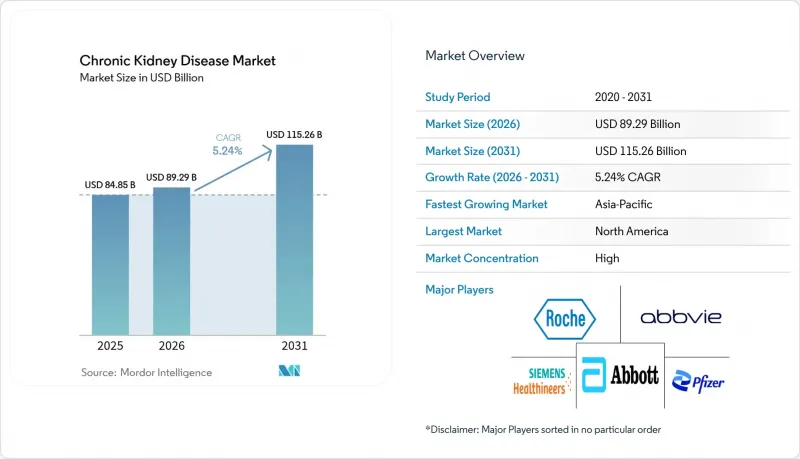
Mordor Intelligence에 의하면, 2026년 만성 신장 질환 시장 규모는 892억 9,000만 달러로 추정되고, 2025년 848억 5,000만 달러에서 확대해, 2031년에는 1,152억 6,000만 달러에 이를 것으로 예측됩니다.
2026-2031년 연평균 성장률(CAGR)은 5.24%가 될 것으로 전망됩니다.
본 보고서는 제품 유형별(진단, 치료), 최종 사용자별(병원, 투석 센터, 재택치료, 기타 최종 사용자) 및 지역별(북미, 유럽, 아시아태평양, 중동 및 아프리카, 남미)로 분류되어 있습니다. 시장 전망은 금액(달러) 기준으로 제시되어 있습니다.
세계의 만성 신장 질환 시장 동향 및 인사이트
당뇨병 및 고혈압 유병률 증가
당뇨병은 5억 3,700만 명의 성인에게, 고혈압은 추가로 12억 8,000만 명에게 영향을 미치고 있어 신장 손상 위험이 있는 방대한 집단을 형성하고 있습니다. 아스트라제네카의 모델 분석에 따르면, 2032년까지 주요 8개국 인구의 최대 16.5%가 만성 신장 질환을 발병할 가능성이 있으며, 진행성 사례는 59.3% 증가할 것으로 예측됩니다. 2025년 FDA가 세마글루타이드의 적응증 확대를 승인했을 때, 신부전 위험이 24% 감소한 것으로 나타나 내분비 시장과 신장 시장이 연결되었습니다. 이러한 추세로 인해 예방 약물, 통합 치료 및 장기 모니터링에 대한 수요가 증가하고 있습니다. 메디케어는 이미 투석에 연간 88억 달러를 지출하고 있어, 조기 대응에 대한 비용 측면의 압박이 부각되고 있습니다. 기저질환을 가진 환자들이 나이를 들어 메디케어 적용 대상이 됨에 따라, 만성 신장 질환 시장에서는 질병 진행을 늦추고 고액의 신장 대체 요법을 피할 수 있는 솔루션에 대한 수요가 증가하고 있습니다.
고령화에 따른 만성 신장 질환(CKD) 발병률 상승
40세가 지나면 신장 기능은 연간 약 1%씩 저하됩니다. 일본처럼 급속한 고령화가 진행되고 있는 국가에서는 진단율이 급증하고 있어 의료 시스템에 부담이 가중되고 있습니다. 70대, 80대에 접어든 베이비붐 세대로 인해 투석 및 이식 서비스에 대한 수요가 증가하고 있습니다. 개발도상국도 유사한 인구 동향 곡선에 직면해 있지만, 인프라가 미비한 경우가 많아 재택 투석에 대한 관심이 높아지고 있습니다. 고령 환자에게는 다직종에 의한 관리가 필요하며, 병원, 1차 진료, 전문 의료 서비스 간의 연계에 대한 수요가 높아지고 있습니다. 이러한 인구통계학적 요인으로 인해 예측 기간을 훨씬 뛰어넘어 환자 수가 꾸준히 증가할 것으로 예측됩니다.
투석 및 치료의 높은 비용
투석의 연간 비용은 환자 1인당 9만 달러를 초과하기도 하여, 저소득 국가에서는 치료 접근성이 제한되고 공공 예산에 부담을 주고 있습니다. 메디케어는 이미 매년 88억 달러를 투석에 배정하고 있습니다. 많은 신흥 시장에서는 종합적인 보험 제도가 마련되어 있지 않아 환자들이 치료를 포기하거나 연기하고 있으며, 이로 인해 치료 건수 증가가 억제되고 있습니다. 비용 장벽으로 인해 일시불 결제 제도나 휴대용 기기 도입이 검토되고 있지만, 자원이 제한된 의료 시스템의 경우 초기 투자는 여전히 큰 과제로 남아 있습니다.
부문 분석
2025년에는 치료용 제품이 매출의 74.90%를 차지했으며, 질환의 모든 단계에서 중심적인 역할을 하고 있는 것으로 나타났습니다. 만성 신장 질환 치료 시장 규모는 635억 5,000만 달러에 달하며, 새로운 정밀 치료제와 차세대 투석 기술의 등장으로 인해 더욱 확대될 것으로 예측됩니다. IgA 신장병 치료제 ‘아트라센탄’ 및 보체 3 사구체 신염 치료제 ‘이프타코판’의 FDA 승인은 고가 책정이 가능한 표적 치료로의 전환을 여실히 보여주고 있습니다. 투석 기술 또한 휴대형 및 웨어러블형 시스템으로 진화하고 있어, 시설에 대한 의존도를 낮추고 환자의 선택 폭을 넓히고 있습니다. 치료제 제조업체들은 현재 가치 기반 계약에서 치료 성과 향상을 입증하기 위해 디지털 복약 준수 지원 도구를 제품에 통합하고 있습니다.
진단용 제품은 시장 점유율은 작지만 6.75%라는 가장 높은 연평균 성장률(CAGR)을 기록하고 있습니다. 조기 발견 키트, 영상 진단 기술의 발전, 그리고 AI를 활용한 위험 모델이 이러한 상승 추세를 뒷받침하고 있습니다. 신속한 바이오마커 패널을 통해 임상의는 혈청 크레아티닌 수치가 상승하기 훨씬 전에 질병의 병기를 판정할 수 있게 되어, 확대되는 예방 의료 시장이 열리고 있습니다. 진단 매출의 대부분은 여전히 혈액 검사가 차지하고 있지만, 임상의들이 다중 모드 평가 방식을 채택함에 따라 소변 바이오마커 패널과 영상 진단 기술의 고도화가 시장 점유율을 확대되고 있습니다. 연속 모니터링 기기를 통해 조만간 eGFR의 실시간 추적이 가능해짐에 따라, 기기 제조업체에게는 구독형 수익 모델이 촉진될 것입니다.
지역별 분석
2025년에는 북미가 매출의 42.20%를 차지하며 1위를 기록했습니다. 이는 광범위한 보험 적용과 신약 및 신의료기기의 조기 도입에 힘입은 결과입니다. 미국이 이러한 선두의 기반이 되고 있으며, 미국 투석 시장의 두 대기업에 의한 독점 구조는 규모의 경제를 가져오는 한편, 독점 금지법 심사를 초래할 우려도 있습니다. 캐나다는 국민건강보험제도로 인해 그 뒤를 따르고 있으며, 멕시코에서는 최근 CKD 선별 검사 캠페인으로 인해 진단 건수가 증가하고 있습니다.
아시아태평양은 연평균 성장률(CAGR) 6.98%로 가장 빠르게 성장하고 있는 지역입니다. 중국은 만성 질환 전문 클리닉과 치료비를 절감하는 국내 제네릭 의약품 생산에 막대한 투자를 하고 있습니다. 인도의 제조 거점은 합리적인 가격의 SGLT2 억제제 공급을 주도하며, 저소득 주에서의 접근성을 확대되고 있습니다. 세계에서 가장 고령화된 인구를 보유한 일본은 첨단 재택 혈액투석 시스템 도입을 지속하는 한편, 웨어러블 인공 신장의 임상시험에 투자하고 있습니다. 한국과 호주는 적극적인 원격 신장내과 프로그램을 통해 지역 성장 모멘텀을 뒷받침하고 있습니다.
유럽, 중동 및 아프리카, 그리고 남미에서는 완만한 성장이 예상됩니다. 유럽은 국민건강보험 제도의 혜택을 받고 있지만, 제네릭 의약품 및 재택 요법을 통해 비용 절감을 도모하고 있습니다. 걸프협력회의(GCC) 회원국들은 지역 내 투석 수요를 충당하기 위해 이식 센터에 투자하고 있습니다. 아프리카는 인프라 부족에 직면해 있지만, 민관 협력을 통해 저비용 복막투석이 도입되어 그 혜택을 누리고 있습니다. 남미에서는 브라질을 필두로 만성 신장 질환(CKD)에 대한 인식이 점차 높아지면서, 1차 진료에서의 선별 검사에 대한 자금 지원이 추진되고 있습니다.
기타 혜택 :
- 엑셀 형식 시장 예측(ME) 시트
- 3개월간의 애널리스트 지원
자주 묻는 질문
목차
제1장 서론
제2장 조사 방법
제3장 주요 요약
제4장 시장 구도
제5장 시장 규모 및 성장 예측
제6장 경쟁 구도
제7장 시장 기회 및 향후 전망
AJY 26.08.26According to Mordor Intelligence, chronic kidney disease market size in 2026 is estimated at USD 89.29 billion, growing from 2025 value of USD 84.85 billion with 2031 projections showing USD 115.26 billion, growing at 5.24% CAGR over 2026-2031.
This report is Segmented by Product Type (Diagnosis, Treatment), End User (Hospitals, Dialysis Centers, Homecare Settings, Other End Users), and Geography (North America, Europe, Asia-Pacific, Middle East & Africa, South America). The Market Forecasts are Provided in Terms of Value (USD).
Global Chronic Kidney Disease Market Trends and Insights
Rising Prevalence of Diabetes & Hypertension
Diabetes affects 537 million adults and hypertension another 1.28 billion, creating a vast at-risk pool for kidney damage. AstraZeneca modelling indicates up to 16.5% of populations in eight major countries may develop chronic kidney disease by 2032, with advanced-stage cases rising 59.3%. FDA expansion of semaglutide in 2025 demonstrated a 24% drop in kidney failure risk, linking endocrine and renal markets. These patterns elevate demand for preventive drugs, integrated care, and long-term monitoring. Medicare already spends USD 8.8 billion yearly on dialysis, underlining cost pressure for early action. As comorbid patients age into Medicare, the chronic kidney disease market is primed for solutions that delay progression and avoid costly renal replacement therapy.
Aging Population Escalating CKD Incidence
Kidney function declines about 1% yearly after age 40. In nations with rapid aging, such as Japan, diagnosis rates have surged, stressing capacity. Baby boomers entering their 70s and 80s present growing demand for dialysis and transplant services. Developing regions face the same demographic curve, but often lack infrastructure, prompting interest in home-based dialysis. Elderly patients require multidisciplinary management, raising demand for coordinated hospital, primary care, and specialized services. This demographic driver ensures steady volume growth well beyond the forecast horizon.
High Cost of Dialysis & Treatment
Annual dialysis outlays can exceed USD 90,000 per patient, limiting access in lower-income economies and straining public budgets. Medicare already allocates USD 8.8 billion to dialysis each year . Many emerging markets lack broad insurance, so patients forgo or delay therapy, capping unit growth. Cost barriers spur exploration of bundled payments and portable devices, yet upfront investments remain challenging for under-resourced systems.
Other drivers and restraints analyzed in the detailed report include:
- Technological Advances in Early Diagnostics
- Value-Based Kidney-Care Payment Incentives
- Generic Erosion in Mature Drug Classes
For complete list of drivers and restraints, kindly check the Table Of Contents.
Segment Analysis
Treatment products generated 74.90% revenue in 2025, illustrating their central role across disease stages. The chronic kidney disease market size for treatment reached USD 63.55 billion and is projected to expand alongside new precision drugs and next-generation dialysis. FDA clearance of atrasentan for IgA nephropathy and iptacopan for complement 3 glomerulopathy underscores a shift to targeted therapy that can carry premium pricing . Dialysis technology is also evolving toward portable and wearable systems, reducing facility dependence and widening patient choice. Treatment manufacturers now bundle digital adherence tools to prove outcome gains in value-based contracts.
Diagnosis products hold a smaller slice yet post the fastest CAGR at 6.75%. Early detection kits, imaging advances, and AI-based risk models support this upswing. Rapid biomarker panels enable clinicians to stage disease well before serum creatinine rises, opening an expanding preventive market. Blood tests still account for most diagnostic revenue, but urine biomarker panels and imaging upgrades gain share as clinicians adopt multi-modal assessment pathways. Continuous monitoring devices could soon allow real-time eGFR tracking, fostering subscription revenue models for device makers.
Complete Report Scope:
- By Product Type
- Diagnosis
- Blood Tests
- Urine Tests
- Imaging Tests
- Point-of-Care Kidney Tests
- Other Diagnosis Products
- Treatment
- Drug Class
- ACE Inhibitors
- Angiotensin-II Receptor Blockers
- Diuretics
- SGLT2 Inhibitors
- Mineralocorticoid Receptor Antagonists
- Erythropoiesis Stimulating Agents
- Phosphate Binders
- HIF-PH Inhibitors (Vadadustat etc.)
- Other Drug Classes
- Dialysis
- Hemodialysis
- Peritoneal Dialysis
- Home Dialysis Systems
- Wearable & Portable Dialysis
- Other Treatment Products
- Drug Class
- Diagnosis
- By End User
- Hospitals
- Dialysis Centers
- Homecare Settings
- Other End Users
- By Geography
- North America
- United States
- Canada
- Mexico
- Europe
- Germany
- United Kingdom
- France
- Italy
- Spain
- Rest of Europe
- Asia-Pacific
- China
- Japan
- India
- Australia
- South Korea
- Rest of Asia-Pacific
- Middle East & Africa
- GCC
- South Africa
- Rest of Middle East & Africa
- South America
- Brazil
- Argentina
- Rest of South America
- North America
Geography Analysis
North America led with 42.20% revenue in 2025, underpinned by broad insurance coverage and early uptake of novel drugs and devices. The United States anchors this lead; its duopoly dialysis structure imparts economies of scale but invites antitrust review. Canada follows with universal coverage, while Mexico's recent CKD screening campaigns expand diagnosis volumes.
Asia-Pacific is the fastest-growing region at 6.98% CAGR. China invests heavily in chronic disease clinics and domestic generic production that cuts therapy costs. India's manufacturing base drives affordable SGLT2 inhibitors, widening access across low-income states. Japan, with the world's oldest population, continues to deploy advanced home hemodialysis systems and invests in wearable artificial kidney trials. South Korea and Australia reinforce regional momentum through proactive tele-nephrology programs.
Europe, the Middle East & Africa, and South America offer moderate growth. Europe benefits from universal payer systems but seeks cost-savings via generics and home therapies. Gulf Cooperation Council states invest in transplant centers to offset regional dialysis demand. Africa faces strained infrastructure yet gains from public-private partnerships introducing low-cost peritoneal dialysis. South America, led by Brazil, incrementally raises CKD awareness and funds screening in primary care.
- Abbott Laboratories
- Abbvie
- Amgen
- AstraZeneca
- Baxter
- Bayer
- Beckton Dickinson
- Boehringer Ingelheim
- Bristol-Myers Squibb
- DaVita
- Roche
- Fresenius
- GlaxoSmithKline
- Johnson & Johnson
- Merck
- Novo Nordisk
- Pfizer
- ProKidney
- Reata Pharmaceuticals
- Siemens Healthineers
- Sysmex
- Teva Pharmaceutical Industries
- Akebia Therapeutics
Additional Benefits:
- The market estimate (ME) sheet in Excel format
- 3 months of analyst support
TABLE OF CONTENTS
1 Introduction
- 1.1 Study Assumptions & Market Definition
- 1.2 Scope of the Study
2 Research Methodology
3 Executive Summary
4 Market Landscape
- 4.1 Market Overview
- 4.2 Market Drivers
- 4.2.1 Rising Prevalence Of Diabetes & Hypertension
- 4.2.2 Aging Population Escalating Ckd Incidence
- 4.2.3 Technological Advances In Early Diagnostics
- 4.2.4 Value-Based Kidney-Care Payment Incentives
- 4.2.5 Ai-Driven Risk Stratification Tools
- 4.2.6 Growth Of Low-Carbon/Home Dialysis Devices
- 4.3 Market Restraints
- 4.3.1 High Cost Of Dialysis & Treatment
- 4.3.2 Generic Erosion In Mature Drug Classes
- 4.3.3 Drug Safety & Adverse-Effect Concerns
- 4.3.4 ESG-Linked Supply-Chain Cost Pressures
- 4.4 Value / Supply-Chain Analysis
- 4.5 Regulatory Landscape
- 4.6 Technological Outlook
- 4.7 Porter's Five Forces Analysis
- 4.7.1 Threat of New Entrants
- 4.7.2 Bargaining Power of Buyers
- 4.7.3 Bargaining Power of Suppliers
- 4.7.4 Threat of Substitutes
- 4.7.5 Competitive Rivalry
5 Market Size & Growth Forecasts (Value)
- 5.1 By Product Type
- 5.1.1 Diagnosis
- 5.1.1.1 Blood Tests
- 5.1.1.2 Urine Tests
- 5.1.1.3 Imaging Tests
- 5.1.1.4 Point-of-Care Kidney Tests
- 5.1.1.5 Other Diagnosis Products
- 5.1.2 Treatment
- 5.1.2.1 Drug Class
- 5.1.2.1.1 ACE Inhibitors
- 5.1.2.1.2 Angiotensin-II Receptor Blockers
- 5.1.2.1.3 Diuretics
- 5.1.2.1.4 SGLT2 Inhibitors
- 5.1.2.1.5 Mineralocorticoid Receptor Antagonists
- 5.1.2.1.6 Erythropoiesis Stimulating Agents
- 5.1.2.1.7 Phosphate Binders
- 5.1.2.1.8 HIF-PH Inhibitors (Vadadustat etc.)
- 5.1.2.1.9 Other Drug Classes
- 5.1.2.2 Dialysis
- 5.1.2.2.1 Hemodialysis
- 5.1.2.2.2 Peritoneal Dialysis
- 5.1.2.2.3 Home Dialysis Systems
- 5.1.2.2.4 Wearable & Portable Dialysis
- 5.1.2.3 Other Treatment Products
- 5.1.2.1 Drug Class
- 5.1.1 Diagnosis
- 5.2 By End User
- 5.2.1 Hospitals
- 5.2.2 Dialysis Centers
- 5.2.3 Homecare Settings
- 5.2.4 Other End Users
- 5.3 By Geography
- 5.3.1 North America
- 5.3.1.1 United States
- 5.3.1.2 Canada
- 5.3.1.3 Mexico
- 5.3.2 Europe
- 5.3.2.1 Germany
- 5.3.2.2 United Kingdom
- 5.3.2.3 France
- 5.3.2.4 Italy
- 5.3.2.5 Spain
- 5.3.2.6 Rest of Europe
- 5.3.3 Asia-Pacific
- 5.3.3.1 China
- 5.3.3.2 Japan
- 5.3.3.3 India
- 5.3.3.4 Australia
- 5.3.3.5 South Korea
- 5.3.3.6 Rest of Asia-Pacific
- 5.3.4 Middle East & Africa
- 5.3.4.1 GCC
- 5.3.4.2 South Africa
- 5.3.4.3 Rest of Middle East & Africa
- 5.3.5 South America
- 5.3.5.1 Brazil
- 5.3.5.2 Argentina
- 5.3.5.3 Rest of South America
- 5.3.1 North America
6 Competitive Landscape
- 6.1 Market Concentration
- 6.2 Market Share Analysis
- 6.3 Company Profiles (includes Global Overview, Market Overview, Core Segments, Financials, Strategic Info, Market Rank/Share, Products & Services, Recent Developments)
- 6.3.1 Abbott Laboratories
- 6.3.2 AbbVie
- 6.3.3 Amgen
- 6.3.4 AstraZeneca
- 6.3.5 Baxter International
- 6.3.6 Bayer AG
- 6.3.7 Beckman Coulter
- 6.3.8 Boehringer Ingelheim
- 6.3.9 Bristol-Myers Squibb
- 6.3.10 DaVita
- 6.3.11 F. Hoffmann-La Roche
- 6.3.12 Fresenius Medical Care
- 6.3.13 GlaxoSmithKline
- 6.3.14 Johnson & Johnson
- 6.3.15 Merck & Co.
- 6.3.16 Novo Nordisk
- 6.3.17 Pfizer
- 6.3.18 ProKidney
- 6.3.19 Reata Pharmaceuticals
- 6.3.20 Siemens Healthineers
- 6.3.21 Sysmex
- 6.3.22 Teva Pharmaceutical Industries
- 6.3.23 Akebia Therapeutics
7 Market Opportunities & Future Outlook
- 7.1 White-space & unmet-need assessment


