

|
시장보고서
상품코드
2114441
네트워크 애널라이저 시장 : 시장 점유율 분석, 업계 동향 및 통계, 성장 예측(2026-2031년)Network Analyzers - Market Share Analysis, Industry Trends & Statistics, Growth Forecasts (2026 - 2031) |
||||||
 Mordor Intelligence
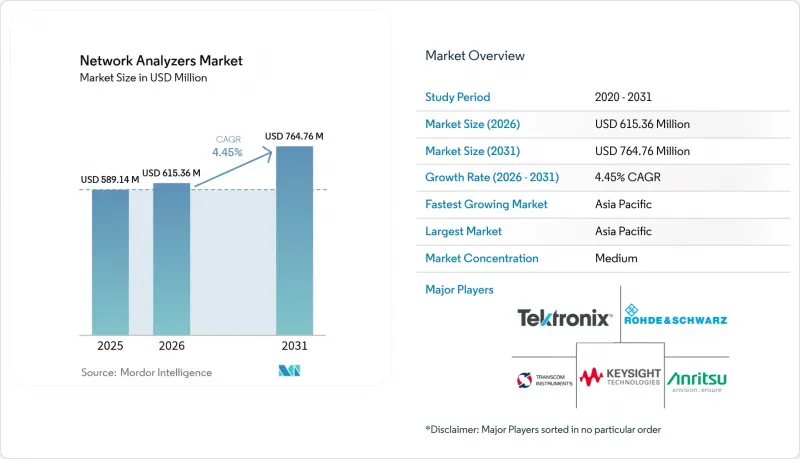
Mordor Intelligence에 의하면, 네트워크 애널라이저 시장 규모는 2025년 5억 8,914만 달러로 평가되었고, 2026년에는 6억 1,536만 달러로 추정되고, 2026-2031년 CAGR 4.45%로 성장을 지속할 전망이며, 2031년에는 7억 6,476만 달러에 이를 것으로 예측됩니다.
본 보고서는 제품 유형별(벡터 네트워크 애널라이저, 스칼라 네트워크 애널라이저), 주파수 범위별(1GHz 미만, 1-20GHz 및 그 이상), 포트 수별(2포트, 4포트, 멀티포트), 용도별(통신, 항공우주 및 방위, 기타) 및 지역별(북미, 남미, 유럽, 아시아태평양, 중동 및 아프리카)로 분류되어 있습니다. 시장 예측은 금액(달러) 기준으로 제시되어 있습니다.
세계의 네트워크 애널라이저 시장 동향 및 인사이트
5G/6G 인프라의 보급
5G 기지국의 급속한 구축과 6G 초기 시험으로 인해, 광대역폭, 동적 범위 및 빔포밍 보정 기능을 갖춘 VNA에 대한 수요가 증가하고 있습니다. 키사이트가 발표한 1.6 Tbps 광트랜시버 테스트는 네트워크 속도 향상과 함께 계측기도 진화하고 있음을 보여줍니다. mm파 및 매시브 MIMO 설계로 인해 40GHz를 초과하는 애널라이저가 일반 실험실에서 주류를 이루고 있습니다. 양자 지원 6G 링크를 위한 극저온 옵션이 등장하면서 하이엔드 VNA에 대한 수요가 확고해지고 있습니다. 지속적인 주파수 재할당으로 인해 장비 교체 주기는 활발한 상태를 유지하고 있습니다. 하드웨어와 업그레이드 가능한 분석 소프트웨어를 결합한 벤더들은 지속적인 수익을 창출하며 차별화를 유지하고 있습니다.
항공우주 및 방위 분야의 RF 프로그램 확대
미국 및 유럽의 레이더 업그레이드에는 AESA 모듈의 멀티포트 특성 평가가 필요하며, 정밀도, 위상 안정성 및 보정의 엄격성이 요구되고 있습니다. 방위 분야의 주요 기업들은 110GHz를 초과하는 계측기에 대해 프리미엄 가격을 수용하고 있어 이익률을 끌어올리고 있습니다. 위성 기반 전자전(EW) 시험으로 인해 주파수 커버리지에 대한 수요가 확대되는 한편, 초전도 센서용 극저온 평가는 틈새 시장의 매출을 창출하고 있습니다. 장기적인 인증 주기로 인해 예측 가능한 수요가 발생하고 있습니다. 수출 관리 규정 준수 역시 심사를 거친 생태계를 갖춘 확고한 공급업체에게 유리하게 작용하고 있습니다.
고주파 VNA의 높은 초기 투자 비용
50만 달러를 초과하는 최고급 애널라이저는 대학이나 소규모 연구소에서의 도입을 방해하여 시장으로의 광범위한 확산을 저해하고 있습니다. 대여는 자금 조달 부담을 덜어주지만, 일정 조정이 복잡해질 뿐만 아니라 수년에 걸친 비용 측면에서의 동등성에 대한 우려도 제기됩니다. 부품, 특히 고정밀 도파관 커플러공급 부족으로 인해 부품 원가는 여전히 높은 수준을 유지하고 있습니다. 공급업체들은 모듈식 업그레이드로 대응하고 있지만, 전체적인 도입 가격은 여전히 높은 수준을 유지하고 있습니다.
부문 분석
VNA는 진폭과 위상 두 가지 파라미터를 모두 측정할 수 있는 독보적인 능력을 바탕으로 2025년 네트워크 애널라이저 시장 규모의 60.95%를 차지했습니다. 스칼라 애널라이저는 전력 처리량 점검에 있어 여전히 중요하지만, 가격 하락과 다기능 펌웨어의 보급으로 인해 광대역 특성 평가에서는 VNA가 기본 선택지가 되었습니다. 새롭게 등장한 PXI 섀시는 슬롯당 비용을 절감하고 자동 핸들러에 원활하게 통합되므로, 제조업체는 풀 랙 계측기를 중복 도입하지 않고도 용량을 확장할 수 있게 되었습니다. 키사이트의 AI 기반 측정 제품군은 소프트웨어 업데이트를 통해 하드웨어 수명을 연장하고, 자본 지출을 지속적인 라이선스 수익으로 전환할 수 있음을 보여줍니다.
또한 모듈성은 현장 배치 가능한 시험 장비가 필요한 주요 방위 산업 기업들에게도 매력적입니다. 엔지니어는 베이스 모듈을 그대로 활용하면서 주파수 확장 헤드를 교체할 수 있으므로 자산 활용도를 최적화할 수 있습니다. 소프트웨어 정의 측정 경로를 통해 위성 페이로드 검증에서 양자 비트 판독에 이르기까지 용도에 특화된 패키지가 구현되어, 섀시를 재설계하지 않고도 대응 가능한 수직 시장을 확대합니다. 오픈 표준인 PXI/LXI 생태계가 성숙해짐에 따라 2차 공급업체들이 시장에 진입하면서 경쟁은 치열해지고 있지만, 중급 시스템 전체의 출하 대수는 증가하고 있습니다.
1-20GHz 대역은 통신 분야 및 자동차용 레이더에서의 확고한 활용으로 인해 2025년 네트워크 애널라이저 시장 점유율의 43.75%를 차지했습니다. 이러한 장비는 최첨단 대역폭보다 속도와 안정성을 중시하는 생산 라인의 핵심을 담당하고 있습니다. 한편, 40GHz 초과 부문은 규모는 작지만, 5G FR2, 77GHz 자동차용 레이더 및 신흥 6G 연구 개발에 힘입어 2031년까지 연평균 성장률(CAGR) 6.11%를 나타낼 것으로 예측됩니다. 도파관 어댑터, 주파수 확장 모듈, 온웨이퍼 프로브는 고정밀 가공 비용이 발생하기 때문에 여전히 가격 프리미엄이 지속되고 있습니다.
양자 컴퓨팅 수요로 인해 애널라이저는 극저온 환경에서 작동하는 동안 광범위한 범위에서 초저잡음을 실현해야 합니다. 이러한 틈새 시장이면서도 고부가가치인 수주는 평균 판매 가격을 끌어올려 이익률에 대한 위험을 완화합니다. 도파관 교정 키트와 디엠베딩 소프트웨어를 번들로 제공하는 제조업체는 설정 시간을 단축하여 최첨단 연구시설의 지지를 얻고 있습니다. 1GHz 미만의 계측기는 전력 전자 분야의 EMC 검사에서 여전히 주류를 이루고 있지만, 증분 수익은 차별화가 가장 두드러지는 밀리파 제품군으로 이동하고 있습니다.
지역별 분석
아시아태평양은 2025년에 네트워크 애널라이저 시장 규모의 32.75%를 차지한 것으로 평가되었으며, 2031년까지 연평균 성장률(CAGR) 5.42%로 확대될 것으로 전망됩니다. 중국의 반도체 자급자족을 위한 노력이 새로운 RF 실험실 건설을 뒷받침하는 한편, 한국의 대형 메모리 기업과 일본의 양자 컴퓨팅 컨소시엄이 고주파 계측기 수주를 주도하고 있습니다. 정부 보조금으로 인해 도입 장벽이 낮아지면서, PXI 및 벤치탑 부문의 누적 출하 대수가 증가하고 있습니다.
북미에서는 항공우주 및 방위 분야에 대한 견실한 예산 배정이 고성능 애널라이저 수요를 뒷받침하고 있습니다. 키사이트의 9억 1,900만 달러에 달하는 연구개발비는 이 회사의 뿌리 깊은 혁신 문화를 보여주고 있으며, 향후 예정된 스필렌트 인수를 통해 엔드투엔드 검증 범위가 확대될 것입니다. 미국 및 캐나다의 양자 컴퓨팅 거점이 특수한 극저온 VNA 수요를 견인하는 한편, 멕시코에서의 수탁 제조 증가로 인해 중급 시스템이 새로운 시설에 도입되고 있습니다.
유럽에서는 독일의 레이더 프로그램과 프랑스의 위성 페이로드 개발을 필두로 한 자동차용 전자기기 검증이 수요를 주도하고 있습니다. ‘인더스트리 4.0’의 요구 사항에 따라 공장 현장에서 PXI 도입이 진행되고 있으며, 엄격한 CE/EMC 준수가 교정기 판매를 뒷받침하고 있습니다. 영국의 항공우주 부문과 이탈리아의 5G 구축도 기초적인 수요를 뒷받침하고 있습니다. 환율 변동이 설비 투자 주기에 영향을 미치지만, EU의 연구 보조금이 조달 예산을 부분적으로 보전하고 있습니다.
기타 혜택 :
- 엑셀 형식 시장 예측(ME) 시트
- 3개월간의 애널리스트 지원
자주 묻는 질문
목차
제1장 서론
제2장 조사 방법
제3장 주요 요약
제4장 시장 구도
제5장 시장 규모 및 성장 예측
제6장 경쟁 구도
제7장 시장 기회 및 향후 전망
AJY 26.08.26According to Mordor Intelligence, the network analyzer market size is expected to grow from USD 589.14 million in 2025 to USD 615.36 million in 2026 and is forecast to reach USD 764.76 million by 2031 at 4.45% CAGR over 2026-2031.
This report is Segmented by Product Type (Vector Network Analyzers, Scalar Network Analyzers), Frequency Range (Less Than 1 GHz, 1-20 GHz, and More), Number of Ports (2-Port, 4-Port, Multi-Port), Application (Communication, Aerospace and Defense, and More), and Geography (North America, South America, Europe, Asia-Pacific, Middle East, Africa). The Market Forecasts are Provided in Terms of Value (USD).
Global Network Analyzers Market Trends and Insights
Proliferation of 5G/6G infrastructure
Rapid 5G base-station deployment and early 6G trials demand VNAs with extended bandwidth, dynamic range, and beam-forming calibration. Keysight's 1.6 Tbps optical-transceiver test launch shows instrument evolution paralleling network speeds. Millimeter-wave and massive-MIMO designs push >40 GHz analyzers into mainstream labs. Cryogenic options are emerging for quantum-ready 6G links, cementing high-end VNA demand. Continuous spectrum-refarming keeps replacement cycles brisk. Vendors that pair hardware with upgradable analytics software gain recurring revenue and sustain differentiation.
Expansion of aerospace and defense RF programs
U.S. and European radar upgrades require multi-port characterization of AESA modules, elevating accuracy, phase stability, and calibration rigor. Defense primes accept premium pricing for instruments exceeding 110 GHz, boosting margins. Satellite-based EW testing widens frequency coverage needs, while cryogenic assessments for superconducting sensors open niche sales. Long qualification cycles produce predictable demand. Export-control compliance also favors established suppliers with vetted ecosystems.
High capital cost of high-frequency VNAs
Top-end analyzers priced above USD 500,000 curb adoption among universities and small labs, throttling broader penetration. Rentals alleviate cash strain yet introduce scheduling complexity and multi-year cost parity concerns. Component scarcity, especially precision waveguide couplers, keeps the bill of materials lofty. Vendors respond with modular upgrades, but overall entry prices remain elevated.
Other drivers and restraints analyzed in the detailed report include:
- Rising IoT device validation needs
- Adoption of nonlinear network analysis for PA design
- Shortage of RF test engineers
For complete list of drivers and restraints, kindly check the Table Of Contents.
Segment Analysis
VNAs accounted for 60.95% of the Network Analyzer market size in 2025, underpinned by their unrivaled ability to capture both magnitude and phase parameters. Scalar analyzers retain relevance for power throughput checks, but price erosion and multi-function firmware make VNAs the default choice for broadband characterization. Emergent PXI chassis lower per-slot cost and integrates seamlessly into automated handlers, enabling manufacturers to expand capacity without duplicating full-rack instruments. Keysight's AI-backed measurement suites illustrate how software updates lengthen hardware life cycles, converting capital outlay into recurring license streams.
Modularity also appeals to defense primes needing field-deployable test rigs. Engineers can swap frequency-extension heads while preserving base modules, optimizing asset utilization. Software-defined paths foster application-specific packages, from satellite payload verification to quantum-bit readout, thereby broadening addressable verticals without redesigning chassis. As open-standard PXI/LXI ecosystems mature, second-tier vendors gain entry, intensifying competition yet expanding overall shipment volume of mid-range systems.
The 1-20 GHz band delivered 43.75% of the Network Analyzer market share in 2025, owing to entrenched telecom and automotive radar use. These units anchor production lines that prize speed and stability over bleeding-edge bandwidth. Conversely, the >40 GHz tier, though smaller, is projected to log a 6.11% CAGR through 2031, fueled by 5G FR2, 77 GHz automotive radar, and emerging 6G explorations. Price premiums persist as waveguide adapters, frequency-extension modules, and on-wafer probes carry high precision-machining costs.
Quantum-computing demands stretch analyzers to deliver ultra-low noise across broad spans while operating at cryogenic temperatures. Such niche yet high-value orders improve average selling prices and buffer margin risk. Manufacturers that bundle waveguide calibration kits and de-embedding software shorten setup time, drawing loyalty from advanced labs. Sub-1 GHz instruments remain staples for power-electronics EMC checks, but incremental revenue shifts toward millimeter-wave portfolios where differentiation is steepest.
Complete Report Scope:
- By Product Type
- Vector Network Analyzers (VNA)
- Scalar Network Analyzers (SNA)
- By Frequency Range
- Less than 1 GHz
- 1 - 20 GHz
- 20 - 40 GHz
- Greater than 40 GHz
- By Number of Ports
- 2-Port
- 4-Port
- Multi-Port (Greater than 4)
- By Application
- Communication
- Aerospace and Defense
- Automotive
- Electronics Manufacturing
- Research and Education
- Other Applications
- By Geography
- North America
- United States
- Canada
- Mexico
- South America
- Brazil
- Argentina
- Rest of South America
- Europe
- Germany
- United Kingdom
- France
- Italy
- Rest of Europe
- Asia-Pacific
- China
- Japan
- South Korea
- India
- Rest of Asia-Pacific
- Middle East
- Saudi Arabia
- United Arab Emirates
- Rest of Middle East
- Africa
- South Africa
- Rest of Africa
- North America
Geography Analysis
Asia-Pacific commanded 32.75% of the Network Analyzer market size in 2025 and is projected to expand at a 5.42% CAGR through 2031. China's drive for semiconductor self-reliance funds new RF-lab buildouts, while South Korea's memory giants and Japan's quantum-computing consortia spur high-frequency instrumentation orders. Government grants lower acquisition barriers, escalating cumulative shipments across PXI and benchtop categories.
North America follows with robust aerospace and defense allocations underpinning demand for performance-tier analyzers. Keysight's USD 919 million R&D bill illustrates an entrenched innovation culture, and its forthcoming acquisition of Spirent boosts end-to-end validation coverage. Quantum-computing hubs in the United States and Canada drive specialized cryogenic VNA needs, while Mexico's contract manufacturing uptick pulls mid-range systems into new facilities.
Europe leverages automotive electronics validation, led by Germany's radar programs and France's satellite payload development. Industry 4.0 mandates drive factory-floor PXI deployments, and strict CE/EMC compliance sustains calibrator sales. The United Kingdom's aerospace sector and Italy's 5G rollouts add to baseline demand. Though currency fluctuations affect capex cycles, EU research grants partially cushion procurement budgets.
- Keysight Technologies Inc.
- Rohde & Schwarz GmbH & Co KG
- Anritsu Corporation
- Tektronix Inc.
- National Instruments Corporation
- Teledyne LeCroy Inc.
- Advantest Corporation
- Copper Mountain Technologies LLC
- Pico Technology Ltd.
- Yokogawa Electric Corporation
- Viavi Solutions Inc.
- Transcom Instruments Co. Ltd.
- RIGOL Technologies Co. Ltd.
- Siglent Technologies Co. Ltd.
- OMICRON Lab (OMICRON electronics GmbH)
- Boonton Electronics (Wireless Telecom Group)
- GW Instek (Good Will Instrument Co. Ltd.)
- Electro Rent Corporation
- Microlease Ltd.
- AET Japan Inc.
Additional Benefits:
- The market estimate (ME) sheet in Excel format
- 3 months of analyst support
TABLE OF CONTENTS
1 INTRODUCTION
- 1.1 Study Assumptions and Market Definition
- 1.2 Scope of the Study
2 RESEARCH METHODOLOGY
3 EXECUTIVE SUMMARY
4 MARKET LANDSCAPE
- 4.1 Market Overview
- 4.2 Market Drivers
- 4.2.1 Proliferation of 5G/6G infrastructure
- 4.2.2 Expansion of aerospace and defense RF programs
- 4.2.3 Rising IoT?device validation needs
- 4.2.4 Adoption of nonlinear network analysis for PA design
- 4.2.5 Quantum-computing cryogenic test demand
- 4.2.6 Modular PXI/LXI integration into automated lines
- 4.3 Market Restraints
- 4.3.1 High capital cost of high-frequency VNAs
- 4.3.2 Shortage of RF test engineers
- 4.3.3 Calibration-related production downtime
- 4.3.4 Supply-chain volatility for >40 GHz connectors
- 4.4 Industry Value Chain Analysis
- 4.5 Regulatory Landscape
- 4.6 Technology Snapshot
- 4.7 Porter's Five Forces Analysis
- 4.7.1 Threat of New Entrants
- 4.7.2 Bargaining Power of Buyers
- 4.7.3 Bargaining Power of Suppliers
- 4.7.4 Threat of Substitutes
- 4.7.5 Intensity of Competitive Rivalry
- 4.8 Assessment of Impact of Macroeconomic Trends on the Market
5 MARKET SIZE AND GROWTH FORECASTS (VALUE)
- 5.1 By Product Type
- 5.1.1 Vector Network Analyzers (VNA)
- 5.1.2 Scalar Network Analyzers (SNA)
- 5.2 By Frequency Range
- 5.2.1 Less than 1 GHz
- 5.2.2 1 - 20 GHz
- 5.2.3 20 - 40 GHz
- 5.2.4 Greater than 40 GHz
- 5.3 By Number of Ports
- 5.3.1 2-Port
- 5.3.2 4-Port
- 5.3.3 Multi-Port (Greater than 4)
- 5.4 By Application
- 5.4.1 Communication
- 5.4.2 Aerospace and Defense
- 5.4.3 Automotive
- 5.4.4 Electronics Manufacturing
- 5.4.5 Research and Education
- 5.4.6 Other Applications
- 5.5 By Geography
- 5.5.1 North America
- 5.5.1.1 United States
- 5.5.1.2 Canada
- 5.5.1.3 Mexico
- 5.5.2 South America
- 5.5.2.1 Brazil
- 5.5.2.2 Argentina
- 5.5.2.3 Rest of South America
- 5.5.3 Europe
- 5.5.3.1 Germany
- 5.5.3.2 United Kingdom
- 5.5.3.3 France
- 5.5.3.4 Italy
- 5.5.3.5 Rest of Europe
- 5.5.4 Asia-Pacific
- 5.5.4.1 China
- 5.5.4.2 Japan
- 5.5.4.3 South Korea
- 5.5.4.4 India
- 5.5.4.5 Rest of Asia-Pacific
- 5.5.5 Middle East
- 5.5.5.1 Saudi Arabia
- 5.5.5.2 United Arab Emirates
- 5.5.5.3 Rest of Middle East
- 5.5.6 Africa
- 5.5.6.1 South Africa
- 5.5.6.2 Rest of Africa
- 5.5.1 North America
6 COMPETITIVE LANDSCAPE
- 6.1 Market Concentration
- 6.2 Strategic Moves
- 6.3 Market Share Analysis
- 6.4 Company Profiles {(includes Global level Overview, Market level overview, Core Segments, Financials as available, Strategic Information, Market Rank/Share for key companies, Products and Services, and Recent Developments)}
- 6.4.1 Keysight Technologies Inc.
- 6.4.2 Rohde & Schwarz GmbH & Co KG
- 6.4.3 Anritsu Corporation
- 6.4.4 Tektronix Inc.
- 6.4.5 National Instruments Corporation
- 6.4.6 Teledyne LeCroy Inc.
- 6.4.7 Advantest Corporation
- 6.4.8 Copper Mountain Technologies LLC
- 6.4.9 Pico Technology Ltd.
- 6.4.10 Yokogawa Electric Corporation
- 6.4.11 Viavi Solutions Inc.
- 6.4.12 Transcom Instruments Co. Ltd.
- 6.4.13 RIGOL Technologies Co. Ltd.
- 6.4.14 Siglent Technologies Co. Ltd.
- 6.4.15 OMICRON Lab (OMICRON electronics GmbH)
- 6.4.16 Boonton Electronics (Wireless Telecom Group)
- 6.4.17 GW Instek (Good Will Instrument Co. Ltd.)
- 6.4.18 Electro Rent Corporation
- 6.4.19 Microlease Ltd.
- 6.4.20 AET Japan Inc.
7 MARKET OPPORTUNITIES AND FUTURE OUTLOOK
- 7.1 White-space and Unmet-need Assessment


