

|
시장보고서
상품코드
2114461
항공기 갤리 : 시장 점유율 분석, 업계 동향 및 통계, 성장 예측(2026-2031년)Aircraft Galley - Market Share Analysis, Industry Trends & Statistics, Growth Forecasts (2026 - 2031) |
||||||
 Mordor Intelligence
Mordor Intelligence에 의하면, 2026년 항공기 갤리 시장 규모는 41억 5,000만 달러로 추정되고 2025년 39억 3,000만 달러에서 확대해, 2031년에는 53억 2,000만 달러에 이를 것으로 예측됩니다.
2026년부터 2031년까지 연평균 성장률(CAGR) 5.64%로 성장할 것으로 전망됩니다.
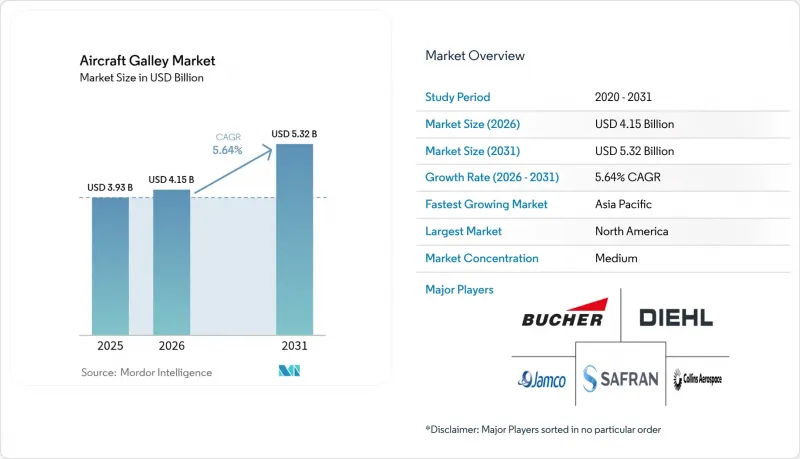
본 보고서는 항공기 유형(단동기, 쌍동기, 비즈니스 제트기), 갤리 인서트 유형(전동 인서트, 비전동 인서트), 설치 형태(라인 핏, 레트로핏), 소재(알루미늄, 복합재료 및 열가소성 수지, 기타),지역(북미, 유럽, 아시아태평양, 기타)별로 세분화되어 있습니다. 시장 전망은 금액(달러) 기준으로 제시되어 있습니다.
세계의 항공기 갤리 시장 동향 및 인사이트
경량 복합재료 및 열가소성 플라스틱으로 제작된 갤리 구조로의 전환
탄소섬유 강화 플라스틱 및 첨단 열가소성 플라스틱으로 제조된 객실용 장비는 기존의 알루미늄 장비 세트에 비해 20-30% 경량화되어, 항공사의 각 항공편별 연료 소비량을 절감합니다. 각 항공사가 전체 기단의 CO2 배출량 감축을 목표로 하는 가운데, 운영 비용 절감은 환경 목표 달성과도 밀접하게 연결되어 있습니다. 또한, 프리미엄 객실을 운영하는 항공사들은 디자인상의 유연성 측면에서 복합 소재를 높이 평가하고 있으며, 브랜드 이미지 통합, 생체 모방형 파티션, 조각품 같은 형태의 셀프 서비스 카운터 등을 구현함으로써 승객과의 접점을 확대되고 있습니다. 방화 시험, 원자재비 급등, 오토클레이브 처리 능력의 제한 등이 도입을 가로막고 있습니다. 그러나 각 OEM 업체의 로드맵에는 더욱 경량화된 갤리가 표준 사양으로 포함되고 있어, 항공기 갤리 장비 시장에서 더 이상 되돌릴 수 없는 변화가 진행되고 있음을 보여줍니다.
신형 단일 통로 항공기 프로그램에서의 스마트 갤리 인서트 수요 증가
최신 세대의 오븐, 칠러, 음료 제조기에는 성능 데이터를 객실 및 지상 포털로 스트리밍하는 IoT 센서가 탑재되어 있습니다. 콜린스 에어로스페이스(Collins Aerospace)의 커넥티드 갤리 스위트(Connected Galley Suite)는 AI 어시스턴트와 연동하여 승무원에게 재고 부족을 알리고 서비스 순서를 최적화함으로써, 예정에 없던 정비 발생을 최대 15%까지 줄여줍니다. 에어버스(Airbus)의 ‘Skywise’ 환경은 이러한 기기를 객실 전체의 데이터 패브릭에 더욱 통합하여, 운항사에 예측적 인사이트력을 제공하는 동시에 턴어라운드 시간을 단축합니다. 이러한 스마트 갤리를 도입하는 항공사는 부가 매출을 확대하는 동시에 전체 수명 주기 동안의 지원 비용을 절감할 수 있습니다. 이러한 이점은 전체 기단에 걸친 디지털 개조를 가속화할 것입니다.
혁신적인 갤리 구조 설계에 따른 긴 인증 과정
갤리의 구조는 ICAO의 객실 안전 프로토콜을 준수하는 엄격한 가연성, 감압 및 대피 경로에 관한 시험을 통과해야 합니다. 새로운 복합재 칸막이와 통합형 조명 레이아웃은 인증 절차를 30개월로 연장하는 경우가 많아, 자본을 묶어두고 취항을 지연시키는 원인이 됩니다. 이 과정은 규제에 대한 깊은 전문 지식을 갖춘 기존 기업에 유리하게 작용하며, 혁신적인 개념을 제시하는 스타트업 기업에게는 장벽이 되고 있습니다. 항공사들은 개조로 인한 운항 중단 기간을 계획할 때 이러한 위험을 고려하기 때문에 차세대 갤리 도입 속도가 둔화되고 있습니다.
부문별 분석
단일 통로 기종에 기인한 항공기 갤리 시장 규모는 2025년 매출의 61.05%를 차지했습니다. B737 MAX 및 A320neo의 생산이 조립 라인을 활발하게 가동시키며, 2031년까지의 연평균 성장률(CAGR)을 4.49%로 끌어올리고 있습니다. 각 항공사가 고빈도 노선의 턴어라운드 시간을 최적화하기 위해, 콤팩트한 설치 면적, 모듈식 인서트, 경량 카트가 사양의 주류를 이루고 있습니다. 이중 통로형 항공기의 갤리 장비 시장 점유율은 현재로서는 여전히 낮은 수준입니다. 그러나 B787-9, A350-900, B777-9의 인도에 힘입어 연평균 성장률(CAGR) 6.13%로 확대되고 있습니다. 이 기종들에는 더 큰 냉장 용량과 디지털 진단 기능을 갖춘 프리미엄 서비스용 갤리가 탑재되어 있습니다. 비즈니스 제트기 시장은 틈새 시장이지만 수익성이 높은 시장으로, 맞춤형 합판, 유도 가열 레인지, 바리스타 모듈 등이 기체당 세트 기준으로 높은 이익률을 창출하고 있습니다.
2세대 협폭기 객실에서는 전방 갤리에 인접한 셀프 서비스식 팬트리가 점점 더 많이 채택되면서 애프터마켓에서 새로운 가능성을 창출하고 있습니다. 장거리 4인 승무원 편에서는 운항사가 서비스 주기를 단축하고 승무원의 피로를 줄여주는 인체공학적인 레이아웃을 우선시하고 있습니다. VIP 항공기 제조업체들은 민용기 프로그램에서 얻은 노하우를 대리석 질감의 표면이나 일렉트로크로믹 디스펜서와 같은 고급스러운 소재에 적용하고 있으며, 이러한 요소들은 이후 양산기용 카탈로그에도 반영되어 항공기 갤리 장비 시장의 지속적인 혁신을 주도하고 있습니다.
2025년에는 전기식 인서트가 전 세계 출하량의 67.40%를 차지했으며, 이는 항공사들이 기내 전력 분배 시스템과 통합된 전력 효율이 뛰어난 오븐, 에스프레소 머신, 칠러를 선호하는 경향을 반영합니다. 이 분야는 연평균 성장률(CAGR) 6.58%를 기록하며, 일부 구형 기종에서 여전히 사용되고 있는 기계 구동식 및 프로판식 기기를 훨씬 능가하고 있습니다. 전기식 아키텍처를 통해 실시간 에너지 모니터링 및 지능형 부하 차단이 가능해지며, 사용 피크 시간대에도 시스템의 내결함성이 확보됩니다. 각 OEM 업체들이 ‘모어 일렉트릭(More Electric)’ 항공기 컨셉을 추구하는 가운데, 인증된 인서트 공급업체들은 커넥티드 가전제품을 표준 사양으로 자리매김하며 항공기 갤리 장비 시장에서 전기식 솔루션의 점유율을 확대되고 있습니다.
기계식 인서트는 개조 예산이 제한적이거나 객실 전원 업그레이드로 인해 가동 중단 시간이 길어질 우려가 있는 경우에 여전히 사용되고 있습니다. 하지만 예비 부품 비용 상승과 규제상 탄소 배출 목표에 따라 총 소유 비용(TCO) 측면에서 전동화된 대체품으로의 전환이 진행되고 있습니다. 리스 회사는 현재 디지털 인서트를 반납 조건에 포함시키고 있으며, 이를 통해 전환이 더욱 정착되어 항공기 갤리 장비 시장 전체의 지속적인 성장을 뒷받침하고 있습니다.
지역별 분석
북미는 대규모 객실 개조 예산과 보잉사의 최종 조립 라인과의 근접성에 힘입어 2025년 매출 점유율 31.30%를 차지하며 1위를 차지했습니다. 이 지역의 혁신적인 갤리 생태계의 조기 도입과 FAA의 엄격한 감독은 개조 실적이 풍부한 공급업체에 유리하게 작용하고 있습니다.
한편, 아시아태평양은 중산층의 여행 수요 증가로 인해 항공기 증편이 촉진되고 현지 MRO 허브가 급증함에 따라 6.18%라는 가장 높은 연평균 성장률(CAGR)을 기록하고 있습니다. 중국의 항공기 제조업체들은 전 세계의 인서트 벤더와 제휴하여 공급의 현지화를 추진하고 있으며, 이로 인해 해당 지역의 항공기 갤리 장비 시장 규모가 확대되고 있습니다.
유럽은 기술적 리더십을 유지하고 있으며, EASA의 로드맵에 따라 저탄소 소재 및 순환 경제 기반의 객실 솔루션에 대한 연구 개발을 추진하고 있습니다. 중동의 항공사들은 대륙 간 주요 노선에서 ‘슈퍼 커넥터’로서의 위상을 추구하는 과정에서 프리미엄 갤리 수요를 견인하고 있는 반면, 아프리카의 신흥 항공사들은 높은 연료비를 상쇄하기 위해 경량화를 중시한 기체를 도입하고 있습니다. 이러한 동향으로 인해 항공기 갤리 장비 시장은 지리적으로 분산된 성장 패턴을 보이고 있습니다.
기타 혜택 :
- 엑셀 형식 시장 예측(ME) 시트
- 3개월간의 애널리스트 지원
자주 묻는 질문
목차
제1장 서론
제2장 조사 방법
제3장 주요 요약
제4장 시장 구도
제5장 시장 규모 및 성장 예측
제6장 경쟁 구도
제7장 시장 기회 및 향후 전망
KTH 26.08.28According to Mordor Intelligence, aircraft galley market size in 2026 is estimated at USD 4.15 billion, growing from 2025 value of USD 3.93 billion with 2031 projections showing USD 5.32 billion, growing at 5.64% CAGR over 2026-2031.
This report is Segmented by Aircraft Type (Single-Aisle, Twin-Aisle, and Business Jets), Galley Insert Type (Electric Inserts and Non-Electric Inserts), Fit (Linefit and Retrofit), Material (Aluminum, Composites and Thermoplastics, and Others), and Geography (North America, Europe, Asia-Pacific, and More). The Market Forecasts are Provided in Terms of Value (USD).
Global Aircraft Galley Market Trends and Insights
Shift Toward Lightweight Composite and Thermoplastic Galley Structures
Cabin monuments fabricated from carbon-fiber reinforced plastics and advanced thermoplastics trim 20-30% off legacy aluminum ship-sets, cutting airline fuel burn on every cycle. Operating-cost relief dovetails with environmental targets as carriers chase fleet-wide CO2 reductions. Premium cabin operators also prize composites for their design flexibility, enabling integrated branding, bionic partitions, and sculpted self-service counters that amplify passenger touch-points. Fire-safety testing, higher raw material outlays, and limited autoclave capacity temper adoption. However, OEM roadmaps now bundle lighter galleys as the default, signaling an irreversible shift in the aircraft galley equipment market.
Rising Demand for Smart Galley Inserts in New Single-Aisle Aircraft Programs
The latest generation of ovens, chillers, and beverage makers embeds IoT sensors that stream performance data to cabin and ground portals. Collins Aerospace's connected galley suite links to an AI assistant that alerts crews to inventory gaps and optimizes service sequencing, reducing unscheduled maintenance events by up to 15%. Airbus's Skywise environment further stitches these appliances into a cabinwide data fabric, giving operators predictive insights and shortening turn times. Airlines deploying such smart galleys unlock higher ancillary sales while lowering lifetime support costs-an advantage set to accelerate fleet-wide digital retrofits.
Long Certification Timelines for Innovative Galley Monument Designs
Galley structures must clear rigorous flammability, decompression, and evacuation-path testing governed by ICAO cabin safety protocols. Novel composite partitions or integrated lighting layouts often extend certification loops to 30 months, tying up capital and delaying entry into service. The process advantages incumbents with deep regulatory expertise, creating a barrier for start-ups offering disruptive concepts. Airlines weigh these risks when scheduling retrofit downtime, slowing the cadence of next-gen galley roll-outs.
Other drivers and restraints analyzed in the detailed report include:
- Widebody Fleet Renewals Driving Adoption of Premium-Class Service Galleys
- Growth in Airline Ancillary Revenue Models Supporting Self-Service Galley Modules
- High Raw Material Costs for Aerospace-Grade Composites
For complete list of drivers and restraints, kindly check the Table Of Contents.
Segment Analysis
The aircraft galley market size attributed to single-aisle platforms accounted for 61.05% of 2025 revenue. B737 MAX and A320neo output keeps assembly lines buzzing, anchoring a 4.49% CAGR through 2031. Compact monument footprints, modular inserts, and lightweight carts dominate specifications as airlines optimize turnaround times on high-cycle routes. The aircraft galley equipment market share for twin-aisles remains smaller today. Still, it is expanding at a 6.13% CAGR due to the deliveries of the B787-9, A350-900, and B777-9, which feature premium-service galleys with larger chilled volumes and digital diagnostics. Business jet demand is a niche yet lucrative market, with bespoke veneers, induction cooktops, and barista modules generating higher margins per ship-set.
Second-generation narrowbody cabins are increasingly featuring self-service pantries adjacent to forward galleys, creating new aftermarket potential. On long-haul quad-crew missions, operators prioritize ergonomic layouts that shorten service cycles and reduce fatigue. VIP airframers translate lessons from commercial programs into high-touch materials-marble-look surfaces, electrochromic dispensers-that later filter back into linefit catalogues, driving continuous innovation in the aircraft galley equipment market.
Electric inserts represented 67.40% of global shipments in 2025, reflecting airlines' tilt toward power-efficient ovens, espresso machines, and chillers that integrate with cabin-power distribution systems. This cohort is tracking a 6.58% CAGR, dwarfing mechanically driven or propane-based equipment still used by select legacy fleets. Electric architectures enable real-time energy monitoring and intelligent load shedding, ensuring system resilience during peak usage. As OEMs pursue more-electric aircraft concepts, certified insert suppliers position connected appliances as standard, strengthening the aircraft galley equipment market share of electric solutions.
Mechanical inserts persist where retrofit budgets are constrained or cabin-power upgrades would extend downtime. Still, rising spare-parts costs and regulatory carbon targets are tilting total-cost-of-ownership math toward electrified replacements. Leasing companies now bundle digital inserts into return-condition clauses, further normalizing the transition and supporting sustained growth across the aircraft galley equipment market.
Complete Report Scope:
- By Aircraft Type
- Single-Aisle
- Twin-Aisle
- Business Jets
- By Galley Insert Type
- Electric Inserts
- Non-Electric Inserts
- By Fit
- Linefit
- Retrofit
- By Material
- Aluminum
- Composites and Thermoplastics
- Others
- By Geography
- North America
- United States
- Canada
- Mexico
- Europe
- United Kingdom
- France
- Germany
- Spain
- Rest of Europe
- Asia-Pacific
- China
- India
- Japan
- South Korea
- Rest of Asia-Pacific
- South America
- Brazil
- Rest of South America
- Middle East and Africa
- Middle East
- United Arab Emirates
- Saudi Arabia
- Rest of Middle East
- Africa
- South Africa
- Rest of Africa
- Middle East
- North America
Geography Analysis
North America led the 2025 revenue table at 31.30%, buoyed by large cabin-upgrade budgets and proximity to Boeing's final assembly lines. The region's early adoption of innovative galley ecosystems and stringent FAA oversight favors suppliers with deep retrofit credentials.
Asia-Pacific, however, is charting the fastest 6.18% CAGR as rising middle-class travel stimulates fleet additions and local MRO hubs proliferate. Chinese airframers partner with global insert vendors to localize supply, broadening the regional aircraft galley equipment market size.
Europe maintains a technology leadership posture, anchoring R&D into low-carbon materials and circular-economy cabin solutions aligned with EASA roadmaps. Middle East carriers fuel premium-galley demand as they chase super-connector status on intercontinental trunk routes, while Africa's nascent fleets adopt lightweight monuments to offset high fuel costs. These dynamics ensure a geographically diversified growth pattern for the aircraft galley equipment market.
- Safran SA
- Collins Aerospace (RTX Corporation)
- Bucher Leichtbau AG
- JAMCO Corporation
- Diehl Stiftung & Co. KG
- Aerolux Ltd.
- AVIC Cabin Systems Limited
- Korita Aviation (Direct Aviation)
- EnCore Corporate, Inc. (The Boeing Company)
- Egret Aviation Co., Ltd.
- Miller Fabrication & Welding, Inc.
- Dynamo Aviation, Inc.
Additional Benefits:
- The market estimate (ME) sheet in Excel format
- 3 months of analyst support
TABLE OF CONTENTS
1 INTRODUCTION
- 1.1 Study Assumptions and Market Definition
- 1.2 Scope of the Study
2 RESEARCH METHODOLOGY
3 EXECUTIVE SUMMARY
4 MARKET LANDSCAPE
- 4.1 Market Overview
- 4.2 Market Drivers
- 4.2.1 Shift toward lightweight composite and thermoplastic galley structures
- 4.2.2 Rising demand for smart galley inserts in new single-aisle aircraft programs
- 4.2.3 Widebody fleet renewals driving adoption of premium-class service galleys
- 4.2.4 Growth in airline ancillary revenue models supporting self-service galley modules
- 4.2.5 Regulatory pressure to implement cabin waste segregation solutions
- 4.2.6 Electrification roadmaps driving the need for load-shedding compatible galley appliances
- 4.3 Market Restraints
- 4.3.1 Long certification timelines for innovative galley monument designs
- 4.3.2 High raw material costs for aerospace-grade composites
- 4.3.3 Supply chain concentration among a small number of Tier-1 galley manufacturers
- 4.3.4 Deferral of retrofit programs due to airline cash flow volatility
- 4.4 Value Chain Analysis
- 4.5 Regulatory Landscape
- 4.6 Technological Outlook
- 4.7 Porter's Five Forces Analysis
- 4.7.1 Bargaining Power of Buyers
- 4.7.2 Bargaining Power of Suppliers
- 4.7.3 Threat of New Entrants
- 4.7.4 Threat of Substitutes
- 4.7.5 Intensity of Competitive Rivalry
5 MARKET SIZE AND GROWTH FORECASTS (VALUE)
- 5.1 By Aircraft Type
- 5.1.1 Single-Aisle
- 5.1.2 Twin-Aisle
- 5.1.3 Business Jets
- 5.2 By Galley Insert Type
- 5.2.1 Electric Inserts
- 5.2.2 Non-Electric Inserts
- 5.3 By Fit
- 5.3.1 Linefit
- 5.3.2 Retrofit
- 5.4 By Material
- 5.4.1 Aluminum
- 5.4.2 Composites and Thermoplastics
- 5.4.3 Others
- 5.5 By Geography
- 5.5.1 North America
- 5.5.1.1 United States
- 5.5.1.2 Canada
- 5.5.1.3 Mexico
- 5.5.2 Europe
- 5.5.2.1 United Kingdom
- 5.5.2.2 France
- 5.5.2.3 Germany
- 5.5.2.4 Spain
- 5.5.2.5 Rest of Europe
- 5.5.3 Asia-Pacific
- 5.5.3.1 China
- 5.5.3.2 India
- 5.5.3.3 Japan
- 5.5.3.4 South Korea
- 5.5.3.5 Rest of Asia-Pacific
- 5.5.4 South America
- 5.5.4.1 Brazil
- 5.5.4.2 Rest of South America
- 5.5.5 Middle East and Africa
- 5.5.5.1 Middle East
- 5.5.5.1.1 United Arab Emirates
- 5.5.5.1.2 Saudi Arabia
- 5.5.5.1.3 Rest of Middle East
- 5.5.5.2 Africa
- 5.5.5.2.1 South Africa
- 5.5.5.2.2 Rest of Africa
- 5.5.5.1 Middle East
- 5.5.1 North America
6 COMPETITIVE LANDSCAPE
- 6.1 Market Concentration
- 6.2 Strategic Moves
- 6.3 Market Share Analysis
- 6.4 Company Profiles (includes Global level Overview, Market level overview, Core Segments, Financials as available, Strategic Information, Market Rank/Share, Products and Services, Recent Developments)
- 6.4.1 Safran SA
- 6.4.2 Collins Aerospace (RTX Corporation)
- 6.4.3 Bucher Leichtbau AG
- 6.4.4 JAMCO Corporation
- 6.4.5 Diehl Stiftung & Co. KG
- 6.4.6 Aerolux Ltd.
- 6.4.7 AVIC Cabin Systems Limited
- 6.4.8 Korita Aviation (Direct Aviation)
- 6.4.9 EnCore Corporate, Inc. (The Boeing Company)
- 6.4.10 Egret Aviation Co., Ltd.
- 6.4.11 Miller Fabrication & Welding, Inc.
- 6.4.12 Dynamo Aviation, Inc.
7 MARKET OPPORTUNITIES AND FUTURE OUTLOOK
- 7.1 White-space and Unmet-Need Assessment


