

|
시장보고서
상품코드
2114464
신장 투석 장비 : 시장 점유율 분석, 업계 동향 및 통계, 성장 예측(2026-2031년)Global Renal Dialysis Equipment - Market Share Analysis, Industry Trends & Statistics, Growth Forecasts (2026 - 2031) |
||||||
 Mordor Intelligence
Mordor Intelligence에 의하면, 신장 투석 장비 시장 규모는 2025년 224억 달러로 평가되었습니다. 2026년에는 235억 6,000만 달러로 확대되어 2026년부터 2031년에 걸쳐 CAGR 5.18%로 성장을 지속하여, 2031년에는 303억 3,000만 달러에 이를 것으로 예측됩니다.
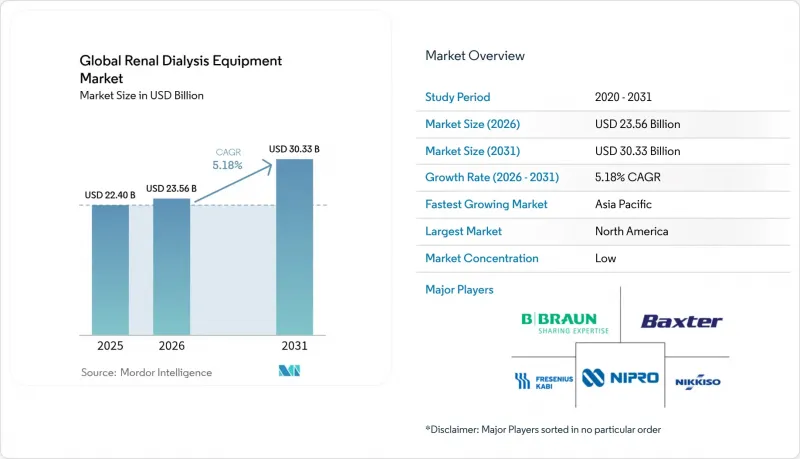
본 보고서에서는 업계를 제품 유형별(혈액투석(HD) 장치, 복막투석(PD) 장치 등), 용도별(혈액투석, 복막투석), 최종 사용자별(투석 센터, 재택 치료), 지역별로 분류하고 있습니다. 시장 규모 및 전망은 금액(달러)으로 제시되어 있습니다.
세계의 신장 투석 장비 시장 동향 및 인사이트
복막투석에 대한 수요 증가
임상적 증거를 통해 복막투석의 생존율이 시설 내 혈액투석과 동등하다는 것이 확인되고, 재택 치료를 받는 환자의 감염 위험이 낮다는 점이 강조됨에 따라 복막투석 이용이 증가하고 있습니다. 미국 신장 데이터 시스템(USRDS) 보고서에 따르면, 메디케어의 ‘2025년 ESRD 치료 선택지 모델’에 따른 인센티브에 힘입어 2012년부터 2022년까지 재택 투석 신규 시작 건수가 70% 급증했습니다. 라틴아메리카에서도 이러한 추세가 나타나고 있으며, 멕시코는 전 세계 복막투석 환자 수의 4분의 1을 차지하고 있습니다. 그러나 외과적 훈련 및 환자 교육의 부족으로 인한 접근성 격차는 일부 지역에서 여전히 남아 있습니다. 현재, 임상 학회는 도입률을 높이기 위해 조기 투석법에 대한 교육을 권장하고 있으며, 의료기기 제조업체들은 설정 및 모니터링을 간소화하는 자동 사이클러를 출시하고 있습니다.
새로운 투석 제품을 위한 연구개발비 증가
주요 제조업체들은 투석 플랫폼 업그레이드를 위해 수년에 걸친 연구개발 예산을 확보하고 있습니다. 프레제니우스 메디컬 케어(Fresenius Medical Care)는 고용량 혈액투석 여과를 실현하고 구형 장비를 대체하기 위한 ‘5008X’ 시스템에 대한 FDA 승인을 획득했습니다. 박스터(Baxter)에서 새롭게 분사된 신장 치료 사업체인 밴티브(Vantive)는 휴대형 및 이식형 기술의 상용화를 위해 5년간 10억 달러를 투자할 계획입니다. 학술 기관들도 이러한 추세를 뒷받침하고 있습니다. 포츠머스 대학교는 장비 가동 중단 시간을 30% 줄이는 예측 유지보수 알고리즘을 입증한 반면, 서울대학교는 소형 복막투석 장비를 위한 나노전기운동 펌프 개발을 추진하고 있습니다. ‘KidneyX’와 같은 자금 지원 프로그램은 2023년 이후 1,700만 달러를 지원하며, 프로젝트의 안정적인 파이프라인을 확보하고 있습니다.
투석 시술에 수반되는 합병증과 위험
2024년 FDA가 발표한 안전 경고에서는 소아용 회로의 실리콘 튜브에서 유해 화합물이 용출되는 문제가 상세하게 기술되었으며, 이에 따라 신속한 설계 변경 및 소재 교체가 이루어졌습니다(fda.gov). 혈관 접근 부위의 감염은 여전히 입원의 주요 원인이 되고 있으며, CMS의 ESRD 측정 매뉴얼에 따르면 카테터 사용은 동정맥루에 비해 패혈증 발생률이 높은 것으로 나타났습니다. 복막투석에 수반되는 복막염은 감소 추세에 있지만, 교육 기회가 제한적인 의료 현장에서는 여전히 임상의들의 주저를 불러일으키고 있습니다. 이러한 합병증은 치료 비용을 증가시키고 치료 시작을 지연시킬 가능성이 있으며, 그 결과 장비 도입 전체가 지연되는 요인이 되고 있습니다.
부문별 분석
혈액 투석 장비, 수처리 시스템 및 관련 일회용 제품은 수십 년에 걸친 인프라 구축과 임상의들의 익숙함에 힘입어 2025년 신장 투석 장비 시장 점유율의 56.05%를 차지했습니다. 5008X 대용량 혈액투석 여과 장치는 미국의 주요 의료 서비스 제공업체들의 장비 교체를 촉진할 것으로 예상되며, 기존 플랫폼에 대한 지속적인 투자를 시사합니다. 대조적으로, 복막 투석 사이클러는 보험사의 인센티브와 사용자 친화적인 인터페이스의 발전에 힘입어 연평균 성장률(CAGR) 6.42%를 나타낼 것으로 예측됩니다. 원격 텔레메트리 기능을 갖춘 자동 사이클러는 고령자 및 지방 거주 환자들 사이에서 보급이 확대되고 있으며, 새로운 생체 적합성 솔루션 덕분에 복막염 발생률이 감소하고 있습니다. 또한, 농축액 및 용액의 경우, 경구용 인산 결합제를 포괄 지급 대상에 포함시키는 CMS(미국 의료보험서비스센터)의 정책 변경으로 혜택을 보고 있어 부수적인 수익원이 확대되고 있습니다.
복막투석 기기의 성장세가 가장 두드러지는 곳은 멕시코, 중국, 미국이며, 이들 국가에서는 과도기 치료 부서가 환자 후보자들에게 치료법 선택을 안내하고 있습니다. 플라스틱 혈액 회로 및 카트리지 공급망의 긴축으로 인해 여러 공급처로부터 조달하는 전략의 필요성이 부각되었으나, 수지 생산 능력을 수직 통합한 제조업체는 동종 업계 타사보다 공급 혼란을 더 잘 극복하고 있습니다. 지속가능성 목표에 따라 재활용 가능한 카트리지로의 전환이 가속화되고 있으며, 연구 컨소시엄에서는 투석기 하우징용 식물 유래 폴리머에 대한 시험이 진행되고 있습니다. 재택 투석 이용이 확대되는 가운데, 사후 서비스와 24시간 기술 지원이 중요한 경쟁 차별화 요인으로 부각되고 있습니다.
지역별 분석
북미는 견실한 보험 환급, 광범위한 클리닉 네트워크, 신속한 의료기기 승인을 바탕으로 2025년 신장 투석 장비 시장에서 43.02%의 점유율을 유지했습니다. 메디케어는 2024년에 만성 신장 질환(CKD) 수급자에게 750억 달러를 지출했으며, CMS는 2025년에 말기 신부전(ESRD)의 기본 단가를 273.82달러로 인상하여 의료 제공업체의 자본 예산이 직접적으로 증가했습니다. 캐나다의 단일 지불자 모델은 전국적인 투석 보험 적용을 보장하는 반면, 멕시코는 지속적인 정책 지원으로 복막 투석 이용률에서 세계를 선도하고 있습니다. 노스캐롤라이나주의 주요 투석기 공장이 허리케인의 영향으로 가동을 중단하면서 공급망의 집중화가 드러났으나, FDA의 긴급 사용 승인으로 대체 조달이 가능해졌고, 제조업체들은 사업 거점의 다각화를 촉진했습니다.
유럽은 두 번째로 큰 규모를 자랑하는 지역으로, 절수 및 저폐기물형 시스템을 권장하는 엄격한 환경 지침이 특징입니다. 독일, 프랑스, 영국의 국민건강서비스(NHS)는 모든 사람에게 투석 접근성을 보장하고 있으며, 유럽신장학회는 품질 기준의 조화를 도모하기 위해 국경을 초월한 임상 지침 수립을 추진하고 있습니다. 이탈리아 신장학회는 2024년에 10단계로 구성된 친환경 프레임워크를 발표하고, 투석기 재처리 및 진료소 내 재생에너지 도입을 장려하고 있습니다. ISO 23500 수질 기준을 AAMI 가이드라인에 부합하도록 규제를 개정함에 따라, 각 공급업체들은 이미 도입된 모든 장비에 대해 여과 모듈 업그레이드를 실시해야 하는 상황에 직면해 있습니다.
아시아태평양은 연평균 성장률(CAGR)이 6.86%로 예측되어 가장 빠르게 성장하고 있는 지역입니다. 일본은 세계 최고 수준의 말기 신부전(ESRD) 유병률을 기록하고 있으며, 주 3회의 시설 내 혈액투석에 대해 충실한 보험 급여 제도를 유지하고 있습니다. 중국과 인도에서는 66%의 접근성 격차가 존재하며, 이것이 가장 큰 잠재 수요층을 형성하고 있습니다. 정부 주도의 보험 적용 확대, 투석 체인에 대한 사모펀드 투자, 그리고 농촌 지역 의료 서비스 제공을 목적으로 한 민관 파트너십을 통해 이러한 격차는 점차 줄어들고 있습니다. 호주와 한국은 거의 전 국민을 대상으로 하는 의료보험 제도를 갖추고 있으며, 원격 모니터링 기능이 탑재된 재택 투석 시스템을 조기에 도입한 국가들입니다. 다국적 기업들은 가격에 민감한 부문 수요에 부응하고 조달 입찰 자격을 얻기 위해 현지 조립 공장을 점점 더 많이 설립하고 있습니다.
기타 혜택 :
- 엑셀 형식 시장 예측(ME) 시트
- 3개월간의 애널리스트 지원
자주 묻는 질문
목차
제1장 서론
제2장 조사 방법
제3장 주요 요약
제4장 시장 구도
제5장 시장 규모 및 성장 예측
제6장 경쟁 구도
제7장 시장 기회 및 향후 전망
KTH 26.08.28According to Mordor Intelligence, the renal dialysis equipment market size is expected to grow from USD 22.40 billion in 2025 to USD 23.56 billion in 2026 and is forecast to reach USD 30.33 billion by 2031 at 5.18% CAGR over 2026-2031.
This report Segments the Industry Into by Product Type (Hemodialysis (HD) Equipment, Peritoneal Dialysis (PD) Equipment, and More), by Application (Hemodialysis, Peritoneal Dialysis), by End User (In-Center Dialysis Settings, Home Care Settings), and Geography. The Market Sizes and Forecasts are Provided in Terms of Value (USD).
Global Renal Dialysis Equipment Market Trends and Insights
Growing Demand for Peritoneal Dialysis
Peritoneal dialysis use is rising as clinical evidence confirms survival rates comparable to in-center hemodialysis and highlights lower infection exposure for patients treated at home. The United States Renal Data System (USRDS) reported a 70% jump in incident home-dialysis starts between 2012 and 2022, supported by Medicare's 2025 ESRD Treatment Choices Model incentives . Latin America illustrates the trend, with Mexico accounting for one-quarter of the world's peritoneal population. Nonetheless, access gaps driven by limited surgical training and patient education persist in several regions. Clinical societies now recommend early modality education to lift adoption, and device makers are launching automated cyclers that simplify set-up and monitoring.
Growth in R&D Expenditure for New Dialysis Products
Top manufacturers have earmarked multi-year R&D budgets to upgrade dialysis platforms. Fresenius Medical Care secured FDA clearance for its 5008X system, which delivers high-volume hemodiafiltration and targets replacement of legacy machines . Vantive, the newly spun-out Baxter kidney-care entity, plans USD 1 billion of investment over five years to commercialize portable and implantable technologies. Academic groups add momentum: the University of Portsmouth demonstrated predictive-maintenance algorithms that cut machine downtime by 30%, while Seoul National University is advancing nano-electrokinetic pumps for compact peritoneal units. Funding programs such as KidneyX have awarded USD 17 million since 2023, ensuring a steady pipeline of projects.
Complications & Risks Associated with Dialysis Procedures
Safety alerts issued by the FDA in 2024 detailed toxic-compound leaching from silicone tubing in pediatric circuits, prompting rapid redesigns and material substitutions fda.gov. Vascular-access infection remains a leading cause of hospitalization; the CMS ESRD Measures Manual showed that catheter use correlated with higher sepsis rates than arteriovenous fistulas. Peritoneal dialysis peritonitis is declining but continues to deter clinicians in settings with limited training. These complications inflate treatment costs and can delay therapy initiation, slowing overall equipment uptake.
Other drivers and restraints analyzed in the detailed report include:
- Increasing Prevalence of Chronic Kidney Disease (CKD)
- Adoption of Portable Sorbent-Based Dialysis Systems
- Reimbursement Limitations in Emerging Markets
For complete list of drivers and restraints, kindly check the Table Of Contents.
Segment Analysis
Hemodialysis machines, water-treatment systems, and ancillary disposables accounted for 56.05% of renal dialysis equipment market share in 2025 underpinned by decades of installed infrastructure and clinician familiarity. The 5008X high-volume hemodiafiltration unit is expected to refresh fleets across major U.S. providers, signaling sustained investment in conventional platforms. In contrast, peritoneal dialysis cyclers are forecast to post a 6.42% CAGR, buoyed by payer incentives and advances in user-friendly interfaces. Automated cyclers equipped with remote telemetry are expanding uptake among elderly and rural patients, and new biocompatible solutions are reducing peritonitis rates. Concentrates and solutions also benefit from CMS policy changes that bring oral phosphate binders into the bundled payment, enlarging adjunct revenue streams.
Peritoneal equipment momentum is strongest in Mexico, China, and the United States, where transitional care units guide candidates through modality selection. Supply-chain tightness for plastic bloodlines and cartridges spotlighted the need for multi-source procurement strategies, yet manufacturers with vertically integrated resin capacity are navigating disruptions better than peers. Sustainability targets are accelerating a shift to recyclable cartridges, and research consortia are trialing plant-based polymers for dialyzer housings. As home uptake rises, after-sales service and 24-hour technical support emerge as key competitive differentiators.
Complete Report Scope:
- By Product Type
- Hemodialysis (HD) Equipment
- Dialysis Machines
- Dialyzers
- Bloodlines & Tubing Sets
- Water Treatment Systems
- Peritoneal Dialysis (PD) Equipment
- Automated PD Cyclers
- Portable PD Devices
- Concentrates & Solutions
- Other Accessories
- Hemodialysis (HD) Equipment
- By Application
- Hemodialysis
- Conventional HD
- Short-Daily HD
- Nocturnal HD
- Peritoneal Dialysis
- CAPD
- APD
- Hemodialysis
- By End User
- In-Center Dialysis Settings
- Home-Care Settings
- By Geography
- North America
- United States
- Canada
- Mexico
- Europe
- Germany
- United Kingdom
- France
- Italy
- Spain
- Rest of Europe
- Asia-Pacific
- China
- Japan
- India
- Australia
- South Korea
- Rest of Asia-Pacific
- Middle East & Africa
- GCC
- South Africa
- Rest of Middle East & Africa
- South America
- Brazil
- Argentina
- Rest of South America
- North America
Geography Analysis
North America retained 43.02% of the renal dialysis equipment market in 2025 thanks to robust reimbursement, extensive clinic networks, and rapid device approvals. Medicare spent USD 75 billion on CKD beneficiaries in 2024, and CMS raised the ESRD base rate to USD 273.82 in 2025, directly boosting provider capital budgets . Canada's single-payer model guarantees nationwide dialysis coverage, while Mexico leads peritoneal usage globally due to sustained policy backing. Although Hurricane-related disruptions to a key North Carolina dialyzer plant exposed supply-chain concentration, FDA emergency-use authorizations enabled alternative sourcing, prompting manufacturers to diversify footprints.
Europe constitutes the second-largest region, characterized by strict environmental directives that favor low-water, low-waste systems. National health services in Germany, France, and the United Kingdom fund universal access, and the European Renal Association promotes cross-border clinical guidelines to harmonize quality standards. Italy's nephrology society published a ten-step green framework in 2024, encouraging dialyzer reprocessing and renewable-energy adoption within clinics. Regulatory updates aligning ISO 23500 water-purity limits with AAMI guidelines are pushing vendors to upgrade filtration modules across the installed base.
Asia-Pacific is the fastest-growing territory at a projected 6.86% CAGR. Japan records the world's highest ESRD prevalence and maintains sophisticated reimbursement for thrice-weekly in-center hemodialysis. China and India face a 66% access gap, representing the largest latent demand pool. Government-led insurance expansions, private-equity investment in dialysis chains, and public-private partnerships for rural outreach are narrowing disparities. Australia and South Korea showcase near-universal coverage and are early adopters of tele-monitored home systems. Multinationals are increasingly establishing localized assembly plants to meet price-sensitive segments and qualify for procurement tenders.
- Fresenius
- Baxter
- Nipro
- B. Braun
- Nikkiso Co. Ltd.
- Asahi Kasei
- Medtronic
- Rockwell Medical
- Teleflex
- Cantel Medical (Medivators)
- Toray Medical Co. Ltd.
- Hemoclean Co. Ltd.
- Quanta Dialysis Technologies
- Outset Medical
- DaVita
- Diaverum AB
- NxStage Medical (Fresenius subsidiary)
- Dialife SA
- Guangdong Biolight Meditech
- Mitra Industries
Additional Benefits:
- The market estimate (ME) sheet in Excel format
- 3 months of analyst support
TABLE OF CONTENTS
1 Introduction
- 1.1 Study Assumptions & Market Definition
- 1.2 Scope of the Study
2 Research Methodology
3 Executive Summary
4 Market Landscape
- 4.1 Market Overview
- 4.2 Market Drivers
- 4.2.1 Growing Demand for Peritoneal Dialysis
- 4.2.2 Growth in R&D Expenditure for New Dialysis Products
- 4.2.3 Increasing Prevalence of Chronic Kidney Disease (CKD)
- 4.2.4 Adoption of Portable Sorbent-Based Dialysis Systems
- 4.2.5 AI-Enabled Predictive Maintenance in Dialysis Machines
- 4.2.6 Net-Zero Water-less Dialysis Technologies
- 4.3 Market Restraints
- 4.3.1 Complications & Risks Associated with Dialysis Procedures
- 4.3.2 Reimbursement Limitations in Emerging Markets
- 4.3.3 Volatile Supply of Medical-grade Polymer Resins
- 4.3.4 Regulatory Scrutiny on Single-Use Plastic Waste
- 4.4 Value / Supply-Chain Analysis
- 4.5 Regulatory Landscape
- 4.6 Technological Outlook
- 4.7 Porter's Five Forces Analysis
- 4.7.1 Threat of New Entrants
- 4.7.2 Bargaining Power of Buyers
- 4.7.3 Bargaining Power of Suppliers
- 4.7.4 Threat of Substitutes
- 4.7.5 Competitive Rivalry
5 Market Size & Growth Forecasts (Value)
- 5.1 By Product Type
- 5.1.1 Hemodialysis (HD) Equipment
- 5.1.1.1 Dialysis Machines
- 5.1.1.2 Dialyzers
- 5.1.1.3 Bloodlines & Tubing Sets
- 5.1.1.4 Water Treatment Systems
- 5.1.2 Peritoneal Dialysis (PD) Equipment
- 5.1.2.1 Automated PD Cyclers
- 5.1.2.2 Portable PD Devices
- 5.1.3 Concentrates & Solutions
- 5.1.4 Other Accessories
- 5.1.1 Hemodialysis (HD) Equipment
- 5.2 By Application
- 5.2.1 Hemodialysis
- 5.2.1.1 Conventional HD
- 5.2.1.2 Short-Daily HD
- 5.2.1.3 Nocturnal HD
- 5.2.2 Peritoneal Dialysis
- 5.2.2.1 CAPD
- 5.2.2.2 APD
- 5.2.1 Hemodialysis
- 5.3 By End User
- 5.3.1 In-Center Dialysis Settings
- 5.3.2 Home-Care Settings
- 5.4 By Geography
- 5.4.1 North America
- 5.4.1.1 United States
- 5.4.1.2 Canada
- 5.4.1.3 Mexico
- 5.4.2 Europe
- 5.4.2.1 Germany
- 5.4.2.2 United Kingdom
- 5.4.2.3 France
- 5.4.2.4 Italy
- 5.4.2.5 Spain
- 5.4.2.6 Rest of Europe
- 5.4.3 Asia-Pacific
- 5.4.3.1 China
- 5.4.3.2 Japan
- 5.4.3.3 India
- 5.4.3.4 Australia
- 5.4.3.5 South Korea
- 5.4.3.6 Rest of Asia-Pacific
- 5.4.4 Middle East & Africa
- 5.4.4.1 GCC
- 5.4.4.2 South Africa
- 5.4.4.3 Rest of Middle East & Africa
- 5.4.5 South America
- 5.4.5.1 Brazil
- 5.4.5.2 Argentina
- 5.4.5.3 Rest of South America
- 5.4.1 North America
6 Competitive Landscape
- 6.1 Market Concentration
- 6.2 Market Share Analysis
- 6.3 Company Profiles (includes Global level Overview, Market level overview, Core Segments, Financials as available, Strategic Information, Market Rank/Share, Products & Services, Recent Developments)
- 6.3.1 Fresenius Medical Care AG & Co. KGaA
- 6.3.2 Baxter International Inc.
- 6.3.3 Nipro Corporation
- 6.3.4 B. Braun Melsungen AG
- 6.3.5 Nikkiso Co. Ltd.
- 6.3.6 Asahi Kasei Corporation
- 6.3.7 Medtronic plc
- 6.3.8 Rockwell Medical Inc.
- 6.3.9 Teleflex Incorporated
- 6.3.10 Cantel Medical (Medivators)
- 6.3.11 Toray Medical Co. Ltd.
- 6.3.12 Hemoclean Co. Ltd.
- 6.3.13 Quanta Dialysis Technologies
- 6.3.14 Outset Medical Inc.
- 6.3.15 DaVita Inc.
- 6.3.16 Diaverum AB
- 6.3.17 NxStage Medical (Fresenius subsidiary)
- 6.3.18 Dialife SA
- 6.3.19 Guangdong Biolight Meditech
- 6.3.20 Mitra Industries
7 Market Opportunities & Future Outlook
- 7.1 White-space & Unmet-Need Assessment


