

|
시장보고서
상품코드
2114481
군용 내비게이션 시스템 : 시장 점유율 분석, 업계 동향 및 통계, 성장 예측(2026-2031년)Military Navigation Systems - Market Share Analysis, Industry Trends & Statistics, Growth Forecasts (2026 - 2031) |
||||||
 Mordor Intelligence
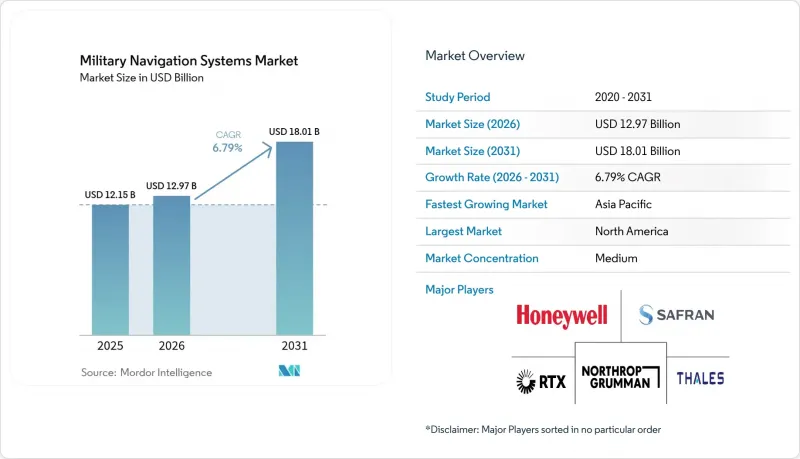
Mordor Intelligence에 의하면, 2026년 군용 내비게이션 시스템 시장 규모는 129억 7,000만 달러로 추정되고 2025년 121억 5,000만 달러에서 확대해, 2031년에는 180억 1,000만 달러에 이를 것으로 예측됩니다.
2026년부터 2031년에 걸쳐 연평균 성장률(CAGR) 6.79%로 성장할 것으로 전망됩니다.
본 보고서는 플랫폼별(항공, 육상, 해상, 우주, 탄약·미사일), 용도별(지휘통제, 정보·감시·정찰, 표적 지정·유도, 수색 및 구조, 기타),구성 요소별(하드웨어, 소프트웨어, 서비스), 지역별(북미, 유럽, 아시아태평양, 기타)로 분류되어 있습니다. 시장 예측은 금액(달러) 기준으로 제시되어 있습니다.
세계의 군용 내비게이션 시스템 시장 동향 및 인사이트
자율형 및 무인 군사 플랫폼의 도입 확대
수상 함정, 무인 항공기(UAV), 무인 지상 차량에는 현재, 조작자의 개입 없이 장기간에 걸쳐 센티미터 단위의 위치 측정 정밀도가 요구되고 있습니다. 미국 해군의 ‘고스트 플리트 오버로드(Ghost Fleet Overlord)’ 시험에서는 GPS를 사용할 수 없는 상태에서 72시간에 걸친 작전을 수행하기 위해서는 시각 관성 오도메트리(VIM)와 통합된 광섬유 자이로가 필요하다는 사실이 입증되었습니다. DARPA의 ‘Squad X’ 로봇은 도시 지역의 ‘캐니언’ 내에서 5미터 미만의 정밀도가 요구되는 유사한 요건을 입증했습니다. 회전식 탄약은 의도적인 방해를 받아도 항로를 유지해야 하므로, 이에 따라 조달 대상이 민수용 GNSS 보드에서 전술급 관성 측정 장치로 전환되고 있습니다. 컴팩트한 케이스에 드리프트가 적은 센서를 탑재할 수 있는 공급업체들은 자율성이 군용 내비게이션 시스템 시장 전반에서 표준 요구 사항이 됨에 따라 수주량이 증가하고 있습니다.
교란·위장 대책 기능을 갖춘 GNSS 내비게이션 시스템의 채택 확대
전자전(EW) 전술이 성숙해짐에 따라 군은 수신기의 내방해성을 강화할 수밖에 없게 되었습니다. 2024년, 갈릴레오의 인증된 OSNMA 메시지를 통해 동지중해에서 민간 항공기를 대상으로 한 스푸핑 공격이 저지되었습니다. GPS III 위성은 현재 3개의 주파수 대역에서 암호화된 M 코드를 전송하고 있지만, 제어 수신 패턴(CRP) 안테나를 갖춘 수신기만이 20 dB의 추가 방해 마진을 확보할 수 있습니다. 레이시온(Raytheon)과 콜린스 에어로스페이스(Collins Aerospace)가 전투기 및 장갑차 개조 시장을 주도하는 한편, 노바텔(Novatel)은 소형 기체 군을 위한 듀얼 주파수 CRPA 안테나를 제공합니다. GPS, 갈릴레오, GLONASS, 베이두를 통합한 멀티 콘스텔레이션 칩으로의 전환에 따라 적대 세력은 4개의 주파수를 동시에 방해해야만 하게 되어, 이로 인해 내장애성이 향상됩니다.
안전하고 암호화된 PNT 기술을 규제하는 엄격한 수출 통제 규정
ITAR(국제무기거래규정)에서는 Y 코드 GPS 수신기 및 고정밀 관성 내비게이션 시스템을 카테고리 XI 품목으로 분류하고 있으며, 이러한 품목의 수출 대부분에는 미국 국무부의 라이선스가 필요합니다. 바세나 협정(Wassenaar Arrangement)의 개정에 따라 드리프트가 0.5°/h 미만인 센서도 규제 대상이 되어, 아시아와 아프리카로의 많은 판매가 차단되고 있습니다. EU 역시 갈릴레오 PRS 하드웨어에 대해 유사한 규제를 적용하고 있습니다. 공급업체는 펌웨어가 다르고 감사를 거친 공급망을 갖춘 민간용과 군용의 별도 생산 라인을 운영해야 하며, 이로 인해 간접비가 증가하고 구매 자격을 갖춘 기업의 범위가 좁아집니다. 규정 준수 대응 자원이 부족한 중소기업은 복잡한 법규를 잘 헤쳐 나갈 수 있는 대기업에 시장을 내주게 될 것입니다.
부문별 분석
우주 부문은 방해 조건 하에서도 타이밍 정확도를 높이는 원자 시계 및 양자 센서의 도입을 배경으로, 2026년부터 2031년에 걸쳐 연평균 성장률(CAGR) 7.44%를 나타낼 것으로 예측됩니다. GPS III 위성에는 하루에 1나노초 미만의 드리프트만 발생하는 루비듐 기준이 탑재되어 있어, 지상에서의 보정 없이도 정밀한 공격이 가능해집니다. 유럽의 ‘갈릴레오 2세대’ 프로그램에서는 안정성이 10배 향상된 수소 마저가 도입됩니다. 2025년에는 항공 플랫폼이 군용 내비게이션 시스템 시장의 40.85%를 차지했으나, 개량 주기가 성숙해짐에 따라 그 성장세는 완만해질 것으로 예측됩니다. 육상 차량의 경우, 상용 가격대에서 1°/h의 드리프트를 실현하는 MEMS IMU가 채택되고 있으며, 선박에서는 장시간 잠수를 가능하게 하기 위해 도플러식 속도계와 결합된 광섬유 자이로스코프가 활용되고 있습니다. 일회용 탄약에는 5,000-2만 달러 상당의 IMU가 탑재되어 있으며, 여기에는 현재 씬 매칭 소프트웨어가 통합되어 있어 종말 유도 시 위성에 대한 의존도가 낮아졌습니다.
무인 항공기(UAV)에서 전기광학 지원형 관성 항법에 대한 관심이 높아짐에 따라 수요가 더욱 다양해지고 있습니다. 미 육군의 ‘퓨처 버티컬 리프트(Future Vertical Lift)’ 프로그램에서는 GPS를 이용할 수 없는 상황에서도 정밀도를 유지할 수 있는 센서 퓨전형 항공 전자 장비가 규정되어 있습니다. 주파수 공존에 관한 국제전기통신연합(ITU)의 규제는 새로운 위성 군집의 설계 선택을 좌우하는 한편, DO-316 규격은 항공기용 수신기의 간섭 내성 임계값을 규정하고 있습니다. 이러한 요인들이 복합적으로 작용하여, 항공기 및 지상 차량이 군용 내비게이션 시스템 시장의 도입 수익 대부분을 차지하고 있음에도 불구하고, 우주 시스템이 혁신의 최전선으로서의 위상을 공고히 하고 있습니다.
지역별 분석
북미는 2025년 매출의 38.25%를 차지했으며, 미국 국방부(DoD)는 PNT 현대화에 연간 18억 달러를 투자하여 GPS III 발사, M-코드 수신기 도입 및 양자 관성 기술 연구에 자금을 지원했습니다. 캐나다는 고위도 지역에서 신호 저하를 완화하는 차세대 수신기를 CF-18의 항공 전자 장비 및 북극해 함정에 사후 장착하기 위해 5억 캐나다 달러(3억 7,000만 달러)를 투자했습니다. 멕시코 수요는 내환경성이 뛰어난 상용 수신기를 사용하는 정찰 드론 및 연안 선박으로 제한되어 있습니다.
아시아태평양은 연평균 성장률(CAGR) 7.62%로 성장하고 있으며, 이는 세계에서 가장 빠른 속도입니다. 중국은 중국 인민해방군(PLA)의 모든 플랫폼에서 북두(BeiDou) 사용을 의무화하고 있는 반면, 인도는 전투기, 장갑차, 항공모함에 NavIC를 통합하고 있습니다. 일본의 7기 위성으로 구성된 QZSS 콘스텔레이션은 1미터 미만의 정확도를 실현하는 보강 신호를 제공하고 있으며, 한국의 KPS는 2027년까지 지역적 자립을 목표로 하고 있습니다. 호주의 다층적 PNT(위치·항법·시간) 전략은 위성과 eLoran, 양자 센서를 결합한 것으로, 인도-태평양 지역 전체로 확산되고 있습니다.
유럽은 갈릴레오 위성군의 혜택을 누리고 있지만, 조달 체계의 분절이라는 과제에 직면해 있습니다. 프랑스는 라팔 전투기에 사프란사의 관성 항법 장치를 채택한 반면, 독일은 유로파이터에 하네웰사를 채택하여 함대 전반에 걸친 규모의 경제가 제한되고 있습니다. 중동에서는 정밀 타격 무기의 비축량을 확대되고 있습니다. 사우디아라비아의 THAAD 구매에는 M-코드 수신기가 포함되어 있으며, UAE는 사프란사와 관성 측정 장치를 공동 개발하고 있습니다. 아프리카는 아직 발전 단계에 있으며, 남아프리카공화국이 기본적인 IMU를 생산하고 있는 것 외에, 사하라 이남 대부분의 군는 시판되는 GNSS 장비를 사용하고 있습니다. 브라질은 남미를 선도하고 있으며, 식생으로 인해 신호가 감쇠되는 정글에서의 임무를 위해 슈퍼 투카노 기체의 업그레이드를 추진하고 있습니다.
기타 혜택 :
- 엑셀 형식 시장 예측(ME) 시트
- 3개월간의 애널리스트 지원
자주 묻는 질문
목차
제1장 서론
제2장 조사 방법
제3장 주요 요약
제4장 시장 구도
제5장 시장 규모 및 성장 예측
제6장 경쟁 구도
제7장 시장 기회 및 향후 전망
KTH 26.08.28According to Mordor Intelligence, the military navigation systems market size in 2026 is estimated at USD 12.97 billion, growing from 2025 value of USD 12.15 billion with 2031 projections showing USD 18.01 billion, growing at 6.79% CAGR over 2026-2031.
This report is Segmented by Platform (Air, Land, Sea, Space, and Munitions and Missiles), Application (Command and Control, Intelligence Surveillance and Reconnaissance, Targeting and Guidance, Search and Rescue, and Others), Component (Hardware, Software, and Services), and Geography (North America, Europe, Asia-Pacific, and More). The Market Forecasts are Provided in Terms of Value (USD).
Global Military Navigation Systems Market Trends and Insights
Growing Deployment of Autonomous and Unmanned Military Platforms
Surface vessels, UAVs, and robotic ground vehicles now require centimeter-grade positioning for extended periods without operator input. The US Navy's Ghost Fleet Overlord trials demonstrated that a 72-hour GPS-denied operation requires fiber-optic gyros integrated with visual-inertial odometry. DARPA's Squad X robots validated similar requirements for sub-5-meter accuracy inside urban canyons. Loitering munitions must stay on course after deliberate jamming, which shifts procurement from consumer GNSS boards to tactical-grade inertial units. Vendors capable of delivering low-drift sensors in compact housings are seeing a rise in orders as autonomy becomes a standard requirement across the military navigation systems market.
Increasing Adoption of Anti-jam and Anti-spoof GNSS Navigation Systems
Electronic warfare (EW) tactics have matured, forcing armed forces to harden their receivers. Galileo's authenticated OSNMA messages blocked spoofing attempts on civil aviation in the Eastern Mediterranean during 2024. GPS III satellites now transmit encrypted M-Code on three bands, yet only receivers with controlled-reception-pattern antennas gain the extra 20 dB jamming margin. Raytheon and Collins Aerospace dominate fighter and armor retrofits, while NovAtel provides dual-frequency CRPA antennas to smaller fleets. The move to multi-constellation chips that blend GPS, Galileo, GLONASS, and BeiDou enhances resilience by forcing adversaries to jam four frequencies simultaneously.
Strict Export-control Regulations Governing Secure and Encrypted PNT Technologies
ITAR classifies Y-code GPS receivers and high-grade inertial systems as Category XI items, which require a US State Department license for most exports. Wassenaar Arrangement amendments now capture sensors with drift better than 0.5°/h, blocking many sales to Asia and Africa. The EU applies similar curbs to Galileo PRS hardware. Vendors must operate separate civilian and military production lines with distinct firmware and audited supply chains, which increases overhead and narrows the pool of eligible buyers. Small firms lacking compliance resources cede ground to primes that can navigate legal complexities.
Other drivers and restraints analyzed in the detailed report include:
- Rising Defense Modernization Spending Across Asia and the Middle East and Africa
- Government Mandates for Assured PNT Capabilities
- Dependence on Limited Supply Chains for Radiation-hardened Electronic Components
For complete list of drivers and restraints, kindly check the Table Of Contents.
Segment Analysis
The space segment is forecasted to grow at a 7.44% CAGR from 2026 to 2031, building on atomic-clock and quantum-sensor deployments that enhance timing accuracy under jamming conditions. The GPS III spacecraft hosts rubidium standards that drift less than one nanosecond per day, enabling precision strikes without ground augmentation. The European Galileo Second Generation program introduces hydrogen masers with ten-fold stability improvements. While air platforms held 40.85% of the military navigation systems market share in 2025, their growth is expected to moderate as retrofit cycles mature. Land vehicles utilize MEMS IMUs, delivering 1°/h drift at commercial price levels, and sea vessels rely on fiber-optic gyroscopes paired with Doppler logs for extended submerged endurance. Disposable munitions embed USD 5,000 to 20,000 IMUs that now integrate scene-matching software, cutting satellite dependencies during terminal guidance.
Growing interest in electro-optic-aided inertial navigation within unmanned aerial vehicles further diversifies demand. The US Army's Future Vertical Lift program specifies sensor-fusion avionics that maintain accuracy when GPS is unavailable. International Telecommunication Union regulations on frequency coexistence drive design choices for new constellations, while DO-316 standards set anti-jam thresholds for aircraft receivers. Together, these factors reinforce space systems as the innovation frontier, even as airborne and land fleets provide the bulk of installed revenue for the military navigation systems market.
Complete Report Scope:
- By Platform
- Air
- Land
- Sea
- Space
- Munitions and Missiles
- By Application
- Command and Control (C2)
- Intelligence, Surveillance and Reconnaissance (ISR)
- Targeting and Guidance
- Search and Rescue (SAR)
- Others
- By Component
- Hardware
- Software
- Services
- By Geography
- North America
- United States
- Canada
- Mexico
- Europe
- United Kingdom
- France
- Germany
- Italy
- Spain
- Rest of Europe
- Asia-Pacific
- China
- India
- Japan
- South Korea
- Rest of Asia-Pacific
- South America
- Brazil
- Argentina
- Rest of South America
- Middle East and Africa
- Middle East
- United Arab Emirates
- Saudi Arabia
- Rest of Middle East
- Africa
- South Africa
- Rest of Africa
- Middle East
- North America
Geography Analysis
North America accounted for 38.25% of 2025 revenue as the US DoD invested USD 1.8 billion annually in PNT modernization, funding GPS III launches, M-Code receiver rollouts, and quantum inertial research. Canada committed CAD 500 million (USD 370 million) to retrofit CF-18 avionics and Arctic vessels with next-generation receivers that mitigate high-latitude signal degradation. Mexico's demand is limited to patrol drones and coastal craft, which use hardened commercial receivers.
The Asia-Pacific region is growing at a 7.62% CAGR, the fastest rate worldwide. China mandates BeiDou across the People's Liberation Army's (PLA's) platforms, while India integrates NavIC into its fighters, armor, and carriers. Japan's seven-satellite QZSS constellation delivers sub-meter augmentation, and South Korea's KPS aims for regional independence by 2027. Australia's layered PNT doctrine combines satellites with eLoran and quantum sensors, echoing across the Indo-Pacific.
Europe benefits from the Galileo constellation yet faces procurement fragmentation. France relies on Safran inertials for the Rafale, while Germany relies on Honeywell for the Eurofighter, limiting cross-fleet economies of scale. The Middle East is expanding its precision-strike arsenals; Saudi Arabia's THAAD purchase included M-Code receivers, and the UAE is co-developing inertial units with Safran. Africa remains nascent, with South Africa producing basic IMUs and most sub-Saharan forces operating commercial GNSS equipment. Brazil leads South America, upgrading Super Tucano aircraft for jungle missions where vegetation attenuates signals
- Northrop Grumman Corporation
- Honeywell International Inc.
- Safran SA
- Thales Group
- RTX Corporation
- Elbit Systems Ltd.
- Lockheed Martin Corporation
- L3Harris Technologies, Inc.
- BAE Systems plc
- Garmin Ltd.
- KVH Industries, Inc.
- CMC Electronics Inc.
- GE Aerospace (General Electric Company)
- Israel Aerospace Industries Ltd.
- Kongsberg Gruppen ASA
- Moog Inc.
- Anschutz GmbH
- Q-CTRL Pty Ltd.
Additional Benefits:
- The market estimate (ME) sheet in Excel format
- 3 months of analyst support
TABLE OF CONTENTS
1 INTRODUCTION
- 1.1 Study Assumptions and Market Definition
- 1.2 Scope of the Study
2 RESEARCH METHODOLOGY
3 EXECUTIVE SUMMARY
4 MARKET LANDSCAPE
- 4.1 Market Overview
- 4.2 Market Drivers
- 4.2.1 Growing deployment of autonomous and unmanned military platforms
- 4.2.2 Increasing adoption of anti-jam and anti-spoof GNSS navigation systems
- 4.2.3 Rising defense modernization spending across Asia and the Middle East and Africa
- 4.2.4 Government mandates for assured PNT capabilities
- 4.2.5 Advancements in quantum and MEMS-based inertial navigation technologies
- 4.2.6 Use of commercial LEO-based PNT constellations to enhance navigation resilience
- 4.3 Market Restraints
- 4.3.1 Strict export-control regulations governing secure and encrypted PNT technologies
- 4.3.2 Dependence on limited supply chains for radiation-hardened electronic components
- 4.3.3 Size, weight, power, and cost limitations in dismounted soldier navigation systems
- 4.3.4 Heightened cyber and electronic warfare threats to space-based navigation infrastructure
- 4.4 Value Chain Analysis
- 4.5 Regulatory Landscape
- 4.6 Technological Outlook
- 4.7 Porter's Five Forces Analysis
- 4.7.1 Bargaining Power of Suppliers
- 4.7.2 Bargaining Power of Buyers
- 4.7.3 Threat of New Entrants
- 4.7.4 Threat of Substitutes
- 4.7.5 Intensity of Competitive Rivalry
5 MARKET SIZE AND GROWTH FORECASTS (VALUE)
- 5.1 By Platform
- 5.1.1 Air
- 5.1.2 Land
- 5.1.3 Sea
- 5.1.4 Space
- 5.1.5 Munitions and Missiles
- 5.2 By Application
- 5.2.1 Command and Control (C2)
- 5.2.2 Intelligence, Surveillance and Reconnaissance (ISR)
- 5.2.3 Targeting and Guidance
- 5.2.4 Search and Rescue (SAR)
- 5.2.5 Others
- 5.3 By Component
- 5.3.1 Hardware
- 5.3.2 Software
- 5.3.3 Services
- 5.4 By Geography
- 5.4.1 North America
- 5.4.1.1 United States
- 5.4.1.2 Canada
- 5.4.1.3 Mexico
- 5.4.2 Europe
- 5.4.2.1 United Kingdom
- 5.4.2.2 France
- 5.4.2.3 Germany
- 5.4.2.4 Italy
- 5.4.2.5 Spain
- 5.4.2.6 Rest of Europe
- 5.4.3 Asia-Pacific
- 5.4.3.1 China
- 5.4.3.2 India
- 5.4.3.3 Japan
- 5.4.3.4 South Korea
- 5.4.3.5 Rest of Asia-Pacific
- 5.4.4 South America
- 5.4.4.1 Brazil
- 5.4.4.2 Argentina
- 5.4.4.3 Rest of South America
- 5.4.5 Middle East and Africa
- 5.4.5.1 Middle East
- 5.4.5.1.1 United Arab Emirates
- 5.4.5.1.2 Saudi Arabia
- 5.4.5.1.3 Rest of Middle East
- 5.4.5.2 Africa
- 5.4.5.2.1 South Africa
- 5.4.5.2.2 Rest of Africa
- 5.4.5.1 Middle East
- 5.4.1 North America
6 COMPETITIVE LANDSCAPE
- 6.1 Market Concentration
- 6.2 Strategic Moves
- 6.3 Market Share Analysis
- 6.4 Company Profiles (includes Global level Overview, Market level overview, Core Segments, Financials as available, Strategic Information, Market Rank/Share for key companies, Products and Services, and Recent Developments)
- 6.4.1 Northrop Grumman Corporation
- 6.4.2 Honeywell International Inc.
- 6.4.3 Safran SA
- 6.4.4 Thales Group
- 6.4.5 RTX Corporation
- 6.4.6 Elbit Systems Ltd.
- 6.4.7 Lockheed Martin Corporation
- 6.4.8 L3Harris Technologies, Inc.
- 6.4.9 BAE Systems plc
- 6.4.10 Garmin Ltd.
- 6.4.11 KVH Industries, Inc.
- 6.4.12 CMC Electronics Inc.
- 6.4.13 GE Aerospace (General Electric Company)
- 6.4.14 Israel Aerospace Industries Ltd.
- 6.4.15 Kongsberg Gruppen ASA
- 6.4.16 Moog Inc.
- 6.4.17 Anschutz GmbH
- 6.4.18 Q-CTRL Pty Ltd.
7 MARKET OPPORTUNITIES AND FUTURE OUTLOOK
- 7.1 White-space and Unmet-Need Assessment


