

|
시장보고서
상품코드
2114485
융착 접속기 : 시장 점유율 분석, 업계 동향 및 통계, 성장 예측(2026-2031년)Fusion Splicer - Market Share Analysis, Industry Trends & Statistics, Growth Forecasts (2026 - 2031) |
||||||
 Mordor Intelligence
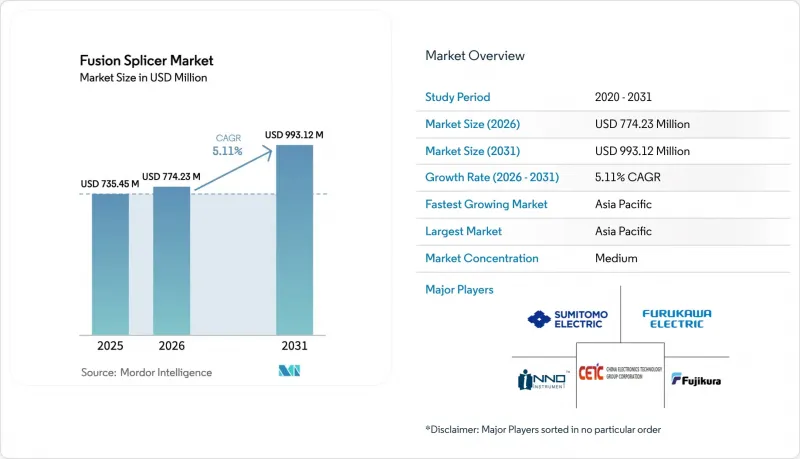
Mordor Intelligence에 의하면, 융착 접속기 시장 규모는 2025년 7억 3,545만 달러로 평가되었습니다. 2026년에는 7억 7,423만 달러로 확대되어 2026년부터 2031년에 걸쳐 CAGR 5.11%로 성장을 지속하여, 2031년에는 9억 9,312만 달러에 이를 것으로 예측됩니다.
본 보고서는 정렬 유형(코어 정렬, 클래드 정렬), 제품 유형(단일 광섬유, 리본 광섬유, 특수 광섬유), 최종 사용자(통신 사업자, 데이터센터, 계약업체 및 시스템 통합사업자, 항공우주 및 방위),용도(통신, 케이블 TV, 구내·기업, 조사·특수 용도), 지역별로 분류되어 있습니다. 시장 예측은 금액(달러) 기준으로 제시되어 있습니다.
세계의 융착 접속기 시장 동향 및 인사이트
하이퍼스케일 데이터센터 건설의 급증
하이퍼스케일 사업자들은 기존 기업의 구축 주기를 능가하는 속도로 서버 용량을 확대되고 있습니다. 각 데이터 홀에는 수만 개의 저손실 광섬유 종단이 필요하며, 400G-800G 광트랜시버에는 병렬 광섬유 리본이 요구되기 때문에 스플라이스 수가 대폭 증가하고 있습니다. 2024년, 하이퍼스케일 용량은 18% 증가했습니다. 이는 총 120곳의 신규 시설이 건설되었고, 이들이 합쳐져 전 세계 스플라이스 수요를 끌어올린 데 기인합니다. 현재 계약업체들은 스플라이스 1회당 소요 시간을 90초 미만으로 단축하는 12가닥 및 24가닥 리본 유닛을 지정하고 있으며, 이를 통해 노동 생산성이 향상되고, 광섬유 수가 많은 상호 연결 전반에 걸쳐 일관된 광 성능이 확보되고 있습니다.
5G 백홀용 광섬유 구축 가속화
이동통신 사업자들은 미드밴드 및 mm파 대역의 셀 밀도를 지속적으로 높이고 있으며, 각 스몰 셀 노드에는 여러 개의 전용 광섬유가 필요합니다. 중국은 2024년까지 300만 곳 이상의 5G 기지국에 광섬유를 설치했으며, 이 건설로 인해 기존 매크로 아키텍처를 훨씬 능가하는 수의 스플라이스 지점이 생길 전망입니다. 현장 작업자들이 구축 기한을 맞추기 위해 분주히 움직이는 가운데, 공중이나 지하의 가혹한 환경에도 견딜 수 있는 배터리 구동식 휴대용 스플라이서에 대한 수요가 높아지고 있습니다.
인증된 광섬유 접속 기술자 부족
미국에서만 해도 2029년까지 70만 명의 자격을 갖춘 광섬유 기술자가 부족할 것으로 예측되고 있으며, 이러한 인력 부족으로 인해 프로젝트 공기가 장기화되고 인건비가 상승하고 있습니다. 유럽에서도 유사한 채용 지연이 보고되고 있으며, 설치 작업 인력의 공석은 일반 건설 직종의 2배에 달하는 기간 동안 채워지지 않은 채로 남아 있습니다. AI 탑재 장비를 통해 습득 기간을 단축할 수 있는 분야도 있지만, 복잡한 리본 광섬유나 특수 광섬유 작업에는 여전히 경험이 풍부한 인력이 필요하여 지방이나 외딴 지역에서의 구축 속도가 제한되고 있습니다.
부문별 분석
2025년, 코어 정렬 시스템은 융착 접속기 시장 매출의 63%를 차지하며, 초저손실이 필수적인 장거리 및 메트로 백본에서 그 중요성을 부각시켰습니다. 고정밀 이미징 기술을 통해 서브미크론 단위의 공차 범위 내에서 광섬유 코어를 정렬하여 감쇠량을 0.02-0.05 dB로 억제합니다. 통신 사업자들이 기존 장비를 AI 지원형으로 업데이트함에 따라, 코어 정렬형 융착 접속기 시장 규모는 계속해서 선두를 유지할 것으로 예측됩니다.
한편, 클래드 정렬에 대한 수요도 증가하고 있으며, 양자 센싱 및 항공우주 프로그램에서 코어 기반 정렬이 불가능한 비표준 광섬유 형상이 채택됨에 따라 연평균 성장률(CAGR) 5.87%로 시장이 확대되고 있습니다. 장비 가격은 일반적으로 코어 정렬 장치보다 15-20% 저렴하게 책정되어 있어, 계약업체는 예산을 압박하지 않고도 특수한 프로젝트를 수행할 수 있습니다. 각 제조업체는 현재 모드를 전환할 수 있는 하이브리드 플랫폼을 도입하여, 하나의 섀시로 주류 요구 사항과 틈새 요구 사항을 모두 충족할 수 있게 되었습니다.
싱글 파이버 모델은 액세스 회선 및 엔터프라이즈 회선에서의 높은 범용성 덕분에 2025년 매출의 58%를 계속 차지했습니다. 한편, 리본용 스플라이서는 12개의 광섬유를 단일 스플라이스로 연결하여 12회의 연속적인 종단 처리를 대체함으로써 작업 시간을 최대 85%까지 단축할 수 있어 6.12%라는 더 빠른 성장 궤도에 올라 있습니다. 하이퍼스케일 사이트 전반에 걸쳐 400G 및 800G 트랜시버가 보급됨에 따라, 리본용 융착 접속기 시장 점유율은 더욱 확대될 전망입니다.
특수 광섬유용 장비는 출하 대수는 적지만 고가 대를 차지하고 있어, 출하 대수가 전체의 불과 8%에 불과함에도 불구하고 벤더 매출의 18%를 차지하고 있습니다. 방위, 양자, 레이저 시스템에 사용되는 포토닉 크리스탈 광섬유 및 편광 유지 광섬유가 이 틈새 시장을 주도하고 있으며, 각 벤더는 미션 크리티컬한 신뢰성 기준을 준수하는 프로그래밍 가능한 아크 프로파일 및 연장 보증을 통해 차별화를 꾀하고 있습니다.
지역별 분석
2025년 매출 중 아시아태평양이 42.1%를 차지했습니다. 중국의 통신 사업자들은 2024년에 6,500만 개의 새로운 FTTH 회선을 추가한 반면, 인도의 BharatNet은 2026년까지 마을 단위의 연결을 실현하는 것을 목표로 하고 있습니다. 일본, 한국, 싱가포르는 분배 허브에서 저손실 재연결이 필요한 10기가비트 패시브 광 네트워크로의 업그레이드에 주력하고 있습니다. 인도네시아와 베트남 등 동남아시아의 신흥 경제국에서는 모바일 백홀 확충이 진행되고 있으며, 공중 및 지하 케이블 부설용으로 내환경성이 뛰어난 휴대용 장비가 선호되고 있습니다.
북미는 최대의 지역 시장으로, 농촌 지역의 인프라 구축과 끊임없는 데이터센터 증설이 맞물려 발전하고 있습니다. 'BEAD'의 자금 지원으로 인해, 인프라가 미비한 지역으로 광섬유를 확장하는 계약업체들로부터 수년에 걸친 장비 발주가 확보되어 있으며, 하이퍼스케일 사업자들은 애쉬번, 피닉스, 콜럼버스 각 클러스터 주변에서 리본형 스플라이서 수요를 높은 수준으로 유지하고 있습니다. 캐나다의 ‘유니버설 브로드밴드 기금’도 유사한 추세를 보이고 있으며, 특히 혹독한 겨울로 인해 내구성이 뛰어난 현장용 하드웨어가 요구되는 주에서 두드러집니다.
유럽의 상황은 지역에 따라 제각각입니다. 스칸디나비아에서는 광섬유 보급률이 거의 100%에 육박하고 있어, 공급업체들의 초점은 데이터센터 내 장비 교체 주기 및 리본 케이블 업그레이드로 옮겨가고 있습니다. 남유럽 및 동유럽 시장은 뒤처져 있지만, ‘EU 디지털 디케이드(EU Digital Decade)’에서는 2030년까지 모든 가구에 기가비트 통신을 보급하는 것을 목표로 하고 있으며, 각국의 프로그램에 따른 보조금 지급이 시작됨에 따라 구매가 가속화될 전망입니다. 중동 및 아프리카는 절대적인 수량 면에서는 뒤처져 있지만, 성장률이 가장 가파른 지역 중 하나입니다. 이는 걸프 지역의 스마트 시티 메가 프로젝트와 특정 아프리카 대도시권의 5G 백홀이 주도하고 있으며, 이 지역에서는 통신 사업자들이 혼잡한 마이크로파 링크에서 광섬유로 트래픽을 전환하고 있기 때문입니다.
기타 혜택 :
- 엑셀 형식 시장 예측(ME) 시트
- 3개월간의 애널리스트 지원
자주 묻는 질문
목차
제1장 서론
제2장 조사 방법
제3장 개요
제4장 시장 구도
제5장 시장 규모 및 성장 예측
제6장 경쟁 구도
제7장 시장 기회 및 향후 전망
KTH 26.08.31According to Mordor Intelligence, the fusion splicer market size is expected to grow from USD 735.45 million in 2025 to USD 774.23 million in 2026 and is forecast to reach USD 993.12 million by 2031 at 5.11% CAGR over 2026-2031.
This report is Segmented by Alignment Type (Core Alignment, Cladding Alignment), Product Type (Single-Fiber, Ribbon-Fiber, Specialty-Fiber), End-User (Telecom Operators, Data Centers, Contractors and System Integrators, Aerospace and Defense), Application (Telecommunications, Cable TV, Premises and Enterprise, Research and Specialty), and Geography. The Market Forecasts are Provided in Terms of Value (USD).
Global Fusion Splicer Market Trends and Insights
Surge in Hyperscale Data Center Construction
Hyperscale operators are adding server capacity at a pace that eclipses traditional enterprise build cycles. Each data hall requires tens of thousands of low-loss fiber terminations, and 400 G to 800 G optical transceivers demand parallel fiber ribbons that magnify splice counts. In 2024 hyperscale capacity grew 18%, underpinned by 120 new facilities that collectively stretched global splice demand. Contractors now specify 12- and 24-fiber ribbon units that cut per-splice time to under 90 seconds, improving labor productivity and ensuring consistent optical performance across high-fiber-count interconnects.
Accelerating 5G Backhaul Fiber Deployment
Mobile operators continue to densify mid-band and millimeter-wave cells, with each small-cell node requiring several dedicated fibers. China plans to install fiber to more than 3 million 5G base stations by 2024, a build that will multiply splice points well beyond legacy macro architectures. Portable, battery-driven splicers that withstand aerial and underground conditions are in high demand as field crews race to meet rollout deadlines.
Shortage of Certified Fiber-Splicing Technicians
The United States alone faces a projected deficit of 700,000 qualified fiber technicians through 2029, a gap that prolongs project timelines and inflates labor rates. Europe reports similar hiring delays, with vacancies for installers remaining open twice as long as general construction trades. Although AI-enabled units reduce the learning curve, complex ribbon or specialty fiber tasks still require experienced personnel, limiting deployment velocity in rural and remote builds.
Other drivers and restraints analyzed in the detailed report include:
- Rising Rural Broadband Funds
- Transition From Mechanical to Automated Fusion Splicing
- High Up-Front Equipment Costs for Contractors
For complete list of drivers and restraints, kindly check the Table Of Contents.
Segment Analysis
Core-alignment systems delivered 63% of fusion splicer market revenue in 2025, underscoring their role in long-haul and metro backbones where ultralow loss is mandatory. Precise imaging aligns fiber cores within sub-micron tolerances, holding attenuation to 0.02-0.05 dB. The fusion splicer market size for core-alignment units is projected to stay ahead as telecom operators refresh existing fleets for AI-assisted versions.
Cladding-alignment demand is nevertheless climbing, expanding at a 5.87% CAGR as quantum sensing and aerospace programs rely on non-standard fiber geometries that preclude core-based alignment. Lower equipment prices, typically 15-20% below core units, help contractors address specialty projects without straining budgets. Manufacturers are now introducing hybrid platforms that toggle between modes, ensuring one chassis covers both mainstream and niche requirements.
Single-fiber models retained 58% of 2025 revenue owing to their versatility across access and enterprise links. Yet ribbon splicers are on a faster 6.12% trajectory because a single 12-fiber splice replaces a dozen sequential terminations, cutting labor time by up to 85%. The fusion splicer market share for ribbon equipment is poised to widen further as 400 G and 800 G transceivers proliferate across hyperscale sites.
Specialty-fiber units occupy a small volume yet command premium pricing, capturing 18% of vendor revenue on just 8% of shipments. Photonic crystal and polarization-maintaining fibers used in defense, quantum, and laser systems drive this niche, and vendors differentiate through programmable arc profiles and extended warranties that align with mission-critical reliability standards.
Complete Report Scope:
- By Alignment Type
- Core Alignment
- Cladding Alignment
- By Product Type
- Single-Fiber Fusion Splicer
- Ribbon-Fiber Fusion Splicer
- Specialty-Fiber Fusion Splicer
- By End-User
- Telecom Operators
- Data Centers
- Contractors and System Integrators
- Aerospace and Defense
- By Application
- Telecommunications
- Cable TV
- Premises and Enterprise
- Research and Specialty Applications
- By Geography
- North America
- United States
- Canada
- Mexico
- South America
- Brazil
- Rest of South America
- Europe
- Germany
- France
- United Kingdom
- Rest of Europe
- Asia-Pacific
- China
- Japan
- India
- Rest of Asia-Pacific
- Middle East
- Gulf Cooperation Council
- Rest of Middle East
- Africa
- South Africa
- Rest of Africa
- North America
Geography Analysis
the Asia-Pacific accounted for 42.1% of 2025 revenue. China's operators added 65 million new fiber-to-the-home lines in 2024, while India's BharatNet targets village-level connectivity by 2026. Japan, South Korea, and Singapore focus on 10-gigabit passive optical network upgrades that require low-loss re-splicing at distribution hubs. Emerging Southeast Asian economies such as Indonesia and Vietnam are scaling mobile backhaul, favoring ruggedized portable units for aerial and underground cable runs.
North America is the largest regional market, coupling rural buildouts with relentless data-center additions. BEAD funding ensures multi-year equipment orders from contractors expanding fiber to unserved communities, and hyperscale operators keep ribbon splicer demand elevated around Ashburn, Phoenix, and Columbus clusters. Canada's Universal Broadband Fund mirrors this pattern, especially in provinces with harsh winters that require durable field hardware.
Europe presents a patchwork. Scandinavia approaches universal fiber penetration, shifting vendor focus to replacement cycles and ribbon upgrades in data centers. Southern and Eastern European markets lag, but EU Digital Decade targets gigabit coverage for all households by 2030, translating into accelerated purchases as national programs unlock grants. The Middle East and Africa trail in absolute volume yet post one of the steepest growth slopes, propelled by smart-city mega-projects in the Gulf and 5G backhaul across select African metros where operators migrate traffic from congested microwave links to fiber.
- Fujikura Ltd.
- Sumitomo Electric Industries, Ltd.
- Furukawa Electric Co., Ltd.
- INNO Instrument Inc.
- Ilsintech Co., Ltd.
- AFL Telecommunications LLC
- Corning Incorporated
- 3SAE Technologies, Inc.
- UCL Swift Co., Ltd.
- Darkhorsechina (Beijing) Telecom Technology Co., Ltd.
- Nanjing Jilong Optical Communication Co., Ltd.
- Shenzhen Ruiyan Communication Equipment Co., Ltd.
- Signal Fire Technology Co., Ltd.
- Shanghai Xianghe Optical Communication Co., Ltd.
- COMWAY Technology LLC
- Skycom Fibre Ltd.
- GAO Tek Inc.
- Thorlabs, Inc.
- Viavi Solutions Inc.
- EXFO Inc.
Additional Benefits:
- The market estimate (ME) sheet in Excel format
- 3 months of analyst support
TABLE OF CONTENTS
1 INTRODUCTION
- 1.1 Study Assumptions and Market Definition
- 1.2 Scope of the Study
2 RESEARCH METHODOLOGY
3 EXECUTIVE SUMMARY
4 MARKET LANDSCAPE
- 4.1 Market Overview
- 4.2 Market Drivers
- 4.2.1 Accelerating 5G Backhaul Fiber Deployment
- 4.2.2 Rising Rural Broadband Funds in North America and Asia-Pacific
- 4.2.3 Surge in Hyperscale Data Center Construction
- 4.2.4 Transition From Mechanical to Automated Fusion Splicing
- 4.2.5 Adoption of AI-Enabled Self-Aligning Splicers
- 4.2.6 Growing Use of Specialty Fibers in Quantum and Sensing Applications
- 4.3 Market Restraints
- 4.3.1 High Up-Front Equipment Costs for Contractors
- 4.3.2 Shortage of Certified Fiber-Splicing Technicians
- 4.3.3 Price Pressure From Low-Cost Chinese Entrants
- 4.3.4 Volatility in Rare-Earth Electrode Materials
- 4.4 Impact of Macroeconomic Factors on the Market
- 4.5 Industry Value Chain Analysis
- 4.6 Regulatory Landscape
- 4.7 Technological Outlook
- 4.8 Porter's Five Forces Analysis
- 4.8.1 Threat of New Entrants
- 4.8.2 Bargaining Power of Suppliers
- 4.8.3 Bargaining Power of Buyers
- 4.8.4 Threat of Substitutes
- 4.8.5 Intensity of Competitive Rivalry
5 MARKET SIZE AND GROWTH FORECASTS (VALUE)
- 5.1 By Alignment Type
- 5.1.1 Core Alignment
- 5.1.2 Cladding Alignment
- 5.2 By Product Type
- 5.2.1 Single-Fiber Fusion Splicer
- 5.2.2 Ribbon-Fiber Fusion Splicer
- 5.2.3 Specialty-Fiber Fusion Splicer
- 5.3 By End-User
- 5.3.1 Telecom Operators
- 5.3.2 Data Centers
- 5.3.3 Contractors and System Integrators
- 5.3.4 Aerospace and Defense
- 5.4 By Application
- 5.4.1 Telecommunications
- 5.4.2 Cable TV
- 5.4.3 Premises and Enterprise
- 5.4.4 Research and Specialty Applications
- 5.5 By Geography
- 5.5.1 North America
- 5.5.1.1 United States
- 5.5.1.2 Canada
- 5.5.1.3 Mexico
- 5.5.2 South America
- 5.5.2.1 Brazil
- 5.5.2.2 Rest of South America
- 5.5.3 Europe
- 5.5.3.1 Germany
- 5.5.3.2 France
- 5.5.3.3 United Kingdom
- 5.5.3.4 Rest of Europe
- 5.5.4 Asia-Pacific
- 5.5.4.1 China
- 5.5.4.2 Japan
- 5.5.4.3 India
- 5.5.4.4 Rest of Asia-Pacific
- 5.5.5 Middle East
- 5.5.5.1 Gulf Cooperation Council
- 5.5.5.2 Rest of Middle East
- 5.5.6 Africa
- 5.5.6.1 South Africa
- 5.5.6.2 Rest of Africa
- 5.5.1 North America
6 COMPETITIVE LANDSCAPE
- 6.1 Market Concentration
- 6.2 Strategic Moves
- 6.3 Market Share Analysis
- 6.4 Company Profiles (includes Global Level Overview, Market Level Overview, Core Segments, Financials as available, Strategic Information, Market Rank/Share, Products and Services, and Recent Developments)
- 6.4.1 Fujikura Ltd.
- 6.4.2 Sumitomo Electric Industries, Ltd.
- 6.4.3 Furukawa Electric Co., Ltd.
- 6.4.4 INNO Instrument Inc.
- 6.4.5 Ilsintech Co., Ltd.
- 6.4.6 AFL Telecommunications LLC
- 6.4.7 Corning Incorporated
- 6.4.8 3SAE Technologies, Inc.
- 6.4.9 UCL Swift Co., Ltd.
- 6.4.10 Darkhorsechina (Beijing) Telecom Technology Co., Ltd.
- 6.4.11 Nanjing Jilong Optical Communication Co., Ltd.
- 6.4.12 Shenzhen Ruiyan Communication Equipment Co., Ltd.
- 6.4.13 Signal Fire Technology Co., Ltd.
- 6.4.14 Shanghai Xianghe Optical Communication Co., Ltd.
- 6.4.15 COMWAY Technology LLC
- 6.4.16 Skycom Fibre Ltd.
- 6.4.17 GAO Tek Inc.
- 6.4.18 Thorlabs, Inc.
- 6.4.19 Viavi Solutions Inc.
- 6.4.20 EXFO Inc.
7 MARKET OPPORTUNITIES AND FUTURE OUTLOOK
- 7.1 White-Space and Unmet-Need Assessment


