|
시장보고서
상품코드
2114494
로봇식 폐기물 선별 시스템 : 시장 점유율 분석, 업계 동향 및 통계, 성장 예측(2026-2031년)Robotic Waste Sorting System - Market Share Analysis, Industry Trends & Statistics, Growth Forecasts (2026 - 2031) |
||||||
 Mordor Intelligence
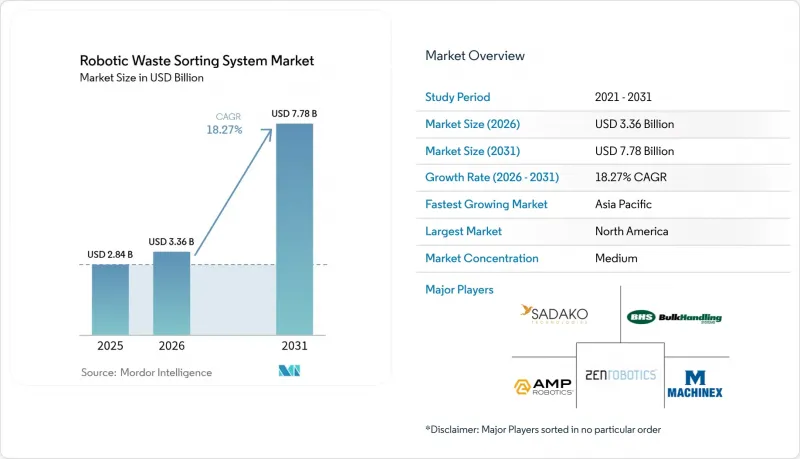
Mordor Intelligence에 의하면, 로봇식 폐기물 선별 시스템 시장 규모는 2025년 28억 4,000만 달러로 평가되었습니다. 2026년에는 33억 6,000만 달러로 확대되어 2026년부터 2031년에 걸쳐 CAGR 18.27%로 성장을 지속하여, 2031년까지 77억 8,000만 달러에 이를 것으로 예측됩니다.
본 보고서는 최종 용도 시설(지자체 MRF, 산업·상업 재활용 플랜트 등), 분리 대상 폐기물(플라스틱, 종이 및 골판지 등), 구성 요소(하드웨어, 소프트웨어, 서비스), 분리 기술(AI 비전만, NIR/하이퍼스펙트럼 광학 등), 지역별로 분류되어 있습니다. 시장 전망은 금액(미 달러) 기준으로 제시되어 있습니다.
세계의 로봇식 폐기물 선별 시스템 시장 동향 및 인사이트
매립 폐기물 감축 및 EPR 규제 강화
확대 생산자 책임(EPR) 규정에 따라 비용 부담이 지자체에서 브랜드 소유자로 이전되고 있으며, EU의 2024년 포장 규정에서는 모든 포장재가 재활용 가능해야 하고, 2030년 및 2040년까지 특정 재생 소재 함유율 기준을 달성해야 할 의무가 부과됨에 따라 자동화 도입이 가속화되고 있습니다. 지자체와 생산자들은 현재 재료의 순도를 높이고 EPR에 따른 벌칙을 피하기 위해 로봇을 도입하고 있습니다. OECD는 변동제 EPR 수수료가 재활용 가능한 제품을 설계하는 기업에 보상을 제공하는 구조라고 지적하고 있으며, 이로 인해 정밀한 분리 수거에 대한 수요가 더욱 높아지고 있습니다. 로봇 시스템을 도입한 시설에서는 가동 개시 후 12개월 이내에 회수율이 20퍼센트 포인트나 상승한 것으로 보고되고 있습니다. 이러한 성과에 힘입어 EU 모델을 본뜬 새로운 지역 규제가 도입됨에 따라 로봇식 폐기물 선별 시스템 시장은 더욱 강화되고 있습니다.
중국 등에 의한 저품질 폐기물 수입 금지
중국의 ‘국가검(National Sword)’ 정책에서는 불순물 함유율을 0.5% 미만으로 억제할 것을 요구하고 있어, 유럽과 미국의 MRF(폐기물 선별 시설)는 수출 수익을 회복하기 위해 설비 업그레이드를 단행할 수밖에 없습니다. 로봇은 이 새로운 품질 기준을 충족하는 데 필요한 정밀도를 제공하며, 처리량이 많은 시설에서는 투자 회수 기간이 24개월 미만으로 단축되고 있습니다. 말레이시아, 태국, 베트남에서의 유사한 수입 금지 조치가 이러한 촉진요인을 더욱 강화하고 있습니다. 그 결과, 로봇식 폐기물 선별 시스템 시장은 국내 처리 능력에 대한 투자로 무게중심을 옮기고 있으며, 북미의 사업자들은 2018년 이후 잃어버린 상품 마진을 회복하기 위해 혼합 플라스틱 처리 라인에 AI 선별기를 도입하고 있습니다.
고액의 설비 투자와 회수 기간의 불확실성
로봇을 활용한 완전한 선별 라인의 비용은 200만-500만 달러로, 이는 처리 능력 10만 톤 규모의 MRF(폐기물 선별 시설) 매출의 8-12개월분에 해당합니다. 상품 가격 변동은 회수 기간을 장기화시켜 신흥 시장의 투자를 지연시키고 있습니다. 리스나 로봇 서비스(RaaS)는 지출을 설비 투자(Capex)에서 운영비(OpEx)로 전환함으로써 이러한 제약을 완화하고 있지만, 선진국 이외의 지역에서는 달러로 표시된 리스 이용이 여전히 제한적입니다. 그 결과, 로봇식 폐기물 선별 시스템 업계는 자본 접근성이 서로 다른 지역 간에 불균등한 발전 양상을 보이고 있습니다.
부문별 분석
2025년, 지자체 운영 MRF는 로봇식 폐기물 선별 시스템 시장의 38.20%를 차지했으며, 이는 가장 많은 도입 실적과 가장 많은 혼합 폐기물 처리량을 반영한 것입니다. 이러한 시설들은 오염률을 1% 미만으로 억제하는 것을 목표로 하고 있기 때문에 관리자들은 순도를 높이고 매립 처리 비용을 절감하기 위해 잔여물 처리 라인에 AI 로봇을 도입하고 있습니다. 지방자치단체 MRF용 로봇식 폐기물 선별 시스템 시장 규모는 미국 주 차원의 자금 지원 프로그램과 캐나다 주 정부 보조금에 힘입어 2031년까지 연평균 성장률(CAGR) 14.62%로 꾸준히 확대될 것으로 전망됩니다.
플라스틱 재처리 업체 시장 규모는 절대값으로는 작지만, 연평균 성장률(CAGR) 20.35%로 급속히 확대되고 있습니다. 이 부문은 폐쇄형 루프 전략을 추구하는 소비재 브랜드 수요를 흡수하고 있습니다. 로봇은 폴리머 분리에 특화되어 있으며, 색상별로 선별된 PET와 HDPE를 추출합니다. 이들 제품은 혼합 베일에 비해 최대 30% 높은 프리미엄 가격이 책정됩니다. 그 결과, 플라스틱 재처리 업체는 2031년까지 로봇식 폐기물 선별 시스템 시장의 23.10% 점유율을 차지할 것으로 예상되며, 지자체 MRF와의 격차를 좁혀갈 전망입니다.
플라스틱은 2025년 매출의 38.60%를 차지했으며 계속해서 가장 빠른 성장세를 보이고 있습니다. 현재 AI 시스템은 다층 필름이나 착색된 PET를 실험실 수준의 정확도로 식별할 수 있게 되었습니다. 밸류체인의 관점에서 볼 때, 플라스틱 베일의 혼입률이 1퍼센트 포인트 낮아질 때마다 재판매 가격이 톤당 25달러 상승하여 투자의 타당성을 입증하고 있습니다. 종이 및 골판지는 광학 스캐너가 잉크나 잔류물을 보정할 수 있게 됨에 따라 안정적인 카테고리로 남아 있습니다. 금속은 와전류법을 사용하여 확실하게 회수되고 있지만, 로봇은 고품질 알루미늄 합금을 선별함으로써 부가가치를 창출하고 있습니다. 유리 선별에서는 AI 기반 색상 감지 모델이 활용되고 있으며, 스칸디나비아의 시설에서는 회수율이 70%에서 85%로 향상되었습니다.
플라스틱만을 대상으로 하는 로봇식 폐기물 선별 시스템 시장 규모는 2031년까지 30억 1,000만 달러를 넘어설 것으로 예측되며, 이는 전 세계 시장의 38.60%에 해당합니다. 복잡한 수지를 선별할 수 있는 로봇의 능력 덕분에 이 부문은 지속적인 두 자릿수 성장이 예상됩니다.
지역별 분석
2025년, 북미는 전 세계 매출의 32.70%를 차지했습니다. 조기에 로봇을 도입한 기업들은 인력 이직을 보완하고 캘리포니아주, 오리건주, 콜로라도주에서 의무화된 재활용률을 달성하기 위해 로봇 군의 규모를 확대되고 있습니다. Waste Management사만 해도 2024년부터 2025년 초까지 AI 지원 시설에 14억 달러를 투자했습니다. 이 지역에는 400대 이상의 AMP Robotics 제조 장비가 도입되어 있으며, 미국의 로봇식 폐기물 선별 시스템 시장 규모는 2031년까지 23억 4,000만 달러를 넘어설 것으로 예측됩니다.
아시아태평양은 연평균 성장률(CAGR) 18.15%를 기록하며 가장 빠르게 성장하는 지역입니다. 중국이 수입국에서 재활용 국가로 국내 정책을 전환함에 따라, 상하이의 ZenRobotics 건설 폐기물 처리 라인을 비롯해 처리 능력 확대가 급증했습니다. 일본의 지자체 시설에서는 AI가 탑재된 유리 선별기가 도입되어 앰버 및 플린트 유리 조각의 회수율이 향상되었으며, 이는 일본의 ‘병에서 병으로(Bottle-to-Bottle)’ 목표 달성을 뒷받침하고 있습니다. 한국의 ATron사의 로봇은 99.3%의 정확도를 입증하여 아세안(ASEAN) 국가로의 수출 가능성을 보여주고 있습니다. 그 결과, 로봇식 폐기물 선별 시스템 시장에서 아시아태평양의 점유율은 2025년 27.40%에서 2031년에는 33.20%로 상승할 것으로 예측됩니다.
유럽에서는 설비 투자를 재정적으로 뒷받침하는 성숙한 EPR(확대 생산자 책임) 규제의 혜택을 받고 있습니다. 덴마크의 자율형 건설 폐기물 처리 플랜트는 재활용 골재 순도 98%를 달성하며 순환 경제의 새로운 기준을 세우고 있습니다. 스페인의 Urbaser사가 추진한 국내 최초의 AI 선별 이니셔티브는 이베리아 반도 전역으로의 확산을 시사하고 있습니다. 성장 속도는 아시아태평양만큼 빠르지는 않지만, 이 지역은 여전히 기술 실증의 장으로 기능하고 있으며, 로봇식 폐기물 선별 시스템 시장의 세계적 기준을 형성하는 시범 프로젝트와 특허가 집중되어 있습니다.
기타 혜택 :
- 엑셀 형식 시장 예측(ME) 시트
- 3개월간의 애널리스트 지원
자주 묻는 질문
목차
제1장 서론
제2장 조사 방법
제3장 개요
제4장 시장 구도
제5장 시장 규모 및 성장 예측
제6장 경쟁 구도
제7장 시장 기회 및 향후 전망
KTH 26.08.31According to Mordor Intelligence, the robotic waste sorting system market size is expected to grow from USD 2.84 billion in 2025 to USD 3.36 billion in 2026 and is forecast to reach USD 7.78 billion by 2031 at 18.27% CAGR over 2026-2031.
This report is Segmented by End-Use Facility (Municipal MRFs, Industrial and Commercial Recycling Plants, and More), Waste Type Sorted (Plastics, Paper and Cardboard, and More), Component (Hardware, Software, Services), Sorting Technology (AI Vision-Only, NIR / Hyperspectral Optical, and More), Geography. The Market Forecasts are Provided in Terms of Value (USD).
Global Robotic Waste Sorting System Market Trends and Insights
Stricter Landfill Diversion and EPR Regulations
Extended Producer Responsibility rules shift cost burdens from municipalities to brand owners, and the EU's 2024 packaging measure requires all packaging to be recyclable and to hit specific recycled-content thresholds by 2030 and 2040, accelerating automation adoption. Municipalities and producers now deploy robots to secure higher material purity and avoid EPR penalties. The OECD notes that variable EPR fees reward companies that design recyclable products, which further sharpens demand for precision sortation. Facilities deploying robotic systems report recovery-rate jumps of 20 percentage points within 12 months of commissioning. These returns strengthen the robotic waste sorting system market as new regional mandates replicate the EU model.
Ban on Low-Grade Waste Imports by China and Others
China's National Sword policy requires sub-0.5% contamination, forcing Western MRFs to upgrade equipment to regain export revenue. Robots provide the accuracy needed to meet the new quality bar, and payback periods have fallen to under 24 months in high-volume plants. Similar bans in Malaysia, Thailand, and Vietnam magnify the driver. Consequently, the robotic waste sorting system market has realigned toward domestic capacity investment, with North American operators adding AI sorters at mixed-plastic lines to recapture commodity margins lost after 2018.
High Capex and Payback Uncertainty
Complete robotic lines cost USD 2-5 million, equal to 8-12 months of revenue for a 100,000-tonne MRF. Commodity-price swings elongate payback, delaying investment in emerging markets. Leasing and Robotics-as-a-Service (RaaS) are mitigating this restraint by shifting spending from capex to opex, yet access to dollar-denominated leases remains limited outside developed economies. The robotic waste sorting system industry therefore advances unevenly across regions with different capital-access profiles.
Other drivers and restraints analyzed in the detailed report include:
- Labor Shortages and Rising MRF Operating Costs
- Surge in Recycled-Content Packaging Mandates
- Cyber-Security Exposure of IIoT Robots
For complete list of drivers and restraints, kindly check the Table Of Contents.
Segment Analysis
Municipal MRFs managed 38.20% of the robotic waste sorting system market in 2025, reflecting the largest installed base and the highest mix-waste volumes. As these plants target contamination thresholds below 1%, managers install AI robots on residual lines to boost purity and reduce landfill levies. The robotic waste sorting system market size for Municipal MRFs is projected to grow at a steady 14.62% CAGR through 2031, supported by state-level funding programs in the United States and provincial grants in Canada.
Plastic Re-processors, while smaller in absolute terms, are accelerating at 20.35% CAGR. The segment captures demand from consumer-packaged-goods brands pursuing closed-loop strategies. Robots specialize in polymer separation, extracting color-sorted PET and HDPE that command price premiums of up to 30% over mixed-bale equivalents. As a result, Plastic Re-processors are expected to hold a 23.10% robotic waste sorting system market share by 2031, narrowing the gap with Municipal MRFs.
Plastics accounted for 38.60% of revenue in 2025 and continue to exhibit the fastest uptake. AI systems now identify multilayer films and colored PET with near-laboratory precision. In value-chain terms, each percentage-point reduction in plastic bale contamination lifts resale prices by USD 25 per tonne, supporting investment cases. Paper and cardboard remain a stable category as optical scanners adjust for ink and residue. Metals enjoy robust capture using eddy currents, yet robots add value by isolating high-grade aluminum alloys. Glass sorting gains from AI color-detection models that lift recovery from 70% to 85% in Scandinavian plants.
The robotic waste sorting system market size for plastics alone is projected to exceed USD 3.01 billion by 2031, equal to 38.60% of global value. Robots' ability to sort complex resins positions the segment for sustained double-digit expansion.
Complete Report Scope:
- By End-use Facility
- Municipal MRFs
- Industrial and Commercial Recycling Plants
- Construction and Demolition Facilities
- Plastic Re-processors
- E-waste Recyclers
- By Waste Type Sorted
- Plastics
- Paper and Cardboard
- Metals
- Glass
- Organic and Food Waste
- Mixed CandD Debris
- By Component
- Hardware
- Software
- Services (Installation, OandM, Leasing)
- By Sorting Technology
- AI Vision-only
- NIR / Hyperspectral Optical
- 3-D Laser and X-ray
- Hybrid Multi-Sensor
- By Geography
- North America
- United States
- Canada
- Mexico
- South America
- Brazil
- Argentina
- Chile
- Rest of South America
- Europe
- Germany
- United Kingdom
- France
- Italy
- Spain
- Russia
- Rest of Europe
- APAC
- China
- India
- Japan
- South Korea
- Australia and New Zealand
- ASEAN-6
- Rest of APAC
- Middle East and Africa
- Middle East
- GCC (Saudi Arabia, UAE, Qatar)
- Turkey
- Rest of Middle East
- Africa
- South Africa
- Egypt
- Nigeria
- Rest of Africa
- Middle East
- North America
Geography Analysis
North America accounted for 32.70% of global revenue in 2025, with early robot adopters scaling fleets to offset labor churn and to hit recycling-rate mandates in California, Oregon, and Colorado. Waste Management alone invested USD 1.4 billion in AI-enabled facilities between 2024 and early 2025. The region hosts over 400 AMP Robotics units, and robotic waste sorting system market size in the United States is projected to exceed USD 2.34 billion by 2031.
Asia-Pacific is the fastest-growing region at 18.15% CAGR. China's domestic policy pivot from importer to recycler triggered a surge in capacity adds, including ZenRobotics construction-waste lines in Shanghai. Japan's municipal plants deploy AI glass sorters that lift recovery rates for amber and flint cullet, supporting the country's bottle-to-bottle targets. South Korea's ATron robots demonstrate 99.3% precision and showcase export potential across ASEAN. Consequently, Asia-Pacific's share of the robotic waste sorting system market is forecast to rise from 27.40% in 2025 to 33.20% in 2031.
Europe benefits from mature EPR regulations that fund capital investment. Denmark's autonomous construction-waste plant achieves 98% purity for recycled aggregates, setting new circular-economy benchmarks. Spain's first AI sorting initiative under Urbaser signals wider Iberian adoption. Although growth is steadier than in Asia-Pacific, the region remains a technology test bed, sustaining a high concentration of pilot projects and patents that inform global standards for the robotic waste sorting system market.
- AMP Robotics Corporation
- ZenRobotics Ltd
- TOMRA Systems ASA
- Bulk Handling Systems (BHS)
- Machinex Industries Inc
- Waste Robotics Inc
- Sadako Technologies
- General Kinematics
- Pellenc ST
- Green Machine LLC
- STADLER Anlagenbau
- Bollegraaf Group
- Everest Labs
- Glacier AI
- Greyparrot
- JONO Environmental
- FANUC Corp.
- ABB Ltd.
- KUKA AG
- SUEZ Group (AI sorting JV)
- Veolia Environnement (robotic pilots)
Additional Benefits:
- The market estimate (ME) sheet in Excel format
- 3 months of analyst support
TABLE OF CONTENTS
1 INTRODUCTION
- 1.1 Study Assumptions and Market Definition
- 1.2 Scope of the Study
2 RESEARCH METHODOLOGY
3 EXECUTIVE SUMMARY
4 MARKET LANDSCAPE
- 4.1 Market Overview
- 4.2 Market Drivers
- 4.2.1 Stricter landfill diversion and EPR regulations
- 4.2.2 Ban on low-grade waste imports by China and others
- 4.2.3 Labour shortages and rising MRF operating costs
- 4.2.4 Surge in recycled-content packaging mandates
- 4.2.5 Demand for AI-enabled closed-loop data (under-reported)
- 4.2.6 OEM service-based robot leasing models (under-reported)
- 4.3 Market Restraints
- 4.3.1 High capex and payback uncertainty
- 4.3.2 Limited technical talent for OandM
- 4.3.3 Volatile secondary-commodity prices
- 4.3.4 Cyber-security exposure of IIoT robots (under-reported)
- 4.4 Value / Supply-Chain Analysis
- 4.5 Regulatory Landscape
- 4.6 Technological Outlook
- 4.7 Porter's Five Forces Analysis
- 4.7.1 Threat of New Entrants
- 4.7.2 Bargaining Power of Buyers
- 4.7.3 Bargaining Power of Suppliers
- 4.7.4 Threat of Substitutes
- 4.7.5 Intensity of Competitive Rivalry
5 MARKET SIZE AND GROWTH FORECASTS (VALUE)
- 5.1 By End-use Facility
- 5.1.1 Municipal MRFs
- 5.1.2 Industrial and Commercial Recycling Plants
- 5.1.3 Construction and Demolition Facilities
- 5.1.4 Plastic Re-processors
- 5.1.5 E-waste Recyclers
- 5.2 By Waste Type Sorted
- 5.2.1 Plastics
- 5.2.2 Paper and Cardboard
- 5.2.3 Metals
- 5.2.4 Glass
- 5.2.5 Organic and Food Waste
- 5.2.6 Mixed CandD Debris
- 5.3 By Component
- 5.3.1 Hardware
- 5.3.2 Software
- 5.3.3 Services (Installation, OandM, Leasing)
- 5.4 By Sorting Technology
- 5.4.1 AI Vision-only
- 5.4.2 NIR / Hyperspectral Optical
- 5.4.3 3-D Laser and X-ray
- 5.4.4 Hybrid Multi-Sensor
- 5.5 By Geography
- 5.5.1 North America
- 5.5.1.1 United States
- 5.5.1.2 Canada
- 5.5.1.3 Mexico
- 5.5.2 South America
- 5.5.2.1 Brazil
- 5.5.2.2 Argentina
- 5.5.2.3 Chile
- 5.5.2.4 Rest of South America
- 5.5.3 Europe
- 5.5.3.1 Germany
- 5.5.3.2 United Kingdom
- 5.5.3.3 France
- 5.5.3.4 Italy
- 5.5.3.5 Spain
- 5.5.3.6 Russia
- 5.5.3.7 Rest of Europe
- 5.5.4 APAC
- 5.5.4.1 China
- 5.5.4.2 India
- 5.5.4.3 Japan
- 5.5.4.4 South Korea
- 5.5.4.5 Australia and New Zealand
- 5.5.4.6 ASEAN-6
- 5.5.4.7 Rest of APAC
- 5.5.5 Middle East and Africa
- 5.5.5.1 Middle East
- 5.5.5.1.1 GCC (Saudi Arabia, UAE, Qatar)
- 5.5.5.1.2 Turkey
- 5.5.5.1.3 Rest of Middle East
- 5.5.5.2 Africa
- 5.5.5.2.1 South Africa
- 5.5.5.2.2 Egypt
- 5.5.5.2.3 Nigeria
- 5.5.5.2.4 Rest of Africa
- 5.5.5.1 Middle East
- 5.5.1 North America
6 COMPETITIVE LANDSCAPE
- 6.1 Market Concentration
- 6.2 Strategic Moves
- 6.3 Market Share Analysis
- 6.4 Company Profiles (includes Global level Overview, Market level overview, Core Segments, Financials as available, Strategic Information, Market Rank/Share for key companies, Products and Services, and Recent Developments)
- 6.4.1 AMP Robotics Corporation
- 6.4.2 ZenRobotics Ltd
- 6.4.3 TOMRA Systems ASA
- 6.4.4 Bulk Handling Systems (BHS)
- 6.4.5 Machinex Industries Inc
- 6.4.6 Waste Robotics Inc
- 6.4.7 Sadako Technologies
- 6.4.8 General Kinematics
- 6.4.9 Pellenc ST
- 6.4.10 Green Machine LLC
- 6.4.11 STADLER Anlagenbau
- 6.4.12 Bollegraaf Group
- 6.4.13 Everest Labs
- 6.4.14 Glacier AI
- 6.4.15 Greyparrot
- 6.4.16 JONO Environmental
- 6.4.17 FANUC Corp.
- 6.4.18 ABB Ltd.
- 6.4.19 KUKA AG
- 6.4.20 SUEZ Group (AI sorting JV)
- 6.4.21 Veolia Environnement (robotic pilots)
7 MARKET OPPORTUNITIES AND FUTURE OUTLOOK
- 7.1 White-space and Unmet-Need Assessment