

|
시장보고서
상품코드
2114504
인지 무선 : 시장 점유율 분석, 업계 동향 및 통계, 성장 예측(2026-2031년)Cognitive Radio - Market Share Analysis, Industry Trends & Statistics, Growth Forecasts (2026 - 2031) |
||||||
 Mordor Intelligence
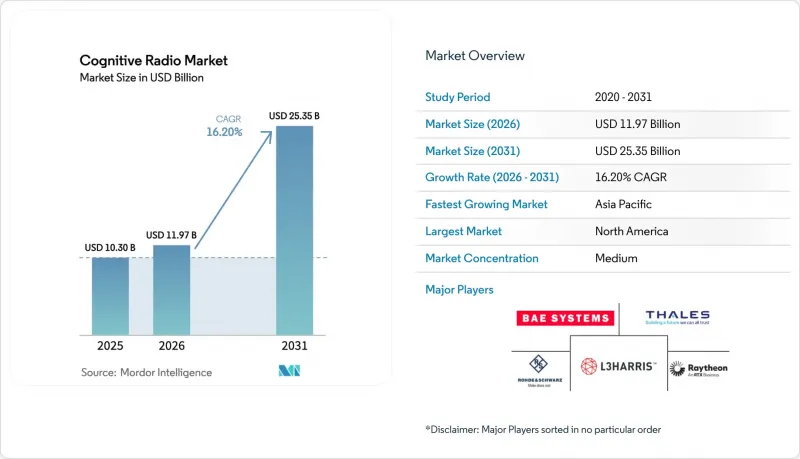
Mordor Intelligence에 의하면, 인지 무선 시장 규모는 2025년에 103억 달러로 평가되었습니다. 2026년 119억 7,000만 달러에서 2031년까지 253억 5,000만 달러에 이를 것으로 예상되며, 예측 기간(2026-2031년) CAGR은 16.20%를 나타낼 전망입니다.
본 보고서는 용도별(스펙트럼 감지 및 할당, 위치 감지, 인지 라우팅 등), 구성 요소별(하드웨어, 소프트웨어 및 펌웨어, 서비스), 주파수 대역별(HF/VHF/UHF(1GHz 미만),SHF(1-6GHz) 등), 최종 사용자 산업(IT 및 통신, IT 서비스, 기타), 그리고 지역별로 분류되어 있습니다. 시장 예측은 금액(달러) 기준으로 제시되어 있습니다.
세계의 인지 무선 시장 동향 및 인사이트
스펙트럼 활용 최적화에 대한 수요 증가
트래픽 증가로 인해 기존의 주파수 할당량이 한계에 다다르면서, 규제 당국은 인지 센싱을 기반으로 한 동적인 공유 정책을 우선시하고 있습니다. 시민 광대역 무선 서비스(CBRS) 규정 개정만으로도 기존 레이더에 악영향을 미치지 않으면서 미국에서 7,200만 명의 사용자에게 서비스를 제공할 수 있게 되었습니다. 새로운 센싱 엔진은 밀리초 단위로 광범위한 영역을 스캔하며, 연방 정부와 민간 간의 경쟁을 완화하기 위한 연구에 16억 달러의 연방 예산이 투입되고 있습니다. 미드밴드 대역은 5G 스마트폰에 있어 전파 조건이 양호한 반면, 기상 레이더 및 방어 시스템도 공존하고 있어 여전히 주목의 대상이 되고 있습니다. 각 벤더는 직접 RF 샘플링과 온칩 AI 추론을 결합하여, 실시간으로 스펙트럼상의 여유 영역을 감지하는 칩셋을 선보이고 있습니다. 이러한 발전 덕분에 통신 사업자는 고가의 신규 라이선스를 취득하지 않고도 용량을 확대할 수 있게 되어, 인지 무선 시장의 장기적인 성장을 뒷받침하고 있습니다.
5G 서비스 용도의 확대
고밀도 5G 네트워크에서는 제한된 주파수 대역 내에서 처리량 목표를 유지하기 위해 민첩한 주파수 관리가 요구됩니다. 중국에서는 기지국 수가 22만 8,700개를 돌파했으며, 2025년까지 사용자 보급률 60%를 달성했습니다. 중국에서는 중대역 및 고대역 캐리어를 조정하기 위해 인지 스케줄링을 활용하고 있습니다. 일본에서는 프라이빗 5G용으로 153건의 4.7GHz 대역 지역 라이선스가 발급되었으며, 컨텍스트 인식형 무선 기술이 엄격하게 구획된 채널 내에서 공장 네트워크를 어떻게 구현하는지가 입증되었습니다. 6G를 위한 ‘통합 감지 및 통신(ICS)’ 개념에서는 레이더와 데이터 링크가 융합되어 스펙트럼 예산이 더욱 엄격해집니다. 각 벤더들은 수십억 달러 규모의 연구개발 투자를, 실시간 스펙트럼 인텔리전스를 활용하여 트래픽을 최적화하는 AI 네이티브 코어 소프트웨어에 쏟아붓고 있습니다. 이러한 도입이 진행됨에 따라, 인지 무선 시장은 모바일 네트워크의 레퍼런스 디자인에서 더 큰 역할을 담당하게 되고 있습니다.
견고한 컴퓨팅 보안 인프라의 부재
동적 무선은 공격자가 센싱 데이터를 위장하거나 머신러닝 모델을 변조할 수 있게 하여 공격 표면을 확대시킵니다. 블록체인을 기반으로 한 초기 공유 시범 프로젝트에서는 트랜잭션 처리 능력이 제한적이어서 스펙트럼 거래 속도를 저하시키고 있습니다. 방위 기관들은 활동을 은폐하기 위한 전자기 미끼를 시험하고 있지만, 적대적 AI에 대한 대책에 대해서는 현재도 활발한 연구가 진행 중입니다. 양자 키 배분은 유망한 기술로 평가받고 있지만, 현 시점에서는 단거리에서 키로비트 수준의 데이터 스트림만 보호할 수 있어 현장 요구 사항을 충족하지 못하고 있습니다. 확장 가능하고 지연 시간이 짧은 보호 수단이 등장할 때까지 중요 인프라 소유자들은 관망하는 태도를 취하고 있으며, 이것이 단기적인 도입을 억제하는 요인이 되고 있습니다.
부문별 분석
‘스펙트럼 감지 및 할당’은 2025년 전 세계 매출의 37.65%를 차지하며, 모든 도입에 있어 통합이 필수적인 기반 계층으로서의 역할을 확고히 했습니다. 고속 검출기는 밀리초 단위의 기존 레이더 보호를 요구하는 FCC 규정을 충족합니다. 미션 크리티컬한 성능 요건으로 인해 벤더들은 직접 RF 샘플링과 엣지 AI 가속기를 통합하게 되었으며, 이를 통해 사업자는 스펙트럼 점유 상황을 거의 즉시 파악할 수 있게 되었습니다. 인지 라우팅은 현재 규모는 작지만, AI 엔진이 경로 선택 시 링크 품질, 사용자 이동성, 지연 예산을 상호 연관시키기 시작함에 따라 연평균 성장률(CAGR) 18.12%로 확대되고 있습니다. 차량과 사물 간 통신(V2X)의 전개에 있어서는 순간적인 채널 변동이 도로 안전 경보를 위협할 가능성이 있으므로 동적인 경로 조정이 필수적입니다. 기업들은 이러한 원칙을 공장 내 로봇에도 적용하여, 금속이 밀집된 공장 내에서도 신뢰성 높은 무선 커버리지를 확보하고 있습니다.
정량적으로 보면, 인지 무선 시장 규모에서 센싱 분야의 기여도는 현재 라우팅 분야의 기여도를 상회하고 있습니다. 그러나 라우팅은 원시 점유율 데이터를 구체적인 의사 결정으로 전환함으로써 시스템 전체의 가치를 높이고 있습니다. 6G 테스트베드에서 센싱과 통신이 통합됨에 따라, 각 벤더는 두 기능을 단일 스택으로 통합하여 평균 판매 가격을 높이고 있습니다. 네트워크 정체를 예측하고 선제적인 자원 할당을 가능하게 하는 예측 프레임워크 덕분에 위치 감지 및 QoS 최적화 분야는 두 자릿수 성장을 기록하고 있습니다. 비상 대응 및 위성 용도이 포트폴리오를 보완하고 있으며, 지상 네트워크가 마비되었을 때 비상 대응 요원이 지상 링크에서 우주 링크로 전환할 수 있게 해주는 다중 궤도 핸드오버 메커니즘의 혜택을 받고 있습니다.
광대역 컨버터, FPGA(Field Programmable Gate Array), 빔 스티어링형 안테나 어레이에 대한 수요가 지속됨에 따라, 2025년 매출의 45.20%를 하드웨어가 차지했습니다. AD9084와 같은 직접 RF 샘플링 칩은 현재 수백 메가헤르츠의 스펙트럼을 한 단계로 디지털화할 수 있게 되어 시스템의 설치 면적을 축소하고 있습니다. 이러한 하드웨어 기반을 통해 소프트웨어의 가치가 급속히 높아지고 있으며, 이것이 소프트웨어 및 펌웨어 부문이 16.74%의 연평균 성장률(CAGR)을 달성한 이유입니다. 각 벤더는 현장에서 스펙트럼 모델을 지속적으로 재학습시키는 컨테이너화된 마이크로 서비스를 통합하여, 인텔리전스를 클라우드에서 엣지로 이전하고 있습니다. 통신 사업자들이 현지 전파 상황에 맞추어 AI 모델을 조정할 수 있는 시스템 통합사업자를 찾음에 따라 서비스 수익은 증가하고 있습니다.
예측 기간 동안 경쟁 무선 모듈들이 유사한 잡음 지수와 출력을 구현함에 따라, 소프트웨어의 발전으로 인해 하드웨어만을 통한 차별화는 점차 약화될 것입니다. 따라서 공급업체들은 기판 교체가 필요 없이 현장에서의 수명을 연장하는 펌웨어 업데이트 파이프라인을 강조하고 있습니다. 사용자의 경우, 이로 인해 자본 지출(Capex)이 운영 비용(OpEx)으로 전환되고 업그레이드 경로가 원활해짐에 따라, 인지 무선 시장에서 소프트웨어의 점유율은 상승 추세를 유지할 것입니다. 안테나 혁신도 진행되고 있습니다. 듀얼 밴드 급전 장치를 갖춘 전자 가변 어레이는 복수 궤도 위성 간의 로밍을 지원합니다.
지역별 분석
북미는 2025년 매출의 36.50%를 차지하며, 규제 측면의 혁신에서 계속해서 주도적인 시장을 형성했습니다. 국가 주파수 전략에서는 반도체 정비 및 저·중·고대역 주파수에 걸친 동적 공유를 시험하는 시범 사업에 66억 달러가 배정되었습니다. L3Harris와 같은 방위 관련 기업들은 330억 달러가 넘는 수주 잔고를 보유하고 있으며, 여기에는 전 영역 합동 작전을 위한 주파수 대응 플랫폼이 포함되어 있습니다. 민간 부문의 높은 보급률은 기존 공공 안전 서비스를 유지하면서 지방의 광대역 격차를 해소하기 위한 적극적인 고정 무선 구축을 반영하고 있습니다.
아시아태평양에서는 통신 사업자들이 거대한 잠재 가입자 기반을 확보하기 위해 노력하고, 각국 정부가 6G 분야의 리더십을 전략적 자산으로 간주함에 따라 연평균 성장률(CAGR) 16.95%의 성장이 예상됩니다. 중국에서는 고밀도 5G 매크로셀 계층과 6G 테스트베드 구축에 따라, 중파 대역 및 mm파 대역 자산을 유연하게 운용할 수 있는 무선 장비가 요구되고 있습니다. 한편, 일본과 한국에서는 공장 및 항만을 위한 프라이빗 5G 라이선스 취득을 장려하고 있습니다. 3개국 간의 기술 협정에 따라, 연구 자금은 탄탄한 공급망과 오픈 RAN 실험에 집중되고 있습니다.
유럽은 벤더의 연구개발 역량과 EU 전역의 표준 조화를 원동력으로 삼아 전진하고 있습니다. 에릭슨은 2024년에 AI 네이티브 아키텍처에 44억 유로(50억 9,000만 달러)를 배정했으며, 탈레스는 방위 통신 관련 수주로 253억 유로(292억 7,000만 달러)를 확보했습니다. EU의 ‘호라이즌 유럽’ 프로젝트는 키사이트와 제휴하여 6G 무선 프로토타입을 검증하고 있으며, 실험실에서 현장으로의 전환 일정을 가속화하고 있습니다. ETSI(유럽전기통신표준화기구)에 의한 국경을 초월한 표준화를 통해 인증 비용이 절감되고, 여러 시장에서 장비 출시 전략이 지원됨에 따라 안정적이고 변동성이 적은 지역 성장이 확고해지고 있습니다.
기타 혜택 :
- 엑셀 형식 시장 예측(ME) 시트
- 3개월간의 애널리스트 지원
자주 묻는 질문
목차
제1장 서론
제2장 조사 방법
제3장 개요
제4장 시장 구도
제5장 시장 규모 및 성장 예측
제6장 경쟁 구도
제7장 시장 기회 및 향후 전망
KTH 26.08.31According to Mordor Intelligence, the cognitive radio market size was valued at USD 10.30 billion in 2025 and estimated to grow from USD 11.97 billion in 2026 to reach USD 25.35 billion by 2031, at a CAGR of 16.20% during the forecast period (2026-2031).
This report is Segmented by Application (Spectrum Sensing and Allocation, Location Detection, Cognitive Routing, and More), Component (Hardware, Software and Firmware, and Services), Spectrum Band (HF/VHF/UHF [Less Than 1 GHz], SHF [1-6 GHz], and More), End-User Industry (Telecommunications, IT and ITes, and More), and Geography. The Market Forecasts are Provided in Terms of Value (USD).
Global Cognitive Radio Market Trends and Insights
Growing Need to Optimize Spectrum Utilization
Traffic growth is exhausting legacy allocations, prompting regulators to prioritize dynamic sharing policies that hinge on cognitive sensing. Citizens Broadband Radio Service rule updates alone unlocked service to 72 million more U.S. users without harming incumbent radars. New sensing engines scan wide swaths in milliseconds, and a USD 1.6 billion federal budget backs research aimed at reducing federal-commercial conflicts. Mid-band corridors remain the epicenter because they hold favorable propagation for 5G smartphones yet also host weather radars and defense systems. Vendors showcase chipsets that couple direct-RF sampling with on-chip AI inference to spot spectral holes on the fly. These advances let operators raise capacity without expensive new licenses, supporting the cognitive radio market's long-run expansion.
Rising Deployment of 5G Service Applications
Dense 5G footprints require agile frequency management to sustain throughput targets within finite spectrum blocks. China has surpassed 228,700 base stations and is on track to achieve 60% user penetration by 2025, relying on cognitive scheduling to coordinate mid- and high-band carriers. Japan issued 153 local 4.7 GHz licenses for private 5G, proving how context-aware radios enable factory networks inside tightly zoned channels. Integrated Sensing and Communication concepts for 6G merge radar and data links, further tightening spectral budgets. Vendors funnel multi-billion-dollar R&D investments into AI-native core software that leverages real-time spectrum intelligence to optimize traffic. As these deployments mature, the cognitive radio market secures a larger role in mobile-network reference designs.
Lack of Robust Computational Security Infrastructure
Dynamic radios broaden the attack surface because adversaries can spoof sensing data or tamper with machine-learning models. Early blockchain-based sharing pilots achieve limited transaction throughput, slowing spectrum trades. Defense agencies test electromagnetic decoys to mask activity, but adversarial-AI countermeasures remain under active research. Quantum key distribution shows promise yet currently secures only kilobit-level streams over short ranges, falling short of field requirements. Until scalable, low-latency safeguards arrive, critical-infrastructure owners adopt wait-and-see postures that temper near-term uptake.
Other drivers and restraints analyzed in the detailed report include:
- Government Mandates for Dynamic Spectrum Sharing Frameworks
- AI-Powered Spectrum Sensing Algorithms Mature
- Regulatory Ambiguity on Secondary Spectrum Usage Rights
For complete list of drivers and restraints, kindly check the Table Of Contents.
Segment Analysis
Spectrum Sensing and Allocation controlled 37.65% of global 2025 revenue, solidifying its role as the prerequisite layer that every deployment must integrate. High-speed detectors satisfy FCC rules that demand incumbent radar protection within milliseconds. Mission-critical performance needs have prompted vendors to integrate direct-RF sampling with edge AI accelerators, enabling operators to gain near-instant insight into spectrum occupancy. Cognitive Routing, while smaller today, is scaling at an 18.12% CAGR as AI engines start to correlate link quality, user mobility, and latency budgets during path selection. Dynamic route adjustment becomes indispensable for vehicle-to-everything (V2X) rollouts, where split-second channel variations can jeopardize road safety alerts. Enterprises extend these principles to factory floor robots, ensuring reliable wireless coverage in metal-dense halls.
In quantitative terms, the cognitive radio market's size contributions from sensing currently surpass those from routing; however, routing augments overall system value by turning raw occupancy data into actionable decisions. As 6G testbeds merge sensing and communications, vendors bundle both features within a single stack, expanding average selling prices. Predictive frameworks that foresee network congestion and facilitate proactive resource allocation have bolstered double-digit growth in Location Detection and QoS Optimization. Emergency and satellite applications round out the portfolio, benefiting from multi-orbit handover mechanisms that let first responders switch from terrestrial to space links when terrestrial networks falter.
Hardware accounted for 45.20% of 2025 sales, thanks to continued demand for wideband converters, field-programmable gate arrays, and beam-steered antenna arrays. Direct-RF sampling chips, such as the AD9084, now digitize hundreds of megahertz of spectrum in a single step, thereby shrinking system footprints. That hardware base enables rapid gains in software value, which explains the 16.74% CAGR achieved by Software and Firmware. Vendors embed containerized microservices that continuously retrain spectrum models onsite, moving intelligence from the cloud to the edge. Services revenue rises as carriers seek system integrators to calibrate AI models for local propagation realities.
Over the forecast horizon, software gains steadily erode hardware-only differentiation because competing radio modules deliver similar noise figures and power outputs. Suppliers, therefore, highlight firmware update pipelines that extend field lifetimes without requiring board swaps. For users, this converts capex into opex and smooths upgrade paths that keep the cognitive radio market share of software on an upward glide path. Antenna innovation also marches ahead; electronically steerable arrays packaged with dual-band feeds support multi-orbit satellite roaming.
Complete Report Scope:
- By Application
- Spectrum Sensing and Allocation
- Location Detection
- Cognitive Routing
- QoS Optimisation
- Other Applications
- By Component
- Hardware (RF Transceivers, SDR Modules, Antennas)
- Software and Firmware
- Services
- By Spectrum Band
- HF/VHF/UHF (Less than 1 GHz)
- SHF (1-6 GHz)
- EHF (More than 6 GHz, mmWave)
- By End-user Industry
- Telecommunication
- IT and ITeS
- Government and Defense
- Transportation and Logistics
- Energy and Utilities
- Other Industries
- By Network Type
- Opportunistic Spectrum Access (OSA)
- Spectrum Sharing
- Cooperative Networks
- By Geography
- North America
- United States
- Canada
- Mexico
- South America
- Brazil
- Rest of South America
- Europe
- United Kingdom
- Germany
- France
- Russia
- Rest of Europe
- Asia Pacific
- China
- India
- Japan
- South Korea
- ASEAN
- Rest of Asia Pacific
- Middle East
- Saudi Arabia
- UAE
- Turkey
- Rest of Middle East
- Africa
- South Africa
- Nigeria
- Rest of Africa
- North America
Geography Analysis
North America accounted for 36.50% of 2025 revenue and remains the leading market in regulatory innovation. The National Spectrum Strategy earmarks USD 6.6 billion for semiconductor buildouts and pilots that test dynamic sharing across low, mid, and high-band frequencies. Defense contractors such as L3Harris carry order backlogs exceeding USD 33 billion, which include spectrum-aware platforms for joint-all-domain operations. High civilian uptake mirrors aggressive fixed-wireless rollouts that bridge rural broadband gaps while preserving incumbent public-safety services.
Asia Pacific is projected to rise at a 16.95% CAGR as operators chase large addressable subscriber bases and governments treat 6G leadership as a strategic asset. China's dense 5G macro-cell layer and 6G testbeds require radios able to juggle mid- and millimeter-wave assets, while Japan and South Korea incentivize private-5G licenses for factories and ports. Tri-lateral technology pacts among the three nations concentrate research funding on resilient supply chains and open-RAN experimentation.
Europe advances on the strength of vendor R&D and pan-EU harmonization. Ericsson allocated EUR 4.4 billion (USD 5.09 billion) to AI-native architectures in 2024, and Thales secured EUR 25.3 billion (USD 29.27 billion) in orders tied to defense communications. The EU's Horizon Europe projects partner with Keysight to validate 6G radio prototypes, accelerating lab-to-field transition timelines. Cross-border alignment under ETSI reduces certification costs and supports multi-market equipment release strategies, cementing steady but less volatile regional growth.
- BAE Systems plc
- Thales Group
- Raytheon Technologies Corp.
- Rohde and Schwarz GmbH and Co KG
- Shared Spectrum Company
- L3Harris Technologies
- Huawei Technologies Co. Ltd.
- NuRAN Wireless Inc.
- Keysight Technologies
- Vecima Networks Inc.
- Northrop Grumman Corp.
- Ericsson AB
- Nokia Corp.
- Qorvo Inc.
- Analog Devices Inc.
- National Instruments Corp.
- Curtis-Wright Corp.
- Viasat Inc.
- Cobham Ltd.
- Elbit Systems Ltd.
Additional Benefits:
- The market estimate (ME) sheet in Excel format
- 3 months of analyst support
TABLE OF CONTENTS
1 INTRODUCTION
- 1.1 Study Assumptions and Market Definition
- 1.2 Scope of the Study
2 RESEARCH METHODOLOGY
3 EXECUTIVE SUMMARY
4 MARKET LANDSCAPE
- 4.1 Market Overview
- 4.2 Market Drivers
- 4.2.1 Growing need to optimize spectrum utilization
- 4.2.2 Rising deployment of 5G service applications
- 4.2.3 Surge in IoT-connected devices driving dynamic spectrum demand
- 4.2.4 Government mandates for dynamic spectrum sharing frameworks
- 4.2.5 AI-powered spectrum sensing algorithms mature
- 4.2.6 Private 6G testbeds accelerating research and development funding
- 4.3 Market Restraints
- 4.3.1 Lack of robust computational security infrastructure
- 4.3.2 Regulatory ambiguity on secondary spectrum usage rights
- 4.3.3 High capex for cognitive-enabled RF front-ends
- 4.3.4 Scarcity of field-proven cognitive radio chipsets
- 4.4 Industry Value Chain Analysis
- 4.5 Regulatory Landscape
- 4.6 Technological Outlook
- 4.7 Porter's Five Forces Analysis
- 4.7.1 Bargaining Power of Consumers
- 4.7.2 Bargaining Power of Suppliers
- 4.7.3 Threat of New Entrants
- 4.7.4 Threat of Substitute Products
- 4.7.5 Intensity of Competitive Rivalry
5 MARKET SIZE AND GROWTH FORECASTS (VALUE)
- 5.1 By Application
- 5.1.1 Spectrum Sensing and Allocation
- 5.1.2 Location Detection
- 5.1.3 Cognitive Routing
- 5.1.4 QoS Optimisation
- 5.1.5 Other Applications
- 5.2 By Component
- 5.2.1 Hardware (RF Transceivers, SDR Modules, Antennas)
- 5.2.2 Software and Firmware
- 5.2.3 Services
- 5.3 By Spectrum Band
- 5.3.1 HF/VHF/UHF (Less than 1 GHz)
- 5.3.2 SHF (1-6 GHz)
- 5.3.3 EHF (More than 6 GHz, mmWave)
- 5.4 By End-user Industry
- 5.4.1 Telecommunication
- 5.4.2 IT and ITeS
- 5.4.3 Government and Defense
- 5.4.4 Transportation and Logistics
- 5.4.5 Energy and Utilities
- 5.4.6 Other Industries
- 5.5 By Network Type
- 5.5.1 Opportunistic Spectrum Access (OSA)
- 5.5.2 Spectrum Sharing
- 5.5.3 Cooperative Networks
- 5.6 By Geography
- 5.6.1 North America
- 5.6.1.1 United States
- 5.6.1.2 Canada
- 5.6.1.3 Mexico
- 5.6.2 South America
- 5.6.2.1 Brazil
- 5.6.2.2 Rest of South America
- 5.6.3 Europe
- 5.6.3.1 United Kingdom
- 5.6.3.2 Germany
- 5.6.3.3 France
- 5.6.3.4 Russia
- 5.6.3.5 Rest of Europe
- 5.6.4 Asia Pacific
- 5.6.4.1 China
- 5.6.4.2 India
- 5.6.4.3 Japan
- 5.6.4.4 South Korea
- 5.6.4.5 ASEAN
- 5.6.4.6 Rest of Asia Pacific
- 5.6.5 Middle East
- 5.6.5.1 Saudi Arabia
- 5.6.5.2 UAE
- 5.6.5.3 Turkey
- 5.6.5.4 Rest of Middle East
- 5.6.6 Africa
- 5.6.6.1 South Africa
- 5.6.6.2 Nigeria
- 5.6.6.3 Rest of Africa
- 5.6.1 North America
6 COMPETITIVE LANDSCAPE
- 6.1 Market Concentration
- 6.2 Strategic Moves
- 6.3 Market Share Analysis
- 6.4 Company Profiles (includes Global level Overview, Market level overview, Core Segments, Financials as available, Strategic Information, Market Rank/Share for key companies, Products and Services, and Recent Developments)
- 6.4.1 BAE Systems plc
- 6.4.2 Thales Group
- 6.4.3 Raytheon Technologies Corp.
- 6.4.4 Rohde and Schwarz GmbH and Co KG
- 6.4.5 Shared Spectrum Company
- 6.4.6 L3Harris Technologies
- 6.4.7 Huawei Technologies Co. Ltd.
- 6.4.8 NuRAN Wireless Inc.
- 6.4.9 Keysight Technologies
- 6.4.10 Vecima Networks Inc.
- 6.4.11 Northrop Grumman Corp.
- 6.4.12 Ericsson AB
- 6.4.13 Nokia Corp.
- 6.4.14 Qorvo Inc.
- 6.4.15 Analog Devices Inc.
- 6.4.16 National Instruments Corp.
- 6.4.17 Curtis-Wright Corp.
- 6.4.18 Viasat Inc.
- 6.4.19 Cobham Ltd.
- 6.4.20 Elbit Systems Ltd.
7 MARKET OPPORTUNITIES AND FUTURE OUTLOOK
- 7.1 White-space and Unmet-need Assessment


