

|
시장보고서
상품코드
2114511
감열 인쇄 시장 : 시장 점유율 분석, 업계 동향 및 통계, 성장 예측(2026-2031년)Thermal Printing - Market Share Analysis, Industry Trends & Statistics, Growth Forecasts (2026 - 2031) |
||||||
 Mordor Intelligence
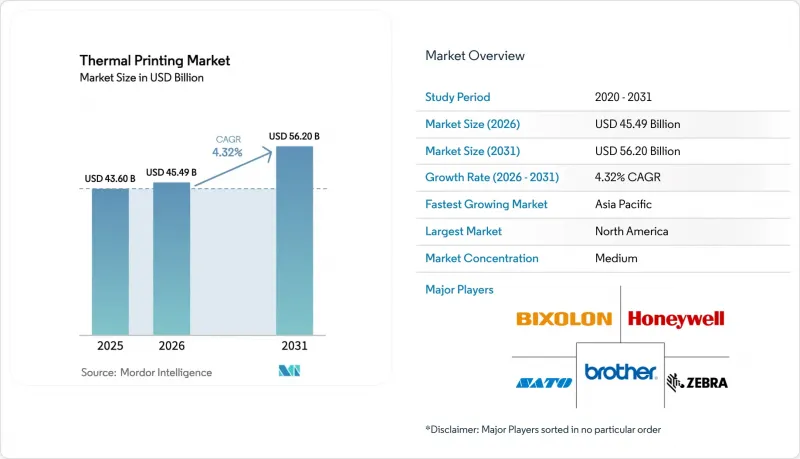
Mordor Intelligence에 의하면, 감열 인쇄 시장 규모는 2026년에 454억 9,000만 달러로 추정되고, 2031년까지 562억 달러에 이를 것으로 예측됩니다.
연평균 성장률(CAGR)은 4.32%를 나타낼 것으로 보이며, 이는 시장 규모의 꾸준한 확대와 모바일 및 라이너리스 솔루션에 대한 수요 증가를 시사합니다.
본 보고서는 용도별(바코드, POS/영수증, 라벨 등), 인쇄 기술별(직접 감열, 감열 등), 형식 유형별(산업용, 데스크톱용, 모바일용), 최종 용도별(소매 및 전자상거래, 운송 및 물류, 제조 및 창고 등) 및 지역별로 분류되어 있습니다. 시장 전망은 금액(달러) 기준으로 제시되어 있습니다.
세계의 감열 인쇄 시장 동향 및 인사이트
전자상거래 물류의 급속한 성장이 바코드 및 배송 라벨 수요를 견인
국경을 초월한 디지털 상거래에 따른 소포 증가로 인해 감열 라벨 소비가 직접적으로 증가하고 있습니다. 택배 업체들은 주문형 인쇄가 필수인 GS1 준수 형식을 의무화하고 있으며, 이에 따라 소규모 사업자들은 라벨 1장당 비용을 0.01달러 미만으로 억제할 수 있는 데스크톱형 직접 감열 프린터의 도입을 추진하고 있습니다. 옴니채널 주문 처리 전략으로 인해 인쇄 업무가 소규모 물류 센터 전체에 분산되면서, 각 거점에서 정기적으로 인쇄 매체와 프린트 헤드를 보충하게 되어 OEM 제조업체의 소모품 매출이 두 배로 증가하고 있습니다. 이에 대응하여 각 제조업체는 이더넷 및 Wi-Fi를 지원하고 인쇄 대기열을 일원적으로 관리할 수 있는 프린터를 제공함으로써, 각 하역문에서 실시간 라벨 흐름을 확보하고 있습니다. 소포 수 증가와 분산된 인쇄 노드라는 시너지 효과로 인해, 배송 라벨은 감열 프린터 시장에서 견조한 수요의 기반이 되고 있습니다.
현장 및 라스트 마일 업무에서 무선/모바일 프린터의 급속한 보급
Bluetooth Low Energy 및 Wi-Fi Direct 프로토콜 덕분에 고정 액세스 포인트가 불필요해졌으며, 배송 담당자, 간호사, 서비스 기술자에게 모바일 프린터는 없어서는 안 될 필수품이 되었습니다. Brother사의 RJ2150 RuggedJet 2는 1회 충전으로 2인치 라벨 1,100장을 인쇄할 수 있으며, IP54 및 MIL-STD-810G 내구성 기준을 충족합니다. BIXOLON은 소독용 물티슈를 통한 소독 인증을 획득함으로써 의료 현장에서의 휴대성을 한층 더 높였습니다. 이를 통해 병상 옆에서 손목 밴드를 인쇄할 수 있게 되어 전사 오류를 줄일 수 있습니다. 클라우드 기반 라벨 디자인 앱을 사용하면 사용자가 스마트폰에서 템플릿을 편집할 수 있으므로, IT 부서의 병목 현상을 해소하고 도입 주기를 단축할 수 있습니다. 차량 대수 증가에 따라 각 OEM 업체들은 모바일 환경에 최적화된 배터리, 충전기, 내구성이 뛰어난 미디어를 통해 새로운 수익원을 확보하며, 감열 인쇄 시장 전체로의 침투를 더욱 심화시키고 있습니다.
높은 유지보수 비용과 프린트 헤드 교체 비용
산업용 프린트 헤드의 가격은 400-1,200달러이며, 30-60킬로미터 분량의 미디어 인쇄를 견딜 수 있습니다. 하루 5만 장의 라벨을 처리하는 풀필먼트 센터에서는 6-12개월마다 교체가 필요하며, 그 비용이 프린터 구입 가격을 초과하는 경우도 있습니다. 독자적인 사양의 인터페이스로 인해 호환성이 저해되고 가격이 높은 수준을 유지하는 데다, 구매자는 단일 공급업체의 생태계에 얽매이게 됩니다. 캐논의 예상 수명 모델에 따르면, 높은 가동률 조건에서는 열화가 가속화되므로 고장의 정확한 시기를 예측하기 어렵습니다. 예방적 교체는 가동 중단 시간을 줄여주지만, 운영 예산을 증가시키기 때문에 중소기업의 반발을 불러일으키며, 감열 프린터 시장의 성장을 둔화시키고 있습니다.
부문 분석
바코드 인쇄는 2025년 매출의 39.73%를 차지했으며, 표준화된 식별자가 상업 및 제조업 분야의 주문 이행 및 재고 관리 업무의 기반이 되고 있음을 보여줍니다. 모바일 핸드헬드 단말기는 유연성을 높여주며 연평균 성장률(CAGR) 5.06%로 확대되고 있습니다. 운전기사나 기술자가 작업 현장에서 라벨을 인쇄함으로써 실수를 줄이고 업무 흐름을 신속하게 처리하고 있기 때문입니다. POS(판매 시점 정보 관리) 및 영수증 용도는 여전히 큰 비중을 차지하고 있지만, 프랑스와 독일에서 디지털 영수증 의무화로 인해 그 성장세는 둔화되고 있습니다. 염료 확산형 감열가 주류를 이루는 카드 인쇄는 정부 및 기업의 안전한 신분증 발급을 뒷받침하고 있는 반면, 키오스크 및 티켓 인쇄는 교통 및 엔터테인먼트 분야 수요를 충족시키고 있습니다. RFID 라벨 인쇄는 열화상 기술과 인레이 인코딩을 융합하여 옴니채널 추적 요건을 충족시키고 있으며, 그 다양한 이용 사례가 감열 인쇄 시장 전체 수요를 안정시키는 데 기여하고 있습니다.
직접 감열 방식의 간편함은 화물의 수명 주기 전반에 걸쳐 이미지가 판독 가능하기만 하면 되는 배송 라벨에 특히 적합합니다. 감열 방식은 화학 물질이나 자외선에 견뎌야 하는 자산 태그 및 실외용 라벨 분야에서 주류를 이루고 있습니다. RFID와 같은 하이브리드 용도의 경우, 인쇄 데이터와 인코딩 데이터가 모두 필요하기 때문에 이 기술이 공급망 가시성에서 핵심적인 역할을 수행하고 있습니다. 콜드체인의 경로 관리, 스마트 라벨 도입, 지속가능성 인증이 융합됨에 따라 용도별 맞춤형 미디어의 조합이 급증하고 있으며, 이로 인해 감열 인쇄 시장의 상품화가 억제되고 이익률의 편차가 유지되고 있습니다.
2025년에는 직접 감열 방식이 51.74%의 점유율을 차지한 것으로 평가되었으며, 리본이 필요 없는 경제성을 살려 영수증이나 수명이 짧은 라벨에 주로 사용되고 있습니다. 한편, 감열 방식은 연평균 성장률(CAGR) 5.65%라는 빠른 속도로 성장하고 있으며, 제조업체들이 가혹한 환경에서도 수년 동안 파손되지 않는 라벨을 필요로 함에 따라 산업 분야의 감열 인쇄 시장의 점진적인 성장을 주도하고 있습니다. 염료 확산형 감열는 틈새 시장이지만, 고해상도 사진이 포함된 ID 카드나 결제 카드 용도로 자리 잡고 있으며, Evolis사의 600 dpi 리트랜스퍼 기술 덕분에 가장자리부터 가장자리까지 화질이 향상되었습니다.
기술 선택은 대부분의 경우 수명 주기 비용에 달려 있습니다. 직접 감열는 리본 비용을 절감하고 유지보수 비용을 낮추지만, 몇 달 후에는 열이나 빛에 의해 이미지가 퇴색하기 때문에 실외나 장기 보관 시 사용에는 제한이 있습니다. 감열는 소모품인 리본을 사용하지만, 최대 10년간 판독 가능한 인쇄물을 생성하여 화학, 전자, 자동차 산업 분야의 규정 준수를 보장하는 데 기여합니다. 도시바 TEC의 듀얼 모드 지원 장치에서는 사용자가 인쇄 방식을 전환할 수 있어, 다양한 용도가 혼재된 환경에서 비용과 내구성을 최적화할 수 있습니다. 라이너리스 및 페놀 프리 미디어를 권장하는 환경 규제도 기술 선택에 추가적인 영향을 미치고 있으며, 감열 인쇄 시장 전반에 걸쳐 지속적인 혁신을 촉진하고 있습니다.
지역별 분석
북미는 2025년 매출의 38.73%를 차지했습니다. 이는 성숙한 물류 인프라, GS1 표준의 의무화, 그리고 미국 우정공사가 지방 배달원을 위해 모바일 프린터를 도입한 것과 같은 정부 계약에 힘입은 결과입니다. 캐나다의 소매업체들은 플라스틱 규제를 준수하기 위해 라이너리스 솔루션을 채택하고 있으며, 멕시코에서의 니어쇼어링 진전은 새로운 창고에 산업용 프린터 도입을 촉진하고 있습니다. RFID의 보급과 디지털 영수증 도입으로 POS(판매 시점 정보 관리)용 롤지 소비는 억제되고 있으며, 북미의 성장은 완만하지만 꾸준한 추세를 유지하고 있어 감열 인쇄 시장의 지역 매출을 뒷받침하고 있습니다.
아시아태평양은 가장 두드러진 성장을 보이고 있는 지역으로, 중국의 소포 처리량 급증, 인도의 세제 기반 영수증 디지털화, 그리고 동남아시아의 크로스보더 전자상거래 부상으로 인해 2031년까지 연평균 성장률(CAGR) 5.62%를 나타낼 것으로 예측됩니다. 중국에서는 2024년에 1,320억 개의 소포가 처리되었으며, 감열 라벨이 물류 분야의 표준으로 자리 잡았습니다. 인도의 제약 및 자동차 부문은 사토(Sato)사의 다국어 지원 산업용 프린터 ‘WT4-AXB’의 목표 시장으로, 지역에 맞춘 펌웨어에 대한 수요가 높다는 점이 부각되고 있습니다. 이 지역의 성장은 신흥 대도시권의 창고 자동화에 대한 지속적인 투자와 모바일 POS 도입에 힘입어 감열 인쇄 시장 전체의 규모를 끌어올리고 있습니다.
유럽은 균형 잡힌 중간 위치를 차지하고 있으며, 지속가능성에 관한 규제로 인해 페놀 프리 및 라이너리스 제품의 채택이 진행되는 한편, 디지털 영수증 요건으로 인해 소매 분야의 처리량은 일부 억제되고 있습니다. 프랑스의 전자 영수증 법과 독일의 라벨 라이너에 대한 확대 생산자 책임(EPR)은 규제 측면에서 서로 다른 압력을 보여주고 있습니다. 브렉시트와 관련된 통관 절차로 인해 영국의 라벨 사용량은 높은 수준을 유지하고 있으며, 남유럽에서 확대되고 있는 바이오 의약품 콜드체인이 내동결성 미디어에 대한 수요를 뒷받침하고 있습니다. 반면, 중동 및 아프리카에서는 스마트 시티 물류 투자가 감열 인프라에 집중되고 있으며, 남미 수요는 브라질 소매 부문에 집중되어 있습니다. 이는 향후 수요가 거시경제의 안정성과 인프라 확충에 크게 좌우된다는 점을 여실히 보여줍니다.
기타 혜택 :
- 엑셀 형식 시장 예측(ME) 시트
- 3개월간의 애널리스트 지원
자주 묻는 질문
목차
제1장 서론
제2장 조사 방법
제3장 주요 요약
제4장 시장 구도
제5장 시장 규모 및 성장 예측
제6장 경쟁 구도
제7장 시장 기회 및 향후 전망
AJY 26.08.26According to Mordor Intelligence, the thermal printing market is valued at USD 45.49 billion in 2026 and is projected to reach USD 56.20 billion by 2031, advancing at a 4.32% CAGR, underscoring steady growth in market size and demand for mobile and linerless solutions.
This report is Segmented by Application (Barcode, POS/Receipt, Label, and More), Printing Technology (Direct Thermal, Thermal Transfer, and More), Format Type (Industrial, Desktop, and Mobile), End-Use Industry (Retail and E-Commerce, Transportation and Logistics, Manufacturing and Warehouse, and More), and Geography. The Market Forecasts are Provided in Terms of Value (USD).
Global Thermal Printing Market Trends and Insights
E-Commerce Logistics Boom Fuels Barcode and Shipping-Label Volumes
Parcel growth tied to cross-border digital commerce is directly lifting thermal label consumption. Express carriers enforce GS1-compliant formats that must be printed on demand, prompting small merchants to adopt desktop direct thermal units that bring per-label costs below USD 0.01. Omnichannel fulfillment strategies decentralize printing across micro-warehouses, multiplying consumables revenue for original-equipment manufacturers by having every node regularly replenish media and printheads. Manufacturers respond with Ethernet- and Wi-Fi-enabled printers that can be centrally queued, ensuring real-time label flow at each dock door. The compounding effect of rising parcel counts and distributed printing nodes positions shipping labels as a durable volume anchor for the thermal printing market.
Rapid Adoption of Wireless/Mobile Printers in Field and Last-Mile Operations
Bluetooth Low Energy and Wi-Fi Direct protocols have removed the need for fixed access points, making mobile printers indispensable for delivery agents, nurses, and service technicians. Brother's RJ2150 RuggedJet 2 prints 1,100 two-inch labels per charge and meets IP54 and MIL-STD-810G durability standards. BIXOLON extends portability to healthcare with wipe-disinfectant certification, allowing bedside wristband printing that cuts transcription errors. Cloud label design apps let users modify templates on smartphones, reducing IT bottlenecks and shortening deployment cycles. As fleets grow, OEMs secure new annuity streams in batteries, chargers, and durable media optimized for mobile environments, deepening overall thermal printing market penetration.
High Maintenance and Print-Head Replacement Costs
Industrial printheads cost USD 400-1,200 and last 30-60 kilometers of media. Fulfillment centers running 50,000 labels daily face replacements every six to twelve months, sometimes exceeding the printer's purchase price. Proprietary interfaces prevent interchangeability, keeping prices high and locking buyers into single-vendor ecosystems. Canon's predictive lifespan model shows accelerated degradation under high-duty-cycle conditions, making accurate failure timing difficult to predict. While preventive swaps curb downtime, they inflate operating budgets, creating resistance among smaller enterprises and tempering the expansion of the thermal printing market.
Other drivers and restraints analyzed in the detailed report include:
- Lower Total Cost of Ownership Versus Inkjet/Laser for High-Volume Jobs
- Surge in Cold-Chain IoT Sensors Requiring On-Demand Frost-Resistant Labels
- RFID Tags and E-Receipts Displacing Some Thermal Applications
For complete list of drivers and restraints, kindly check the Table Of Contents.
Segment Analysis
Barcode printing commanded 39.73% of 2025 revenue, demonstrating how standardized identifiers underpin fulfillment and inventory operations across commerce and manufacturing. Mobile handheld units add flexibility, expanding at a 5.06% CAGR as drivers and technicians print labels at the point of task, reducing errors and speeding workflows. Point-of-sale and receipt applications remain sizable, but digital receipt mandates in France and Germany are moderating growth. Card printing, dominated by dye-diffusion thermal transfer, supports secure identity issuance for governments and enterprises, while kiosk and ticket printing address transportation and entertainment needs. RFID label printing merges thermal imaging with inlay encoding to satisfy omnichannel tracking requirements, and the diversity of use cases helps stabilize overall demand in the thermal printing market.
Direct thermal simplicity is particularly suited to shipping labels, where images need only remain legible throughout the parcel lifecycle. Thermal transfer dominates asset tagging and outdoor labels that must withstand chemical or ultraviolet exposure. Hybrid applications such as RFID require both printed and encoded data, reinforcing the technology's centrality in supply-chain visibility. As cold-chain routing, smart-label adoption, and sustainability certifications converge, application-specific media formulations are proliferating, limiting commoditization and sustaining margin dispersion in the thermal printing market.
Direct thermal held 51.74% share in 2025, favored for receipt and short-lifecycle labels that benefit from ribbon-free economics. Thermal transfer is growing faster, at a 5.65% CAGR, as manufacturers require labels that remain intact for years in harsh environments, driving incremental growth in the thermal printing market in industrial sectors. Dye-diffusion thermal transfer, though niche, secures high-resolution photo ID and payment card applications, with Evolis' 600 dpi retransfer technology enhancing edge-to-edge image quality.
Technology choice often hinges on lifecycle costs. Direct thermal strips out ribbon spend and lowers maintenance, but suffers image fade under heat or light after several months, limiting use outdoors or in long-term archives. Thermal transfer uses consumable ribbons yet yields prints that remain readable for up to a decade, providing compliance assurance in chemical, electronics, and automotive settings. Toshiba TEC's dual-mode devices allow users to switch between methods, optimizing expense and durability in mixed-duty environments. Environmental mandates encouraging linerless and phenol-free media further influence technology selection, encouraging continual innovation across the thermal printing market.
Complete Report Scope:
- By Application
- Barcode
- POS / Receipt
- Label
- Card
- RFID
- Kiosk and Ticket
- Mobile (Hand-held)
- By Printing Technology
- Direct Thermal (DT)
- Thermal Transfer (TT)
- Dye Diffusion Thermal Transfer (D2T2)
- By Format Type
- Industrial
- Desktop
- Mobile
- By End-Use Industry
- Retail and E-commerce
- Transportation and Logistics
- Manufacturing and Warehouse
- Healthcare and Pharma
- Government and Public Safety
- Hospitality and Entertainment
- Banking and Financial Services
- By Geography
- North America
- United States
- Canada
- Mexico
- South America
- Brazil
- Argentina
- Rest of South America
- Europe
- Germany
- United Kingdom
- France
- Italy
- Spain
- Rest of Europe
- Asia-Pacific
- China
- Japan
- India
- South Korea
- ASEAN
- Rest of Asia-Pacific
- Middle East and Africa
- Middle East
- Saudi Arabia
- United Arab Emirates
- Rest of Middle East
- Africa
- South Africa
- Nigeria
- Rest of Africa
- Middle East
- North America
Geography Analysis
North America accounted for 38.73% of 2025 revenue, supported by mature logistics infrastructure, mandatory GS1 standards, and government contracts such as the United States Postal Service's rollout of mobile printers for rural carriers. Canadian retailers are adopting linerless solutions to comply with plastics regulations, and Mexican near-shoring is spurring the installation of industrial printers in new warehouses. RFID uptake and digital receipts temper point-of-sale roll consumption, keeping North American growth muted but steady, thereby safeguarding regional revenue for the thermal printing market.
Asia-Pacific is the fastest-growing territory, projected to grow at a 5.62% CAGR through 2031, driven by surging parcel volumes in China, India's tax-driven digitization of receipts, and the rise of cross-border e-commerce in Southeast Asia. China processed 132 billion parcels in 2024, cementing thermal labels as a logistics staple. India's pharmaceutical and automotive sectors are targets for SATO's multilingual WT4-AXB industrial printer, underlining demand for regionally tailored firmware. Regional growth rests on ongoing investments in warehousing automation and mobile point-of-sale adoption across emerging metropolitan areas, boosting overall thermal printing market size.
Europe occupies a balanced middle position, with sustainability mandates driving phenol-free and linerless adoption while digital-receipt requirements stifle some retail volumes. France's electronic receipt law and Germany's extended producer responsibility for label liners illustrate divergent regulatory pressures. Brexit-related customs paperwork keeps United Kingdom label usage elevated, and Southern Europe's expanding biologics cold chain sustains demand for frost-resistant media. Meanwhile, the Middle East and Africa are channeling smart-city logistics investments into thermal infrastructure, and South America's demand is concentrated in Brazil's retail sectors, highlighting that future volumes depend heavily on macroeconomic stability and infrastructure expansion.
- Zebra Technologies Corporation
- SATO Holdings Corporation
- Toshiba TEC Corporation
- Honeywell International Inc.
- Brother Industries Ltd.
- Star Micronics Co., Ltd.
- Seiko Instruments Inc.
- Citizen Systems Japan Co., Ltd.
- Fujitsu Frontech Ltd.
- Seiko Epson Corporation
- BIXOLON Co., Ltd.
- TSC Auto ID Technology Co., Ltd.
- Printronix Auto ID Inc.
- Avery Dennison Corporation
- Evolis SA
- Axiohm SAS
- CognitiveTPG LLC
- Dymo - Newell Brands Inc.
- Posiflex Technology Inc.
- Xiamen Rongta Technology Co., Ltd.
- Brady Corporation
- cab Produkttechnik GmbH and Co KG
- GoDEX International Co., Ltd.
- Dascom Holdings Ltd.
Additional Benefits:
- The market estimate (ME) sheet in Excel format
- 3 months of analyst support
TABLE OF CONTENTS
1 INTRODUCTION
- 1.1 Study Assumptions and Market Definition
- 1.2 Scope of the Study
2 RESEARCH METHODOLOGY
3 EXECUTIVE SUMMARY
4 MARKET LANDSCAPE
- 4.1 Market Overview
- 4.2 Market Drivers
- 4.2.1 E-commerce logistics boom fuels barcode and shipping-label volumes
- 4.2.2 Rapid adoption of wireless/mobile printers in field and last-mile ops
- 4.2.3 Lower TCO versus inkjet/laser for high-volume label and receipt jobs
- 4.2.4 Surge in cold-chain IoT sensors requiring on-demand frost-resistant labels
- 4.2.5 Rise of phenol-free, liner-less media to meet ESG scorecards
- 4.2.6 Embedded AI diagnostics reducing print-head downtime in 24/7 fulfilment hubs
- 4.3 Market Restraints
- 4.3.1 High maintenance and print-head replacement costs
- 4.3.2 RFID tags and e-receipts displacing some thermal applications
- 4.3.3 Phenol/BPA regulations inflating specialty-paper input costs
- 4.3.4 Pulp-price volatility disrupting global label-stock supply
- 4.4 Industry Value Chain Analysis
- 4.5 Regulatory Landscape
- 4.6 Technological Outlook
- 4.7 Porter's Five Forces Analysis
- 4.7.1 Threat of New Entrants
- 4.7.2 Bargaining Power of Buyers
- 4.7.3 Bargaining Power of Suppliers
- 4.7.4 Threat of Substitutes
- 4.7.5 Competitive Rivalry
- 4.8 Investment Analysis
5 MARKET SIZE AND GROWTH FORECASTS (VALUE)
- 5.1 By Application
- 5.1.1 Barcode
- 5.1.2 POS / Receipt
- 5.1.3 Label
- 5.1.4 Card
- 5.1.5 RFID
- 5.1.6 Kiosk and Ticket
- 5.1.7 Mobile (Hand-held)
- 5.2 By Printing Technology
- 5.2.1 Direct Thermal (DT)
- 5.2.2 Thermal Transfer (TT)
- 5.2.3 Dye Diffusion Thermal Transfer (D2T2)
- 5.3 By Format Type
- 5.3.1 Industrial
- 5.3.2 Desktop
- 5.3.3 Mobile
- 5.4 By End-Use Industry
- 5.4.1 Retail and E-commerce
- 5.4.2 Transportation and Logistics
- 5.4.3 Manufacturing and Warehouse
- 5.4.4 Healthcare and Pharma
- 5.4.5 Government and Public Safety
- 5.4.6 Hospitality and Entertainment
- 5.4.7 Banking and Financial Services
- 5.5 By Geography
- 5.5.1 North America
- 5.5.1.1 United States
- 5.5.1.2 Canada
- 5.5.1.3 Mexico
- 5.5.2 South America
- 5.5.2.1 Brazil
- 5.5.2.2 Argentina
- 5.5.2.3 Rest of South America
- 5.5.3 Europe
- 5.5.3.1 Germany
- 5.5.3.2 United Kingdom
- 5.5.3.3 France
- 5.5.3.4 Italy
- 5.5.3.5 Spain
- 5.5.3.6 Rest of Europe
- 5.5.4 Asia-Pacific
- 5.5.4.1 China
- 5.5.4.2 Japan
- 5.5.4.3 India
- 5.5.4.4 South Korea
- 5.5.4.5 ASEAN
- 5.5.4.6 Rest of Asia-Pacific
- 5.5.5 Middle East and Africa
- 5.5.5.1 Middle East
- 5.5.5.1.1 Saudi Arabia
- 5.5.5.1.2 United Arab Emirates
- 5.5.5.1.3 Rest of Middle East
- 5.5.5.2 Africa
- 5.5.5.2.1 South Africa
- 5.5.5.2.2 Nigeria
- 5.5.5.2.3 Rest of Africa
- 5.5.5.1 Middle East
- 5.5.1 North America
6 COMPETITIVE LANDSCAPE
- 6.1 Market Concentration
- 6.2 Strategic Moves
- 6.3 Market Share Analysis
- 6.4 Company Profiles (includes Global level Overview, Market level overview, Core Segments, Financials as available, Strategic Information, Market Rank/Share for key companies, Products and Services, and Recent Developments)
- 6.4.1 Zebra Technologies Corporation
- 6.4.2 SATO Holdings Corporation
- 6.4.3 Toshiba TEC Corporation
- 6.4.4 Honeywell International Inc.
- 6.4.5 Brother Industries Ltd.
- 6.4.6 Star Micronics Co., Ltd.
- 6.4.7 Seiko Instruments Inc.
- 6.4.8 Citizen Systems Japan Co., Ltd.
- 6.4.9 Fujitsu Frontech Ltd.
- 6.4.10 Seiko Epson Corporation
- 6.4.11 BIXOLON Co., Ltd.
- 6.4.12 TSC Auto ID Technology Co., Ltd.
- 6.4.13 Printronix Auto ID Inc.
- 6.4.14 Avery Dennison Corporation
- 6.4.15 Evolis SA
- 6.4.16 Axiohm SAS
- 6.4.17 CognitiveTPG LLC
- 6.4.18 Dymo - Newell Brands Inc.
- 6.4.19 Posiflex Technology Inc.
- 6.4.20 Xiamen Rongta Technology Co., Ltd.
- 6.4.21 Brady Corporation
- 6.4.22 cab Produkttechnik GmbH and Co KG
- 6.4.23 GoDEX International Co., Ltd.
- 6.4.24 Dascom Holdings Ltd.
7 MARKET OPPORTUNITIES AND FUTURE OUTLOOK
- 7.1 White-space and Unmet-need Assessment


