

|
시장보고서
상품코드
2114519
치과 수술 기구 시장 : 점유율 분석, 업계 동향과 통계, 성장 예측(2026-2031년)Dental Surgical Instruments - Market Share Analysis, Industry Trends & Statistics, Growth Forecasts (2026 - 2031) |
||||||
 Mordor Intelligence
Mordor Intelligence에 의하면, 2026년 치과 수술 기구 시장 규모는 68억 8,000만 달러로 추정되고 있어 2025년 65억 달러에서 확대해, 2031년에는 91억 5,000만 달러에 이를 것으로 예측됩니다.
2026년부터 2031년까지의 연평균 성장률(CAGR)은 5.87%가 될 것으로 전망됩니다.
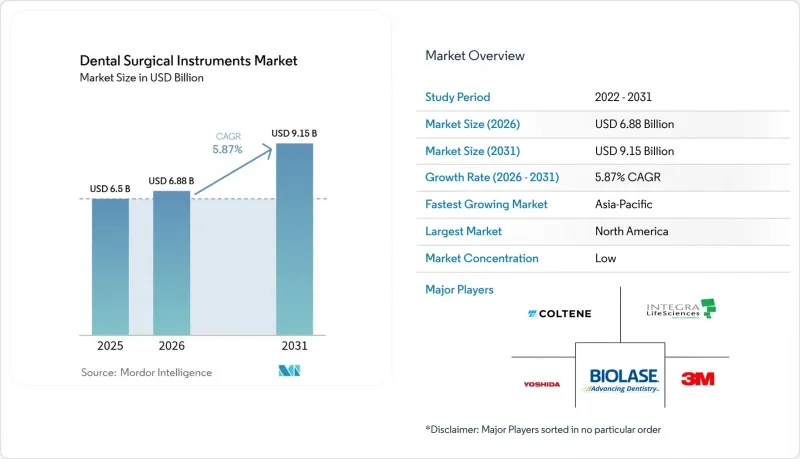
본 보고서는 제품별(핸드헬드 기구, 레이저, 소모품, 기타 제품), 용도별(수복 치과, 교정 치과, 치내 치료, 기타 용도), 지역별(북미, 유럽, 아시아태평양, 중동 및 아프리카, 남미)로 분류되어 있습니다. 시장 예측은 금액(미화) 기준으로 제시되어 있습니다.
전 세계 치과 수술 기구 시장 동향 및 인사이트
압전식 골절개술의 보급
선택적인 미세 진동을 통해 압전 장치는 인접한 신경이나 혈관을 손상시키지 않고 석회화된 조직을 절삭할 수 있어, 제3대구치 발치나 임플란트 식립 부위 준비 시 수술 후 통증과 부기를 완화합니다. 신경 손상률이 낮다는 임상적 증거가 늘어나면서 전문 진료소에서는 기존의 로터리 드릴에서 압전 수술로 전환하는 추세가 확산되고 있습니다. 미국 및 독일의 연수 센터에서는 현재 레지던트 교육 과정에 압전 수술 모듈이 포함되어 있어, 젊은 임상 의사의 기술 향상이 가속화되고 있습니다. 각 공급업체는 접근이 어려운 하악 부위를 위해 팁의 설계 개선을 추진하고 있으며, 유통업체에서는 2024년에 두 자릿수의 판매량 증가가 예상됩니다. 로터리 시스템과의 보험 급여 격차가 좁혀짐에 따라, 이러한 요인은 치과 수술 기구 시장에서 중기적으로 견조한 성장을 지속시킬 것입니다.
AI 유도형 로봇 치과 수술의 보급
로봇 플랫폼은 수술 전 콘빔 CT 데이터와 실시간 내비게이션을 통합함으로써 서브mm 단위의 임플란트 식립 정밀도를 실현하고, 일회용 수술 가이드를 불필요하게 만들었습니다. 2025년 임상시험에서 수기 시술의 평균 직진도 편차가 2.0mm인 반면, 이 기술에서는 1.2mm인 것으로 입증되어 수술 중 조정 횟수가 감소했습니다. 초기 도입자들로부터는 진료 시간 단축과 환자에게 매력적인 예측 가능한 플랩리스 프로토콜에 대한 보고가 이어지고 있습니다. 설비 투자 비용은 여전히 높은 편이지만, 리스 모델이나 서비스 계약을 통해 진입 장벽은 낮아지고 있습니다. 캐나다 및 일본의 규제 당국 승인으로 대상 시장이 확대되면서, 치과 수술 기구 시장 전체에 장기적인 성장 동력을 제공합니다.
치과 수술 기구의 높은 비용
고급 다이오드 레이저는 5만-7만 달러, 압전식 수술 유닛은 5,000-1만 5,000달러에 판매되고 있어 지방 치과 병원의 설비 투자 예산을 초과하고 있습니다. 서비스 계약 및 의무적인 교정으로 인해 연간 소유 비용은 15-20% 증가합니다. 노스캐롤라이나주의 커뮤니티 칼리지는 보조원들에게 첨단 기기 조작법을 교육하기 위해 357만 달러를 확보했으나, 이는 수익을 실현하기까지 막대한 투자가 필요함을 여실히 보여줍니다. 소규모 치과 병원들은 구매를 미루고 있으며, 이는 치과 수술 기구 시장 중 가격에 민감한 부문에서의 보급을 직접적으로 억제하고 있습니다.
부문 분석
2025년, 핸드헬드 기구는 치과 수술 기구 시장 점유율의 39.12%를 유지하고 있으며, 이는 일상적인 스케일링, 발치, 수복 치료에서 이 기구가 수행하는 핵심적인 역할을 반영합니다. 스테인리스 스틸 탐침, 바늘 홀더, 뼈용 파일은 여전히 구매의 기준이 되고 있으며, 핸들의 널링 가공이나 균형 미세 조정과 같은 개선 사항이 임상의들의 지지를 유지하고 있습니다. 지배적인 위치를 차지하고 있음에도 불구하고, 제품 구성은 제한된 수술 영역에서 보다 정교한 조작을 가능하게 하는 미세 수술용 제품으로 점차 전환되고 있습니다. 치과 레이저는 도입 대수는 적지만, 2031년까지 연평균 성장률(CAGR)이 6.86%를 나타낼 것으로 예측되는 가장 빠르게 성장하는 제품군입니다. 교정치과 및 치주과 전문의들은 부수적인 손상을 최소화하면서 연조직을 절제할 수 있는 에르븀 및 다이오드 시스템을 선호하며, 이를 통해 치료 시간을 단축하고 긍정적인 입소문을 촉진하고 있습니다. 레이저 시스템 분야의 치과 수술 기구 시장 규모는 단가 하락과 제조업체가 구매 계약에 교육 프로그램을 함께 제공하는 추세에 힘입어 꾸준히 확대될 것으로 예측됩니다.
임플란트 식립 부위 형성 및 근관 형성 분야에서는 전동 핸드피스 및 수술 모터에 대한 수요가 견조한 추세를 보이고 있습니다. 브러쉬리스 마이크로모터와 내장형 LED 조명은 토크 안정성과 가시성을 향상시켜 고급 모델의 차별화를 더욱 강화하고 있습니다. 전기 수술 유닛은 구강안면 종양학 분야의 응고 처치에 활용되는 한편, 초음파 스케일러는 치주질환의 유지 관리에 있어 여전히 핵심적인 역할을 하고 있습니다. 팬데믹으로 인한 봉쇄 기간 중에는 선택적 심미 치과 치료 건수가 감소했으나, 환자 수가 회복됨에 따라 전동 기구 수요는 급속히 회복되었습니다. 모듈식 배터리 팩이나 오토클레이브 대응 케이스를 활용하는 업체들이 시장 점유율을 확대할 것으로 예상되며, 치과 수술 기구 시장은 기술 주도형 업그레이드의 길을 계속 걸어갈 것입니다.
지역별 분석
2025년, 북미는 치과 수술 기구 시장의 40.85%를 계속 차지했습니다. 로봇을 이용한 임플란트 식이에 대한 조기 보험 급여와 콘빔 CT의 광범위한 도입이 기기의 지속적인 교체 주기를 뒷받침하고 있습니다. 미국치과의사협회(ADA)에 따르면, 현재 미국 치과 진료소의 67%가 원내 3D 영상 진단을 제공하고 있으며, 이 비율이 호환 가능한 수술 가이드 및 정밀 바에 대한 수요를 끌어올리고 있습니다. 2024년 메디케어·메디케이드 서비스 센터(CMS)가 확정된, 진료 장소에 관계없이 일률적으로 지급되는 연방 급여금은 병원의 첨단 구강수술 세트 구매 의욕을 북돋우고 있습니다.
아시아태평양은 2031년까지 연평균 성장률(CAGR)이 7.18%로 가장 강력한 성장세를 보이고 있습니다. 태국과 튀르키예는 서유럽보다 60% 저렴한 가격으로 풀 아치 임플란트 수복을 원하는 해외 환자들을 유치하고 있으며, 임플란트용 드릴, 토크 드라이버, 이식용 주사기의 충분한 재고 확보가 필수적입니다. 중국은 3등급 의료기기에 대한 세제 혜택 조치를 통해 국내 생산량을 늘리고, 공급망의 회복력을 높이고 있습니다. 인도의 ‘생산 연계형 인센티브 제도’는 중규모 의료 기술 기업에 대한 보조금을 지정하고 있어, 초음파 스케일러 및 충전 시스템의 국내 생산을 촉진하고 있습니다. 일본은 국산 햅틱 컨트롤러와 수입 내비게이션 소프트웨어를 결합하여 로봇 기술의 통합을 추진하고, 지역 내 제품 수요의 추가적인 다각화를 도모하고 있습니다.
유럽에서는 치주질환을 대상으로 한 각국의 예방 프로그램의 뒷받침을 받아 꾸준한 보급이 진행되고 있습니다. 독일은 저침습성 구순소대 절제술에 대한 보험 환급 코드를 통해 레이저 치료의 보급을 추진하고 있는 반면, 영국의 국민보건서비스(NHS)는 의료 서비스가 미치지 않는 지역에 도달하기 위해 휴대용 수술 세트를 갖춘 이동 치과 진료차를 운영하고 있습니다. 중동부 유럽 국가들은 대학 부속 병원의 현대화 및 국경을 초월한 연수 교류를 촉진하는 EU 구조 기금의 혜택을 받고 있습니다. 중동 및 아프리카에서는 걸프협력회의(GCC) 회원국들이 석유 수입을 전문 임플란트 센터 건설에 투자하고 있는 반면, 브라질 등 남미 시장에서는 가처분 소득 증가에 따라 심미 치과에 대한 수요가 급증하고 있습니다. 이러한 동향들이 맞물려 치과 수술 기구 시장 전체의 장기적인 성장 기회의 토대가 되고 있습니다.
기타 혜택:
- 엑셀 형식 시장 예측(ME) 시트
- 3개월간의 애널리스트 지원
자주 묻는 질문
목차
제1장 서론
제2장 조사 방법
제3장 주요 요약
제4장 시장 구도
제5장 시장 규모와 성장 예측
제6장 경쟁 구도
제7장 시장 기회와 향후 전망
JHS 26.09.03According to Mordor Intelligence, dental surgical instruments market size in 2026 is estimated at USD 6.88 billion, growing from 2025 value of USD 6.5 billion with 2031 projections showing USD 9.15 billion, growing at 5.87% CAGR over 2026-2031.
This report is Segmented by Product (Handheld Instruments, Lasers, Consumables, and Other Products), Application (Restorative Dentistry, Orthodontics, Endodontics, and Other Applications), and Geography (North America, Europe, Asia-Pacific, Middle East and Africa, and South America). The Market Forecasts are Provided in Terms of Value (USD).
Global Dental Surgical Instruments Market Trends and Insights
Adoption of Piezoelectric-Assisted Osteotomy
Selective micro-vibrations allow piezoelectric devices to cut mineralized tissue while sparing adjacent nerves and vessels, reducing postoperative pain and swelling for third-molar extractions and implant site preparation. Growing clinical evidence of a lower nerve-injury rate is prompting specialty practices to replace conventional rotary drills. Training centers in the United States and Germany now include piezosurgery modules in residency curricula, accelerating competency among young clinicians. Suppliers are refining tip designs for hard-to-access mandibular regions, and distributors report double-digit unit growth in 2024. As reimbursement parity with rotary systems improves, the driver sustains a positive medium-term lift on the dental surgical instruments market.
AI-Guided Robotic Dental Surgery Uptake
Robotics platforms integrate pre-operative cone-beam CT data with real-time navigation, enabling sub-millimeter implant placement accuracy and eliminating disposable surgical guides. Clinical trials in 2025 demonstrated mean trueness deviations of 1.2 mm compared with 2.0 mm for manual techniques, translating to fewer intra-operative adjustments. Early adopters report reduced chair time and predictable flapless protocols that appeal to patients. Capital cost remains high, yet leasing models and service contracts are lowering entry barriers. Regulatory approvals in Canada and Japan broaden the addressable base, feeding long-term momentum across the dental surgical instruments market.
High Cost of Dental Surgical Instruments
Premium diode lasers sell for USD 50,000-70,000 and piezoelectric surgery units for USD 5,000-15,000, exceeding the capital budgets of rural clinics. Service contracts and mandatory calibration add 15-20% to annual ownership costs. Community colleges in North Carolina secured USD 3.57 million to train assistants on advanced devices, underscoring the sizable investment required before revenue materializes. Smaller practices defer purchases, directly suppressing uptake in price-sensitive segments of the dental surgical instruments market.
Other drivers and restraints analyzed in the detailed report include:
- Tourism-Led Demand for Complex Implant Surgeries
- Geriatric Oral-Health Programs Boosting Minimally-Invasive Kits
- Poor Reimbursement Policies
For complete list of drivers and restraints, kindly check the Table Of Contents.
Segment Analysis
Handheld instruments retained 39.12% of dental surgical instruments market share in 2025, reflecting their central role in routine scaling, extraction, and restorative work. Stainless-steel explorers, needle holders, and bone files continue to set purchasing baselines, and incremental refinements in handle knurling and balance sustain loyalty among clinicians. Despite dominance, the product mix is nudging toward micro-surgical variants that allow finer gestures in confined operative fields. Dental lasers, although representing a smaller installed base, are the fastest-growing line with a 6.86% CAGR forecast through 2031. Orthodontic offices and periodontists favor erbium and diode systems that ablate soft tissue with minimal collateral damage, shortening chair time and driving positive word-of-mouth. The dental surgical instruments market size for laser systems is projected to expand steadily as unit prices decline and manufacturers bundle training with purchase agreements.
Powered handpieces and surgical motors are in steady demand for implant bed preparation and endodontic shaping. Brushless micro-motors and integrated LED illumination improve torque stability and visualization, further differentiating premium models. Electrosurgical units cater to coagulation in oro-facial oncology, whereas ultrasonic scalers remain cornerstones of periodontal maintenance. Although elective cosmetic cases fell during pandemic lockdowns, powered instrumentation rebounded swiftly as patient flow normalized. Vendors leveraging modular battery packs and autoclavable casings are expected to capture share, keeping the dental surgical instruments market on a technology-driven upgrade path.
Complete Report Scope:
- By Product Type (Value)
- Handheld Instruments
- Handpieces & Motors
- Electrosurgical & Cautery Systems
- Ultrasonic Instruments & Scalers
- Powered Surgical Instruments
- Dental Lasers
- Sutures & Hemostats
- By Application (Value)
- Implantology
- Endodontic Surgery
- Periodontal Surgery
- Orthodontic & Cosmetic Surgery
- Oral & Maxillofacial Surgery
- Restorative / Prosthodontic Surgery
- By End User (Value)
- Hospitals
- Dental Clinics
- Others
- By Geography (Value)
- North America
- United States
- Canada
- Mexico
- Europe
- Germany
- United Kingdom
- France
- Italy
- Spain
- Rest of Europe
- Asia-Pacific
- China
- India
- Japan
- South Korea
- Australia
- Rest of Asia-Pacific
- Middle East and Africa
- GCC
- South Africa
- Rest of Middle East
- South America
- Brazil
- Argentina
- Rest of South America
- North America
Geography Analysis
North America retained 40.85% of the dental surgical instruments market in 2025. Early reimbursement for robotic implant placement and widespread incorporation of cone-beam CT underwrite sustained equipment refresh cycles. The American Dental Association notes that 67% of U.S. practices now offer in-house 3-D imaging, a rate that pushes demand for compatible surgical guides and precision burs. Federal payment parity across service sites, finalized by the Centers for Medicare & Medicaid Services in 2024, strengthens hospital purchasing confidence for advanced oral-surgery sets.
Asia-Pacific shows the strongest momentum with a 7.18% CAGR to 2031. Thailand and Turkey attract inbound patients seeking full-arch implant rehabilitation at prices 60% lower than in Western Europe, necessitating robust inventories of implant drills, torque drivers, and graft syringes. China increases local manufacturing output through tax breaks on Class III medical devices, enhancing supply chain resilience. India's Production-Linked Incentive scheme earmarks subsidies for mid-size med-tech firms, lifting domestic output of ultrasonic scalers and obturation systems. Japan advances robotics integration by pairing indigenous haptic controllers with imported navigation software, further diversifying regional product demand.
Europe continues to exhibit steady uptake driven by national prevention programs targeting periodontal disease. Germany champions laser adoption via reimbursement codes for minimally invasive frenectomies, while the United Kingdom's NHS deploys mobile dental vans equipped with portable surgical sets to reach underserved communities. Central and Eastern Europe benefit from EU structural funds that modernize university clinics and foster cross-border training exchanges. In the Middle East and Africa, Gulf Cooperation Council states allocate oil revenues to build specialized implant centers, whereas South American markets such as Brazil witness a surge in esthetic demand linked to rising disposable income. Collectively, these dynamics anchor long-run expansion opportunities across the dental surgical instruments market.
- Danaher Corporation (KaVo, Nobel Biocare)
- Dentsply Sirona
- Henry Schein Inc. (Hu-Friedy)
- 3M
- Straumann Group
- Osstem Implant Co., Ltd.
- Coltene Holding
- B. Braun Melsungen AG (Aesculap)
- Acteon Group
- Brasseler USA
- BIOLASE Inc.
- Carl Zeiss
- A-dec
- NSK Nakanishi Inc.
- W&H Group
- Planmeca
- Dentium Co., Ltd.
- Zimvie
- Yoshida Dental Mfg. Co., Ltd.
- Medesy Srl
Additional Benefits:
- The market estimate (ME) sheet in Excel format
- 3 months of analyst support
TABLE OF CONTENTS
1 Introduction
- 1.1 Study Assumptions & Market Definition
- 1.2 Scope of the Study
2 Research Methodology
3 Executive Summary
4 Market Landscape
- 4.1 Market Overview
- 4.2 Market Drivers
- 4.2.1 Adoption of piezoelectric-assisted osteotomy
- 4.2.2 AI-guided robotic micro-surgery uptake in North America implant centres
- 4.2.3 Tourism-led demand for complex implant surgeries in Turkey & GCC drives kit sales
- 4.2.4 Geriatric oral-health programs boosting minimally-invasive kits in Japan & Nordics
- 4.2.5 Bulk procurement by fast-growing DSO chains in U.S. & Canada
- 4.2.6 Clear-aligner IPR boom driving precision burs demand in South America
- 4.3 Market Restraints
- 4.3.1 Reimbursement gap for advanced electrosurgical devices in Caribbeans & Africa
- 4.3.2 Limited stainless-steel metallurgy capacity in Nordics inflates costs
- 4.3.3 EU MDR certification delays for new laser handpieces
- 4.3.4 Counterfeit handhelds influx from Asia impacting Oceania
- 4.4 Value / Supply-Chain Analysis
- 4.5 Regulatory & Technological Outlook
- 4.6 Porter's Five Forces
- 4.6.1 Bargaining Power of Suppliers
- 4.6.2 Bargaining Power of Buyers
- 4.6.3 Threat of New Entrants
- 4.6.4 Threat of Substitutes
- 4.6.5 Competitive Rivalry
5 Market Size & Growth Forecasts
- 5.1 By Product Type (Value)
- 5.1.1 Handheld Instruments
- 5.1.2 Handpieces & Motors
- 5.1.3 Electrosurgical & Cautery Systems
- 5.1.4 Ultrasonic Instruments & Scalers
- 5.1.5 Powered Surgical Instruments
- 5.1.6 Dental Lasers
- 5.1.7 Sutures & Hemostats
- 5.2 By Application (Value)
- 5.2.1 Implantology
- 5.2.2 Endodontic Surgery
- 5.2.3 Periodontal Surgery
- 5.2.4 Orthodontic & Cosmetic Surgery
- 5.2.5 Oral & Maxillofacial Surgery
- 5.2.6 Restorative / Prosthodontic Surgery
- 5.3 By End User (Value)
- 5.3.1 Hospitals
- 5.3.2 Dental Clinics
- 5.3.3 Others
- 5.4 By Geography (Value)
- 5.4.1 North America
- 5.4.1.1 United States
- 5.4.1.2 Canada
- 5.4.1.3 Mexico
- 5.4.2 Europe
- 5.4.2.1 Germany
- 5.4.2.2 United Kingdom
- 5.4.2.3 France
- 5.4.2.4 Italy
- 5.4.2.5 Spain
- 5.4.2.6 Rest of Europe
- 5.4.3 Asia-Pacific
- 5.4.3.1 China
- 5.4.3.2 India
- 5.4.3.3 Japan
- 5.4.3.4 South Korea
- 5.4.3.5 Australia
- 5.4.3.6 Rest of Asia-Pacific
- 5.4.4 Middle East and Africa
- 5.4.4.1 GCC
- 5.4.4.2 South Africa
- 5.4.4.3 Rest of Middle East
- 5.4.5 South America
- 5.4.5.1 Brazil
- 5.4.5.2 Argentina
- 5.4.5.3 Rest of South America
- 5.4.1 North America
6 Competitive Landscape
- 6.1 Market Concentration
- 6.2 Strategic Moves
- 6.3 Market Share Analysis
- 6.4 Company Profiles {(includes Global level Overview, Market level overview, Core Segments, Financials as available, Strategic Information, Market Rank/Share for key companies, Products & Services, and Recent Developments)}
- 6.4.1 Danaher Corporation (KaVo, Nobel Biocare)
- 6.4.2 Dentsply Sirona Inc.
- 6.4.3 Henry Schein Inc. (Hu-Friedy)
- 6.4.4 3M Company
- 6.4.5 Institut Straumann AG
- 6.4.6 Osstem Implant Co., Ltd.
- 6.4.7 COLTENE Holding AG
- 6.4.8 B. Braun Melsungen AG (Aesculap)
- 6.4.9 ACTEON Group
- 6.4.10 Brasseler USA
- 6.4.11 BIOLASE Inc.
- 6.4.12 Carl Zeiss Meditec AG
- 6.4.13 A-dec Inc.
- 6.4.14 NSK Nakanishi Inc.
- 6.4.15 W&H Group
- 6.4.16 Planmeca Oy
- 6.4.17 Dentium Co., Ltd.
- 6.4.18 Zimvie
- 6.4.19 Yoshida Dental Mfg. Co., Ltd.
- 6.4.20 Medesy Srl
7 Market Opportunities & Future Outlook
- 7.1 White-space & Unmet-Need Assessment


