

|
시장보고서
상품코드
2114523
자가 세포 치료 시장 : 점유율 분석, 업계 동향과 통계, 성장 예측(2026-2031년)Autologous Cell Therapy - Market Share Analysis, Industry Trends & Statistics, Growth Forecasts (2026 - 2031) |
||||||
 Mordor Intelligence
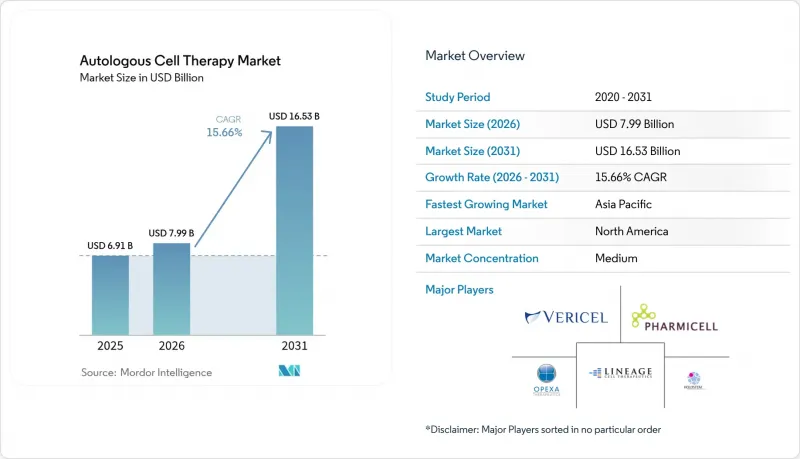
Mordor Intelligence에 의하면, 자가 세포 치료 시장 규모는 2025년에 69억 1,000만 달러로 평가되었고 2026년 79억 9,000만 달러에서 2031년까지 165억 3,000만 달러에 이를 것으로 예측되며, 예측 기간(2026-2031년) CAGR은 15.66%를 나타낼 전망입니다.
본 보고서에서는 치료법별(줄기세포 치료, 면역세포 치료, 유전자 변형 비면역세포 치료), 용도별(종양학, 심혈관 질환, 정형외과·근골격계 질환, 신경학 등), 지역별(북미, 유럽, 아시아태평양, 중동 및 아프리카, 남미)로 업계를 분류하고 있습니다. 시장 전망은 금액(달러) 기준으로 제시되어 있습니다.
전 세계 자가 세포 치료 시장 동향 및 인사이트
전 세계 승인된 CAR-T 요법의 전개
승인된 CAR-T 제품의 전 세계적 전개는 혈액 질환을 넘어 자가면역 질환 및 고형암 적응증으로 확대되고 있습니다. 2026년 출시를 예정하고 있는 길리어드(Gilead)사의 ‘anito-cel’은 다발성 골수종을 표적으로 하며, 제3상 임상시험에서 입원 환자에 대한 정맥 주사 투여의 20%를 외래 치료로 전환하는 것을 목표로 하고 있습니다. 브리스톨-마이어스 스퀴브사의 CD19 NEX-T 프로그램은 최적화된 제조 기술을 중증 전신성 홍반성 루푸스에 적용하고 있으며, 이는 종양학에서 면역 리셋 치료로 전략적 전환을 시사합니다. 2억 달러 규모의 바이오엔테크(BioNTech)와 오툴러스(Autolus)간의 제휴는 여러 자산으로 구성된 파이프라인을 뒷받침할 수 있는 공유 생산 플랫폼을 중심으로 한 통합을 강조하는 것입니다(오툴러스 테라퓨틱스). Kite Pharma의 실세계 데이터에 따르면, Yescarta는 외래 종양 클리닉에서 안전하게 투여할 수 있으며, 병상 점유율과 총 의료비를 절감할 수 있는 것으로 확인되었습니다(Kite Pharma). 이러한 이정표들이 결합되면서 환자의 접근성이 확대되는 동시에 자가 세포 치료 시장을 둘러싼 경제적 전망도 개선되고 있습니다.
밀폐형 포인트 오브 케어 바이오리액터의 급속한 보급
밀폐형 자동 바이오리액터는 밀폐된 카세트 내에서 세포 분리, 형질 도입, 증식을 통합하여, 기존에는 배치 실패 요인이 되었던 수작업 공정을 줄여줍니다. Ori Biotech사의 IRO 플랫폼은 기존 워크플로우의 45%에 비해 69%의 바이러스 형질전환율을 달성하는 동시에, 생산 주기를 25% 단축함으로써 1회분당 비용을 절반으로 줄였습니다. Xcell Biosciences사는 자사의 ‘AVATAR Foundry’에서 50mL부터 1.5L에 이르는 규모에 걸쳐 일관된 T세포 증식이 확인되어, 병원 클린룸 내 분산형 운영이 가능해졌습니다. 이러한 개선 사항은 공급의 회복탄력성을 강화하는 동시에 자가 유래 세포 치료 시장에서 선순환을 만들어내고 있습니다. 즉, 처리 시간 단축이 임상 도입을 더욱 촉진하는 선순환입니다.
높은 비용과 제한된 규모의 경제성
기증자별 선별 검사, 독자적인 배치 기록, 그리고 낮은 설비 가동률로 인해 환자 1인당 제조 비용은 2,260-3,040파운드에 달하는 반면, 동종 이식 옵션의 경우 930-1,140파운드에 그칩니다(『BioPharm International』). 동원 시술의 평균 비용은 1만 605달러이지만, 『Nature Blood &Marrow Transplantation』지에 따르면, 유해 사건 없이 최적의 CD34+ 세포 수율을 달성할 수 있는 후보자는 불과 20%에 불과합니다. 자동화를 통해 노동 집약성이 해소되기 전까지는 높은 비용이 자가 유래 세포 치료 시장의 확산을 저해하는 요인이 될 것입니다.
부문 분석
2025년, 면역 세포 제품은 자가 세포 치료 시장 점유율의 43.12%를 차지했으며, CAR-T, TCR-T 및 종양 침윤 림프구 치료가 혈액학 이외의 분야에서도 치료 가능성을 입증함에 따라 연평균 성장률(CAGR) 16.98%로 성장했습니다. 배양 시간을 단축한 차세대 CD19 구축체 등 획기적인 발전이 임상 현장에서의 신뢰도 향상을 뒷받침하고 있습니다. 한편, 난치성 고형암을 대상으로 임상시험이 진행 중인 자연살해(NK) 세포 치료법은 더 광범위한 면역 커버리지를 약속하면서도 자가 유래 세포 특유의 적합성 이점을 유지하고 있습니다.
줄기세포 치료는 조혈모세포 이식 및 염증성 질환에 대한 중간엽 줄기세포(MSC)의 응용을 통해 여전히 필수적인 위치를 차지하고 있습니다. 2025년 remestemcel-L이 FDA 승인을 받으면서, MSC 치료는 소아 GVHD에 대한 최초의 적응증을 획득하여 투자자들의 관심을 다시 불러일으켰습니다. 유도 만능 줄기세포(iPS 세포) 파이프라인은 허혈성 심근증을 표적으로 하고 있지만, 기존 치료법과 경쟁하기 위해서는 1회 투여당 원가를 8만 달러 미만으로 억제해야 합니다. 유전자 변형 비면역 세포는 틈새 재생의학 분야를 차지하고 있으며, CRISPR-Cas를 통한 정밀성의 이점을 누리고 있는 반면, 광범위한 방출 시험 요건에 직면해 있습니다.
지역별 분석
북미는 2025년 자가 세포 치료 시장 점유율 52.74%를 유지했습니다. 이는 등록 데이터 수집을 조건으로 승인된 제품에 대한 환급을 실시하는 메디케어의 CGT 접근 모델(CMS)에 힘입은 결과입니다. 이 지역의 견고한 CDMO 네트워크가 공급 라인을 단축시키고 있으며, FDA 치료제품국은 2025년까지 연간 10-20건의 승인을 예상하고 있어 리더십을 유지할 전망입니다.
아시아태평양은 일본의 신속 승인 프로그램 ‘사키가케’와 현재 특정 CAR-T 요법을 보험 적용 대상으로 하고 있는 중국의 성(省) 단위 보험 시범 사업과 같은 지원적인 규제 덕분에 17.58%라는 가장 높은 연평균 성장률(CAGR)을 기록했습니다. 현지에 설치된 소규모 공장을 통해 물류 비용을 최대 40%까지 절감할 수 있으며, 이는 신흥 경제국에서 필수적인 요소가 되고 있습니다. 인도는 의료 관광을 활용하는 한편, 호주와 한국은 지역 GMP 허브에 투자하여 자가 세포 치료 시장을 더욱 확대되고 있습니다.
유럽에서는 관리형 시장 진입 협정에 따라 다년간의 지급이 임상적 이익과 연동되도록 되어 있어 꾸준한 성장이 예상됩니다. 독일의 NUB(신규 치료법) 환급 제도에서는 공식적인 가격 협상에 앞서 일시적인 자금 지원이 이루어지기 때문에 시장 진입 장벽이 완화되고 있습니다. 동유럽 및 러시아 시장은 여전히 초기 단계이지만, 규제가 명확해짐에 따라 장기적인 성장 잠재력을 지니고 있습니다.
기타 혜택:
- 엑셀 형식 시장 예측(ME) 시트
- 3개월간의 애널리스트 지원
자주 묻는 질문
목차
제1장 서론
제2장 조사 방법
제3장 주요 요약
제4장 시장 구도
제5장 시장 규모와 성장 예측
제6장 경쟁 구도
제7장 시장 기회와 향후 전망
JHS 26.09.03According to Mordor Intelligence, the autologous cell therapy market size was valued at USD 6.91 billion in 2025 and estimated to grow from USD 7.99 billion in 2026 to reach USD 16.53 billion by 2031, at a CAGR of 15.66% during the forecast period (2026-2031).
This report Segments the Industry Into by Therapy Modality (Stem Cell Therapy, Immune Cell Therapy, Gene-Modified Non-Immune Cell Therapies), by Application (Oncology, Cardiovascular, Orthopaedic & Musculoskeletal Disorders, Neurology and More ), and Geography (North America, Europe, Asia-Pacific, Middle East and Africa, South America). The Market Forecasts are Provided in Terms of Value (USD)
Global Autologous Cell Therapy Market Trends and Insights
Post-approval CAR-T Therapy Roll-outs Worldwide
Global deployment of licensed CAR-T products is broadening beyond hematology to autoimmune and solid-tumor indications. Gilead's anito-cel, positioned for a 2026 launch, targets multiple myeloma with the ambition to convert 20% of inpatient infusions to outpatient settings during pivotal trials. Bristol Myers Squibb's CD19 NEX-T program applies optimized manufacturing to severe systemic lupus erythematosus, signalling a strategic pivot from oncology into immune reset therapies. A USD 200 million BioNTech-Autolus alliance underscores consolidation around shared production platforms able to support multi-asset pipelines Autolus Therapeutics. Real-world evidence from Kite Pharma confirms that Yescarta can be administered safely in outpatient oncology clinics, reducing bed occupancy and total care costs Kite Pharma. Together, these milestones widen patient access while improving the economic narrative that surrounds the autologous cell therapy market.
Rapid Adoption of Closed-system Point-of-care Bioreactors
Closed, automated bioreactors integrate cell isolation, transduction, and expansion inside a sealed cassette, trimming manual touch-points that previously drove batch failures. Ori Biotech's IRO platform achieved 69% viral transduction versus 45% in legacy workflows while halving per-dose costs through 25% shorter production cycles. Xcell Biosciences reports consistent T-cell outgrowth in its AVATAR Foundry across 50 mL to 1.5 L scale, enabling decentralized runs within hospital cleanrooms. These improvements strengthen supply resilience and create a virtuous feedback loop in the autologous cell therapy market, whereby faster turn-around amplifies clinical adoption.
High Cost & Limited Economies of Scale
Per-patient manufacturing totals GBP 2,260-3,040 versus GBP 930-1,140 for allogeneic options due to donor-specific screening, unique batch records, and low equipment utilization BioPharm International. Mobilization procedures average USD 10,605, with merely 20% of candidates achieving optimal CD34+ cell yields without adverse events Nature Blood & Marrow Transplantation. Until automation neutralizes labor intensity, high cost tempers diffusion of the autologous cell therapy market.
Other drivers and restraints analyzed in the detailed report include:
- Expansion of Cell-processing Micro-factories Inside Transplant Centres
- Emergence of Cryopreserved Autologous Starting-material Banks
- Complex Vein-to-Vein Logistics & QC Bottlenecks
For complete list of drivers and restraints, kindly check the Table Of Contents.
Segment Analysis
Immune-cell products held 43.12% of autologous cell therapy market share in 2025, growing at a 16.98% CAGR as CAR-T, TCR-T, and tumor-infiltrating lymphocyte therapies validate curative potential beyond hematology. Breakthroughs such as next-generation CD19 constructs with shortened culture times underpin rising clinical confidence. Meanwhile, natural-killer cell programs trialed in refractory solid tumors promise broader immune coverage yet retain autologous compatibility advantages.
Stem-cell modalities remain integral through hematopoietic transplantation and mesenchymal stem cell (MSC) applications in inflammatory disorders. FDA clearance of remestemcel-L in 2025 gave MSC therapies their first pediatric GVHD label, revitalizing investor appetite. Induced pluripotent stem cell pipelines target ischemic cardiomyopathy but will require cost-of-goods below USD 80,000 per dose to compete with existing options. Gene-modified non-immune cells occupy niche regenerative segments, benefiting from CRISPR-Cas precision yet facing extensive release testing demands.
Complete Report Scope:
- By Therapy Modality (Value)
- Stem Cell Therapies
- Hematopoietic Stem Cells (HSC)
- Mesenchymal Stem Cells (MSC)
- Induced Pluripotent Stem Cells (iPSC)
- Immune Cell Therapies
- CAR-T Cells
- TCR-T Cells
- Tumour-Infiltrating Lymphocytes (TIL)
- Natural Killer (NK) Cells
- Gene-Modified Non-immune Cell Therapies
- Stem Cell Therapies
- By Application (Value)
- Oncology
- Cardiovascular Diseases
- Orthopaedic & Musculoskeletal Disorders
- Neurology
- Dermatology & Wound Healing
- Auto-immune Disorders
- Others
- By End User (Value)
- Hospitals & Transplant Centres
- Specialty Clinics
- Academic & Research Institutes
- Others
- By Geography (Value)
- North America
- United States
- Canada
- Europe
- Germany
- United Kingdom
- France
- Italy
- Spain
- Russia
- Asia-Pacific
- China
- Japan
- India
- South Korea
- Australia
- Rest of Asia-Pacific
- Middle East & Africa
- GCC
- South Africa
- Rest of Middle East and Africa
- South America
- Brazil
- Argentina
- Rest of South America
- North America
Geography Analysis
North America maintained 52.74% of autologous cell therapy market share in 2025, propelled by Medicare's CGT Access Model that reimburses approved products contingent on registry data collection CMS. The region's robust CDMO network shortens supply lines, and FDA's Office of Therapeutic Products expects 10-20 annual approvals by 2025, sustaining leadership.
Asia-Pacific recorded the highest 17.58% CAGR owing to supportive regulation under Japan's fast-track Sakigake program and China's provincial insurance pilots that now cover select CAR-T therapies. Localized micro-factories dampen logistics costs by up to 40%, an essential factor in emerging economies. India leverages medical tourism, while Australia and South Korea invest in regional GMP hubs, further enlarging the autologous cell therapy market.
Europe grows steadily as managed entry agreements align multi-year payments with clinical benefit. Germany's NUB reimbursement path grants temporary funding ahead of formal price negotiation, easing market access hurdles. Eastern Europe and Russia remain nascent but represent long-run whitespace as regulatory clarity improves.
- Novartis
- Gilead Sciences / Kite Pharma
- Bristol-Myers Squibb
- Vericel
- Anterogen Co. Ltd.
- Pharmicell Co. Ltd.
- Osiris Therapeutics / Smith+Nephew
- SanBio Co. Ltd.
- Kolon TissueGene
- Boehringer Ingelheim (Stemlab)
- Medipost Co. Ltd.
- ReNeuron Group
- Takeda Pharmaceutical (TiGenix)
- Cell Therapies Pty Ltd.
- Lonza Group (Autologous CDMO)
- Minaris Regenerative Medicine
- Fate Therapeutics
- Tessa Therapeutics
- CliniMACS / Miltenyi Biotec
- MaxCyte
- BioNTech Cell & Gene
- Iovance Biotherapeutics
- NorthX Biologics
- Vineti Inc.
- Ori Biotech
Additional Benefits:
- The market estimate (ME) sheet in Excel format
- 3 months of analyst support
TABLE OF CONTENTS
1 Introduction
- 1.1 Study Assumptions & Market Definition
- 1.2 Scope of the Study
2 Research Methodology
3 Executive Summary
4 Market Landscape
- 4.1 Market Overview
- 4.2 Market Drivers
- 4.2.1 Post-approval CAR-T therapy roll-outs worldwide
- 4.2.2 Rapid adoption of closed-system point-of-care bioreactors
- 4.2.3 Expansion of cell-processing micro-factories inside transplant centres
- 4.2.4 Emergence of cryopreserved autologous starting-material banks
- 4.2.5 Outcomes-based reimbursement pilots in EU & Japan
- 4.3 Market Restraints
- 4.3.1 High cost & limited economies of scale
- 4.3.2 Complex vein-to-vein logistics & QC bottlenecks
- 4.3.3 Scarcity of viable cells in heavily pre-treated oncology patients
- 4.3.4 Inter-patient cellular phenotype variability
- 4.4 Value / Supply-Chain Analysis
- 4.5 Regulatory Landscape
- 4.6 Technological Outlook
- 4.7 Porter's Five Forces
- 4.7.1 Threat of New Entrants
- 4.7.2 Bargaining Power of Suppliers
- 4.7.3 Bargaining Power of Buyers
- 4.7.4 Threat of Substitutes
- 4.7.5 Competitive Rivalry
5 Market Size & Growth Forecasts
- 5.1 By Therapy Modality (Value)
- 5.1.1 Stem Cell Therapies
- 5.1.1.1 Hematopoietic Stem Cells (HSC)
- 5.1.1.2 Mesenchymal Stem Cells (MSC)
- 5.1.1.3 Induced Pluripotent Stem Cells (iPSC)
- 5.1.2 Immune Cell Therapies
- 5.1.2.1 CAR-T Cells
- 5.1.2.2 TCR-T Cells
- 5.1.2.3 Tumour-Infiltrating Lymphocytes (TIL)
- 5.1.2.4 Natural Killer (NK) Cells
- 5.1.3 Gene-Modified Non-immune Cell Therapies
- 5.1.1 Stem Cell Therapies
- 5.2 By Application (Value)
- 5.2.1 Oncology
- 5.2.2 Cardiovascular Diseases
- 5.2.3 Orthopaedic & Musculoskeletal Disorders
- 5.2.4 Neurology
- 5.2.5 Dermatology & Wound Healing
- 5.2.6 Auto-immune Disorders
- 5.2.7 Others
- 5.3 By End User (Value)
- 5.3.1 Hospitals & Transplant Centres
- 5.3.2 Specialty Clinics
- 5.3.3 Academic & Research Institutes
- 5.3.4 Others
- 5.4 By Geography (Value)
- 5.4.1 North America
- 5.4.1.1 United States
- 5.4.1.2 Canada
- 5.4.2 Europe
- 5.4.2.1 Germany
- 5.4.2.2 United Kingdom
- 5.4.2.3 France
- 5.4.2.4 Italy
- 5.4.2.5 Spain
- 5.4.2.6 Russia
- 5.4.3 Asia-Pacific
- 5.4.3.1 China
- 5.4.3.2 Japan
- 5.4.3.3 India
- 5.4.3.4 South Korea
- 5.4.3.5 Australia
- 5.4.3.6 Rest of Asia-Pacific
- 5.4.4 Middle East & Africa
- 5.4.4.1 GCC
- 5.4.4.2 South Africa
- 5.4.4.3 Rest of Middle East and Africa
- 5.4.5 South America
- 5.4.5.1 Brazil
- 5.4.5.2 Argentina
- 5.4.5.3 Rest of South America
- 5.4.1 North America
6 Competitive Landscape
- 6.1 Market Concentration
- 6.2 Market Share Analysis
- 6.3 Company Profiles (includes Global level Overview, Market level overview, Core Segments, Financials as available, Strategic Information, Market Rank/Share for key companies, Products & Services, and Recent Developments)
- 6.3.1 Novartis AG
- 6.3.2 Gilead Sciences / Kite Pharma
- 6.3.3 Bristol Myers Squibb
- 6.3.4 Vericel Corporation
- 6.3.5 Anterogen Co. Ltd.
- 6.3.6 Pharmicell Co. Ltd.
- 6.3.7 Osiris Therapeutics / Smith+Nephew
- 6.3.8 SanBio Co. Ltd.
- 6.3.9 Kolon TissueGene
- 6.3.10 Boehringer Ingelheim (Stemlab)
- 6.3.11 Medipost Co. Ltd.
- 6.3.12 ReNeuron Group
- 6.3.13 Takeda Pharmaceutical (TiGenix)
- 6.3.14 Cell Therapies Pty Ltd.
- 6.3.15 Lonza Group (Autologous CDMO)
- 6.3.16 Minaris Regenerative Medicine
- 6.3.17 Fate Therapeutics
- 6.3.18 Tessa Therapeutics
- 6.3.19 CliniMACS / Miltenyi Biotec
- 6.3.20 MaxCyte Inc.
- 6.3.21 BioNTech Cell & Gene
- 6.3.22 Iovance Biotherapeutics
- 6.3.23 NorthX Biologics
- 6.3.24 Vineti Inc.
- 6.3.25 Ori Biotech
7 Market Opportunities & Future Outlook
- 7.1 White-space & Unmet-Need Assessment


