|
시장보고서
상품코드
2114536
살서제 시장 : 점유율 분석, 업계 동향과 통계, 성장 예측(2026-2031년)Rodenticides - Market Share Analysis, Industry Trends & Statistics, Growth Forecasts (2026 - 2031) |
||||||
 Mordor Intelligence
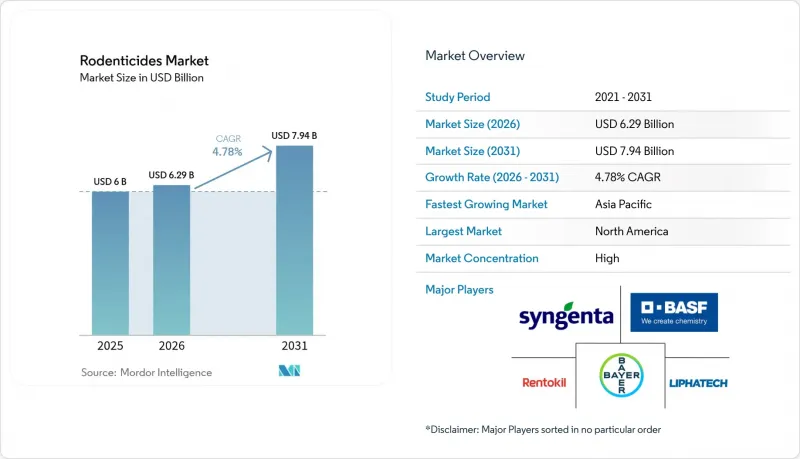
Mordor Intelligence에 의하면, 살서제 시장 규모는 2025년 60억 달러에서 2026년에는 62억 9,000만 달러로 확대되어 2026년부터 2031년까지 CAGR 4.78%로 성장을 지속하여, 2031년에는 79억 4,000만 달러에 이를 것으로 예측됩니다.
본 보고서는 유형(비항응고계 살서제 및 항응고계 살서제), 형태(블록, 펠릿, 분말 등),용도(농지, 창고·보관 시설 등), 유통 경로(해충 방제 업체(PCO) 등), 지역(북미, 유럽, 아시아태평양 등)별로 분류되어 있습니다. 시장 예측은 금액(달러) 기준으로 제시되어 있습니다.
세계 살서제 시장 동향 및 인사이트
생물 보안 대책이 강화된 상품 무역 기준의 급증
무역 협정에서는 국경을 넘는 해충의 전파를 방지하기 위해 인증된 쥐 퇴치 프로토콜의 채택이 점점 더 요구되고 있으며, 곡물 터미널, 창고, 해운 회사는 전문가에 의한 살서제 살포나 통합 해충 관리(IPM) 계획의 도입을 강요받고 있습니다. 유럽연합(EU) 및 북미의 유사한 규제로 인해 수출 적격성은 ‘해충 없음’ 보관 증명서와 연계되어 있으며, 수출업체들은 2세대 항응고성 살서제(SGAR) 관리 규범을 준수하고 위조 방지 기능이 탑재된 미끼 상자를 도입하도록 권장받고 있습니다. 이러한 조치는 수백만 달러 규모의 화물이 검역에서 압류되는 것을 방지하며, 전문용 살서제가 무역의 연속성을 지키기 위한 최전선 도구로 자리매김하게 합니다. 경제협력개발기구(OECD)와 유엔식량농업기구(FAO)의 ‘농업 전망’에 따르면, 2032년까지 소비량이 연평균 1.3% 성장할 것으로 예측되며, 이미 포화 상태에 이른 물류 네트워크에 가해지는 압박이 더욱 심화되는 가운데 경제적 인센티브는 더욱 확대되고 있습니다.
식량 수요 증가와 농업 생산성 향상
칼로리 수요 증가와 기후 변화로 인한 수확량 변동으로 인해, 곡물 및 원예 시스템에서는 수확 후 손실이 심각해지고 있습니다. 설치류 방제가 미흡한 신흥 시장에서는 그 손실이 30-40%에 달하기도 합니다. 아시아태평양의 벼 재배 지대에서 실시된 현장 조사에 따르면, 생태계 기반의 설치류 관리를 통해 수확량이 6-15% 향상되고 농가 소득이 15% 이상 증가하는 것으로 나타났으며, 이는 살서제 투자에 비해 매우 매력적인 수익률이라고 할 수 있습니다. 아프리카에서는 다유두쥐가 옥수수 수확량을 최대 48%나 감소시키고 있어, 각국 정부는 광범위한 인산아연 방제 캠페인에 대한 지원을 할 수밖에 없는 실정입니다. 유엔 식량농업기구(FAO)는 사일로의 구조적 개선과 표적 화학 방제를 결합함으로써 저장 중 손실을 대폭 줄일 수 있음을 확인했습니다. 기후 변화로 인해 번식기가 장기화되는 가운데, 생산자들은 국지적인 방제에서 계획적인 살포로 규모를 확대하고 있으며, 이는 살서제 시장의 장기적인 판매량 증가를 뒷받침하고 있습니다.
내성을 가진 해충 증가
유전적 변이, 특히 Vkorc1 유전자의 변이는 1세대 및 2세대 항응고제의 효과를 약화시키고, 처리 비용을 상승시키며, 피해의 장기화를 초래하고 있습니다. 레바논에서 실시된 현장 조사에서는 살서제 판매에 대한 감시가 미흡한 상황임에도 불구하고, 집쥐와 늑대쥐에서 내성이 확인되었습니다. 뉴질랜드의 연구에서는 과거에 노출 이력이 없는 고립된 개체군에서 브로디파쿰에 대한 내성이 검출되어, 유전적 부동에 의한 자연 발생적 내성의 가능성이 시사되고 있습니다. 캘리포니아의 지리스는 현재 디파시논이나 클로로파시논의 단회 투여를 견뎌내게 되어, 아연 인화물이나 코레칼시페롤 혼합제로의 전환이 불가피한 상황입니다. 내성의 확산은 서비스 의뢰 건수를 증가시키고 진단 기술에 대한 투자를 촉진하는 한편, 기존 화학 물질의 판매량 증가세를 둔화시키고 있습니다.
부문 분석
항응고제는 2025년 매출의 65.40%를 차지하며, 살서제 시장에서 주도적인 위치를 공고히 하고 있습니다. 내성 균주에 대한 1회 투여 시 치사율은 규제 당국이 허용 농도를 낮추고 있는 상황에서도 창고나 식품 공장에서의 사용을 뒷받침하고 있습니다. 브로디파쿰(Brodiacoum)과 같은 2세대 화합물은 여전히 전문가들의 지지를 받고 있지만, 비항응고제 계열은 2031년까지 연평균 성장률(CAGR) 7.35%를 나타낼 것으로 예측되며, 인화아연 및 코레칼시페롤 하이브리드 제품에 대한 수요가 증가하고 있습니다. 연구에 따르면, 인화아연은 야생 개체군을 58.15% 감소시켜 기존의 1세대 제품보다 우수한 결과를 보였습니다.
한편, 브로메탈린과 스트리키닌은 항응고제 내성이 급증하고 있는 굴형 개체군에서 틈새 용도로 활용되고 있습니다. 저소득 지역에서 금속 인화물에 대한 규제 동향이 광범위한 채택을 억제하고 있지만, 특수한 수요로 인해 일정한 수요는 유지되고 있습니다. 전반적으로, 포트폴리오의 다양화를 통해 시장을 선도하는 기업들은 개별적인 규제 강화의 영향을 완화할 수 있으며, 살서제 시장은 적응력을 유지하고 있습니다.
블록형 제품은 내후성이 뛰어나고, 2세대 항응고제 계통 살서제(SGAR) 관리 체제에서 의무화되어 있는 변조 방지 스테이션과 호환성이 있어, 2025년 시장 규모에서 수요의 44.30% 점유율을 유지했습니다. 전문가들은 실외 내구성이 높고 재방문 빈도를 줄일 수 있다는 점을 높이 평가했습니다. 그 다음으로 펠릿이 뒤를 잇고 있으며, 논이나 줄 재배 작물에 기계를 이용한 살포에 적합하다는 점에서 선호되고 있습니다. 액상 농축제에 기인한 살서제 시장 규모는 정밀 살포 장치 및 미끼 주머니 충전기의 보급에 따라 시장 전체의 확대율을 상회하는 연평균 성장률(CAGR) 7.05%를 나타낼 것으로 예측됩니다.
현장 조사에 따르면, 파라핀 블록은 실외에서도 유효 성분의 회수율이 100%를 유지했으나, 5주 이내에 50%가 박리되었기 때문에 고정 시스템의 혁신이 진행되고 있습니다. 페이스트와 젤은 눈에 띄지 않는 살포가 필수적인, 가시성이 높은 소매점이나 호텔 및 레스토랑 업계에서 수요가 증가하고 있습니다. 분말은 비산 우려로 인해 수요가 감소하고 있지만, 곡물 시설의 훈증용 구멍에 살포하는 데 있어서는 여전히 중요한 역할을 하고 있습니다. 바로 사용할 수 있는 소포장은 편의성을 추구하는 일반 가정 수요를 충족시키고 있지만, 2세대 항응고성 살서제(SGAR)에 대한 라이선스 취득 장벽이 높아짐에 따라 DIY 용품 매장에서는 1세대 유효 성분이나 번식 억제 정제로의 전환이 진행되고 있습니다. 인터넷 연결형 미끼통으로의 전환에 따라, 소비량을 기록하는 센서 장치 하에서도 안정적인 제제에 대한 수요가 높아지고 있습니다. 파손에 강한 고밀도 블록 개발에 주력하는 제조업체는 서비스 계약에서 현장 방문 횟수 감축이 요구되는 가운데, 판매량 증가를 기대할 수 있습니다.
지역별 분석
북미는 2025년에도 35.60%라는 가장 규모가 큰 지역 시장 점유율을 유지했습니다. 이는 성숙한 규제 체계, 전문 해충 방제 서비스의 높은 보급률, 그리고 상업 및 산업 분야에서의 광범위한 이용을 반영한 것입니다. 이 지역이 주도적인 위치를 차지하고 있는 배경에는 창고 및 가공 시설에 대한 엄격한 식품 안전 규제, 체계적인 해충 관리가 필요한 대규모 농업 경영, 그리고 쥐의 번식에 이상적인 조건을 조성하는 도시화 추세가 있습니다. 2031년까지의 연평균 성장률(CAGR)은 3.98%로 예측되며, 환경 규제로 인한 제약이 있기는 하지만 기후 변화에 따른 도시 지역 쥐 개체 수 증가와 적용 기술의 발전에 힘입어 성장할 것으로 보입니다. 2024년 11월에 발표된 미국 환경보호청(EPA)의 종합적인 살서제 전략은 규제를 명확히 하는 동시에, 멸종 위기 종 보호를 위한 표적 완화 조치를 추가하고 있습니다.
아시아태평양은 급속한 도시화, 농업 확대, 그리고 개발도상국에서의 식량 안보에 대한 인식 제고에 힘입어 2031년까지의 CAGR이 5.95%로, 지역별 가장 높은 성장률을 보이고 있습니다. 중국의 쥐 퇴치 프로그램에서는 공생종에 대해서는 디파시논을, 농지 해충에 대해서는 인화아연을 다용하고 있으며, 각 성의 기관이 도시와 농촌을 아우르는 대규모 퇴치 캠페인을 조정하고 있습니다. 생태학에 기반한 쥐 관리를 통해 여러 국가에서 곡물 수확량이 6-15%, 농업 소득이 15% 이상 향상되면서 도입 추세가 더욱 가속화되고 있습니다.
유럽에서는 EU의 통일 규정에 따라 제품 표시 표준화가 촉진되고, 친환경 제제 개발이 뒷받침됨에 따라 2031년까지 연평균 성장률(CAGR) 3.65%로 시장이 확대될 것으로 예측됩니다. 영국에서는 2024년 7월부터 실외에서의 브로마지올론 및 디페나쿰 사용이 금지됨에 따라, 제품 포트폴리오는 코레칼시페롤 및 플로쿠마펜으로 전환되고 있습니다. 아프리카 및 중동에서는 도시화 진전, 농업 확대, 그리고 쥐 매개 질병 억제를 목적으로 한 공중 보건 대책에 힘입어 각각 연평균 성장률(CAGR) 5.25% 및 4.72%를 나타낼 것으로 예측됩니다. 남미는 5.02%의 연평균 성장률(CAGR)로 성장할 것으로 예측되며, 브라질의 생물 보안에 중점을 둔 무역 규제가 안정적인 수요를 뒷받침하고 있습니다. 사하라 이남 아프리카에서 생태계를 고려한 쥐 방제 방식으로의 점진적인 전환은 전략적 진화를 보여주고 있지만, 급격한 발생 시에는 여전히 기존의 살서제가 필요합니다.
기타 혜택:
- 엑셀 형식 시장 예측(ME) 시트
- 3개월간의 애널리스트 지원
자주 묻는 질문
목차
제1장 서론
제2장 조사 방법
제3장 주요 요약
제4장 시장 구도
제5장 시장 규모와 성장 예측
제6장 경쟁 구도
제7장 시장 기회와 향후 전망
JHS 26.09.03According to Mordor Intelligence, the rodenticides market size is expected to grow from USD 6.0 billion in 2025 to USD 6.29 billion in 2026 and is forecast to reach USD 7.94 billion by 2031 at 4.78% CAGR over 2026-2031.
This report is Segmented by Type (Non-Anticoagulant Rodenticides, and Anticoagulant Rodenticides), Form (Blocks, Pellets, Powders, and More), Application (Agricultural Fields, Warehouses and Storage Facilities, and More), Mode of Distribution (Pest Control Operators (PCO), and More) and Geography (North America, Europe, Asia-Pacific, and More). The Market Forecasts are Provided in Terms of Value (USD).
Global Rodenticides Market Trends and Insights
Surge in Bio-secure Commodity Trade Standards
Trade agreements are increasingly requiring certified rodent-control protocols to prevent the transmission of pests across borders, compelling grain terminals, warehouses, and shipping lines to adopt professionally applied rodenticides and integrated pest-management (IPM) plans. Parallel mandates in the European Union and North America tie export eligibility to pest-free storage certificates, prompting exporters to deploy tamper-resistant bait boxes that comply with stewardship codes for second-generation anticoagulant rodenticides (SGAR). These measures shield multi-million-dollar consignments from quarantine holds, making professional-grade rodenticides a frontline tool in safeguarding trade continuity. The economic incentive widens as the Organisation for Economic Co-operation and Development and Food and Agriculture Organization (OECD-FAO) Agricultural Outlook anticipates 1.3% annual growth in consumption through 2032, intensifying pressure on already-stretched logistics networks .
Increasing Demand for Food and Agricultural Productivity
Rising calorie needs and climate-induced yield volatility expose grain and horticulture systems to heavier post-harvest losses, which can reach 30-40% in emerging markets when rodent control is inadequate. Field studies across Asia-Pacific rice belts show ecologically based rodent management lifting yields 6-15% and farm incomes beyond 15%, a compelling return on rodenticide investments. In Africa, multimammate rats shave as much as 48% from maize harvests, pushing governments to subsidize broad-acre zinc-phosphide campaigns. The Food and Agriculture Organization confirms that combining structural silo upgrades with targeted chemical control sharply curtails storage losses. As climate shifts stretch breeding seasons, growers scale up from spot treatments to programmatic applications, reinforcing long-run volume growth in the rodenticides market.
Rise in the Number of Resistant Pests
Genetic mutations, particularly in the Vkorc1 gene, undermine first- and second-generation anticoagulants, raising treatment costs and prolonging infestation timelines. Lebanese fieldwork confirmed resistance in house mice and rats despite limited oversight of rodenticide sales. New Zealand studies detected brodifacoum tolerance in isolated populations lacking prior exposure, hinting at spontaneous resistance via genetic drift. California ground squirrels now survive diphacinone and chlorophacinone pulses, compelling rotation to zinc-phosphide or cholecalciferol mixtures. Resistance inflates service calls and drives investment in diagnostics, tempering volume growth for legacy chemistries.
Other drivers and restraints analyzed in the detailed report include:
- Proliferation of Large-scale, Vertically Integrated Farming
- Rapid Urban Rodent Infestations Linked to Climate Change
- Environmental and Human Health Hazards
For complete list of drivers and restraints, kindly check the Table Of Contents.
Segment Analysis
Anticoagulants secured 65.40% of 2025 revenue, underpinning the rodenticides market leadership story. Their single-dose lethality against resistant strains anchors usage in warehouses and food plants even as regulators trim permissible concentrations. Second-generation molecules, such as brodifacoum, remain favored among professionals, while non-anticoagulant classes are projected to grow at a 7.35% CAGR to 2031, drawing demand toward zinc phosphide and cholecalciferol hybrids. Studies show that zinc phosphide reduced field populations by 58.15%, surpassing traditional first-generation outcomes.
In parallel, bromethalin and strychnine hold niche utility for burrow systems where anticoagulant resistance soars. Regulatory developments against metal phosphides in low-income regions temper broader adoption, yet specialized needs sustain modest demand. Overall, portfolio diversification lets market leaders buffer exposure to any single regulatory clampdown, keeping the rodenticides market adaptable.
Blocks retained a 44.30% share of the 2025 market size demand due to weather resistance and compatibility with tamper-proof stations mandated under Second-generation anticoagulant rodenticides (SGAR) stewardship. Professionals appreciate their longevity outdoors, limiting call-backs. Pellets followed, favored for mechanical broadcast across rice paddies and row crops. The rodenticides market size attributable to liquid concentrates is forecast to grow 7.05% CAGR, outpacing overall sector expansion as precision-spray rigs and bait baggers gain traction.
Fieldwork shows that paraffin blocks kept 100% active-ingredient recovery in open air, although 50% detached within five weeks, prompting innovation in anchor systems. Pastes and gels have a growing demand in high-visibility retail and hospitality settings, where discreet application is crucial. Powders are declining due to drift concerns, but retain relevance for fumigant burrow dusting in grain facilities. Ready-to-use sachets meet the demand among homeowners for convenience, but rising licensing barriers on Second-generation anticoagulant rodenticides (SGARs) are tilting the DIY aisle toward first-generation actives or fertility tablets. The move toward internet-connected bait boxes amplifies demand for formulations stable under sensor rigs that log consumption. Manufacturers of engineering denser blocks that resist fragmentation stand to capture incremental volume as service contracts specify reduced site visits.
Complete Report Scope:
- By Type
- Non-Anticoagulant Rodenticides
- Bromethalin
- Cholecalciferol
- Zinc Phosphide
- Strychnine
- Anticoagulant Rodenticides
- First-Generation
- Warfarin
- Chlorophacinone
- Diphacinone
- Coumatetralyl
- Second-Generation
- Difenacoum
- Brodifacoum
- Flocoumafen
- Bromadiolone
- First-Generation
- Non-Anticoagulant Rodenticides
- By Form
- Blocks
- Pellets
- Powders
- Pastes and Gels
- Liquid Concentrates
- By Application
- Agricultural Fields
- Warehouses and Storage Facilities
- Commercial and Industrial Premises
- Residential Buildings
- By Mode of Distribution
- Pest Control Operators (PCOs)
- Retail/DIY Channels
- Government Vector-Control Programs
- By Geography
- North America
- United States
- Canada
- Mexico
- Rest of North America
- Europe
- Germany
- United Kingdom
- France
- Russia
- Spain
- Rest of Europe
- Asia-Pacific
- China
- Japan
- India
- Australia
- Rest of Asia-Pacific
- South America
- Brazil
- Argentina
- Rest of South America
- Middle East
- Saudi Arabia
- United Arab Emirates
- Rest of Middle East
- Africa
- South Africa
- Egypt
- Rest of Africa
- North America
Geography Analysis
North America maintained the largest regional market share at 35.60% in 2025, reflecting mature regulatory frameworks, high adoption of professional pest control services, and substantial commercial and industrial applications. The region's leadership stems from stringent food-safety regulations in warehousing and processing facilities, extensive agricultural operations requiring systematic pest management, and urbanization patterns that create ideal conditions for rodent infestations. Growth is projected at 3.98% CAGR through 2031, constrained by environmental regulations yet supported by climate-driven urban rodent population rises and advances in application technology. The Environmental Protection Agency's comprehensive rodenticide strategy, released in November 2024, delivers regulatory clarity while adding targeted mitigation measures for endangered-species protection.
Asia-Pacific represents the fastest-growing regional segment at a 5.95% CAGR to 2031, propelled by rapid urbanization, agricultural expansion, and heightened food security awareness in developing economies. China's rodent programs rely heavily on diphacinone for commensal species and zinc phosphide for field pests, with provincial agencies coordinating large-scale campaigns across urban and rural zones. Ecologically-based rodent management has lifted cereal yields by 6-15% and farm income by more than 15% across multiple nations, reinforcing adoption momentum.
Europe is expected to advance at a 3.65% CAGR through 2031, as harmonized EU rules encourage standardized product labeling and spur the development of eco-friendly formulations. The United Kingdom's ban on outdoor bromadiolone and difenacoum, effective July 2024, shifts product portfolios toward cholecalciferol and flocoumafen. Africa and the Middle East are projected to post CAGRs of 5.25% and 4.72%, respectively, driven by urban growth, expanding agriculture, and public health measures aimed at controlling rodent-borne diseases. South America is projected to advance at a 5.02% CAGR, with Brazil's biosecurity-centered trade rules underpinning steady demand. A gradual shift toward ecologically based rodent management in Sub-Saharan Africa signals a strategic evolution, yet acute outbreaks still necessitate conventional rodenticides.
- BASF SE
- Bayer AG
- Syngenta Group
- Liphatech
- Rentokil Initial plc
- Neogen Corporation
- JT Eaton
- Bell Laboratories
- SenesTech Inc.
- PelGar International
- Impex Europa
- Russell IPM
- Truly Nolen
- Vebi Istituto Biochimico
- Fumakilla
- UPL Limited
- Detia Degesch GmbH
Additional Benefits:
- The market estimate (ME) sheet in Excel format
- 3 months of analyst support
TABLE OF CONTENTS
1 Introduction
- 1.1 Study Assumptions and Market Definition
- 1.2 Scope of the Study
2 Research Methodology
3 Executive Summary
4 Market Landscape
- 4.1 Market Overview
- 4.2 Market Drivers
- 4.2.1 Surge in bio-secure commodity trade standards
- 4.2.2 Increasing demand for food and agricultural productivity
- 4.2.3 Proliferation of large-scale, vertically-integrated farming
- 4.2.4 Rapid urban rodent infestations linked to climate change
- 4.2.5 Adoption of single-dose, eco-labeled second-generation anticoagulants
- 4.2.6 Subsidized rodent-borne zoonosis prevention programs
- 4.3 Market Restraints
- 4.3.1 Rise in the number of resistant pests
- 4.3.2 Environmental and human-health hazards
- 4.3.3 Tightening restrictions on outdoor SGAR use
- 4.3.4 Growing availability of fertility-control alternatives
- 4.4 Regulatory Landscape
- 4.5 Technological Outlook
- 4.6 Porter's Five Forces
- 4.6.1 Threat of New Entrants
- 4.6.2 Bargaining Power of Buyers
- 4.6.3 Bargaining Power of Suppliers
- 4.6.4 Threat of Substitutes
- 4.6.5 Intensity of Competitive Rivalry
5 Market Size and Growth Forecasts (Value, USD)
- 5.1 By Type
- 5.1.1 Non-Anticoagulant Rodenticides
- 5.1.1.1 Bromethalin
- 5.1.1.2 Cholecalciferol
- 5.1.1.3 Zinc Phosphide
- 5.1.1.4 Strychnine
- 5.1.2 Anticoagulant Rodenticides
- 5.1.2.1 First-Generation
- 5.1.2.1.1 Warfarin
- 5.1.2.1.2 Chlorophacinone
- 5.1.2.1.3 Diphacinone
- 5.1.2.1.4 Coumatetralyl
- 5.1.2.2 Second-Generation
- 5.1.2.2.1 Difenacoum
- 5.1.2.2.2 Brodifacoum
- 5.1.2.2.3 Flocoumafen
- 5.1.2.2.4 Bromadiolone
- 5.1.2.1 First-Generation
- 5.1.1 Non-Anticoagulant Rodenticides
- 5.2 By Form
- 5.2.1 Blocks
- 5.2.2 Pellets
- 5.2.3 Powders
- 5.2.4 Pastes and Gels
- 5.2.5 Liquid Concentrates
- 5.3 By Application
- 5.3.1 Agricultural Fields
- 5.3.2 Warehouses and Storage Facilities
- 5.3.3 Commercial and Industrial Premises
- 5.3.4 Residential Buildings
- 5.4 By Mode of Distribution
- 5.4.1 Pest Control Operators (PCOs)
- 5.4.2 Retail/DIY Channels
- 5.4.3 Government Vector-Control Programs
- 5.5 By Geography
- 5.5.1 North America
- 5.5.1.1 United States
- 5.5.1.2 Canada
- 5.5.1.3 Mexico
- 5.5.1.4 Rest of North America
- 5.5.2 Europe
- 5.5.2.1 Germany
- 5.5.2.2 United Kingdom
- 5.5.2.3 France
- 5.5.2.4 Russia
- 5.5.2.5 Spain
- 5.5.2.6 Rest of Europe
- 5.5.3 Asia-Pacific
- 5.5.3.1 China
- 5.5.3.2 Japan
- 5.5.3.3 India
- 5.5.3.4 Australia
- 5.5.3.5 Rest of Asia-Pacific
- 5.5.4 South America
- 5.5.4.1 Brazil
- 5.5.4.2 Argentina
- 5.5.4.3 Rest of South America
- 5.5.5 Middle East
- 5.5.5.1 Saudi Arabia
- 5.5.5.2 United Arab Emirates
- 5.5.5.3 Rest of Middle East
- 5.5.6 Africa
- 5.5.6.1 South Africa
- 5.5.6.2 Egypt
- 5.5.6.3 Rest of Africa
- 5.5.1 North America
6 Competitive Landscape
- 6.1 Market Concentration
- 6.2 Strategic Moves
- 6.3 Market Share Analysis
- 6.4 Company Profiles (Includes Global-level Overview, Market-level Overview, Core Segments, Financials as available, Strategic Information, Market Rank/Share, Products & Services, Recent Developments)
- 6.4.1 BASF SE
- 6.4.2 Bayer AG
- 6.4.3 Syngenta Group
- 6.4.4 Liphatech
- 6.4.5 Rentokil Initial plc
- 6.4.6 Neogen Corporation
- 6.4.7 JT Eaton
- 6.4.8 Bell Laboratories
- 6.4.9 SenesTech Inc.
- 6.4.10 PelGar International
- 6.4.11 Impex Europa
- 6.4.12 Russell IPM
- 6.4.13 Truly Nolen
- 6.4.14 Vebi Istituto Biochimico
- 6.4.15 Fumakilla
- 6.4.16 UPL Limited
- 6.4.17 Detia Degesch GmbH