

|
시장보고서
상품코드
2114541
위치 센서 시장 : 시장 점유율 분석, 업계 동향 및 통계, 성장 예측(2026-2031년)Position Sensor - Market Share Analysis, Industry Trends & Statistics, Growth Forecasts (2026 - 2031) |
||||||
 Mordor Intelligence
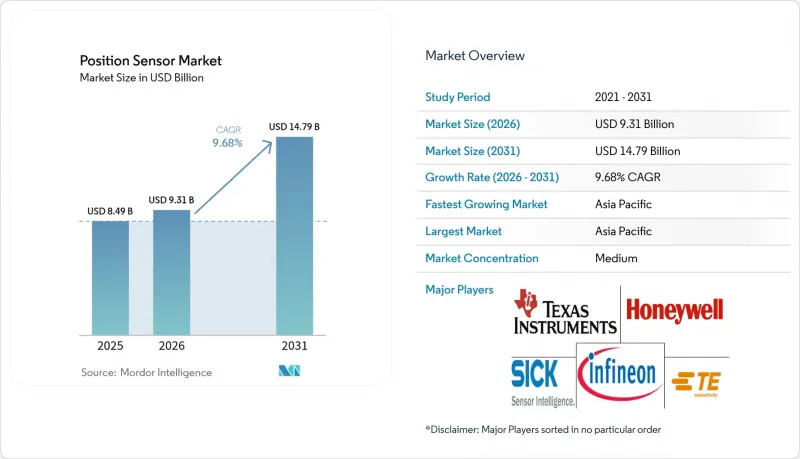
Mordor Intelligence에 의하면, 2026년 위치 센서 시장 규모는 93억 1,000만 달러로 추정되고, 2025년 84억 9,000만 달러에서 확대해, 2031년에는 147억 9,000만 달러에 이를 것으로 예측됩니다.
2026-2031년 연평균 성장률(CAGR) 9.68%로 성장할 것으로 전망됩니다.
본 보고서는 유형별(선형 센서, 회전식 센서 등), 기술별(접촉식 및 비접촉식), 출력 인터페이스별(아날로그 및 디지털), 용도별(농업용 차량/자행식 기계, 가축의 위치 및 건강 모니터링 등), 지역별(북미, 유럽, 아시아태평양 등)로 분류되어 있습니다. 시장 예측은 금액(달러) 기준으로 제시되어 있습니다.
세계의 위치 센서 시장 동향 및 인사이트
인더스트리 4.0 환경에서의 자동화 발전
스마트 팩토리의 원칙에 따라 기계 설계가 재구축되고 있으며, 디지털 트윈과 원활하게 연동되는 서브mm 단위의 연속적인 위치 데이터가 요구되고 있습니다. 트랙터 및 콤바인 제조업체들은 현재 센서 출력을 클라우드 대시보드로 스트리밍하는 텔레매틱스 게이트웨이를 사전 설치하고 있으며, 이를 통해 차량군의 실시간 조정 및 원격 진단이 가능해졌습니다. 정밀 파종 시스템은 실린더 위치를 10µm 이내의 정밀도로 감지하는 자기변형 로드를 사용하여, 작업 중에 파종기의 깊이를 동적으로 조정함으로써 제한된 파종 기간 동안 연료와 자재를 절약하고 있습니다. 이와 동시에 각 제조업체는 LiDAR, 레이더, 각도 센서를 융합하여 무인 차량을 위한 360도 상황 인식을 실현하고 있습니다. OEM 각사가 신형 모델 플랫폼 전반에 걸쳐 스마트 인터페이스를 표준화하고 있는 만큼, 이러한 추세는 위치 센서 시장을 더욱 강화하고 있습니다.
전동화와 기능 안전에 대한 요구
고전압 구동 시스템으로의 전환에 따라, 설계자들은 전자기 간섭이나 큰 온도 변동 하에서도 정밀도를 유지할 수 있는 센서를 선정해야 하는 상황에 직면해 있습니다. 전기 구동 모터의 로터 위치는 최고 효율을 실현하기 위해 1° 이내의 정밀도로 측정해야 하며, ISO 26262의 자동차 안전 무결성 수준 D(SIL D)를 충족하기 위해서는 중복 채널이 필수적입니다. 인피니온이 마벨의 자동차용 이더넷 사업을 25억 달러에 인수한 것은 센싱과 네트워킹 스택을 긴밀하게 연계하는 것의 전략적 가치를 부각시키고 있습니다. 인증된 듀얼 다이 아키텍처로의 전환은 차량당 탑재 부품 수를 증가시키고 공급업체와의 협력을 심화시키며, 기존 차량을 전동화하는 개조 키트를 통해 위치 센서 시장에 더욱 탄력을 불어넣고 있습니다.
비접촉식 선형 센서의 높은 평균 판매 가격(ASP)
자기변형식 및 광학식 인코더는 대부분의 경우 전위차계식 로드의 3배에서 5배에 달하는 가격으로 책정되어, 소규모 농장에게는 설비 투자 예산에 부담이 되고 있습니다. 네오 퍼포먼스 머티리얼즈(Neo Performance Materials)는 네오디뮴 자석의 분기별 가격 변동이 매출 총이익률의 변동으로 이어지고, 이것이 센서 가격에 파급되고 있다고 지적합니다. 수명 연장 및 재교정의 필요성이 사라짐에 따라 총 소유 비용은 낮아지지만, 높은 초기 비용으로 인해 구형 유압 실린더의 교체가 지연되면서 위치 센서 시장의 단기적인 전환이 억제되고 있습니다.
부문 분석
리니어 센서는 2025년 위치 센서 시장 규모의 40.45%를 차지했으며, 이는 경운, 파종 및 살포기 붐의 수평 조정에서 정밀 제어를 수행하는 데 필수적인 요소임을 반영합니다. 자기 변형식 로드는 350 bar를 초과하는 유압을 견디고, 마모성이 강한 토양에도 내성이 있어 유지보수 주기를 20,000시간 이상으로 연장합니다. 로터리 엔코더는 스티어링 너클 및 PTO 샤프트에서 중요한 역할을 수행하며, 폐쇄 루프 안내에는 정확한 각도 데이터가 필수적입니다. 근접형 및 변위형 모델 또한 헤더 높이 감지 및 장애물 회피 시스템에 적용되어 큰 시장 점유율을 차지하고 있습니다.
레이저 변위 센서는 가격 하락과 광학 오염 대책의 개선에 따라 2031년까지 연평균 성장률(CAGR) 13.25%를 나타낼 것으로 예측됩니다. 이러한 성장 속도는 위치 센서 시장 전체의 성장률을 상회하며, 작물 분류에 서브mm 단위의 거리 측정이 필요한 컨베이어식 수확기의 수확량 모니터 및 과실 선별 시스템의 보급이 이를 뒷받침하고 있습니다.
비접촉형 아키텍처는 2025년 매출의 61.25%를 차지했으며, 와이퍼 암의 전위차계 성능을 저하시키는 진흙, 충격, 진동에 대한 내성이 확인되었습니다. T-코드 인터페이스가 내장된 홀식 각도 센서는 접촉에 의한 마모가 고장 위험이 되는 600 hp를 초과하는 트랙터에 현재 탑재되어 있습니다. 접촉식 솔루션은 곡물 운반차의 오거나 사료 믹서의 슬라이드에서 적은 비용으로 충분한 정밀도를 제공하기 때문에 여전히 위치 센서 시장의 38.75%를 차지하고 있습니다.
비접촉식 부문은 실리콘 및 광학 설계를 공유하는 자동차용 크로스오버 플랫폼과 자동 광학 검사 라인에 힘입어 연평균 12.20%의 성장률이 예상됩니다. SICK사와 Endress+Hauser사의 제휴를 통해 산업용 수준의 견고성이 스마트 농기계에 도입됨에 따라 대상 시장 규모가 확대되어, 비접촉식 솔루션의 위치 센서 시장 규모는 향후 10년 말까지 100억 단위로 성장할 것으로 전망됩니다.
지역별 분석
아시아태평양은 2025년까지 농업의 75%를 기계화하겠다는 중국의 목표와 인도의 ‘디지털 농업 미션’에 따라 디지털 플랫폼에 60억 달러가 배정된 점 등에 힘입어 2025년 매출의 45.60%를 차지했습니다. 이 지역의 예상 연평균 성장률(CAGR)은 11.15%로, 2031년까지 위치 센서 시장 규모 성장의 원동력으로 작용할 것으로 보입니다. 중국의 농업 기계 수입은 전년 대비 14.6% 증가한 반면, 인도의 예산에서는 농지 등록부와 대출·보험 시스템을 연계하는 원격 감지 인프라에 60억 달러가 배정되었습니다. 이 지역의 지속적인 두 자릿수 성장은 기본적인 GPS 유도에서 완전 자율 주행 차량 군으로의 지속적인 업그레이드를 나타내며, 위치 센서 시장의 핵심으로서 아시아태평양의 역할을 확고히 하고 있습니다.
유럽에서는 ‘그린 딜(Green Deal)’에서 제시된 농약 감축 목표를 달성하기 위해 정밀 살포기 및 자율형 제초 로봇의 도입이 진행되고 있습니다. 유럽연합 집행위원회는 ‘호라이즌 유럽’ 프로그램 하에 1,500만 유로(1,650만 달러)를 배정하고, 2025년에 농업용 로봇 시범 사업을 실시할 예정입니다. 북미 시장은 완전 자동화 장비의 규모의 경제를 가능하게 하는 광활하고 연속된 농지를 배경으로 확대되고 있습니다. 이러한 성장은 연방 정밀농업 태스크포스를 발족시킨 ‘2024년 농업·식량·국가안보법’에 의해 더욱 뒷받침되고 있습니다. 이 지역의 성장을 주도하고 있는 것은 30미터 붐식 살포기, 자동 유도식 파종기, 완전 자율형 곡물 운반차 등의 첨단 기술을 빈번히 활용하는 조기 도입 농가들입니다.
수자원이 부족한 지역에서는 이러한 기술 발전이 큰 이점을 가져다주는 것으로 입증되었습니다. 예를 들어, 플로리다주의 스마트 관개 프로그램은 토양 수분 프로브와 밸브 위치 센서를 통합하여 2024년에 1억 6,400만 갤런의 물을 절약했습니다. 이 지역의 성장세는 아시아태평양에 비해 완만하지만, 단계적인 기술 업그레이드, 세제 혜택, 그리고 위치 센서 시장의 성장을 지속적으로 견인하는 개조 키트 공급업체들의 견고한 생태계 덕분에 여전히 탄탄한 성장세를 보이고 있습니다.
기타 혜택 :
- 엑셀 형식 시장 예측(ME) 시트
- 3개월간의 애널리스트 지원
자주 묻는 질문
목차
제1장 서론
제2장 조사 방법
제3장 주요 요약
제4장 시장 구도
제5장 시장 규모 및 성장 예측
제6장 경쟁 구도
제7장 시장 기회 및 향후 전망
AJY 26.08.26According to Mordor Intelligence, position sensor market size in 2026 is estimated at USD 9.31 billion, growing from 2025 value of USD 8.49 billion with 2031 projections showing USD 14.79 billion, growing at 9.68% CAGR over 2026-2031.
This report is Segmented by Type (Linear Sensors, Rotary Sensors, and More), by Technology (Contact and Non-Contact), Output Interface (Analog and Digital), by Application (Agricultural Vehicles/Self-Propelled Machinery, Livestock Position and Health Monitoring, and More), and by Geography (North America, Europe, Asia-Pacific, and More). The Market Forecasts are Provided in Terms of Value (USD).
Global Position Sensor Market Trends and Insights
Rising Automation in Industry 4.0 Settings
Smart-factory principles are reshaping machinery design, demanding continuous, sub-millimeter positional data that links seamlessly with digital twins. Tractor and combine builders now preload telematics gateways that stream sensor outputs into cloud dashboards, enabling real-time fleet coordination and remote diagnostics. Precision seeding systems adjust planter depth on the fly using magnetostrictive rods that report cylinder position to within 10 µm, saving fuel and inputs during tight planting windows. In parallel, manufacturers are fusing lidar, radar, and angle sensing to create 360-degree situational awareness for driverless vehicles. This momentum strengthens the position sensor market as OEMs standardize smart interfaces across new model platforms.
Electrification and Functional-Safety Needs
Transitioning to high-voltage drivetrains forces designers to specify sensors that remain accurate despite electromagnetic interference and large temperature swings. Rotor position in electric traction motors must be measured to within 1° for peak efficiency, and redundant channels are mandatory to meet ISO 26262 Automotive Safety Integrity Level D. Infineon's USD 2.5 billion purchase of Marvell's automotive Ethernet business underscores the strategic value of tightly coupled sensing and networking stacks. The push toward certified, dual-die architectures boosts content per vehicle and deepens supplier engagement, adding momentum to the position sensor market through retrofit kits that electrify legacy fleets.
High ASPs of Non-Contact Linear Sensors
Magnetostrictive and optical encoders often list three to five times above potentiometric rods, stretching capital budgets for small farms. Neo Performance Materials links quarter-on-quarter price swings in neodymium magnets to volatility in gross margins that cascade into sensor pricing. While longer life and zero recalibration lower the total cost of ownership, the upfront premium slows replacements in older hydraulic cylinders and restrains near-term conversion within the position sensor market.
Other drivers and restraints analyzed in the detailed report include:
- Miniaturization of MEMS Position Sensors
- On-Chip Diagnostics for ISO 26262 Compliance
- Combo-IC Inertial Sensors Substituting Dedicated Line
For complete list of drivers and restraints, kindly check the Table Of Contents.
Segment Analysis
Linear sensors captured 40.45% of the 2025 position sensor market size, reflecting their indispensability in-depth control for tillage, seeding, and sprayer boom leveling. Magnetostrictive rods endure hydraulic pressures above 350 bar and resist abrasive soil, extending service intervals beyond 20,000 hours. Rotary encoders play a vital role in steering knuckles and power take-off shafts, where accurate angular data is essential for closed-loop guidance. Proximity and displacement models also held a significant market share, driven by their application in header height detection and obstacle avoidance systems.
Laser displacement sensors are projected to climb at a 13.25% CAGR to 2031 as prices fall, and optical contamination mitigation improves. This pace outstrips overall position sensor market growth, helped by conveyor-type harvester yield monitors and fruit grading systems that require sub-millimeter distance measurement to classify crops.
Non-contact architectures secured a 61.25% share of 2025 revenue, confirming their suitability for mud, shock, and vibration that degrade wiper-arm potentiometers. Hall-based angle devices with integrated T-code interfaces now ship in tractors exceeding 600 hp, where contact wear poses failure risks. Contact solutions still occupy 38.75% of the position sensor market because they offer adequate accuracy in grain cart augers and feed mixer slides at a fraction of the cost.
The non-contact segment is forecast to expand at 12.20% annually, supported by automotive cross-over platforms and automated optical inspection lines that share silicon and optical designs. SICK and Endress+Hauser's cooperation transfers industrial ruggedness into smart implements, multiplying addressable volume and pushing the position sensor market size for non-contact solutions toward double-digit billions by decade's end.
Complete Report Scope:
- By Type
- Linear Sensors
- Rotary Sensors
- Proximity/Displacement Sensors
- Other Types
- By Technology
- Contact
- Non-contact
- By Output Interface
- Analog
- Digital
- By Agricultural Application
- Agricultural Vehicles/Self-propelled Machinery
- Livestock Position and Health Monitoring
- Indoor/Vertical Farming Automation
- Other Agricultural Applications
- By Geography
- North America
- United States
- Canada
- Mexico
- Rest of North America
- South America
- Brazil
- Argentina
- Rest of South America
- Europe
- Germany
- United Kingdom
- France
- Russia
- Spain
- Rest of Europe
- Asia-Pacific
- China
- Japan
- India
- Australia
- Rest of Asia-Pacific
- Middle East
- Saudi Arabia
- United Arab Emirates
- Rest of Middle East
- Africa
- South Africa
- Nigeria
- Rest of Africa
- North America
Geography Analysis
Asia-Pacific accounted for 45.60% of 2025 sales, boosted by China's quest for 75% farm mechanization by 2025 and India's USD 6 billion allocation for digital platforms under its Digital Agriculture Mission. The region's projected 11.15% CAGR will keep it the growth engine for the position sensor market size through 2031. Imports of agricultural machinery into China rose 14.6% year on year, while India's budget carved out USD 6 billion for remote-sensing infrastructure linking farm registries to credit and insurance engines. The region's sustained double-digit expansion signals continual upgrades from basic GPS guidance to fully autonomous fleets, cementing Asia-Pacific's role as the fulcrum of the position sensor market.
Europe is advancing the use of precision sprayers and autonomous weeding robots to achieve the pesticide-reduction targets outlined in the Green Deal. The European Commission earmarked EUR 15 million (USD 16.5 million) under Horizon Europe to pilot agrobotics in 2025. The North American market is expanding, supported by large contiguous fields that enable economies of scale for fully automated equipment. This growth is further reinforced by the 2024 Farm, Food, and National Security Act, which launched a Federal Precision Agriculture Task Force. The region's growth is driven by early adopter farms that frequently utilize advanced technologies such as 30-meter boom sprayers, auto-guided planters, and fully autonomous grain carts.
Water-scarce areas have demonstrated significant benefits from these advancements. For instance, Florida's smart irrigation program saved 164 million gallons of water in 2024 by integrating soil-moisture probes with valve position sensors. While the region's growth is steadier compared to Asia-Pacific, it remains positive due to incremental technological upgrades, tax incentives, and a robust ecosystem of retrofit kit suppliers, which continue to drive the position sensor market upward.
- Honeywell International Inc.
- TE Connectivity Ltd.
- Texas Instruments Incorporated
- SICK AG (Sick Holding GmbH)
- Infineon Technologies AG
- STMicroelectronics N.V.
- Balluff GmbH
- Renishaw plc
- Omron Corporation
- Allegro MicroSystems, Inc.
- Baumer Holding AG
- Pepperl+Fuchs SE
- ifm electronic gmbh (Ifm Stiftung & Co. Kg)
- ams-OSRAM AG (ams AG)
- Panasonic Industry Co., Ltd.
Additional Benefits:
- The market estimate (ME) sheet in Excel format
- 3 months of analyst support
TABLE OF CONTENTS
1 Introduction
- 1.1 Study Assumptions and Market Definition
- 1.2 Scope of the Study
2 Research Methodology
3 Executive Summary
4 Market Landscape
- 4.1 Market Overview
- 4.2 Market Drivers
- 4.2.1 Rising automation in Industry 4.0 settings
- 4.2.2 Electrification and functional-safety needs
- 4.2.3 Miniaturization of MEMS position sensors
- 4.2.4 On-chip diagnostics for ISO 26262 compliance
- 4.2.5 AI-enabled edge sensing for predictive O&M
- 4.2.6 Ultra-low-power energy-harvesting sensors
- 4.3 Market Restraints
- 4.3.1 High ASPs of non-contact linear sensors
- 4.3.2 Combo-IC inertial sensors substituting lines
- 4.3.3 Complex supply chain for specialty magnetics
- 4.3.4 Certification bottlenecks for ASIL-D designs
- 4.4 Technological Outlook
- 4.4.1 Hall-effect vs. AMR vs. TMR architectures
- 4.4.2 Magnetostrictive and optical encoder roadmaps
- 4.5 Regulatory Landscape
- 4.6 Porter's Five Forces Analysis
- 4.6.1 Bargaining Power of Suppliers
- 4.6.2 Bargaining Power of Buyers
- 4.6.3 Threat of New Entrants
- 4.6.4 Threat of Substitute Products
- 4.6.5 Intensity of Competitive Rivalry
5 Market Size and Growth Forecasts (Value)
- 5.1 By Type
- 5.1.1 Linear Sensors
- 5.1.2 Rotary Sensors
- 5.1.3 Proximity/Displacement Sensors
- 5.1.4 Other Types
- 5.2 By Technology
- 5.2.1 Contact
- 5.2.2 Non-contact
- 5.3 By Output Interface
- 5.3.1 Analog
- 5.3.2 Digital
- 5.4 By Agricultural Application
- 5.4.1 Agricultural Vehicles/Self-propelled Machinery
- 5.4.2 Livestock Position and Health Monitoring
- 5.4.3 Indoor/Vertical Farming Automation
- 5.4.4 Other Agricultural Applications
- 5.5 By Geography
- 5.5.1 North America
- 5.5.1.1 United States
- 5.5.1.2 Canada
- 5.5.1.3 Mexico
- 5.5.1.4 Rest of North America
- 5.5.2 South America
- 5.5.2.1 Brazil
- 5.5.2.2 Argentina
- 5.5.2.3 Rest of South America
- 5.5.3 Europe
- 5.5.3.1 Germany
- 5.5.3.2 United Kingdom
- 5.5.3.3 France
- 5.5.3.4 Russia
- 5.5.3.5 Spain
- 5.5.3.6 Rest of Europe
- 5.5.4 Asia-Pacific
- 5.5.4.1 China
- 5.5.4.2 Japan
- 5.5.4.3 India
- 5.5.4.4 Australia
- 5.5.4.5 Rest of Asia-Pacific
- 5.5.5 Middle East
- 5.5.5.1 Saudi Arabia
- 5.5.5.2 United Arab Emirates
- 5.5.5.3 Rest of Middle East
- 5.5.6 Africa
- 5.5.6.1 South Africa
- 5.5.6.2 Nigeria
- 5.5.6.3 Rest of Africa
- 5.5.1 North America
6 Competitive Landscape
- 6.1 Market Concentration
- 6.2 Strategic Moves
- 6.3 Market Share Analysis
- 6.4 Company Profiles (includes Global Overview, Market Overview, Core Segments, Financials as available, Strategic Information, Market Rank/Share for key companies, Products and Services, Recent Developments)
- 6.4.1 Honeywell International Inc.
- 6.4.2 TE Connectivity Ltd.
- 6.4.3 Texas Instruments Incorporated
- 6.4.4 SICK AG (Sick Holding GmbH)
- 6.4.5 Infineon Technologies AG
- 6.4.6 STMicroelectronics N.V.
- 6.4.7 Balluff GmbH
- 6.4.8 Renishaw plc
- 6.4.9 Omron Corporation
- 6.4.10 Allegro MicroSystems, Inc.
- 6.4.11 Baumer Holding AG
- 6.4.12 Pepperl+Fuchs SE
- 6.4.13 ifm electronic gmbh (Ifm Stiftung & Co. Kg)
- 6.4.14 ams-OSRAM AG (ams AG)
- 6.4.15 Panasonic Industry Co., Ltd.


