

|
시장보고서
상품코드
2114567
비혈관용 스텐트 : 시장 점유율 분석, 업계 동향 및 통계, 성장 예측(2026-2031년)Non-vascular Stents - Market Share Analysis, Industry Trends & Statistics, Growth Forecasts (2026 - 2031) |
||||||
 Mordor Intelligence
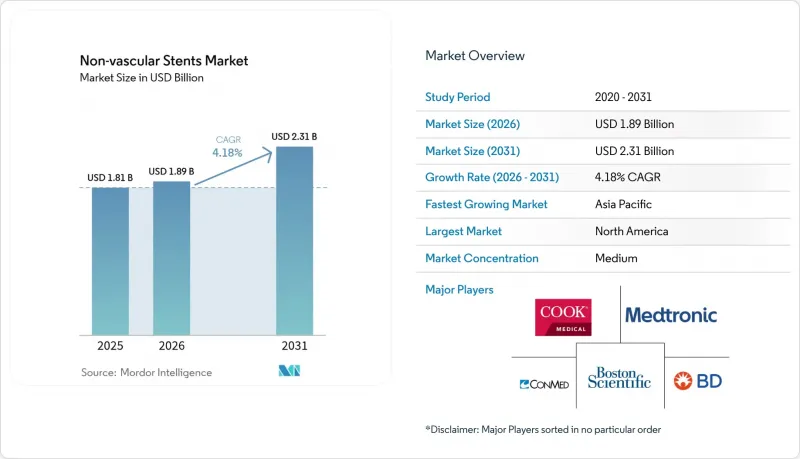
Mordor Intelligence에 의하면, 비혈관용 스텐트 시장 규모는 2025년에 18억 1,000만 달러로 평가되었습니다. 2026년 18억 9,000만 달러에서 2031년까지 23억 1,000만 달러에 이를 것으로 예상되며, 예측 기간(2026-2031년) CAGR은 4.18%를 나타낼 전망입니다.
본 보고서는 제품 유형(소화기용 스텐트, 폐(기도)용 스텐트 등), 재질(금속, 비금속 등), 설계(자가팽창형, 풍선 팽창형), 최종 사용자(병원, 외래수술센터(ASC) 등), 지역(북미, 유럽, 아시아태평양 등)별로 분류되어 있습니다. 시장 전망은 금액(달러) 기준으로 제시되어 있습니다.
세계의 비혈관용 스텐트 시장 동향 및 인사이트
고령 인구 증가 및 만성 질환 유병률 상승
인구 고령화에 따라 소화기, 호흡기, 비뇨기 질환의 발생률이 높아지고 있으며, 비혈관용 스텐트 시장 내 모든 치료 분야에서 시술 건수가 증가하고 있습니다. 2040년까지의 예측에 따르면, 대장암, 췌장암, 간암의 발생 건수는 증가 추세를 유지할 것으로 보이며, 고령층에서 다기관에 대한 시술이 필요한 사례가 증가할 것으로 보입니다. 고령층은 조직의 취약성이나 동반 질환이 있기 때문에 적응성이 높고 염증 유발성이 낮은 스텐트가 요구되고 있습니다. 따라서 이러한 성장은 증례의 절대적 증가뿐만 아니라, 만성 질환을 앓으면서 장수하는 환자에 의한 재수술 증가도 반영하고 있습니다.
재료 및 코팅 기술의 발전
차세대 몰리브덴-레늄 합금은 높은 피로 강도와 생체 적합성을 겸비하고 있어, 기존의 니티놀을 뛰어넘는 새로운 설계의 자유도를 제공합니다(Argus Media). 레이저 미세 패터닝 기술은 평활근 세포의 증식을 75% 억제하는 동시에 내피 세포의 증식을 2배로 촉진할 수 있습니다. 마찬가지로, 약물을 포함하지 않는 콜라겐 기능화 플랫폼도 항증식제에 의존하지 않고 치유 기간을 단축합니다. 이러한 혁신 기술은 재협착의 위험과 금속 알레르기 우려를 줄임으로써 치료 대상 환자층을 확대되고 있습니다.
합병증 : 이탈, 폐색, 감염
담관 스텐트의 이탈은 치료를 받은 환자의 8.4%에서 나타나며, 종종 담관염이나 폐색을 유발하고 긴급한 제거가 필요하기 때문에 비용과 임상적 부담을 증가시키고 있습니다. 요관용 기기에서 드물게 발생하는 심장 내 이동은 합병증의 중증도 범위를 보여주는 한 예이며, 혈관 내 제거나 다학제적 치료가 필요하게 되어 병원의 자원 사용량이 증가합니다. 고정 설계가 개선되었음에도 불구하고, 특히 첨단 제거 도구가 부족한 지역에서는 합병증에 대한 우려가 임상의의 의사 결정에 큰 부담으로 작용하고 있습니다.
부문별 분석
2025년에는 식도, 담도, 대장·직장 수술에 대한 확립된 프로토콜에 힘입어 소화기용 플랫폼이 비혈관용 스텐트 시장의 41.98%를 차지했습니다. 병원에서는 악성 폐색 치료에 자가 팽창형 금속 스텐트를 채택하고 있어, 완화적인 감압 처치를 통해 응급 수술을 피하고 삶의 질을 유지할 수 있게 되었습니다. 기술적 성공률은 꾸준히 90%를 상회하고 있으며, 완전 피복형 기기가 양성 식도 협착 치료에도 도입되면서 적용 범위가 확대되고 있습니다. 폐용 스텐트는 시장 규모는 작지만, 악성 기도 폐쇄 및 양성 기관지 연화증 모두에서 중재적 폐의학이 널리 받아들여짐에 따라 연간 7.41%의 속도로 성장하고 있습니다.
현재 임상 지침에서는 중앙 병변에 대해 실리콘 및 금속·실리콘 하이브리드 튜브가 1차 선택으로 권장되고 있지만, 생분해성 폴리디옥사논으로 제작된 대체품은 성인 코호트에서 2개월 후 89.7%의 유효성을 보였으며, 이후 제거가 용이합니다. AI를 활용한 3D 모델링을 통해 제조되는 맞춤형 기관지 유닛은 번거로운 수작업 성형에 비해 리드 타임을 더욱 단축하고 있습니다. 이와 병행하여 비뇨기과용 기기 역시 계속해서 의료진의 주목을 받고 있습니다. 이는 제거 가능한 스트링 덕분에 제거 시 통증 점수가 5.23에서 0.86으로 낮아지고, 삽입 기간이 16일로 단축되어 환자의 사후 관리 비용을 146달러 절감했기 때문입니다. 구강 종양용 스텐트 또한 고부가가치의 틈새 시장을 형성하고 있으며, 방사선 치료 중 주변 조직을 보호하는 동시에 적층 가공가 소량 생산의 맞춤형 이용 사례를 어떻게 실현하는지를 여실히 보여주고 있습니다.
주로 니치놀로 구성된 금속 구조체는 수십 년에 걸친 임상 실적, 높은 반경 방향의 힘, 그리고 비틀림 저항성이라는 장점 덕분에 2025년 매출의 61.10%를 차지했습니다. 그러나 공급망 혼란으로 인해 합금 비용이 20% 상승함에 따라 소재의 다양화가 진행되고 있으며, 철이나 마그네슘으로 만든 생체 흡수성 소재에 대한 관심이 다시 높아지고 있습니다. AMS-2.1과 같은 2세대 마그네슘 스캐폴드는 혈관의 강도를 회복시키면서 720일 이내에 완전히 분해되므로, 영구적인 케이지화를 피하고 일시적인 지지를 원하는 임상의들의 요구를 충족시키고 있습니다. 철제 스캐폴드는 여전히 부식 속도가 너무 느리지만, 표면 텍스처링 및 갈바닉 결합에서는 초기 단계이긴 하나 유망한 조짐이 보입니다.
폴리머 기반 설계는 분해를 가속화하지만, 강도를 확보하기 위해 금속 골격에 의존하는 경우가 많기 때문에 하이브리드 모델에서는 폴리-L-락타이드나 폴리디옥사논으로 만든 슬리브와 얇은 니티놀 프레임워크를 결합하고 있습니다. 시롤리무스나 파클리탁셀을 이용한 약물 방출층은 신생 내막 과형성을 더욱 억제하며, 코팅 시스템 시장의 8.63% 성장률을 뒷받침하고 있습니다. 지속가능성에 관한 규제 또한 연구 개발에 영향을 미치고 있으며, 각 기업은 2026년에 시행될 EU 포장 규정을 준수하기 위해 셀룰로오스 기반 전달 시스 및 재활용 가능한 트레이 소재에 대한 시험을 진행하고 있습니다.
지역별 분석
북미는 2025년 매출의 36.10%를 차지했으며, FDA 승인 후 6개월 이내에 획기적인 의료기기의 환급을 보장하는 메디케어 적용 경로의 뒷받침을 받았습니다. FDA는 이미 1,041건의 획기적 의료기기 지정을 승인했으며, 그중 128건이 시장에 출시되어 첨단 폴리머 및 AI 지원 플랫폼의 국내 채택을 빠르게 촉진하고 있습니다. 외래 진료로의 전환이 특히 두드러지며, 병원 외래 진료 부서에서는 담낭 배액용 전기 소작 기능이 있는 스텐트가 빠르게 도입되고 있습니다.
아시아태평양은 인구 고령화와 공공 보험 프로그램의 확대가 맞물려 연평균 성장률(CAGR) 7.52%로 세계에서 가장 빠른 속도로 성장하고 있습니다. 일본은 여전히 이 지역의 기술 선도자 역할을 하고 있으며, 의사들의 도입 주기가 보수적임에도 불구하고 복잡한 담도 및 기도 증례에 사용할 수 있는 고정밀 미국산 스텐트 시스템을 수입하고 있습니다. 또한, 각 지역의 정책 입안자들은 서유럽의 지적 재산권과 현지 대량 생산 능력을 결합한 기술 이전 계약을 적극적으로 모색하고 있으며, 이는 환율 위험과 공급망 변동을 상쇄하는 데 도움이 되고 있습니다. 2024년에는 벤처 자금 조달이 축소되었지만, 독자적인 3D 프린팅 기도 기기는 여전히 규제 당국의 승인을 획득하고 있어, 차별화된 적응증에 대한 투자자들의 관심이 여전히 높음을 보여주고 있습니다.
유럽은 국민건강보험 제도와 지속가능성에 관한 지침의 조기 도입에 힘입은 수요 덕분에 안정적인 영향력을 유지하고 있습니다. 2026년부터 시행되는 포장 규제로 인해 의료기기 제조업체는 멸균 환경하에서도 사용 후 제품의 재활용을 고려해야 할 의무가 있으며, 연구 개발은 경량 트레이 및 QR 코드를 통한 추적성 실현으로 향하고 있습니다. 중동 및 아프리카 및 남미는 시장 규모는 작지만, 3차 의료기관에서의 스텐트 프로그램 신속한 확장을 지원하는 모듈식 내시경실에 대한 입찰 활동이 증가하고 있습니다.
기타 혜택 :
- 엑셀 형식 시장 예측(ME) 시트
- 3개월간의 애널리스트 지원
자주 묻는 질문
목차
제1장 서론
제2장 조사 방법
제3장 주요 요약
제4장 시장 구도
제5장 시장 규모 및 성장 예측
제6장 경쟁 구도
제7장 시장 기회 및 향후 전망
KTH 26.08.28According to Mordor Intelligence, the non-vascular stents market size was valued at USD 1.81 billion in 2025 and estimated to grow from USD 1.89 billion in 2026 to reach USD 2.31 billion by 2031, at a CAGR of 4.18% during the forecast period (2026-2031).
This report is Segmented by Product Type (Gastrointestinal Stents, Pulmonary (Airway) Stents, and More), Material Type (Metallic, Non-Metallic, and More), Design (Self-Expandable and Balloon-Expandable), End-User (Hospitals, Ambulatory Surgical Centers, and More), and Geography (North America, Europe, Asia-Pacific, and More). The Market Forecasts are Provided in Terms of Value (USD).
Global Non-vascular Stents Market Trends and Insights
Growing Geriatric Population and Chronic Disease Prevalence
Population aging intersects with higher incidences of gastrointestinal, pulmonary and urological disorders, lifting procedure volumes across every therapeutic class within the non-vascular stents market. Forecasts to 2040 show colorectal, pancreatic and liver cancers remaining on an upward trajectory, creating multi-organ intervention requirements among elderly cohorts, whose tissue fragility and comorbidities demand stents with improved conformability and reduced inflammatory profiles. Growth therefore reflects not only rising absolute case numbers but also repeat procedures as patients live longer with chronic conditions.
Technological Advances in Materials and Coatings
Next-generation molybdenum-rhenium alloys combine high fatigue strength with biocompatibility, unlocking new design freedom beyond conventional nitinol Argus Media. Laser micro-patterning techniques can suppress smooth-muscle proliferation by 75% while enhancing endothelialization twofold. Drug-free collagen-functionalized platforms similarly shorten healing times without relying on anti-proliferative agents. Collectively, these innovations are widening addressable patient pools by reducing restenosis risks and metal allergy concerns.
Complications: Migration, Occlusion and Infection
Biliary stent migration appears in 8.4% of treated patients and frequently triggers cholangitis or obstruction that require urgent retrieval, adding cost and clinical burden. Rare intracardiac displacement of ureteral devices illustrates the severity spectrum, with endovascular extraction and multidisciplinary care raising hospital resource use. Despite improved anchoring designs, complication anxiety weighs on clinician decision-making, especially in regions lacking advanced retrieval tools.
Other drivers and restraints analyzed in the detailed report include:
- Rising Demand for Minimally Invasive Procedures
- 3-D-Printed Patient-Specific Stents
- Availability of Alternative Therapies
For complete list of drivers and restraints, kindly check the Table Of Contents.
Segment Analysis
Gastrointestinal platforms generated 41.98% of the non-vascular stents market in 2025 on the strength of entrenched protocols for esophageal, biliary and colorectal procedures. Hospitals deploy self-expandable metal designs to treat malignant obstruction where palliative decompression can avert emergency surgery and preserve quality of life. Technical success consistently exceeds 90%, while fully covered devices are entering benign esophageal strictures, broadening application scope. Pulmonary stents, although a smaller base, are expanding 7.41% per year as interventional pulmonology gains acceptance for both malignant airway obstruction and benign tracheobronchomalacia.
Clinical guidelines now position silicone and hybrid metal-silicone tubes as first-line for central lesions, but biodegradable polydioxanone alternatives have achieved 89.7% effectiveness in adult cohorts after two months, easing later removal. Custom tracheobronchial units produced through AI-enabled 3-D modeling further compress lead times compared with labor-intensive manual molding. In parallel, urological devices continue to capture physician mind-share thanks to extractable strings that cut removal pain scores from 5.23 to 0.86 and slash dwell time to 16 days, saving patients USD 146 in follow-up costs. Oral oncology stents represent another high-value niche, protecting surrounding tissue during radiotherapy and underscoring how additive manufacturing unlocks low-volume bespoke use cases.
Metallic constructions, primarily nitinol, contributed 61.10% of 2025 revenue, benefiting from decades of clinical familiarity, high radial force and kink resistance. Supply chain turbulence, however, has raised alloy costs by 20%, prompting both diversification and renewed interest in iron and magnesium bioresorbables. Second-generation magnesium scaffolds such as AMS-2.1 restore vessel strength yet complete degradation inside 720 days, answering clinician calls for temporary support that avoids permanent caging. Iron scaffolds still corrode too slowly, though surface texturing and galvanic coupling show early promise.
Polymer-based designs accelerate degradation but often rely on metallic backbones for strength; hybrid models therefore combine poly-l-lactide or poly-dioxanone sleeves with thin nitinol frameworks. Drug-eluting layers using sirolimus or paclitaxel further cut neointimal hyperplasia, supporting 8.63% growth for coated systems. Sustainability mandates are also shaping R&D, with firms testing cellulose-based delivery sheaths and recyclable tray materials to align with EU packaging rules effective in 2026.
Complete Report Scope:
- By Product Type
- Gastrointestinal Stents
- Pulmonary (Airway) Stents
- Urological Stents
- Others
- By Material Type
- Metallic
- Non-metallic
- Biodegradable / Drug-eluting Coated
- By Design
- Self-expandable
- Balloon-expandable
- By End-User
- Hospitals
- Ambulatory Surgical Centers
- Specialty Clinics
- By Geography
- North America
- United States
- Canada
- Mexico
- Europe
- Germany
- United Kingdom
- France
- Italy
- Spain
- Rest of Europe
- Asia-Pacific
- China
- Japan
- India
- Australia
- South Korea
- Rest of Asia-Pacific
- Middle East and Africa
- GCC
- South Africa
- Rest of Middle East and Africa
- South America
- Brazil
- Argentina
- Rest of South America
- North America
Geography Analysis
North America consolidated 36.10% revenue in 2025, buoyed by Medicare coverage pathways that guarantee reimbursement for breakthrough devices within six months of FDA clearance.The FDA has already granted 1,041 Breakthrough Device designations, 128 of which reached the market, turbo-charging domestic adoption of advanced polymer and AI-assisted platforms. Outpatient migration is particularly strong, with hospital outpatient departments swiftly integrating electrocautery-enhanced stents for gallbladder drainage.
Asia-Pacific is advancing at a 7.52% CAGR, the fastest worldwide, as demographic aging intersects with expanded state insurance programs. Japan remains the region's technology bellwether, importing high-precision U.S. stent systems for complex biliary and airway cases despite conservative physician adoption cycles. Regional policymakers are also courting technology transfer deals that pair Western intellectual property with local mass-production capacity, helping offset foreign-exchange exposure and supply chain volatility. Venture funding compressed in 2024 yet proprietary 3-D printed airway devices still secured regulatory approvals, signaling continued investor appetite for differentiated indications.
Europe represents a stabilizing influence with demand anchored in universal coverage schemes and early adoption of sustainability directives. Packaging regulations effective from 2026 oblige device makers to account for end-of-life recycling even in sterile environments, nudging R&D toward light-weight trays and QR-code-enabled traceability. Middle East & Africa and South America collectively hold a smaller footprint yet exhibit rising tender activity for modular endoscopy suites that support rapid deployment of stent programs in tertiary hospitals.
- Beckton Dickinson
- Boston Scientific
- Conmed
- Cook Group
- ELLA-CS s.r.o.
- Glaukos
- Hobbs Medical
- Medtronic
- Micro-tech
- W. L. Gore & Associates
- Taewoong Medical
- Olympus
- Abbott Laboratories
- Medi-Globe (EndoFlex GmbH)
- Stryker
- Merit Medical Systems
- Coloplast
- Changzhou Intl. Trade & Enterprises Cooperative Co., Ltd(CITEC)
Additional Benefits:
- The market estimate (ME) sheet in Excel format
- 3 months of analyst support
TABLE OF CONTENTS
1 Introduction
- 1.1 Study Assumptions and Market Definition
- 1.2 Scope of the Study
2 Research Methodology
3 Executive Summary
4 Market Landscape
- 4.1 Market Overview
- 4.2 Market Drivers
- 4.2.1 Growing Geriatric Population & Chronic Disease Prevalence
- 4.2.2 Technological Advancements In Materials & Coatings
- 4.2.3 Rising Demand For Minimally-Invasive Procedures
- 4.2.4 3D-Printed Patient-Specific Stents Gain Clinical Traction
- 4.2.5 Fast-Track Regulatory Pathways
- 4.2.6 Advantages Associated with Biodegradable Polymer Stents
- 4.3 Market Restraints
- 4.3.1 Complications: Migration, Occlusion & Infection
- 4.3.2 Availability Of Alternative Therapies
- 4.3.3 Supply-Chain Risk For Ni-Ti Alloys & Rare Metals
- 4.3.4 Sustainability Pressure On Single-Use Devices
- 4.4 Value / Supply-Chain Analysis
- 4.5 Regulatory Landscape
- 4.6 Technology Outlook
- 4.7 Porter's Five Forces Analysis
- 4.7.1 Bargaining Power of Suppliers
- 4.7.2 Bargaining Power of Buyers
- 4.7.3 Threat of New Entrants
- 4.7.4 Threat of Substitutes
- 4.7.5 Intensity of Competitive Rivalry
5 Market Size and Growth Forecasts (Value-USD)
- 5.1 By Product Type
- 5.1.1 Gastrointestinal Stents
- 5.1.2 Pulmonary (Airway) Stents
- 5.1.3 Urological Stents
- 5.1.4 Others
- 5.2 By Material Type
- 5.2.1 Metallic
- 5.2.2 Non-metallic
- 5.2.3 Biodegradable / Drug-eluting Coated
- 5.3 By Design
- 5.3.1 Self-expandable
- 5.3.2 Balloon-expandable
- 5.4 By End-User
- 5.4.1 Hospitals
- 5.4.2 Ambulatory Surgical Centers
- 5.4.3 Specialty Clinics
- 5.5 By Geography
- 5.5.1 North America
- 5.5.1.1 United States
- 5.5.1.2 Canada
- 5.5.1.3 Mexico
- 5.5.2 Europe
- 5.5.2.1 Germany
- 5.5.2.2 United Kingdom
- 5.5.2.3 France
- 5.5.2.4 Italy
- 5.5.2.5 Spain
- 5.5.2.6 Rest of Europe
- 5.5.3 Asia-Pacific
- 5.5.3.1 China
- 5.5.3.2 Japan
- 5.5.3.3 India
- 5.5.3.4 Australia
- 5.5.3.5 South Korea
- 5.5.3.6 Rest of Asia-Pacific
- 5.5.4 Middle East and Africa
- 5.5.4.1 GCC
- 5.5.4.2 South Africa
- 5.5.4.3 Rest of Middle East and Africa
- 5.5.5 South America
- 5.5.5.1 Brazil
- 5.5.5.2 Argentina
- 5.5.5.3 Rest of South America
- 5.5.1 North America
6 Competitive Landscape
- 6.1 Market Concentration
- 6.2 Market Share Analysis
- 6.3 Company profiles (includes Global level Overview, Market level overview, Core Segments, Financials as available, Strategic Information, Market Rank/Share for key companies, Products and Services, and Recent Developments)
- 6.3.1 Becton, Dickinson and Company
- 6.3.2 Boston Scientific Corporation
- 6.3.3 CONMED Corporation
- 6.3.4 Cook Medical
- 6.3.5 ELLA-CS s.r.o.
- 6.3.6 Glaukos Corporation
- 6.3.7 Hobbs Medical
- 6.3.8 Medtronic plc
- 6.3.9 Micro-Tech (Nanjing) Co., Ltd.
- 6.3.10 W. L. Gore & Associates, Inc.
- 6.3.11 Taewoong Medical Co., Ltd.
- 6.3.12 Olympus Corporation
- 6.3.13 Abbott Laboratories
- 6.3.14 Medi-Globe (EndoFlex GmbH)
- 6.3.15 Stryker Corporation
- 6.3.16 Merit Medical Systems, Inc.
- 6.3.17 Coloplast A/S
- 6.3.18 Changzhou Intl. Trade & Enterprises Cooperative Co., Ltd(CITEC)
7 Market Opportunities and Future Outlook
- 7.1 White-Space and Unmet-Need Assessment


