

|
시장보고서
상품코드
2114573
심장 정보 시스템(CIS) : 시장 점유율 분석, 업계 동향 및 통계, 성장 예측(2026-2031년)Cardiology Information System - Market Share Analysis, Industry Trends & Statistics, Growth Forecasts (2026 - 2031) |
||||||
 Mordor Intelligence
Mordor Intelligence에 의하면, 심장 정보 시스템(CIS) 시장 규모는 2025년에 13억 5,000만 달러로 평가되었습니다. 2026년 14억 7,000만 달러에서 2031년까지 22억 3,000만 달러에 이를 것으로 예상되며, 예측 기간(2026-2031년) CAGR은 8.74%를 나타낼 전망입니다.
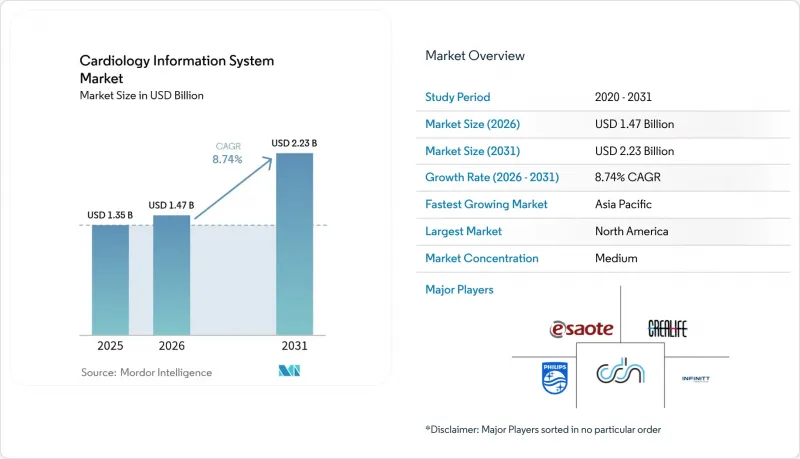
본 보고서는 운영 형태(웹 기반, On-Premise), 구성 요소, 최종 사용자 및 지역별로 세분화되어 있습니다. 본 시장 보고서에서는 상기 각 부문 시장 규모를 제시하고 있습니다.
세계의 심장 정보 시스템(CIS) 시장 동향 및 인사이트
전 세계 심장 질환 및 뇌졸중 유병률 증가
1990년부터 2024년에 걸쳐 심혈관 질환 사례 수는 거의 두 배로 증가하여 5억 2,300만 건에 달했습니다. 이는 성숙한 의료 시스템과 신흥 의료 시스템 모두에서 확장성이 뛰어난 정보 플랫폼에 대한 구조적인 필요성을 부각시키고 있습니다. 현재 저·중소득 지역이 전 세계 심혈관 질환 사망의 80%를 차지하고 있지만, 진단 인프라는 여전히 제한적이기 때문에 각국의 보건부는 영상 진단, 혈역학 및 구조화된 보고서 모듈에 대한 비용 효율적인 클라우드 접근을 의무화하고 있습니다. 허혈성 심장 질환과 뇌졸중은 합쳐서 전체 사망자의 3분의 1 이상을 차지하고 있어, 비용이 많이 드는 급성 사건이 발생하기 전에 고위험군을 식별하는 예측 분석의 시급성이 더욱 커지고 있습니다. 아시아태평양 및 중동의 보험사들은 국가 차원의 심장 정보 시스템(CIS) 시장 도입으로 직접 이어지는 인구 단위 선별 검사에 대한 자금 지원을 시작하고 있습니다. 또한 의료 시스템에서는 인센티브 자금을 평생에 걸친 종단적 기록을 지원하는 벤더 중립 아카이브(NVA)에 할당하여, 질병 관리 프로그램의 임상적 기반을 구축하고 있습니다. 이러한 움직임은 전문공급이 제한적인 상황에서 증가하는 환자 수를 관리할 수 있는 상호 운용성이 보장되고 AI가 탑재된 심장 정보 시스템(CIS) 시장 플랫폼에 대한 지속적인 수요를 보여줍니다.
디지털 심장학 및 EHR 의무화에 대한 정부 자금
미국에서는 메디케어·메디케이드 서비스 센터(CMS)가 인증된 전자건강기록(EHR)의 상호운용성을 조건으로 환급 보너스를 부여하고 있으며, 최근의 지역별 적용 결정(LCD)에 따라 AI를 활용한 관상동맥 CT 분석 비용이 지급되게 되었습니다. 이 분석 결과는 심장 정보 시스템(CIS) 시장의 워크플로우에 직접 반영됩니다. ‘21세기 치료법(21st Century Cures Act)’은 정보 차단에 대해 엄격한 처벌을 부과하고 있어, 그동안 투자를 미루어 왔던 중규모 병원들이 심혈관 영상 및 구조화된 보고서를 위한 표준 기반 인터페이스를 채택할 수밖에 없게 되었습니다. 유럽도 이에 발맞추어 European Health Data Space를 통해 국경을 초월한 데이터 교환을 의무화하고 있으며, 단편적인 솔루션보다는 종합적인 솔루션을 우선시하고 있습니다. 싱가포르와 한국이 주도하는 아시아태평양 각국 정부는 클라우드 플랫폼의 초기 이용료를 보전해 주는 매칭 보조금을 제공합니다. 이러한 정책들이 결합되어 총 소유 비용(TCO)이 절감되고 예산 승인이 신속해짐에 따라, 이전에는 설비 투자 제약으로 인해 도입이 억제되었던 시장에서 도입 곡선이 상승하고 있습니다.
고액의 초기 투자 및 통합 비용
하드웨어, 인터페이스, 변경 관리 서비스를 포함하면 전체 범위의 심장 정보 시스템(CIS) 시장 도입 비용은 100만 달러를 초과하는 경우가 많으며, 임상적 효과가 입증되었음에도 불구하고 이 금액이 중규모 병원의 도입을 주저하게 만드는 요인이 되고 있습니다. 구형 방사선 아카이브나 폐쇄형 혈역학 모듈은 통합을 복잡하게 만들어 프로젝트 기간을 12개월을 훨씬 넘게 하고, 제한된 정보 시스템 담당 직원을 장기간의 테스트 주기에 묶어두게 됩니다. 클라우드 구독 요금제 덕분에 서버가 더 이상 필요 없게 되더라도, 데이터 마이그레이션 비용과 워크플로우 재설계 비용은 여전히 큰 부담이 됩니다. 대형 소아병원에서는 벤더 중립 아카이브(NVA)로의 전환을 통해 5년 동안 300만 달러에 가까운 비용 절감을 달성한 바 있으며, 비용 절감이 가능하기는 하지만 이를 실현하기 위해서는 규모 확대와 협상력이 필요하다는 점이 드러났습니다. 도입 서비스를 패키지화한 새로운 구독 모델이 주목을 받고 있지만, 이사회가 여전히 백오피스 IT 업그레이드보다 의사 채용이나 시설 확장을 우선시하고 있어 도입 진전은 더딘 임베디드니다.
부문별 분석
클라우드/SaaS 모델은 연평균 성장률(CAGR) 10.21%로 성장하고 있으며, 2025년 매출의 73.62%를 차지하며 여전히 견고한 입지를 유지하고 있는 브라우저 호스팅형 시스템의 우위를 분명히 잠식하고 있습니다. 구독 방식은 지출이 자본 지출에서 운영 예산으로 전환되기 때문에 예산 제약이 있는 지방 병원에게 매력적이며, 공급업체는 현재 사내 데이터센터에 필적하는 99.9%의 가동률을 보장하고 있습니다. 클라우드 도입에 따른 심장 정보 시스템(CIS) 시장 규모는 다른 어떤 도입 형태보다 빠르게 확대될 것으로 예상되며, 특히 사모펀드에 의한 통합으로 형성된 다중 거점 외래 진료 네트워크 내에서 성장이 두드러집니다. On-Premise형 클러스터는 엄격한 데이터 주권 규제가 적용되는 관할 구역이나 에어 갭 정책이 유지되는 군 의료시설 등에서 여전히 사용되고 있습니다. 그러나 이러한 도입처에서도 이용이 집중되지 않는 시간대에 익명화된 데이터 세트를 퍼블릭 클라우드상의 분석 워크스페이스에 동기화하는 하이브리드 환경의 도입을 시범적으로 추진하고 있습니다.
클라우드 도입으로 인해 최신 RESTful API의 가용성, 싱글 사인온(SSO) 워크플로우, 그리고 혈역학 파형을 거의 실시간으로 처리하는 서버리스 분석 파이프라인 등 새로운 평가 기준이 생겨나고 있습니다. 심장 전문의들은 클라이언트 소프트웨어를 설치하지 않고도 경량 노트북으로 고도의 3D 시각화를 실행할 수 있는 기능을 중시하는 반면, 의료 시스템의 CFO는 시술 건수 증가에 맞추어 비용을 조정할 수 있는 예측 가능한 검사별 요금 체계를 선호합니다. 두 번째 성장 가속 요인은 외래수술센터(ASC)의 심장 정보 시스템에 대한 수요입니다. 해당 센터에서는 2022년에 메디케어 수급자 1만 명당 0.87건의 PCI 시술이 이루어졌으며, 의뢰 병원과 즉각적인 영상 교환이 요구되고 있습니다. 따라서 주요 EHR에 심혈관 모듈을 미리 통합해 둔 벤더는 사내 IT 역량이 아직 충분하지 않은 시장에서 신속하게 수주를 확보하고 있습니다.
2025년 매출에서 소프트웨어가 차지하는 비중은 50.88%이었지만, 서비스 부문은 연평균 성장률(CAGR) 9.97%라는 더 빠른 속도로 확대되고 있습니다. 이는 경영진이 기술만으로는 업무 효율 향상을 실현할 수 없습니다는 점을 인식하고 있기 때문입니다. 종합적인 시스템 가동을 위해서는 인터페이스 스크립트 작성, 워크플로우 매핑, 의사 온보딩, 그리고 여러 거점에 걸친 변경 관리가 필요하지만, 이를 처리할 수 있는 병원의 IT 팀은 거의 없습니다. 따라서 구매자들이 3-5년 간의 최적화 리테이너 계약을 마스터 계약에 포함시키면서, 서비스를 통해 창출되는 심장 정보 시스템(CIS) 시장 규모는 향후 10년이 끝날 무렵에는 라이선스 수입과 거의 비슷한 수준에 도달할 것으로 예측됩니다. 하이퍼 컨버지드 어플라이언스가 컴퓨팅과 스토리지의 설치 공간을 통합함에 따라 하드웨어의 성장은 둔화되고 있지만, 혈역학 데이터 수집에 결정론적 처리가 필요한 고처리량 카테터실에서는 수요가 여전히 견조합니다.
통합 서비스는 가장 빠르게 성장하는 하위 부문입니다. 이는 Epic, Oracle, Meditech의 고객들이 구조화된 심초음파 검사 소견을 임상 기록에 직접 반영할 수 있는 실시간 트리거를 원하기 때문입니다. Abbott, GE, Philips의 의료기기를 위해 미리 구축된 커넥터 카탈로그를 유지하고 있는 벤더들은 가치 실현까지 걸리는 시간을 단축하고, 그 결과 더 큰 규모의 서비스 계약을 수주하고 있습니다. 교육 프로그램도 마찬가지로 중요합니다. 의료 시스템은 간호 인력이 템플릿을 설정하고 벤더의 헬프데스크에 대한 의존도를 최소화할 수 있도록 1주일간의 집중 교육에 투자하고 있습니다. 그 결과, 분석가들은 2025년부터 2030년까지의 RFP 주기에서 심장 정보 시스템(CIS) 시장이 전문 서비스의 깊이와 소프트웨어 기능의 폭넓음에 동등한 전략적 비중을 두게 될 것으로 예측했습니다.
지역별 분석
2025년 매출의 42.31%를 차지한 북미는 EHR 보급률이 높고, 명확하게 정의된 메디케어 추가 지급, 그리고 다른 어떤 지역보다 신속하게 심장학 AI를 승인하는 FDA의 심사 파이프라인과 같은 이점을 누리고 있습니다. 그러나 미국 카운티의 46%에는 상주하는 심장 전문의가 없어, 의료 시스템은 원격 진단 및 업무 부하 분류 대시보드에 의존할 수밖에 없습니다. 이러한 요소들은 심장 정보 시스템(CIS) 시장에서 점점 더 핵심 기능으로 통합되고 있습니다. 심장학 전문 ASC로 유입되는 사모펀드 자본 덕분에, On-Premise 서버가 필요 없고 여러 주에 걸친 사업 거점으로 확장 가능한 ‘클라우드 퍼스트’ 도입이 더욱 가속화되고 있습니다. 사이버 보안은 여전히 경영진 차원의 우려 사항이며, 백악관 랜섬웨어 대책 태스크포스의 권고에 따라 멀티 클라우드 아키텍처에는 추가적인 규정 준수 의무가 부과되고 있습니다.
아시아태평양은 심장 영상 진단을 첫 번째 이용 사례로 삼는 각국의 디지털화 전략에 힘입어 10.32%라는 가장 높은 연평균 성장률(CAGR)을 기록하고 있습니다. 인도네시아는 2024년에 최초의 로봇 보조 심장 우회 수술을 시행하고, 해외 벤더와 제휴하여 지방의 주요 병원에 클라우드 기반 CVIS 노드를 도입했습니다. 중국은 초음파 진단 장비를 대상으로 수량 기준 조달 프로그램을 확대했으며, 이에 따라 현지 제조업체들은 차별화 요소로 네이티브 CVIS 소프트웨어를 통합하도록 장려받고 있습니다. 일본의 초고령 사회에서는 증가하는 심부전으로 인한 입원을 억제하기 위해 AI를 활용한 위험도 계층화에 대한 투자가 진행되고 있으며, 호주의 ‘My Health Record’ 의무화로 인해 CVIS 아카이브에 직접 연결되는 DICOMweb 엔드포인트 도입이 가속화되고 있습니다.
유럽은 견조한 중등도의 성장 궤도에 있으며, GDPR(EU 개인정보보호규정) 및 European Health Data Space에 따라 조달 방향이 개방형 표준 아키텍처로 이끌리고 있습니다. 북유럽 국가들은 국경을 초월한 영상 공유의 선구자가 되고 있으며, 적합성 시험소의 인증을 취득한 벤더는 조기에 최종 후보 목록에 선정되는 이점을 누리고 있습니다. 중동 국가 정부들은 석유 수입 다각화를 통해 확보한 풍부한 예산을 활용하여, 하이브리드 수술실과 실시간 분석 타워를 갖춘 새로운 심혈관 센터 건설을 의뢰하고 있습니다. 남미에서는 진척도에 편차가 나타납니다. 브라질의 민간 병원 체인은 차세대 혈역학 모니터링 시스템에 투자하고 있는 반면, 공공 기관은 여전히 예산 제약으로 어려움을 겪고 있어 클라우드 PACS부터 도입을 시작하고, 추후 구조화된 보고서 기능을 추가하는 단계적 도입을 선호하고 있습니다. 전반적으로 이러한 지역별 동향으로 인해 심장 정보 시스템(CIS) 시장은 지역별 다양성을 유지하고 있으며, 단일 공급업체가 전 세계적으로 지배적인 지위를 차지하는 것을 막고 있습니다.
기타 혜택 :
- 엑셀 형식 시장 예측(ME) 시트
- 3개월간의 애널리스트 지원
자주 묻는 질문
목차
제1장 서론
제2장 조사 방법
제3장 주요 요약
제4장 시장 구도
제5장 시장 규모 및 성장 예측
제6장 경쟁 구도
제7장 시장 기회 및 향후 전망
KTH 26.08.28According to Mordor Intelligence, the cardiology information system market size was valued at USD 1.35 billion in 2025 and estimated to grow from USD 1.47 billion in 2026 to reach USD 2.23 billion by 2031, at a CAGR of 8.74% during the forecast period (2026-2031).
This report is Segmented by Mode of Operation (Web-Based and On-Premises), Component, End-User and Geography. The Market Provides the Value (in USD Million) for the Above-Mentioned Segments.
Global Cardiology Information System Market Trends and Insights
Rise in Global Prevalence of Cardiac Diseases & Stroke
Cardiovascular disease cases almost doubled between 1990 and 2024, reaching 523 million and underscoring the structural need for scalable informatics platforms in both mature and emerging health systems . Low- and middle-income regions now represent 80% of global cardiovascular deaths, yet diagnostic infrastructure remains limited, prompting ministries to mandate cost-efficient cloud access to imaging, hemodynamics, and structured reporting modules. Ischemic heart disease and stroke together contribute more than one-third of total mortality, amplifying the urgency for predictive analytics that identify high-risk cohorts before costly acute events occur. Payers in Asia-Pacific and the Middle East have begun financing population-level screening that feeds directly into national cardiology information system market deployments. Health systems are also directing stimulus funds toward vendor-neutral archives that support life-long longitudinal records, providing the clinical backbone for disease-management programs. These moves signal durable demand for interoperable, AI-enabled cardiology information system market platforms able to manage escalating caseloads with constrained specialist supply.
Government Funding for Digital Cardiology & EHR Mandates
In the United States the Centers for Medicare & Medicaid Services tie reimbursement bonuses to certified EHR interoperability, and recent Local Coverage Determinations now pay for AI-enabled coronary CT analysis that feeds output directly into cardiology information system market workflows . The 21st Century Cures Act imposes stiff penalties for information blocking, forcing mid-tier hospitals that previously postponed investments to adopt standards-based interfaces for cardiovascular images and structured reports. Europe is following with the European Health Data Space, which compels cross-border data exchange, favoring comprehensive over point solutions. Asia-Pacific governments, led by Singapore and South Korea, offer matching grants that offset initial subscription costs for cloud platforms. Collectively these policies lower total cost of ownership and accelerate budget approvals, lifting adoption curves in markets that were formerly restrained by cap-ex constraints.
High Upfront Investment & Integration Costs
Full-scope cardiology information system market deployments often exceed USD 1 million when hardware, interfaces, and change-management services are included, a figure that deters medium-sized hospitals despite proven clinical returns. Legacy radiology archives and closed hemodynamic modules complicate integration, stretching project timelines well beyond twelve months and locking scarce informatics staff into prolonged test cycles. Even where cloud-subscription pricing eliminates servers, data-migration fees and workflow redesign expenses remain material. Leading children's hospitals cut almost USD 3 million over five years by pivoting to vendor-neutral archives, showing savings are possible but require scale and negotiating clout. Newer subscription models that bundle implementation services are gaining traction, yet take-up is slow because boards still prioritize physician recruitment and facility expansion over back-office IT upgrades.
Other drivers and restraints analyzed in the detailed report include:
- Shift to Value-Based Care & Demand for Enterprise Imaging
- AI-Powered Decision Support Improving Cardiologist Workflow
- Cyber-Security & Data-Sovereignty Concerns in Multi-Cloud
For complete list of drivers and restraints, kindly check the Table Of Contents.
Segment Analysis
Cloud & SaaS models are growing at a 10.21% CAGR and are visibly eroding the once unassailable dominance of browser-hosted systems that still account for 73.62% of 2025 revenue. Subscription pricing appeals to budget-constrained regional hospitals because outlays shift from capital to operating budgets, and vendors now guarantee 99.9% uptime that rivals internal datacenters. The cardiology information system market size for cloud deployments is projected to rise faster than any other mode, especially inside multi-site ambulatory networks created by private-equity roll-ups. On-premises clusters persist in jurisdictions with strict data-sovereignty rules or military-health installations where air-gap policies remain. Yet even those buyers are experimenting with hybrid stacks that sync anonymized datasets to analytic workspaces in the public cloud during off-peak hours.
Cloud adoption triggers new evaluation criteria, including availability of modern RESTful APIs, single-sign-on workflows, and serverless analytics pipelines that crunch hemodynamic waveforms in near real time. Cardiologists value the ability to launch advanced 3-D visualizations on lightweight laptops without loading client software, and health-system CFOs prefer the predictable per-study fees that align cost with procedure growth. A second accelerant is the cardiology information system market demand from ambulatory surgical centers, which reached 0.87 PCI procedures per 10,000 Medicare beneficiaries in 2022 and requires instant image exchange with referral hospitals. Vendors that pre-integrate cardiovascular modules into leading EHRs therefore secure rapid cycle wins in markets where in-house IT skills remain thin.
Software still commands 50.88% of 2025 revenue, yet services are advancing at a faster 9.97% CAGR because boards realize technology alone cannot deliver operational gains. Comprehensive go-lives demand interface scripting, workflow mapping, physician onboarding, and multi-site change management that few hospital IT teams can absorb. The cardiology information system market size generated by services is thus expected to approach parity with licenses by decade-end as buyers bundle three- to five-year optimization retainers into master agreements. Hardware growth is tapering because hyper-converged appliances consolidate compute and storage footprints, but demand remains solid in high-throughput cath labs that require deterministic processing for hemodynamic acquisition.
Integration services are the fastest-growing sub-segment because Epic, Oracle, and Meditech clients seek real-time triggers that push structured echocardiography findings directly into clinical notes. Vendors that maintain catalogues of pre-built connectors for Abbott, GE, and Philips modalities shorten time-to-value and thus capture larger service envelopes. Education programs are equally pivotal: health systems invest in week-long boot camps so that nursing staff can configure templates and minimize dependence on vendor help desks. As a result, analysts expect the cardiology information system market to place comparable strategic weight on professional-services depth and software feature breadth during 2025-2030 RFP cycles.
Complete Report Scope:
- By Mode of Operation
- Web-based
- On-premises
- Cloud / SaaS
- By Components
- Hardware
- Software
- Services
- By System Type
- Cardiovascular Information System (CVIS)
- Cardiology PACS (C-PACS)
- Integrated CVIS-PACS Platform
- By Application
- Catheterization Lab
- Echocardiography
- Electrophysiology
- ECG & Stress
- Nuclear Cardiology
- Others
- By End-user
- Hospitals
- Ambulatory Surgical Centers
- Specialty Cardiology Clinics
- By Geography
- North America
- United States
- Canada
- Mexico
- Europe
- Germany
- United Kingdom
- France
- Italy
- Spain
- Rest of Europe
- Asia-Pacific
- China
- Japan
- India
- South Korea
- Australia
- Rest of Asia-Pacific
- Middle East
- GCC
- South Africa
- Rest of Middle East
- South America
- Brazil
- Argentina
- Rest of South America
- North America
Geography Analysis
North America, responsible for 42.31% of 2025 revenue, benefits from deep EHR penetration, well-defined Medicare add-on payments, and an FDA pipeline that clears cardiology AI faster than any other region. However, 46% of US counties have no resident cardiologist, forcing health systems to rely on tele-interpretation and workload triage dashboards that the cardiology information system market increasingly embeds as core features. Private-equity capital flows toward cardiology ASCs intensify the push for cloud-first deployments that scale across multi-state footprints without on-premises servers. Cyber-security remains a board-level worry, and the White House ransomware task-force advisories place additional compliance obligations on multi-cloud architectures.
Asia-Pacific delivers the fastest 10.32% CAGR, fueled by national digitization strategies that earmark cardiac imaging as a first-wave use case. Indonesia executed its inaugural robotic-assisted cardiac bypass in 2024 and partnered with foreign vendors to install cloud CVIS nodes in provincial referral centers . China expanded its volume-based procurement program to include ultrasound machines, driving local manufacturers to integrate native CVIS software as a bundled differentiator. Japan's super-aged society invests in AI risk stratification to curb mounting heart-failure admissions, and Australia's My Health Record mandate accelerates adoption of DICOMweb endpoints that plug directly into CVIS archives.
Europe occupies a solid mid-growth trajectory where GDPR and the European Health Data Space steer procurements toward open-standards architectures. Nordic nations pioneer cross-border image sharing, and vendors that gain conformance lab certification enjoy earlier shortlist placement. Middle-Eastern governments, flush with oil-diversification budgets, commission greenfield cardiology centers outfitted with hybrid ORs and real-time analytics towers. South America shows uneven progress: Brazil's private hospital chains invest in next-generation hemodynamic systems, while public institutions still battle budget restrictions, favoring phased rollouts that start with cloud PACS and add structured reporting later. Collectively, geography trends ensure the cardiology information system market maintains regional diversity, preventing any single vendor from dominating on a global scale.
- Agfa HealthCare
- Canon
- Central Data Networks
- Change Healthcare
- Cerner Corporation (Oracle Health)
- CREALIFE Medical Technology
- Digisonics
- Epic Systems
- Esaote
- FUJIFILM
- GE Healthcare
- Infinitt Healthcare
- Koninklijke Philips
- Mckesson
- Merative (Merge Cardio)
- Sectra
- Siemens Healthineers
- Shimadzu
- RamSoft Inc
- TomTec Imaging Systems GmbH
Additional Benefits:
- The market estimate (ME) sheet in Excel format
- 3 months of analyst support
TABLE OF CONTENTS
1 Introduction
- 1.1 Study Assumptions & Market Definition
- 1.2 Scope of the Study
2 Research Methodology
3 Executive Summary
4 Market Landscape
- 4.1 Market Overview
- 4.2 Market Drivers
- 4.2.1 Rise in global prevalence of cardiac diseases & stroke
- 4.2.2 Government funding for digital cardiology & EHR mandates
- 4.2.3 Shift to value-based care & demand for enterprise imaging
- 4.2.4 Expansion of ambulatory & ASC cardiac procedures
- 4.2.5 AI-powered decision support improving cardiologist workflow
- 4.2.6 Cloud-native CVIS platforms enabling mid-tier hospital adoption
- 4.3 Market Restraints
- 4.3.1 High upfront investment & integration costs
- 4.3.2 Reluctance to change existing PACS/EMR workflows
- 4.3.3 Cyber-security & data-sovereignty concerns in multi-cloud
- 4.3.4 Shortage of CVIS-literate cardiology IT talent
- 4.4 Value / Supply-Chain Analysis
- 4.5 Regulatory Landscape
- 4.6 Technological Outlook
- 4.7 Porter's Five Forces
- 4.7.1 Threat of New Entrants
- 4.7.2 Bargaining Power of Buyers
- 4.7.3 Bargaining Power of Suppliers
- 4.7.4 Threat of Substitute Products
- 4.7.5 Intensity of Competitive Rivalry
5 Market Size & Growth Forecasts
- 5.1 By Mode of Operation
- 5.1.1 Web-based
- 5.1.2 On-premises
- 5.1.3 Cloud / SaaS
- 5.2 By Components
- 5.2.1 Hardware
- 5.2.2 Software
- 5.2.3 Services
- 5.3 By System Type
- 5.3.1 Cardiovascular Information System (CVIS)
- 5.3.2 Cardiology PACS (C-PACS)
- 5.3.3 Integrated CVIS-PACS Platform
- 5.4 By Application
- 5.4.1 Catheterization Lab
- 5.4.2 Echocardiography
- 5.4.3 Electrophysiology
- 5.4.4 ECG & Stress
- 5.4.5 Nuclear Cardiology
- 5.4.6 Others
- 5.5 By End-user
- 5.5.1 Hospitals
- 5.5.2 Ambulatory Surgical Centers
- 5.5.3 Specialty Cardiology Clinics
- 5.6 By Geography
- 5.6.1 North America
- 5.6.1.1 United States
- 5.6.1.2 Canada
- 5.6.1.3 Mexico
- 5.6.2 Europe
- 5.6.2.1 Germany
- 5.6.2.2 United Kingdom
- 5.6.2.3 France
- 5.6.2.4 Italy
- 5.6.2.5 Spain
- 5.6.2.6 Rest of Europe
- 5.6.3 Asia-Pacific
- 5.6.3.1 China
- 5.6.3.2 Japan
- 5.6.3.3 India
- 5.6.3.4 South Korea
- 5.6.3.5 Australia
- 5.6.3.6 Rest of Asia-Pacific
- 5.6.4 Middle East
- 5.6.4.1 GCC
- 5.6.4.2 South Africa
- 5.6.4.3 Rest of Middle East
- 5.6.5 South America
- 5.6.5.1 Brazil
- 5.6.5.2 Argentina
- 5.6.5.3 Rest of South America
- 5.6.1 North America
6 Competitive Landscape
- 6.1 Market Concentration
- 6.2 Market Share Analysis
- 6.3 Company Profiles (includes Global level Overview, Market level overview, Core Segments, Financials as available, Strategic Information, Market Rank/Share for key companies, Products & Services, and Recent Developments)
- 6.3.1 Agfa HealthCare
- 6.3.2 Canon Medical Systems Corporation
- 6.3.3 Central Data Networks PTY Ltd
- 6.3.4 Change Healthcare
- 6.3.5 Cerner Corporation (Oracle Health)
- 6.3.6 CREALIFE Medical Technology
- 6.3.7 Digisonics Inc
- 6.3.8 Epic Systems Corporation
- 6.3.9 Esaote SpA
- 6.3.10 Fujifilm Holdings Corporation
- 6.3.11 GE HealthCare
- 6.3.12 Infinitt Healthcare Co Ltd
- 6.3.13 Koninklijke Philips N V
- 6.3.14 McKesson Corporation
- 6.3.15 Merative (Merge Cardio)
- 6.3.16 Sectra AB
- 6.3.17 Siemens Healthineers AG
- 6.3.18 Shimadzu Corporation
- 6.3.19 RamSoft Inc
- 6.3.20 TomTec Imaging Systems GmbH
7 Market Opportunities & Future Outlook
- 7.1 White-space & Unmet-Need Assessment


