|
시장보고서
상품코드
2114583
의료기기 유지보수 시장 : 시장 점유율 분석, 업계 동향 및 통계, 성장 예측(2026-2031년)Medical Equipment Maintenance - Market Share Analysis, Industry Trends & Statistics, Growth Forecasts (2026 - 2031) |
||||||
 Mordor Intelligence
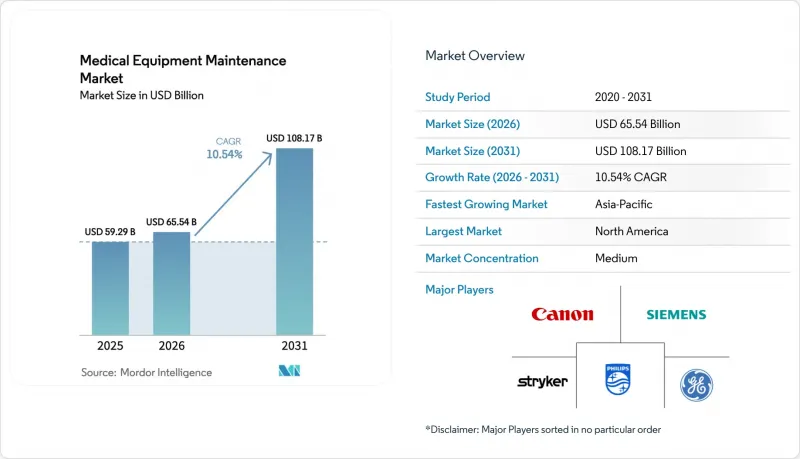
Mordor Intelligence에 의하면, 의료기기 유지보수 시장 규모는 2025년 592억 9,000만 달러로 평가되었고, 2026년 655억 4,000만 달러에서 2031년까지 1,081억 7,000만 달러로 확대될 것으로 예측되며, 2026-2031년 연평균 복합 성장률(CAGR)은 10.54%를 나타낼 전망입니다.
본 보고서는 서비스 유형별(예방 정비, 시정 정비 등), 계약 모델별(풀서비스 계약 등), 장비 유형별(영상 진단 장비, 내시경 장비 등), 서비스 제공업체별(독립 서비스 조직 등), 최종 사용자별(병원 등) 및 지역별로 분류되어 있습니다. 시장 전망은 금액(달러) 기준으로 제시되어 있습니다.
세계의 의료기기 유지보수 시장 동향 및 인사이트
예방 정비 프로그램에 대한 집중
병원에서는 비용이 많이 드는 가동 중단을 피하기 위해 예방 유지보수 일정을 일상적인 임상 워크플로우에 통합하고 있습니다. ASHE의 보고에 따르면, 체계적인 프로그램 도입으로 2024년에는 장비 고장이 22% 감소했다고 합니다. 영상 진단 부문은 MRI 한 대가 가동 중단될 경우 수십 건의 시술이 중단되어 수익에 타격을 입을 수 있기 때문에 그 혜택을 가장 크게 받고 있습니다. 펌웨어 업데이트, 교정 점검, 소모품 교체는 작업 지시를 사전에 예약하는 OEM 포털을 통해 자동화되었습니다. 장비의 복잡성이 증가함에 따라 그 경제적 이점은 더욱 커지고 있습니다. 최신 MRI에는 50개 이상의 하위 시스템이 탑재되어 있어, 부품을 사전에 확보해 두지 않을 경우 예기치 못한 고장으로 인해 장비가 수 주간 가동 불능 상태에 빠질 가능성이 있습니다. 그 결과, 병원들은 리스 계약에 예방 정비 조항을 포함하도록 협상하여, 서비스 비용을 가치 기반 상환 제도에 따른 예측 가능한 운영 경비로 전환하고 있습니다.
의료 인프라에 대한 투자 확대
중국의 ‘제14차 5개년 계획’에서는 2025년까지 병원 건설에 1조 2,000억 위안(1,680억 달러)을 배정하고, 모든 조달 패키지에 다년간의 유지보수 계약을 의무화했습니다. 인도의 ‘아유슈만 바라트(Ayushman Bharat)’ 프로그램은 2024년까지 20만 곳의 웰니스 센터를 구축할 계획이며, 각 센터에는 기본적인 진단 장비가 구비되어 있어 현지 서비스 팀이 필요합니다. OEM 및 ISO는 이에 따른 수요에 대응하고 생의학 기술자를 양성하기 위해 지역 허브를 설립하고 있습니다. 인도네시아와 베트남 등 동남아시아의 신흥 시장도 대출 기관의 자산을 보호하기 위해 유지보수를 장기 프로젝트 파이낸싱에 통합한 민관 파트너십을 통해 유사한 길을 걷고 있습니다.
서비스 계약의 높은 비용
영상 진단 기기의 풀서비스 계약 비용은 연간 구매 가격의 10%를 초과하기도 하여, 가격에 민감한 지역에서는 예산에 부담을 주고 있습니다. AAMI의 조사에 따르면, 라틴아메리카 및 동남아시아 병원의 38%가 규정된 점검 주기를 초과하여 장비를 가동하고 있어 치명적인 고장의 위험에 노출되어 있습니다. 소규모 시설은 협상력이 부족하기 때문에 당장의 비용은 절감할 수 있더라도, 장기적인 가동 중단 시간을 증가시키는 임시방편적인 수리를 선택하는 경우가 많습니다.
부문 분석
2025년, 예방 유지보수는 의료기기 유지보수 시장 점유율의 40.56%를 차지했습니다. 예측 유지보수는 2031년까지 연평균 성장률(CAGR) 12.25%를 기록하며, 다른 모든 서비스를 능가하는 성장이 예상됩니다. 병원에서는 센서 데이터가 고장 위험을 나타낼 때에만 기술자를 파견하는 알고리즘 기반의 대응 방식을 선호하는 경향이 있습니다. 이러한 변화로 인해 불필요한 방문이 줄어들고 자산 가동률이 향상됩니다. 시정 수리는 여전히 중요하지만, 가치 기반 계약에서는 가동 중단 시 벌금이 부과되기 때문에 그 비중은 감소하는 추세입니다. 사용자 교육 및 일일 교정을 포함하는 운영 유지보수는 로봇 수술 등 복잡한 플랫폼의 도입에 따라 확대되고 있습니다.
예측 유지보수로의 전환은 텔레메트리 통합을 뒷받침하는 IT 인프라가 잘 갖춰진 북미 및 서유럽에서 가장 두드러집니다. 신흥 시장에서는 네트워크 대역폭이 제한적이기 때문에 여전히 달력 기반의 일정에 의존하고 있습니다. 그 결과, 예측 유지보수 서비스는 OEM 및 주요 ISO가 더 높은 가동률을 보장받기를 원하는 시설을 대상으로 판매하는 프리미엄 서비스 계층이 되었습니다. 예측 기간 동안, 클라우드 연결성과 사이버 보안 프레임워크가 전 세계적으로 성숙해짐에 따라 예측 모델이 표준적인 접근 방식이 되고, 선진 의료 시스템과 개발도상국 의료 시스템 간의 성능 격차는 점차 줄어들 것입니다.
2025년에는 풀서비스 계약이 계약 총액의 47.53%를 차지하며 의료기기 유지보수 시장 규모를 지탱할 것입니다. 이는 병원 측이 부품비와 인건비를 충당하는 고정된 연간 요금이라는 확실성을 선호하기 때문입니다. 다중 공급업체 계약은 관리 업무의 효율화와 전체 의료기기군의 데이터 분석 활용을 목표로 하는 통합 의료 제공 네트워크에 힘입어 2031년까지 연평균 성장률(CAGR) 11.85%로 확대되고 있습니다. 이러한 계약 형태를 통해 의료 제공업체는 더 큰 할인을 협상할 수 있을 뿐만 아니라, 다양한 의료기기 브랜드에 걸쳐 표준화된 대응 시간을 실현할 수 있습니다. 변동비를 수용할 의사가 있는 소규모 진료소에서는 여전히 ‘시간·재료비 방식’의 계약이 일반적이지만, 병원과 OEM(원래 장비 제조업체)이 비용을 분담하는 ‘공유 서비스 모델’이 비용 관리가 가능한 중간적인 대안으로 부상하고 있습니다.
다중 벤더 지원의 확대에 따라 각 OEM 업체는 기존의 패키지 상품을 모듈형 서비스로 분해할 수밖에 없게 되었습니다. ISO(독립 서비스 제공업체)는 ‘수리권’에 관한 법령에 근거하여 합법화된 제3자 진단 도구를 활용하여, 혼재된 장비 군에 대응할 수 있는 중립적인 파트너로서의 입지를 확립하고 있습니다. 앞으로 계약 구조는 더욱 세분화될 것이며, 장비의 중요도에 따라 조정된 가동률 조항 및 성과 지표가 도입됨에 따라 서비스 가격과 품질을 둘러싼 경쟁이 격화될 것입니다.
지역별 분석
북미는 2025년에 매출의 35.13%를 차지한 것으로 평가되었으며, 예측 분석의 광범위한 도입과 외래수술센터(ASC) 및 영상 진단센터의 밀집된 네트워크가 성장의 견인차 역할을 했습니다. 현재 미국 내 신규 영상 진단 장비 판매의 40% 이상에는 서비스 구독이 번들로 제공되고 있습니다. 캐나다에서는 다년간의 유지보수 계약을 조건으로 하는 장비 구매에 대해 주 정부의 보조금이 지원되고 있으며, 멕시코의 민간 병원은 국제 인증 기준을 충족하기 위해 OEM과 계약을 체결하고 있습니다. FDA의 사이버 보안 규정은 이 지역 전체의 원격 서비스 규정 준수 기준이 되고 있으며, 전 세계 OEM의 관행에 영향을 미치고 있습니다.
아시아태평양은 2031년까지 11.81%라는 가장 높은 연평균 성장률(CAGR)을 나타낼 전망입니다. 중국의 인프라 계획에서는 현급 병원에 표준화된 유지보수를 의무화하고 있어, OEM과 ISO 모두에게 의료기기 유지보수 시장 규모가 확대되고 있습니다. 인도의 웰니스 센터에서는 수천 건에 달하는 기초 진단 서비스가 추가되면서 지역별 서비스 허브가 필요해지고 있습니다. 일본과 한국에서는 노후화된 스캐너를 구독형 소프트웨어 업데이트를 활용하는 AI 지원 플랫폼으로 교체하고 있습니다. 호주의 통합 민간 병원 그룹은 기업 전체를 대상으로 한 계약을 협상하고 있는 반면, 인도네시아와 베트남에서는 싱가포르 및 방콕의 지역 서비스 센터가 지원하는 민관 협력 프로젝트를 통해 처음으로 대응 역량이 확충되고 있습니다. 인력 부족은 여전히 과제로 남아 있어, 도시 외곽 지역에서의 예측 유지보수 도입을 지연시키고 있습니다.
2025년, 유럽은 독일, 영국, 프랑스를 선두로 여전히 큰 점유율을 유지했습니다. EU의 MDR(의료기기 규정)은 가동 시간 기록을 통일하고, 디지털 자산 관리 플랫폼 도입을 촉진하는 동시에 서비스 지출을 증가시키고 있습니다. 독일에서는 종합적인 보고가 포함된 올인클루시브 계약이 선호되고 있습니다. 영국의 국민보건서비스(NHS)는 비용 절감을 위해 위험 분담 모델의 시범 운영을 진행 중인 반면, 남유럽 국가들은 예산 압박을 완화하기 위해 ISO에 대한 의존도를 높이고 있습니다. 중동 및 아프리카에서는 의료 관광에 투자하는 GCC 국가들을 중심으로 시장이 확대되고 있는 반면, 라틴아메리카에서는 공공 부문의 자금 부족에도 불구하고 브라질과 아르헨티나의 민간 병원이 국제 기준에 부합하도록 시설을 현대화하는 것이 성장의 핵심이 되고 있습니다.
기타 혜택 :
- 엑셀 형식 시장 예측(ME) 시트
- 3개월간의 애널리스트 지원
자주 묻는 질문
목차
제1장 서론
제2장 조사 방법
제3장 주요 요약
제4장 시장 구도
제5장 시장 규모 및 성장 예측
제6장 경쟁 구도
제7장 시장 기회 및 향후 전망
AJY 26.08.26According to Mordor Intelligence, the medical equipment maintenance market size is projected to expand from USD 59.29 billion in 2025 and USD 65.54 billion in 2026 to USD 108.17 billion by 2031, registering a CAGR of 10.54% between 2026 to 2031.
This report is Segmented by Service Type (Preventive Maintenance, Corrective Maintenance, and More), Contract Model (Full-Service Agreements, and More), Equipment Type (Imaging Equipment, Endoscopic Devices, and More), Service Providers (Independent Service Organizations, and More), End User (Hospitals, and More), and Geography. The Market Forecasts are Provided in Terms of Value (USD).
Global Medical Equipment Maintenance Market Trends and Insights
Focus on Preventive Maintenance Programs
Hospitals are embedding preventive schedules into daily clinical workflows to avoid costly downtime. ASHE reported that structured programs cut equipment failure by 22% in 2024. Imaging departments feel the greatest benefit because a single MRI outage can cancel dozens of procedures, eroding revenue. Firmware updates, calibration checks, and consumable swaps are now automated through OEM portals that schedule work orders in advance. The economic case has strengthened as device complexity rises; a modern MRI has more than 50 subsystems, and any unscheduled failure can idle the unit for weeks if parts are not pre-staged. Consequently, hospitals negotiate preventive clauses within lease agreements to convert service costs into predictable operating expenses that align with value-based reimbursement.
Rising Healthcare Infrastructure Investments
China's 14th Five-Year Plan earmarked CNY 1.2 trillion (USD 168 billion) for hospital construction through 2025, mandating multi-year maintenance contracts within every procurement package. India's Ayushman Bharat program scaled to 200,000 wellness centers by 2024, each equipped with basic diagnostics that require local service teams. OEMs and ISOs are setting up regional hubs to meet the ensuing demand and train biomedical technicians. Emerging Southeast Asian markets such as Indonesia and Vietnam follow similar paths via public-private partnerships that bundle maintenance into long-term project financing to protect lenders' assets.
High Cost of Service Contracts
Full-service agreements for imaging devices can exceed 10% of purchase price each year, straining budgets in price-sensitive regions. An AAMI survey showed 38% of hospitals in Latin America and Southeast Asia operate equipment beyond prescribed service intervals, risking catastrophic failures. Smaller facilities lack negotiating clout, often opting for ad-hoc fixes that reduce immediate costs but increase long-term downtime.
Other drivers and restraints analyzed in the detailed report include:
- Expanding Installed Base of Imaging Equipment
- IoT-Enabled Remote Diagnostics Adoption
- Shortage of Skilled Biomedical Engineers
For complete list of drivers and restraints, kindly check the Table Of Contents.
Segment Analysis
In 2025 preventive maintenance captured a 40.56% slice of the medical equipment maintenance market share. Predictive maintenance is projected to outpace all other services at a 12.25% CAGR to 2031. Hospitals favor algorithm-driven interventions that dispatch technicians only when sensor data signals a failure risk. This change reduces unnecessary visits and improves asset availability. Corrective repairs remain relevant, yet their proportion is shrinking as value-based contracts penalize downtime. Operational maintenance, including user training and daily calibrations, is expanding alongside adoption of complex platforms such as robotic surgery.
The shift toward predictive routines is most pronounced in North America and Western Europe, where IT infrastructure supports telemetry integration. Emerging markets still rely on calendar-based schedules because of limited network bandwidth. As a result, predictive offerings represent a premium service tier that OEMs and leading ISOs market to facilities seeking higher uptime guarantees. Over the forecast horizon, predictive models will become the default approach as cloud connectivity and cybersecurity frameworks mature globally, narrowing the performance gap between advanced and developing health systems.
Full-service agreements held 47.53% of contract value in 2025, underpinning the medical equipment maintenance market size because hospitals prefer the certainty of fixed annual fees that cover parts and labor. Multi-vendor contracts are expanding at an 11.85% CAGR through 2031, driven by integrated delivery networks aiming to streamline administration and leverage fleet-wide data analytics. These arrangements allow providers to negotiate larger discounts and achieve standardized response times across diverse equipment brands. Time-and-material contracts remain common in small clinics willing to accept variable costs, while shared-service models, where expenses are split between hospital and OEM, are emerging as a cost-controlled middle option.
The rise of multi-vendor coverage compels OEMs to unbundle traditional packages into modular offerings. ISOs position themselves as neutral partners able to service mixed fleets, using third-party diagnostic tools legalized under right-to-repair statutes. Over time, contract structures will become more granular, with uptime clauses and performance metrics tailored by device criticality, amplifying competition on service price and quality.
Complete Report Scope:
- By Service Type
- Preventive Maintenance
- Corrective Maintenance
- Operational Maintenance
- Predictive Maintenance
- Software & Firmware Updates
- By Contract Model
- Full-Service Agreements
- Shared-Service Agreements
- Time & Material Contracts
- Multi-Vendor Contracts
- By Equipment Type
- Imaging Equipment
- MRI Systems
- CT Scanners
- X-ray & Fluoroscopy
- Ultrasound
- Nuclear Medicine & PET
- Endoscopic Devices
- Surgical Equipment
- Electrosurgical Devices
- Robotic Surgical Systems
- Minimally-Invasive Devices
- Life-Support Devices
- Ventilators
- Anesthesia Machines
- Patient Monitoring Equipment
- Dialysis Equipment
- Other Devices
- Imaging Equipment
- By Service Provider
- Original Equipment Manufacturers (OEMs)
- Independent Service Organizations (ISOs)
- In-house Biomedical Teams
- By End User
- Hospitals
- Diagnostic Imaging Centers
- Ambulatory Surgical Centers
- Dialysis Centers
- Laboratories
- Dental & Specialty Clinics
- Home-Care Settings
- By Geography
- North America
- United States
- Canada
- Mexico
- Europe
- Germany
- United Kingdom
- France
- Italy
- Spain
- Rest of Europe
- Asia-Pacific
- China
- Japan
- India
- South Korea
- Australia
- Rest of Asia-Pacific
- Middle East & Africa
- GCC
- South Africa
- Rest of Middle East & Africa
- South America
- Brazil
- Argentina
- Rest of South America
- North America
Geography Analysis
North America claimed 35.13% of revenue in 2025, driven by widespread adoption of predictive analytics and dense networks of ASCs and imaging centers. More than 40% of new imaging equipment sales in the United States now bundle service subscriptions. Canada directs provincial grants toward equipment purchases that require multi-year maintenance agreements, and Mexico's private hospitals secure OEM contracts to meet international accreditation standards. FDA cybersecurity rules set the benchmark for remote-service compliance across the region, influencing global OEM practices.
Asia-Pacific is forecast to register the highest CAGR at 11.81% through 2031. China's infrastructure plan mandates standardized maintenance within county-level hospitals, expanding the medical equipment maintenance market size for OEMs and ISOs alike. India's wellness centers add thousands of basic diagnostics requiring regional service hubs. Japan and South Korea replace aging scanners with AI-ready platforms that use subscription software updates. Australia's consolidated private-hospital groups negotiate enterprise-wide contracts, while Indonesia and Vietnam add first-time capacity via public-private projects supported by regional service centers in Singapore and Bangkok. Workforce shortages remain a challenge, slowing adoption of predictive maintenance in less urban areas.
Europe maintained a substantial share in 2025, spearheaded by Germany, the United Kingdom, and France. The EU MDR harmonizes uptime documentation, encouraging digital asset-management platforms and boosting service spending. Germany favors all-inclusive agreements with comprehensive reporting. The U.K.'s National Health Service pilots shared-risk models to curb costs, while Southern European nations rely increasingly on ISOs to relieve budget pressure. The Middle East and Africa witness expansion in GCC states investing in medical tourism, whereas Latin America's growth centers on Brazil and Argentina's private hospitals upgrading to international standards despite public-sector funding gaps.
- Agfa-Gevaert
- Aramark Healthcare+
- Baxter
- Canon
- Dragerwerk
- Fisher & Paykel Healthcare
- FUJIFILM
- GE Healthcare
- Getinge
- Karl Storz SE
- Koninklijke Philips
- Medtronic
- Mindray Bio-Medical
- Nihon Kohden
- Olympus Corp.
- Resmed
- Siemens Healthineers
- Sodexo Clinical Technology Mgmt
- Steris plc
- ZOLL Medical (Asahi Kasei)
- Stryker
Additional Benefits:
- The market estimate (ME) sheet in Excel format
- 3 months of analyst support
TABLE OF CONTENTS
1 Introduction
- 1.1 Study Assumptions & Market Definition
- 1.2 Scope of the Study
2 Research Methodology
3 Executive Summary
4 Market Landscape
- 4.1 Market Overview
- 4.2 Market Drivers
- 4.2.1 Focus on preventive maintenance programs
- 4.2.2 Rising healthcare infrastructure investments
- 4.2.3 Expanding installed base of imaging equipment
- 4.2.4 IoT-enabled remote diagnostics adoption
- 4.2.5 Regulatory uptime mandates (EU MDR, NMPA)
- 4.2.6 Shift to value-based pay-per-use contracts
- 4.3 Market Restraints
- 4.3.1 High cost of service contracts
- 4.3.2 Shortage of skilled biomedical engineers
- 4.3.3 Cyber-security liabilities in remote maintenance
- 4.3.4 Replacement-parts supply-chain disruptions
- 4.4 Regulatory Landscape
- 4.5 Technological Outlook
- 4.6 Porter's Five Forces
- 4.6.1 Threat of New Entrants
- 4.6.2 Bargaining Power of Buyers
- 4.6.3 Bargaining Power of Suppliers
- 4.6.4 Threat of Substitutes
- 4.6.5 Competitive Rivalry
5 Market Size & Growth Forecasts (Value, USD)
- 5.1 By Service Type
- 5.1.1 Preventive Maintenance
- 5.1.2 Corrective Maintenance
- 5.1.3 Operational Maintenance
- 5.1.4 Predictive Maintenance
- 5.1.5 Software & Firmware Updates
- 5.2 By Contract Model
- 5.2.1 Full-Service Agreements
- 5.2.2 Shared-Service Agreements
- 5.2.3 Time & Material Contracts
- 5.2.4 Multi-Vendor Contracts
- 5.3 By Equipment Type
- 5.3.1 Imaging Equipment
- 5.3.1.1 MRI Systems
- 5.3.1.2 CT Scanners
- 5.3.1.3 X-ray & Fluoroscopy
- 5.3.1.4 Ultrasound
- 5.3.1.5 Nuclear Medicine & PET
- 5.3.2 Endoscopic Devices
- 5.3.3 Surgical Equipment
- 5.3.3.1 Electrosurgical Devices
- 5.3.3.2 Robotic Surgical Systems
- 5.3.3.3 Minimally-Invasive Devices
- 5.3.4 Life-Support Devices
- 5.3.4.1 Ventilators
- 5.3.4.2 Anesthesia Machines
- 5.3.5 Patient Monitoring Equipment
- 5.3.6 Dialysis Equipment
- 5.3.7 Other Devices
- 5.3.1 Imaging Equipment
- 5.4 By Service Provider
- 5.4.1 Original Equipment Manufacturers (OEMs)
- 5.4.2 Independent Service Organizations (ISOs)
- 5.4.3 In-house Biomedical Teams
- 5.5 By End User
- 5.5.1 Hospitals
- 5.5.2 Diagnostic Imaging Centers
- 5.5.3 Ambulatory Surgical Centers
- 5.5.4 Dialysis Centers
- 5.5.5 Laboratories
- 5.5.6 Dental & Specialty Clinics
- 5.5.7 Home-Care Settings
- 5.6 By Geography
- 5.6.1 North America
- 5.6.1.1 United States
- 5.6.1.2 Canada
- 5.6.1.3 Mexico
- 5.6.2 Europe
- 5.6.2.1 Germany
- 5.6.2.2 United Kingdom
- 5.6.2.3 France
- 5.6.2.4 Italy
- 5.6.2.5 Spain
- 5.6.2.6 Rest of Europe
- 5.6.3 Asia-Pacific
- 5.6.3.1 China
- 5.6.3.2 Japan
- 5.6.3.3 India
- 5.6.3.4 South Korea
- 5.6.3.5 Australia
- 5.6.3.6 Rest of Asia-Pacific
- 5.6.4 Middle East & Africa
- 5.6.4.1 GCC
- 5.6.4.2 South Africa
- 5.6.4.3 Rest of Middle East & Africa
- 5.6.5 South America
- 5.6.5.1 Brazil
- 5.6.5.2 Argentina
- 5.6.5.3 Rest of South America
- 5.6.1 North America
6 Competitive Landscape
- 6.1 Market Concentration
- 6.2 Market Share Analysis
- 6.3 Company Profiles (includes Global level Overview, Market level overview, Core Segments, Financials as available, Strategic Information, Market Rank/Share for key companies, Products & Services, and Recent Developments)
- 6.3.1 Agfa-Gevaert
- 6.3.2 Aramark Healthcare+
- 6.3.3 Baxter International
- 6.3.4 Canon Medical Systems
- 6.3.5 Dragerwerk AG
- 6.3.6 Fisher & Paykel Healthcare
- 6.3.7 Fujifilm Healthcare
- 6.3.8 GE HealthCare
- 6.3.9 Getinge AB
- 6.3.10 Karl Storz SE
- 6.3.11 Koninklijke Philips N.V.
- 6.3.12 Medtronic plc
- 6.3.13 Mindray Bio-Medical
- 6.3.14 Nihon Kohden
- 6.3.15 Olympus Corp.
- 6.3.16 ResMed Inc.
- 6.3.17 Siemens Healthineers
- 6.3.18 Sodexo Clinical Technology Mgmt
- 6.3.19 Steris plc
- 6.3.20 ZOLL Medical (Asahi Kasei)
- 6.3.21 Stryker
7 Market Opportunities & Future Outlook
- 7.1 White-space & Unmet-Need Assessment