

|
시장보고서
상품코드
2114600
소아용 의료기기 : 시장 점유율 분석, 업계 동향 및 통계, 성장 예측(2026-2031년)Global Pediatric Medical Devices - Market Share Analysis, Industry Trends & Statistics, Growth Forecasts (2026 - 2031) |
||||||
 Mordor Intelligence
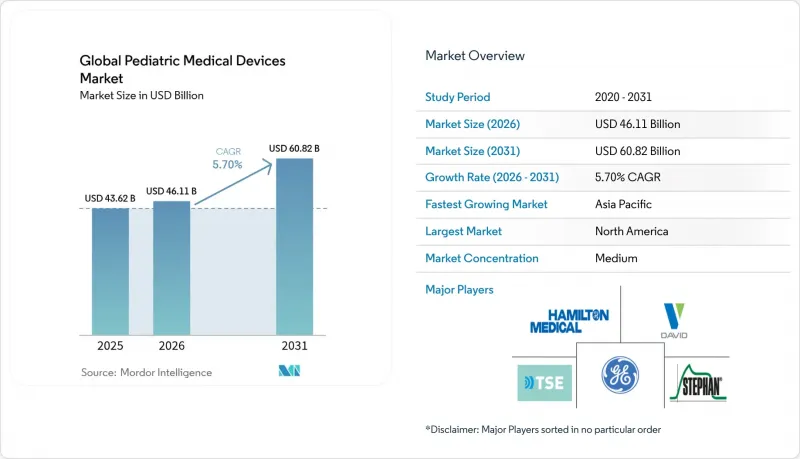
Mordor Intelligence에 의하면, 소아용 의료기기 시장 규모는 2025년에 436억 2,000만 달러로 평가되었습니다. 2026년 461억 1,000만 달러에서 2031년까지 608억 2,000만 달러에 이를 것으로 추정되고 예측 기간(2026-2031년) CAGR은 5.70%를 나타낼 전망입니다.
본 보고서에서는 업계를 제품별(체외진단용 의료기기, 순환기용 의료기기, 마취·호흡 관리용 의료기기, 신생아 집중치료실(NICU)용 의료기기, 모니터링 기기, 영상진단장치, 기타), 최종 사용자별(병원, 진단실험실, 소아과 클리닉, 기타), 그리고 지역별(북미, 유럽, 아시아태평양, 중동 및 아프리카, 남미)로 분류하고 있습니다.
세계의 소아용 의료기기 시장 동향 및 인사이트
조산 발생률 상승
미국의 조산 비율은 3년 연속 10.4%에 달했습니다. 인도에서는 매년 약 150만 건의 조산이 기록되고 있으며, 이는 인큐베이터, 튜브, 인공호흡기에 대한 지속적인 수요를 견인하고 있습니다. 이러한 통계 데이터로 인해 제조업체들은 기기의 소형화와 장기적인 신생아 치료 주기에 대응하기 위한 내구성 향상을 요구받고 있으며, 이는 소아용 의료기기 시장의 성장을 직접적으로 뒷받침하고 있습니다.
소아 전문 병원 인프라 확충
중국의 소아·정신건강 서비스 추진 계획(2025-2027년)에서는 소아 전용 병동 및 전문센터를 강화하기 위한 8가지 방안이 제시되어 있습니다. 인도의 레인보우 칠드런 메디케어는 현재 17개 병원에서 총 1,715개의 병상을 운영하고 있으며, 지난 2개 회계연도 동안 병상 가동률이 44.6%에서 55.4%로 상승했습니다. 이는 환자 수용 속도가 가속화되고 조달 수요가 증가하고 있음을 보여줍니다. 아시아 인프라 투자 은행(AIIB) 등 다자간 금융 기관들은 필리핀 내 새로운 소아과 병동 건설에 자금을 지원하고 있습니다. 필리핀의 경우 주민 1,000명당 병상 수가 0.89개로 여전히 낮은 수준입니다. 이러한 시설 확장은 소아용 의료기기 시장을 뒷받침하는 지속적인 장비 갱신으로 이어지고 있습니다.
대상 환자 수가 적어 ROI가 제한됨
인도적 목적의 승인 대상에는 SeaStar Medical사의 소아 급성 신장 손상용 카트리지 등, 미국에서 연간 20만 명 미만의 환자가 앓고 있는 질환을 치료하는 의료기기가 포함됩니다. 소아 환자만을 전문으로 하는 OrthoPediatrics사는 71건의 정형외과 시스템을 도입하고 있으나, 사업 규모 확대에는 여전히 고가 전략이나 인수합병에 의존하고 있습니다. 판매량이 제한적이어서 연구개발비 회수율이 낮아지고, 본래라면 소아용 의료기기 시장을 확대시켜야 할 신제품 출시가 지연되고 있습니다.
부문별 분석
2025년, 체외진단용 의료기기(IVD)는 소아용 의료기기 시장 점유율의 22.40%를 차지하며, 임상 판단에서 그 핵심적인 역할을 부각시켰습니다. 의료진이 간헐적인 샘플링에서 지속적인 데이터 수집으로 전환함에 따라, 모니터링 기기는 2031년까지 연평균 성장률(CAGR) 6.15%를 나타낼 것으로 예측됩니다. 영아의 신경 발달을 평가하는 AI 탑재 봉제 인형은 환경 센서가 어린이 친화적인 형태로 변화하고 있음을 여실히 보여줍니다. 순환기용 의료기기는 Minima Stent와 같은 카테터 기술의 획기적인 발전으로 인해 계속해서 혜택을 보고 있습니다. 호흡기 및 마취 플랫폼은 인공호흡기 지원이 필요한 조산아의 수가 많기 때문에 안정적인 수요를 유지하고 있습니다. 특수 폴리머 공급 부족으로 인해 임상의가 성인용 제품을 전용해야 하는 경우도 있어, 소아용 의료기기 시장에서 소재 혁신의 중요성이 부각되고 있습니다.
영상 진단 부문의 기업들은 초음파 진단 기기 및 X선 기기에 딥러닝 모듈을 추가하고 있으며, 이비인후과 및 이동 보조 기기 분야에서는 SONU Band와 같은 웨어러블 기기가 시장을 견인하고 있습니다. 이러한 혁신들이 종합적으로 병원이나 재택 환경을 불문하고 소아용 의료기기 시장 규모를 지탱하는 다양화의 기반이 되고 있습니다.
2025년에는 고도로 복잡한 시술과 통합 공급 계약 덕분에 병원이 수익의 53.70%를 차지했습니다. 그러나 보험 환급 제도와 기술의 융합으로 병원 밖에서도 고도의 치료가 가능해짐에 따라, 재택치료 시장 규모는 연평균 6.55%의 성장률을 보일 것으로 전망됩니다. 현장 진단(Point-of-Care) 분석 장치와 저침습 센서를 통해 환자의 가까운 곳에서 검사가 이루어지게 됨에 따라, 검사실의 검체 수는 감소하고 있습니다. 소아과 클리닉에서는 트리아지를 신속하게 처리하고 진료 효율을 높이는 소형 초음파 진단 장치가 도입되고 있습니다. 경카테터 치료의 보급으로 개복 수술의 필요성이 줄어들면서, 외래 수술용 소아용 의료기기 시장 규모는 완만하게 확대되고 있습니다. AI를 활용한 상처 흡입 장치나 바이오센서를 통해 가족이 집에서 회복 관리를 할 수 있게 됨에 따라 입원 환자 수의 부담이 경감되는 동시에, 소아용 의료기기 시장 수요 패턴도 재편되고 있습니다.
지역별 분석
2025년, 북미는 소아용 의료기기 시장의 43.10%를 차지했으며, 이러한 위상은 신뢰할 수 있는 보험 환급 제도와 활발한 규제 파이프라인에 의해 뒷받침되고 있습니다. FDA가 Minima Stent에 ‘획기적 의료기기(Breakthrough Label)’를 부여하고 2025년 6월 SONU Band를 승인한 것은 신속한 승인이 연구를 임상 현장의 도구로 전환시킨다는 점을 보여줍니다. CMS의 2025년 지급 규정은 재택 도입을 더욱 촉진하고 있습니다. 캐나다는 규제 조화와 국경을 초월한 의료기기 유통의 혜택을 누리고 있는 반면, 멕시코는 인프라 격차로 인해 해외 공급업체에게 성장 여지가 남아 있습니다.
아시아태평양은 2031년까지 연평균 7.08%의 성장률이 예상되며, 다른 모든 지역을 능가하는 속도로 확대될 것으로 전망됩니다. 중국의 2025년부터 2027년에 걸친 소아 의료 서비스 추진책은 정책의 기반이 되는 한편, 인도의 소아 의료 부문은 국내 의료비의 33%를 차지하고 있으며, 2026년까지 335억 달러에 달할 것으로 전망됩니다. 한국의 조산 관련 비용 증가와 일본의 카테터 치료 조기 도입은 고급 의료기기 업계에 호재가 되고 있습니다. 지역적 연구 제휴를 통해 진료 기준의 통일이 진행되면서, 다국적 기업이나 국내 공급업체를 불문하고 소아용 의료기기 시장 규모가 확대되고 있습니다.
유럽에서는 EU MDR 2024/1860을 활용하여 안전 기준을 강화하는 한편, 2028년까지의 이행 기간을 두고 있습니다. 독일, 프랑스, 영국이 연구개발 프로그램을 주도하는 한편, 스페인과 이탈리아에서는 소아 중환자실(ICU) 확충이 진행되고 있습니다. 레바논에서 좌심저형성증후군에 대한 하이브리드 완화 요법을 통해 사망률 제로라는 성과를 거둔 것은 기존의 의료 거점 이외의 곳에서도 임상적 탁월성이 발휘될 수 있음을 보여줍니다. 남미 및 중동 및 아프리카에서는 도입 속도가 완만하지만, 전 세계 금융 기관 및 다국적 기업의 기부 지원을 받아 소아용 의료기기 시장은 서서히 확대되고 있습니다.
기타 혜택 :
- 엑셀 형식 시장 예측(ME) 시트
- 3개월간 애널리스트 지원
자주 묻는 질문
목차
제1장 서론
제2장 조사 방법
제3장 주요 요약
제4장 시장 구도
제5장 시장 규모 및 성장 예측
제6장 경쟁 구도
제7장 시장 기회 및 향후 전망
KTH 26.08.28According to Mordor Intelligence, the pediatric medical devices market size was valued at USD 43.62 billion in 2025 and estimated to grow from USD 46.11 billion in 2026 to reach USD 60.82 billion by 2031, at a CAGR of 5.70% during the forecast period (2026-2031).
This report Segments the Industry Into by Product (IVD Devices, Cardiology Devices, Anesthesia & Respiratory Care Devices, Neonatal ICU Devices, Monitoring Devices, Others), by End-User (Hospitals, Diagnostic Laboratories, Pediatric Clinics, Others), and Geography (North America, Europe, Asia-Pacific, Middle-East and Africa, South America).
Global Pediatric Medical Devices Market Trends and Insights
Rising Pre-term Birth Incidence
Preterm births reached 10.4% in the United States for the third straight year. India records roughly 1.5 million premature deliveries each year, driving sustained demand for incubators, tubes, and ventilators. Such statistics oblige manufacturers to miniaturize devices and extend durability for lengthier neonatal care cycles, directly fueling the pediatric medical devices market.
Expansion of Pediatric-Focused Hospital Infrastructure
China's "years of pediatric and mental health services" (2025-2027) program lists eight initiatives that strengthen dedicated children's wards and specialist centers. India's Rainbow Children's Medicare now runs 1,715 beds across 17 hospitals with occupancy up from 44.6% to 55.4% in two fiscal years, signaling faster throughput and procurement intensity. Multilateral lenders such as the Asian Infrastructure Investment Bank finance new pediatric towers in the Philippines, where bed density remains low at 0.89 per 1,000 residents. These bricks-and-mortar expansions translate into continuous capital-equipment refreshes that underpin the pediatric medical devices market.
Small Addressable Patient Pools Limit ROI
Humanitarian approvals cover devices that treat conditions faced by fewer than 200,000 US patients annually, such as SeaStar Medical's cartridge for pediatric acute kidney injury . OrthoPediatrics, focused solely on young patients, has installed 71 orthopedic systems yet still leans on premium pricing and acquisitions to scale. Limited volumes dilute R&D payback, slowing new-product launches that would otherwise enlarge the pediatric medical devices market.
Other drivers and restraints analyzed in the detailed report include:
- Rapid Adoption of Minimally Invasive Cardiac Interventions
- Home-Based Remote Monitoring Reimbursement Roll-Outs
- Stringent FDA & EU Safety Evidence Requirements
For complete list of drivers and restraints, kindly check the Table Of Contents.
Segment Analysis
IVD devices captured 22.40% of the pediatric medical devices market share in 2025, underlining their centrality in clinical decision-making. Monitoring devices are projected to clock a 6.15% CAGR through 2031 as care teams transition from episodic sampling to continuous data feeds. The AI-equipped plush toy that grades infant neuro-development underscores how ambient sensors migrate into child-friendly form factors. Cardiology devices keep benefitting from catheter-based breakthroughs such as the Minima Stent. Respiratory and anesthesia platforms hold steady given the high volume of premature births that need ventilatory support. Supply tightness in specialty polymers occasionally forces clinicians to repurpose adult lines, highlighting the importance of material innovation for the pediatric medical devices market.
Diagnostic imaging players add deep-learning modules to ultrasound and X-ray consoles, while ENT and mobility aids receive a boost from wearables such as the SONU Band. Collectively these innovations anchor the diversification that sustains the pediatric medical devices market size across hospital and home settings.
Hospitals controlled 53.70% of revenue in 2025 thanks to high-complexity procedures and integrated supply contracts. Yet homecare settings are set to rise 6.55% annually as reimbursement and technology converge to allow advanced interventions outside hospital walls. Laboratories face shrinking sample volumes as point-of-care analyzers and minimally invasive sensors redirect testing closer to patients. Children's clinics adopt compact ultrasound units that quicken triage and improve throughput. The pediatric medical devices market size for ambulatory surgeries inches up as transcatheter approaches remove the need for open repair. AI-supported wound vacuums and biosensors enable families to manage recovery at home, easing the inpatient load and reshaping demand patterns in the pediatric medical devices market.
Complete Report Scope:
- By Product Type
- IVD Devices
- Cardiology Devices
- Anesthesia & Respiratory Care Devices
- Neonatal ICU Devices
- Monitoring Devices
- Diagnostic Imaging Devices
- Others (ENT, Ortho, Mobility Aids)
- By End-User
- Hospitals
- Diagnostic Laboratories
- Pediatric Clinics
- Ambulatory Surgical Centers
- Homecare Settings
- By Care Setting
- Inpatient Care
- Outpatient Care
- Home-based Care
- Emergency & Critical Care
- By Technology
- Conventional Devices
- Wearable & Connected Devices
- AI-Enabled Devices
- 3D-Printed Patient-Specific Devices
- Minimally-Invasive Catheter-Based
- By Geography
- North America
- United States
- Canada
- Mexico
- Europe
- Germany
- United Kingdom
- France
- Italy
- Spain
- Rest of Europe
- Asia-Pacific
- China
- Japan
- India
- Australia
- South Korea
- Rest of Asia-Pacific
- Middle East & Africa
- GCC
- South Africa
- Rest of Middle East & Africa
- South America
- Brazil
- Argentina
- Rest of South America
- North America
Geography Analysis
North America held 43.10% of the pediatric medical devices market in 2025, a position powered by reliable reimbursement and an active regulatory pipeline. The FDA's breakthrough label for the Minima Stent and the June 2025 green light for the SONU Band show how rapid clearances translate research into bedside tools fda.gov. CMS's 2025 payment rule further strengthens home-based adoption. Canada benefits from harmonized rules and cross-border device flows, while Mexico's infrastructure gap leaves headroom for foreign suppliers.
Asia-Pacific is forecast to grow at 7.08% through 2031, outpacing all other regions. China's 2025-2027 pediatric service drive sets a policy anchor, whereas India's pediatric segment, equal to 33% of national healthcare spending, should reach USD 33.5 billion by 2026. South Korea's escalating preterm costs and Japan's early adoption of catheter therapies create fertile ground for high-end devices. Regional research alliances are harmonizing practice standards and expanding the pediatric medical devices market size for multinational and domestic vendors alike.
Europe leverages EU MDR 2024/1860 to tighten safety while offering transition windows to 2028. Germany, France, and the United Kingdom spearhead R&D programs, whereas Spain and Italy scale pediatric ICUs. Lebanon's zero-mortality outcome in hybrid palliation of hypoplastic left heart syndrome underscores how clinical excellence can emerge beyond traditional hubs. South America and the Middle East & Africa record slower adoption but draw support from global lenders and multinational donations that gradually grow the pediatric medical devices market.
- Abbott Laboratories
- Medtronic
- GE Healthcare
- Koninklijke Philips
- Johnson & Johnson (Ethicon & DePuy Synthes)
- Siemens Healthineers
- Boston Scientific
- Becton Dickinson & Co.
- Smiths Group
- Cook Group
- Edward Lifesciences
- Atom Medical
- Hamilton Medical
- Phoenix Medical Systems
- TSE Medical
- David Medical
- Fritz Stephan
- Elektro-M
- Trimpeks
- Novonate
- Stryker
- Masimo
- Hill-Rom
Additional Benefits:
- The market estimate (ME) sheet in Excel format
- 3 months of analyst support
TABLE OF CONTENTS
1 Introduction
- 1.1 Study Assumptions & Market Definition
- 1.2 Scope of the Study
2 Research Methodology
3 Executive Summary
4 Market Landscape
- 4.1 Market Overview
- 4.2 Market Drivers
- 4.2.1 Rising Pre-Term Birth Incidence
- 4.2.2 Expansion of Pediatric-Focused Hospital Infrastructure
- 4.2.3 Rapid Adoption of Minimally-Invasive Cardiac Interventions
- 4.2.4 Home-Based Remote Monitoring Reimbursement Roll-Outs
- 4.2.5 New Reimbursement Codes in the US and Parts of Europe
- 4.2.6 3D Printed Patient-Specific Implants for Rare Anomalies
- 4.3 Market Restraints
- 4.3.1 Small Addressable Patient Pools Limit ROI
- 4.3.2 Stringent FDA & EU Safety Evidence Requirements
- 4.3.3 Scarcity of Large, High-Quality Pediatric Datasets
- 4.3.4 Supply-Chain Shortages of Pediatric-Grade Biomaterials
- 4.4 Value / Supply-Chain Analysis
- 4.5 Regulatory Landscape
- 4.6 Technological Outlook
- 4.7 Porter's Five Forces Analysis
- 4.7.1 Threat of New Entrants
- 4.7.2 Bargaining Power of Buyers
- 4.7.3 Bargaining Power of Suppliers
- 4.7.4 Threat of Substitutes
- 4.7.5 Competitive Rivalry
5 Market Size & Growth Forecasts (Value, USD Million)
- 5.1 By Product Type
- 5.1.1 IVD Devices
- 5.1.2 Cardiology Devices
- 5.1.3 Anesthesia & Respiratory Care Devices
- 5.1.4 Neonatal ICU Devices
- 5.1.5 Monitoring Devices
- 5.1.6 Diagnostic Imaging Devices
- 5.1.7 Others (ENT, Ortho, Mobility Aids)
- 5.2 By End-User
- 5.2.1 Hospitals
- 5.2.2 Diagnostic Laboratories
- 5.2.3 Pediatric Clinics
- 5.2.4 Ambulatory Surgical Centers
- 5.2.5 Homecare Settings
- 5.3 By Care Setting
- 5.3.1 Inpatient Care
- 5.3.2 Outpatient Care
- 5.3.3 Home-based Care
- 5.3.4 Emergency & Critical Care
- 5.4 By Technology
- 5.4.1 Conventional Devices
- 5.4.2 Wearable & Connected Devices
- 5.4.3 AI-Enabled Devices
- 5.4.4 3D-Printed Patient-Specific Devices
- 5.4.5 Minimally-Invasive Catheter-Based
- 5.5 By Geography
- 5.5.1 North America
- 5.5.1.1 United States
- 5.5.1.2 Canada
- 5.5.1.3 Mexico
- 5.5.2 Europe
- 5.5.2.1 Germany
- 5.5.2.2 United Kingdom
- 5.5.2.3 France
- 5.5.2.4 Italy
- 5.5.2.5 Spain
- 5.5.2.6 Rest of Europe
- 5.5.3 Asia-Pacific
- 5.5.3.1 China
- 5.5.3.2 Japan
- 5.5.3.3 India
- 5.5.3.4 Australia
- 5.5.3.5 South Korea
- 5.5.3.6 Rest of Asia-Pacific
- 5.5.4 Middle East & Africa
- 5.5.4.1 GCC
- 5.5.4.2 South Africa
- 5.5.4.3 Rest of Middle East & Africa
- 5.5.5 South America
- 5.5.5.1 Brazil
- 5.5.5.2 Argentina
- 5.5.5.3 Rest of South America
- 5.5.1 North America
6 Competitive Landscape
- 6.1 Market Concentration
- 6.2 Market Share Analysis
- 6.3 Company Profiles (includes Global level Overview, Market level overview, Core Segments, Financials as available, Strategic Information, Market Rank/Share for key companies, Products & Services, and Recent Developments)
- 6.3.1 Abbott
- 6.3.2 Medtronic plc
- 6.3.3 GE Healthcare
- 6.3.4 Philips Healthcare
- 6.3.5 Johnson & Johnson (Ethicon & DePuy Synthes)
- 6.3.6 Siemens Healthineers
- 6.3.7 Boston Scientific
- 6.3.8 Becton Dickinson & Co.
- 6.3.9 Smiths Medical
- 6.3.10 Cook Medical
- 6.3.11 Edwards Lifesciences
- 6.3.12 Atom Medical
- 6.3.13 Hamilton Medical
- 6.3.14 Phoenix Medical Systems
- 6.3.15 TSE Medical
- 6.3.16 David Medical
- 6.3.17 Fritz Stephan GmbH
- 6.3.18 Elektro-Mag
- 6.3.19 Trimpeks
- 6.3.20 Novonate Inc.
- 6.3.21 Stryker Corp.
- 6.3.22 Masimo Corporation
- 6.3.23 Hill-Rom Holdings
7 Market Opportunities & Future Outlook
- 7.1 White-space & Unmet-need Assessment


