

|
시장보고서
상품코드
2114621
말초 정맥 카테터 : 시장 점유율 분석, 업계 동향 및 통계, 성장 예측(2026-2031년)Peripheral Intravenous Catheters - Market Share Analysis, Industry Trends & Statistics, Growth Forecasts (2026 - 2031) |
||||||
 Mordor Intelligence
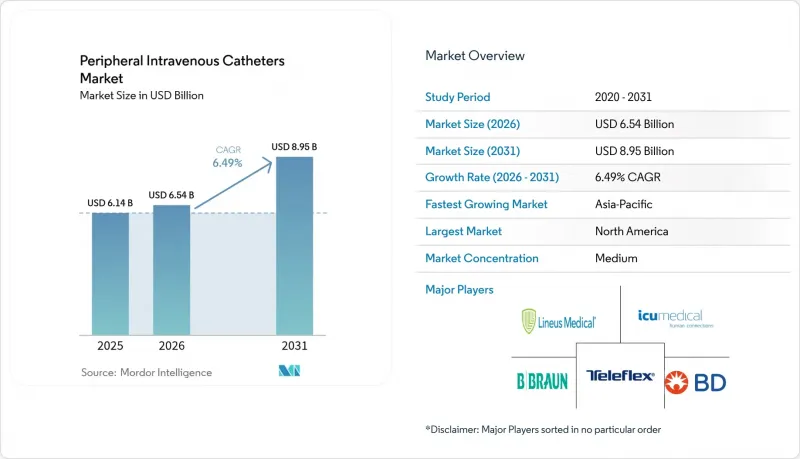
Mordor Intelligence에 의하면, 말초 정맥 카테터 시장 규모는 2025년 61억 4,000만 달러로 평가되었습니다. 2026년에는 65억 4,000만 달러로 확대되어 2026년부터 2031년에 걸쳐 CAGR 6.49%로 성장을 지속하여, 2031년에는 89억 5,000만 달러에 이를 것으로 예측됩니다.
본 보고서는 제품 유형(단축 말초 정맥 카테터 등), 기술(안전성/출혈 제어 카테터, 기존 카테터), 소재(폴리우레탄 등), 최종 사용자(병원 등), 용도(약물 투여 등) 및 지역(북미 등)별로 분류되어 있습니다. 시장 예측은 금액(달러) 기준으로 제시되어 있습니다.
세계의 말초 정맥 카테터 시장 동향 및 인사이트
만성 및 급성 질환 부담 증가
당뇨병과 관련된 장애 조정 생명년(DALY)은 2000년 이후 80% 이상 증가했으며, 급성기 및 장기 치료 현장에서 신뢰할 수 있는 혈관 접근에 대한 수요가 높아지고 있습니다. 미국, 일본, 서유럽에서는 고령화에 따라 다중 질환 병존이 두드러지고 있으며, 이로 인해 카테터 삽입 기간의 연장 및 수액 투여 빈도 증가가 필요해지고 있습니다. 병원에서는 인장 강도가 52.9 MPa이면서도 광투과율이 90%에 달하는 폴리우레탄 소재에 대한 검증이 진행되고 있으며, 이를 통해 삽입 부위의 가시성이 향상되어 예정에 없던 재삽입이 감소하고 있습니다. 맞춤형 암 치료나 생물학적 제제를 이용한 치료에서는 장기간에 걸쳐 안정적인 유량이 요구되므로, 의료진은 삽입 시 부담을 줄여주는 미드라인 카테터나 장기 삽입형 기기를 선호하여 채택하고 있습니다. 이러한 역학적 동향이 맞물리면서 시장 규모는 꾸준히 확대되고 있으며, 감염에 강하고 투명도가 높은 카테터를 시장에 출시하는 공급업체에 혜택을 가져다주고 있습니다.
외래 및 재택 정맥 주사 환경의 확대
ASC(외래수술센터(ASC))에서는 2034년까지 4,400만 건의 수술이 이루어질 것으로 예측되며, 이는 2024년 대비 21% 증가한 수치로, 혈관 접근 시작 지점의 양상을 변화시키고 있습니다. 외래로의 전환이 진행됨에 따라, 치료 중 시스템을 밀폐 상태로 유지하는 일체형 연장 튜브 등 ICU 외부에서의 유지 관리를 목적으로 한 기기 구매가 가속화되고 있습니다. 재택 수액 요법 프로토콜에서는 2024년 수액 요법 실천 기준에 개략적으로 설명된 바와 같이, 간호사의 개입을 최소화하면서도 개통성을 유지할 수 있는 기기가 중요시되고 있습니다. BD사의 SiteRite 9와 같은 디지털 초음파 시스템은 영상 진단과 바늘 추적 기능을 결합하여 첫 시도 성공률을 높이고, 예정에 없던 병원 방문을 줄여줍니다. 이러한 의료 제공 방식의 변화로 인해, 카테터와 휴대용 유도 도구, 소모품, 그리고 병원 외 직원을 위한 교육 모듈을 세트로 제공하는 공급업체가 유리한 입장에 서게 되었습니다.
카테터 시술 실패 및 합병증 발생률의 높음
첫 천자 실패율은 시도의 40%에 달하며, 천자가 어려운 환자군에서는 70%까지 치솟습니다. 이로 인해 미국에서는 매년 약 26억 8,000만 달러의 응급실 비용이 추가로 발생하고 있습니다. 특정 PowerPICC 로트에 대한 FDA의 조기 경보와 같은 제품 리콜은 임상의의 신뢰를 훼손하고 예산 외의 교체 주기를 초래합니다. 중심정맥카테터 관련 혈류 감염은 여전히 의료 관련 균혈증의 약 20%를 차지하고 있으며, 지속적인 소독을 위해 현장에서 차아염소산을 생성하는 허브의 도입이 검토되고 있습니다. 이러한 실패를 완화하기 위해서는 추가 교육, 초음파 진단 기기 도입 및 견고한 데이터 추적이 필요하지만, 소규모 병원의 경우 단기적으로 이러한 비용을 감당하기 어려울 수 있습니다.
부문별 분석
2031년까지의 기간 동안 미드라인 카테터는 8.21%라는 가장 높은 연평균 성장률(CAGR)을 기록했으나, 2025년 시점에서는 단거리 말초정맥 카테터가 매출의 60.58%를 차지했으며, 이는 일상적인 수액 투여에서의 높은 범용성에 기인합니다. 임상시험을 통해 중기 치료에서 미드라인 카테터는 말초 삽입형 중심정맥 카테터(PICC)에 비해 혈류 감염 위험을 감소시킨다는 사실이 입증되었습니다. 만성기 치료 경로가 외래 시설로 전환됨에 따라, 미드라인 카테터 시장 규모는 더욱 확대될 것으로 예측됩니다.
설계상의 개선점으로는 소프트 팁의 조영성 샤프트, 일체형 스태빌라이저, 그리고 28일 이상 폐색되지 않는 폐쇄형 커넥터 등이 주를 이룹니다. B. Braun사의 Introcan Safety 2Deep Access IV 카테터에 대한 규제 당국의 승인은 자동 바늘 보호 기능과 유량 향상이 결합되어 임상의들의 신뢰를 높이고 있음을 보여줍니다. 가격에 민감한 구매자들은 여전히 기본적인 단거리 카테터를 선호하고 있지만, 재삽입을 최소화해야 한다는 임상적 요구에 따라 미들라인 카테터는 종양학, 심부전 및 복합 항생제 치료 분야에서 새로운 표준으로 자리 잡고 있습니다.
안전성 및 혈액 관리 기능을 갖춘 제품은 2025년 매출의 67.95%를 차지하며 연평균 성장률(CAGR) 8.54%로 성장을 지속해, 조달에 있어 규정 준수가 비용보다 더 중요한 결정 기준이 되고 있음을 보여주었습니다. 클로즈드 허브 밸브와 자동 수축식 바늘은 현재 BD사의 Insyte Autoguard BC와 같은 주력 제품군에 널리 채택되어 있으며, 이 제품은 혈액 노출을 95% 감소시킵니다. 말초 정맥 카테터 시장에서는 특히 소송 위험이 높은 지역에서 기존 오픈 허브 제품의 단계적 폐지가 진행되고 있습니다.
전문 학회는 안전 카테터와 병상 초음파 검사의 병용을 권장하고 있습니다. 미국 심초음파학회(ASE)의 2024년 지침에서는 삽입 시 외상을 줄이기 위해 출고 시 통합된 플래시백 챔버 및 뭉툭한 끝단 캐뉼라의 사용을 권장하고 있습니다. 병원들이 공개 대시보드를 통해 날카로운 물체로 인한 부상 지표를 추적하는 가운데, 위험 조정형 보상 모델에 따라 사고 발생률이 높은 시설에는 벌금이 부과되기 시작했으며, 이는 안전 기기로의 전환을 촉진하고 있습니다.
지역별 분석
북미는 2025년 매출의 39.88%를 차지했으며, 그 중심은 연간 소비량이 3억 개를 넘는 미국입니다. 견실한 상환 제도와 병원들의 안전 제품군에 대한 투자가 높은 평균 판매 가격을 유지하고 있습니다. 이 지역에서는 초음파 유도 삽입 모듈,원격 혈관 접근 인증, 그리고 카테터 삽입 시간 준수 현황을 모니터링하는 예측 분석 대시보드가 도입되고 있습니다. 캐나다와 멕시코는 각각 공공 부문 입찰 및 마키라도라(수출용 제조 거점)의 신규 제조 거점 확장을 통해 지역 규모를 확대되고 있습니다.
규제 환경이 성숙한 유럽에서는 환자 안전에 대한 의무와 새롭게 부상하고 있는 순환 경제의 요건 간에 균형이 잡혀 있습니다. 독일, 프랑스, 영국이 해당 지역 수요의 대부분을 차지하고 있지만, 스페인과 이탈리아에서는 일회용 플라스틱을 줄이기 위해 재사용 시범 사업이 도입되고 있습니다. EU 의료기기 규정의 시행으로 공급업체들은 기술 문서 및 시판 후 조사 갱신을 의무화받게 되어, 신규 시장 진출기업에 대한 시장 진입 장벽이 높아지고 있습니다. 공공 조달 체계에서는 임상적 근거 외에도 지속가능성이 중요시되면서, 재생 폴리머 및 수명 연장형 제품에 대한 논의가 촉진되고 있습니다.
아시아태평양은 중국, 인도, 일본, 한국, 호주의 주도 하에 연평균 성장률(CAGR) 7.34%로 가장 빠르게 성장하고 있는 지역입니다. 인도의 의료 기술 부문은 2023년 신약·의료기기·화장품 법안에 따라 2030년까지 160억-170억 달러에서 500억 달러로 규모가 확대될 전망이며, 국내 제조 제휴를 촉진하고 있습니다. 중국은 비용 효율적인 대량 생산을 활용하는 한편, 3차 의료기관을 대상으로 고품질 영상 유도 시스템에 대한 투자를 추진하고 있습니다. 일본의 초고령 사회에서는 취약한 정맥에 대응하는 첨단 실리콘 카테터가 요구되고 있는 반면, 호주는 국가 품질 지표에 부합하는 감염 예방 기준에 중점을 두고 있습니다. 이러한 동향들이 맞물리면서 말초정맥 카테터 시장은 가격대에 관계없이 확대되고 있으며, 다국적 기업들은 공급망의 현지화와 임상 교육 플랫폼의 공동 개발을 서둘러야 하는 상황에 놓여 있습니다.
기타 혜택 :
- 엑셀 형식 시장 예측(ME) 시트
- 3개월간의 애널리스트 지원
자주 묻는 질문
목차
제1장 서론
제2장 조사 방법
제3장 개요
제4장 시장 구도
제5장 시장 규모 및 성장 예측
제6장 경쟁 구도
제7장 시장 기회 및 향후 전망
KTH 26.08.31According to Mordor Intelligence, the peripheral intravenous catheters market size is expected to grow from USD 6.14 billion in 2025 to USD 6.54 billion in 2026 and is forecast to reach USD 8.95 billion by 2031 at 6.49% CAGR over 2026-2031.
This report is Segmented by Product Type (Short Peripheral IV Catheters, and More), Technology (Safety/Blood-Control Catheters and Conventional Catheters), Material (Polyurethane, and More), by End User (Hospitals, and More), by Application (Medication Administration, and More), and Geography (North America, and More). The Market Forecasts are Provided in Terms of Value (USD).
Global Peripheral Intravenous Catheters Market Trends and Insights
Rising Burden of Chronic and Acute Diseases
Diabetes-related disability-adjusted life years climbed more than 80% since 2000, amplifying demand for dependable vascular access across acute and long-term care settings. Aging populations in the United States, Japan, and Western Europe are experiencing multi-morbidities that necessitate longer dwell catheters and higher infusion frequencies. Hospitals are validating polyurethane materials showing 52.9 MPa tensile strength yet 90% light transmittance, which improves site visualization and reduces unplanned restarts. Personalized oncology and biologic regimens demand consistent flow rates over extended durations, leading providers to favor midline and extended-dwell devices that decrease insertion trauma. Collectively, these epidemiological dynamics sustain steady volume growth and reward suppliers that bring infection-resistant, high-clarity catheters to market.
Expansion of Outpatient and Home Infusion Settings
ASCs are forecast to process 44 million procedures by 2034, a 21% jump from 2024, reshaping where vascular access is initiated. Outpatient migration accelerates purchasing of devices designed for maintenance outside the ICU, including integrated extension tubing that keeps systems closed during therapy. Home infusion protocols now emphasize devices that hold patency with minimal nurse intervention, as outlined in the 2024 Infusion Therapy Standards of Practice. Digital ultrasound systems such as BD's SiteRite 9 pair imaging with needle tracking, increasing first-attempt success rates and reducing unscheduled hospital visits. These care-delivery shifts favor suppliers that bundle catheters with portable guidance tools, consumables, and education modules for non-hospital staff.
High Incidence of Catheter Failures and Complications
First-pass cannulation fails in 40% of attempts, spiking to 70% in difficult-access cohorts, adding an estimated USD 2.68 billion in emergency department costs each year in the United States. Device recalls, such as the FDA's early alert on specific PowerPICC lots, erode clinician confidence and trigger unbudgeted replacement cycles. Central line-associated bloodstream infections still account for roughly 20% of healthcare-associated bacteremia, prompting exploration of hubs that generate on-site hypochlorous acid for continuous disinfection. Mitigating these failures requires more training, ultrasound capital, and robust data tracking, costs that smaller hospitals may struggle to absorb in the short term.
Other drivers and restraints analyzed in the detailed report include:
- Regulatory Mandates on Needlestick and Blood-Exposure Safety
- Continuous Product Innovation in Catheter Materials and Design
- Environmental Sustainability and Waste-Disposal Concerns
For complete list of drivers and restraints, kindly check the Table Of Contents.
Segment Analysis
Midline catheters generated the fastest 8.21% CAGR through 2031, even as short IV catheters retained 60.58% revenue in 2025, a position underscored by their versatility in routine infusions. Clinical trials have verified that midlines cut bloodstream infection risk relative to peripherally inserted central catheters for intermediate-duration therapies. The peripheral intravenous catheters market size for midlines is forecast to widen further as chronic-care pathways migrate to outpatient venues.
Design updates center on soft-tip radiopaque shafts, integrated stabilizers, and closed connectors that remain occlusion-free longer than 28 days. Regulatory clearance for B. Braun's Introcan Safety 2 Deep Access IV Catheter illustrates how automatic needle shielding and enhanced flow rates are converging to reinforce clinician confidence. While price-sensitive buyers still rely on basic short catheters, the clinical imperative to minimize reinsertion events positions midlines as a rising standard for oncology, heart-failure, and complex antibiotic regimens.
Safety and blood-control formats held 67.95% of 2025 revenue and are adding 8.54% CAGR, signaling that compliance is outpacing cost as the pivotal procurement criterion. Closed-hub valves and automatic retraction needles are now embedded across flagship portfolios such as BD Insyte Autoguard BC, which cuts blood exposure by 95%. The peripheral intravenous catheters market continues to phase out conventional open-hub products, especially in high-litigation regions.
Professional societies recommend pairing safety catheters with bedside ultrasound; 2024 guidelines from the American Society of Echocardiography endorse factory-integrated flashback chambers and blunt cannulae to cut insertion trauma. As hospitals track sharps-injury metrics on public dashboards, risk-adjusted reimbursement models are beginning to penalize facilities with high incident rates, reinforcing the switch to safety devices.
Complete Report Scope:
- By Product Type
- Short Peripheral IV Catheters
- Integrated / Closed IV Catheters
- Midline Catheters
- Extended-Dwell Catheters
- By Technology
- Safety / Blood-Control Catheters
- Conventional Catheters
- By Material
- Polyurethane
- Silicone
- Other Plastics
- By End User
- Hospitals
- Ambulatory Surgical Centers
- Home Healthcare & Alternate Care
- Clinics & Physician Offices
- By Application
- Medication Administration
- Fluid & Nutrition Administration
- Blood Transfusion
- Diagnostic Testing & Imaging Contrast
- Geography
- North America
- United States
- Canada
- Mexico
- Europe
- Germany
- United Kingdom
- France
- Italy
- Spain
- Rest of Europe
- Asia-Pacific
- China
- Japan
- India
- Australia
- South Korea
- Rest of Asia-Pacific
- Middle East & Africa
- GCC
- South Africa
- Rest of Middle East & Africa
- South America
- Brazil
- Argentina
- Rest of South America
- North America
Geography Analysis
North America generated 39.88% of 2025 revenue, anchored by the United States, where annual consumption exceeds 300 million units. Robust reimbursement and hospital investment in safety portfolios sustain premium average selling prices. The region is adding ultrasound-guided insertion modules, remote vascular-access credentialing, and predictive analytics dashboards that monitor catheter dwell time compliance. Canada and Mexico broaden regional scale through public-sector tenders and new maquiladora manufacturing footprints, respectively.
Europe, a mature regulatory environment, balances patient-safety mandates with emergent circular-economy requirements. Germany, France, and the United Kingdom account for the majority of regional demand, while Spain and Italy adopt reuse pilots to curb single-use plastics. EU Medical Device Regulation enforcement compels suppliers to refresh technical documentation and post-market surveillance, elevating market-entry barriers for new entrants. Public procurement frameworks now weight sustainability alongside clinical evidence, fostering dialogue on recycled polymers and extended-life formats.
Asia-Pacific is the fastest-growing geography at 7.34% CAGR, driven by China, India, Japan, South Korea, and Australia. India's medical technology sector is set to scale from USD 16-17 billion to USD 50 billion by 2030 under the New Drugs, Medical Devices and Cosmetics Bill of 2023, catalyzing domestic manufacturing alliances. China leverages cost-effective mass production yet is investing in premium image-guided systems to serve tertiary hospitals. Japan's super-aged society necessitates advanced silicone designs for fragile veins, while Australia focuses on infection-prevention benchmarks that align with national quality indicators. Collectively, these trends expand the peripheral intravenous catheters market footprint across price tiers, compelling multinationals to localize supply chains and co-develop clinical education platforms.
- Becton Dickinson & Co.
- B. Braun
- ICU Medical
- Teleflex
- Terumo Corp.
- Nipro Medical Corp.
- Vygon
- VOGT Medical GmbH
- Lineus Medical
- Access Vascular Inc.
- AngioDynamics
- 3M
- Baxter
- MedSource Labs
- RenovoRx
- Retractable Technologies
- Vascular Pathways Inc.
- Health Line Medical Products
- Shenzhen Antmed Co. Ltd.
- Greiner Bio-One GmbH
Additional Benefits:
- The market estimate (ME) sheet in Excel format
- 3 months of analyst support
TABLE OF CONTENTS
1 Introduction
- 1.1 Study Assumptions & Market Definition
- 1.2 Scope of the Study
2 Research Methodology
3 Executive Summary
4 Market Landscape
- 4.1 Market Overview
- 4.2 Market Drivers
- 4.2.1 Rising Burden of Chronic and Acute Diseases
- 4.2.2 Expansion of Outpatient and Home Infusion Settings
- 4.2.3 Regulatory Mandates on Needlestick and Blood-Exposure Safety
- 4.2.4 Continuous Product Innovation in Catheter Materials And Design
- 4.2.5 Government Bulk Procurement Programs in Emerging Markets
- 4.2.6 Integration of Imaging and Digital Guidance for Vascular Access
- 4.3 Market Restraints
- 4.3.1 High Incidence of Catheter Failures And Complications
- 4.3.2 Availability of Alternative Vascular Access Devices
- 4.3.3 Environmental Sustainability and Waste-Disposal Concerns
- 4.3.4 Purchasing Power Concentration of Group Purchasing Organizations
- 4.4 Technological Outlook
- 4.5 Porter's Five Forces Analysis
- 4.5.1 Threat of New Entrants
- 4.5.2 Bargaining Power of Buyers
- 4.5.3 Bargaining Power of Suppliers
- 4.5.4 Threat of Substitutes
- 4.5.5 Competitive Rivalry
5 Market Size & Growth Forecasts (Value, USD)
- 5.1 By Product Type
- 5.1.1 Short Peripheral IV Catheters
- 5.1.2 Integrated / Closed IV Catheters
- 5.1.3 Midline Catheters
- 5.1.4 Extended-Dwell Catheters
- 5.2 By Technology
- 5.2.1 Safety / Blood-Control Catheters
- 5.2.2 Conventional Catheters
- 5.3 By Material
- 5.3.1 Polyurethane
- 5.3.2 Silicone
- 5.3.3 Other Plastics
- 5.4 By End User
- 5.4.1 Hospitals
- 5.4.2 Ambulatory Surgical Centers
- 5.4.3 Home Healthcare & Alternate Care
- 5.4.4 Clinics & Physician Offices
- 5.5 By Application
- 5.5.1 Medication Administration
- 5.5.2 Fluid & Nutrition Administration
- 5.5.3 Blood Transfusion
- 5.5.4 Diagnostic Testing & Imaging Contrast
- 5.6 Geography
- 5.6.1 North America
- 5.6.1.1 United States
- 5.6.1.2 Canada
- 5.6.1.3 Mexico
- 5.6.2 Europe
- 5.6.2.1 Germany
- 5.6.2.2 United Kingdom
- 5.6.2.3 France
- 5.6.2.4 Italy
- 5.6.2.5 Spain
- 5.6.2.6 Rest of Europe
- 5.6.3 Asia-Pacific
- 5.6.3.1 China
- 5.6.3.2 Japan
- 5.6.3.3 India
- 5.6.3.4 Australia
- 5.6.3.5 South Korea
- 5.6.3.6 Rest of Asia-Pacific
- 5.6.4 Middle East & Africa
- 5.6.4.1 GCC
- 5.6.4.2 South Africa
- 5.6.4.3 Rest of Middle East & Africa
- 5.6.5 South America
- 5.6.5.1 Brazil
- 5.6.5.2 Argentina
- 5.6.5.3 Rest of South America
- 5.6.1 North America
6 Competitive Landscape
- 6.1 Market Concentration
- 6.2 Market Share Analysis
- 6.3 Company Profiles (includes Global level Overview, Market level overview, Core Business Segments, Financials, Headcount, Key Information, Market Rank, Market Share, Products and Services, and analysis of Recent Developments)
- 6.3.1 Becton Dickinson & Co.
- 6.3.2 B. Braun Melsungen AG
- 6.3.3 ICU Medical Inc. (Smiths Medical)
- 6.3.4 Teleflex Inc.
- 6.3.5 Terumo Corp.
- 6.3.6 Nipro Medical Corp.
- 6.3.7 Vygon SA
- 6.3.8 VOGT Medical GmbH
- 6.3.9 Lineus Medical
- 6.3.10 Access Vascular Inc.
- 6.3.11 AngioDynamics Inc.
- 6.3.12 3M Company
- 6.3.13 Baxter International Inc.
- 6.3.14 MedSource Labs
- 6.3.15 RenovoRx Inc.
- 6.3.16 Retractable Technologies Inc.
- 6.3.17 Vascular Pathways Inc.
- 6.3.18 Health Line Medical Products
- 6.3.19 Shenzhen Antmed Co. Ltd.
- 6.3.20 Greiner Bio-One GmbH
7 Market Opportunities & Future Outlook
- 7.1 White-space & Unmet-Need Assessment


