

|
시장보고서
상품코드
2114627
생분해성 고분자 코팅 요소 : 시장 점유율 분석, 업계 동향 및 통계, 성장 예측(2026-2031년)Biodegradable Polymer Coated Urea - Market Share Analysis, Industry Trends & Statistics, Growth Forecasts (2026 - 2031) |
||||||
 Mordor Intelligence
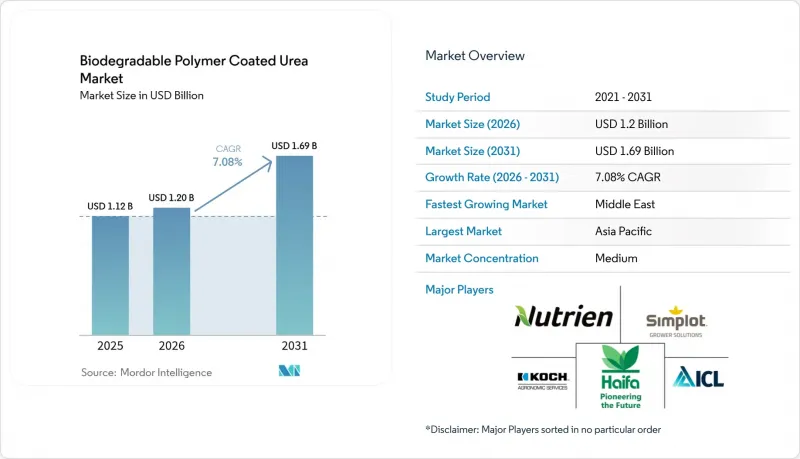
Mordor Intelligence에 의하면, 생분해성 고분자 코팅 요소 시장 규모는 2025년에 11억 2,000만 달러로 평가되었습니다. 2026년 12억 달러에서 2031년까지 16억 9,000만 달러에 이를 것으로 예상되며, 예측 기간(2026-2031년) CAGR은 7.08%를 나타낼 전망입니다.
본 보고서는 작물 유형(곡물 및 곡류, 콩류·유지종자, 상업용 작물 등), 폴리머 유형(폴리젖산, 폴리카프로락톤, 전분계 폴리머 등), 시비 방법(살포, 관개 등),및 지역(북미, 아시아태평양, 남미 등)별로 세분화되어 있습니다. 시장 예측은 금액(달러) 기준으로 제시되어 있습니다.
세계의 생분해성 고분자 코팅 요소 시장 동향 및 인사이트
질소 이용 효율이 높은 비료에 대한 규제 추진
2024년 유럽연합(EU) 질산염 지침 개정에 따라 농장의 질소 시비량이 1헥타르당 170kg으로 제한됨에 따라, 생산자들은 휘발을 억제하는 방출 조절 비료의 도입을 불가피하게 되었습니다. 이에 이어 독일은 2030년까지 암모니아 배출량을 29% 감축하겠다고 공약하여, 대기 중 손실이 적은 서방형 제제에 대한 직접적인 수요를 창출했습니다. 중국도 이러한 움직임에 발맞추어 대규모 농업 기업에 질소 이용 효율 인증을 의무화함으로써, 전 세계 요소 소비량의 3분의 1 가까이를 차지하는 시장에서 수요를 확고히 다졌습니다. 이러한 동시적인 규제 조치로 인해 생분해성 고분자 코팅 요소 시장은 단순한 선택 사항인 고부가가치 자재가 아니라, 규제 준수를 위한 수단으로 자리매김하게 되었습니다. 그 결과, 판매업체들은 현재 코팅 요소 계약에 규제 관련 자문 서비스를 함께 제공하고 있으며, 이는 정책 시행이 중기적으로 지속적인 수요의 원동력으로 계속 작용할 것임을 시사합니다.
아시아태평양의 특산 작물 재배 면적 급증
2024년, 아시아태평양의 과일 및 채소 수출은 급증하여 베트남에서만 68억 달러의 수출액을 기록하며 전년 대비 22% 증가했습니다. 태국, 베트남, 필리핀의 특산 작물 생산자들은 코팅 요소와 기존 요소의 비용 차이를 상쇄하는 가격 프리미엄을 얻고 있습니다. 수출지에서는 엄격한 잔류 기준이 적용되고 있기 때문에 생산자들은 시즌 말기의 질산염 농도 급증을 최소화하기 위해 방출 조절 비료를 사용하고 있습니다. 이러한 사정으로 인해 밭작물로의 보급은 여전히 제한적이지만, 생분해성 고분자 코팅 요소 시장은 고부가가치 작물 분야에서 확고한 입지를 다지고 있습니다. 품질 및 환경 관련 요건이 일치한다는 점을 감안할 때, 향후 화훼 재배 및 보호 재배 분야로 2차적인 파급 효과도 예상됩니다.
기존 요소에 비해 높은 가격 프리미엄
2024년, 기존 입상 요소의 평균 가격은 1미터톤당 425달러였으나, 생분해성 고분자 코팅 요소는 1,200-1,400달러에 거래되고 있으며, 이는 제조 비용 및 폴리머 원자재비 급등을 반영한 것입니다. 이익률이 낮은 밭작물의 경우, 10-15%의 수확량 증가로는 이러한 가격 차이를 상쇄하기 어려우므로, 도입은 주로 고부가가치 원예 작물이나 보조금 대상 재배 면적으로 제한되고 있습니다. 탄소 크레딧을 통한 수익이나 인건비 절감을 통해 그 차이는 일부 상쇄되지만, 특히 금융 접근성이 제한된 시장에서는 높은 가격이 여전히 큰 장벽으로 작용하고 있습니다. 공급업체들은 이에 대응하여 소용량 패키지나 계절 한정 할인 프로그램을 도입하고 있지만, 이러한 조치로 인해 비용에 대한 우려가 완화되는 정도는 미미합니다.
부문별 분석
2025년, 곡물 및 곡류는 생분해성 고분자 코팅 요소 시장 규모의 45.30%를 차지했습니다. 이는 비용 측면의 역풍에도 불구하고, 해당 작물의 광범위한 재배 면적 덕분입니다. 이 광범위한 부문 내에서 도입은 쌀이나 옥수수와 같은 고질소 곡물에 집중되어 있으며, 서방형 특성으로 인해 측정 가능한 수확량 향상을 가져오고 있습니다. 한편, 과일 및 채소는 생산자들이 수출 시장의 잔류 기준 준수를 목표로 하고, 농산물의 등급 향상을 통한 부가가치 증대를 활용하고 있기 때문에 2031년까지 연평균 성장률(CAGR) 10.22%로 확대되고 있습니다. 두리안, 드래곤프루트, 식용 포도 품종 등의 고급 작물은 1헥타르당 1만 5,000달러를 초과하는 수익 밀도를 달성하고 있어, 피복 요소에 대한 투자를 단기간 내에 회수할 수 있게 되었습니다. 콩류나 유지종자의 경우, 생물학적 질소 고정으로 인해 합성 비료의 필요성이 부분적으로 상쇄되기 때문에 도입 속도는 완만하지만, 윤작 시스템을 채택하는 생산자들 사이에서는 영양소의 이용 가능 시기를 콩과 작물 수요 피크와 일치시킬 수 있다는 장점이 높이 평가되고 있습니다. 잔디나 관상용 식물은 틈새 시장이지만, 도시 조경 분야에서 지자체 관할 구역 내 영양분 유출을 제한하는 규제가 의무화되어 있어 안정적인 시장을 유지하고 있습니다.
과일 및 채소 분야는 생분해성 고분자 코팅 요소 시장이 왜 특수 농업에서 지지를 받고 있는지를 여실히 보여줍니다. 영양분 공급 시기를 정밀하게 제어함으로써 생리 장애나 외관상의 결함이 완화되고, 포장률과 수출 적격률이 향상됩니다. 생산자들은 시비 및 관개 프로그램에 코팅 우레아를 도입하고, 질소 공급을 중요한 생육 단계에 맞추어 조정함으로써 시비 작업 횟수를 절반으로 줄여 인건비를 절감하고 있습니다. 곡물의 경우, 도입 여부는 수확량 측면의 경제성뿐만 아니라 정책적 인센티브나 탄소 크레딧 적립에 따라 좌우되기 때문에 작물 유형에 따라 보급률에 차이가 나타납니다.
지역별 분석
아시아태평양은 2025년에 생분해성 고분자 코팅 요소 시장 매출 점유율의 37.50%를 유지했습니다. 이는 서방형 자재에 대한 보조금을 지급하고 이를 관개 설비의 현대화와 연계하는 정부의 현대화 프로그램에 힘입은 결과입니다. 중국 각 성이 지정하는 친환경 농업 구역에서는 코팅 요소 비용의 최대 50%가 보조되며, 질소 이용 효율이 지역 농업 보급원의 성과 평가 지표에 반영되고 있습니다. 인도의 프라단 만트리 크리시 신차이 요자나(Pradhan Mantri Krishi Sinchayee Yojana)는 점적 관개에 대한 보조금을 영양분 공급 목표와 연계함으로써 비료 관개(퍼티게이션)의 도입을 촉진하고 있습니다. 베트남, 태국, 필리핀의 특산 작물 재배 밀도가 높아짐에 따라 수익 잠재력과 고가의 투입재 비용이 균형을 이루며, 지역적 수요가 강화되고 있습니다.
중동은 가장 빠르게 성장하는 지역으로, 식량 안보 전략과 심각한 물 부족을 배경으로 2031년까지 연평균 성장률(CAGR) 9.56%가 예상됩니다. 사우디아라비아는 ‘비전 2030’에 따라 지속 가능한 농업 기술에 80억 달러를 배정하고, 물의 증발 손실을 억제하는 고효율 비료를 우선적으로 도입하고 있습니다. 아랍에미리트(UAE)에서는 폐쇄형 수경 재배 시스템을 위한 서방형 요소를 지정된 수직 농업 복합 시설이 추진되고 있으며, 이 시스템에서는 영양소의 정밀한 관리가 시스템 전체의 경제성을 결정짓고 있습니다. 경작 가능한 토지가 제한적이어서 절대 생산량에는 상한선이 있지만, 1헥타르당 지출액이 높기 때문에 전 세계 생분해성 고분자 코팅 요소 시장에 대한 이 지역의 가치 기여도는 높아지고 있습니다.
북미와 유럽은 성숙한 시장임에도 불구하고 꾸준한 도입이 진행되고 있으며, 각각 연평균 성장률(CAGR) 6.05% 및 5.28%로 확대되고 있습니다. 두 지역 모두 투입 자재의 높은 가격을 정당화하기 위해 환경 규제 준수와 탄소 시장 통합에 의존하고 있습니다. 미국 농무부(USDA)의 비용 분담 프로그램 외에도, 유럽연합(EU) 전역의 질산염 취약 지역에서 시행되는 질산칼슘 및 질산암모늄 규제가 기초 수요를 뒷받침하고 있습니다. 아프리카는 연평균 성장률(CAGR) 8.73%로 성장을 지속하고 있으며, 비료 접근성과 토양 건강 회복을 결합한 기부자 자금 지원 시범 사업이 전개되고 있지만, 물류 측면의 과제와 농가에 대한 교육 부족이 여전히 사업 규모 확대를 저해하고 있습니다. 전반적으로, 지리적 다각화를 통해 생분해성 고분자 코팅 요소 시장은 지역별 정책 전환이나 가격 충격의 영향을 피하고 있습니다.
기타 혜택 :
- 엑셀 형식 시장 예측(ME) 시트
- 3개월간의 애널리스트 지원
자주 묻는 질문
목차
제1장 서론
제2장 조사 방법
제3장 개요
제4장 시장 구도
제5장 시장 규모 및 성장 예측
제6장 경쟁 구도
제7장 시장 기회 및 향후 전망
KTH 26.08.31According to Mordor Intelligence, the biodegradable polymer coated urea market size was valued at USD 1.12 billion in 2025 and estimated to grow from USD 1.2 billion in 2026 to reach USD 1.69 billion by 2031, at a CAGR of 7.08% during the forecast period (2026-2031).
This report is Segmented by Crop Type (Grains and Cereals, Pulses and Oilseeds, Commercial Crops, and More), by Polymer Type (Polylactic Acid, Polycaprolactone, Starch-Based Polymers, and More), by Application Method (Broadcast Spreading, Fertigation, and More), and by Geography (North America, Asia-Pacific, South America, and More). The Market Forecasts are Provided in Terms of Value (USD).
Global Biodegradable Polymer Coated Urea Market Trends and Insights
Regulatory Push for Nitrogen-Use-Efficiency Fertilizers
Amendments to the European Union Nitrates Directive in 2024 capped on-farm nitrogen application at 170 kg per hectare, compelling growers to adopt controlled-release inputs that curb volatilization. Germany followed by pledging a 29% ammonia-emission cut by 2030, creating a direct pull for slow-release formulations that demonstrate lower atmospheric losses. China mirrored this stance by requiring large farming enterprises to certify nitrogen-use efficiency, anchoring demand in a market responsible for nearly one-third of global urea consumption. These synchronized mandates elevate the biodegradable polymer coated urea market as a compliance tool rather than an optional premium input. Consequently, distributors now bundle regulatory advisory services with coated urea contracts, signaling that policy enforcement will remain a durable demand driver over the medium term.
Surge in Specialty Crop Acreage in Asia-Pacific
Asia-Pacific fruit and vegetable exports rose sharply in 2024, with Vietnam alone posting USD 6.8 billion in shipments, a 22% year-on-year gain. Specialty growers in Thailand, Vietnam, and the Philippines command price premiums that offset the cost differential between coated and conventional urea. Because export destinations enforce strict residue limits, producers use controlled-release inputs to minimize late-season nitrate spikes. This calculus anchors the biodegradable polymer coated urea market in high-value crops, even as field-crop penetration remains limited. Over time, secondary spillovers into floriculture and protected cultivation are likely, given aligned quality and environmental requirements.
High Price Premiums Over Conventional Urea
Conventional granular urea averaged USD 425 per metric ton in 2024, whereas bio-degradable polymer coated grades traded between USD 1,200 and USD 1,400, reflecting higher manufacturing and polymer feedstock costs. For low-margin field crops, yield gains of 10-15% rarely outweigh such premiums, confining adoption mainly to high-value horticulture or subsidy-backed acreage. Although carbon-credit revenue and labor savings partially offset the gap, sticker-shock remains a formidable hurdle, particularly in markets with limited credit access. Suppliers have responded by launching smaller pack sizes and seasonal discount programs, but these measures only marginally ease cost concerns.
Other drivers and restraints analyzed in the detailed report include:
- Farmer Incentives Under 4R Nutrient Stewardship Programs
- Breakthroughs in Bio-Polymer Micro-Encapsulation
- Regulatory Ambiguity Around Biodegradable Claims
For complete list of drivers and restraints, kindly check the Table Of Contents.
Segment Analysis
Grains and cereals held a 45.30% share of the biodegradable polymer coated urea market size in 2025, a function of sheer acreage despite cost headwinds. Within this broad segment, adoption concentrates in high-nitrogen cereals like rice and corn, where controlled release delivers measurable yield bumps. Conversely, fruits and vegetables expand at a 10.22% CAGR to 2031 as growers aim for residue compliance in export markets and exploit the value uplift stemming from higher produce grades. Premium crops such as durian, dragon fruit, and table grapes achieve revenue densities above USD 15,000 per hectare, enabling rapid payback on coated-urea investments. Pulses and oilseeds show moderate uptake because biological nitrogen fixation partially offsets synthetic input needs, though growers in rotation systems appreciate the benefit of synchronizing nutrient availability with peak legume demand. Turf and ornamentals, though niche, remain a steady market due to urban landscaping mandates that cap nutrient run-off in municipal areas.
The fruits and vegetables cohort illustrates why the biodegradable polymer coated urea market resonates with specialty agriculture. Precision nutrient timing reduces physiological disorders and cosmetic blemishes, enhancing pack-out rates and export acceptance. Growers integrate coated urea within fertigation programs to align nitrogen supply with critical growth phases, halving application trips and lowering labor costs. For grains, adoption hinges on policy incentives and carbon-credit stacking rather than yield economics alone, underscoring variable penetration across crop types.
Complete Report Scope:
- By Crop Type
- Grains and Cereals
- Pulses and Oilseeds
- Commercial Crops
- Fruits and Vegetables
- Turf and Ornamentals
- By Polymer Type
- Polylactic Acid (PLA)
- Polycaprolactone (PCL)
- Starch-based Polymers
- Other Biodegradable Polymers
- By Application Method
- Broadcast Spreading
- Fertigation
- Foliar Application
- By Geography
- North America
- United States
- Canada
- Mexico
- Rest of North America
- Europe
- Germany
- United Kingdom
- France
- Netherlands
- Russia
- Rest of Europe
- Asia-Pacific
- China
- Japan
- India
- Australia
- Rest of Asia-Pacific
- South America
- Brazil
- Argentina
- Rest of South America
- Middle East
- Saudi Arabia
- Turkey
- Rest of Middle East
- Africa
- South Africa
- Egypt
- Rest of Africa
- North America
Geography Analysis
Asia-Pacific sustained a 37.50% revenue share of the biodegradable polymer coated urea market in 2025, bolstered by government modernization programs that subsidize controlled-release inputs and tie them to irrigation upgrades. China's provincial eco-agriculture zones reimburse up to 50% of coated-urea costs, embedding nitrogen-use efficiency into performance metrics for local extension officers. India's Pradhan Mantri Krishi Sinchayee Yojana links drip-irrigation grants with nutrient-delivery targets, galvanizing fertigation-based adoption. High specialty-crop density across Vietnam, Thailand, and the Philippines reinforces regional demand by aligning revenue potential with premium input costs.
The Middle East is the fastest-growing regional cluster, poised for a 9.56% CAGR through 2031, underpinned by food-security strategies and acute water scarcity. Saudi Arabia earmarked USD 8 billion for sustainable farming technologies under Vision 2030, prioritizing efficient fertilizers that curtail water evaporation losses. The United Arab Emirates advances vertical-farming complexes that specify controlled-release urea for closed-loop hydroponic systems where nutrient precision determines overall system economics. While limited arable land caps absolute volume, the high per-hectare spend elevates regional value contribution to the global biodegradable polymer coated urea market.
North America and Europe remain mature but steady adopters, advancing at 6.05% and 5.28% CAGRs, respectively. Both regions rely on environmental compliance and carbon-market integration to justify input premiums. USDA cost-share programs, coupled with calcium ammonium nitrate restrictions in nitrate-vulnerable zones across the European Union, sustain baseline demand. Africa, with an 8.73% CAGR, showcases donor-funded pilots that blend fertilizer access with soil-health restoration, though logistics gaps and limited farmer education continue to dampen scalability. Collectively, geographic diversification shields the biodegradable polymer coated urea market from regional policy reversals and price shocks.
- Nutrien Ltd
- Koch Agronomic Services LLC
- ICL Specialty Fertilizers Ltd
- J. R. Simplot Company
- Haifa Chemicals Ltd
- Yara International ASA
- Kingenta Ecological Engineering Co., Ltd.
- The Mosaic Company
- SQM S.A.
- OCP S.A.
- Compo Expert GmbH
- Hanfeng Evergreen Inc.
- DeltaChem GmbH
- Pursell Agritech LLC
- Florikan ESA LLC
Additional Benefits:
- The market estimate (ME) sheet in Excel format
- 3 months of analyst support
TABLE OF CONTENTS
1 Introduction
- 1.1 Study Assumptions and Market Definition
- 1.2 Scope of the Study
2 Research Methodology
3 Executive Summary
4 Market Landscape
- 4.1 Market Overview
- 4.2 Market Drivers
- 4.2.1 Regulatory push for nitrogen use-efficiency fertilizers
- 4.2.2 Surge in specialty crop acreage in Asia-Pacific
- 4.2.3 Farmer incentives under 4R nutrient-stewardship programs
- 4.2.4 Breakthroughs in bio-polymer micro-encapsulation
- 4.2.5 Carbon-credit monetization for slow-release fertilizers
- 4.2.6 Corporate net-zero procurement of low NO fertilizers
- 4.3 Market Restraints
- 4.3.1 High price premiums over conventional urea
- 4.3.2 Regulatory ambiguity around biodegradable claims
- 4.3.3 Enzyme-coated urea as a low-cost substitute
- 4.3.4 Supply-chain dependency on bio-polymer feedstocks
- 4.4 Regulatory Landscape
- 4.5 Technological Outlook
- 4.6 Porter's Five Forces Analysis
- 4.6.1 Threat of New Entrants
- 4.6.2 Bargaining Power of Suppliers
- 4.6.3 Bargaining Power of Buyers
- 4.6.4 Threat of Substitutes
- 4.6.5 Intensity of Competitive Rivalry
5 Market Size and Growth Forecasts (Value, USD)
- 5.1 By Crop Type
- 5.1.1 Grains and Cereals
- 5.1.2 Pulses and Oilseeds
- 5.1.3 Commercial Crops
- 5.1.4 Fruits and Vegetables
- 5.1.5 Turf and Ornamentals
- 5.2 By Polymer Type
- 5.2.1 Polylactic Acid (PLA)
- 5.2.2 Polycaprolactone (PCL)
- 5.2.3 Starch-based Polymers
- 5.2.4 Other Biodegradable Polymers
- 5.3 By Application Method
- 5.3.1 Broadcast Spreading
- 5.3.2 Fertigation
- 5.3.3 Foliar Application
- 5.4 By Geography
- 5.4.1 North America
- 5.4.1.1 United States
- 5.4.1.2 Canada
- 5.4.1.3 Mexico
- 5.4.1.4 Rest of North America
- 5.4.2 Europe
- 5.4.2.1 Germany
- 5.4.2.2 United Kingdom
- 5.4.2.3 France
- 5.4.2.4 Netherlands
- 5.4.2.5 Russia
- 5.4.2.6 Rest of Europe
- 5.4.3 Asia-Pacific
- 5.4.3.1 China
- 5.4.3.2 Japan
- 5.4.3.3 India
- 5.4.3.4 Australia
- 5.4.3.5 Rest of Asia-Pacific
- 5.4.4 South America
- 5.4.4.1 Brazil
- 5.4.4.2 Argentina
- 5.4.4.3 Rest of South America
- 5.4.5 Middle East
- 5.4.5.1 Saudi Arabia
- 5.4.5.2 Turkey
- 5.4.5.3 Rest of Middle East
- 5.4.6 Africa
- 5.4.6.1 South Africa
- 5.4.6.2 Egypt
- 5.4.6.3 Rest of Africa
- 5.4.1 North America
6 Competitive Landscape
- 6.1 Market Concentration
- 6.2 Strategic Moves
- 6.3 Market Share Analysis
- 6.4 Company Profiles (Includes Global Level Overview, Market Level Overview, Core Segments, Financials as Available, Strategic Information, Market Rank/Share for Key Companies, Products and Services, and Recent Developments)
- 6.4.1 Nutrien Ltd
- 6.4.2 Koch Agronomic Services LLC
- 6.4.3 ICL Specialty Fertilizers Ltd
- 6.4.4 J. R. Simplot Company
- 6.4.5 Haifa Chemicals Ltd
- 6.4.6 Yara International ASA
- 6.4.7 Kingenta Ecological Engineering Co., Ltd.
- 6.4.8 The Mosaic Company
- 6.4.9 SQM S.A.
- 6.4.10 OCP S.A.
- 6.4.11 Compo Expert GmbH
- 6.4.12 Hanfeng Evergreen Inc.
- 6.4.13 DeltaChem GmbH
- 6.4.14 Pursell Agritech LLC
- 6.4.15 Florikan ESA LLC


