

|
시장보고서
상품코드
2114641
점막 분무 장치 : 시장 점유율 분석, 업계 동향 및 통계, 성장 예측(2026-2031년)Mucosal Atomization Devices - Market Share Analysis, Industry Trends & Statistics, Growth Forecasts (2026 - 2031) |
||||||
 Mordor Intelligence
점막 분무 장치 시장 규모는 2025년에 7억 3,000만 달러, 2026년 7억 8,000만 달러에서 2031년까지 10억 9,000만 달러에 이를 것으로 예측되며, 예측 기간(2026년-2031년) CAGR은 6.91%를 기록할 전망입니다.
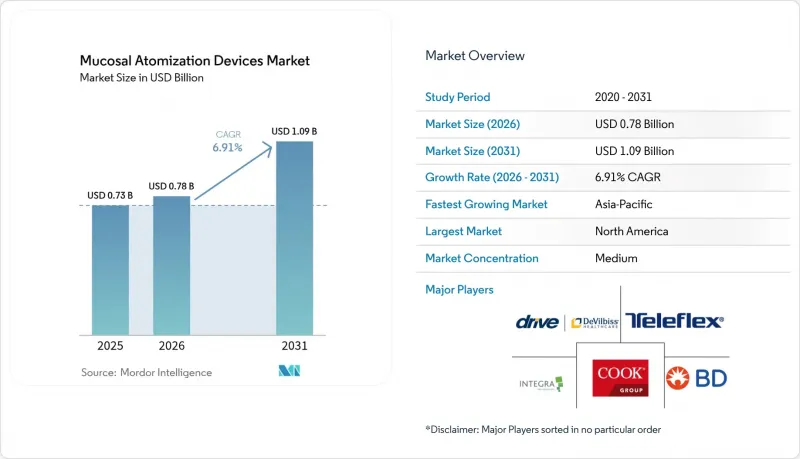
본 보고서는 제품 유형(가스 구동식, 전기식), 최종 사용자(병원, 진료소, 기타 최종 사용자), 지역(북미, 유럽, 아시아태평양, 중동 및 아프리카, 남미)별로 분류되어 있습니다. 시장 예측은 금액(달러) 기준으로 제시되어 있습니다.
세계 경점막 분무 기기 시장 동향 및 인사이트
알레르기성 비염 및 부비동염 유병률 증가
현재 알레르기성 비염은 미국인의 6명 중 1명이 앓고 있으며, 유럽 인구에서도 비슷한 비율을 차지하고 있어 비강 요법을 통한 신속한 증상 완화가 필요한 환자가 끊임없이 발생하고 있습니다. 2024년에 발표된 네트워크 메타분석에 따르면, 분무형 비강 제제는 작용 발현 속도와 안전성 측면에서 경구제를 능가한다고 결론지었으며, 이는 스테로이드, 항히스타민제 및 응급용 생물학적 제제 스프레이의 처방량 증가를 뒷받침합니다. 특히 아시아와 라틴아메리카에서 미세먼지 농도가 높은 도시 지역의 공기와 비염 발병률 상승 간의 연관성을 보여주는 연구로 인해 수요가 더욱 촉진되고 있으며, 점막 분무 기기 시장의 세계적 중요성이 부각되고 있습니다. 생체 이용률을 최적화하기 위해 점막에 대한 정확한 표적화가 필요한 오말리주맙 및 듀필맙과 같은 단일 클론 항체의 등장으로, 전문 알레르기 클리닉에서의 기기 사용은 더욱 정착되었습니다. 현재 전문가 패널은 표준 치료에 반응하지 않는 지속적인 콧물이 있는 환자에게 아토마이저를 이용한 이프라트로피움 브로마이드를 포함한 비강용 항콜린제를 권장하고 있으며, 이로 인해 교체 주기와 판매량이 증가하고 있습니다.
분무기 설계의 기술적 진보
기기 공학 분야의 획기적인 발전으로 투여 정확도, 생물학적 제제의 안정성, 그리고 사용자의 복약 순응도가 향상되고 있습니다. Bespak사의 일회용 ‘NasaDose’ 플랫폼은 일회 투여용 블리스터를 채택하여, 작동할 때까지 습기로부터 취약한 펩타이드를 보호합니다. 오징어의 제트 추진 방식에서 영감을 얻은 산학 협력을 통해, 비갑개로의 더 깊은 침투와 잔류량 감소를 가능하게 하는 무바늘 시스템의 프로토타입이 개발되었으며, 전임상 모델에서 생체이용률을 두 자릿수 비율로 향상시켰습니다. Trudell Medical사의 ‘AEROCOUNT’는 블루투스와 클라우드 텔레메트리를 통합하여, 임상의가 투여 상황을 실시간으로 추적하고 원격으로 투여 계획을 조정할 수 있게 해줍니다. 이 기능은 현재 미국의 여러 보험사에서 보험 적용 대상에 포함되어 있습니다. 나노 구조 지질 운반체에 관한 조사에 따르면, 150 nm 미만의 미립자는 후각 상피를 통과하여 중추 신경계(CNS)로 저분자를 전달할 수 있는 것으로 시사되고 있어, 향후 적응증 확대가 기대되고 있습니다. 한편, 코 막힘 치료용 온도 제어형 고주파 치료 기기는 대형 보험사에서 4년간 2,000만 달러의 수술 비용을 절감했으며, 이는 간접적으로 비강 치료 솔루션에 대한 인지도 향상으로 이어지고 있습니다.
과다 투여/미스트 누출로 인한 부작용
기기의 오작동이나 액적의 역류는 특히 충분한 훈련을 받지 않은 사용자가 투여할 경우, 치료에 필요한 투여량에 도달하지 못하거나 유해사건을 유발할 가능성이 있습니다. 응급 이송 전 나록손을 이용한 금단 증상 역전 치료를 받은 1,200건을 대상으로 한 관찰 연구에 따르면, 스프레이 분사 형태에 편차가 있는 경우 7%의 사례에서 금단 증상과 관련된 흥분 상태가 나타난 것으로 나타났습니다. FDA는 현재 새로운 510(k) 신청에 대해 더 엄격한 액적 크기 기준을 의무화하고 있으며, 이로 인해 품질 보증 비용이 증가하고 설계 검증 주기가 장기화되고 있습니다. 제조업체들은 이에 대응하여 정상 작동을 확인하기 위한 시각적 변색 표시기를 추가하고 있지만, 지역 사회의 응급 의료진에게는 여전히 사용법을 익히기 어려운 상황입니다. 그 결과, 자원이 제한된 시장에서 도입 장벽이 점막 분무 기기 시장 성장률을 일시적으로 둔화시키고 있습니다.
부문 분석
가스 구동식 플랫폼은 점막 분무 기기 시장 규모에서 가장 큰 점유율을 차지하고 있으며, 2025년 매출의 67.05%에 해당하는 4억 9,000만 달러를 차지하고 있습니다. 이러한 확고한 입지는 임상의들이 익숙하게 사용하는 사용감, 입증된 투여량의 안정성, 그리고 간편한 충전 조작에 기인합니다. 그러나 환경 정책의 전환으로 인해 제형의 재검토가 시급해지고 있습니다. 미국 소비자제품안전위원회(CPSC) 및 환경보호청(EPA)은 HFC-134a 및 HFC-152a의 단계적 감축 일정을 제안하고 있으며,이에 따라 각 제조업체들은 분무의 질량 중앙 공기역학적 직경을 저해하지 않으면서, 최소 90%의 탄소 배출 감축을 실현하는 저지구온난화잠열 혼합물의 시험적 도입을 추진하고 있습니다. 임상 브릿징 시험을 통해 약동학적 동등성이 입증되었으며, 2027년부터의 상용화를 위한 규제적 기반이 마련되어 있습니다. 한편, 전기식 분무기는 2025년 매출의 32.95%에 불과하지만, 병원들이 분사량을 프로그래밍할 수 있고 IoT 원격 측정 기능을 갖춘 추진제 없는 제품을 선호하는 경향이 있어 연평균 성장률(CAGR) 8.51%라는 눈부신 성장을 이루고 있습니다. 가스통이 필요 없어짐에 따라 전 세계 운송 규정 준수가 간소화되고, 물류비가 평균 12% 절감되는 동시에 추진제 공급 부족으로 인한 공급망에 미치는 영향도 완화됩니다. 단가가 여전히 주요 장벽으로 작용하고 있지만, 환경세를 고려한 총 소유 비용(TCO) 모델에서는 선진국 경제권에서 전기식 솔루션이 점점 더 유리해지고 있습니다.
이러한 동향은 예상되는 시장 변화를 뒷받침하고 있습니다. 가스 구동형 제품은 2026년까지 응급 의료 분야에서 주도적인 위치를 유지하겠지만, 그 후에는 ESG를 중시하는 새로운 조달 방침에 따라 판매 구성이 전기식으로 전환될 전망입니다. 추진제 사용형과 추진제 무사용형 모두를 공급할 수 있는 하이브리드 제품 라인업을 갖춘 제조업체는 시장 점유율을 지키면서 지속가능성을 통해 프리미엄을 확보할 수 있는 입장에 있어, 경점막 분무 기기 시장에서의 경쟁 균형을 유지하게 될 것입니다.
지역별 분석
미국을 핵심으로 하는 북미는 2025년 전 세계 매출의 41.62%를 차지했습니다. 이는 화학·제조·품질 관리(CMC) 신청을 효율화하고, 510(k)와 신약 승인 신청(NDA)의 병용 신청을 가능하게 하는 FDA의 체계에 힘입은 결과입니다. 전국적인 나록손 배포 이니셔티브와 주 차원의 상시 처방전이 일상적인 수요를 뒷받침하는 한편, 선진적인 지불자 제도가 스마트 투여량 추적 기능을 갖춘 분무기의 보급을 촉진하고 있습니다. 캐나다 보건부(Health Canada)의 비강용 에피네프린 제품에 대한 신속 승인 제도는 지역적 일관성을 보여주고 있으며, 국경을 넘어 진출하는 기업 시장 출시 기간을 단축하고 있습니다.
아시아태평양은 연평균 성장률(CAGR) 8.73%로 가장 가파른 성장 궤도를 기록하고 있습니다. 일본의 의약품 및 의료기기종합기구(PMDA)는 2024년 Aculys Pharma사의 디아제팜 비강 스프레이 신청을 접수했습니다. 이는 동종 최초의 항간질제로, 명확한 규제상의 선례를 확립하는 것입니다. 중국 국가의약품감독관리국과 호주 치료제품관리국은 ‘neffy’를 병행 심사 절차를 통해 평가함으로써, 다국적 기업의 신청을 뒷받침하는 기준의 수렴을 부각시켰습니다. 도시화가 진행되는 경제권에서 중산층의 의료비 지출 확대와 알레르기성 비염의 높은 유병률은 의료기기 판매량의 지속적인 성장을 뒷받침하고 있습니다.
유럽에서는 EU 의료기기 규정(MDR)에 따라 엄격한 시판 후 감시가 요구되고 있지만, 시장은 성숙해 가면서도 꾸준한 확장을 보이고 있어, 탄탄한 임상 데이터와 환경 보호 실적을 갖춘 공급업체에게는 경쟁상의 기회가 생기고 있습니다. ‘그린 딜’ 목표의 채택으로 인해 추진제를 사용하는 제품에 대한 압박이 강화되면서, 전기식 분무기 및 저GWP 추진제로의 전환이 가속화되고 있습니다. 라틴아메리카, 중동 및 아프리카의 신흥 지역은 새로운 기회를 내포하고 있습니다. 응급 의료 시스템의 현대화와 기부금에 의한 예방접종 캠페인이 수요를 자극하고 있지만, 콜드체인 네트워크의 부족이나 임상의의 교육 부족과 같은 구조적 과제로 인해 점막 분무 기기 시장의 보급률은 제한되고 있습니다.
기타 혜택:
- 엑셀 형식 시장 예측(ME) 시트
- 3개월간의 애널리스트 지원
자주 묻는 질문
목차
제1장 서론
제2장 조사 방법
제3장 주요 요약
제4장 시장 구도
제5장 시장 규모와 성장 예측
제6장 경쟁 구도
제7장 시장 기회와 향후 전망
LSH 26.08.26According to Mordor Intelligence, the mucosal atomization devices market size was valued at USD 0.73 billion in 2025 and estimated to grow from USD 0.78 billion in 2026 to reach USD 1.09 billion by 2031, at a CAGR of 6.91% during the forecast period (2026-2031).
This report is Segmented by Product Type (Gas-Propelled, Electrical), End User (Hospitals, Clinics, Other End Users), and Geography (North America, Europe, Asia-Pacific, Middle East and Africa, South America). The Market Forecasts are Provided in Terms of Value (USD).
Global Mucosal Atomization Devices Market Trends and Insights
Increasing Prevalence of Allergic Rhinitis & Sinusitis
Allergic rhinitis now affects 1 in 6 Americans and comparable shares of European populations, creating a consistent stream of patients dependent on rapid symptom relief via intranasal therapy. Network meta-analyses released in 2024 concluded that atomized nasal formulations outperform oral agents on onset of action and safety, supporting higher prescription volumes for steroid, antihistamine, and emergent biologic sprays . Demand is reinforced by studies linking particulate-rich urban air to rising rhinitis incidence, especially in Asia and Latin America, underscoring the global relevance of the mucosal atomization devices market. The addition of monoclonal antibodies such as omalizumab and dupilumab, which require precise mucosal targeting to optimize bioavailability, has further entrenched device use in specialty allergy clinics . Expert panels now recommend nasal anticholinergics including ipratropium bromide through atomizers for patients with persistent rhinorrhea unresponsive to standard therapy, boosting replacement cycles and unit volumes.
Technological Advancements in Atomizer Design
Device engineering breakthroughs are raising dosing precision, stability of biologics, and user adherence. Bespak's single-use NasaDose platform employs unit-dose blisters that protect fragile peptides from humidity until actuation. Academic-industry collaborations inspired by squid jet propulsion have produced prototype no-needle systems capable of deeper turbinate penetration and lower residual volume, improving bioavailability by double-digit percentages in pre-clinical models. Trudell Medical's AEROCOUNT integrates Bluetooth and cloud telemetry, allowing clinicians to track dose events in real time and adjust regimens remotely-functionality now reimbursed by several U.S. payers. Nanostructured lipid carrier research suggests atomized particles below 150 nm can cross the olfactory epithelium and deliver small molecules to the CNS, widening future indications. Meanwhile, temperature-controlled radiofrequency tools for nasal obstruction are cutting surgical costs by USD 20 million over four years for large insurers, indirectly driving awareness of intranasal therapeutic solutions.
Side Effects Due to Overdose / Mist Leakage
Device misfires and droplet backflow can lead to sub-therapeutic exposure or adverse events, especially when administered by minimally trained users. Observational studies covering 1,200 pre-hospital naloxone reversals linked inconsistent spray plume geometry with withdrawal-related agitation in 7% of cases. The FDA now mandates tighter droplet-size thresholds in new 510(k) submissions, increasing quality-assurance costs and prolonging design-validation cycles. Manufacturers respond by adding visual color-change indicators that confirm full actuation, yet learning curves remain steep for community responders. Adoption headwinds in resource-constrained markets thus temporarily temper the mucosal atomization devices market growth rate.
Other drivers and restraints analyzed in the detailed report include:
- Rising Intranasal Vaccine / Drug-Delivery R&D Funding
- Adoption in Pre-Hospital & Battlefield Analgesia
- Availability of Alternative Delivery Routes
For complete list of drivers and restraints, kindly check the Table Of Contents.
Segment Analysis
Gas-propelled platforms represented the largest slice of the mucosal atomization devices market size, accounting for USD 0.49 billion and 67.05% of 2025 revenue. Their entrenched status stems from clinician familiarity, proven dose consistency, and straightforward filling operations. Nevertheless, environmental policy shifts are compelling reformulation. The U.S. Consumer Product Safety Commission and the Environmental Protection Agency proposed phase-down schedules for HFC-134a and HFC-152a, prompting manufacturers to pilot low-global-warming blends that deliver at least 90% carbon reduction without compromising plume mass median aerodynamic diameter. Clinical bridging studies indicate pharmacokinetic equivalence, paving regulatory pathways for commercial rollout beginning 2027. Electrical atomizers, by comparison, posted only 32.95% of 2025 sales but generate headline growth of 8.51% CAGR as hospitals gravitate toward propellant-free options with programmable spray volumes and IoT telemetry. Absence of canned gases streamlines global shipping compliance, trimming logistics expenses by 12% on average and mitigating supply chain exposure to propellant shortages. Higher unit cost remains the principal barrier, though total-cost-of-ownership models that factor in environmental levies increasingly favor electric solutions across developed economies.
These dynamics reinforce the expected tilt: gas-propelled units maintain core emergency-medicine dominance through 2026, after which new ESG-motivated procurement policies tip the sales mix toward electrical formats. Manufacturers with hybrid pipelines-able to supply both propellant and propellant-free versions-are positioned to defend share and capture sustainability premiums, preserving competitive balance within the mucosal atomization devices market.
Complete Report Scope:
- By Product Type
- Gas-propelled
- Electrical
- By End User
- Hospitals
- Clinics
- Other End Users
- By Geography
- North America
- United States
- Canada
- Mexico
- Europe
- Germany
- United Kingdom
- France
- Italy
- Spain
- Rest of Europe
- Asia-Pacific
- China
- Japan
- India
- Australia
- South Korea
- Rest of Asia-Pacific
- Middle East and Africa
- GCC
- South Africa
- Rest of Middle East and Africa
- South America
- Brazil
- Argentina
- Rest of South America
- North America
Geography Analysis
North America, anchored by the United States, delivered 41.62% of global sales in 2025, buoyed by an FDA framework that streamlines chemistry-manufacturing-controls submissions and enables 510(k) plus NDA-combination filings. National naloxone distribution initiatives and state-level standing orders bolster everyday demand, while advanced payer systems incentivize smart dose-tracking atomizers. Canada's Health Canada fast-track for nasal epinephrine products signals regional alignment, shortening launch timelines for cross-border entrants.
Asia-Pacific records the steepest trajectory with an 8.73% CAGR. Japan's Pharmaceuticals and Medical Devices Agency accepted Aculys Pharma's diazepam nasal spray application in 2024, the first antiepileptic of its kind, establishing a visible regulatory precedent. China's National Medical Products Administration and Australia's Therapeutic Goods Administration evaluated neffy under parallel review pathways, highlighting converging standards that favor multinational submissions. Expanding middle-class healthcare spend and high prevalence of allergic rhinitis in urbanizing economies underpin durable device volume growth.
Europe offers mature but steady expansion as the EU's Medical Device Regulation imposes stringent post-market surveillance, creating competitive openings for suppliers with robust clinical data and environmental credentials. Adoption of Green Deal targets exerts pressure on propellant-based products, accelerating the pivot to electric atomizers and low-GWP propellants. Emerging territories in Latin America, the Middle East, and Africa represent nascent opportunities: modernization of emergency medical systems and donor-funded vaccination drives stimulate demand, yet structural hurdles-from limited cold-chain networks to clinician training deficits-moderate penetration rates for the mucosal atomization devices market.
- Teleflex
- Drive DeVilbiss Healthcare
- Beckton Dickinson
- Cook Group
- Medica Holdings
- Integra LifeSciences Holdings Corp.
- BVM Meditech
- Life-Assist
- BTME Group Limited (Medtree)
- Wolfe Tory Medical Inc.
- Medtronic
- World Precision Instruments
- Westmed
- Smiths Group
- Aerogen Ltd.
- Solventum
- Optinose US Inc.
- Kurve Technology Inc.
- Impel Pharmaceuticals Inc.
- AptarGroup Inc.
Additional Benefits:
- The market estimate (ME) sheet in Excel format
- 3 months of analyst support
TABLE OF CONTENTS
1 Introduction
- 1.1 Study Assumptions & Market Definition
- 1.2 Scope of the Study
2 Research Methodology
3 Executive Summary
4 Market Landscape
- 4.1 Market Overview
- 4.2 Market Drivers
- 4.2.1 Increasing prevalence of allergic rhinitis & sinusitis
- 4.2.2 Technological advancements in atomizer design
- 4.2.3 Rising intranasal vaccine / drug-delivery R&D funding
- 4.2.4 Adoption in pre-hospital & battlefield analgesia
- 4.2.5 Regulatory push for needle-free vaccination in LMICs
- 4.2.6 Integration with smart dose-counter IoT modules
- 4.3 Market Restraints
- 4.3.1 Side effects due to overdose / mist leakage
- 4.3.2 Availability of alternative delivery routes
- 4.3.3 Supply-chain fragility of specialty nozzle materials
- 4.3.4 Environmental concerns over canned-gas propellants
- 4.4 Value / Supply-Chain Analysis
- 4.5 Regulatory Landscape
- 4.6 Technological Outlook
- 4.7 Porters Five Forces Analysis
- 4.7.1 Threat of New Entrants
- 4.7.2 Bargaining Power of Buyers/Consumers
- 4.7.3 Bargaining Power of Suppliers
- 4.7.4 Threat of Substitute Products
- 4.7.5 Intensity of Competitive Rivalry
5 Market Size & Growth Forecasts (Value, USD)
- 5.1 By Product Type
- 5.1.1 Gas-propelled
- 5.1.2 Electrical
- 5.2 By End User
- 5.2.1 Hospitals
- 5.2.2 Clinics
- 5.2.3 Other End Users
- 5.3 By Geography
- 5.3.1 North America
- 5.3.1.1 United States
- 5.3.1.2 Canada
- 5.3.1.3 Mexico
- 5.3.2 Europe
- 5.3.2.1 Germany
- 5.3.2.2 United Kingdom
- 5.3.2.3 France
- 5.3.2.4 Italy
- 5.3.2.5 Spain
- 5.3.2.6 Rest of Europe
- 5.3.3 Asia-Pacific
- 5.3.3.1 China
- 5.3.3.2 Japan
- 5.3.3.3 India
- 5.3.3.4 Australia
- 5.3.3.5 South Korea
- 5.3.3.6 Rest of Asia-Pacific
- 5.3.4 Middle East and Africa
- 5.3.4.1 GCC
- 5.3.4.2 South Africa
- 5.3.4.3 Rest of Middle East and Africa
- 5.3.5 South America
- 5.3.5.1 Brazil
- 5.3.5.2 Argentina
- 5.3.5.3 Rest of South America
- 5.3.1 North America
6 Competitive Landscape
- 6.1 Market Concentration
- 6.2 Market Share Analysis
- 6.3 Company Profiles (includes Global level Overview, Market level overview, Core Segments, Financials as available, Strategic Information, Market Rank/Share for key companies, Products & Services, and Recent Developments)
- 6.3.1 Teleflex Incorporated
- 6.3.2 DeVilbiss Healthcare LLC
- 6.3.3 Becton, Dickinson and Company
- 6.3.4 Cook Group (Cook Medical)
- 6.3.5 Medica Holdings
- 6.3.6 Integra LifeSciences Holdings Corp.
- 6.3.7 BVM Meditech Private Limited
- 6.3.8 Life-Assist Inc.
- 6.3.9 BTME Group Limited (Medtree)
- 6.3.10 Wolfe Tory Medical Inc.
- 6.3.11 Medtronic plc
- 6.3.12 World Precision Instruments
- 6.3.13 Westmed Inc.
- 6.3.14 Smiths Medical (ICU Medical)
- 6.3.15 Aerogen Ltd.
- 6.3.16 Solventum
- 6.3.17 Optinose US Inc.
- 6.3.18 Kurve Technology Inc.
- 6.3.19 Impel Pharmaceuticals Inc.
- 6.3.20 AptarGroup Inc.
7 Market Opportunities & Future Outlook
- 7.1 White-space & Unmet-need Assessment


