

|
시장보고서
상품코드
2114647
특수 가스 : 시장 점유율 분석, 업계 동향 및 통계, 성장 예측(2026-2031년)Specialty Gas - Market Share Analysis, Industry Trends & Statistics, Growth Forecasts (2026 - 2031) |
||||||
 Mordor Intelligence
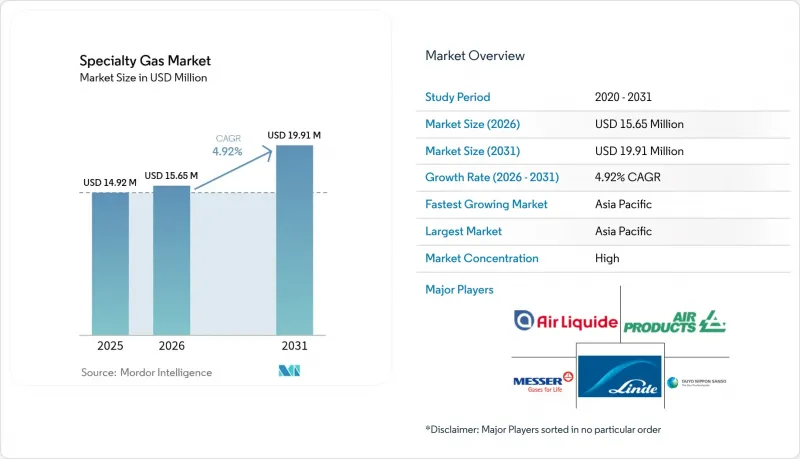
특수 가스 시장 규모는 2026년에 1,565만 달러로 추정되고 있으며, 2025년 1,492만 달러에서 2031년에는 1,991만 달러에 달할 것으로 예측됩니다.
또한 2026-2031년 연평균 성장률(CAGR) 4.92%를 기록할 전망입니다.
본 보고서에서는 업계를 ‘유형’(고순도 가스, 비활성기체, 탄소계 가스, 할로겐계 가스, 기타), ‘최종 사용자 산업’(전자, 의료 및 헬스케어, 자동차, 식품 및 음료, 석유 및 가스, 기타 산업), ‘지역’(아시아태평양, 북미, 유럽, 남미, 중동 및 아프리카)별로 분류하고 있습니다. 시장 전망은 금액(달러) 기준으로 제시되어 있습니다.
세계 특수 가스 시장 동향과 인사이트
반도체 등급 웨이퍼 제조 붐이 특수 가스 수요를 견인
전례 없는 반도체 제조 투자로 인해 초고순도 질소, 아르곤 및 불소 화합물의 소비량이 증가하고 있습니다. 삼성 평택 캠퍼스에 가스를 공급하고 있는 린데(Linde)사의 SPECTRA 공장이 보여주듯이, 현재 화학 기상 증착(CVD), 에칭 및 이온 주입 공정에서 6N 순도(99.9999%)가 지정되고 있습니다. 미국의 ‘CHIPS and Science Act’는 90개 프로젝트에 걸쳐 4,500억 달러 규모의 민간 투자를 촉진하고 있으며, 2032년까지 국내 웨이퍼 생산량을 3배로 확대할 것으로 예측됩니다. 대만, 한국, 중국 본토에 위치한 아시아태평양의 팹도 규모를 확대하고 있으며, 이는 전 세계 가스 공급업체들과의 장기 계약을 뒷받침하고 있습니다. 이러한 동향은 정제 스키드, 마이크로 벌크 탱크, 전자 등급 충전 플랜트의 견조한 수주 전망을 뒷받침하고 있습니다. 따라서 특수 가스 시장은 예측 가능한 판매량과 순도 보증에 연동된 프리미엄 가격 책정의 혜택을 받고 있습니다.
석유화학 산업에서의 특수 가스 사용 확대
수소, 일산화탄소 및 맞춤형 탄화수소 혼합물은 석유화학 복합 시설의 수소화 처리, 크래킹 및 촉매 재생 과정에서 여전히 필수적입니다. 중동 및 텍사스주 걸프 코스트의 사업자들은 총 길이 1,600km가 넘는 에어 프로덕츠(Air Products)사의 수소 파이프라인에 연결되어 있습니다. 실시간 가스 분석을 통해 제품 수율이 향상되는 동시에 플레어링이 감소하고 있으며, 산화 공정을 위한 교정용 혼합 가스 및 고순도 산소의 조달이 진행되고 있습니다. 저유황 연료로의 전환을 추진하는 정유시설로 인해 소비량은 더욱 증가하고 있습니다. 그 결과, 특수 가스 시장에서는 안정적인 베이스로드 수요가 나타나고 있을 뿐만 아니라, 가스, 설비, 공정 제어 소프트웨어를 패키지화한 턴키 공급 방식에 대한 수요가 높아지고 있습니다.
특수 가스의 생산 및 품질 관리에 관한 엄격한 환경 규제 및 제한
AIM법은 2036년까지 HFC 소비량을 85% 감축할 것을 의무화하고 있으며, 이에 따라 특수 냉매 블렌드의 재조성 및 배출 감축 시스템에 대한 투자가 촉진되고 있습니다. 미국 석유 및 가스 부문의 메탄 배출 사업자에게는 2024년에 톤당 900달러의 폐기물 배출 과징금이 부과되며, 2026년까지 1,500달러로 인상될 예정입니다. 유럽의 공장은 ‘산업 배출 지침’ 및 탄소 가격 제도의 적용을 받으며 운영되고 있어, 이에 따른 규정 준수 비용이 증가하고 있습니다. 이러한 규제는 저 GWP 가스의 혁신을 촉진하는 한편, 생산 능력 확충을 지연시키고 단기적인 공급 부족을 초래할 가능성이 있어 특수 가스 시장의 성장률에 약간의 하방 압력을 가하게 될 것입니다.
부문 분석
2025년에는 반도체 제조 공장이 불순물 기준을 1조 분의 1 수준으로 강화한 결과, 고순도 가스의 매출 점유율이 37.79%를 차지했습니다. UBE사가 우베 공장에서 고순도 질산의 생산 능력을 30% 증강한 것은 반도체 수요의 지속성을 뒷받침하고 있습니다. 희귀 가스는 지정학적 긴장과 액화 플랜트의 유지보수 중단으로 인해 산발적인 공급 차질이 발생하고 있지만, 회수 능력 강화와 액화 플랜트 업그레이드를 위한 집중적인 투자로 공급 안정화가 진행되고 있습니다. 전자 가스 및 공정 가스는 3D NAND 및 게이트 올 어라운드(GAA) 트랜지스터에 필요한 첨단 에칭 화학 기술의 혜택을 받아, 연평균 성장률(CAGR) 5.48%로 가장 빠르게 성장하고 있는 하위 부문입니다.
초고순도(UHP) 수소 및 불소화 화합물은 1자리 ppt 임계값을 초과하는 금속이나 수분의 혼입을 허용할 수 없는 급속히 확대되는 EUV 리소그래피 라인을 뒷받침하고 있습니다. 한편, OLED 전구체 합성에 사용되는 고순도 일산화탄소를 포함한 탄소계 특수 가스에 대한 수요는 파인케미컬 및 디스플레이 제조 분야 전반에 걸쳐 계속해서 견조한 모습을 보이고 있습니다. 이러한 다양한 이용 사례는 특정 부문의 단기적인 변동에 대한 특수 가스 시장의 회복력을 강화하고 있습니다.
지역별 분석
아시아태평양은 2025년에 전 세계 매출의 47.85%를 차지할 것으로 예상되며, 2031년까지 연평균 성장률(CAGR) 6.55%로 성장할 전망입니다. 중국 본토에서는 벌크 질소 및 전자 등급 불소화 가스를 소비하는 메모리 및 로직용 메가팹의 가동이 계속 진행되고 있습니다. 한국의 평택 및 중국의 시안 생산 라인은 초고순도(UHP) 아르곤 수요를 견인하고 있습니다. 대만의 반도체 클러스터는 우크라이나로부터공급 리스크를 완화하기 위해 다양한 정제 거점에서 조달되는 네온의 주요 구매자로 자리매김하고 있습니다. 일본의 OEM 기업들은 국내 반도체 제조 장비 생산을 지키기 위해 헬륨 장기 계약에 투자하고 있으며, 전 세계적인 공급 부족에도 불구하고 수입을 유지하고 있습니다. 말레이시아와 베트남을 중심으로 한 아세안(ASEAN) 국가들은 대량의 성형 가스 혼합물이 필요한 첨단 패키징 공장을 유치하고 있으며, 이로 인해 지역 유통업체이 최종 사용자와 더 가까워지고 있습니다. 이러한 투자의 시너지 효과로 인해 아시아태평양은 특수 가스 시장에서 오랫동안 리더십을 유지하고 있습니다.
북미에서는 ‘CHIPS 법’을 계기로 4,500억 달러 규모의 민간 반도체 투자의 혜택을 받고 있으며, 웨이퍼 생산량이 확대됨에 따라 전구체 가스, 고순도 암모니아, 챔버 세정용 혼합 가스의 판매가 촉진되고 있습니다. 셰일가스 생산량은 2025년에 하루 105 Bcf에 달할 전망이며, 질소 및 수소의 원료 비용이 개선될 것으로 예측됩니다. 또한, 이 지역에서는 그린 수소용 전해 장치 및 CO2 포집 장치의 설치가 활발해지고 있으며, 이들 모두는 교정 표준 물질에 의존하고 있기 때문에 특수 가스 조달을 뒷받침하고 있습니다. 병원 개보수 공사 증가에 더해 국방 보건 프로그램 예산까지 더해지면서 의료용 등급에 대한 수요가 가속화되고 있습니다. 그 결과, 미국 및 캐나다의 특수 가스 시장은 수년에 걸쳐 견조한 상승세를 보이고 있습니다.
유럽에서는 엄격한 산업 배출 규제로 인해 성장 속도는 비교적 완만하지만, 그린 수소에 대한 강한 의지와 선진적인 연구 기관의 존재로 인해 안정적인 소비가 확보되고 있습니다. 독일이 전해 설비의 용량을 두 배로 늘릴 계획인 것은 H2, O2, CO 교정 가스에 대한 수요를 뒷받침하고 있는 반면, 유럽 최대의 LNG 수입국인 프랑스의 역할은 선박용 연료 전환 가스 및 벙커 등급 질소 수요를 견인하고 있습니다. 실리콘 카바이드 및 갈륨 질화물 소자에 주력하는 스칸디나비아의 반도체 제조 공장은 고순도 실란 및 디클로로실란을 발주하고 있어 특수 가스 시장의 틈새 분야를 확대되고 있습니다. 동유럽의 제약 클러스터 역시 동결건조 라인을 위해 무균 등급의 CO2를 구매함으로써 수요에 또 다른 층을 더하고 있습니다.
남미의 특수 가스 시장은 규모는 작지만 성장하고 있으며, 브라질의 석유화학 단지에서는 폴리머 등급 제품 생산에 수소와 질소가 사용되고, 아르헨티나의 정유시설에서는 특수 혼합 가스가 필요한 황 회수 설비의 업그레이드에 투자하고 있습니다. 중동 및 아프리카에서는 사우디아라비아의 대규모 정유 및 가스에서 화학제품으로의 전환 프로젝트가 미량 원소 제거용 벌크 수소 및 SO₂ 주문을 견인하고 있습니다. 한편, 남아프리카의 의료 분야에서는 각 주 병원을 아우르는 대량 산소 공급 네트워크가 확대되고 있습니다. 이러한 노력들이 어우러져 특수 가스 시장의 세계 진출 범위를 넓히고 있습니다.
기타 혜택:
- 엑셀 형식 시장 예측(ME) 시트
- 3개월간의 애널리스트 지원
자주 묻는 질문
목차
제1장 서론
제2장 조사 방법
제3장 주요 요약
제4장 시장 구도
제5장 시장 규모와 성장 예측
제6장 경쟁 구도
제7장 시장 기회와 향후 전망
LSH 26.08.26According to Mordor Intelligence, the specialty gas market size in 2026 is estimated at USD 15.65 million, growing from 2025 value of USD 14.92 million with 2031 projections showing USD 19.91 million, growing at 4.92% CAGR over 2026-2031.
This report Segments the Industry by Type (High-Purity Gases, Noble Gases, Carbon Gases, Halogen Gases, and Other Types), End-User Industry (Electronics, Medical and Healthcare, Automotive, Food and Beverage, Oil and Gas, and Other Industries), Geography (Asia-Pacific, North America, Europe, South America, and Middle East and Africa). The Market Forecasts are Provided in Terms of Value (USD).
Global Specialty Gas Market Trends and Insights
Semiconductor-grade wafer fabrication boom creating demand for specialty gas
Unprecedented chip-fabrication investment is elevating consumption of ultra-high-purity nitrogen, argon, and fluorinated compounds. Plants now specify 6 N purity (99.9999%) for chemical vapor deposition, etching, and ion implantation, as shown by Linde's SPECTRA plants that supply Samsung's Pyeongtaek campus. The U.S. CHIPS and Science Act has catalyzed USD 450 billion in private spending across 90 projects, expected to triple national wafer output by 2032. Asia-Pacific fabs in Taiwan, South Korea, and mainland China are also scaling, fueling long-term contracts with global gas suppliers. These dynamics underpin a robust pipeline of purification skids, micro-bulk tanks, and electronic-grade fill plants. The specialty gas market therefore benefits from predictable volume off-take and premium pricing tied to purity guarantees.
Increasing utilization for specialty gases from petrochemical industry
Hydrogen, carbon monoxide, and bespoke hydrocarbon blends remain critical for hydrotreating, cracking, and catalyst regeneration within petrochemical complexes. Operators in the Middle East and Texas Gulf Coast are connecting to Air Products' hydrogen pipelines that exceed 1,600 km in length. Real-time gas analytics enhance product yields while reducing flaring, driving procurement of calibration mixes and high-purity oxygen for oxidative processes. Refineries shifting toward low-sulfur fuels intensify consumption further. As a result, the specialty gas market sees stable base-load volumes and rising demand for turnkey supply schemes that bundle gas, equipment, and process control software.
Stringent environmental regulations and restrictions on specialty gas production and quality control
The AIM Act compels an 85% phase-down of HFC consumption by 2036, prompting reformulation of specialty refrigerant blends and investment in abatement systems. Methane emitters in the U.S. oil and gas sector face a Waste Emissions Charge of USD 900 per ton in 2024, rising to USD 1,500 by 2026. European plants operate under the Industrial Emissions Directive and carbon pricing, which elevate compliance costs. Although these rules drive innovation in low-GWP gases, they can slow capacity additions and tighten short-term supply, putting minor downward pressure on the specialty gas market's growth rate.
Other drivers and restraints analyzed in the detailed report include:
- Rapid expansion of green hydrogen pilots requiring calibration gases
- Increasing demand from the healthcare sector
- Supply chain vulnerabilities impacting utilization in certain geographies
For complete list of drivers and restraints, kindly check the Table Of Contents.
Segment Analysis
High-purity gases accounted for a 37.79% revenue share in 2025 as fabs tightened impurity specifications to parts-per-trillion levels. UBE's 30% capacity increase for high-purity nitric acid at its Ube facility underlines sustained semiconductor demand. Noble gases face sporadic supply disruptions following geopolitical tensions and maintenance outages at liquefaction plants, but targeted investments in recovery and liquefier upgrades are stabilizing availability. Electronic and process gases make up the fastest-growing sub-segment at 5.48% CAGR, benefiting from advanced etch chemistries needed in 3-D NAND and gate-all-around transistors.
Ultra-high-purity (UHP) hydrogen and fluorinated compounds support aggressively scaled EUV lithography lines that cannot tolerate metallic or moisture contamination beyond single-digit ppt thresholds. Meanwhile, demand for carbon-based specialty gases-including high-purity carbon monoxide for OLED precursor synthesis-remains strong across fine-chemical and display manufacturing. These diverse use cases reinforce the specialty gas market's resilience to short-cycle swings in any one sector.
Complete Report Scope:
- By Type
- High-Purity Gases
- Noble Gases
- Carbon Gases
- Halogen Gases
- Other Types (Electronic and Process Gases, etc.)
- By End-User Industry
- Electronics
- Medical and Healthcare
- Automotive
- Food and Beverage
- Oil and Gas
- Other Industries (Manufacturing and Metallurgy, etc.)
- By Geography
- Asia-Pacific
- China
- Japan
- India
- South Korea
- Rest of Asia-Pacific
- North America
- United States
- Canada
- Mexico
- Europe
- Germany
- United Kingdom
- France
- Italy
- Rest of Europe
- South America
- Brazil
- Argentina
- Rest of South America
- Middle East and Africa
- Saudi Arabia
- South Africa
- Rest of Middle East Africa
- Asia-Pacific
Geography Analysis
Asia-Pacific generated 47.85% of global revenue in 2025 and is on course to grow at a 6.55% CAGR through 2031. Mainland China continues to commission memory and logic megafabs that consume bulk nitrogen and electronic-grade fluorinated gases. South Korea's Pyeongtaek and Xi'an lines bolster demand for UHP argon. Taiwan's cluster remains a heavy purchaser of neon sourced from diversified purification hubs to mitigate Ukrainian supply risk. Japanese OEMs invest in long-term helium contracts to shield domestic chip tool production, sustaining imports despite global shortages. ASEAN nations, led by Malaysia and Vietnam, have attracted advanced-packaging plants that require large volumes of forming-gas mixtures, drawing regional distributors closer to end-users. These combined investments secure Asia-Pacific's long-running leadership in the specialty gas market.
North America benefits from USD 450 billion in private semiconductor investment sparked by the CHIPS Act, expanding wafer output and stimulating sales of precursor gases, high-purity ammonia, and chamber-clean blends. Shale gas production is set to hit 105 Bcf/d in 2025, improving feedstock economics for nitrogen and hydrogen. The region is also witnessing brisk installation of green-hydrogen electrolyzers and CO2 capture units, each reliant on calibration standards that spur specialty gas procurement. Rising hospital refurbishment, coupled with the Defense Health Program budget, accelerates medical-grade demand. Consequently, the specialty gas market in the United States and Canada is on a firm, multi-year upswing.
Europe shows more measured growth due to stringent industrial-emission directives, yet its strong green-hydrogen ambitions and advanced research laboratories ensure steady consumption. Germany's plan to double electrolyzer capacity underpins demand for H2, O2, and CO calibration gases, while France's role as Europe's largest LNG importer drives marine-fuel transition gases and bunker-grade nitrogen. Scandinavian fabs focusing on silicon carbide and gallium nitride devices order high-purity silane and dichlorosilane, expanding the specialty gas market's niche segments. Eastern European pharmaceutical clusters add another layer of volume, purchasing sterile-grade CO2 for lyophilization lines.
South America's specialty gas market is smaller but rising, with Brazilian petrochemical complexes using hydrogen and nitrogen for polymer grade output, and Argentine refineries investing in sulfur-recovery upgrades that require specialty blends. In the Middle East & Africa, mega-refining and gas-to-chemicals projects in Saudi Arabia drive ordering of bulk hydrogen and SO2 for trace-element removal, while South Africa's healthcare sector expands bulk oxygen networks across provincial hospitals. These initiatives collectively widen the specialty gas market's global footprint.
- Air Liquide
- Air Products and Chemicals Inc.
- Coregas
- ILMO Products Company
- Linde plc
- Matheson Tri-Gas Inc.
- Matheson Tri-Gas, Inc.
- Messer SE & Co. KGaA
- Mitsui Chemicals Inc.
- Norco Inc.
- Resonac Holdings Corporation
- SK Materials Co. Ltd.
- TAIYO NIPPON SANSO CORPORATION
- Yingde Gases Group
- Yueyang Kaimeite Electronic Specialty Rare Gases CO., Ltd
Additional Benefits:
- The market estimate (ME) sheet in Excel format
- 3 months of analyst support
TABLE OF CONTENTS
1 Introduction
- 1.1 Study Assumptions and Market Definition
- 1.2 Scope of the Study
2 Research Methodology
3 Executive Summary
4 Market Landscape
- 4.1 Market Overview
- 4.2 Market Drivers
- 4.2.1 Semiconductor-grade Wafer Fabrication Boom Creating Demand for Specialty Gas
- 4.2.2 Increasing Utilization for Specialty Gased from Petrochemcial Industry
- 4.2.3 Rapid Expansion of Green Hydrogen Pilots Requiring Calibration Gases
- 4.2.4 Increasing Demand from the Healthcare Sector
- 4.2.5 Increasing Usage in the Solar Power Sector for Energy Absorption and Operational Efficiency
- 4.3 Market Restraints
- 4.3.1 Stringent Environmental Regulations and Restrictions on Specialty Gas Production and Quality Control
- 4.3.2 Supply Chain Concerns Impacting Utilization in Certain Geographies
- 4.3.3 High Production and Purification Cost for Certain Gases
- 4.4 Value Chain Analysis
- 4.5 Porter's Five Forces
- 4.5.1 Bargaining Power of Suppliers
- 4.5.2 Bargaining Power of Buyers
- 4.5.3 Threat of New Entrants
- 4.5.4 Threat of Substitutes
- 4.5.5 Degree of Competition
5 Market Size and Growth Forecasts (Value)
- 5.1 By Type
- 5.1.1 High-Purity Gases
- 5.1.2 Noble Gases
- 5.1.3 Carbon Gases
- 5.1.4 Halogen Gases
- 5.1.5 Other Types (Electronic and Process Gases, etc.)
- 5.2 By End-User Industry
- 5.2.1 Electronics
- 5.2.2 Medical and Healthcare
- 5.2.3 Automotive
- 5.2.4 Food and Beverage
- 5.2.5 Oil and Gas
- 5.2.6 Other Industries (Manufacturing and Metallurgy, etc.)
- 5.3 By Geography
- 5.3.1 Asia-Pacific
- 5.3.1.1 China
- 5.3.1.2 Japan
- 5.3.1.3 India
- 5.3.1.4 South Korea
- 5.3.1.5 Rest of Asia-Pacific
- 5.3.2 North America
- 5.3.2.1 United States
- 5.3.2.2 Canada
- 5.3.2.3 Mexico
- 5.3.3 Europe
- 5.3.3.1 Germany
- 5.3.3.2 United Kingdom
- 5.3.3.3 France
- 5.3.3.4 Italy
- 5.3.3.5 Rest of Europe
- 5.3.4 South America
- 5.3.4.1 Brazil
- 5.3.4.2 Argentina
- 5.3.4.3 Rest of South America
- 5.3.5 Middle East and Africa
- 5.3.5.1 Saudi Arabia
- 5.3.5.2 South Africa
- 5.3.5.3 Rest of Middle East Africa
- 5.3.1 Asia-Pacific
6 Competitive Landscape
- 6.1 Market Concentration
- 6.2 Strategic Moves
- 6.3 Market Share(%)/Ranking Analysis
- 6.4 Company Profiles {(includes Global-level Overview, Market-level Overview, Core Segments, Financials, Strategic Information, Market Rank/Share, Products and Services, Recent Developments)}
- 6.4.1 Air Liquide
- 6.4.2 Air Products and Chemicals Inc.
- 6.4.3 Coregas
- 6.4.4 ILMO Products Company
- 6.4.5 Linde plc
- 6.4.6 Matheson Tri-Gas Inc.
- 6.4.7 Matheson Tri-Gas, Inc.
- 6.4.8 Messer SE & Co. KGaA
- 6.4.9 Mitsui Chemicals Inc.
- 6.4.10 Norco Inc.
- 6.4.11 Resonac Holdings Corporation
- 6.4.12 SK Materials Co. Ltd.
- 6.4.13 TAIYO NIPPON SANSO CORPORATION
- 6.4.14 Yingde Gases Group
- 6.4.15 Yueyang Kaimeite Electronic Specialty Rare Gases CO., Ltd
7 Market Opportunities and Future Outlook
- 7.1 White-Space and Unmet-Need Assessment
- 7.2 Use in the Pharmaceutical or Biotechnology Sector


