

|
시장보고서
상품코드
2114663
신경 진단 : 시장 점유율 분석, 업계 동향 및 통계, 성장 예측(2026-2031년)Neurodiagnostics - Market Share Analysis, Industry Trends & Statistics, Growth Forecasts (2026 - 2031) |
||||||
 Mordor Intelligence
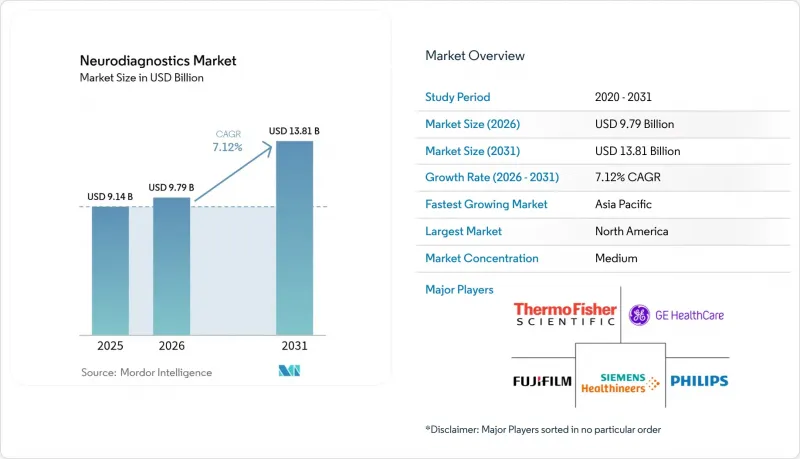
신경 진단 시장 규모는 2026년에 97억 9,000만 달러로 추정되고 있으며, 2025년 91억 4,000만 달러에서 2031년에는 138억 1,000만 달러에 달할 것으로 예측됩니다.
또한 2026-2031년 연평균 성장률(CAGR) 7.12%를 기록할 전망입니다.
본 보고서는 제품 유형(시약 및 소모품 등), 기술(신경 영상 진단 기술 등), 질환(신경퇴행성 질환, 뇌혈관 질환 등), 최종 사용자(병원·외과 센터, 진단실험실·영상 진단센터 등), 지역(북미, 유럽 등)별로 분류되어 있습니다. 시장 전망은 금액(달러) 기준으로 제시되어 있습니다.
세계 신경진단 시장 동향 및 인사이트
새로운 영상 진단 기술의 도입 확대
인공지능(AI)이 탑재된 스캐너를 통해 MRI 검사 소요 시간이 1시간 미만으로 단축되는 동시에, 프로토콜 선택, 슬라이스 위치 지정, 재구성이 자동화되어 화질을 저하시키지 않으면서 처리량이 향상되고 있습니다. 듀얼 엔진 재구성 알고리즘을 통해 노이즈가 감소된 고해상도 신경 영상이 얻어지며, 조직 부피의 정량적 매핑 및 병변의 조기 발견이 가능해집니다. 각 벤더사는 냉각제가 불과 7리터밖에 필요하지 않은 헬륨 프리 자석을 우선적으로 채택하고 있으며, 이를 통해 전체 수명 주기에 걸친 운영 비용을 절감하고, 자금 사정에 어려움을 겪는 의료 시스템의 도입 장벽을 완화하고 있습니다. 캐논 메디컬 시스템즈와 유나이티드 이미징이 동등한 AI 지원 플랫폼을 잇달아 출시함에 따라 경쟁 압력이 심화되고 있으며, 기존 제조업체들은 업그레이드 주기를 가속화할 수밖에 없는 상황입니다. 의료 기관의 입장에서 이러한 기능 강화는 스캐너 이용률 향상, 임상 판단의 신속화, 환자 만족도 향상으로 이어지며, 이 모든 요소가 구매 의욕을 북돋우는 동시에 AI 워크플로우를 신경 진단 시장의 핵심으로 자리매김시키고 있습니다.
혈액 검사를 통한 NFL 및 기타 신경학적 바이오마커의 등장
인산화 타우 217, 뉴로필라멘트 경쇄,및 MTBR-타우 243을 표적으로 하는 혈장 분석법은 요추 천자나 PET 영상 진단을 대체할 수 있는 비침습적 대안을 제공함으로써 신경학적 검사의 패러다임을 재정의하고 있으며, 다기관 공동 연구에서 85% 이상의 진단 정확도가 확인되었습니다. 주요 진단 기업들은 제휴를 맺고 자동 면역 분석기용 고처리량 분석법을 공동 개발하고 있으며, 이를 통해 규모의 경제가 실현되어 검사 1회당 비용이 절감되고 있습니다. 미국 FDA의 ‘브레이크스루 디바이스(Breakthrough Device)’ 제도에 따라 심사 주기는 가속화되고 있지만, 보험사 측의 주저함은 여전히 남아 있어 혈장 기반 알츠하이머병 패널에 대한 보험 환급률은 기존 검사법에 비해 여전히 낮은 수준에 머물러 있습니다. 가격 책정에 대한 우려는 있지만, 신경과 의사들은 기억 클리닉의 프로토콜에 바이오마커 패널을 점점 더 많이 포함시키고 있으며, 이를 통해 조기 의뢰, 계층화된 임상시험 등록, 그리고 맞춤형 치료가 촉진되고 있습니다. 검증 대상이 파킨슨병, ALS, 외상성 뇌손상으로 확대됨에 따라, 바이오마커 개발 기업들은 여러 질환에 걸친 수익원을 확보하고 있으며, 이는 신경진단 시장의 장기적인 성장을 뒷받침하고 있습니다.
첨단 신경 진단 시스템의 고액 초기 투자 및 유지비
헬륨 냉각식 3테슬라 MRI의 총 소유 비용은 설치비, 차폐비, 연간 유지보수 계약비를 포함하면 300만 달러를 초과할 수 있으며, 이러한 지출은 라틴아메리카나 동남아시아의 중규모 의료 기관에 큰 부담이 되고 있습니다. 헬륨이 없는 자석은 운영 비용을 20-30% 절감할 수 있지만, 높은 초기 도입 비용이 여전히 도입을 가로막고 있습니다. 그 결과, 여러 시설을 보유한 병원 그룹에서는 고성능 스캐너를 일원화하여 관리하고 있으며, 인근 진료소는 환자를 의뢰할 수밖에 없어 진료 경로가 길어지고 있습니다. 검사실 자동화는 장기적인 비용 절감이 기대되지만, ‘다크 랩’에는 로봇 이송 라인, AI 미들웨어, 이중화된 사이버 보안 계층이 필요하며, 시간당 500건의 검사를 수행하는 시설의 경우 도입 비용은 1,000만-1,500만 달러로 추산됩니다. 보조금이 포함된 자금 조달이나 위험 분담 계약이 없다면, 많은 지역 의료 기관은 현대화를 미루게 될 것이며, 신경 진단 시장에서 고성능 검사법의 보급 곡선이 둔화될 것입니다.
부문 분석
임상의들이 뉴로필라멘트 경쇄, 인산화 타우, GFAP 모니터링을 목적으로 한 연속 혈액 검사 패널 주문을 늘리고 있기 때문에 시약 및 소모품은 2025년 매출의 51.02%에 해당하는 지속적인 현금 흐름을 창출하고 있습니다. 장비 공급업체들은 독자적으로 개발한 카트리지와 미들웨어 분석 기능을 전략적으로 묶음 판매함으로써 검사실과의 유대를 공고히 하고, 신경 진단 시장에서 분기별 매출의 가시성을 높이고 있습니다. 임상 검사 장비(주로 휴대용 뇌파(EEG) 시스템, 핸드헬드형 경두개 도플러 장치, 현장 진단(POC) 바이오마커 분석 장치)는 응급실 체류 시간을 단축하려는 병원의 노력에 힘입어 두 번째로 큰 수익원이 되고 있습니다. 진단용 영상 시스템은 여전히 필수적이지만, 설비 투자 예산이 소프트웨어 구독, 클라우드 스토리지, 사이버 보안 업그레이드로 이동함에 따라 평균 판매 가격(ASP)에 대한 압박은 커지고 있습니다.
유전자 치료와 관련된 진단 분야는 규모는 작지만, 뇌-컴퓨터 인터페이스(BCI) 임상시험 및 유전성 운동 실조증에 대한 CRISPR 기반 치료의 진전을 배경으로 2031년까지 연평균 성장률(CAGR) 9.28%로 확대될 것으로 전망됩니다. 유전자 치료 동반 진단 분야의 신경 진단 시장 규모는 환자의 유전자형 판정, 벡터의 생체 내 분포 모니터링, 표적 단백질의 회복 검증과 같은 수요에 힘입어 2031년까지 10억 7,000만 달러를 넘어설 것으로 예측됩니다. 벡만 콜터(Beckman Coulter)와 같은 공급업체들은 p-Tau217 및 GFAP를 포괄하는 RUO(연구용) 패널을 제공하며, 임상시험에서 바이오마커 종점의 사실상의 표준을 확립하고 있습니다. 규제 당국이 대체 마커 및 장기 안전성 모니터링에 관한 지침을 최종 확정함에 따라, 소모품 사업은 더욱 확대되어 신경 진단 시장의 지속적인 성장에 필수적인 제품 포트폴리오의 다양성을 강화하게 될 것입니다.
신경 영상 진단 기술은 2025년에도 68.10%라는 압도적인 매출 점유율을 유지하고 있으며, 그 배경에는 신경학적 용도 전용 MRI 및 CT 스캐너가 전 세계적으로 4만 5,000대 이상 도입되어 있다는 점이 있습니다. 생성형 재구성 알고리즘을 통해 현재는 서브mm급의 등방성 해상도가 실현되어, 병변 감지 감도와 수술 계획의 정확도가 향상되고 있습니다. 벤더 중립형 분석 제품군은 DICOM 수준의 분할과 인지 기능 저하 예측을 통합하여, 스캐너의 활용 범위를 예방 신경학 분야로 더욱 확대되고 있습니다.
신경정보학 및 AI 분석 플랫폼은 매출 기준은 작지만 연평균 성장률(CAGR) 11.45%로 확대되고 있으며, 2031년까지 신경진단 시장 규모에서 두 자릿수 점유율을 차지할 것으로 예측됩니다. 클라우드 기반 발작 예측 엔진은 곡선 아래 면적(AUC) 점수 0.97을 달성하여, 위험도에 따른 계층화된 치료 경로 구축을 촉진하고 있습니다. 다국어를 지원하는 자연어 처리 모듈은 전자 건강 기록에서 미묘한 인지 기능 변화를 추출함으로써, 영상 진단으로의 조기 의뢰를 촉진합니다. GE 헬스케어가 AWS 네이티브 서비스를 에디슨(Edison) 플랫폼에 통합함에 따라, 경쟁의 초점은 하드웨어 사양에서 알고리즘 성능, 사이버 보안 실적, 임상시험을 통한 검증 데이터 세트로 이동하고 있으며, 이로 인해 신경진단 시장에서 공급업체의 차별화 요인 순위가 근본적으로 재편되고 있습니다.
지역별 분석
북미는 2025년에도 36.00%의 점유율로 매출 1위를 유지했습니다. 이는 2025년에 총액 3억 2,100만 달러에 달하는 NIH BRAIN 이니셔티브의 보조금이 산학 협력 파이프라인을 뒷받침하고 있는 것이 원동력이 되었습니다. 미국의 보험사들은 가치 기반 의료(VBC) 시범 사업의 일환으로 MRI와 바이오어세이 번들에 대한 환급을 지속하고 있으며, 책임 의료 조직(ACO) 내 통합 진단 알고리즘의 도입을 촉진하고 있습니다. 캐나다에서는 ‘전 캐나다 AI 전략 기금’을 통해 각 주의 원격 신경학 포털을 지원하고 있으며, 한편 멕시코의 민간 병원에서는 전문의 부족 문제를 해결하기 위해 휴대용 뇌파(EEG) 헤드셋을 수입하고 있습니다.
유럽에서는 견고한 국민건강보험 제도와 엄격하면서도 예측 가능한 CE 마크 취득 절차 덕분에 높은 도입률이 유지되고 있습니다. 독일에서는 지속가능성 목표에 부합하기 위해 방사선과에 헬륨이 없는 스캐너를 도입하고 있으며, 고령화가 진행되는 인구 구조로 인해 신경퇴행성 질환 선별 검사에 대한 수요는 계속해서 높은 수준을 유지하고 있습니다. 영국의 첨단 연구·발명청(ARIA)은 정밀 신경 기술 프로젝트에 6,900만 달러를 지원하여 옥스퍼드와 케임브리지 클러스터의 벤처 활동을 활성화했습니다. 지중해 국가들에서는 EU 연대 기금을 통해 혈장 교환법에 기반한 바이오마커 검사에 대한 접근성이 개선되고 있지만, 인력 부족으로 인해 도입이 지연되면서 지방의 신경 진단 시장 침투가 더뎌지고 있습니다.
아시아태평양은 연평균 성장률(CAGR) 9.28%로 가장 빠른 속도로 성장하고 있으며, 중국의 의료 기술 시장이 28% 확대되고 있는 점과 유나이티드 이미징(United Imaging) 및 마인드레이(Mindray)가 주도하는 하이엔드 영상 진단 및 AI 플랫폼으로의 전략적 전환의 혜택을 받고 있습니다. 일본의 ‘헬스케어 2035’ 로드맵에서는 신경 질환 예방 선별 검사가 연례 건강검진에 포함되어 있으며, 이는 시립 진료소에서의 뇌파(EEG) 웨어러블 기기 일괄 조달을 촉진하고 있습니다. 인도의 ‘국가 디지털 헬스 미션’은 클라우드 PACS 및 원격 뇌파(tele-EEG) 게이트웨이에 대한 보조금을 지원하고 있으며, 이를 통해 2급 도시에서 수요가 촉진되고 있습니다. 한국에서는 AI를 활용한 영상진단 정책에 맞추어 보험 환급 제도를 정비하고 있는 반면, 호주의 메디케어는 재택 수면 검사 비용을 부담함으로써 수면장애 진단 도입을 가속화하고 있습니다. 이러한 정책 조치들이 맞물려, 해당 지역은 전 세계 신경진단 시장에서 판매량 증가에 가장 크게 기여하는 지역이 되었습니다.
기타 혜택:
- 엑셀 형식 시장 예측(ME) 시트
- 3개월간의 애널리스트 지원
자주 묻는 질문
목차
제1장 서론
제2장 조사 방법
제3장 주요 요약
제4장 시장 구도
제5장 시장 규모와 성장 예측
제6장 경쟁 구도
제7장 시장 기회와 향후 전망
LSH 26.08.26According to Mordor Intelligence, neurodiagnostics market size in 2026 is estimated at USD 9.79 billion, growing from 2025 value of USD 9.14 billion with 2031 projections showing USD 13.81 billion, growing at 7.12% CAGR over 2026-2031.
This report is Segmented by Product Type (Reagents & Consumables, and More), Technology (Neuroimaging Technologies, and More), Condition (Neurodegenerative Diseases, Cerebrovascular Disorders, and More), End-User (Hospitals & Surgical Centers, Diagnostic Laboratories & Imaging Centers, and More), and Geography (North America, Europe, and More). The Market Forecasts are Provided in Terms of Value (USD).
Global Neurodiagnostics Market Trends and Insights
Growing Adoption of Novel Diagnostic Imaging Technologies
Artificial-intelligence-enabled scanners now shorten MRI sessions to under an hour while automating protocol selection, slice positioning and reconstruction, raising throughput without compromising image quality. Dual-engine reconstruction algorithms deliver noise-reduced, high-resolution neuro images that support quantitative tissue volume mapping and early lesion detection. Vendors are prioritizing helium-free magnets that require as little as 7 liters of coolant, cutting lifetime operating costs and easing procurement barriers in cash-strapped health systems. Competitive pressure intensifies as Canon Medical and United Imaging roll out comparable AI-ready platforms, forcing incumbents to accelerate upgrade cycles. For providers, these enhancements translate into higher scanner utilization, faster clinical decisions and improved patient satisfaction, all of which reinforce purchasing intent and embed AI workflows at the core of the Neurodiagnostics market.
Emergence of Blood-Based NFL and Other Neurological Biomarkers
Plasma assays targeting phosphorylated tau217, neurofilament-light chain and MTBR-tau243 are redefining neurological work-ups by offering non-invasive alternatives to lumbar puncture and PET imaging, with diagnostic accuracy above 85% in multi-center trials. Large diagnostic firms are partnering to co-develop high-throughput assays for automated immuno-analyzers, unlocking economies of scale and reducing per-test costs. The U.S. FDA's breakthrough-device pathway accelerates review cycles, yet payer hesitation persists; reimbursement rates for plasma-based Alzheimer's panels still lag behind legacy modalities. Despite pricing doubts, neurologists increasingly integrate biomarker panels into memory-clinic protocols, leading to earlier referrals, stratified trial enrollment and personalized therapeutics. As validation expands to Parkinson's, ALS and traumatic brain injuries, biomarker developers gain a multi-disease revenue stream that underpins the long-run expansion of the Neurodiagnostics market.
High Capital and Maintenance Costs of Advanced Neurodiagnostic Systems
Total ownership expenses for a helium-cooled 3-Tesla MRI can surpass USD 3 million when factoring installation, shielding and annual service contracts, an outlay that strains mid-size providers in Latin America and Southeast Asia. Although helium-free magnets cut running costs by 20-30%, the upfront premium still inhibits adoption. Multisite hospital systems therefore centralize high-end scanners, compelling peripheral clinics to refer patients and elongating care pathways. Laboratory automation promises long-term savings, yet "dark labs" require robotic track lines, AI middleware and redundant cybersecurity layers, with deployment estimates ranging between USD 10 million and USD 15 million for a 500-test-per-hour facility. Without subsidized financing or risk-sharing contracts, many regional providers postpone modernization, slowing the penetration curve of premium modalities within the Neurodiagnostics market.
Other drivers and restraints analyzed in the detailed report include:
- Rising Geriatric Population and Longevity
- Rapid Expansion of Point-of-Care EEG Wearables in Emerging Markets
- Shortage of Trained Neurotechnologists & Neuroradiologists
For complete list of drivers and restraints, kindly check the Table Of Contents.
Segment Analysis
Reagents & consumables produced recurrent cash flows equal to 51.02% of 2025 revenue as clinicians increasingly order serial blood-based panels for neurofilament-light chain, phosphorylated tau and GFAP monitoring. Instrument vendors strategically bundle proprietary cartridges with middleware analytics, cementing laboratory stickiness and smoothing quarterly revenue visibility in the Neurodiagnostics market. Clinical testing instruments-chiefly portable EEG systems, handheld transcranial Doppler units and point-of-care biomarker analyzers-form the second-largest contributor, propelled by hospital attempts to shorten emergency-department dwell times. Diagnostic imaging systems remain mission-critical, yet ASP pressure intensifies as capital budgets shift toward software subscriptions, cloud storage and cybersecurity upgrades.
Gene-therapy-linked diagnostics, though representing a small base, are scaling at a 9.28% CAGR through 2031 on the back of brain-computer-interface trials and CRISPR-mediated interventions for inherited ataxias. Neurodiagnostics market size for gene-therapy-companion tests is forecast to surpass USD 1.07 billion by 2031, supported by the need to genotype patients, monitor vector biodistribution and verify on-target protein restoration. Vendors such as Beckman Coulter offer RUO panels covering p-Tau217 and GFAP, creating de-facto standards for biomarker endpoints in clinical trials. As regulatory agencies finalize guidelines on surrogate markers and long-term safety monitoring, the consumables franchise will deepen, reinforcing the product-portfolio diversity vital for sustainable Neurodiagnostics market growth.
Neuroimaging technologies preserved a commanding 68.10% revenue share in 2025, underpinned by a global installed base exceeding 45,000 MRI and CT scanners dedicated to neurological applications. Generative reconstruction algorithms now deliver sub-millimeter isotropic resolution, enhancing lesion detectability and surgical-planning precision. Vendor-neutral analytic suites integrate DICOM-level segmentation with cognitive-decline prediction, further extending scanner reach into preventive neurology.
Neuroinformatics & AI analytics platforms, although starting from a smaller revenue base, are expanding at 11.45% CAGR and are projected to account for a double-digit share of the Neurodiagnostics market size by 2031. Cloud-deployed seizure-prediction engines achieve area-under-curve scores of 0.97, facilitating risk-stratified care pathways. Multilingual natural-language-processing modules mine electronic health-records for subtle cognitive changes, prompting earlier imaging referrals. As GE Healthcare layers AWS native-services into its Edison platform, competition pivots from hardware specifications to algorithmic performance, cybersecurity credentials and clinical-trial validation data sets, fundamentally re-ranking supplier differentiation in the Neurodiagnostics market.
Complete Report Scope:
- By Product
- Reagents & Consumables
- Clinical Testing Instruments
- Diagnostic & Imaging Systems
- By Technology
- Neuroimaging Technologies
- In-Vitro Diagnostics
- Neuroinformatics & AI Analytics Platforms
- By Condition
- Neurodegenerative Diseases
- Cerebrovascular Disorders
- Epilepsy & Seizure Disorders
- Sleep Disorders
- Headache & Migraine
- Others (TBI, CNS Infections, Tumors)
- By End User
- Hospitals & Surgical Centers
- Diagnostic Laboratories & Imaging Centers
- Ambulatory Care & Emergency Settings
- Research & Academic Institutes
- Specialized Neurology Centers
- Geography
- North America
- United States
- Canada
- Mexico
- Europe
- Germany
- United Kingdom
- France
- Italy
- Spain
- Rest of Europe
- Asia-Pacific
- China
- Japan
- India
- South Korea
- Australia
- Rest of Asia-Pacific
- Middle East and Africa
- GCC
- South Africa
- Rest of Middle East and Africa
- South America
- Brazil
- Argentina
- Rest of South America
- North America
Geography Analysis
North America remained the revenue leader with 36.00% share in 2025, propelled by NIH BRAIN Initiative grants totaling USD 321 million in 2025 that cushion academic-industry collaboration pipelines. U.S. payers continue to reimburse MRI and bio-assay bundles under value-based-care pilots, encouraging integrated diagnostic algorithms within accountable-care organizations. Canada, through Pan-Canadian AI strategy funds, supports provincial tele-neurology portals, while Mexico's private hospitals import portable EEG headsets to close specialist gaps.
Europe sustains high adoption due to robust universal healthcare financing and stringent but predictable CE-mark pathways. Germany refits radiology departments with helium-free scanners to align with sustainability targets, and its aging demographic keeps demand for neurodegenerative screening elevated. The U.K.'s Advanced Research and Invention Agency awarded USD 69 million to precision neurotechnology projects, sparking venture activity in Oxford and Cambridge clusters. Mediterranean markets improve access to plasmapheresis-based biomarker assays through EU solidarity funds, yet workforce shortages slow implementation, tempering Neurodiagnostics market penetration in rural areas.
Asia-Pacific, registering the fastest pace at 9.28% CAGR, benefits from China's 28% medtech expansion and a strategic pivot toward high-end imaging and AI platforms led by United Imaging and Mindray. Japan's healthcare-2035 roadmap embeds neuro-preventive screening into annual wellness checks, driving bulk procurement of EEG wearables for municipal clinics. India's National Digital Health Mission subsidizes cloud PACS and tele-EEG gateways, unlocking tier-II city demand. South Korea aligns reimbursement with AI-augmented imaging policy, whereas Australia's Medicare funds home-sleep studies, accelerating sleep-disorder diagnostics adoption. Collectively, these policy levers make the region the principal incremental volume contributor to the global Neurodiagnostics market.
- Siemens Healthineers
- GE Healthcare
- Koninklijke Philips
- Canon
- FUJIFILM
- Thermo Fisher Scientific
- Roche
- Natus Medical
- Nihon Kohden
- Lifelines Neuro Company
- Advanced Brain Monitoring
- Mitsar Co. Ltd.
- Medtronic
- Abbott Laboratories
- Boston Scientific
- Cadwell
- Compumedics
- Electrical Geodesics Inc.
- Neurosoft
- Masimo
- Quanterix Corporation
Additional Benefits:
- The market estimate (ME) sheet in Excel format
- 3 months of analyst support
TABLE OF CONTENTS
1 Introduction
- 1.1 Study Assumptions & Market Definition
- 1.2 Scope of the Study
2 Research Methodology
3 Executive Summary
4 Market Landscape
- 4.1 Market Overview
- 4.2 Market Drivers
- 4.2.1 Increasing Incidence Of Neurological Disorders
- 4.2.2 Growing Adoption Of Novel Diagnostic Imaging Technologies
- 4.2.3 Rising Geriatric Population And Longevity
- 4.2.4 Emergence Of Blood-Based NfL And Other Neurological Biomarkers
- 4.2.5 Rapid Expansion Of Point-Of-Care EEG Wearables In Emerging Markets
- 4.2.6 Government Neurotech Moonshot Funding & Public-Private Consortia
- 4.3 Market Restraints
- 4.3.1 High Capital And Maintenance Costs Of Advanced Neurodiagnostic Systems
- 4.3.2 Shortage Of Trained Neurotechnologists & Neuroradiologists
- 4.3.3 Reimbursement Uncertainty For Novel Biomarker And AI-Based Tests
- 4.3.4 Data Privacy & Cybersecurity Concerns With Cloud-Connected Brain Data
- 4.4 Technological Outlook
- 4.5 Porter's Five Forces Analysis
- 4.5.1 Threat of New Entrants
- 4.5.2 Bargaining Power of Buyers
- 4.5.3 Bargaining Power of Suppliers
- 4.5.4 Threat of Substitute Products
- 4.5.5 Intensity of Competitive Rivalry
5 Market Size & Growth Forecasts (Value, USD)
- 5.1 By Product
- 5.1.1 Reagents & Consumables
- 5.1.2 Clinical Testing Instruments
- 5.1.3 Diagnostic & Imaging Systems
- 5.2 By Technology
- 5.2.1 Neuroimaging Technologies
- 5.2.2 In-Vitro Diagnostics
- 5.2.3 Neuroinformatics & AI Analytics Platforms
- 5.3 By Condition
- 5.3.1 Neurodegenerative Diseases
- 5.3.2 Cerebrovascular Disorders
- 5.3.3 Epilepsy & Seizure Disorders
- 5.3.4 Sleep Disorders
- 5.3.5 Headache & Migraine
- 5.3.6 Others (TBI, CNS Infections, Tumors)
- 5.4 By End User
- 5.4.1 Hospitals & Surgical Centers
- 5.4.2 Diagnostic Laboratories & Imaging Centers
- 5.4.3 Ambulatory Care & Emergency Settings
- 5.4.4 Research & Academic Institutes
- 5.4.5 Specialized Neurology Centers
- 5.5 Geography
- 5.5.1 North America
- 5.5.1.1 United States
- 5.5.1.2 Canada
- 5.5.1.3 Mexico
- 5.5.2 Europe
- 5.5.2.1 Germany
- 5.5.2.2 United Kingdom
- 5.5.2.3 France
- 5.5.2.4 Italy
- 5.5.2.5 Spain
- 5.5.2.6 Rest of Europe
- 5.5.3 Asia-Pacific
- 5.5.3.1 China
- 5.5.3.2 Japan
- 5.5.3.3 India
- 5.5.3.4 South Korea
- 5.5.3.5 Australia
- 5.5.3.6 Rest of Asia-Pacific
- 5.5.4 Middle East and Africa
- 5.5.4.1 GCC
- 5.5.4.2 South Africa
- 5.5.4.3 Rest of Middle East and Africa
- 5.5.5 South America
- 5.5.5.1 Brazil
- 5.5.5.2 Argentina
- 5.5.5.3 Rest of South America
- 5.5.1 North America
6 Competitive Landscape
- 6.1 Market Concentration
- 6.2 Market Share Analysis
- 6.3 Company Profiles (includes Global level Overview, Market level overview, Core Segments, Financials as available, Strategic Information, Market Rank/Share for key companies, Products & Services, and Recent Developments)
- 6.3.1 Siemens Healthineers
- 6.3.2 GE Healthcare
- 6.3.3 Koninklijke Philips N.V.
- 6.3.4 Canon Medical Systems Corporation
- 6.3.5 Fujifilm Holdings Corporation
- 6.3.6 Thermo Fisher Scientific Inc.
- 6.3.7 Hoffmann-La Roche Ltd.
- 6.3.8 Natus Medical Incorporated
- 6.3.9 Nihon Kohden Corporation
- 6.3.10 Lifelines Neuro Company
- 6.3.11 Advanced Brain Monitoring Inc.
- 6.3.12 Mitsar Co. Ltd.
- 6.3.13 Medtronic Plc
- 6.3.14 Abbott Laboratories
- 6.3.15 Boston Scientific Corporation
- 6.3.16 Cadwell Industries Inc.
- 6.3.17 Compumedics Limited
- 6.3.18 Electrical Geodesics Inc.
- 6.3.19 Neurosoft
- 6.3.20 Masimo Corporation
- 6.3.21 Quanterix Corporation
7 Market Opportunities & Future Outlook
- 7.1 White-space & Unmet-need Assessment


