

|
시장보고서
상품코드
2114673
의료용 선형 가속기 : 시장 점유율 분석, 산업 동향 및 통계 데이터, 성장 예측(2026-2031년)Medical Linear Accelerator - Market Share Analysis, Industry Trends & Statistics, Growth Forecasts (2026 - 2031) |
||||||
 Mordor Intelligence
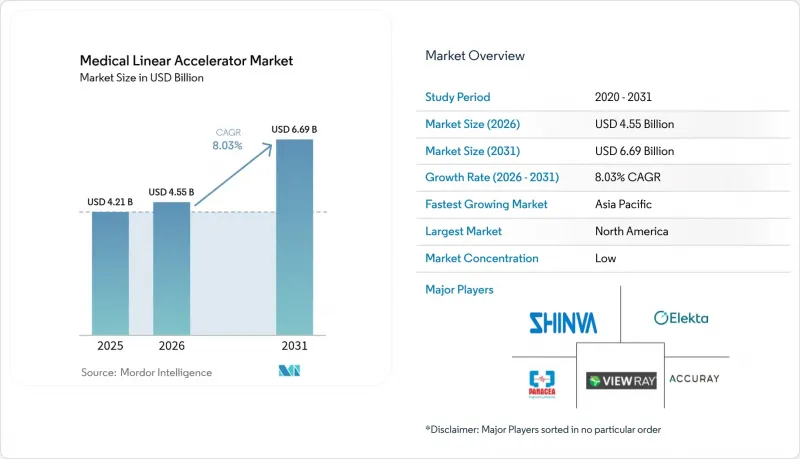
Mordor Intelligence에 의하면, 의료용 선형 가속기(리니악크) 시장 규모는 2025년에 42억 1,000만 달러, 2026년 45억 5,000만 달러에서 2031년까지 66억 9,000만 달러에 이를 것으로 추정되고 있어 예측 기간(2026-2031년) CAGR은 8.03%를 기록할 전망입니다.
본 보고서는 기술별(강도조절 방사선 치료(IMRT), 체적 변조 아크 치료 등), 용도별(유방암, 폐암 등), 에너지 유형별(저에너지(6 MeV 미만),고에너지(6-15 MeV) 등), 모달리티(광자 기반 리니어 액셀러레이터, 전자 기반 리니어 액셀러레이터 등), 지역(북미, 유럽 등)별로 분류되어 있습니다. 시장 예측은 금액(달러) 기준으로 제시되어 있습니다.
전 세계 의료용 선형 가속기 시장 동향 및 인사이트
전 세계 암 발병률 증가
세계 암 환자 수는 2040년까지 42% 증가할 것으로 예측되며, 그 중 70%는 여전히 방사선 치료 접근성이 현저히 제한된 저·중소득 국가에서 발생할 것으로 전망됩니다. 현재 보급률은 12억 명의 아프리카 인구에 비해 약 380대의 리니어 가속기인 반면, 3억 3,100만 명의 미국 인구에 대해서는 4,000대에 육박하고 있어, 이러한 불균형이 의료용 리니어 가속기 시장의 지속적인 수요를 견인하고 있음이 부각되고 있습니다. 국제 기구들은 현재 방사선 치료 장비를 핵심적인 개입 수단으로 간주하며, 신흥 경제국에서의 투자 우선순위를 기존 장비의 교체에서 신규 도입으로 전환하고 있습니다. 이러한 인구 통계학적 압력이 의료용 선형 가속기 시장의 장기적인 확대 추세를 뒷받침하고 있습니다.
AI를 활용한 적응형 방사선 치료의 급속한 보급
AI를 통해 윤곽 묘사, 치료 계획 및 치료대 상에서의 적응이 자동화되어 계획 시간이 최대 70% 단축될 뿐만 아니라, 인력 부족 문제 해결에도 기여하고 있습니다. 일렉트라(Elekta)사의 적응형 CT-LINAC 등의 시스템은 해부학적 변화에 따라 빔 매개변수를 실시간으로 조정하여 선량 적합성을 향상시키고, 정상 조직에 대한 피폭을 저감합니다. 이러한 성능 향상은 고가형 업그레이드를 촉진하여 의료용 선형 가속기 시장에서 차세대 플랫폼의 가치 제안을 강화하고 있습니다.
높은 초기 투자 및 유지 관리 비용
구매 가격은 400만 달러를 초과하며, 연간 유지보수 비용은 설비 투자액의 10%에 달하기도 하고, 7년 차 경에 정점을 맞이합니다. 이러한 경제적 요인으로 인해 조기 교체 의향이 억제되고, 자원이 부족한 환경에서는 도입이 어려워지고 있습니다. 그 결과, 임상적 필요성이 명백함에도 불구하고 의료용 선형 가속기 시장의 성장은 제약을 받고 있습니다.
부문 분석
2025년에는 강도조절 방사선 치료(IMRT)가 26억 9,000만 달러 시장 규모로 의료용 선형 가속기 시장을 주도했습니다. 이 부문은 확립된 보험 환급 체계와 확고한 임상적 근거의 혜택을 받고 있으며, 유방암, 전립선암, 두경부암 치료 프로토콜에서 일상적으로 사용되고 있습니다. 그러나 IMRT의 입지는 VMAT에 의해 서서히 잠식되고 있습니다. VMAT의 회전식 선량 조사로 인해 치료 시간이 2-4분으로 단축되어, 치료 건수 처리 부담도 완화되고 있습니다. VMAT는 2031년까지 연평균 성장률(CAGR)이 8.10%를 나타낼 것으로 예측되며, 의료용 선형 가속기 시장 전체를 상회하는 성장이 기대됩니다.
영상 유도 방사선 치료(IGRT)나 정위 방사선 수술(SRS)/정위 체외 방사선 치료(SBRT)와 같은 신흥 하위 기술은 환자의 편의성과 의료진의 업무 효율화에 부합하는 저분할 조사법에 힘입어 성장하고 있습니다. FLASH-RT 및 생물학 기반 시스템의 급속한 발전이 다음 성장 동력이 될 전망이지만, 규제 및 근거와 관련된 과제로 인해 2025년까지의 총 매출 점유율은 3% 미만에 그칠 것으로 예측됩니다. 따라서 각 벤더사는 IMRT를 통한 기존 판매량을 유지하면서 VMAT 소프트웨어 업그레이드 및 적응형 워크플로우에 대한 투자를 추진하고 있습니다.
2025년 의료용 선형 가속기 시장 규모 중 유방암 치료는 34억 6,000만 달러를 차지하고 있으며, 이는 높은 발병률과 표준화된 분할 조사 일정에 힘입은 결과입니다. 현재 리니어 가속기 소프트웨어에 통합된 심호흡 유지 기술 덕분에 그 보급은 더욱 확고해지고 있습니다. 그럼에도 불구하고, 폐암 치료 매출은 연평균 성장률(CAGR) 8.69%로 가장 빠르게 증가하고 있으며, 이는 움직임이 있는 흉부 구조물 주변에서 초고정밀 선량 스컬프팅이 필요하기 때문입니다.
폐 및 뼈에 대한 적용이 승인된 생물학적 유도 방사선 치료는 종양의 PET 신호에 빔 조사를 동기화함으로써 재조사 및 4기 적응 범위를 확대되고 있습니다. 전립선암 치료 워크플로우에서는 MRI 유도를 활용하여 주변 장기를 보호하고, 적응형 계획을 통해 독성을 줄이고 있습니다. 대장암 및 두경부암 치료는 저분할 조사 모델이 보험사로부터 수용됨에 따라 꾸준히 보급되고 있습니다. 각 범주에서 총 조사 횟수를 줄이는 기술이 보험 지급 기준에서 점점 더 중요시되고 있으며, 이러한 추세는 의료용 선형 가속기 시장에 호재가 되고 있습니다.
지역별 분석
북미는 2025년에도 38.88%의 시장 점유율을 유지하고 있으며, 이는 견고한 의료 인프라, 유리한 보험 환급 체계, 그리고 AI를 활용한 적응형 시스템 및 생물학 기반 방사선 치료와 같은 획기적인 기술의 조기 도입에 힘입은 결과입니다. 이 지역은 영국의 7,000만 파운드 규모의 방사선 치료 장비 프로그램, 노후화된 리니어 가속기의 교체와 치료 능력 확대를 동시에 달성하는 캐나다의 장비 교체 이니셔티브 등으로 대표되는 정부의 막대한 투자 혜택을 받고 있습니다. 한편, 아시아태평양은 의료 인프라 확충, 암 발병률 증가, 그리고 정부가 지원하는 기술 도입 프로그램에 힘입어 2031년까지 연평균 성장률(CAGR) 9.08%를 기록하며 가장 빠르게 성장하는 지역으로 부상하고 있습니다.
유럽에서는 회원국 전체의 기술 도입을 촉진하는 협력적인 의료 현대화 프로그램과 규제 조화 노력을 통해 꾸준한 성장이 나타나고 있습니다. 이 지역이 MRI 유도 시스템과 적응형 방사선 치료를 중시하고 있는 점은 정밀 종양학 연구 및 임상 응용 분야의 리더십을 반영하고 있습니다. 남미에서는 암 치료 인프라에 대한 집중적인 투자를 통해 새로운 가능성이 드러나고 있으며, 중동 및 아프리카에서는 의료 시스템 개발과 국제적인 기술 이전 프로그램에 힘입어 성장을 이루고 있습니다. 업계 규모를 두 배로 늘리는 것을 목표로 하는 2021년부터 2035년까지의 개발 계획에 힘입어 중국 핵의학 분야의 확장은 아시아태평양이 고도의 암 치료 역량 확립에 주력하고 있음을 보여줍니다. 대만이 세계 최고 수준의 입자선 치료 시설 밀도를 달성한 것은 해당 지역의 기술적 성숙도를 보여주는 동시에, 환자 대기 목록과 같은 운영상의 과제도 증가하는 수요에 부응하기 위해 지속적인 역량 확대가 필요함을 여실히 드러내고 있습니다.
기타 혜택:
- Excel 형식 시장 예측(ME) 시트
- 3개월간의 애널리스트 지원
자주 묻는 질문
목차
제1장 서론
제2장 분석 방법
제3장 주요 요약
제4장 시장 구도
제5장 시장 규모·성장률 예측
제6장 경쟁 구도
제7장 시장 기회와 향후 전망
LSH 26.08.26According to Mordor Intelligence, the medical linear accelerator market size was valued at USD 4.21 billion in 2025 and estimated to grow from USD 4.55 billion in 2026 to reach USD 6.69 billion by 2031, at a CAGR of 8.03% during the forecast period (2026-2031).
This report is Segmented by Technology (Intensity-Modulated RT, Volumetric-Modulated Arc Therapy, and More), Application (Breast Cancer, Lung Cancer, and More), Energy Type (Low-Energy <6 MeV, High-Energy 6-15 MeV, and More), Modality (Photon-Based LINAC, Electron-Based LINAC, and More), and Geography (North America, Europe, and More). The Market Forecasts are Provided in Terms of Value (USD).
Global Medical Linear Accelerator Market Trends and Insights
Rising Global Cancer Incidence
Global cancer cases are forecast to rise 42% by 2040, with 70% occurring in low- and middle-income nations where radiotherapy access remains severely constrained. Current penetration stands at roughly 380 LINACs for 1.2 billion Africans versus nearly 4,000 units for 331 million Americans, underscoring the inequity driving sustained demand in the medical linear accelerator market. International agencies now frame radiotherapy equipment as a core intervention, pivoting investment priorities in emerging economies from replacement to greenfield installation. This demographic pressure underpins the long-term expansion profile of the medical linear accelerator market.
Rapid Adoption of AI-Enabled Adaptive Radiotherapy
AI now automates contouring, planning and on-table adaptation, cutting planning times by up to 70% and helping offset workforce gaps. Systems such as Elekta's adaptive CT-LINAC adjust beam parameters in real time to anatomical change, boosting dose conformity and sparing healthy tissue. These performance gains fuel premium-priced upgrades and reinforce the value proposition of next-generation platforms within the medical linear accelerator market.
High Capital & Maintenance Costs
Purchase prices exceed USD 4 million and annual service can top 10% of capital outlay, peaking near year seven. These economics limit early replacement appetite and complicate uptake in low-resource settings, restraining the medical linear accelerator market despite demonstrable clinical need.
Other drivers and restraints analyzed in the detailed report include:
- Government Funding & Equipment Replacement Cycles
- Expansion of Radiotherapy Capacity in Emerging Economies
- Shortage of Trained Radiation-Oncology Workforce
For complete list of drivers and restraints, kindly check the Table Of Contents.
Segment Analysis
Intensity-Modulated RT led the medical linear accelerator market size with USD 2.69 billion in 2025. The segment benefits from entrenched reimbursement frameworks and robust clinical evidence, securing routine use across breast, prostate and head-and-neck protocols. Yet IMRT's position is gradually eroded by VMAT, whose rotational dose delivery cuts treatment time to 2-4 minutes, easing throughput pressures. VMAT posted an 8.10% CAGR outlook to 2031, outpacing the overall medical linear accelerator market.
Emerging sub-technologies, including image-guided RT and stereotactic SRS/SBRT, grow on the strength of hypo-fractionated regimens that align with patient convenience and workforce optimization. Rapid progress in FLASH-RT and biology-guided systems represents the next curve, but regulatory and evidence hurdles keep their aggregate revenue share below 3% through 2025. Vendor portfolios thus straddle legacy volumes from IMRT while investing in VMAT software upgrades and adaptive workflows.
Breast cancer therapy represented USD 3.46 billion of the medical linear accelerator market size in 2025, fueled by high disease prevalence and standardized fractionation schedules. Deep-inspiration breath-hold techniques, now integrated into LINAC software, further entrench adoption. Nonetheless, lung cancer revenues climb fastest at an 8.69% CAGR, propelled by the need for ultra-precise dose sculpting around mobile thoracic structures.
Biology-guided radiotherapy, cleared for lung and bone applications, synchronizes beam delivery to tumor PET emissions, expanding re-irradiation and Stage IV indications. Prostate workflows leverage MRI guidance to spare surrounding organs, with adaptive planning reducing toxicity. Colorectal and head-and-neck treatments continue steady uptake as hypofractionation models gain payor acceptance. Across categories, reimbursement alignment increasingly prizes technologies that reduce total fractions, a trend that benefits the medical linear accelerator market.
Complete Report Scope:
- By Technology (Value, USD Million)
- Intensity-Modulated RT (IMRT)
- Volumetric-Modulated Arc Therapy (VMAT)
- Image-Guided RT (IGRT)
- Stereotactic SRS/SBRT
- Others
- By Application (Value, USD Million)
- Breast Cancer
- Lung Cancer
- Prostate Cancer
- Colorectal Cancer
- Head & Neck Cancer
- Other Cancers
- By Energy Type (Value, USD Million)
- Low-Energy (<6 MeV)
- High-Energy (6-15 MeV)
- Very-High Energy (>15 MeV)
- By Modality (Value, USD Million)
- Photon-based LINAC
- Electron-based LINAC
- MRI-guided LINAC
- Adaptive RT Systems
- FLASH-ready LINAC
- By Geography (Value, USD Million)
- North America
- United States
- Canada
- Europe
- Germany
- United Kingdom
- France
- Italy
- Spain
- Rest of Europe
- Asia-Pacific
- China
- India
- Japan
- South Korea
- Australia
- Rest of Asia-Pacific
- South America
- Brazil
- Argentina
- Rest of South America
- Middle East and Africa
- GCC
- South Africa
- Rest of Middle East and Africa
- North America
Geography Analysis
North America maintains 38.88% market share in 2025, supported by robust healthcare infrastructure, favorable reimbursement frameworks, and early adoption of breakthrough technologies including AI-powered adaptive systems and biology-guided radiotherapy. The region benefits from substantial government investments, exemplified by the UK's £70 million radiotherapy equipment program and Canada's equipment replacement initiatives that modernize aging LINAC fleets while expanding treatment capacity. However, Asia-Pacific emerges as the fastest-growing region at 9.08% CAGR through 2031, driven by healthcare infrastructure expansion, rising cancer incidence, and government-supported technology adoption programs.
Europe demonstrates steady growth through coordinated healthcare modernization programs and regulatory harmonization initiatives that facilitate technology adoption across member states. The region's emphasis on MRI-guided systems and adaptive radiotherapy reflects its leadership in precision oncology research and clinical implementation. South America shows emerging potential through targeted investments in cancer care infrastructure, while Middle East and Africa regions experience growth driven by healthcare system development and international technology transfer programs. China's nuclear medicine expansion, supported by the 2021-2035 development plan targeting industry scale doubling, exemplifies Asia-Pacific's commitment to advanced cancer treatment capabilities. Taiwan's achievement of the world's highest particle therapy facility density demonstrates the region's technological sophistication, though operational challenges including patient waitlists highlight the need for continued capacity expansion to meet growing demand.
- Varian Medical Systems
- Elekta
- Accuray
- ViewRay Inc.
- United Imaging Healthcare Co. Ltd.
- Shinva Medical Instrument
- RefleXion Medical Inc.
- Xstrahl Ltd.
- Hitachi
- GE HealthCare Technologies Inc.
- Sumitomo Heavy Industries Ltd.
- Mevion Medical Systems Inc.
- Advanced Oncotherapy plc
- Panacea Medical Technologies
- Neusoft Medical Systems Co. Ltd.
- TAE Life Sciences LLC
Additional Benefits:
- The market estimate (ME) sheet in Excel format
- 3 months of analyst support
TABLE OF CONTENTS
1 Introduction
- 1.1 Study Assumptions & Market Definition
- 1.2 Scope of the Study
2 Research Methodology
3 Executive Summary
4 Market Landscape
- 4.1 Market Overview
- 4.2 Market Drivers
- 4.2.1 Rising global cancer incidence
- 4.2.2 Rapid adoption of AI-enabled adaptive radiotherapy
- 4.2.3 Government funding & equipment replacement cycles
- 4.2.4 Expansion of radiotherapy capacity in emerging economies
- 4.2.5 Commercialization of FLASH-RT-ready LINAC platforms
- 4.2.6 Growth of compact LINACs for decentralized cancer care
- 4.3 Market Restraints
- 4.3.1 High capital & maintenance costs
- 4.3.2 Shortage of trained radiation-oncology workforce
- 4.3.3 Lengthy regulatory & reimbursement approval timelines
- 4.3.4 RF-component supply-chain disruptions for klystrons
- 4.4 Value / Supply-Chain Analysis
- 4.5 Regulatory Landscape
- 4.6 Technological Outlook
- 4.7 Porter's Five Forces
- 4.7.1 Threat of New Entrants
- 4.7.2 Bargaining Power of Suppliers
- 4.7.3 Bargaining Power of Buyers
- 4.7.4 Threat of Substitute Therapies
- 4.7.5 Industry Rivalry
5 Market Size & Growth Forecasts
- 5.1 By Technology (Value, USD Million)
- 5.1.1 Intensity-Modulated RT (IMRT)
- 5.1.2 Volumetric-Modulated Arc Therapy (VMAT)
- 5.1.3 Image-Guided RT (IGRT)
- 5.1.4 Stereotactic SRS/SBRT
- 5.1.5 Others
- 5.2 By Application (Value, USD Million)
- 5.2.1 Breast Cancer
- 5.2.2 Lung Cancer
- 5.2.3 Prostate Cancer
- 5.2.4 Colorectal Cancer
- 5.2.5 Head & Neck Cancer
- 5.2.6 Other Cancers
- 5.3 By Energy Type (Value, USD Million)
- 5.3.1 Low-Energy (<6 MeV)
- 5.3.2 High-Energy (6-15 MeV)
- 5.3.3 Very-High Energy (>15 MeV)
- 5.4 By Modality (Value, USD Million)
- 5.4.1 Photon-based LINAC
- 5.4.2 Electron-based LINAC
- 5.4.3 MRI-guided LINAC
- 5.4.4 Adaptive RT Systems
- 5.4.5 FLASH-ready LINAC
- 5.5 By Geography (Value, USD Million)
- 5.5.1 North America
- 5.5.1.1 United States
- 5.5.1.2 Canada
- 5.5.2 Europe
- 5.5.2.1 Germany
- 5.5.2.2 United Kingdom
- 5.5.2.3 France
- 5.5.2.4 Italy
- 5.5.2.5 Spain
- 5.5.2.6 Rest of Europe
- 5.5.3 Asia-Pacific
- 5.5.3.1 China
- 5.5.3.2 India
- 5.5.3.3 Japan
- 5.5.3.4 South Korea
- 5.5.3.5 Australia
- 5.5.3.6 Rest of Asia-Pacific
- 5.5.4 South America
- 5.5.4.1 Brazil
- 5.5.4.2 Argentina
- 5.5.4.3 Rest of South America
- 5.5.5 Middle East and Africa
- 5.5.5.1 GCC
- 5.5.5.2 South Africa
- 5.5.5.3 Rest of Middle East and Africa
- 5.5.1 North America
6 Competitive Landscape
- 6.1 Market Concentration
- 6.2 Market Share Analysis
- 6.3 Company Profiles (includes Global level Overview, Market level overview, Core Segments, Financials as available, Strategic Information, Market Rank/Share for key companies, Products & Services, and Recent Developments)
- 6.3.1 Varian Medical Systems
- 6.3.2 Elekta AB
- 6.3.3 Accuray Incorporated
- 6.3.4 ViewRay Inc.
- 6.3.5 United Imaging Healthcare Co. Ltd.
- 6.3.6 Shinva Medical Instrument Co. Ltd.
- 6.3.7 RefleXion Medical Inc.
- 6.3.8 Xstrahl Ltd.
- 6.3.9 Hitachi Ltd.
- 6.3.10 GE HealthCare Technologies Inc.
- 6.3.11 Sumitomo Heavy Industries Ltd.
- 6.3.12 Mevion Medical Systems Inc.
- 6.3.13 Advanced Oncotherapy plc
- 6.3.14 Panacea Medical Technologies Pvt. Ltd.
- 6.3.15 Neusoft Medical Systems Co. Ltd.
- 6.3.16 TAE Life Sciences LLC
7 Market Opportunities & Future Outlook
- 7.1 White-space & Unmet-Need Assessment


