

|
시장보고서
상품코드
2114686
의료용 진공 시스템 시장 : 시장 점유율 분석, 업계 동향 및 통계, 성장 예측(2026-2031년)Medical Vacuum Systems - Market Share Analysis, Industry Trends & Statistics, Growth Forecasts (2026 - 2031) |
||||||
 Mordor Intelligence
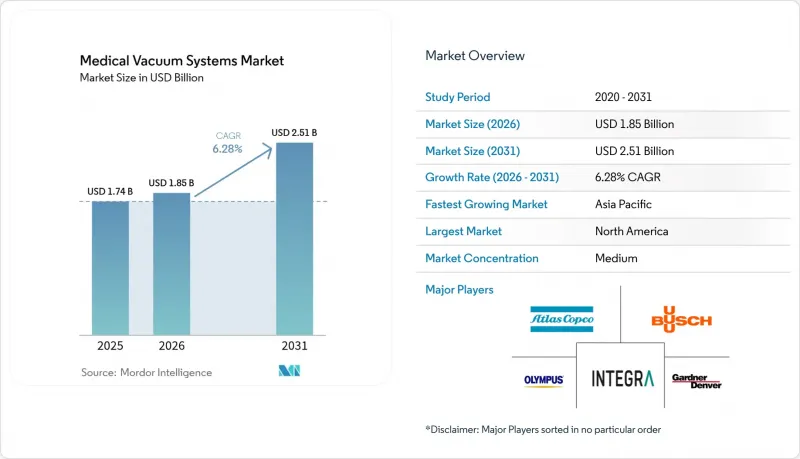
Mordor Intelligence에 의하면, 의료용 진공 시스템 시장 규모는 2025년 17억 4,000만 달러로 평가되었고, 2026년에는 18억 5,000만 달러로 추정되고, 2026-2031년 CAGR 6.28%로 성장을 지속할 전망이며, 2031년에는 25억 1,000만 달러에 이를 것으로 예측됩니다.
본 보고서는 제품 유형별(독립형 진공 시스템, 중앙 집중형 진공 시스템 등), 용도별(상처 관리/NPWT, 마취학 등), 최종 사용자별(병원, 진료소·외래 센터 등), 지역별(북미, 유럽, 아시아태평양, 중동 및 아프리카, 남미)로 분류되어 있습니다. 시장 예측은 금액(달러) 기준으로 제시되어 있습니다.
세계의 의료용 진공 시스템 시장 동향 및 인사이트
만성 질환 및 감염증 발생률 증가
선진국에서는 인구의 최대 2%가 만성 상처로 고통받고 있으며, 메디케어 수급자의 치료비도 증가하고 있습니다. 이러한 비용 증가로 인해 의료 서비스 제공업체들은 치유 기간을 단축하고 감염 재발을 억제하는 음압상처치료(NPWT) 플랫폼으로의 전환을 추진하고 있습니다. 코로나19 대유행으로 인해 호흡 관리에 있어 신뢰할 수 있는 흡입의 필요성이 높아진 반면, 항생제 내성 문제로 인해 중앙 집중식 플랜트 전체의 여과 기준이 강화되었습니다. 현재 대규모 시설에서는 면역 결핍 환자를 보호하기 위해 다단계 여과 기능을 갖춘 대용량 펌프가 도입되고 있습니다. 가치 기반 의료 인센티브로 인해 재입원율 감소가 중요하게 평가됨에 따라, 휴대용 및 중앙 집중식 NPWT 솔루션에 대한 수요는 지속적인 상승 추세를 유지하고 있습니다.
수술 건수 증가와 흡인 장치 도입 확대
고령화의 진행과 최소 침습 수술 기술에 대한 접근성 확대에 따라 전 세계 수술 건수가 증가하고 있으며, 수술실에서는 더욱 스마트한 체액 관리 시스템의 도입이 요구되고 있습니다. 진공 기술은 현재 기본적인 흡인에 그치지 않고, 지방 흡입, 기관 내 세척 및 현미경 수술에서의 체액 제거까지 응용되고 있습니다. ‘Thopaz+’ 디지털 흉강 배액 플랫폼과 같은 기기는 중환자실 체류 기간을 단축하여 비용 절감과 병상 확보에 기여하고 있습니다. 아시아태평양의 신흥 시장에서는 새로운 수술실에서 공사로 인한 혼란을 일으키지 않고 신속하게 설치할 수 있는 모듈식 진공 붐이 선호되고 있으며, 이는 병원이 중요한 서비스를 더 빨리 가동하는 데 도움이 되고 있습니다.
높은 초기 비용 및 유지비
중규모 중앙 관리 설비의 설치 비용은 대개 10만 달러를 초과하며, 연간 유지보수 계약 비용은 그 지출액의 20%에 달하기도 합니다. 신흥 경제국의 예산이 빠듯한 병원에서는 이러한 비용과 병상, 임상 검사 장비, 영상 진단 장비와의 균형을 고려해야 합니다. 그러나 의료비에 관한 연구에 따르면, 휴대용 NPWT(비침습적 음압상처치료)는 수술에 비해 복잡한 상처를 가진 환자 1인당 2만 4,808달러의 비용 절감이 가능함이 밝혀졌습니다. 케냐의 98개 의료기관을 대상으로 한 프로그램과 같은 장비 관리 서비스 계약은 자본 비용을 분산시키고 가동 시간을 보장함으로써 이러한 장벽을 점차 해소하고 있습니다.
부문 분석
2025년, 의료용 진공 시스템 시장에서 독립형 펌프가 41.05%를 차지했습니다. 이는 주요 진료 부서에서 병원이 대용량 전용 장치를 필요로 하고 있음을 반영합니다. 이러한 설치를 통해 개별 장비를 전체 서비스에 지장을 주지 않고 업그레이드할 수 있으므로 단계적인 현대화가 가능해집니다. 수술실이나 중환자실(ICU)에서는 독립적인 스키드형 유닛이 제공하는 신속한 서비스 대응과 내장된 이중화 기능이 중요하게 여겨집니다. 에너지 효율이 뛰어난 드라이 클로우(dry claw) 방식 및 스크롤 방식의 설계가 기존의 윤활식 모델을 대체하고 있으며, 이는 광열비 및 유지보수 인건비 절감을 목적으로 한 설비 투자 계획과 맞물려 진전되고 있습니다.
휴대용 기기는 연평균 성장률(CAGR) 8.72%로 가장 높은 성장률을 보이고 있습니다. 재택치료 간호사는 최대 7일간 착용 가능한 2파운드 무게의 배터리 구동식 NPWT 드레싱을 일상적으로 사용하고 있으며, 이를 통해 환자의 입원을 방지할 수 있을 뿐만 아니라 보험사의 인센티브 정책과도 부합합니다. 첨단 모델에는 임상의가 원격으로 확인할 수 있는 블루투스 지원 압력 기록 기능이 탑재되어 있어, 근거에 기반한 치료의 미세 조정을 지원하고 있습니다. 팬데믹 이후 분산형 치료의 기세는 가격 하락 후에도 두 자릿수 판매량 성장이 지속될 것임을 시사하고 있습니다.
액세서리 및 소모품(필터, 캐니스터, 튜브 등)은 설비 투자가 정체되는 시기에도 수익을 뒷받침하는 견고한 애프터마켓 수익원이 되고 있습니다. 고효율 입자 필터는 엄격한 일정에 따라 교체해야 하며, 항균 캐니스터는 강화되는 감염 예방 기준을 충족합니다. 제조업체들은 이러한 소모품을 여러 해 분량의 서비스 팩으로 묶어 제공함으로써 고객의 충성도를 확보하고 이익률을 안정화하고 있습니다.
지역별 분석
2025년, 북미는 의료용 진공 시스템 시장의 37.20%를 차지했습니다. 이는 NFPA 99에 대한 광범위한 준수와 시설 현대화를 위한 풍부한 자본 준비금을 배경으로 합니다. 의료 시스템의 통합으로 기술 사양의 표준화가 진행되고 있으며, 이를 통해 여러 거점에 걸친 종합적인 계약이 가능해져 단위 비용 절감과 부품의 안정적인 공급이 실현되고 있습니다. 의료 서비스 제공업체들은 가변 속도 오일 프리 펌프로의 업그레이드를 통해 30%의 에너지 절감 효과를 보고하고 있으며, 이를 통해 운영 예산을 확보하여 추가적인 탈탄소화에 대한 투자가 가능해졌습니다. 주요 대학 부속 의료 센터는 연구개발(R&D) 단계에서 제조업체와 긴밀히 협력하고 있으며, 디지털 진단 및 원격 모니터링 모듈의 도입을 가속화하고 있습니다. 메디케어나 민간 보험사에 의한 NPWT(비수술적 상처 치료)의 보험 적용이 확실하기 때문에 입원·외래를 불문하고 고품질 휴대용 기기의 도입이 순조롭게 진행되고 있습니다.
아시아태평양은 대규모 병원 건설과 공급망을 단축하는 국내 의료기기 공장 증가에 힘입어 연평균 성장률(CAGR) 7.59%로 성장할 전망입니다. 중국, 인도, 동남아시아의 공공 의료 투자 프로그램은 NFPA(미국 화재 예방 협회) 기준을 준수하는 의료용 가스 플랜트를 갖춘 새로운 3차 의료 기관에 자금을 지원하고 있습니다. 상처 치료 클리닉이 급속히 증가하고 있어 전문적인 진공 기기에 대한 수요가 높아지고 있습니다. 의료 관광을 목표로 하는 민간 병원에서는 국제 인증 기준을 충족하기 위해 오일프리 펌프와 실시간 진공 경보 시스템을 도입하고 있습니다. 규제 체계는 지역마다 크게 다르지만, 지역 간 조화를 위한 노력이 진행되고 있으며, 각 공급업체는 현장에서 신속하게 설정할 수 있는 적응성이 높은 규정 준수 키트 개발을 추진하고 있습니다.
유럽, 중동 및 아프리카, 남미에서는 인프라 확장과 초기 비용을 절감하는 관리형 장비 서비스 모델이 맞물려 큰 성장 가능성이 예상됩니다. 국제금융공사(IFC)가 2024 회계연도에 민간 의료 부문에 560억 달러의 지원을 약속한 것은 지속적인 투자 모멘텀을 뒷받침하고 있습니다(ifc.org). 유럽의 병원들은 ‘그린 딜(Green Deal)’ 정책에 따라 야심찬 기후 목표를 추구하고 있으며, 탄소 발자국을 줄이기 위해 드라이 펌프 기술과 지능형 제어 시스템을 도입하고 있습니다. 중동의 초대형 병원 프로젝트에서는 사막의 에너지 부하에 대응하기 위해 열 회수 루프와 호환되는 모듈식 사전 테스트 완료 진공 스키드가 사양으로 요구되고 있습니다. 남미의 의료 서비스 제공업체들은 엔지니어링 인력 부족 문제를 해결하고 설비 가동률을 높게 유지하기 위해 제조업체와 제휴하여 직원 교육 프로그램을 실시했습니다.
기타 혜택 :
- 엑셀 형식 시장 예측(ME) 시트
- 3개월간의 애널리스트 지원
자주 묻는 질문
목차
제1장 서론
제2장 조사 방법
제3장 주요 요약
제4장 시장 구도
제5장 시장 규모 및 성장 예측
제6장 경쟁 구도
제7장 시장 기회 및 향후 전망
AJY 26.08.26According to Mordor Intelligence, the medical vacuum systems market size is expected to grow from USD 1.74 billion in 2025 to USD 1.85 billion in 2026 and is forecast to reach USD 2.51 billion by 2031 at 6.28% CAGR over 2026-2031.
This report is Segmented by Product Type (Standalone Vacuum Systems, Centralized Vacuum Systems, and More), Application (Wound Care/NPWT, Anesthesiology, and More), End User (Hospitals, Clinics & Outpatient Centers, and More), and Geography (North America, Europe, Asia-Pacific, Middle East & Africa, South America). The Market Forecasts are Provided in Terms of Value (USD).
Global Medical Vacuum Systems Market Trends and Insights
Rising Incidence of Chronic & Infectious Diseases
Chronic wounds affect up to 2% of the population in developed nations, and treatment for Medicare beneficiaries. These mounting costs are steering providers toward negative pressure wound therapy (NPWT) platforms that shorten healing times and reduce infection recurrence. COVID-19 heightened the need for reliable suction during respiratory management, while antibiotic resistance raised filtration standards across centralized plants. Larger facilities now deploy higher-capacity pumps with multi-stage filtration to protect immunocompromised patients. Value-based care incentives reward providers for lowering readmissions, keeping demand for portable and centralized NPWT solutions on a sustained upward path.
Growing Surgical Volumes & Adoption of Suction Equipment
An aging demographic and broader access to minimally invasive techniques are lifting global procedure counts, compelling operating rooms to integrate smarter fluid-control systems. Vacuum technology now reaches beyond basic suction into liposuction, endotracheal cleaning, and microsurgery fluid removal. Devices such as the Thopaz+ digital chest-drainage platform shorten intensive-care stays, which lowers costs and frees up capacity. In emerging Asia-Pacific markets, new operating theaters favor modular vacuum booms that install quickly without disruptive construction, helping hospitals bring critical services online faster.
High Upfront & Maintenance Costs
Installing a medium-sized centralized plant often exceeds USD 100,000, and annual service contracts can reach 20% of that outlay. Budget-stretched hospitals in emerging economies must weigh these sums against beds, lab analyzers, and imaging equipment. Yet cost-of-care studies show portable NPWT can save USD 24,808 per complex-wound patient relative to surgery. Managed-equipment service agreements, such as the 98-facility Kenyan program, spread capital costs and guarantee uptime, gradually eroding this barrier.
Other drivers and restraints analyzed in the detailed report include:
- Shift Toward Oil-Free, NFPA-Compliant Dry Vacuum Pumps
- Modular Construction Spurring Demand for Integrated Vacuum Booms
- Stringent Installation-Code Compliance
For complete list of drivers and restraints, kindly check the Table Of Contents.
Segment Analysis
Standalone pumps claimed 41.05% of the medical vacuum systems market in 2025, reflecting hospitals' need for dedicated, high-capacity units in critical departments. These installations allow phased modernization because individual machines can be upgraded without disrupting wider service. Operating theaters and ICUs value quick service access and built-in redundancy that independent skids deliver. Energy-efficient dry-claw and scroll designs increasingly replace legacy lubricated models, dovetailing with capital programs aimed at cutting utility bills and maintenance labor.
Portable devices are growing fastest at a 8.72% CAGR. Home-health nurses routinely deploy two-pound, battery-powered NPWT dressings that stay in place for up to seven days, which keeps patients out of hospital and aligns with payer incentives. Advanced models now feature Bluetooth-enabled pressure logs that clinicians review remotely, supporting evidence-based therapy titration. The momentum behind decentralized care following the pandemic indicates sustained double-digit unit growth even after price erosion.
Accessories and consumables-filters, canisters, and tubing-form a resilient aftermarket stream that cushions revenue during capital-budget pauses. High-efficiency particulate filters must be replaced on a strict schedule, and antimicrobial canisters address rising infection-prevention standards. Manufacturers bundle these supplies into multiyear service packs that lock in customer loyalty and stabilize margins.
Complete Report Scope:
- By Product Type
- Standalone Vacuum Systems
- Centralized Vacuum Systems
- Portable/Compact Vacuum Systems
- Accessories & Consumables
- By Application
- Wound Care / NPWT
- Anesthesiology
- Gynecology & Obstetrics
- Dental
- Respiratory & Airway Management
- Surgical Suction & OR Fluid Management
- Diagnostic & Research
- Pharma-Biotech Manufacturing
- By End User
- Hospitals
- Clinics & Outpatient Centers
- Laboratories & Diagnostic Centers
- Pharmaceutical & Biotech Companies
- Home Care Settings
- Ambulance & Emergency Services
- By Geography
- North America
- United States
- Canada
- Mexico
- Europe
- Germany
- United Kingdom
- France
- Italy
- Spain
- Rest of Europe
- Asia-Pacific
- China
- Japan
- India
- Australia
- South Korea
- Rest of Asia-Pacific
- Middle East & Africa
- GCC
- South Africa
- Rest of Middle East & Africa
- South America
- Brazil
- Argentina
- Rest of South America
- North America
Geography Analysis
North America accounted for 37.20% of the medical vacuum systems market in 2025, leveraging widespread NFPA 99 compliance and deep capital reserves for plant modernization. Health-system consolidation steers toward standardized technical specifications, enabling multisite frame agreements that lower unit costs and secure parts availability. Providers report 30% energy savings after upgrading to variable-speed, oil-free pumps, freeing operational budgets for further decarbonization. Major academic medical centers work closely with manufacturers during R&D, accelerating the rollout of digital diagnostics and remote-monitoring modules. Reimbursement certainty for NPWT under Medicare and private payers ensures ready uptake of premium portable devices across inpatient and outpatient settings.
Asia-Pacific is set to expand at an 7.59% CAGR, driven by large-scale hospital buildouts and growing domestic medical-device factories that shorten supply chains. Public healthcare investment programs in China, India, and Southeast Asia fund new tertiary centers equipped with NFPA-aligned medical-gas plants. Wound-healing clinics have multiplied rapidly, increasing specialized vacuum demand. Private hospitals targeting medical tourism install oil-free pumps and real-time vacuum alarms to meet international accreditation standards. While regulatory frameworks vary widely, regional harmonization efforts are underway, prompting vendors to develop adaptable compliance kits packaged for quick field-configuration.
Europe, the Middle East & Africa, and South America present meaningful growth potential as infrastructure expansions intersect with managed-equipment service models that mitigate upfront cost. The International Finance Corporation's USD 56 billion commitment to private-sector healthcare in fiscal 2024 underscores lasting investment momentum ifc.org. European hospitals pursue ambitious climate targets under Green Deal policies, adopting dry-pump technology and intelligent controls to trim carbon footprints. Middle-East mega-hospital projects specify modular, pre-tested vacuum skids compatible with heat-recovery loops to cope with desert energy loads. South American providers partner with manufacturers for staff-training programs that counter limited engineering workforces and keep plant uptime high.
- Atlas Copco AB (BeaconMedaes)
- Busch Vacuum Solutions
- Ingersoll Rand (Gardner Denver)
- Dragerwerk
- Air Techniques
- Allied Healthcare Products
- Medela
- ConvaTec Group plc
- Integra Biosciences AG
- Laerdal Medical
- EBARA Corporation
- Olympus
- Ohio Medical Corporation
- Amico Corporation
- Precision Medical
- ZOLL Medical Corp.
- 3M (Acelity)
- Smiths Group
- Cardinal Health
- Leybold GmbH
Additional Benefits:
- The market estimate (ME) sheet in Excel format
- 3 months of analyst support
TABLE OF CONTENTS
1 Introduction
- 1.1 Study Assumptions & Market Definition
- 1.2 Scope of the Study
2 Research Methodology
3 Executive Summary
4 Market Landscape
- 4.1 Market Overview
- 4.2 Market Drivers
- 4.2.1 Rising Incidence of Chronic & Infectious Diseases
- 4.2.2 Growing Surgical Volumes & Adoption of Suction Equipment
- 4.2.3 Shift Toward Oil-Free, NFPA-Compliant Dry Vacuum Pumps
- 4.2.4 Modular or Construction Spurring Demand for Integrated Vacuum Booms
- 4.2.5 Hospital Decarbonization Targets Favoring Energy-Efficient Systems
- 4.2.6 Expansion of Outpatient Wound Clinics in Emerging Markets
- 4.3 Market Restraints
- 4.3.1 High Upfront & Maintenance Costs
- 4.3.2 Stringent Installation-Code Compliance
- 4.3.3 Helium-Supply Volatility Inflating Pump Manufacturing Costs
- 4.3.4 Cyber-Security Risks in IOT-Enabled Centralized Plants
- 4.4 Porter's Five Forces Analysis
- 4.4.1 Threat of New Entrants
- 4.4.2 Bargaining Power of Buyers
- 4.4.3 Bargaining Power of Suppliers
- 4.4.4 Threat of Substitutes
- 4.4.5 Competitive Rivalry
5 Market Size & Growth Forecasts (Value in USD)
- 5.1 By Product Type
- 5.1.1 Standalone Vacuum Systems
- 5.1.2 Centralized Vacuum Systems
- 5.1.3 Portable/Compact Vacuum Systems
- 5.1.4 Accessories & Consumables
- 5.2 By Application
- 5.2.1 Wound Care / NPWT
- 5.2.2 Anesthesiology
- 5.2.3 Gynecology & Obstetrics
- 5.2.4 Dental
- 5.2.5 Respiratory & Airway Management
- 5.2.6 Surgical Suction & OR Fluid Management
- 5.2.7 Diagnostic & Research
- 5.2.8 Pharma-Biotech Manufacturing
- 5.3 By End User
- 5.3.1 Hospitals
- 5.3.2 Clinics & Outpatient Centers
- 5.3.3 Laboratories & Diagnostic Centers
- 5.3.4 Pharmaceutical & Biotech Companies
- 5.3.5 Home Care Settings
- 5.3.6 Ambulance & Emergency Services
- 5.4 By Geography
- 5.4.1 North America
- 5.4.1.1 United States
- 5.4.1.2 Canada
- 5.4.1.3 Mexico
- 5.4.2 Europe
- 5.4.2.1 Germany
- 5.4.2.2 United Kingdom
- 5.4.2.3 France
- 5.4.2.4 Italy
- 5.4.2.5 Spain
- 5.4.2.6 Rest of Europe
- 5.4.3 Asia-Pacific
- 5.4.3.1 China
- 5.4.3.2 Japan
- 5.4.3.3 India
- 5.4.3.4 Australia
- 5.4.3.5 South Korea
- 5.4.3.6 Rest of Asia-Pacific
- 5.4.4 Middle East & Africa
- 5.4.4.1 GCC
- 5.4.4.2 South Africa
- 5.4.4.3 Rest of Middle East & Africa
- 5.4.5 South America
- 5.4.5.1 Brazil
- 5.4.5.2 Argentina
- 5.4.5.3 Rest of South America
- 5.4.1 North America
6 Competitive Landscape
- 6.1 Market Concentration
- 6.2 Market Share Analysis
- 6.3 Company Profiles (includes Global level Overview, Market level overview, Core Segments, Financials as available, Strategic Information, Market Rank/Share for key companies, Products & Services, and Recent Developments)
- 6.3.1 Atlas Copco AB (BeaconMedaes)
- 6.3.2 Busch Vacuum Solutions
- 6.3.3 Ingersoll Rand (Gardner Denver)
- 6.3.4 Dragerwerk AG & Co. KGaA
- 6.3.5 Air Techniques
- 6.3.6 Allied Healthcare Products
- 6.3.7 Medela AG
- 6.3.8 ConvaTec Group plc
- 6.3.9 Integra Biosciences AG
- 6.3.10 Laerdal Medical
- 6.3.11 EBARA Corporation
- 6.3.12 Olympus Corporation
- 6.3.13 Ohio Medical Corporation
- 6.3.14 Amico Corporation
- 6.3.15 Precision Medical Inc.
- 6.3.16 ZOLL Medical Corp.
- 6.3.17 3M (Acelity)
- 6.3.18 Smith & Nephew plc
- 6.3.19 Cardinal Health Inc.
- 6.3.20 Leybold GmbH
7 Market Opportunities & Future Outlook
- 7.1 White-space & Unmet-need Assessment


