

|
시장보고서
상품코드
2114694
포름알데히드 시장 : 시장 점유율 분석, 업계 동향 및 통계, 성장 예측(2026-2031년)Formaldehyde - Market Share Analysis, Industry Trends & Statistics, Growth Forecasts (2026 - 2031) |
||||||
 Mordor Intelligence
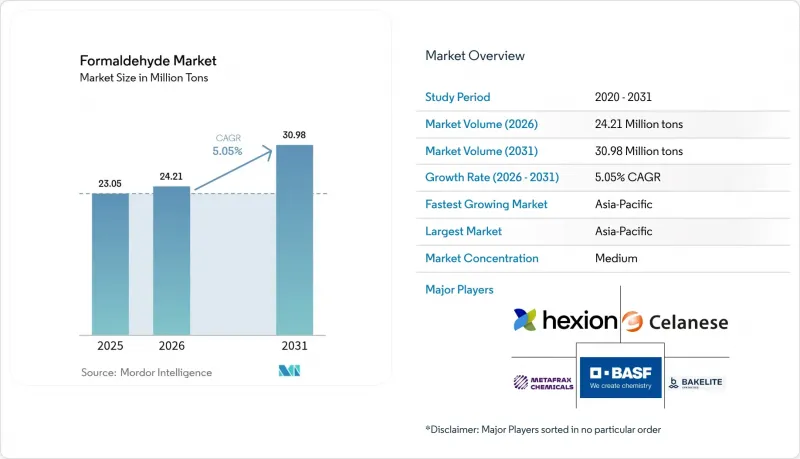
Mordor Intelligence에 의하면, 포름알데히드 시장 규모는 2025년에 2,305만 톤으로 평가되었고, 2026년 2,421만 톤에서 2031년까지 3,098만 톤에 이를 것으로 예측되며, 예측 기간(2026-2031년) CAGR은 5.05%를 나타낼 전망입니다.
본 보고서는 유도체별(요소 포름알데히드, 페놀 포름알데히드, 헥사민 등), 최종 사용자 산업별(건설, 자동차, 농업, 의료 등), 제조 공정별(은 촉매, 철·몰리브덴 촉매 등), 지역별(아시아태평양, 북미, 유럽, 남미, 중동 및 아프리카)로 분류되어 있습니다. 시장 예측은 수량(톤) 기준으로 제시되어 있습니다.
세계의 포름알데히드 시장 동향 및 인사이트
건설 분야의 목재 패널 수요
도시화가 진행됨에 따라 주택 착공 건수는 계속 증가하고 있으며, 그 결과 요소-포름알데히드 및 페놀-포름알데히드계 바인더에 의존하는 집성재의 소비량도 증가하고 있습니다. 패널 생산 능력 증가분에서는 중국과 인도가 주도적인 위치를 차지하고 있지만, 조림 활엽수의 사용이 증가하고 있어 접착 강도를 유지하면서 배출량을 저감하는 개량형 수지 배합이 요구되고 있습니다. 주요 패널 제조업체들은 생산 라인 속도를 희생하지 않으면서 캘리포니아주 대기자원국(CARB)의 규제 기준을 충족하기 위해 첨단 스캐빈저 첨가제 및 촉매 산화 장치를 도입하고 있습니다. 대두 단백질계 접착제 등의 대체 화학 물질이 고급 캐비닛 시장에서 점차 보급되고 있지만, 대중 시장을 겨냥한 보드의 경우 여전히 포름알데히드 수지가 비용 면에서 최적의 선택지입니다.
자동차 업계의 폴리옥시메틸렌(POM) 기반 경량 부품으로의 전환
모든 차종을 대상으로 한 연비 목표를 배경으로, 자동차 제조업체들은 금속을 엔지니어링 열가소성 플라스틱으로 대체하는 움직임을 가속화하고 있으며, 높은 강성 대 밀도 비율을 가진 폴리옥시메틸렌(POM)이 경량화 전략의 중심에 자리 잡고 있습니다. 배터리식 전기차(BEV) 모델의 경우, 이 폴리머가 내가수분해성뿐만 아니라 절연 내력도 갖추고 있기 때문에 전기 커넥터 및 냉각수 관리 매니폴드에 POM의 채택이 더욱 가속화되고 있습니다. 중서부 및 동아시아의 자동차 산업 거점 인근에 기반을 둔 1차 공급업체들은 안정적인 중합을 보장하는 고순도 포름알데히드를 공급받는 다년 계약을 체결하고 있습니다. 촉매 기술의 발전으로 메탄올에서 POM으로의 전환 효율이 향상되어 처리 능력이 증가하고 톤당 에너지 소비량이 감소했으며, 이러한 이점들이 부품의 가격 경쟁력 향상으로 이어지고 있습니다.
실내 공기 배출 규제
미국 환경보호청(EPA)이 2024년 TSCA에 근거하여 58가지 최종 용도가 부당한 건강 위험을 초래한다고 판단함에 따라, 초저배출 보드로의 전환이 가속화되고 있으며, 북미의 패널 공장에서는 시급한 설비 갱신이 요구되고 있습니다. 독일, 일본, 호주에서의 유사한 규제로 인해 배출 기준이 엄격해지면서, 제조업체들은 재생식 열산화 장치의 도입이나 스캐빈저 수지의 채택을 강요받고 있습니다. 규제 준수를 위한 투자로 인해 연간 30만 m³의 보드 생산 라인당 최대 1,200만 달러의 설비 투자(CAPEX)가 증가하여, 비통합형 라미네이트 제조업체의 이익률이 압박받고 있습니다. 조기에 Acrodur 수성 시스템을 도입한 기업들은 현재 배출 제로라는 실적을 가격 프리미엄으로 이어지는 차별화 요인으로 내세우고 있습니다.
부문 분석
요소 포름알데히드는 2025년에 포름알데히드 시장 점유율 36.25%를 유지했습니다. 이는 아시아태평양의 저렴한 주택 프로그램에 대응하는 합판, 파티클보드, 중밀도 섬유판(MDF)의 각 생산 라인에서 비용 효율성이 뛰어난 이 제품의 채택이 확대된 것이 주된 요인입니다. 대조적으로, 폴리옥시메틸렌(POM)은 열 사이클 하에서 치수 안정성이 극히 중요한 정밀 기어 및 배터리 팩 하드웨어에 대한 수요를 흡수함으로써 연평균 성장률(CAGR) 6.05%로 확대되고 있습니다. 멜라민·포름알데히드 수지는 내화성 라미네이트 소재 분야에서 여전히 중요한 위치를 차지하고 있는 반면, 페놀·포름알데히드 수지는 더 높은 내열성이 요구되는 주조 및 연마 디스크 분야에서 꾸준한 수요를 유지하고 있습니다. 헥사민 수요는 정체되어 있지만, 군용 등급 폭발물 및 산업용 고무의 가황 과정에서는 여전히 없어서는 안 될 존재입니다.
Johnson & Massey사의 ‘FORMOX’ 브랜드를 통한 촉매 코팅의 지속적인 혁신은 선택성을 1.5% 향상시키고 반응기 온도를 15°C 낮추는 점진적인 개선을 가져왔으며, 특히 POM의 경제성에 큰 이점을 제공합니다. 통합형 수지 제조업체들은 UF의 주기성에 대한 헤지 수단으로 파라포름알데히드 및 1,4-부탄디올로의 다각화를 추진하고 있으며, 기존 포름알데히드 자산을 활용하면서 가치 곡선을 상승시키고 있습니다.
지역별 분석
아시아태평양은 생산 거점이자 소비 거점이라는 이중 역할을 수행함으로써 포름알데히드 시장에서 확고한 리더십을 구축하고 있으며, 2025년에는 포름알데히드 시장 점유율의 51.88%를 차지하였고, 2031년까지 연평균 성장률(CAGR) 5.8%를 기록할 전망입니다. 중국 석탄 산지 인근에 위치한 메탄올에서 포름알데히드로 이어지는 일괄 생산 라인은 비용 면에서 우위를 점하고 있지만, 탈탄소화 목표에 따라 신규 투자자들은 말레이시아나 태국의 천연가스를 원료로 하는 프로젝트로 눈을 돌리고 있습니다. 인도의 정부 주도 도시 주택 건설은 중밀도 섬유판(MDF)에 대한 지속적인 수요를 창출하고 있으며, 메탄올 수입을 활용하기 위해 항만 도시 인근에서 생산 능력 확충이 진행되고 있습니다. 일본과 한국은 전자용 포름알데히드를 전문으로 하며, 고순도 제품을 반도체의 습식 에칭 및 커패시터 봉지재로 전용하고 있습니다.
북미에서는 2024년에 정체에서 완만한 성장에 그쳤지만, 저유리 포름알데히드(LFF) 패널 분야에서의 기술적 리더십을 유지하고 있습니다. 오리건주 및 조지아주에 위치한 미국 시설에서는 EPA(미국 환경보호청)의 유해 대기 오염 물질에 관한 국가 배출 기준을 준수하기 위해 스크러버 및 촉매 산화 장치를 업그레이드했으나, 생산량의 대폭적인 감소까지는 이르지 않았습니다. 캐나다는 풍부한 침엽수 자원을 활용하여 퀘벡주 및 브리티시컬럼비아주의 목재 패널 대기업과 통합된 수지 공장을 기반으로 하고 있습니다. 멕시코는 미국 자동차 공장과 인접해 있어 POM 수요가 촉진되고 있으며, 바히오 지역이 수요의 거점으로 자리 잡고 있습니다.
유럽의 순환형 경제 및 휘발성 유기 화합물(VOC) 규제에 대한 정책 기조는 생산량 증가를 억제하고 있지만, 제품 구성을 고수익률의 저배출 수지로 전환시키고 있습니다. 독일과 폴란드를 합치면 유럽 소비량의 40% 이상을 차지하며, 독일 기업들은 탄소 리스크를 헤지하기 위해 바이오메탄올 시범 사업에 투자하고 있습니다. 북유럽의 패널 제조업체들은 리그닌 대체 기술 연구 개발을 추진하고 있지만, 구조용 코어 재료로는 여전히 포름알데히드를 계속 구매하고 있습니다.
남미 및 중동 및 아프리카는 규모는 작지만 시장 침투율이 높아지고 있습니다. 브라질에서는 경기 침체 이후 건설업의 회복에 힘입어 리우그란데두술 주에서 포름알데히드계 패널의 생산 능력이 확대되고 있습니다. 한편, 메탄올 자원이 풍부한 사우디아라비아에서는 ‘비전 2030’의 다각화 목표에 따라 다운스트림 공정의 포름알데히드·UF(요소) 사업 도입을 검토하고 있습니다.
기타 혜택 :
- 엑셀 형식 시장 예측(ME) 시트
- 3개월간 애널리스트의 지원
자주 묻는 질문
목차
제1장 서론
제2장 조사 방법
제3장 주요 요약
제4장 시장 구도
제5장 시장 규모 및 성장 예측
제6장 경쟁 구도
제7장 시장 기회 및 향후 전망
AJY 26.08.26According to Mordor Intelligence, the formaldehyde market size was valued at 23.05 Million tons in 2025 and estimated to grow from 24.21 Million tons in 2026 to reach 30.98 Million tons by 2031, at a CAGR of 5.05% during the forecast period (2026-2031).
This report is Segmented by Derivative (Urea Formaldehyde, Phenol Formaldehyde, Hexamine, and More), End-User Industry (Construction, Automotive, Agriculture, Healthcare, and More), Production Process (Silver Catalyst, Iron-Molybdenum Catalyst, and More), and Geography (Asia-Pacific, North America, Europe, South America, and Middle East and Africa). The Market Forecasts are Provided in Terms of Volume (tons).
Global Formaldehyde Market Trends and Insights
Construction Demand for Wood Panels
Urbanization continues to elevate housing starts, which in turn lifts engineered-wood consumption that relies on urea-formaldehyde and phenol-formaldehyde binders. China and India dominate incremental panel capacity, yet rising plantation hardwood use demands modified resin formulations that preserve bond strength while lowering emissions. Tier-1 panel producers deploy advanced scavenger additives and catalytic oxidation units to meet California Air Resources Board limits without sacrificing line speed. Although alternative chemistries such as soy-protein adhesives gain traction in premium cabinetry, formaldehyde resins remain cost-optimal for mass-market boards.
Automotive Shift to Polyoxymethylene (POM)-based Lightweight Parts
Fleet-wide fuel-economy targets spur automakers to replace metal with engineering thermoplastics, placing Polyoxymethylene (POM) at the center of light-weighting strategies due to its high stiffness-to-density ratio. Battery-electric models further accelerate POM uptake in electrical connectors and coolant-management manifolds because the polymer offers dielectric strength alongside hydrolysis resistance . Tier-1 suppliers situated near Midwest and East-Asian vehicle hubs secure multi-year contracts that guarantee formaldehyde of tight purity for stable polymerization. Catalyst advances improve methanol-to-POM conversion, yielding higher throughput and lower per-ton energy consumption, benefits that cascade into competitive component pricing.
Indoor-air Emission Regulations
The Environmental Protection Agency (EPA)'s 2024 TSCA determination that 58 end uses pose unreasonable health risks accelerates the shift to ultra-low-emission boards, requiring immediate retooling at North American panel mills. Similar rules in Germany, Japan, and Australia tighten emission thresholds, pushing producers to install regenerative thermal oxidizers and to adopt scavenger resins. Compliance investments raise capex by up to USD 12 million for a 300,000 m3/year board line, squeezing margins for non-integrated laminators. Firms that moved early on Acrodur water-based systems now market emission-free credentials as a price-premium differentiator .
Other drivers and restraints analyzed in the detailed report include:
- Fertilizer Sector Expansion in Developing Economies
- Healthcare Use in Vaccines and Disinfectants
- Methanol Feedstock Price Volatility
For complete list of drivers and restraints, kindly check the Table Of Contents.
Segment Analysis
Urea-formaldehyde retained 36.25% of the Formaldehyde market share in 2025, anchored by cost-efficient adoption across plywood, particleboard, and Medium Density Fiberboard (MDF) lines servicing affordable housing programs in Asia-Pacific. Polyoxymethylene (POM), in contrast, expands at a 6.05% CAGR by capturing demand for precision gearwheels and battery-package hardware where dimensional stability under thermal cycling is critical. Melamine-formaldehyde retains relevance for fire-resistant laminates, whereas phenol-formaldehyde persists in foundry and abrasive discs requiring higher thermal endurance. Hexamine demand plateaus but remains essential in military-grade explosives and industrial rubber vulcanization.
Continued innovation in catalyst coatings under Johnson Matthey's FORMOX label delivers incremental gains-1.5% higher selectivity and 15°C lower reactor temperature-significantly benefiting POM economics in particular. Integrated resin producers diversify into paraformaldehyde and 1,4-butanediol to hedge against UF cyclicality, leveraging existing formaldehyde assets while ascending the value curve.
Complete Report Scope:
- By Derivative
- Urea Formaldehyde (UF)
- Phenol Formaldehyde (PF)
- Melamine Formaldehyde (MF)
- Polyoxymethylene (POM)
- Hexamine
- Other Derivatives (MDI, 1,4-Butanediol, Para-formaldehyde)
- By End-user Industry
- Construction
- Automotive
- Agriculture
- Healthcare
- Chemicals and Petrochemicals
- Other End-user Industries (Paints, Textiles and Others, etc.)
- By Production Process
- Silver Catalyst (Formox) Process
- Iron-Molybdenum Catalyst Process
- Metal Oxide Mixed Catalyst Process
- By Geography
- Asia-Pacific
- China
- Japan
- India
- South Korea
- ASEAN Countries
- Rest of Asia-Pacific
- North America
- United States
- Canada
- Mexico
- Europe
- Germany
- United Kingdom
- France
- Italy
- Spain
- Russia
- NORDIC Countries
- Rest of Europe
- South America
- Brazil
- Argentina
- Rest of South America
- Middle East and Africa
- Saudi Arabia
- South Africa
- Rest of Middle East and Africa
- Asia-Pacific
Geography Analysis
Asia-Pacific's dual role as the production and consumption center cements its Formaldehyde market leadership, accounting for a 51.88% Formaldehyde market share in 2025 and tracking toward a 5.8% CAGR through 2031. China's integrated methanol-to-formaldehyde lines near coal basins offer cost advantages, yet decarbonization goals are steering new investors toward gas-fed projects in Malaysia and Thailand. Government-backed urban housing in India unlocks continuous Medium Density Fiberboard (MDF) demand, prompting capacity additions near port cities to exploit methanol imports. Japan and South Korea specialize in electronics-grade formaldehyde, diverting high-purity output into semiconductor wet-etch and capacitor encapsulants.
North America posted flat to modest growth in 2024 but retains technological leadership in low-free formaldehyde (LFF) panels. United States facilities in Oregon and Georgia upgraded scrubbers and catalytic oxidizers to comply with the EPA National Emission Standards for Hazardous Air Pollutants without material production curtailment. Canada benefits from vast softwood resources, anchoring resin plants integrated with wood-panel giants in Quebec and British Columbia. Mexico's proximity to United States auto plants stimulates POM off-take, positioning the Bajio region as a demand node.
Europe's policy stance on circularity and Volatile Organic Compound (VOC) limits restrains volume growth but skews the product mix toward high-margin low-emission resins. Germany and Poland together account for over 40% of European consumption, with German players investing in bio-methanol pilots to hedge carbon exposure. Nordic panel producers deploy lignin-substitution R&D yet continue purchasing formaldehyde for structural cores.
South America and the Middle East & Africa, though smaller, show rising penetration. Brazil's construction rebound after economic downturns drives formaldehyde-based panel capacity in Rio Grande do Sul. Meanwhile, methanol-rich Saudi Arabia evaluates downstream formaldehyde-UF ventures aligned with Vision 2030 diversification targets.
- BASF
- Acron
- Bakelite Synthetics
- Balaji Formalin Pvt. Ltd.
- Capital Resin Corporation
- Celanese Corporation
- Dynea AS
- Ercros S.A.
- Foremark Performance Chemicals
- Frati Luigi S.p.A
- Hexion Inc.
- Kanoria Chemicals & Industries Ltd.
- Metafrax Chemicals
- Perstorp
- Simalin Chemical Industries Pvt Ltd
Additional Benefits:
- The market estimate (ME) sheet in Excel format
- 3 months of analyst support
TABLE OF CONTENTS
1 Introduction
- 1.1 Study Assumptions and Market Definition
- 1.2 Scope of the Study
2 Research Methodology
3 Executive Summary
4 Market Landscape
- 4.1 Market Overview
- 4.2 Market Drivers
- 4.2.1 Construction Demand for Wood Panels
- 4.2.2 Automotive Shift to Polyoxymethylene (POM)-based Lightweight Parts
- 4.2.3 Fertilizer Sector Expansion in Developing Economies
- 4.2.4 Healthcare Use in Vaccines and Disinfectants
- 4.2.5 Growing Utilization for Chemical Manufacturing
- 4.3 Market Restraints
- 4.3.1 Indoor-air Emission Regulations
- 4.3.2 Cosmetics and Consumer Bans
- 4.3.3 Methanol Feedstock Price Volatility
- 4.4 Value Chain Analysis
- 4.5 Porter's Five Forces
- 4.5.1 Bargaining Power of Suppliers
- 4.5.2 Bargaining Power of Buyers
- 4.5.3 Threat of New Entrants
- 4.5.4 Threat of Substitutes
- 4.5.5 Degree of Competition
5 Market Size and Growth Forecasts (Volume)
- 5.1 By Derivative
- 5.1.1 Urea Formaldehyde (UF)
- 5.1.2 Phenol Formaldehyde (PF)
- 5.1.3 Melamine Formaldehyde (MF)
- 5.1.4 Polyoxymethylene (POM)
- 5.1.5 Hexamine
- 5.1.6 Other Derivatives (MDI, 1,4-Butanediol, Para-formaldehyde)
- 5.2 By End-user Industry
- 5.2.1 Construction
- 5.2.2 Automotive
- 5.2.3 Agriculture
- 5.2.4 Healthcare
- 5.2.5 Chemicals and Petrochemicals
- 5.2.6 Other End-user Industries (Paints, Textiles and Others, etc.)
- 5.3 By Production Process
- 5.3.1 Silver Catalyst (Formox) Process
- 5.3.2 Iron-Molybdenum Catalyst Process
- 5.3.3 Metal Oxide Mixed Catalyst Process
- 5.4 By Geography
- 5.4.1 Asia-Pacific
- 5.4.1.1 China
- 5.4.1.2 Japan
- 5.4.1.3 India
- 5.4.1.4 South Korea
- 5.4.1.5 ASEAN Countries
- 5.4.1.6 Rest of Asia-Pacific
- 5.4.2 North America
- 5.4.2.1 United States
- 5.4.2.2 Canada
- 5.4.2.3 Mexico
- 5.4.3 Europe
- 5.4.3.1 Germany
- 5.4.3.2 United Kingdom
- 5.4.3.3 France
- 5.4.3.4 Italy
- 5.4.3.5 Spain
- 5.4.3.6 Russia
- 5.4.3.7 NORDIC Countries
- 5.4.3.8 Rest of Europe
- 5.4.4 South America
- 5.4.4.1 Brazil
- 5.4.4.2 Argentina
- 5.4.4.3 Rest of South America
- 5.4.5 Middle East and Africa
- 5.4.5.1 Saudi Arabia
- 5.4.5.2 South Africa
- 5.4.5.3 Rest of Middle East and Africa
- 5.4.1 Asia-Pacific
6 Competitive Landscape
- 6.1 Market Concentration
- 6.2 Strategic Moves
- 6.3 Market Share(%)/Ranking Analysis
- 6.4 Company Profiles (includes Global level Overview, Market level overview, Core Segments, Financials as available, Strategic Information, Market Rank/Share for key companies, Products and Services, and Recent Developments)
- 6.4.1 BASF
- 6.4.2 Acron
- 6.4.3 Bakelite Synthetics
- 6.4.4 Balaji Formalin Pvt. Ltd.
- 6.4.5 Capital Resin Corporation
- 6.4.6 Celanese Corporation
- 6.4.7 Dynea AS
- 6.4.8 Ercros S.A.
- 6.4.9 Foremark Performance Chemicals
- 6.4.10 Frati Luigi S.p.A
- 6.4.11 Hexion Inc.
- 6.4.12 Kanoria Chemicals & Industries Ltd.
- 6.4.13 Metafrax Chemicals
- 6.4.14 Perstorp
- 6.4.15 Simalin Chemical Industries Pvt Ltd
7 Market Opportunities and Future Outlook
- 7.1 White-space and Unmet-need Assessment
- 7.2 Research and Development on Formaldehyde Use in Industrial Waste Treatment


